Visitors pass through a small room, full of bold, layered colour, that leads them into to Fahmida Hossain Urmi’s contemporary expressionistic Angles of Relationships exhibition at Ame-Art.
Ame-Art is a non-profit collective that houses Mile End artists’ work and displays one gallery at a time, currently Urmi’s second exhibit. After receiving her masters in art in her native country of Bangledesh, Urmi moved to Canada to create and display her work, slowly integrating with Montreal culture after learning French and English. At the vernissage of Angles, Urmi explained that her greatest joy from the show is finally feeling like a true member of the art community.
Urmi’s paintings portray this theme of interpersonal connections through layered colour and inconsistently-shaped bodies. They are made with thick layers of paint, creating a heavy effect.
“Each colour represents the synopsis of a feeling,” Urmi explains. The paintings are so full because people always carry many emotions, but only present the one currently felt the most.
Without faces, or even defined shapes, the colours express the entirety of the paintings’ message. There are some human forms silhouetted in several pieces, but they have neutral stances and only convey expression through their surrounding colour and proximity to similar silhouettes. Each painting presents itself as a collection of distinct shapes and colours that somehow flow together and evolve with further examination.
“They capture an emotion. Certain moments we feel, but don’t notice. Then there’s a spotlight and you realize your connections to those around you,” Urmi says.
Angles of Relationships 06, 07, and 08 are a set of paintings which centrally feature what is vaguely the same facial shape outlined in black, with an assortment of individual colours and details. Each of the three display a different feeling based on the same shape: 06 is chaotic, 07 is playful, and 08 is inspiring. These three pieces include magazine pictures, making them the only ones to include a medium besides paint. The picture on 08 includes the caption “Life’s Too Short,” and, painted underneath, “Live it!”. These are the only words in the entire exhibition.
Of Urmi’s 23 pieces, 11 bear the title Angles of Relationships, while the rest are either Sans Nomer or from her previous exhibition, Prismatique Relations. These other paintings are not as dramatic as her newer work, but add to the theme of the gallery. Regrettably, even with these additions, the works only take up one room.
Although this exhibition includes interesting paintings that may be enjoyable to ponder, there is only one room at Ame-Art, and the quality of the art does not make up for its small quantity. For this reason, Angles of Relationships does not merit the 20 minute bus or bike ride from McGill campus. However, if somebody were to find themselves within a block or two of the galleries, they might want to take a few minutes and peek inside.
Angles of Relationships is on at Ame-Art (5345 Ave. du Parc) until Sept. 22. Admission is free.
Residents of Pictou, Nova Scotia, are demanding that the Northern Pulp Nova Scotia Corporation mill be held accountable for damages to health and to the environment caused by its pollution since its opening in 1967.
Discussion surrounding the mill and its effect on residents has been a point of contention, as it remains a source of employment for approximately 250 residents of the area and puts millions of dollars into the economy of the region.
According to residents, pollution from the mill has begun to take a toll on the environment and the health of residents. The mill’s production of paper products results in the release of toxins into the air and waste being dumped into the surrounding natural area.
The town has the nation’s seventh highest rate of cancer per 100,000 residents of Canada’s 106 health regions. Residents who believe that the high cancer rate is due to pollution caused by the mill are demanding change.
Two local residents have created an online petition called, “Premier Darrell Dexter: Clean up the Pictou Country Pulp Mill,” which urges the premier to address the issue. The petition has received nearly 1,700 signatures to date.
G20 officer convicted three years later
On Thursday, Constable Babak Andalib-Goortan became the only police officer to date to be found guilty of using excessive force during the G20 protests of June 2010.
1,105 demonstrators were detained by police as a result of the G20 protests over three years ago, and many have criticized police for using excessive force. Thursday’s ruling found Andalib-Goortani guilty of using violence while arresting protestor Adam Nobody and detaining him in jail for over 30 hours.
The constable, whose sentence will be announced in November, faces a maximum sentence of 18 months jail time or a $5,000 fine. He is also charged with assaulting a member of the media with a weapon, a case that will proceed to trial in February.
The plaintiff, Nobody, is pursuing a $14.2 million lawsuit against officers implicated in the event. Multiple other civil cases, including a class-action lawsuit launched by 1,000 people, are awaiting court dates.
Yasmin Nakhuda loses court case to reclaim IKEA monkey
On Sept. 13, Darwin, the infamous monkey found strolling around an IKEA parking lot last year, was placed in the custody of an animal sanctuary.
He was seized from Nakhuda by Animal Services and placed in the care of Story Book Farm Primate Sanctuary in Sunderland, Ontario. Nakhuda, who had signed over ownership of the monkey to the City of Toronto earlier this year, sued the Sanctuary, claiming that the seizure of Darwin was unlawful on the basis that he was domesticated.
Ontario Superior Court Judge Mary Vallee dismissed Nakhuda’s claim, citing that Nakhuda’s ownership of Darwin was no longer valid the moment he escaped from her care.
“A high onus regarding provision of secure housing for wild animals is appropriate to place on their owners,” Vallee’s decision reads “Wild animals, particularly exotic ones, can be dangerous to the public.”
Aptly nicknamed the “IKEA Monkey,” Darwin originally lived with his previous owner, Yasmin Nakhuda, her husband, and their two children. Last December, at an IKEA in North York, Ontario, Darwin escaped from Nakhuda’s car and, soon afterwards, an image of him wandering the parking lot dressed in a shearling coat went viral.
Montreal student released from Filipino jail
Université de Montreal student Kim Chatillon-Meunier, age 24, returned to Canada on Sunday after spending several days in jail in the Philippines.
Chantillon-Meunier was in Manila for a government-funded internship working with impoverished women, when she was arrested on Friday at the Ninoy Aquino International Airport as she was about to board a plane out of the country.
Her quick release from jail can be attributed to pressure from the human rights organization KARAPATAN, and lawyers from the Philippines’ National Union of People’s Lawyers.
The Philippines’ Bureau of Immigration officers took her into custody Friday night due to her participation in one of multiple anti-government protests on July 22, many of which were deemed illegal for failing to gain a permit from the government to hold a demonstration. Chantillon-Meunier’s boyfriend Emile Kinley-Gauthier, who was not arrested, said the two were merely observing the rallies.
The demonstrations fell on the day of President Benigno Aquino’s state-of-the-nation address, and were in protest of his administration’s alleged abuses of human rights.
Senator Wallin pays off falsely claimed expense money
On Friday, Canadian Senator Pamela Wallin finished paying off the last of the expenses that she had wrongly claimed, starting in December 2010 until November 2012. Wallin paid back the $100,600.98 plus interest—an additional $13,938.19—in personal cheques to the federal government.
Wallin’s senate expense scandal began in May of this year, when it was found that she was using taxpayer dollars for extra travelling expenses.
After paying her expenses Friday, Wallin made a public statement in which she accused the auditing firm who conducted the review of her expenses, Deloitte, as well as the Senate internal economy committee of treating her unfairly.
“Evidence that casts doubt on the correctness of the amounts owing was either ignored or disregarded during the review,” Wallin said in a statement released by her office.
Despie the scandal, Wallin has also said that she does not plan to resign as a Senator.
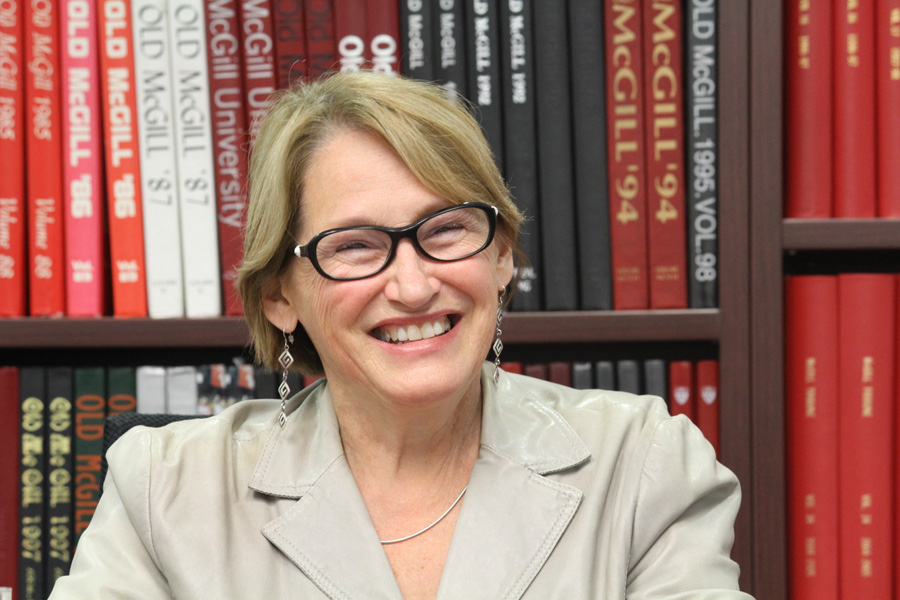
Having completed her B.Sc. and PhD at McGill, Suzanne Fortier returned to her alma mater on Sept. 5 as McGill’s first francophone principal, second female principal, and 17th principal overall. After her first few days, Fortier sat down with the Tribune to discuss how being an alumnus has influenced her life, the value of a McGill degree, and her first week on the job.
Fortier grew up in Saint-Timothée, Quebec, a small former-municipality located on an island less than an hour’s drive from McGill. According to Fortier, her rural background had a strong influence on her attitude when she entered the university as an undergraduate.
“One thing I had not expected coming to McGill—because I was pretty ignorant, there was no one who went to university before me in my family—was that I’d be surrounded by the best people in their field in the world,” she said. “It’s inspiring. You’re a young person […] and these giants, people whose names you read in your textbooks, [were] there and talk[ed] to you. They were people who allowed me to think ‘I could do that, too.’ ”
Following her PhD, Fortier held several leadership positions at Queen’s University including vice-principal (academic), before becoming the president of National Sciences and Engineering Research Council of Canada (NSERC) in 2006.
Fortier credits McGill’s international reputation with opening doors for her throughout her career, and expects it will continue to do so for students despite the challenges facing the university. Among these challenges are the $38.3 million cuts to McGill’s budget, which were announced by the provincial government last December.
“Everyone here has such a strong commitment to students,” she said. “Having to take some [budget] cuts—that’s the most challenging because people don’t want to see any diminishing of the quality of the environment for students.”
McGill has also recently received media attention for its drop in the Quacquarelli Symonds (QS) International Universities Rankings. Previously ranked 18 in the world, McGill fell to 21 this year, falling behind the University of Toronto for the first time.
“These aren’t very accurate scientific studies, so the margin of error is big,” Fortier said, adding that the university will examine the data from the rankings to assess the ways in which McGill can improve. “A degree from McGill right now is worth a lot, because the reputation of McGill worldwide is strong. It’s not strong based on marketing or publicity; it’s strong based on accomplishments. It’s strong because of the many, many people before us who have built the reputation of this university.”
Fortier may also have to address current political issues, such as the Parti Québécois’ (PQ) current attempt to pass the Charter of Values, which would ban most religious clothing and symbols worn by government employees at work. If this legislation passes, McGill would face the possibility of opting out of the regulations for a five-year period.
“One of my personal values is that it is important, when you are part of a community, to allow that community to express itself, particularly when it comes to values and principles,” she said. “It is difficult for me, having this value myself, to declare five days into the job, what this university will do. However, I know the university has done quite a bit of work in the past on diversity and inclusiveness, and that’s what we need to refer to as a community.”
Since becoming principal, Fortier has been quick to immerse herself into the community, including appearances at Open Air Pub (OAP) and the Students’ Society of McGill University’s (SSMU) Activities Night.
“The centre of what we do is the learning environment that we provide to students; and to do it well, we have to work together as partners,” she said. “[The students] are the centre of this university, so you’ll see me a lot on campus because I want to learn about the community.”
While Fortier is still settling into her new role, Fortier said she will be paying close attention to what is needed at McGill.
“I’m keenly aware of the importance of human talent; that means we must try to offer people opportunities for doing their best, for developing their potential,” Fortier said. “The challenge for all universities around the world is to think about what it means to be a learning community in this century. That’s to me the biggest challenge of all universities, because it’s a transformation, probably, that we have to be looking at.”
—For a full transcript of the interview, visit www.thetribune.ca.
On Feb. 21, the Toronto City Council passed a motion declaring Toronto a “sanctuary city.” According to the Toronto Star, the motion establishes a formal policy allowing undocumented individuals access to city services regardless of status. The statistics surrounding illegal immigration in Canada are unclear, but current estimates by Professor Peter Showler, director of the Refugee Forum at the University of Ottawa, conclude that between 35,000 and 120,000 undocumented immigrants live in the country.
Discussion of legislation to address a pathway to citizenship for undocumented immigrants has not been introduced to Parliament in recent years. With an estimated foreign-born population of 6.8 million, Canada is known as an immigrant-friendly destination, but there are still issues that the undocumented face.
South of the border, the issue has seemingly reached a tipping point. Immigration reform has not only been addressed in Congress, but has also seen overwhelming support from activists, labour unions, employers, and the president himself, all of whom are demanding comprehensive reform.
Earlier this year, the Border Security, Economic Opportunity, and Immigration Modernization Act of 2013 was introduced in the United States Senate. On June 27, 2013, the bill passed with overwhelming bipartisan support, with 68 senators, of both parties, for and 32 Republicans senators against. Senator Charles Schumer (D-NY) introduced the Act and it was, in turn, written and rewritten by a group of another seven senators, known collectively as the “gang of eight.” The bill would provide a pathway to citizenship for undocumented immigrants—of which there are an estimated 11 million—while setting up provisions that would strengthen American border security. Other parts of the Act address visa backlog and increasing work permits.
Currently on the table at the House of Representatives, the Act has proved divisive amongst voters and members of Congress. Given the socially conservative nature of the Republican-led House, the future of the Act remains unclear.
Struggles faced by the undocumented
Fletcher* arrived in Canada on a business trip from China. Instead of returning at the end of his trip, he overstayed his visa and settled into life without legal status, living with friends and, occasionally, distant family. He received a Temporary Resident Permit and eventually gained citizenship. He now works as an insurance salesman and has three children. They live in a suburban neighborhood in the Greater Toronto Area.
Fletcher’s motivations are often shared by many in similar situations: the prospect of employment and a better life for his children.
“My father’s dream was to come to Canada, and that [had] been my dream, too,” Fletcher says. “I came here […] for the chance to achieve [that dream].”
As posted by the Wall Street Journal, unemployment in China rests at an estimated 9.2 per cent,.Unemployment in Canada, however, has been reported by the Financial Post to be around 7 per cent since the recession. When taking into account the population disparity between the two countries—1.3 billion to 34.8 million—the problem becomes much more clear.
Despite varying motivations, immigrants typically face similar struggles: lack of access to health care, vulnerability to exploitation in the workplace, and the constant fear of having their lack of status revealed.
Without legal status, Fletcher worked meticulously to stay healthy. In the few times he experienced prolonged illness, he chose to pay in cash and upfront for services at health clinics.
Between lacking the right to work legally and requiring a job to get by, Fletcher was stuck in limbo, working diligently for each week’s under-the-table pay, yet unable to use his skills as leverage for fair wages. Undocumented immigrants often find themselves in vulnerable positions, unwilling to disclose cases of abuse or harassment, as doing so would put themselves at risk of exposing their status.
On Jun. 17, the Washington Post reported that the owners of multiple East Coast 7-Eleven stores had employed over 50 undocumented workers under false identities, while pocketing portions of their wages and requiring rent in cash for living in their homes. This is just one example of the precarious situations immigrants often face.
“I did not have to pay rent to most of the friends who allowed me to live with them. Others [in my situation] are not so fortunate,” Fletcher recalls. “But I was still wiring funds home to my parents, and there was never a week when I thought, ‘this week I did enough work.’”
In addition to financial difficulties, undocumented individuals face a number of social and emotional tolls. Despite contributing to the economy through taxes on purchases, property, and employment, undocumented immigrants face race-based discrimination, stigma, and blame in matters such as unemployment rates and welfare.
Motivating factors to illegally immigrate
Gillian’s* father, originally a citizen of the Philippines, met his first wife through an arrangement by his family. In exchange for $1,000, he married her, applied for a green card, and then applied for a divorce. A few years later, he swore the Oath of Allegiance and became an American citizen. Years later, he met another woman, an American living in Guam, who would later become his second wife and the mother of his two children. They have since relocated to the Pacific Northwest.
Although this situation is very real for some immigrants, it has been frequently used as a comedic plot point. On television, Tom Haverford’s marriage to Wendy on NBC’s Parks and Recreation is a source of peculiarity and plot development. In film, Sandra Bullock’s outrageous nd longwinded pursuit of Ryan Reynolds in The Proposal is based on her expired work visa and desire to remain in the United States. But media portrayal of marriage fraud has rarely explored the harsh realities that face its participants in real life—motivations that drive them to break the law. Marriage fraud is just a snippet of a larger thread of issues surrounding the difficulties of immigration.
In Canada and the United States, the decision to commit marriage fraud, to overstay a visa, or to cross borders without documentation is not one made with ease. Motivating factors range from access to education to employment opportunities. The consequences, if marriage fraud or lack of status is discovered, are accordingly drastic; they include deportation or the revocation of citizenship, as well as a ban from the country.
These individuals have emigrated from countries around the world and cite an array of reasons for their displacement. Those who choose to eschew the route of obtaining an immigrant visa and immigrate through a legal manner do so in the face of a number of obstacles in achieving legal immigration, including financial difficulties and lengthy wait times.
Immigration in Canada is not subject to country-specific quotas, but visa processing can still take up to four years depending on an immigrant’s location. According to Citizenship and Immigration Canada (CIC), the cost of immigration depends on many factors, such as type of visa, fees that can cost up to $550 per person, and additional legal consultation fees.
Wait times for green cards in the United States depend on a number of factors, including type of immigrant visa and country of origin. Due to per-country allowances, a citizen of the Philippines, like Gillian’s father, may have to wait up to 20 years for permanent residency on a work permit. Within such a time frame, the immigrants remain affixed to the terms of their visas, which bind them to their employer, their area of work, and a geographic region amongst other stipulations.
Marriage, on the other hand, is not subject to quotas. Permanent residency can be gained within a year of application, and the wait to apply for citizenship is shortened for those married to citizens. Hence, immigrants sometimes attempt to forgo the long wait and complicated process through marriage fraud.
Long-standing consequences
Oftentimes, whole families will immigrate and live under the shadows, and as a result, many children end up facing another range of issues, which can include social isolation and anxiety.
Fears of deportation and separation from parents take immeasurable tolls on children, who as a result, may do worse in school, have more physical and mental health issues, and find themselves alienated in their community.
Growing Up in the Shadows: The Developmental Implications of Unauthorized Status is a journal article published by the Harvard Education Publishing Group. “Poor work conditions, such as low wages, lack of access to benefits, and limited opportunities for employment, which are more prevalent among unauthorized adults, are associated with low academic achievement among their middle school and high school children,” the journal reported.
“It is likely that living in a community where family members or friends’ parents have been detained or deported heightens insecurity and may undermine a sense of belonging and trust. If the child is a citizen, her sense of belonging to the nation could be undermined as its authorities actively seek to expel his or her parents, siblings, and other loved ones.”
Given the divisive nature of the issue, a decision of immigration reform can only be predicted warily. As the debate goes on, undocumented immigrants continue to contribute to our communities, while struggling with the technical barriers and emotional tolls of living in the shadows. Life becomes one of contradictions: living under a constant cloud of fear, while trying to maintain an outward appearance of normalcy. The priority becomes living, working, and growing in a country known for its fundamental freedoms while remaining cautious day in and day out of what can be revealed and who can be trusted.
*Names have been changed.
Information on the Border Security, Economic Opportunity, and Immigration Modernization Act collected from congress.gov
The Arts Undergraduate Society (AUS) is holding a by-election for two positions, following the resignation of both the vice-president academic and an Arts representative to the Students’ Society of McGill University (SSMU) in the past two months. The nomination period for the vacant positions will run from Sept. 6 to Sept. 24, and the election period will take place in an online vote from Oct. 3 to Oct. 8.
“Both elections, which will occur in the same time frame [and] on the same ballot, will follow the same calendar, require the same compliance with nomination, campaign, and polling regulations, [as well as] preserve the fairness and equality of the McGill election system,” Sophia Reuss, AUS chief returning officer of elections, said.
Students may put forth their name for nomination if they can acquire a minimum of 75 student signatures. Only Arts students may vote for Arts representative, but both Arts and Arts and Science students may vote for the VP Academic.
Former Vice-President Academic Colleen Morawetz resigned on July 29, citing personal reasons for leaving the position.
“I am still very invested in the AUS, and I will be doing all I can to help the current executives ensure a smooth transition,” Morawetz said.
On Sept. 4, Steven Curran resigned from his position as one of three Arts representatives to SSMU.
“[Curran] resigned on the first day of classes after realizing that courses conflicted with the AUS Council meetings, which are mandatory in terms of attendance,” Reuss said.
At the Sept. 4 AUS meeting, Council voted that AUS President Justin Fletcher would be designated to sit on SSMU Council on behalf of Arts students until a new Arts representative was elected. They also determined that an interim vice-president academic would not be appointed.
“The executive committee at this juncture is able to handle the VP academic portfo1lio tasks,” Fletcher said, adding that training an interim VP academic who would then go up for election may be more disruptive to their yearly work plans than waiting until October, when the new VP academic and Arts representative will be elected.
Duties of the VP academic include acting as a liaison between AUS and various committees and university services such as the library and OASIS (Arts Advising), as well as distributing the Arts Student Employment Fund, which provides funding for the creation of academically based job opportunities for undergraduate Arts students.
Fletcher explained that AUS operations would not be greatly affected by the resignations.
“The executive committee is currently handling the responsibilities of the VP academic portfolio,” he said. “I expect this arrangement to continue until the conclusion of elections, with little to no implications for the operations of the AUS. While they have required the executive committee to put forth more time, the AUS executives ran for this position in March with the understanding that it is our responsibility to serve and protect the interests of Arts students here at McGill.”
Since Sheryl Crow debuted in the mid ‘90s, she has tried on a number of different personas: earnestly personal, politically charged, and now—with her latest offering, Feels Like Home—folksy country.
The subject matter checks most of the usual boxes for country music—passionate flings (“Callin’ Me When I’m Lonely”), casual alcoholism (“We Oughta Be Drinking”), and the allure of the open road (“Shotgun”)—but fails to say anything interesting or original about them. At times, it feels like every line is a cliché. Nothing on the album is worse than the cringe-worthy line, “Thank god they make waterproof mascara / ‘cause it won’t run like his daddy did.”
Thankfully, some tracks are much more grounded than that, namely with the one-two gut punch of “Homesick” and “Homecoming Queen,” two emotionally honest tracks about lost love and the compromise that comes with fading glory. The closing track, “Stay at Home Mother,” which Crow whispers through, is also hauntingly beautiful. Here, the ostentatious content of the rest of the album gets stripped away in favour of a more personal and real sound.
Sadly, the same can’t be said for most of the other tracks which are overproduced in the most inoffensively bland, radio-friendly way possible. It’s a shame that the album as a whole can’t rise above these few isolated moments of greatness—but the saccharine arrangements torpedo any nuance that might have otherwise managed to shine through.
Germany’s all-time best-selling musician Herbert Grönemeyer, fresh from the release of his new album I Walk, plays one of two Canadian dates of his live tour in Montreal.
Thursday, Sept. 19, 8:00 p.m., le National (1220 St. Catherine). Tickets $35-$102.50.
DANCE
Loops
Originally performed underground, in Montreal’s metro system, Loops is a reflection on the fast pace of daily urban life. This time around, it makes its premiere on stage in Montreal after a successful series at the Lincoln Centre Institute in New York City.
Thursday, Sept. 19, and Friday, Sept. 20, 8:00 p.m., Montréal, arts interculturels (MAI) (3680 Jeanne-Mance). Student tickets $15.
FILM
films4peace
Old Montreal’s PHI Centre screens films exploring the subject of peace, for World Peace Day (Sept. 21). Mediums of film include 33 mm live action, experimental animation, and fine art.
Saturday, Sept. 21, 12:00 p.m. – 6:00 p.m., Centre PHI (407 Rue Saint Pierre). Admission is free.
MUSIC
The Cheap Speakers
Toronto rock band The Cheap Speakers play for the second time in their Canadian east-coast tour in Montreal, with Montreal trio Dany Laj and the Looks, following the release of their new album Switches and Levers last spring.
Saturday, Sept. 21, 9:00 p.m., Bistro de Paris (4536 St. Denis). Admission $5.
MUSIC
The In ‘n’ Outs
Montreal trio The In ‘n’ Outs play the grand opening of local rock climbing centre Zéro Gravité, following the release of their album Zero Gravity this past year. In an acrobatic performance, the band promises live music in mid-air for the duration of their show.
In the future, children may not be pasting their coloured pictures to the fridge. Instead, parents can breathe life into these drawings by adding a 3D model to their kitchen.
Lately, the hype around 3D printing—the technology used to create these models—has exploded with buzz about its extraordinary capacities and potential to revolutionize industry. 3D printing is an additive manufacturing process that constructs a three-dimensional solid object from a digital model.
However, the process is far from new. In 1983, the same year that the camcorder and the CD were invented, inventor Chuck Hull developed the concept of 3D printing. He founded the company 3D Printing Systems in 1986—though this technology’s real economic and societal impact did not come to life for almost 30 years.
There are two original components that drive Hull’s idea today: the novel method of additive manufacturing, and accessible computerized blueprints.
Additive manufacturing is unique to 3D printers. While traditional manufacturing methods relied on melting, molding, and breaking down large pieces of plastics and metals into a final form, the new additive mode of manufacturing efficiently builds up the desired object using micro-layers of plastics and metals. By taking a blueprint of an object, the 3D printer adds layer after layer using powdered plastics or metals that are solidified via a laser or UV ray into a final form.
Beyond these benefits of efficiency, digital 3D printing is also more accessible to the public and manufacturers than immutable molds and leviathan manufacturing machines. The technology is moving in a direction where the general consumer will have more access to its uses, compared to the past when only high technological engineering firms used these devices. There are even 3D printers available for personal use, going for less than $1,300.
The accessibility of 3D printing technology to the public is exactly what restricted Hull’s technology in the ’80s and has allowed it flourish in the past few years.
Far more in depth than our everyday printers, the three-dimensional systems require special computer-aided design (CAD) software in order to design the object through the computer. In the 1980’s, this kind of software was far more esoteric and less efficient, taking months to generate a single prototype. 3D printing has spent much of its lifetime trucking along in specialized engineering firms.
Today’s more advanced computer technology has expanded the horizons of 3D printing systems. The printers have made their way into numerous branches of industry including medical work, military, and other forms of research.
For instance, because of the printers’ ability to build unique objects from a malleable blueprint, the technology has proved invaluable in building medical apparatuses including hearing aids and orthopedics. Since every patient has slight differences in form and structure—such as in ear size and shape—additive manufacturing has assisted in creating devices like hearing aids by adjusting a blueprint for each patient, making hundreds of plastic molds.
This technology has also been used in the military sector. The VICE videos on YouTube went viral showing functioning assault rifles built through the 3D printing process.
Researchers at McGill have also used the technology to design precise prosthetics that attach to a dancer and play music as the performer moves.
Some critics, however, remain skeptical of the new process’ future in manufacturing. For example, Terry Gou, head of Foxconn electric manufacturing goods, stated to Taiwan media that, “3D printing is a gimmick [….] If it really is that good, then I’ll write my surname ‘Gou’ backwards.” Offering to rewrite the spelling of one’s family name is a bold statement in Chinese culture.
Despite some doubt, 3D printing has surfaced as a novel and promising technology. Where precision and selection are needed, 3D printing has proved an invaluable technology, continuing to expand the horizons of modern manufacturing.
Science fiction is a genre known to warn us of the dangers of technological progress, but sometimes it acts as the one to inspire it. In the ’60s, viewers of Star Trek would never have imagined that small pocket phones, microwaves, or automatic doors could be possible in 20 years.
Although we can’t pinpoint exactly what inspires the scientists of today, it is always interesting to look at what technologies are included in modern movies and how close we are to achieving them. This week, we take a look at some of the science that may have inspired Iron Man 3, released this past summer.
3D User Interfaces:
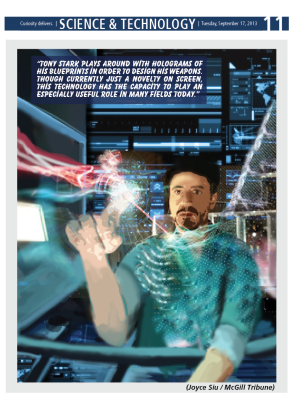
One interesting feature the Iron Man films continue revisiting is the concept of a 3D user interface. Throughout the series, superhero Tony Stark plays around with holograms of his blueprints in order to design his weapons. Though currently just a novelty on screen, this technology has the capacity to play an especially useful role in many fields today.
Inventor Elon Musk and his team at SpaceX, a California space transport company, recognized this application when they designed a 3D user interface to aid in modeling and designing rocket parts and engines. The program uses a Leap Motion controller—a small device with two cameras and three infrared LEDs which allows users to interact with the wireframe of an object that is projected on a screen, similar to Stark’s manipulation of his blueprints. The model can then be produced using a 3D printing technique called Direct Metal Laser Sintering (DMLS).
The user currently only has rudimentary motion control of the model, but this is simply one application of the technology in action. There are other examples of 3D user interface concepts currently in use that have been developed by other groups. The applications range from controlling a robotic arm to browsing an anatomical model during surgery, all of which are accomplished by manipulating a wireframe on screen.
Regenerating Limbs:
Another interesting idea in Iron Man 3 was the Extremis project, developed by Iron Man’s enemy, the Mandarin, to regenerate body parts. The super strength and fire breathing abilities were fun in their own right, but the way it restored amputated limbs was the truly interesting and much more realistic application.
Salamanders and other animals like starfish are able to regenerate their limbs. In fact, adult salamanders can regrow their spinal cord, heart and even parts of their brain.
The regeneration observed in organisms like the salamander is accomplished through a complex system of chemical reactions and immune cells working together at the injury site to repair the wound. It also involves the de-differentiation of cells to their original state: the stem cell. Unlike other cells, stem cells have not yet differentiated into a particular type of cell—like a heart or muscle cell—meaning they have the potential to proliferate into any type of tissue. Therefore, stem cells can adopt the properties of the salamander’s lost tissue in order to replace the limb.
A similar regeneration system is present in mammals; however, due to the scarcity of stem cells, the effect is not quite to the same capacity. Nonetheless, it is well documented that fingertips in humans can heal to about their original state after an accident.
Recent studies in genetically engineered mice suggest that the Wnt-signalling pathway, a signaling system that transmits information from outside the cell to within, is involved in the regeneration of amputated fingertips. Assistant Professor of Dermatology Mayumi Ito from the New York University’s School of Medicine reported his discovery of self-renewing stem cells located in the nail matrix (the part of the nail bed that stimulates nail growth) in a paper published June 2013. This finding, among others, supports the concept that fingertips are able to regenerate to their original state after injury.
The regeneration of limbs is not a novel idea, but it has been researched extensively in recent years due to advances in genetic and biological techniques. These new studies have offered an outlook on the biology of regeneration that may even lead the way to one day restoring an amputee’s limbs.
Living in Montreal, there’s a lot to be proud of, even more to be healthily suspicious of, and sometimes, quite a bit to complain about. Construction blocking your path for the fifth time this week? Narrowly avoided getting sideswiped by a rampaging cabbie yet again? Tuition fees continuing to rise while your wallet only gets lighter and lighter? These are all valid concerns, and are all felt by many of us here at McGill. Sometimes, however, people get up-in-arms about something so trivial that it begs the question of why anyone cares in the first place.
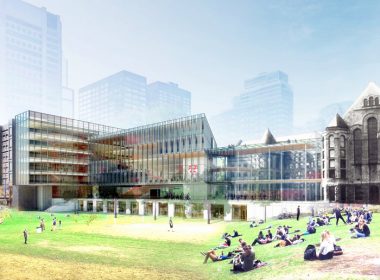
The latest controversy to stir up the community comes courtesy of a recent project by McGill University Services, which some see as an attempt to build an imposing, fortress-like enclosure out of our once peaceful and scenic campus—no doubt with the intention of frightening the university’s 38,779 students into simultaneous obedience. “What could possibly be so terrifying and/or dramatic?” you may wonder.
As it happens, bike barriers were installed at the Milton Gates over the summer. Three foot tall, dinky, metal bike barriers. ‘Gate’ is a bit of a misnomer, considering that anyone with an agenda can easily barge (or cycle) right on through if so desired. They even swing.
As anyone who has wandered down University Street can attest, the Milton Gates entrance is jam-packed full of students, professors, and assorted Montrealers on any given day. If you were to poll a random sample of these commuters, chances are very few would welcome getting run over by a speeding cyclist, which is why these barriers were installed in the first place. A recent article by the McGill Reporter describes “at least four incidents of collisions between cyclists and pedestrians in recent years,” as well as numerous anecdotes about near-misses; the implementation of these bike barriers, modest though they may be, is purely in the interest of public safety.
And even if it weren’t, these gates are so unobtrusive that for most of us, walking through them doesn’t even register as an event, much like opening a door, or putting on pants in the morning. If ever there was a definition of anti-climatic, it is the gentle brushing aside of a weakly protesting turnstile. The whole process is forgettable and insignificant in the extreme, yet these gates’ mere existence has provoked members of the student community to the point of necessitating a 700-word essay denouncing them (in which, by the way, these relatively innocuous turnstiles are painted as instruments of anti-environmental, anti-francophone, and anti-intellectual sentiment, all in one go).
The fact that such an argument is considered worthy of anything but the paper shredder indicates one of two things: a lamentably slow news week around McGill’s downtown campus, during which absolutely nothing of note occurred—or, failing that, the beginning of the end for journalism.
Between its vibrant social scene, dubious political schemes, gang presence, monetary issues (felt especially at McGill), and more, there’s quite a bit to write about in this city, and even more to gripe about, if one were so inclined. This isn’t to say that we shouldn’t protest things with which we disagree; that’s how democracy works, after all. If you don’t like something, tell the people in charge and if enough people share your view, that something may get changed to a better something. But whining about bike gates? That’s just a waste of time.