The synopsis of Snitch seems to confirm the modern critique that Hollywood has run out of plausible ideas, and simply makes any excuse for action to occur. This sentiment, however, is doubly incorrect for the newest Dwayne “The Rock” Johnson action-drama.
The story follows an ordinary citizen named John (Dwayne Johnson), who goes undercover in an attempt to arrest a major drug dealer, so that the District Attorney will let his wrongfully imprisoned son out of jail. The plot sounds rather fantastical until viewers learn that it is based on a true story, and discover that this action-drama is surprisingly more dramatic than pulse-pounding.
Seeing Johnson as the lead character inspires the idea that this film will either be a testosterone-fest (Fast Five) or a family comedy (Tooth Fairy), but he instead brings out a more emotional side, emphasizing the pain of a parent worried about his son.
Jon Bernthal plays Daniel—an ex-con trying to set his life straight, who works with John on one last illegal deal in order to secure his family’s finances. Although both characters are meant to be average guys in a bad situation—men who just want to protect their families—their massive necks and biceps present a different story. I really tried, but I could not take Johnson seriously as a dramatic actor. Whenever he talks about his innocent son and tries to emote his anguish, I could not stop thinking about how many protein shakes he must ingest per day.
Although he, too, is larger and stronger than the average gorilla, Berthal portrays the anxiety brought on by financial stress with his wife (Lela Loren) more effectively. The couple cycles through anger, sadness, and love at all the right moments in their arguments, and convinces the audience of the struggles straining their relationship. Malik (Michael Kenneth Williams), the drug dealer that John and Daniel first work with, also completely embodies his character. He emanates power and respect, manipulating Johnson (who could potentially crush his head like an overweight man sitting on an old kiwi) with only a sentence and a glare. Unfortunately, the performance of the higher ranked kingpin (Benjamin Bratt) fails to hold as much gravitas.
Part of the problem with Snitch is that the film seems constantly confused about its identity; it plays like an action flick while containing the plot and dialogue of a drama. There are only a handful of real action sequences thrown in, but every scene contains an exhilarating score and shaky hand-held shots—implying movement when the scene merely consists of men conversing. The action scenes themselves are forced and unrealistic, but entertaining. At the onset of the film, John has never held a gun—a week later, he shoots and kills four people while driving.
The audience is meant to believe that John is enduring this hardship to save his son; in reality, he doesn’t even know the boy particularly well. John divorced the mother years earlier, and he now has a new family. He completely ignores this new family, however, isolating his daughter like he did his son, despite beginning the film by swearing never to make that mistake again.
An unexpected political message came in the last shot: the statement that a first-time offender of non-aggressive drug possession in the U.S. may serve more time than someone convicted of rape or manslaughter. This fact inspires a more political angle from which to consider both the film’s events and tone.
Despite questionable motives and wobbly shots, Snitch contains a few scenes with real emotional impact, and a strong sense of suspense throughout. Due to its action veneer and dramatic content, the film could be a bridge for a younger audience learning to appreciate movies—not just for pure entertainment, but for their emotional message.
Snitch is playing at Cinema Banque Scotia (977 Ste-Catherine West).
Jonathan Emile is only 27, yet he’s already overcome one of the toughest challenges anyone can ever face.
The 27 year-old Jamaican-Canadian musician, Montreal native, and McGill student-on-hiatus fought a lengthy battle with cancer after being diagnosed at the age of 18. Today, he’s an artist on the rise with his own record label, and a soon to be released collaboration with rapper Kendrick Lamar.
“I only started taking [music] seriously when I went through my illness,” Emile tells the Tribune. “That’s when I really found a love for it and decided, ‘Hey, if I make it through, this is what I want to do for the rest of my life.’”
Emile defeated the cancer and followed through on that life-changing decision. During the recovery period, he began to lay the foundation for Mindpeacelove Enterprises, a label that would aim to become a creative hub for so-called “conscious” artists.
“It’s a label in the most basic sense of the word,” says Emile. “We just produce records with a certain sound, a certain aesthetic. It’s a sonic aesthetic, but also thematic. Our records are all positive records; they’re all conscious hip-hop, R&B, rock, reggae. It’s all conscious social music. It’s like neo-soul.”
In 2009, Emile’s debut album, The Lover Fighter Document, was the label’s first release. In 2011, the EP was long-listed for a Grammy nomination.
Simon Poitrimolt / McGill Tribune
Even on the heels of such a successful first effort, Emile has been focused on more than just his career. He backs up the message of his music with social action in the Montreal community. Emile is greatly involved with the Montreal-based organization Overture With the Arts, a group dedicated to bringing performance arts education to youth.
Overture is also responsible for the Songs of Freedom Tour for Black History Month, which brought Emile to McGill on February 20th. In the SSMU ballroom, he delivered an inspiring hour-long presentation that educated and excited the hundred or so high school kids that were invited to attend.
As he explained to the students, the thesis is simple: “Music is a tool for communication and social justice.” Then, he took them on a chronological musical journey that jumped around from early tribal music to legendary anthems of change “Redemption Song” and “A Change is Gonna Come,” and eventually freestyles and written raps that he authored himself.
A few years ago, Emile was working on his music while studying Philosophy and Political Science at McGill, but realized that he couldn’t juggle both at the same time if he was going to make a serious run at the music industry, so he took an “extended sabbatical.” He speaks fondly about his passion for both disciplines (eagerly recommending Professor Buckley’s class in Phenomenology), and plans on eventually finishing his degree, then either exploring more academic opportunities or working in education.
The way things are going, it could be a while before he finds himself on campus again. Emile is working hard to try and get his second album released sometime in the fall, and when Kendrick Lamar isn’t busy living the high life and hosting Saturday Night Live, the two are planning to get together to shoot a music video for their collaboration, “Heaven Help Dem.”
Emile is excited to meet the celebrated rapper in person, but his most anticipated event will come in the spring when he will get married, and travel to France and Spain for his honeymoon. It’s a big step for Emile—but then, he’s taken quite a few of those since conquering cancer and committing himself to pursuing his musical dreams.
Check out Jonathan Emile on the last stop of his tour on Feb. 28, 5:30 p.m., Riverdale High School (5060 Sources Boulevard). Free admission.
Following the release of their self-titled breakout album, pop outlet Walk The Moon (WTM) garnered quite the fan following, and toured around the U.S. festival circuit this past summer. After attracting festival-goers with their playful, sing-along inducing indie-pop, WTM briefly returned to the drawing board to throw together a follow-up EP, titled Tightrope.
The album picks up exactly where Walk the Moon left off, with six spring-ready tunes. On the title track, lead singer Nicholas Petricca belts, “Walk your tightrope, walk your little tightrope, this heart is burning up” to a symphony of cutesy percussion and smooth guitar riffs. “Drunk in the Woods,” reminiscent of Cold War Kids, sounds like a beckoning anthem for the carefree atmosphere of summertime, and “Tightrope (acoustic)” is a colourful simplification of the upbeat title track. Walk the Moon’s lyrics are not ridden with social commentary nor any complexity. Instead, the band sings about fleeting romance, putting your feelings on the “tightrope,” and winning back ex-girlfriends: songs for beach parties and pre-drinks.
Tightrope is cheeky, easily consumable, contagious pop music. While this EP does not mark deep progress or evolution from their previous release, one can tell that the band had way too much fun last summer, and are just simply trying to re-live the experience by doing what they do best: producing another youth-celebrating indie-pop record.
Josh Groban has a new album ready to go, and it’s going to hit listeners like the opposite of a freight train. That’s not because All that Echoes is weak, nor because Groban’s voice is weak. Quite the contrary—his is the most majestically gentle voice in music today. Straddling the line between pop rock and classical singing is Josh Groban, weighing in at one hundred and thirty pounds.
Groban is the little engine that could. He’s been singing all his life, pursuing the performing arts, working hard, and leaving university for months in order to pursue his musical career. His breakout moment was well-documented, when he filled in for legendary tenor Andrea Bocelli to perform a duet with Céline Dion. Since then, Groban’s been a fixture in the powerful male vocal register circuit.
Groban’s legendary voice is both tenor and baritone, but because there is no authoritative standard voice classification system for non-classical music, it’s probably just best to describe it as ‘impressive.’ All That Echoes is Groban’s sixth effort as a pop-classical artist. It features Groban’s skill as a multilingual singer, performing in Spanish with legendary trumpeter Arturo Sandoval on “Un Alma Más,” and in Italian on a duet “E Ti Prometterò”) with the famed Italian singer Laura Pausini. “Un Alma Más” is one of the strongest tracks of the album, and the fact that Groban is not a native Spanish speaker does not hold him back. Fans of his, and of contemporary classical music, will love All That Echoes.
With the charts dominated by catchy pop stars, and the occasional indie group who has broken through to the mainstream, it is refreshing to listen to actual rock ‘n’ roll. Biffy Clyro, a Scottish band currently touring with Muse made it big in 2007 with the release of their album Puzzle, which went platinum in the UK. In 2009, their album Only Revolutions followed the same path. With six music awards and 15 nominations under their belt, Biffy Clyro released their sixth studio album early last month.
Boasting 20 tracks, Opposites, the band’s first #1 album, is an ambitious undertaking.
Simon Neil, lead vocalist and guitarist, elaborated on the album’s concept of duality in an interview with BBC Radio One.
“Each album is the exact opposite vibe to the other lyrically,” says Neil. “One’s about putting things in the worst possible way and thinking you’re getting yourself into a hole. The other looks at things more positively.”
Biffy Clyro is distinctively rock, characterized by a solid bass-line, deep melodies, and a vocal-centric full tenor. “Different People” (with wistful, heartfelt vocals), “Biblical” (exemplary of the band’s powerful sound), and “Spanish Radio” (with a playful Spanish guitar rhythm) are particularly good examples of the group’s musicianship. The two discs do have opposing vibes, and every song is well put together and interesting, although few are truly amazing stand-outs—while it is split over two discs, this arrangement may be excessive. A more compact, though still dual album would have left more of impression, and been more poignant, while still retaining the concept. Nevertheless, their position on the UK’s top 100 speaks for itself.
A fatal thrust of the sword while your heart somersaults; the delightful ease with which a smile is teased from your lips. For many, such moments of passion and emotion epitomize the experience of live theatre. The sight of a performer, excelling in her craft before your very eyes, conveys excitement in a way that few other art forms can.
But the show itself is the culmination of months of preparation. What is seen on stage rests on a foundation of sweat and tears, of mental and physical dedication and devotion. Behind every standing ovation is a tireless technician, a dogged director, and countless others who have poured heart and soul into providing you with a uniquely enjoyable experience.
For this special issue of the Tribune, A&E takes you behind the scenes of student theatre at McGill, celebrating the work of our friends and peers, the challenges they face, and the indelible joy that binds it all together.
A long and arduous path
Come September, most students return to classes with wild stories, fond memories, and a reluctance to start classes. A few, like Martin Law, return with all that plus one other thing: an artistic vision.
Law is the director of Players’ Theatre’s current production of Macbeth, a position for which he was selected last spring. The McGill Savoy Society, which just wrapped up their production of Iolanthe, similarly hired their director Emma McQueen last May. The directors spent the summer in research and reverie, and by the time auditions began in late September/early October, both had a game plan to set in motion.
Iolanthe began rehearsals Oct. 1, meeting 10 hours per week. Macbeth started a little later, rehearsing “three to four hours … a night, five to seven nights a week,” says Stage Manager Celia Fogel. Time spent also varies across roles; Sophie Krahnke, who plays Celia in Iolanthe in addition to serving as President of the Savoy Society, says she spent up to 20 hours a week working on the show outside of rehearsals.
Spending this much time together facilitates one of the biggest rewards of the rehearsal experience: a fostering of camaraderie among cast and crew, a sentiment which seems to be universally shared. Asked about her favourite memory from rehearsals, Isabelle Liu, who played Fleta in Iolanthe and serves as Publications Director, replies, “starving together.”
“Most of the time, we don’t have time to go out and get lunch [during Saturday rehearsals], so we all end up starving with each other,” says Liu. “Rather than biting each others’ heads off, we just make fun of how hungry we are. it’s during that time that I realize that we’re all in the same boat; we’re all in this together.”
The frenzy of preparation reaches its apex the week before performances begin, when technical elements are all finally incorporated into rehearsals. Lights are hung, sound cues are programmed, and emotions run high, as the fruits of the labours of the cast and crew are in sight. This is tech week—or ‘Hell Week,’ as the Iolanthe cast affectionately termed it.
“I considered arriving at 3 p.m. and leaving at 10 p.m. to be a ‘short’ day at Moyse Hall,” says Iolanthe Stage Manager Marissa Lewis.
An array of challenges
On top of the demands of perfecting a theatrical production, students face a battery of institutional and physical barriers to a successful show.
One concern shared by the two productions was the rehearsal space itself. Macbeth rehearsed primarily in the English Lounge, and Iolanthe in the SSMU Clubs Lounge. Both shows were forced to secure alternative rehearsal spaces at one point or another, sometimes with little advance warning.
“It’s crazy, because we do three to four months of rehearsal[s] … in a classroom, or a hallway, really wherever we can get space,” says Fogel.
“As a director you usually go a little more insane than everyone else in the cast,” says Law, pointing to his attempts to push rehearsal hours to capitalize on free space.
To this, Fogel replies, “I definitely would say that’s one area in which I try to put my foot down. ‘Martin, we are not rehearsing from 10 p.m. to 1 a.m. just because SSMU is open and has free space.’”
For Fogel, the difficulty in finding rehearsal space is only one symptom of an environment in which professors and administrators are largely unsympathetic to the concerns of student actors and technicians. She points to the limited opportunities to study technical theatre at McGill, or to gain academic credit for experience gained in out-of-school productions.
“I think I understand where the university is coming from,” she says. “McGill isn’t known for its arts. It’s a research school known for its med program…. But it’s also a big, important, world renowned school. It should embrace this status and offer more opportunities for programs like theatre that are only growing in popularity every year.”
Fogel is also careful to point out that many professors, particularly those in the drama department, do “understand the difficulty of balancing an extracurricular passion like theatre with the demand[s] of school.”
Still, this balance act entails walking a precarious tightrope. Law admits that “schoolwork suffers for sure,” but adds that “It’s worth it.”
Alexandra Allaire / McGill Tribune
Opening night
An hour before the show opens, backstage buzzes with the hum of a well-calibrated machine. Actors are conducting warm-ups, exercising their limbs and voices, in addition to getting into character and changing into costumes. Technicians are preoccupied with setting the multitude of props, and doing one last check on lights and sound. Macbeth also rehearses their fight choreography prior to every performance, to ensure the preparation and safety of their actors. Law takes this opportunity to give last minute directorial notes—what to change from the last production, what to focus on this time—while McQueen is busy assisting with hair and makeup.
This well-orderedness disguises a hearty dose of nerves.
“I spend most of my time running around backstage making sure everyone … is ready to go,” says Lewis, who describes her state of mind as “rather stressed.”
Liu, who describes herself as being “super nervous” prior to the show’s start, agrees. “Some people can’t stop talking because they’ve got the pre-show jitters; others just keep quiet.”
“[I’m] always trying to find a balance between being pumped up and at the same time relaxed,” says Margaret Frainier, who plays Iolanthe. “What I like to do with the girls in my dressing room is put on some dance-y music and jam out.”
Not everyone is fazed, however.
“I don’t get that pre-show butterfly thing,” admits Fogel. “From the minute I set foot in the theatre, I’m concentrated on what I have to do.”
Soon the doors fly open, and the audience shuffles in, buzzing with anticipation of seeing their friends perform, or whispering eagerly about rumoured surprises in store.
And then, the show begins.
Behind the performance
The magic seen on stage is powered behind the scenes by actors and technicians who, though not visible to the audience, are wholly dedicated to ensuring the smooth running of the production.
Performers who are not on stage are often needed to assist with scene changes, or help other actors who have a quick change of costume.
“Sometimes you’re reflecting on the scenes that have gone by,” says Law. “But most of the time you’re just focusing on what [you] still have left to do.”
“The actors are pretty much concentrated and in character—there’s not too much joking going on backstage,” says Fogel. “You can tell everyone’s having a good time, but they take it very seriously.”
Much of this is due to necessity. Despite the enormity of talent on stage, Players’ backstage is a constrained space, and the narrow confines only increases the demand on actors to be efficient, focused, and of course, silent during performances. Moyse Hall, though no leviathan itself as a space for musical theatre, at least provides Savoy the luxury of a green room with a TV, so that backstage cast and crew can follow along with the onstage action. This also facilitates a more relaxed atmosphere.
“We goof off and have so much fun backstage,” says Liu. “When we come off stage, everybody just gives each other a pat on the back and a ‘It looked really good!’ It’s a really nice feeling.”
In the lighting booth and while relaying cues through her headset, Lewis sometimes has to deal with “panic-filled problems,” such as the occasional tipping over of a set piece. But even the stage manager and technicians find opportunity to hit a more relaxed tone during performances:
“We occasionally question plot holes—isn’t Phyllis still mortal?—and converse about parts of the show when technical work isn’t required,” she says.
Alexandra Allaire / McGill Tribune
McGill theatre: Theatre for McGill
The performance itself is merely the tip of an iceberg, one that stretches deep, through months of intense preparation and work. Yet, for the people behind the spectacular productions that grace McGill’s stages every year, theatre is not only a personal creative outlet, but a way to give back to the community, and a school that lacks a fine arts program of its own.
“We as an executive really take it to heart that we are a student service,” says Fiona Penny, Players’ Theatre’s Executive Director. “What underlies every decision we make … is, at the end of the day … are we choosing people that will provide the most accessible show and provide experiences for other McGill students?”
She adds: “Most people [who] get involved in theatre don’t study theatre…. I think that, because it’s not school, that’s why people get so passionate about it. It’s wonderful to have something outside of school that you can care so much about.”
Montreal’s winters may be frigid, but the bleak weather doesn’t stop it from being one of North America’s most vibrant cities. The buzz of winter is most evident on Nuit Blanche, a night where the city explodes with light and activity.
As part of the Montreal en Lumière festival, artists, musicians, and everyday Montrealers will team up with the city of Montreal to present its tenth annual Nuit Blanche on Mar. 2. This evening, in which all sorts of venues open their doors for the entirety of the night, is conveniently taking place on the first Saturday of reading week—an excellent opportunity to venture outside of the McGill bubble and experience Montreal’s diverse culture.
If you’re planning on spending the night wandering around the city, remember that the Metro is open all night long, but it’s not free. Your best bet is to purchase an Unlimited Evening pass for $4, which works from 6 p.m. to 5 a.m. on both metro and shuttle buses.
This Nuit Blanche, the Tribune offers its recommendations for free events all over the city.
Place des Festivals
The flagship venue of the festival, Place des Festivals will feature a huge urban slide, a ferris wheel, a 360° cinema, and more. Although this is one of the night’s most popular destinations, with long lines and crowded spaces, the area will be worth checking out at 9 p.m., when fireworks officially kick off the night.
Free. 6 p.m. to 3 a.m.
Corner of Jeanne-Mance and Ste-Catherine.
Montreal Museum of Fine Arts
To complement its current exhibit Peru: Kingdom of the Moon and Sun, the Montreal Museum of Fine Arts is hosting a variety of activities, from a showcase of traditional Peruvian dances, to a multimedia presentation on Peru’s rich archeology and folk culture; to the delight of visual artists, there will also be a live-drawing workshop. But the highlight of the evening may be a free chocolate tasting by the Cacao Berry Lounge and live chocolate body painting (presumably, not at the same time).
Activities are free, and entry to the special exhibit is half price for the night. 7 p.m. to 1 a.m.
1380 Sherbrooke West.
Ballets Jazz de Montreal
In celebration of its 40th anniversary, the Ballets Jazz de Montreal (BJM) is offering free dance classes all night long. In the same building, the BJM will be showing a documentary and a multimedia exhibit of its history, as well as holding a dance rally.
Free. Reservation required if you intend to take a dance lesson. 8.30 p.m. to 3.30 a.m.
Maison du Conseil des arts de Montréal—Édifice Gaston-Miron
1210 Sherbrooke East.
Biodome Penguins
Attention animal lovers! On Nuit Blanche, the Biodôme takes some of its penguins from the facility and outdoors to play in the real Montreal snow and interact with visitors. Experts will be in the area to answer any questions about these birds from the South pole.
Free. 5 to 11 p.m.
Olympic park
4777 Pierre-de Coubertin Ave.
Rio Tinto Alcan Planetarium
If it’s a clear night, stop by the Rio Tinto Alcan Planetarium, part of the Espace pour la vie complex. The planetarium, which will be inaugurated on April 6, will set up telescopes for visitors to stargaze and learn about astronomy.
Free. 5 p.m. to 2 a.m.
Rio Tinto Alcan Planetarium
4801 Pierre-de Coubertin Ave.
Coupe Bizzarre
For the more daring night owls, this Nuit Blanche the salon Coupe Bizzarre will be giving out free haircuts to those who stop by. The catch? You don’t get to choose the haircut. Trim at your own risk.
Free. 11 p.m. to 3 a.m.
3770 Saint-Laurent Blvd
Atelier Circulaire
The printmaking experts at Atelier Circulaire are hosting a “scratching” session in which visitors will learn techniques of dry print etching on vinyl records while enjoying music by live DJs. Participants will be able to take their art home.
Imagine arriving late to class, ears burning from the cold, and stepping over puddles and bags until you finally find a seat. As the professor lectures away, a student several rows down raises his hand. The professor, unaware, continues the lecture. After some time, the student eventually puts it down.
For most McGill students, this scenario isn’t hard to imagine. Professors might not always be fully aware of the hands that go up at the top or the far sides of a lecture hall, and it’s not their fault. They’re only human after all.
What if there was a way to detect if a student raised their hand in a large crowd, or to recognize if students were confused during a lecture? These possibilities are being explored at the McGill Shared Reality lab.
“A prototype system that we developed years back was used to automatically detect if a student raised his or her hand up for a question,” Dr. Jeremy Cooperstock, Director of the Shared Reality Lab, said. “Since it was in a large class setting, the system would then inform the instructor by raising a flag on the screen about who has their hand up, and what part of the room they’re in.”
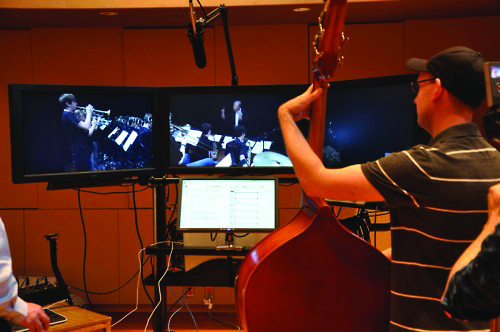
Experiments at the Shared Reality Lab involve the use of virtualized reality techniques and advanced networking protocols to give users a strong sense of co-presence—the feeling of being together in a shared physical environment. This is accomplished using a number of screens, cameras, projectors, and microphones, along with a high-fidelity vibrosensory system.
“This high fidelity and low latency type of communication gives people the ability to feel like they are engaged in coordinated synchronous activity with those far away, while in the comfort of McGill,” Cooperstock explained.
The lab was one of the first research groups in the world to support a distributed music performance. Jazz students from Montreal and Stanford performed together at the same time using the technology developed by the Shared Reality Lab. They were able to see and hear each other in the same capacity as if they were physically in the same space.
cim.mcgill.ca
The lab also looks at how to adapt users to a different kind of environment by rendering physical scenarios, such as the sensation of walking on different ground surfaces, such as snow, gravel, or sand.
“And they can experience that even though they are physically in a laboratory environment, walking on floor tiles,” Cooperstock explained.
The third dimension of the lab involves looking at sensory substitutions for those unable to experience a certain aspect of the everyday world around them. By working with the blind community, the Shared Reality Lab looks for ways to give these people the visual experience of the world around them. This is accomplished by providing the information usually available to vision through audio, explains Cooperstock. The lab has also given demonstrations on new technologies for the Android and iPhone, which give users a constant display, through audio, of what points of interest are around them while walking outside.
Along with developing sensory substitutions, the lab has created different applications to help Music and Medical students at McGill. For musical training, the lab developed a simulator known as “Open Orchestra” which has received significant recognition.
“The simulator was [developed] to give classical and jazz musicians the experience of rehearsing with the rest of their band or the orchestra around them,” Cooperstock explained. “It wasn’t a live performance scenario. Rather, it was a rich multimodal experience of what it feels like, looks like, and sounds like to be sitting in, for example, the second violinist seat in a 30 seat orchestra and playing along with the different musicians, while seeing and hearing the conductor at the same time.”
Similarly, a training system was used to train McGill medical students in response scenarios. This project was funded by the Canarie’s Network Enabled Platforms (NEP) program, and was completed in 2010. It involved using medical mannequins to mimic different physiological functions, such as blood flow to the heart, and teaching students through scenarios where they had to experience and address real situations, such as a patient in a car accident.
Through this new approach to human-computer interactions, the Shared Reality Lab offers a glimpse into the future of virtualized reality, which could change the way we interact with people around the world. One day, attending the opera could involve listening to different opera singers in different time zones, standing on different stages in a worldwide opera house located in cyberspace.
The Dent Lab in the Stewart Biology building is humming with activity. Run by Dr. Joseph Dent, an associate professor and researcher at McGill University, the lab focuses on the molecular genetics of the behaviour in C. elegans, a nematode roundworm.
Specifically, the lab’s research focuses on understanding the structure and function of neurotransmitter receptors, the role they play in behaviour, and how we can manipulate them to treat diseases, or better understand how nervous systems work. Essentially, neurotransmitter receptors are membrane receptors that receive electrical signals, facilitating the transmission of information from the brain to the body, and vice versa.
“Our lab has basically two components,” explains Dent. “One is a relatively applied component, and the other a more basic research component.”
The applied component of the lab concerns the relationship between neurotransmitter receptors—important targets for antiparasitic drugs—and pesticides. Dent and his team are currently looking into how existing drugs kill parasites, specifically nematode roundworm parasites, and how nematode parasites develop mutations that allow them to become resistant to these drugs. They hope, through this research, to learn how we can use antiparasitic drugs to better prevent the disease from reoccurring, as well as to make the drugs more effective against resistance developed by parasites.
Nematode roundworm parasites are of significant importance due to the disease caused by the nematode Onchocerca volvulus. River blindness, caused by O. volvulus, is endemic to Sub-Saharan Africa, where 18 million people are at risk of losing their sight. The disease is currently being treated with the drug Ivermectin, which is given in yearly doses by the World Health Organization (WHO) to help people who are already affected and reduce the rate of transmission.
This second area of research comprises the lab’s more basic research aspect. The team has investigated the role neurotransmitters play in behaviour, how the nervous system uses them to modulate behaviour in interesting ways, and the fundamental features of the neurotransmitters themselves. Through this work, they are able to look at the mechanisms behind Ivermectin resistance and how nematodes develop resistance to the drug.
The team works with the roundworm C. elegans in its experiments. While not parasitic, this organism is a much more efficient model to use during experimentation. Since C. elegans is highly similar to other organisms, the team can translate what they learn to various other systems.
“It turns out nematodes have a lot of receptors that humans do not have. These are a good target for anti-parasitic drugs. You want a drug that targets the parasite and not humans,” says Dent.
The Dent Lab works with C. elegans first, and then collaborates with the Institute of Parasitology in order to transfer the work performed on C. elegans to see if it has a similar effect on the parasite.
Looking to the future, Dent says, “We’d love to come up with a new, effective, safe drug that would allow us to have an impact on these diseases.”
“We would also like to better understand the design of the neurotransmitters in all organisms, [in order to] use the information to better focus or target our search for drugs to specific subsets of channels,” explains Dent. “If we understand it, can we design better drugs and better drug targets that are less likely to develop resistance? If we understand how resistance occurs before it occurs, can we use the drugs in better ways?”
Behind the scenes of the lab’s operations, funding plays an important role. According to Dent, the Lab does not get as much support as he would like, since the Canadian health agencies are focused on research concerned more directly with Canadian health. However, the lab receives more support from the agricultural and pharmaceutical industry, which is interested in these drugs because they can also be used to treat livestock. Ivermectin, for instance, is an active ingredient in drugs used by farmers to treat livestock with deworming agents.
“The economics are such that the companies make their money selling these drugs to farmers to treat livestock, so that they can produce cheap meat. We benefit from that, in the sense that we receive industry money to support this research.”
Most important, however, is the idea that spurred this research. When asked, Dent explains it was “just lucky.” While studying the eating behaviour of C. elegans as a post doctoral fellow, Dent discovered a mutant gene that affected their behaviour, and made it less efficient. He located and cloned the gene, only to discover it was a neurotransmitter receptor and the target of the drug Ivermectin—from there, his research took off.
“It often happens that you study one thing and make a completely unexpected observation. What is exciting about research is that, you never know where it will go next—the most exciting research is the research you didn’t anticipate on doing.”
The season three finale of Hasbro’s animated series My Little Pony: Friendship is Magic aired earlier this month. The children’s show has attracted an unexpected adult male fan base called “bronies,” a phenomenon that has garnered attention and sparked much gender-based debate. A long history of gender-exclusive children’s programming has formed gender archetypes in viewership. From an early age, we are conditioned to have fixed social expectations of what plot content and character traits boys and girls should or should not like. I find this problematic. It deters viewers from adopting seemingly benign, yet often very important, traits generically attributed to the opposite sex, and hinders any social progression in redefining gender archetypes.
Gender-exclusive programming as a strategy of market segmentation has long been a dominant pattern in the children’s entertainment industry. Producers identify and isolate a particular gender and age group, and tailor the programming preferences of each market to guarantee viewership. Producers then secure the attention of audiences to create the “audience commodity,” which is sold to advertisers.
According to the 2001 study “Development of Gender Differences in Children’s responses to Animated Entertainment” from the journal Sex Roles, among children ages three to five, boys showed a much greater preference for violent content, while girls were rather more interested in romantic drama. Consequently, programs marketed specifically at boys, such as Transformers or Ben 10, primarily feature male characters possessing masculine attributes of leadership, bravery, and aggression. Programs for girls contrarily mainly portray female protagonists and their struggles with relationships. Friendship is Magic, for instance, follows the adventures of six female ponies as they discover the importance of friendship. When chidren’s programs aimed at specific genders repeat gender codes, the implicit message is: “This is what you are supposed to like.” This influences the gendered preferences of young viewers, which in turn determines content of future shows. There is a vicious cycle of constant reiteration of gender archetypes, one that allows little space for deviation.
[pullquote]When chidren’s programs aimed at specific genders repeat gender codes, the implicit message is ‘This is what you are supposed to like.[/pullquote]
So what happens when these gender archetypes are challenged? The emergence of “brony” subculture has demonstrated the rigidity of the public’s expectations of gender performativity. Many commentators have expressed their disbelief that a show for little girls could be so popular among males, seeing this trend as unexpected, or even intolerable. Fox News commentator Andy Levy stated that these men “should feel shame” for their obsession. “Bronies” have radically rewritten expectations of gender behaviour by appreciating a show that embodies benign—though supposedly feminine—virtues of love and friendship. I would argue that this is a form of social progress, even while expectations of gender behaviour have deemed the “brony” subculture as something highly unnatural.
As ingrained as gender archetypes are, the public should embrace the these roles as social progress. Perhaps to redefine viewer archetypes in a more subtle way (as opposed to the radical nature of “brony” fandom), producers should further explore the possibilities of gender-neutral programming: shows that seek to portray both male and female protagonists possessing atypical gender codes. Non-gender exclusive shows such as Annie Award nominees Avatar: The Legend of Korra and Adventure Time have recently found immense popularity among both boys and girls. A new era of gender-neutral programming may be on the horizon.