Latest News

(Sam Reynolds / McGill Athletics)
a, Sports

Championship Recap

RSEQ Championship — Track & Field

For the third time this season, McGill hosted the wealth of track teams from across Quebec in the RSEQ provincial championships.

Battling hard throughout the weekend, the Martlets claimed their first conference title in the last six years—thanks in large part to an incredible meet by Alana Battison. En route to becoming female athlete of the meet, Battison claimed two golds, three silvers and a bronze to amount for 28 points over the course of the weekend.

Helping out Battison in the first place push were gold medallists Caroline Tanguay in the high jump, and the 4x200m relay contingent of Sarah Glen, Clare Williams, Ellen Parker, and Helena Reinfels.

On the men’s side, a different story unfolded. Finishing third overall, the team failed to garner the results that the Martlets did. However, the team still mustered three golds over the weekend.

Vincent Parent-Pichette was golden twice, first individually in the 1000m and then again as the anchor of the 4x800m relay. Joining him in the relay bid were Benjamin Raymond, Nathan Goldstein, and Michael Abramson. Riley van Ryswyk then closed the weekend with a gold in the pole vault, clearing 4.31m.

Done now with provincial competition for the year, McGill Track and Field turns its attention to the national scene for the final event of the season for the CIS Championships, where 20 athletes have earned the right to compete. Athletes are nominated based on their results throughout the year, needing to meet standards set for each event to qualify. Any gold medallist from the RSEQ championships automatically qualified.

Most of McGill’s medal hopefuls land on the women’s side, with Battison leading the charge in the pentathlon.

The CIS national championship runs March 7-9 in Edmonton, Alberta. 

(Victor Tangerman / McGill Athletics)

CIS Championship — Swimming

The butterfly, backstroke, breaststroke, and freestyle cmake up swimming’s individual medley (IM). It’s easy enough to remember, yet incredibly difficult to perform. Therefore, Steven Bielby’s feat of a CIS gold medal sweep in the 200m and 400m IMs are that much more impressive.

Over the weekend, Bielby joined 18 other McGillians in Calgary for the CIS National Swimming Championships. Over the course of the meet, McGill claimed four medals—Bielby’s two golds, along with a bronze and silver from upstart Katie Caldwell, again in the 400m IM and 200m IM. Overall, both the Redman and Martlet swimmers finished eighth as a team. Caldwell was chosen for the second all-Canadian team, and Bielby reached first team all-star status.

Other strong results over the weekend came in the relay, where the men’s 4x200m relay team beat a McGill record, clocking in at 7:24.89, good for sixth place. The quartet, anchored by Pierre-Alexandre Renaud also includes Bielby, Marc-Andre Benoit, and Erik Cheng. The 4x200m women’s relay team—comprised of Caldwell, Taryne Landry, Rebecca Cheverton, and Jennifer Darling—broke a McGill record as well, as Caldwell swam the lead-off leg in 2:00.90.

With Bielby having now completed his final race as a Redman, a look back on his career reveals a history of excellence. By far McGill’s most decorated swimmer, Bielby amassed 13 CIS medals, including eight golds, one silver, and four bronzes, as well as four all-Canadian selections over his five years with the team. Internationally, he has represented Canada twice at the World University Games, and plans to compete for his country for a third time this summer.

With the season over, the Martlets and Redmen take a break, before looking forward to another exciting 2013-2014 campaign.

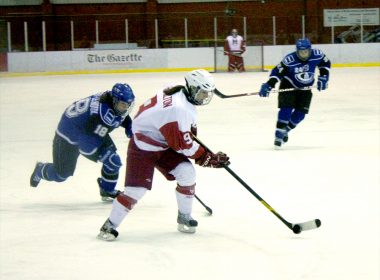
McGill has already beaten Montreal five times this year, but needs two more. (Jesse Conterato / McGill Tribune)
a, Sports

Martlets overcome Game 2 scare to sweep Ravens

When you win 28 games in a row, some inevitably will be close and others less so. That was the case in the Martlets’ RSEQ semifinal series against the Carleton Ravens last week, as they prevailed 9-0 and 3-1, en route to a two-game series sweep. While Game 1 was a cakewalk, McGill relied on some late-game heroics from Stacie Tardif to advance to the RSEQ finals.

Heading into the semifinal series, there was no doubt that the odds were stacked in the Martlets’ favour. They were the top seed, had won 28 CIS games in a row, and had previously beaten Carleton 70 out of 72 games in their all-time series. The Martlets also had yet to lose an RSEQ playoff game since February of 2005, so anything short of a win would have been unacceptable.

As they have done all season—and in many before it—the Martlets pounced early and often in a dominating Game 1 performance. The dynamic duo of Leslie Oles and Mélodie Daoust contributed an other-worldly seven and six points respectively, as each registered hat tricks. On any other night, the three points scored by Katia Clement-Hydra and Chelsey Saunders might have been the story, but in a game where one of Oles and Daoust had a hand in eight of the team’s nine goals, credit must be given where it is due. The Martlets didn’t even need those eight goals, as Taylor Salisbury stopped 17 shots for her fourth shutout of the year.

(Jesse Conterato / McGill Tribune)

The return date in Ottawa was a different story, however. After a scoreless first stanza, Carleton burst out of the gates and took the lead when Tawnya Guindon beat Martlet goalie Andrea Weckman under three minutes into the frame. Despite four power play opportunities, the Martlets seemed to have wasted all of their scoring power in Game 1. They went into the second intermission staring at a 1-0 deficit and a possible rubber match back at McConnell Arena.

Who else could the Martlets look to but the prolific Oles and Daoust to rouse them from their scoring slumber. As the period neared the halfway point, Daoust found Oles, who slipped the puck past Ravens goaltender Eri Kiribuchi for her fourth of the series. The teams dug in for the next 10 minutes, as any goal would likely end or extend the series. The Martlets were granted an opening with less than two minutes to play in regulation when Ravens defender Erin Beaver was called for interference. McGill jumped on the chance as Tardif—who is not known for her scoring prowess—fired a shot from the face-off circle that beat Kiribuchi, sending the Martlets into the final and their fans to delirium. Chelsey Saunders would add an empty net marker to ice the series.

The Martlets now prepare to take on the rival Montreal Carabins for the right to represent Quebec at the CIS Championships in Toronto in March. The Carabins have only lost five of their 20 RSEQ games this season, with all five defeats coming from McGill. The puck drops on Feb. 27 at McConnell Arena.

(Luke Orlando / McGill Tribune)
a, Sports

Ken Dryden takes skills from the rink to the classroom

McGill Tribune (MT): Growing up, how did you balance the challenges of being a student, with your high expectations as an athlete?

Ken Dryden (KD): All my life I played sports and all my life I was in school. I liked both. If you like something, you get absorbed by it. You lose track of time because you just keep doing it. You can see when you’re not doing it well [and] you see when you are doing it well. You notice how you feel in each instance. You like how you feel when you’re doing it well, and you don’t like it very much when you’re not, and you want to get better. … Once you develop a kind of taste for doing something well, you don’t lose it, you don’t leave it behind, because it haunts you. So to me, it wasn’t any different whether it was on or off the ice. It’s just—if you’re going to do something, you may as well do it well.

MT: How would you describe the course you lecture called “Thinking The Future to Make The Future” and why did you decide to teach it at McGill?

KD: This is the second year I’ve taught this course. I went to McGill with the idea and it was kind of an experimental [at first]. The approach of it is not to focus on learning what was and what is, but to apply that to what a future might be. So I divided up the course into different elements of the way in which we live; whether it is the workplace, family, religion, health or healthcare, or politics and public discourse. To have [a lecturer] in who’s an expert in each of those fields [is important]. I enjoyed doing it last year and I’m enjoying it again this year.

MT: You wrote a book titled “The Game” in 1983. What inspired you to write it?

KD: I read a lot of sports books while growing up and when I played. Some of them were very good, but none of them described quite what I had experienced as a player, and the full life that you live. That’s natural [because] everyone takes in experiences differently. So I wanted to have my chance.

MT: Why was the 1972 Summit series so special?

KD: It was one of those very special experiences [and] it turned out more special than any of us ever imagined because it was harder than we thought [it would be]. In the end, because it was harder, it was far more memorable.

MT: How closely do you pay attention to what is going on in the NHL?

KD: I think I watch like most fans. It’s once or twice a year, that I’ll watch a whole game. I’ll see bits and pieces, and I go to one or two games a year. I’ll catch the sports at 11, so I roughly know who’s doing well [and] who isn’t. About every two or three weeks, I’ll look at the standings and be surprised at some [team] who I missed that is doing better than I thought, or some teams that are performing worse than I thought. I watch the first round of the playoffs, but [the subsequent rounds] less.

MT: What was your take on the recent NHL lockout, and who do you think was to blame?

KD: This was something that was going to happen.  And like a lot of things, a trail of something before leads to something later. The seeds were sown in 2004. So you arrived last summer when they really started negotiating, and all you had to do was look at the circumstances of the parties. The league had won in 2004. The end result of that negotiation was that the NHL players’ association basically broke apart—its leadership left, the interim leaders came and went; it was a mess. … They were run over in 2004. So when you lose, you need to find a way of winning the next time, or else others see you as a loser; players know that better than anybody. When you win, you see yourself as a winner. Winners win. Winners win the next time. Winners can’t lose. Self-images get determined out of all of that. So going into this negotiation, you had one that had to win and one that [couldn’t] lose. … In 2004, the owners could claim victory because they got the salary cap, even if a season was lost. This time, neither was going to win if there wasn’t a season. I think in the end, that’s what generated the season.

MT: How do you react when someone compares a current NHL goaltender to you?

KD: Usually, the person bringing it up will sort of think ‘Well wait a second, he’s early in his career. He hasn’t earned his place yet.’ That’s not what it feels like to me. For me, you just don’t know yourself as a player. You played, but others can put you into some kind of perspective. I don’t have that perspective on myself.  I just know what I see on a television screen. I see some nights—and whether it’s Carey Price or somebody else—just doing what seem to be impossible things. If the commentator [compares that goalie] to past ones, [including myself], then that’s terrific. It’s wonderful because what you see on the ice looks so good, so if people want to make that comparison, then thank you very much.

Fans greet Alexandar Mitrovic after his last regular season game as a Redmen. (Remi Lu / McGill Tribune)
a, Sports

Staying at home: McGill clinches first in conference

When Dave DeAveiro took over as McGill Redmen head coaching position in 2010, the program was in a bit of a rut. The Redmen couldn’t match up with division foes like Concordia, Laval, or UQAM, all of whom regarded McGill as an easy victory on the schedule. DeAveiro was determined to turn things around. With solid recruiting, a team-first environment, and immense player development, the Redmen have reached prominence once again. On Thursday night at Love Competition Hall, McGill clinched their first regular season RSEQ title since 2001 by defeating the Laval Rouge-et-Or 71-70 in a game that showcased exactly how far the program has come.

Remi Lu / McGill Tribune

The game quickly became a defensive struggle, as both teams traded ugly perimeter-oriented possessions. As a result, each team made fewer than 40 per cent of their field goals in the first quarter. McGill held a slim two-point lead heading into the second—thanks in large part to their defence—dropping seven points off of turnovers.

The Redmen have prided themselves on defence all season, something that DeAveiro has cited as crucial for success.

“We are one of the best teams in the country, defensively. Usually, that gives you a chance to be successful [in any game],” he said.

McGill found success against Laval’s defence during the first five minutes of the second quarter as the Redmen built a nine-point lead after generating a structured inside-out balance. However, McGill fell apart down the latter stretch of the frame, as the Rouge-et-Or duo of Karl Demers-Belanger and Boris Hadzimuratovic bullied the Redmen in the paint, en route to a 17-2 Laval run to close the quarter.

With the stakes higher than ever, it was clear the Redmen were a bit tentative. Perhaps they were shying away from their big opportunity. DeAveiro disagreed and credited the last-placed Rouge-et-Or.

“Laval’s record is deceiving. They are a young, talented team, [and] aggressive defensively,” he said. “At this time of year, it is important for us to block out distractions [like the se expectations].”

The Redmen settled down after the break, and caught fire offensively. Second-year duo Vincent Dufort and Te’Jour Riley each stepped up—something they’ve been doing all season—and combined for 19 of McGill’s 25 points in the quarter. Riley finished with a team-high 15 points, while Dufort chipped in with 14 points and 10 rebounds.

Remi Lu / McGill Tribune

McGill was tested in the game’s final quarter, however, as Laval nipped at the Redmen lead. After closing McGill’s advantage to a mere two points, they finally overcame the deficit with just over three minutes remaining, after a strong post move by Antoine Beaumier. Beaumier was dominant all game, finishing with 19 points and seven rebounds. The Redmen answered right back, as Adrian Hynes-Guery nailed a jumper to regain the lead. With a chance to seal the game, the usually reliable Christian McCue missed two free throws, giving Laval a chance for one last possession. However, the trademark Redmen defence stepped up and forced Laval’s Ryan Hugues into a difficult three-point shot. McGill collected the rebound to secure the win and the RSEQ title.

The result wasn’t surprising to anyone who’s followed the team this season. This group of Redmen is different than years past. They are a mentally tough bunch, who know how to handle adversity.

“I believe the team has shown resiliency. With all our injuries throughout the year, our team really proved that we are a team, and [it’s] not just about one or two players,” DeAveiro said. “Our players are [now] a year older. They are maturing and as a result, so is our team.”

Despite the excitement surrounding the regular season championship, the Redmen are far from finished. They battle UQAM on Wednesday in the RSEQ semifinal. DeAveiro kept it simple when he explained what improvements need to be made heading into the postseason.

“[There are] always things to work on. [Specifically,] we need to shore up our rebounding and decision making,” he said.

With only one guaranteed RSEQ berth available for the CIS basketball championship, there’s nothing guaranteed for the Redmen. However, what is guaranteed is that they won’t be fazed by anything they encounter—a marker that the program is finally back on its feet.

Coach Thorne addresses his team before big game against Laval. (Remi Lu / McGill Tribune)
a, Sports

Martlets rising: unlocking the keys to success

Remi Lu / McGill Tribune

“What should we do better? What else can we do better?”

It’s 5:30 p.m., and the Martlet basketball team is sitting in front of a television. They’re not catching the latest Breaking Bad episode, nor are they relaxing on a couch chatting with friends. Rather, what separates this group from their typical undergraduate peers is the person standing in front of them, Martlet Head Coach Ryan Thorne, gesturing at the screen where all attention is focused.

The women have notebooks out. Pens scribble, pages turn, and heads shift from their coach to the paper in front of them. For the players, this is a standard video review session the day before a game. The team is watching footage of themselves playing against Laval earlier in the year, and Coach Thorne is grilling them about their efforts on screen.

“What can we do better?” Coach Thorne asks again.

The players respond, immediately pinpointing the issues Coach Thorne wants addressed: they need to improve their awareness on the court, their communication, and tighten their pick-and-roll defence. The team’s knowledge of the game is obvious, Coach Thorne leaning back and nodding as each player contributes to the discussion.

Laughter dots the hour-long session. As I will discover in my two days with the team, levity and seriousness balance each other out in the Martlet locker room. However, there is one key aspect that’s never absent: focus. 

[pullquote]There is a look of respect on every player’s face. They have reached this level of excellence together as a team.[/pullquote]

The Martlets leave the video room a short while later, jogging across the corridor to Love Competition Hall where they hold their practices. They are clearly eager to get a basketball in their hands after staring at a screen for an hour.

The team needs no prompting from Coach Thorne as they warm-up—they’ve been through these motions many times before. The mood is light and relaxed, and the group’s chemistry is on full display. The Martlets are extremely comfortable with each other, both on and off the court.

“Before the game, we put some music on, [and] sometimes some girls dance,” rookie forward Mariam Sylla says, laughing.

As Coach Thorne calls the Martlets to centre-court and practice formally begins, the mood change in the gym is palpable. Intensity uproots the lightheartedness immediately. It’s time to work.

The team begins rapidly—suicides, full-court drills, half-court drills—with Coach Thorne focusing on the issues they identified during the film session. The players pick up on the improvements quickly, and both the offence and defence hum along smoothly by the end of practice.

The smiles and laughter return as the Martlets finish the day. There is no reason to be nervous for tomorrow’s matchup. They have tweaked their game to perfection and have thoroughly scouted their opponents.

They are confident that tomorrow, they will beat Laval.

The gentle notes of a “Teach Me How to Dougie (Remix)” greet me as I enter the Martlet locker room the next day. It’s 30 minutes before tip-off, and the girls are going through their pre-game motions, namely: dancing, staying loose, and laughing.

Coach Thorne walks in and reminds the team of their game plan: remember to run in transition, box-out the opponent, and stay intense on defence. The girls nod. He offers a few last words of encouragement, and then gathers the team for a huddle before leaving the locker room.

As a last ritual before they step onto the court, the Martlets gather in a circle with their arms around each other and start swaying together as a team.  

Martlets huddle up for their pre-game ritual. (Remi Lu / McGill Trihune)

“Who runs it?”

“McGILL!”

“Who runs it?”

“MARTLETS!”

The game is a rout. McGill dominates the boards, runs the Rouge-et-Or out of the gym, and shuts down Laval with their stifling defence. Hélène Bibeau stars for McGill with 19 points, Sylla registers a double-double, and Françoise Charest and Dianna Ros both log over 30 minutes to lead the Martlets to a 63-39 victory.

Following the game, McGill honours team veteran Anneth Him-Lazarenko, a previous retiree due to recurring back injuries. She has had an illustrious career, garnering accolades such as All-Canadian, RSEQ Rookie of the Year, RSEQ First Team All-Star, RSEQ scoring champion, and RSEQ Player of the Year.

“It’s ridiculous, the contributions she made [for] us,” Coach Thorne says after the game. “She’s a winner. She gave us a lot [and] helped turn this program around. When she [came] here we had missed the playoffs [and] had our worst season ever. [Since] she’s been back, [we’ve] been very successful.”

As we enter the locker room, Coach Thorne addresses his team.

“I’m proud. … You guys just kept going, kept going, and kept going. Listen, that team had to deal with you, you, you…” he says, as he points around the room.

It’s clear that he’s proud of his team’s effort.

“That [one] move that she made,” he continues, pointing to Ros. The team explodes in congratulations and laughter, recalling a moment earlier in the game when Ros shook her defender with an ankle-breaking move. “Wow … that was amazing.”

He continues to praise the team, occasionally offering constructive criticism. It’s been a perfect day for the Martlets, the type of perfection that is achieved by refining details through constant practice and repetition. The team enters the RSEQ playoffs in first place not by any fluke, but rather, consistent hard work.

As Coach Thorne reaches the end of his post-game speech, he looks around the room at each of his players. There is a look of respect on every player’s face. They have reached this level of excellence together as a team. To make a deep push into the playoffs, the Martlets must move forward together and continue to improve.

He smiles.

“Tomorrow, time for more video.”

(Simon Poitrimolt / McGill Tribune)
a, Features

Campus Life of the Student Parent

Lllian Boctor is in her first year of legal studies at McGill. Selected from among 1,395 other aspiring lawyers who submitted their applications for the renowned B.C.L, LL.B program, this former freelance journalist and social activist’s future holds great promise. Even more admirable than her acceptance into one of the most coveted law programs in the country, however, is the fact that Lillian has done all this while raising her daughter, Mahalia Angelica. 

(Simon Poitrimolt / McGill Tribune)

(Simon Poitrimolt / McGill Tribune)

Mahalia Angelica Garzon Boctor is now  11 -years-old. She has experienced, alongside her mother, the life of a graduate journalism student at Concordia University, and now embarks with her in the venture of getting through McGill’s rigorous law program.

This small family’s unconventional path has not been without its challenges. As part of a largely underrepresented category among McGill’s student population, the struggles specific to Lillian’s situation often go overlooked.

“In certain work places, other people have children, so there is more understanding of what it is like to be a parent. But in my class, I’m one of two [students with children who are under 15-years-old]. Student life [at McGill] is not set up on a parent schedule. It’s not something that is in the university’s radar because it’s just not that common,” Lillian explains. “That is one of the challenges of being a mother at school; that not that many people decide to undertake it.”

The rarity of her circumstance has made it difficult for Lillian to adjust to student life at the university. Concessions are rarely made and, contrary to what could be presumed, expectations for a student parent are often even higher than for a regular student.

“Timeliness and deadlines are very important [in law school], so you need to do it no matter what. You have to figure it out … the [Administration] would be open if there’s an emergency situation, but because you are a mom … [they think] you should know that at any moment, your child could get sick, or there could be an emergency,” Lillian says.  “I think there’s a double burden of being a parent. Because you have this additional responsibility, they expect you to always think about that beforehand, and plan accordingly.”

Yet, this expectation might not be undue. Lillian and her daughter, like many other student -parents at McGill, have figured out ways to overcome challenges, and get ahead.

“[If] your kid is sick and there’s nobody to take care of your kid, you only have two choices: you either don’t go to school, or you bring your child with you,” Lillian says. “My daughter would actually come with me to school several times. Everybody would turn their heads [when I walked into class]. I mean, there’s a kid in the faculty!”

This dynamic might surprise many aspiring lawyers at McGill, who are more accustomed to seeing Supreme Court justices visiting the Faculty than a child roaming around the Nahum Gelber Law Library.

“The funny thing for me is the look at people’s faces when I bring her to school, [because] it’s so rare to see a kid in the law faculty. One time that I brought my daughter … we were in the middle of [Professor] Forray’s class, [and] somebody told me that they saw this really, really, really young student, some genius kid, [at the faculty],” recalls Lillian amused.

The drill is all too familiar to Mahalia Angelica, who by now has accompanied her mother through numerous all-nighters, library visits, and café study sessions, learning about student life way ahead of time.

“I went back to journalism school when my daughter was between four and five [years old],” she recalls. “That was really challenging because there were a lot of assignments for which you would have to work on all night. So she would actually come with me to the computer lab, and I would set up her bed and do my work. Sometimes, she would spend the night there with me because there was no other way.”

Far from seeing it as a burden, Lillian does not recount her experience as a student mother with anger or discontent. Rather, the two have learnt to see it as a way to spend time with each other.

“I’m with my daughter on the weekends, and she wants to be able to do fun things and not just sit around all day while I’m studying, so we do ‘café trips’ … I let her watch movies at the café and I get to work. I’m happy that we get to do that,” she says.

McGill Childcare, a Step in the Right Direction

While the path towards graduation has proven steep for student-parents at McGill, conscious efforts have been made to ease their semesters and ensure their success. Most members of the McGill community might recall the charming row of little toddlers who pace around campus every now and then, following their dedicated program educators. Among these programs is the SSMU Daycare Centre, an independent, non-profit organization subsidized by the government of Quebec, as well as by McGill University undergraduate student fees. Located on the second floor of the Brown Student Services Building, the SSMU Daycare Centre currently offers full-time childcare to 40 children of members of the McGill community.

“[Our service costs] $7 a day, [and because] we have only a total of 40 kids in our daycare and nursery, we can give a more individualized service, and spend a little more time helping them and supporting them as much as we can,” says Amy Vincent, manager of the centre.

In addition, well aware of the financial struggles that many student-parents might face, the SSMU Daycare Centre has taken matters in its own hands to provide financial aid to those most in need.

“In [September] 2011, we started a bursary program here at the SSMU Daycare … We started it with any accumulated surplus that we had in our operating budget, and the Board of Directors decided to start what is called the SSMU Daycare Bursary Fund, which we would award to full time undergraduate student parents who have children in our daycare or nursery,” Vincent says. “Every year, we can award up to $15,000 in assistance to parents with children in our daycare … some of them are not able to work because they have a child. We do everything we can to try to help them out.”

Also noteworthy is the student-oriented service that the SSMU Daycare provides.

“Our first priority goes to undergraduate students, and our second priority goes to graduate students … We are the only student-focused university daycare in Montreal,” says Vincent. “UQAM, Université de Montréal, and Concordia, they all have daycares on campus, but they are [primarily] for staff and faculty. For us, the student comes first and then, if there is space, we receive kids from faculty and staff.”

Click to see the full feature!

Click to see the full feature!

The university has clearly gone a long way in assisting its student parents. Like the SSMU Daycare Centre, other notable institutions, such as McGill’s Centre de la Petite Enfance—which now serves 106 children of McGill students, staff, and faculty—have also risen to the occasion. Yet, more needs to be done to create a more welcoming environment for parents who aspire to continue their education at the university.

Lillian can attest to the exclusionary environment  that some student parents might perceive at McGill. “I think it’s important for the university to acknowledge that there may be a lot of people [with children] whowant to go back to school and study, and that there may be obstacles [for them to do that],” she says. “Some people told me ‘don’t even mention that you have a kid [in your letter of intent to apply to McGill] because they might see this as a barrier.’ I would like to see McGill as an environment where having a kid isn’t seen as any kind of barrier.”

Gustav and Luca look out to the sea. (www.inalonelyplaceencounterswithfilm.wordpress.com)
a, Arts & Entertainment

Depression and disaffection in Italy’s lost generation

“Che te dice la patria?” asked Ernest Hemingway in 1927. The question of what the fatherland—Italy, under the yoke of Mussolini—had to say was, in those years, of seminal importance; doubly so for Hemingway, a man whose first taste of love and death came on the Italian front during WWI. In one of his (unfortunately) lesser-known short stories, Hemingway recounts the end of a ten-day automobile trip he had taken with a journalist friend named Guy Hickok across the north of Italy. Neither the beauty of Raphael and Titian, nor the poetry of Dante, figure here—rather, the pair’s every interaction is marred by the squalor and corruption that fascism has wreaked on Hemingway’s beloved country. All roads lead to Rome, and each is caked in dirt. Reading Hemingway’s pithy account, one develops a palpable sense of disgust—not only with the regime’s lack of scruples, but with the iniquity it fostered throughout the country. Such depth of feeling, however, is not only lacking, but is almost anti-thetical to Gustav Hoffer and Luca Ragazzi’s documentary, Italy: Like it or leave it.

The premise of Italy is simple: Hoffer and Ragazzi are a homosexual couple living in Rome, who learn that they have six months to find another apartment. The more volatile of the two, Hoffer is frustrated with Italy’s corruption, cronyism, and priggish religious traditions. He attempts to convince Ragazzi to move to Berlin, but Ragazzi feels a deep bond with his country and demurs. For the next 70 minutes, the duo drives around Italy, in an attempt to discover its many facets and decide on their course of action; if you will, a “Che te dice la patria de Berlusconi.”

The film’s numerous problems stem from Ragazzi and Hoffer’s desultory approach. The couple drives from one city to the next, seeing the mountains of uncollected waste in mafia-infested Naples, pro-Berlusconi rallies in Milan, and the impoverished immigrant shacks of Rosarno. The transition scenes, however, feature toy cars and quaint animation more fitting to a Discovery channel Eye on Italy special. The narrator, speaking for Ragazzi with elegant British diction, further detracts from the gravity of the situation—rather than communicating the population’s vast frustrations, the disembodied voice gives one a sense of being given a tour of a prim English garden. Italy is not sure where it’s going—while the film can’t decide whether to treat its subject with humour and levity, the country seems to be falling apart under the weight of its bureaucratic glut.

Whether Ragazzi and Hoffer move to Berlin or remain in Italy becomes irrelevant as soon as their indecisive heavy-handedness turns the film into a blend of limp humour and half-formed national criticism. It’s not that the two have nothing to say—Ragazzi and Hoffer simply can’t articulate it. For a tender elegy to Italy’s greatness, the pair should have looked to Hemingway.

Italy: Like It or Leave It opens Feb. 22 at Cinema du Parc (3575 Avenue du Parc). Student tickets $8.50

a, Arts & Entertainment

Criminally blonde: Red, white, and dead

Blondes around the world, natural and bleached alike, are attacking strangers for no reason. The cause is unknown, but it only affects women.  Hazel Hayes, a brunette Toronto native, witnesses the first attack in New York City, right after she finds out she’s pregnant from an affair with her married professor. Thus goes the premise of The Blondes by Emily Schultz.

As the mass hysteria known as the Blonde Fury ensues, Hazel writes a PhD thesis in ‘Aesthetology,’ the study of looking. More specifically, she writes an essay on “what women look like, and what we think they look like.” The story interweaves a social commentary on vanity and our ideals of female beauty, but as Hazel strives to dismantle blonde stereotypes and false preconceived notions about women, it’s difficult to say whether the book will attract blonde readers or alienate them.

With some derisive undertones, Hazel is articulate and conversational, speaking to her unborn child to push away the loneliness of being isolated in a cottage in the woods during a relentless winter—all in an attempt to avoid an ill-researched virus linked to hair colour. As she talks to her kicking bundle of joy, she shows herself to possess an incredible memory, recalling with great accuracy the places she has been, the people she has met, and the conversations she has carried with them. Her first encounter with the professor reads as if it happened yesterday. The reader can conjure vivid images from her accounts, increasing the believability of the story, but at the expense of questioning Hazel’s mental capabilities, which exceed that of an average human being.

She speaks to her unborn child directly, referring to her baby in the second person. This gives the illusion that she is speaking to the reader, when she’s actually having a one-sided conversation with her swollen abdomen. Because the narrator is 25 years old, this gives the impression of being talked down to by someone as old as your sister, who thinks you’re no bigger than a football. The narrative style is personal, but it’s too close for comfort.

Hazel is an observer, exhibiting minimal reactions compared to other characters in the book when the pandemic occurs. She is no superhero, but then again, you can’t ask too much from a woman filled with pregnancy angst.

The premise of the book is original enough, externalizing the character’s competitive nature in subtle but knifing ways—the brewing of a poison these women might keep hidden inside. However, The Blondes is born from a mix of admiration and fear of beautiful people, bundled together with a deep rage at their heightened social status and privileges.

The book is well written for avid readers of women’s literature, but it doesn’t pick up until page 40, when a teenage Thai school girl dies from the first recorded blonde attack. If the initial pacing of the novel can be overlooked, Emily Schultz’ story can be decent fare, following Hazel’s voice and her seamless flashbacks.  While Hazel’s often sardonic inner dialogue with her unborn child is arguably strange but understandable, what can be certain from this book by an author who was a finalist of the 2010 Trillium Book Award is the following: don’t mess with blondes.

a, Music

Flux Pavillion: Blow the Roof

Today, some listeners are voicing concerns that dubstep is a dying genre—a fad that existed solely as an exciting, contrarian alternative to the growing popularity of catchy electronic pop. Likewise, they argue that with new mainstream acceptance, the genre is floundering—the limelight brings the destruction of a genre that can only succeed as a counter-cultural movement. Listening to new albums like Flux Pavilion’s Blow the Roof lends begrudging merit to these words.

The album is average; of the eight tracks, six deliver the anticipated blend of pulsing bass and electronic melodies which “make your body wanna bounce,” as the first track invites. A producer like Flux Pavilion, however, coming off of celebrated singles such as “Bass Cannon” and “I Can’t Stop” as well as collaboration work with the likes of Major Lazer and Jay-Z, should not remain content with generic, and ultimately, forgettable beats. “Double Edge” and “Do or Die” feature rappers who only serve to irritate the listener and distract from the main event: the beat. The lyrics on other tracks, especially “The Scientist,” are wholly nonsensical and only contribute the bare minimum of another sound layer. The most disappointing track, “I Still Can’t Stop” sounds like a lazy attempt at remixing Flux Pavilion’s own “I Can’t Stop.” With the same sample and structure, it adds nothing to the original, but serves as an attempt to stir up more appreciation for an old hit.

The album is like Boreale beer: it accomplishes its intended intoxicating goal, and most people wouldn’t deny a bottle if offered—but few actively seek it out. This is in no way a bad record (your reviewer caught himself humming “Starlight” today); it’s simply music that any dubstep fan will have already bounced to.

a, Music

Hollerado: White Paint

The 2009 release of Hollerado’s breakthrough debut, Record in a Bag, uprooted the band from small-town beginnings and propelled them into the indie limelight. The band’s sophomore effort, White Paint, is the culmination of the ensuing four years—more than a thousand live shows and several tonnes of confetti later.

The title track “Pick Me Up” closely matches Hollerado’s signature sound, reminiscent of the 2011 single, “Good Day at the Races.” Just as catchy as its predecessor, the album is filled with snappy melodies (“Fresno Chunk”) and punchy hooks (“Pure Emotion”), complete with Hollerado’s whimsically nonsensical lyric-writing (“When I’m giving an encore, my north pole expedition, where I claim to see the flashes far from the window in our kitchen”). From the pop-infused “Too Much to Handle”, which artfully blends vocal harmonies with syncopation, the music progresses to “Lonesome George,” which begins on a contemplative note, but quickly builds into a full-blown lament over an extinct tortoise. With much of the songwriting inspired by lead singer Menno Versteeg’s grandfather, White Paint pays its respects through “So It Goes,” an echo of lessons learned during WWII.

The album reveals a mature side to the band; but that isn’t to say they’ve forgotten how to have fun. Quirkier than ever, the band handpainted 10,000 copies of the album with—of course—white paint. This stunt rivals their debut album, which came in ziplock bags packed with confetti. White Paint is a promising second release, one which adds fuel to the fire left burning after Record in a Bag. Although the two albums are similar enough, White Paint is yet another step in the right direction.

Read the latest issue

Read the latest issue