Latest News

a, Opinion

Creating (and fighting) for a more heavenly campus

This Christmas Day, my family found ourselves in the Old City of Jerusalem, the historical intersection of the world’s three great monotheistic religions—Judaism, Christianity, and Islam. Although we are Jewish, we walked to the Church of the Holy Sepulchre to see what Christmas was like at one of the religion’s holiest sites. On the way, we ran into a priest from France, who gave us directions to the church. As we parted, he left us with a blessing: “I will see you all again in Heaven. Not just in the real Heaven, but in the heavenly Jerusalem.” The experience that day was indeed close to heavenly, walking from such a holy Christian site, to the Kotel or Western Wall, the holiest site in Judaism while hearing the muffled sound of the muezzin—the Muslim call to prayer—emanating from the al-Aqsa Mosque, the third holiest shrine in Islam.

The peace of that day led me to reflect that despite the friction and constant upheaval in this most coveted of lands, there was a feeling of an unlikely tolerance above it all. Yes, later that day, we read reports of an Ultra-Orthodox Jew fighting with an Armenian priest, and breaking his 16th-century cross; later, stories came out of conflict between Palestinians and soldiers of the Israel Defence Forces in East Jerusalem. From my perspective, however, that day was noticeably calm, and the tolerant words of the priest stuck with me.

One memory from before my trip kept re-entering my mind. It was the story of a fellow McGill student, Alex, who’d had an opposite experience—not in the Middle East, but in McGill’s “safe space.” Sitting in the Redpath cafeteria during the most recent flare-up of the Arab-Israeli conflict, Alex—wearing a kippa, or skullcap—said he was accosted by a group of students wearing black-and-white checkered keffiyehs, the symbol of the Palestinian resistance movement, who he had not provoked. One of the members of the group pointed to Alex’s kippa and then drew his finger across his throat, a universal symbol. Regardless of whether it was serious, Alex saw this as a death threat. According to Canada’s Criminal Code this was a crime, inspired by his religion. It was a hate crime. Like Arab and Muslim students who are unfairly targeted and branded as ‘terrorists’ due to baseless hatred and ignorance, Alex experienced something that we cannot accept.

It is particularly troubling that a hate crime occurred on our campus; and not only did no one do anything about it, no one knows about it. We don’t know about it because Alex did not know where to go, and did not think he could actually achieve a positive resolution or be treated fairly because he was on “the Israeli side.”

We cannot let events like this go unnoticed nor unmentioned. “We” here takes three separate meanings: I personally use the word “we” as a member of the campus media; a member of the Jewish community; and a member of the broader McGill community. When we see hate, we must stop it. When we experience hate, we must report it. And when we believe that something is fundamentally wrong, we must take action against it.

From a media perspective, we need to remember that fair and honest reporting does not involve pretending that all sides are right, and steering away from controversy. This case of anti-Semitism should have been reported, as should other acts of hate be they against women, homosexuals, people of other races, or anyone else. If students are not forthcoming, as in this case, it is our job to find these stories, to write them down, and to make them known. If one student like Alex cannot tell his or her story to every student at McGill, a student journalist can.

From a Jewish perspective, “we” as a community must re-find our voice. For decades, Jewish students were known as activists who took on causes they believed were right and made a difference. The movement to help Soviet Jewry escape from the galvanized Jews on campus was successful. Jewish leaders marched with the leaders of the Civil Rights Movement in the ‘60s. Today, many of us shy away from controversy, and we let things slide, rather than take up a fight that might be difficult. Apathy has never been part of our culture. This includes the fight against anti-Semitism, but our values go beyond our own people. “We” must pursue justice and prevent hate not just against our own people, but wherever it takes place in the world.

Finally, from a campus perspective, “we” not only need to be more tolerant, but we also need to be more accommodating of everyone who experiences hate and discrimination, on all sides of a given issue or conflict, despite what the media decides to report. Alex did not know where to turn to find help, he felt like he was alone. Students should know that there is a welcoming, comforting place to tell their stories regardless of their political views. The equity complaints process and resources such as the McGill Counselling Service and the Legal Information Clinic (just to name a few) need to be better publicized so as to be used by anyone who needs help. Based on the prevailing campus rhetoric on the Arab-Israeli conflict, Alex felt that he would not have received fair  treatment. If we claim that McGill is a safe space where everyone is heard, we cannot apply a double standard. Picking and choosing is not justice.

Regardless of which category you fall into, as you return to class this semester, ask yourself if you are as tolerant as you think you are. Ask what you do to promote and preserve justice. Take up a cause that you believe is right and fight for it. Others may disagree with you, but do not be deterred. When we all do that, our campus will be as peaceful as the visions of the French priest in Jerusalem on Christmas Day. Let’s make that happen in 2013.


a, Opinion

East to West

Two notable Liberal missteps in the past couple of weeks have enflamed regional tensions in Canada. First, MP David McGuinty apologized and resigned from his post as natural resource critic, after suggesting that Conservative MPs with regionally-based views on energy policy should “go back to Alberta.” Shortly thereafter, Justin Trudeau’s similarly disparaging comments from 2010, which pointed the finger at “Albertans who control our community and socio-democratic agenda,” resurfaced.   Though Trudeau promptly issued an apology, all of the comments in question—and the reactions they elicited—demonstrate a willingness by politicians to play up ‘East-West enmity.’ If continued, this rhetoric will certainly prove harmful to Canada’s national unity and democratic effectiveness.

Party politics in Canada, though not as polarized as in the United States, have long been a vicious game, and parties are relentless in their attacks across the aisle. While the nature of our multi-party system somewhat tempers this, the influence and tactics of American politics continue to bleed into our political culture. We’ve seen this recently in Justin Trudeau’s consultations with Obama advisor Mitch Stewart, and in the increased presence of overtly partisan media outlets, such as those under the Sun Media umbrella, often referred to by critics as ‘Fox North’.

The divide between East and West in Canada is nothing new, either. Its defining moment came with Pierre Elliott Trudeau’s National Energy Program (NEP) in 1980. Intended to help the struggling East by regulating oil prices, the economic meltdown that it caused in the West resulted in immense cross-country hostilities. The West’s subsequent caustic slogan, “Let the Eastern bastards freeze in the dark,” is a telling indicator of attitudes at the time.

If the comments in dispute seem to point to continuing friction today, the Conservatives’ responses to them only affirm this tension. Even the Prime Minster joined the pile-on, declaring it “shameful that 30 years after the National Energy Program, these anti-Alberta attitudes are still close to the surface in the Liberal Party.”

In reality, a certain amount of regional party divide is natural. The purpose of parties is to value the priorities of their constituents, of which will align better with the experiences and interests of certain regions than others. As such, Alberta’s alignment primarily with the federal Conservative party isn’t entirely unfounded nor is it the source of impropriety here. What’s problematic is that members of the Opposition propagate a view of Alberta or ‘the West’ as their adversary. Likewise, responses to this—that paint the entire East as resentful of Alberta’s oil wealth and seeking to disadvantage the West—are both misguided and misleading to voters on both sides.

[pullquote]All of the comments in question—and the reactions they elicited—demonstrate a willingness by politicians to play up ‘East-West enmity.’ If continued, this rhetoric will certainly prove harmful to Canada’s national unity and democratic effectiveness.[/pullquote]

Canada is a federalist nation, whose leaders are elected from provinces each possessing a level of individual autonomy and competing values and interests. This makes it even more imperative for the role of federal representatives to be to unite the country by its common interests, not to divide. This is not just a matter of political principle, but of federal well-being.

At its core, the message propagated here is not just that certain parties only represent the interests of certain regions, but that they actively pursue policy detrimental to other regions. If people were to take this message to heart, and vote solely based on understood regional divides, the issues would no longer matter. Elections would essentially become a foregone conclusion, with the winner being whichever party most successfully instills the electorate’s mistrust in their opponents.

Parties would no longer be held to the same level of accountability by the electorate, nor would they have any real desire to accommodate to the needs of regions that did not elect them. Assessments of regional estrangement would quickly become a self-fulfilling prophecy. At best, this amounts to a huge obstacle to electoral legitimacy; at worst it, it would amount to a total circumvention of democracy. In any case, it is not an acceptable outcome.

Political leaders of all stripes need to step up, take accountability when they speak rashly on such matters, and behave graciously when their opponents do the same. Most of all, they need to stop pitting Canadians against one another. Partisanship and posturing have their place and time; but these must ultimately take a backseat to the ongoing sustenance of a united, healthy Canada.

a, Opinion

Letter from the Editor

Every week, the Tribune’s editorial board meets to express ourselves beyond each section’s typical jurisdiction. Because the membership of our editorial board changes from year to year, these discussions are a dynamic process, by which we define ourselves as a wide, disparate group united by the same curiosity.

At the beginning of the semester, we wrote about our intended contributions to McGill, and discussed the appropriate role of campus media. At its core, the Tribune’s objective is to provide coverage for all who share this campus in a professional and even-keeled manner. We strive to keep students informed, to celebrate student achievements, and to generate a positive community in an instution that often feels large and impersonal. This is the role that we believe campus media should play.

We try to cast a light on the student pursuits, often overlooked by other media outlets. From McGill athletics to student-run theatre productions, there is significant room to highlight the talent, hard work, and drive of our peers.

Student newspapers should inform readers and provide accountability and transparency in the otherwise overlooked area of student government. This semester, we’ve  held associations and representatives accountable, through our coverage on the student-run café or semesterly evaluations of SSMU executives’ performances (see page 6-7).

Ultimately, the objective of student media should be to contribute to the community that we are, overall, happy to be a part of. This is what we have tried to bring to campus. We are your student newspaper: run entirely by students, reporting on student life. Our pages reflect what this community produces, from the peer-nominated student of the week, to letters to the editor, to pieces by our own contributing writers. Together, have learned a lot from covering this community. Enjoy our special issue and see you next semester!

Courtesy of Martha Hall Findlay.
a, News

Exclusive Interview with Martha Hall Findlay

With the race for the Liberal Party of Canada leadership in full swing, Martha Hall Findlay has been considered one of the main contenders for the position. The McGill Tribune spoke to Hall Findlay, a former Toronto Member of Parliament, about her vision for the Liberals, her campaign, and the Quebec student movement.

McGill Tribune: In the last federal election, the Liberal Party became the third-place party for the first time in Canadian history. What does the Liberal Party need to do to regain momentum in Canada?

Martha Hall Findlay: I believe very strongly that by the last election, a large number of Canadians weren’t sure of what the Liberal Party stood for any more .… We need to be very clear about our positions that reflect economic responsibility, economic intelligence, and fiscal prudence. We need to be very clear about whether we’re willing to take on the world and embrace the global economic opportunity, as opposed to hiding from it, and we need to be very clear on the social justice and social policy issues that make us Liberal, such as equality of opportunity.

MT: Justin Trudeau has been described as a candidate that appeals to younger voters. What ideas do you bring to the table to engage the youth of Canada?

MHF: That’s a very interesting question. Especially given the large number of [young] people we have on our campaign, I know that they say ‘just because we’re young, doesn’t mean we want somebody young. It doesn’t mean we don’t look in our leadership for substance or experience’  .… I think a lot of people relate to people who have experience that they can identify with.

So for me in particular, the only way I was able to get through university and law school was through student loans and grants. It took me a long time to pay them off, but it was an investment in my future. I was incredibly lucky to have access to loans and grants, so that I could pursue my studies, but that is a tough thing to do, and you end up having to work through school to be able to get that financial assistance, while also knowing that in the years to come, you have to repay it, it’s not free. … That kind of experience is incredibly valuable in terms of people understanding what you understand. I think people really appreciate having a leadership that understands what they’re going through.

MT: You ran for the leadership of the party in 2006. What will be different about this campaign?

MHF: Hah. Well, I have more wrinkles. Lots more. [Laughter] I am six years older. Certainly since then, I’ve been elected twice, and in my case, held four different cabinet positions, which have added tremendously to my own experience— especially political experience. I’ve learned a lot in that regard. It was a much longer campaign; it was 10 months. That length of time [allowed] me to… travel across the country, which was absolutely extraordinary. This one is shorter, so we have to run a bit of a different campaign. Because of improvements in technology in the past six years … [we hope to use] technology and social media to great effect. That’s something that, given the talent of our campaign people, we’ll be doing a lot more.

MT: One of the main issues in Quebec and on the McGill campus in the past few months was that of tuition increases, leading to wide participation on the student movement. What are your thoughts on that issue and the subsequent government reaction?

MHF: Quebec is facing some challenging economic times for sure, and a lot of people are having to cut back, a lot of people are having to make do. I would love it if the government had engaged the students in a discussion early on about what those challenges are, how the students can participate in dealing with larger provincial issues.  I firmly believe, that when you ask people—when you explain the challenges facing the whole community—and ask for their advice on how to help, and how to work through that, that would have been fantastic. That would have been a very interesting discussion with a lot of the students—to talk about what role tuition plays in the overall fiscal situation in the province. Unfortunately, that wasn’t done, and we saw the reaction. I felt very strongly about the law restricting protests—I thought that was a mistake. I’m a big supporter of freedom of speech.

—This interview was edited and condensed by Carolina Millán Ronchetti. 

a, News

SSMU Midterm Review

Josh Redel: President

Josh Redel has helped guide the Executive and Council of the Students’ Society of McGill University (SSMU) through a smooth transition from the divided political atmosphere on campus last year. At the beginning of the semester, he stated that one of his main goals was to improve SSMU General Assemblies (GA), and make the online ratification system a success. So far, Redel has demonstrated his ability to follow through with his objectives. The Fall SSMU GA online ratification period exceeded quorum with 13 per cent participation. Although the GA lost quorum after passing two motions, the Tribune encourages Redel to maintain his efforts and increase advertising for the Winter GA.

Redel has also worked hard to represent student interests at Senate and the Board of Governors; he has helped organize and execute a newly integrated Orientation Week at the beginning of the semester. Rede has tried to reach out to Macdonald Campus and other parts of the university through his “roaming Council” initiative, which has SSMU Council sometimes meeting outside of its regular location in the SSMU Building. In the Winter Semester, the Tribune hopes to see Redel seek to increase Council’s engagement with different student groups, rather than simply changing the location of Council.

Allison Cooper: VP Clubs & Services

Allison Cooper’s enthusiasm never seems to falter. She has done a good job improving the room bookings section of the SSMU website to facilitate the process of booking space for clubs in the SSMU Building. Fall Activities Night also went on without a hitch, and The Tribune looks forward to seeing what she will do with Winter Activities night, which traditionally has allowed for more creative forms of student engagement. We are also excited to see what Cooper will do with her plans for a new “Club Hub” website.

On occasion, however, Cooper appears to be behind on her work. Last minute emails to heads of clubs and services have proved to be a source of frustration for some. She has also continued the long-awaited office re-allocations that former VP Clubs and Services Carol Fraser started last year. Although the process has not been seamless, we applaud Cooper’s efforts to give clubs and services the space they both want and need.

Jean Paul Briggs: VP Finance

Jean Paul Briggs has been one of the least visible executives on campus. Under his jurisdiction, however, the new Gerts renovations have been successfully completed, featuring a great new source of cheap student food at Gertrude’s Corner. While some students may have reservations about the bar’s new design, we are happy to see that the project is finally finished.

The Tribune is disappointed, however, with Briggs’ handling of the new second floor tenants of the Shatner building, who have expressed concern about their ability to promote their businesses on campus and access appropriate equipment. We also hope Briggs’ can make progress next semester on the long-awaited student-run café project, as we have been disillusioned with his apparent lack of interest in exploring all possible options for the long-awaited student-run café.


Haley Dinel: VP University Affairs

Haley Dinel has been an important presence on the SSMU executive so far this year. We appreciate her role in overseeing the newly created Student Advocacy Resource Committee, and we look forward to seeing this committee develop fully to help students navigate McGill’s bureaucracy. Dinel has also been diligently negotiating with the McGill administration over the new lease for the Shatner building, and we are impressed with her constant presence at events such as the Fall Consultation Fair.

However, attendence was lacking at the Consulation Fairs. The Tribune hopes that Dinel can help advertise future events like this more effecitvely and reach out into the student body. Dinel should also take care to be more aware of the repercussions of the public documents she writes. In a report to SSMU Council in September, Dinel wrote that Dean of Arts, Christopher Manfredi had officially confirmed the creation of an Indigenous Studies Program, even though he did not possess the authority to make such a claim.

At the beginning of the year, Dinel emphasized her commitment to improving and promoting equity on campus. We look forward to seeing how she will address this topic, especially at the equity conference, next semester.

Michael Szpejda: VP Internal

Michael Szpejda started the year off on a positive note with a well-organized, well-executed, and integrated Frosh. Frosh offered many ‘dry’ activities and “À la carte events” that engaged first-year students with student-run clubs and McGill services— successful initiatives that achieved their aim of being inclusive of different student interests. Since Frosh, however, Szpejda has dropped off the radar. The SSMU listservs are lacklustre and impersonal, and the Tribune detects very little effort to connect with the student body.

While Szpejda cannot be held accountable for other students’ actions, the presence of a person in blackface at 4Floors raises greater concerns about the running of SSMU events. In Winter 2013, we would like to see more effort on his part in maintaining the SSMU building as a safe space.


Robin Reid-Fraser: VP External

Robin Reid-Fraser has proven to be one of the more engaged and active members of the SSMU executive team this semester. She has conducted and initiated many projects ranging from Community Engagement Day, to helping create a program of Community Ambassadors to lint students to the wider community. She has also been a capable liaison between the student and non-student populations of the Milton-Parc community.

Reid-Fraser has also been an important representative to the Table de Concertation Étudiante du Québec (TaCEQ), where she has worked to represent different student concerns, and to bring awareness to the issues of international and out-of-province students. Robin has worked incredibly hard to create SSMU consultation sessions in preparation for the upcoming Quebec education summit, and created a website to make the topic of education more accessible to McGill students. However, these consultations were planned last minute, and were sparsely attended. We look forward to seeing more of her work in Winter 2013, especially with the Quebec education summit on the horizon.

Photos by Alexandra Allaire and Simon Poitrimolt

a, Opinion

Protocol on Demonstrations has no place on our campus

Last Friday, McGill released the first draft of its Protocol on Demonstrations, Protests, and Occupations. Following a period of consultation with the McGill community, it will be presented to Senate for approval on Jan. 23. With the exception of a few minor changes, the draft protocol is identical to the Provisional Protocol on Demonstrations that we called on the administration to remove in our Oct. 16 editorial. We are dismayed to see a document stifling free speech on campus now on its way to permanence.

The following paragraph is the most troubling to this editorial board:

“The more intense (in terms of degree of inconvenience to normal University activities, number of participants, level of noise, tone of discourse, level of anger expressed, etc.), and/or the more deliberately disruptive, and/or the longer (in terms of duration of inconvenience), and/or the more unsuited the location to the size of the assembly, protest or demonstration, the greater the likelihood that it will be deemed not to be peaceful.”

[pullquote]We are dismayed to see a provisional document that we found to be stifling of free speech on campus now on its way to permanence.[/pullquote]

Vague, unquantifiable terms like “intensity” and “intentionality” give the university far too much discretion in branding a particular protest “not peaceful.” They give the administration nearly free reign to decide what kind of protest it wishes to permit, and which it does not. Such broad terms, which could potentially deny a fundamental freedom, are unacceptable.

In addition, a protest that does not “permit the conduct of University activities” can similarly be deemed “not peaceful.” The latter stipulation fails to acknowledge the point of civil disobedience: successful protests hinge on the inconvenience they cause. As a community, we must place enough value on freedom of speech to accept a certain level of inconvenience. This value is not reflected in the protocol.

Despite months of community input on the subject via Manfredi’s Open Forum, this document is almost identical to the initial Provisional Protocol. It seems that the university’s apparent readiness to reconcile differing viewpoints was purely tokenistic, and that their plan was to institute the original, repressive protocol all along.  It’s just as unlikely that emails to [email protected], a confidential account set up by the administration to receive community input, will have any greater effect.

It’s instructive to consider the context under which the provisional protocol in question was drafted. It was established by the administration in response to the occupation of the James Administration Building in early February. It was intended—ostensibly—to prevent future, similar demonstrations from interfering with the university’s business. It was not drafted in collaboration with staff, students, and faculty,  with the purpose of determining the kind of space we collectively want to make for protest on our campus. Rather, its origins as a device to “[safeguard] other core institutional objectives” mean it could never achieve balance and neutrality.

Because the Code of Student Conduct already outlines what is acceptable behaviour on campus, and effectively deals with protest action, we don’t see a need for a protocol on demonstrations. This protocol should not be instituted. As a place that values—and encourages—the expression of differing viewpoints and peaceful dissent, our campus should provide more freedom than the outside world, not less.

This document has not yet been approved. At this stage, it’s still a draft awaiting the McGill community’s feedback, and the consultation period runs until Jan. 7. However, we’ve lost faith in the administration’s genuine interest in student consultation,  and are wary of the confidential email address provided.

Clearly, stronger action is needed. Next month, the Protocol will go before Senate. We call upon all at McGill to voice their concerns directly to members of Senate, and have listed the names of student representatives to Senate below.

The severity of this issue cannot go understated. Peacefully assembly and protests are among the final channels of recourse available to students, when all other lines of communication prove ineffective—as they have just this week­. This protocol, if passed, would severely limit such action. We understand, and appreciate, that students have different viewpoints on many issues. This is one issue, however, that demands unified opposition, and all members of the McGill community need to stand together and prevent the passage of this protocol.

The following are student representatives to Senate: George Azmy (Engineering), Stephanie Bachelet (Law), Laurence Belanger (Medicine), Andrew Boudreau (Music), Nikhil Srinidhi (Engineering), Haley Dinel (SSMU VP University Affairs), Rodrigo Espinosa (Arts), Jimmy Gutman (Arts), Shannon Herrick (Science), Moe Nasr (Science), Josh Redel (SSMU President), Avi Rush (Mangement), Max Zidel (Arts). A more comprehensive list of  all Senators, and their contact information, is available on our website.

(Carolina Millán Ronchetti / McGill Tribune)
a, News

Admin releases draft protocol on protests

Last Friday, Vice-Principal Administration and Finance Michael Di Grappa and Provost Anthony Masi released the first draft of a permanent Protocol, concerning demonstrations, assemblies, and protests on campus.

Members of the McGill community may submit comments and suggestions regarding the draft protocol to the administration until Jan. 7, 2013. Principal Heather Munroe-Blum has said this feedback will be integrated into a second version of the protocol, which will be presented to McGill Senate on Jan. 23, and to the Board of Governors on Jan. 29.

The draft’s release comes almost 10 months after the administration implemented a provisional protocol on Feb. 12, following a five-day student occupation of the sixth floor of the James Administration Building. The provisional protocol outlined parameters for how protests and similar activities may occur on university premises, and in what circumstances they would not be condoned and allowed to continue.

Critics of the original protocol condemned the document  as vague and open to interpretation, and criticized the McGill administration for drafting it without any student consultation. Since then, the administration has been working to create a permanent protocol. This first draft of the new document was released Nov. 30.

“[The protocol] is intended to clarify how the right to freedom of expression and peaceful assembly on campus will be protected, while at the same time, safeguarding the rights of members of the community to carry out their normal activities,” Di Grappa and Masi wrote.

The draft protocol provides a definition of peaceful demonstrations and protests, and outlines seven conditions they must meet.

For example, the “intensity, intentionality, duration, and location” of demonstrations must be such that they allow McGill to maintain “a safe and secure environment” for its members, and permit the conduct of learning, teaching, and research. Protests are forbidden from occurring in classrooms, libraries, laboratories, private offices, or working spaces.

“If such activities go beyond the framework described in this protocol, or if demonstrators or protesters refuse to comply with instructions from Security Services personnel … appropriate actions will be taken, including calling civil authorities, if necessary,” the draft reads.

The protocol also emphasizes that “demonstrators, protestors and occupiers are responsible for their actions,” and that actions that breach the protocol could lead to disciplinary measures.

The draft protocol’s rules and conditions reveal few substantial changes from the February provisional protocol. However, the seven conditions in the  draft have been reworded in a more affirmative tone.

In reaction to the new protocol, Students’ Society of McGill University (SSMU) President Josh Redel emphasized the need to balance the rights of students, such as the right to go to class, and the right to freedom of assembly.

“Nothing should violate those rights, but we also need to realize the importance of protests,” Redel said. “I worry that some of the language [in the protocol] might limit the power of protests, and hence some of the power community members have in this form of action.”

Redel encouraged students who desire change to comment on the draft protocol through the channels the administration has provided.

At its last Council meeting, the AUS voted to oppose the draft protocol in its current form.

Several campus labour unions, such as McGill’s Teaching Union (AGSEM), the McGill University Non-Academic Certified Association (MUNACA), and the Association for McGill University Support Employees (AMUSE) have openly condemned the new protocol.

“In its current form, the protocol conflates mere inconvenience with violent disruption, and therefore, tramples on the right of McGill community members to express all but the weakest forms of political dissent,” a statement on AGSEM’s homepage reads. “In doing so, the Protocol contravenes the Quebec Charter of Human Rights and Freedoms, which explicitly protects the freedom of all citizens to engage in principled, non-violent protest.”

“The protocol is restrictive on the rights of all employees on campus,” AMUSE President Jaime MacLean said. “Canada, Quebec, and the city of Montreal already have regulations in place for responding to demonstrations. There is no reason that McGill should take further measures.”

For those wishing to submit comments and suggestions regarding the draft protocol, the administration has created a confidential email address specifically for feedback: [email protected]

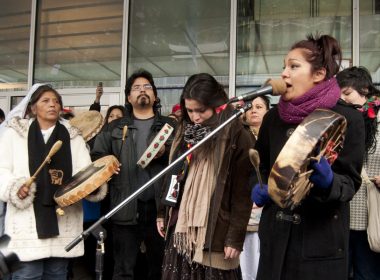
Last September’s Pow Wow. (Josh Walker / McGill Tribune)
a, News

Students discuss Indigenous Studies minor

On Nov. 27, students, faculty, and other members of the McGill community shared their opinions and thoughts on the potential North American Indigenous Studies minor program at McGill during a public forum. The forum was a collaborative effort by the Aboriginal Sustainability Project (ASP), the Indigenous Student Alliance, the Aboriginal Law Students’ Association, McGill’s Indigenous Studies Community (KANATA), and the Students’ Society of McGill University (SSMU).

At the forum, Brett Lamoureux, a researcher for SSMU, announced that his preliminary research into the logistics and classes of a North American Indigenous Studies minor program at McGill would be finalized in December. Lamoureux said that he would post a report of his findings online by January 2013.

Lamoureux has already compiled a comprehensive list of pre-existing courses under several departments that could fit into the minor program. These include courses in anthropology, biology, Canadian studies, education, English, environmental science, history, geography, law, political science, social work, and sociology. His research will be used to create a proposal for the program, which will be submitted to the Faculty of Arts curriculum committee.

Lamoureux is a U3 Education student who identifies as a Métis person—a term for someone of mixed First Nations and Euro-American ancestry.

“As a Métis person, I have been involved with Métis and other First Nations organizations for many years,” Lamoureux said. “All First Nations people, I think, have something to offer. They deal with modernity in a unique way, and it’s important to incorporate that into any academic program.”

The forum shed light on the amount of work left to be done before the university can officially create an Indigenous Studies minor program. Allan Vicaire, coordinator of the ASP, described the next steps involved in keeping the program’s development moving ahead.

“The next step forward is a foundational course,” Vicaire said. “We need to take into account opinions from the Quebec native community and find out how McGill can help them and learn from them.”

Vicaire said the Indigenous Studies foundational courses—introductory courses that will discuss key themes in a program and teach basic research methods—still require more discussion and feedback.

Lamoureux also emphasized the importance of receiving input from the community.

“I think more consultation should be done with the community around here to see what they want,” Lamoureux said. “Their perspective and needs are essential. More consultation has to happen.”

In June 2011 the McGill Institute for the Study of Canada (MISC) agreed to house a North American Indigenous Studies minor program at McGill. This means that the MISC would manage the program and offer services, documentations, and certificates to students who wish to pursue a minor in Indigenous Studies.

MISC currently operates the Canadian Studies courses, as well as the major, minor, honours, and joint-honours programs. MISC Director William Straw has been supportive of the project throughout the preliminary process. At the forum, he detailed some additional challenges still facing the creation of such a program.

“We have to face the realities that the university faces,” Straw said. “We need to find money to hire people to teach, and [we need to] talk to all the departments to make sure they can help make this happen.”

The forum itself consisted of smaller workshops where participants could discuss topics such as who should teach in the minor program and what the specific name of the program should be. During the workshops, students expressed how they were feeling about the progress of the program.

“I think [the] McGill community has the mindset that Indigenous Studies is not worth anything,” Arts Senator Jimmy Gutman said. “The fact that students have to push [for] this is somewhat ridiculous. I think Indigenous people have a lot to offer, and I hope that this program will help change our attitudes towards Indigenous people.”

Sarah Cartier, U1 arts, said she hopes to see a program take shape soon.

“I really enjoyed the conference and am glad the organizers are putting so much effort into getting student feedback,” Cartier said. “I think it’s going to turn out really well, and I look forward to seeing [an Indigenous Studies] minor program [at] McGill soon.”

Council sits for last time in 2012. (Simon Poitrimolt / McGill Tribune)
a, News

Council opposes McGill weapons research

Last Thursday, the Students’ Society of McGill University’s (SSMU) Legislative Council voted against a motion condemning Plan Nord and McGill’s investments in the project, but passed a motion opposing military research funded by McGill. Vice-President External Robin-Reid Fraser also presented her report on the SSMU-run education summits last week.

The motion against Plan Nord “as a form of colonialism,” mandated that SSMU cut all ties to groups that support or profit from the implementation of Plan Nord, and pressure the McGill administration to divest from holdings in companies that profit from the plan.

Plan Nord was initiated in 2011 by the former Liberal government of Quebec to economically develop the northern regions of Quebec; this includes investments in mining, logging, and the construction of dams. Many Indigenous communities have spoken out against this plan, and seek to put an end to its continuation.

“Plan Nord violates the James Bay and Northern Quebec Agreement, impeding Indigenous communities’ lands and right to hunt, harvest, fish, and trap in these regions,” the motion reads. “Plan Nord represents a serious concern in all three issues of human rights, social justice and environmental protection.”

Some councillors felt that the terms in the motion were ambiguous, and that the motion was too complex for Council to support in its current form.

“There are a lot of issues here that we can get into [more deeply],” Law Representative Andrew Baker said. “I think that [this issue] is very complex … which makes it problematic to support.”

Ultimately, the motion did not pass.

SSMU Council then debated, and passed a motion advocating for “a campus free from weapons development.” The motion mandates that SSMU oppose any funding of research on weapons, or other facilitators of military violence.

Discussion of this motion focused on whether the SSMU constitution requires SSMU to condemn the university’s investment in such research, and whether it is appropriate to ask McGill to cut off the research of professors who may have devoted their careers to these areas of study.

Some councillors were supportive of the motion.

“The place of a university in society is not to be developing weapons,” Clubs and Services Representative Zachary Rosentzveig said. “We don’t want our university to be funding extremely brutal explosives …. If you want to develop weapons, you don’t work for universities.”

The motion passed, following a successful amendment by Arts Senator Max Zidel, which proposed that Council set up a review board to look into the different areas of research being done by McGill professors and evaluate ethical standards on a case-by-case basis.

“The current motion ignores the nature of technological and scientific research and innovation,” Zidel said. “Do we know for sure that the surveillance technology that is [going to] drones [will] not be undertaken for more noble causes?”

Towards the end of the meeting, Reid-Fraser discussed the report she wrote, following last week’s consultation sessions, where students and other members of the McGill community voiced their concerns about education. Reid-Fraser will submit this document to the Quebec Student Roundtable (Table de concertation étudiante du Québec, or TaCEQ), which will represent SSMU at February’s provincial summit on higher education.

The report makes several recommendations on the topics of accessibility and participation, financing and governance, the role of university in society, out-of-province and international students, and quality of education. Despite the wide range of topics, the report draws several conclusions about general student attitudes at the SSMU summits.

“McGill students have a desire for more information about how universities work, why decisions are made the way they are, and where exactly their tuition money is going,” the report reads. “Students also expressed a wish to collaborate across faculties on issues in which many or all of them have a stake, and to find ways to apply their learning while they are still in school.”

Arts Councillor Colleen Morawetz, however, expressed concern that the recommendations in Reid-Fraser’s report focused too closely on McGill-specific issues. For example, one recommendation calls on McGill to “increase the number of opportunities for practical application of studies.” and another calls for an improved advising system.

Reid-Fraser emphasized that this version of the report is only a preliminary draft, and that she seeks feedback from students and other members of the McGill community.

“I will be taking recommendations that are more broad to go to the Quebec [summit],” she said. “We can have a more internal discussion about the things that are more specific to McGill.”

a, News

To be or not to be

Every semester, McGill students encounter flyers, emails, and campaign slogans that draw their attention to issues that are the subject of the current referendum period. For some student groups and services, referenda are a valuable opportunity to request an increase in student fees. But referenda can also be a source of anxiety—especially for the five Independent Student Groups (ISGs) McGill requires to run ‘existence referenda.’ A ‘no’ vote means the end to both the group’s fees and their Memorandum of Agreement (MoA) with the university.

However, the McGill administration has only required existence referenda since 2006. In light of the upcoming existence referendum for the Daily Publications’ Society (DPS), the Tribune set out to find out why the administration requires existence referenda, how McGill’s referendum system compares to other Canadian universities, and what those involved think of the process.

History of existence referenda at McGill

Existence referenda are tied to the renewal of a student group’s MoA, the document which governs the group’s relationship with the administration. The MoA covers issues such as insurance, office space, and the collection of student fees.

Unlike most student groups, which receive their fees through the Students’ Society of McGill University (SSMU), ISGs are financially autonomous. The administration therefore collects student fees on behalf of the group, as established in their MoA.

This arrangement affects five ISGs—the DPS, the Tribune Publications Society, Radio CKUT, the Legal Information Clinic (LIC), and the Quebec Public Interest Research Group (QPIRG).

“The logic is that we actually have three parties here—we have the university, we have the student body, and we have an independent group, which exists only if the student body wants it to exist,” Deputy Provost (Student Life and Learning) Morton Mendelson said. “The university is asked to enter into an agreement, take money out of the pockets of students, and hand it to the independent group.”

According to Mendelson, the current system came into practice following several incidences where the administration was asked to mediate issues between students and ISGs. In 1995, for example, SSMU attempted to run a referendum to lobby the administration to cut the DPS’s student fee, after councillors expressed concerns about the ability of students to participate in the DPS. However, the DPS successfully had the results invalidated by the SSMU Judicial Board.

Mendelson said tension also emerged over the structure and management of CKUT, leading some to question the role of the radio station in relation to the student body. According to a document from the Office of the Deputy Provost (Student Life and Learning), McGill’s Board of Governors (BoG) voiced concerns about CKUT’s structure when its MoA was brought to them for approval in 2001, citing the fact that only four of 12 members on the CKUT Board of Directors were McGill students.

“The university reflected that there was no mechanism in place to know whether the activity still had student support for it to continue on campus,” the document reads.

Following these concerns and negotiations, CKUT ran McGill’s first existence referendum in the Winter 2006 semester. Since then, the administration has required all five ISGs that collect student fees to run existence referenda every five years, before the university renews their MoA. According to Mendelson, this time frame was implemented so that students have the opportunity to vote on most organizations’ existence during their time at McGill.

Mendelson said he does not know why the BoG did not propose existence referenda prior to 2006.

“The Board of Governors changes and the notions of accountability change,” he said.

Referenda across Canada

Across Canada, universities’ referendum systems vary. Concordia University, Simon Fraser University (SFU), and Queen’s University each require referenda for student groups to establish fee levies. However, none of these their administrations require groups to run referenda at set intervals. The University of Toronto and the University of British Columbia were not available for comment.

Student groups across Canada have faced referenda on whether students wish to remove their student fees. In 2008, students at the University of Waterloo voted to stop paying a mandatory fee for CKMS radio station. However, this referendum was initiated by the students’ council, and was not the result of a regular system like McGill’s.

Mendelson emphasized the  relative novelity of McGill system’s when comparing it to other universities.

“It’s very possible that other universities may move in this direction,” he said. “Regardless, we feel that our process safeguards the interests of students at McGill.”

At SFU and Concordia, a group must establish a fee levy in a referendum, but groups are not required to run referenda to renew student support. Tim Rahilly, associate vice-president of students at SFU, said existing fees for independent student groups can be cancelled through student-initiated referenda.

“SFU’s system does not provide a mechanism requiring a new mandate from the student body, but does require a concerted effort by a group of students who might want to stop paying to support one of the organizations funded by student levy,” Rahilly told the Tribune.

According to Mendelson, differences between referenda systems at universities probably come from provincial legislation, and different arrangements between administrations and student groups.

“I don’t know whether other universities in Quebec have the kind of arrangements that we have with our independent student groups,” he said. “Our arrangements with student associations pre-date the law for the accreditation of student associations, so we’ve been doing this for many, many years.”

Like McGill, Queen’s University has a referendum system where student groups must renew their student fees. However, this “triennial review” is implemented and conducted by its student government, the Alma Mater Society (AMS).

“The entire referendum process and all of its rules and procedures are governed by the AMS,” AMS President Doug Johnson said. “The university does not have much say in how that works.”

The system at Queen’s also affects far more student groups than  McGill’s. In the 2012 Winter Semester, 22 student groups ran referenda renewing their fees, and three of these failed.

Allison Cooper, SSMU vice-president clubs and services, said she does not think SSMU has ever considered running existence referenda for student clubs. She explained that she does not support the administration’s requirement that ISGs prove that students support them every five years, because referenda require a lot of money and effort on the part of student groups.

“Students [should be able to] bring an existence question to the table if they feel it is necessary, but I think having it as a default … should not be the case,” she said.

According to Cooper, referendum costs include the use of online voting software, staff salaries, and up to $300 in campaigning costs for each ‘yes’ and ‘no’ committee.

Negotiations over graduate students’ votes in referenda

While referenda affect all students, not every student is allowed to vote in McGill existence referenda. Jonathan Mooney, secretary-general of the Post-Graduate Students’ Society (PGSS), has talked with Mendelson about the inability of PGSS members to vote in existence referenda that are run through Elections SSMU, even though the results often affect PGSS student fees too.

“The decision on the part of the university to either continue or cease to collect the fees levied by an independent student group on postgraduate students should not be based on a referendum of exclusively undergraduate students,” he said.

Graduate students pay fees for four ISGs—the DPS, CKUT, QPIRG, and the LIC. Mooney said this issue came to his attention after examining the LIC’s 2009 existence referendum, which was run through Elections SSMU.

Mendelson described this issue as a “shortcoming” in the referendum process, and said he is unsure of how it came about.

“In the past, what had happened, I believe, [was] that the undergraduates were polled and the graduate students were okay with the results,” he said. “So you could imagine that [PGSS would] say ‘well, there are so many undergraduates that have given support, and as a student body we don’t expect that we would have a different result.’ ”

According to Mendelson, resolving the issue would be complicated. For example, someone would have to determine if both PGSS and SSMU would have to pass referenda, or if the result would be determined from their combined votes. He said he is willing to have conversations with PGSS about the issue.

Mendelson added that nothing currently stops ISGs from polling both undergraduate and graduate students. To do so, however, groups have to either run their question independently of SSMU or PGSS—which means the group would bear the costs—or have separate questions run through PGSS and SSMU simultaneously.

Next winter, the DPS will run an independent referendum that will poll both undergraduates and graduates combined. DPS Chair Sheehan Moore said the DPS felt this was the fairest way to run their referendum.

“I’m aware that the administration is willing to accept the results of questions that not all members have been polled for,” Moore said. “For me, this willingness raises some serious questions about their claim that existence referenda are all about democracy and accountability.”

Mooney said he is confident that the current system comes from “a legitimate interest in assuring accountability.” He expressed optimism that the involved groups can work together in the future to improve the system.

“I believe accountability may be ensured in multiple ways via the MoA—for example, requiring that bylaws ensure sufficient student member participation in the group’s governance,” he said. “PGSS could certainly work with SSMU, the incoming Deputy Provost, and the Independent Student Groups to explore alternate mechanisms that consider the concerns of the Independent Student Groups while preserving accountability for students.”

Read the latest issue

Read the latest issue