Latest News

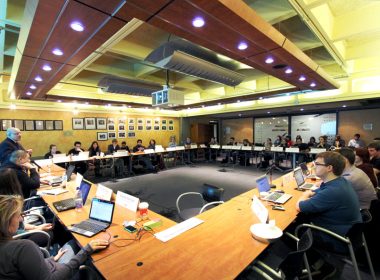
Council sits for last time in 2012. (Simon Poitrimolt / McGill Tribune)
a, News

Council opposes McGill weapons research

Last Thursday, the Students’ Society of McGill University’s (SSMU) Legislative Council voted against a motion condemning Plan Nord and McGill’s investments in the project, but passed a motion opposing military research funded by McGill. Vice-President External Robin-Reid Fraser also presented her report on the SSMU-run education summits last week.

The motion against Plan Nord “as a form of colonialism,” mandated that SSMU cut all ties to groups that support or profit from the implementation of Plan Nord, and pressure the McGill administration to divest from holdings in companies that profit from the plan.

Plan Nord was initiated in 2011 by the former Liberal government of Quebec to economically develop the northern regions of Quebec; this includes investments in mining, logging, and the construction of dams. Many Indigenous communities have spoken out against this plan, and seek to put an end to its continuation.

“Plan Nord violates the James Bay and Northern Quebec Agreement, impeding Indigenous communities’ lands and right to hunt, harvest, fish, and trap in these regions,” the motion reads. “Plan Nord represents a serious concern in all three issues of human rights, social justice and environmental protection.”

Some councillors felt that the terms in the motion were ambiguous, and that the motion was too complex for Council to support in its current form.

“There are a lot of issues here that we can get into [more deeply],” Law Representative Andrew Baker said. “I think that [this issue] is very complex … which makes it problematic to support.”

Ultimately, the motion did not pass.

SSMU Council then debated, and passed a motion advocating for “a campus free from weapons development.” The motion mandates that SSMU oppose any funding of research on weapons, or other facilitators of military violence.

Discussion of this motion focused on whether the SSMU constitution requires SSMU to condemn the university’s investment in such research, and whether it is appropriate to ask McGill to cut off the research of professors who may have devoted their careers to these areas of study.

Some councillors were supportive of the motion.

“The place of a university in society is not to be developing weapons,” Clubs and Services Representative Zachary Rosentzveig said. “We don’t want our university to be funding extremely brutal explosives …. If you want to develop weapons, you don’t work for universities.”

The motion passed, following a successful amendment by Arts Senator Max Zidel, which proposed that Council set up a review board to look into the different areas of research being done by McGill professors and evaluate ethical standards on a case-by-case basis.

“The current motion ignores the nature of technological and scientific research and innovation,” Zidel said. “Do we know for sure that the surveillance technology that is [going to] drones [will] not be undertaken for more noble causes?”

Towards the end of the meeting, Reid-Fraser discussed the report she wrote, following last week’s consultation sessions, where students and other members of the McGill community voiced their concerns about education. Reid-Fraser will submit this document to the Quebec Student Roundtable (Table de concertation étudiante du Québec, or TaCEQ), which will represent SSMU at February’s provincial summit on higher education.

The report makes several recommendations on the topics of accessibility and participation, financing and governance, the role of university in society, out-of-province and international students, and quality of education. Despite the wide range of topics, the report draws several conclusions about general student attitudes at the SSMU summits.

“McGill students have a desire for more information about how universities work, why decisions are made the way they are, and where exactly their tuition money is going,” the report reads. “Students also expressed a wish to collaborate across faculties on issues in which many or all of them have a stake, and to find ways to apply their learning while they are still in school.”

Arts Councillor Colleen Morawetz, however, expressed concern that the recommendations in Reid-Fraser’s report focused too closely on McGill-specific issues. For example, one recommendation calls on McGill to “increase the number of opportunities for practical application of studies.” and another calls for an improved advising system.

Reid-Fraser emphasized that this version of the report is only a preliminary draft, and that she seeks feedback from students and other members of the McGill community.

“I will be taking recommendations that are more broad to go to the Quebec [summit],” she said. “We can have a more internal discussion about the things that are more specific to McGill.”

a, News

To be or not to be

Every semester, McGill students encounter flyers, emails, and campaign slogans that draw their attention to issues that are the subject of the current referendum period. For some student groups and services, referenda are a valuable opportunity to request an increase in student fees. But referenda can also be a source of anxiety—especially for the five Independent Student Groups (ISGs) McGill requires to run ‘existence referenda.’ A ‘no’ vote means the end to both the group’s fees and their Memorandum of Agreement (MoA) with the university.

However, the McGill administration has only required existence referenda since 2006. In light of the upcoming existence referendum for the Daily Publications’ Society (DPS), the Tribune set out to find out why the administration requires existence referenda, how McGill’s referendum system compares to other Canadian universities, and what those involved think of the process.

History of existence referenda at McGill

Existence referenda are tied to the renewal of a student group’s MoA, the document which governs the group’s relationship with the administration. The MoA covers issues such as insurance, office space, and the collection of student fees.

Unlike most student groups, which receive their fees through the Students’ Society of McGill University (SSMU), ISGs are financially autonomous. The administration therefore collects student fees on behalf of the group, as established in their MoA.

This arrangement affects five ISGs—the DPS, the Tribune Publications Society, Radio CKUT, the Legal Information Clinic (LIC), and the Quebec Public Interest Research Group (QPIRG).

“The logic is that we actually have three parties here—we have the university, we have the student body, and we have an independent group, which exists only if the student body wants it to exist,” Deputy Provost (Student Life and Learning) Morton Mendelson said. “The university is asked to enter into an agreement, take money out of the pockets of students, and hand it to the independent group.”

According to Mendelson, the current system came into practice following several incidences where the administration was asked to mediate issues between students and ISGs. In 1995, for example, SSMU attempted to run a referendum to lobby the administration to cut the DPS’s student fee, after councillors expressed concerns about the ability of students to participate in the DPS. However, the DPS successfully had the results invalidated by the SSMU Judicial Board.

Mendelson said tension also emerged over the structure and management of CKUT, leading some to question the role of the radio station in relation to the student body. According to a document from the Office of the Deputy Provost (Student Life and Learning), McGill’s Board of Governors (BoG) voiced concerns about CKUT’s structure when its MoA was brought to them for approval in 2001, citing the fact that only four of 12 members on the CKUT Board of Directors were McGill students.

“The university reflected that there was no mechanism in place to know whether the activity still had student support for it to continue on campus,” the document reads.

Following these concerns and negotiations, CKUT ran McGill’s first existence referendum in the Winter 2006 semester. Since then, the administration has required all five ISGs that collect student fees to run existence referenda every five years, before the university renews their MoA. According to Mendelson, this time frame was implemented so that students have the opportunity to vote on most organizations’ existence during their time at McGill.

Mendelson said he does not know why the BoG did not propose existence referenda prior to 2006.

“The Board of Governors changes and the notions of accountability change,” he said.

Referenda across Canada

Across Canada, universities’ referendum systems vary. Concordia University, Simon Fraser University (SFU), and Queen’s University each require referenda for student groups to establish fee levies. However, none of these their administrations require groups to run referenda at set intervals. The University of Toronto and the University of British Columbia were not available for comment.

Student groups across Canada have faced referenda on whether students wish to remove their student fees. In 2008, students at the University of Waterloo voted to stop paying a mandatory fee for CKMS radio station. However, this referendum was initiated by the students’ council, and was not the result of a regular system like McGill’s.

Mendelson emphasized the  relative novelity of McGill system’s when comparing it to other universities.

“It’s very possible that other universities may move in this direction,” he said. “Regardless, we feel that our process safeguards the interests of students at McGill.”

At SFU and Concordia, a group must establish a fee levy in a referendum, but groups are not required to run referenda to renew student support. Tim Rahilly, associate vice-president of students at SFU, said existing fees for independent student groups can be cancelled through student-initiated referenda.

“SFU’s system does not provide a mechanism requiring a new mandate from the student body, but does require a concerted effort by a group of students who might want to stop paying to support one of the organizations funded by student levy,” Rahilly told the Tribune.

According to Mendelson, differences between referenda systems at universities probably come from provincial legislation, and different arrangements between administrations and student groups.

“I don’t know whether other universities in Quebec have the kind of arrangements that we have with our independent student groups,” he said. “Our arrangements with student associations pre-date the law for the accreditation of student associations, so we’ve been doing this for many, many years.”

Like McGill, Queen’s University has a referendum system where student groups must renew their student fees. However, this “triennial review” is implemented and conducted by its student government, the Alma Mater Society (AMS).

“The entire referendum process and all of its rules and procedures are governed by the AMS,” AMS President Doug Johnson said. “The university does not have much say in how that works.”

The system at Queen’s also affects far more student groups than  McGill’s. In the 2012 Winter Semester, 22 student groups ran referenda renewing their fees, and three of these failed.

Allison Cooper, SSMU vice-president clubs and services, said she does not think SSMU has ever considered running existence referenda for student clubs. She explained that she does not support the administration’s requirement that ISGs prove that students support them every five years, because referenda require a lot of money and effort on the part of student groups.

“Students [should be able to] bring an existence question to the table if they feel it is necessary, but I think having it as a default … should not be the case,” she said.

According to Cooper, referendum costs include the use of online voting software, staff salaries, and up to $300 in campaigning costs for each ‘yes’ and ‘no’ committee.

Negotiations over graduate students’ votes in referenda

While referenda affect all students, not every student is allowed to vote in McGill existence referenda. Jonathan Mooney, secretary-general of the Post-Graduate Students’ Society (PGSS), has talked with Mendelson about the inability of PGSS members to vote in existence referenda that are run through Elections SSMU, even though the results often affect PGSS student fees too.

“The decision on the part of the university to either continue or cease to collect the fees levied by an independent student group on postgraduate students should not be based on a referendum of exclusively undergraduate students,” he said.

Graduate students pay fees for four ISGs—the DPS, CKUT, QPIRG, and the LIC. Mooney said this issue came to his attention after examining the LIC’s 2009 existence referendum, which was run through Elections SSMU.

Mendelson described this issue as a “shortcoming” in the referendum process, and said he is unsure of how it came about.

“In the past, what had happened, I believe, [was] that the undergraduates were polled and the graduate students were okay with the results,” he said. “So you could imagine that [PGSS would] say ‘well, there are so many undergraduates that have given support, and as a student body we don’t expect that we would have a different result.’ ”

According to Mendelson, resolving the issue would be complicated. For example, someone would have to determine if both PGSS and SSMU would have to pass referenda, or if the result would be determined from their combined votes. He said he is willing to have conversations with PGSS about the issue.

Mendelson added that nothing currently stops ISGs from polling both undergraduate and graduate students. To do so, however, groups have to either run their question independently of SSMU or PGSS—which means the group would bear the costs—or have separate questions run through PGSS and SSMU simultaneously.

Next winter, the DPS will run an independent referendum that will poll both undergraduates and graduates combined. DPS Chair Sheehan Moore said the DPS felt this was the fairest way to run their referendum.

“I’m aware that the administration is willing to accept the results of questions that not all members have been polled for,” Moore said. “For me, this willingness raises some serious questions about their claim that existence referenda are all about democracy and accountability.”

Mooney said he is confident that the current system comes from “a legitimate interest in assuring accountability.” He expressed optimism that the involved groups can work together in the future to improve the system.

“I believe accountability may be ensured in multiple ways via the MoA—for example, requiring that bylaws ensure sufficient student member participation in the group’s governance,” he said. “PGSS could certainly work with SSMU, the incoming Deputy Provost, and the Independent Student Groups to explore alternate mechanisms that consider the concerns of the Independent Student Groups while preserving accountability for students.”

Students march through the streets of Montreal against tuition increases. (Luke Orlando / McGill Tribune)
a, News

The march of history: students on the move

2012 was a tumultuous year for Quebec students. Over the course of the year, hundreds of thousands mobilized in opposition to the former Liberal government’s proposed tuition increases of $1,625 over five years. Following an election almost four months ago, the newly-elected Parti Québécois (PQ) government announced a tuition freeze. As the province prepares for the education summits, planned by the PQ for February, the Tribune looks back on the student movement and its impacts.

Themes of the student movement

The student movement first made headlines following a national protest on Nov. 10, 2011 that brought over 30,000 people to the streets. In February, student associations from Cégeps and universities across Quebec voted to go on an ‘unlimited student strike’—renewable through weekly votes in general assemblies—in which students did not attend classes to protest fee increases. A national protest on March 22 drew an estimated 200,000 people to march through the streets of Montreal. According to Radio-Canada, by March 22, over 300,000 students were estimated to have been on strike. In the ensuing weeks, students organized nearly daily demonstrations, which often resulted in violent clashes between demonstrators and riot police.

At a panel reflecting on the student movement, organized by the Commission des Affaires Francophones (CAF) on Nov. 23, McGill Assistant Professor of Sociology Marcos Ancelovici noted that the student movement emerged out of the context of other recent social movements around the world—from Occupy to calls for democracy in the Arab Spring.

“Something we can see in particular is that, generally, these movements—in Quebec, Chile, Spain, Greece, and even in Egypt and Tunisia—are movements by the middle class,” Ancelovici said in French. “They are not workers’ movements. They are middle class movements, which mobilize a wide range of people with the common point being the debt of the middle class, and the downgrading of the economic situation.”

(Luke Orlando / McGill Tribune)

In May, as a result of the ongoing violent encounters between riot police and demonstrators, the National Assembly of Quebec passed an emergency law, Bill 78, which restricted protests near university grounds, and required organizers of protests comprising of more than 50 people to submit a proposal of their route to the Montreal police. Bill 78 was broadly criticized and triggered widespread nightly protests, during which citizens banged pots and pans to show their disapproval.

“The movement was very fluid, and we saw with the passage of Bill 78 and the Casseroles [pots and pans] movement that it went from being a student movement, to a citizen movement,” Angelovici said. “The morphology of the mobilization changed. There was much dynamism. Notably, a lot of people who are not associated with a student federation, and were part of smaller collectives, or were not affiliated, still organized to participate in the protests. They were part of the movement.”

A decentralized movement

Notably, the student movement was not led by a single organization, but rather by a coalition of different student associations.

“The student movement is interesting because it is not monolithic, but rather, it’s composed [of] the Federation Étudiante Universitaire du Québec (FEUQ), the Féderation Étudiante Collegiale du Québec (FECQ), and the Coalition Large de l’Association pour un Solidarité Syndicale Étudiante (CLASSE),” Angelovici said. “These are different organizations with different ideologies, different preferences in terms of techniques, and different political support.”

Martine Desjardins, president of the FEUQ, noted that a decentralized movement posed challenges, particularly at the negotiation table with the provincial government.

“It was a challenge every day to keep up this united front, because of course, there’s a lot of ideology when you’re talking with student associations, and we don’t [all] have the same ideology,” Desjardins said. “When you’re fighting for something, you need to have a common objective, and this is probably the most difficult part.”

Assessing the student movement

According to the leaders of the main student associations, the movement was a success.

(Luke Orlando / McGill Tribune)

“The aim of the strike was achieved,” said Jérémie Bédard-Wien, spokesperson for the Association pour un Solidarité Syndicale (ASSÉ).  “We managed to bring down tuition hikes, we managed to bring down Bill 78, we forced an election, and we forced a minister to resign—all because of the historic mobilization of hundreds of thousands. For the first time for our generation, we realized that we had political power, and we applied it during this movement.”

However, Desjardins said that student federations must continue to lobby the government.

“We made many gains last year, but we still are looking at other things,” she said. “We’re still working to represent [international students] because we want … [to make sure] that they won’t be paying for the tuition fee hikes cancellation. We’re also looking into the governance and the financing of universities”

At the CAF event, Germain Belzile, research director at the Montreal Economic Institute, noted that the paralysis of the downtown area was an important effect of the movement. According to Belzile, the Université de Québec à Montréal spent over 20 million dollars in security measures and the city spent over 20 million dollars on police fees.

“We haven’t included private costs, like that of restaurant owners who have lost money, or maids who lost their job because downtown hotels were empty,” he said in French. “I’m under the impression that we’re approaching 100 million dollars in costs.”

McGill and the student movement

Despite the widespread student mobilization in the province, the majority of McGill students were not involved in the student movement. Although McGill’s Arts Undergraduate Society (AUS) held a vote to strike last March, students voted against the motion. However, some of the smaller student associations at McGill voted in favour of an unlimited strike, such as the faculty of social work and departmental associations such as the English and philosophy associations.

(Luke Orlando / McGill Tribune)

“It’s difficult to say why McGill students were [less involved], although some possible reasons include the socioeconomic origin of most students [and] the geographic origin, as there are many foreign students,” Angelovici said in French. “Many professors at McGill, even in sociology, political science, and history, declared themselves in favour of the increase. The administration was quite repressive when it came to the student mobilizations, most of which were related to McGill issues, but this limited the space for students to organize.”

Mary Anne Poutanen, a Quebec history professor at both McGill and Concordia, commented on how the university administrations approached the movement.

“[At Concordia] we got messages from the administration that showed empathy [and] understanding for those who were not going to class,” she said. “[At McGill], there was certainly no solidarity from administrators. Concordia changed the date…and waved the fee for late submissions. That’s a very different approach.”

Éliane Laberge, president of the FECQ, suggested that anglophone and francophone students’ differing perceptions of the strike may explain the disinterest of the majority of McGill students.

“For the movement to be effective, it’s important that the cause touch one personally,” she said in French. “For students in francophone universities, the cause is more personal—it directly affects what they are living through.”

The Students’ Society of McGill University (SSMU), first passed a mandate to promote accessible education in a GA in 2007, and renewed the mandate last Fall. SSMU provided information and promoted participation in the marches.

“SSMU’s efforts did an important job of providing information to students from outside of Quebec who didn’t know much about student strikes, and also were a source of information in English,” SSMU VP External Robin Reid-Fraser said.

The election of the PQ and the student movement

For Laberge, the election of the PQ minority government was a positive step in achieving the movement’s aims to keep education accessible.

“The fact that the PQ has been so fast in its decisions to cancel the tuition hike and organize the summit is because of our presence last spring,” Laberge said.

Bédard-Wien expressed more uncertainty regarding the PQ’s interest in pursuing policies in the future that promote accessible education.

“Currently, the PQ seems to be a little afraid of us,” he said. “It wants to solve this question as soon as possible, and is organizing an education summit. … And I’d say, quite frankly, ASSÉ is quite skeptical of this process, and will not hesitate to resort to more effective tactics in order to make its points and make its demands translate into policy.”

Laberge noted that the education summit is an exciting opportunity for students to play a role in policy-making.

“The fact that the PQ members are more open to discussion, and that they are organizing this summit, has changed the way that we are going to continue … working towards better accessibility of studies [and a] better education system,” Laberge said. “For [once], we’re not going to be against something; we are going to be a part of the construction of something.”

Effects on Quebec society at large

Laberge said she was impressed by how the movement grew to involve people outside the scope of student federations.

“People started to organize themselves to protest, not only in Montreal, but in other cities,” she said. “Of course it’s good to have a national platform which is more concrete [and] led by a big organization, but it’s a really good thing… to know that people can change something by themselves and [by] working with people around them. They don’t need a leader for that.”

Belzile noted that the student movement may have long-term repercussions on Quebec’s economy.

“The government has to make decisions [about funding], but the door is closed on the issue of raising tuition fees as a result of the societal pressure,” he said in French. “What we’ll have to do now is probably increase taxes, with the consequence that people will leave Quebec.”

Bédard-Wien pointed to how the student strike politically engaged Quebec youth.

“The strike had the effect of radicalizing and politicizing an entire generation of students, and providing a space for the population to organize politically outside of the tired structures of parliamentary democracy,” he said. “These are incredibly important victories, whose effects we will see in the coming few months and years.”

a, Arts & Entertainment

Acts to Watch

Need playlist suggestions for finals? Looking to expand your musical palette for the coming year? Hoping to impress the resident hipsters in your classes with your musical foresight? We’ve got you covered with a roundup of acts that should make a big splash in the year ahead.

Half Moon Run

A Montreal collective which includes a former McGill student, Half Moon Run has already managed to leave a mark. A single full-length album, Dark Eyes, was enough to sign them up for a tour with the likes of Patrick Watson and Metric. With well-crafted lyrics, chilling harmonies, and flawless song structure, their passion for songwriting is clear—and listeners can’t wait to see what else they come up with. Half Moon Run is performing this Friday, Dec. 7 at The National.

Undecided? Listen to “Call Me in the Afternoon,” and their big single, “Full Circle.”

Flume

Since remixing New Navy’s “Zimbabwe” last year, Flume has been making serious musical waves down under. The young Sydney native’s smooth beats, subdued percussion, and soulful samples have garnered acclaim from blogosphere (his mixes have been increasingly trending on  Hype Machine, a blog aggregation website) and print publications alike. Fresh off two sold-out tours and this year’s festival circuit—music festivals play an even larger role in Australian culture than they do in North America—Flume is only getting hotter.

Tracks to watch include Onra’s “The Anthem (Flume remix),” Hermitude’s “HyperParadise (Flume remix),” and Flume’s own, “Holdin’ On.”

Le Matos

Quebec natives Le Matos recently performed at M for Montreal with Danger, and blew his set out of the water. The trio’s music is infused with the coarse synth characteristic of Ed Banger Records (Justice, Busy P), bad-boy Kavinsky’s early work (circa “Testarossa Overdrive”). Unlike Kavinsky, Le Matos manages to keep the heavy synth fresh from track to track, and consistently deliver stripped down Justice-esque beats (think of a minimalist version of † rather than Audio, Video, Disco.

Standout tracks include “88mph,” “Sarah,” and “Quiet Earth.”

Angel Haze

Recent years have seen a reemergence of female rappers. Nicki Minaj, Iggy Azalea, and Azealia Banks have received the baton from Missy Elliot & Co., injected a dose of feminine swagger into mainstream hip-hop. Think of Angel Haze as a rougher, leaner, and grimmer version of Banks. While Haze cracks the occasional joke, her flow is more desperate; her clever wordplay is tinged with a sense of urgency that in Banks’ lyrics, is replaced by levity and cheek. If her recent mixtape Classick is anything to go by, 2013 will be Haze’s year.

For a taste of her lyrical flair, listen to Haze’s version of “Gossip Folks,” or her visceral cover of Eminem’s “Cleanin’ Out My Closet.”

Wild Child

Texas natives Wild Child released their brilliant indie-folk concoction, Pillow Talk, at the end of 2011, to surprisingly little fanfare. The seven-piece band’s debut showcased an unusual musical maturity and their genial sense of humour—think Edward Sharpe with a macabre streak. In 2013, Wild Child hope to record a new album called The Runaround, under the auspices of Ben Kweller, the latest subject of the “Bob-Dylan-of-our-time” campaign. They’re currently raising recording funds via Kickstarter.

Before you contribute, check out “Pillow Talk,” “Someone Else,” and “Day Dreamer.”

MT

Michael Tomlinson, a twenty-something Australian living in London, has an impressive musical background. Tomlinson is the former lead singer of Yves Klein Blue, an indie-rock group which drew worldwide attention with their gritty “Silence is Distance” and “Polka.” While YKB disbanded in 2010, Tomlinson continued his musical career with his new project, MT. With a new 7” vinyl single out (“Paranoid People”), MT is quickly gathering momentum. Expect big things for MT in the coming months; meanwhile, check out Tomlinson’s songwriting on “Alpha Romeo.”

Lianne La Havas

Lianne La Havas first played in North America this time last year as the opening act for the Grammy-award winning Bon Iver. If that’s not an impressive way to make an entrance, her rare soulfulness, and heart-shattering lyrics give you no other choice but to fall head-over-heels in love with her. Musically situated somewhere between Billie Holiday and Adele, her talents won’t go unnoticed much longer. Nominated for Zane Lowe’s 100 Hottest Record of 2012, “Band to Watch” by Rolling Stone, and having done every American late night talk show from Conan O’Brien to Craig Ferguson, this can only be the beginning. Lianne La Havas’ album, Is Your Love Big Enough is in stores now.

Standouts include “No Room For Doubt,” and “Forget.”

a, Arts & Entertainment

Setting the stage for the future: English theatre in a French city

QS World University Rankings recently named Montreal one of the best student cities in the world, but you didn’t need a pollster to tell you that. Cheap food, cheap rent, and enough culture to last a lifetime—for many, these are the principal attractions of the bohemian, dynamic metropolis.

At the same time, students at anglophone universities like McGill are keenly aware of the undercurrent of language politics constantly at play within Quebec. National identity is intimately tied to the French language, which finds expression in culture and art. Situated in this context are the English theatre companies of Montreal: they are presented with unique challenges, but also exciting opportunities, by the interplay of a rich national history and a promising cosmopolitan future.

According to Jane Needles, Executive Director of the Quebec Drama Federation (QDF), a non-profit umbrella organization for English theatre in Quebec, the history of English theatre in the province stretches all the way back to the 1600s, when sailors performed on ships docked in Quebec City. From then on, theatre remained a significant part of life in the province; although until the 1940s, it remained a recreational rather than professional activity. Since then, English theatre in particular has seen its highs (during Expo 67) and lows (following the anglophone exodus after Bill 101 in 1977).

Language barriers pose challenges. (Tessa Bryant / McGill Tribune)

A challenging path

Though English theatre in Montreal has seen a resurgence within the last decade, significant challenges remain. One key issue is funding. While theatre is situated in a broader discussion of public funding for the arts in Canada, it is a common concern within the English theatre community that anglophone theatres receive less funding than their French colleagues.

Paul Flicker, artistic director for the Segal Centre, notes that government support “accounts for somewhere around six per cent of our operating funding, which is significantly less than most other theatres … in Canada or Quebec.”

Infinithéâtre, an English theatre company in the Mile-End, receives “less than half of what a francophone company would get,” according to its artistic director Guy Spring.

“The anglophones face the funding challenge, because the francophone companies are funded on a much greater basis than the anglophones are,” says Needles. “This is not a complaint, it’s just a mere fact.” She quickly notes, however, that even this limited support is still important. That English theatre is funded at all indicates to Needles that underfunding reflects the government’s instinct to “protect the francophone culture.”

Challenges are not only incumbent on theatre companies, but aspiring actors as well. Dane Stewart, U3 arts, is actively involved with theatre both at McGill, and within the wider community. He hopes to pursue a professional career in theatre—but likely not in Montreal.

“I couldn’t think of a better city to have spent my undergrad in, because I’ve been able to be involved in so many groups,” says Stewart. “But if I want to actually start getting paid for it, especially if I’m not bilingual … it’s not that sensible to stay in Montreal.”

“A lot of the people who have been involved in the shows that I’ve done outside of McGill … feel the same way about getting out of the city … especially the anglophones,” he continues. “The francophones … they find a bit more work.”

Forming the “cultural tapestry” of Quebec

In speaking with diverse groups within the community, an apparent conflict soon arises. Though most are buoyed by the proliferation of new, independent English companies in recent years, some artistic directors and actors express concern that the large number of companies does not reflect the relatively small size of the market.

“There are just so many groups that are cropping up in the English scene,” notes Stewart. “The support in the community is divided so much between all of these shows. Nobody could see all the shows by all the companies … therefore no company can get a strong enough foundation and support, to lift itself up and become financially stable enough to pay their actors—or at least it’s very difficult to.” He adds that “this is more my opinion than fact.”

Similarly contentious is the role that English theatres play in general society. Erin Hurley, associate professor in McGill’s department of English, emphasizes the significance of francophone theatre in Quebec culture.

“Since the ’60s, English-language theatre has not attained, nor particularly sought, the status of being a kind of identity-holder, or identity-marker, for Quebec,” she says, noting the difference between anglophone and francophone theatres. With the latter, “there is also a real emphasis on local—which is to say national, Quebecois—dramaturgy and playwriting.”

Needles views English theatre as one part of Montreal’s “cultural tapestry,” which is characterized by the city’s “multicultural disciplines.”

“There [are] so many languages spoken; French and English just happen to be the official languages,” she notes.

Some in the English theatre community have criticized francophone theatres for their lack of diversity.

“You’d be hard-pressed to find anybody of colour that’s in any theatre in French at the moment,” Sprung says. “It’s unbelievable how retrograde most of  the theatres in French in this city are, or how blind they are to the world … in terms of integration on stage…. Most francophone theatres are fairly right-wing and reactionary.”

A growing bilingual collaboration

[pullquote]There is increasing experimentation with bilingual productions…. I think theatre companies are wise to capitalize on that potential.[/pullquote]

The strengths and weaknesses of English and French theatre in the city also present an opportunity for both in the future: mutual recognition, and mutual learning.

“There is increasing experimentation with bilingual productions, of one kind or another,” says Hurley. “You can presume that most [anglophones] understand some French, and most francophones understand some English. That’s just historic contact, plus education policy and language policy. I think theatre companies are wise to capitalize on that potential, and it might be a way of bringing in more francophone audiences to what is putatively English-language theatre.”

Flicker describes the relationship between anglophone and francophone theatres “as a huge opportunity.”

At the Segal, “every second year, we’ve done these co-productions with French theatres,” says Flicker. “A show will run in French in their theatre, it runs in English in our theatre, with the same director and same cast and design team. So they get exposed to the English-language tradition, and we get exposed to theirs; and those are usually amazing experiences.”

Sprung, whose Infinithéâtre’s mandate embraces the way in which being a linguistic minority “helps shape our identity and fuels our creative work,” similarly cherishes opportunities to experiment with bilingual productions.

“We did an adaptation [where] we took … the English version and the French version, we had a cast of two anglophones and two francophones, and we basically overlapped the two versions,” says Sprung. “The idea is that we reflect the life around us.”

Needles notes that this trend towards increasing collaboration between English and French theatres was “not common” a decade ago.

“You have, right now, Good People playing at Centaur, and its French counterpart is playing at the same time. That rarely happens. But that’s an indication of the value of what both cultures found with each other,” she says.

This strategy may be paying off.

“This year our subscription is up five per cent,” says Flicker. “I think we put together a season that people really want to see. The subscribers are the most important group we have.”

“You see it by the number of productions that are playing throughout the year, with the increase in those productions being very marked,” says Needles. “So [English theatre] is definitely thriving and becoming more recognized.”

For aspiring actors, then, the solution may be similar.

“If you’re going to stay here in Quebec, learn the history, learn the culture, learn the language,” says Needles. “Understand the rationale and appreciate what the French culture has done for culture in general.”

“There is that major joie de vivre in francophone culture, it’s the only way I can explain it,” she adds. “And if you are going to be a student, and you want to stay here, then understand what that means, and be part of it.”

a, Arts & Entertainment

Film Wrap-Up

Looking back on this year in film, the Tribune’s Arts & Entertainment editors weigh in on the hits, misses, and the movies that slipped through the cracks.

The Good

Looper

Telekinesis, time travel, mafia men—your average director would have combined these elements into something resembling a B-movie from the ’80s. In the hands of Rian Johnson (Brick), the result is the strongest sci-fi script since 2004’s Primer. Starring Joseph Gordon-Levitt, Bruce Willis, and Emily Blunt, Looper has already grossed five times its budget, and received some of the best reviews of the year.

Moonrise Kingdom

Many contemporary films strive for ‘entertainment’; rarely does one achieve true aesthetic play. Deeply influenced by the French New Wave, Wes Anderson is one director who consistently delivers bubbling, joyous euphoria to the screen. Moonrise Kingdom brims with Anderson’s distinct and delightful vision. The all-star cast includes Bruce Willis, Bill Murray, and Tilda Swinton—though it is Edward Norton who truly steals the scene. Young love has never looked as sweet as it does under Anderson’s lens.

The Master

Paul Thomas Andersen’s latest tour-de-force is a sure Oscar bet. Joaquim Phoenix delivers an emotional deluge as the damaged veteran Freddie Quell, countered only by the wall of cerebral ice embodied in Lancaster Dodd (Philip Seymour Hoffman). The script is intricate, without verging on excessive complexity; intelligent, without pretentiousness. The film is a sumptuous visual feast, with beautifully balanced scenes subtly-shot in 65mm film. Head to Bank Scotia Cinema on Tuesday—you’ll be seeing this one twice.

21 Jump Street

Another year, another bromance comedy starring Jonah Hill. In this remake of the ’80s TV series, Hill and Channing Tatum play undercover police officers who infiltrate a high school drug ring. The premise is as ridiculous as it sounds, and cheesy instances abound; nevertheless, few comedies play to the genre’s strengths so well. Genuinely clever dialogue and strong performances make 21 Jump Street one the best blockbuster comedies of the year.

The Bad

The Avengers

This evaluation is sure to turn some heads, and the available space is not enough for a full justification. But hear me out. Why assemble an A-list cast if you’re only going to create one-liners rather than characters? Why squander the vast vault of comic-book lore available with a formulaic and uninspired plot line? Why fumble your bottomless budget and the promise of a big-bad-climactic battle on something so joylessly predictable, and shot with the skill of Michael Bay? The only ones who ought to feel vengeful are the movie-goers.

John Carter

Does anyone still remember this disastrous sci-fi film? Disney, perhaps, given the smoking crater it left in their earnings. Why civilizations with technology like walking cities resort to swordplay to wage war still eludes understanding; Mars may have life, but it lacks logic. Andrew Stutton (WALL-E; Finding Nemo) ought to have been able to strike a tone of whimsical nostalgia; what resulted instead is laughably old-fashioned in its best moments, and cringe-worthy at its worst.

Total Recall

Children of the ’80s will remember their youth, peppered with Schwarzenegger’s forays into film. One of his better efforts was Total Recall, an original spin on the sci-fi action genre. In the 2012 version, Colin Farrell assumes the role of a secret agent embroiled in a nefarious government plot. Unfortunately, the script is as dull as Farrell’s acting—better off forgetting this lukewarm remake.

The Hunger Games

The Hunger Games, the story of a post-apocalyptic world where society watches children battle in a duel to the death, was based on the hit book series (adding a sibilant to the term “hit” may be a more accurate descriptor). Pros: the script ensures that the inept actors are swiftly put out of their misery. Cons: the film reminds one of the cult-classic Battle Royale—without delivering any of the enjoyment.

The Underrated

Bullhead

Maybe a nominee for last year’s Best Foreign Film Oscar isn’t exactly ‘underrated.’ Nevertheless, Bullhead is an absolute, visceral punch-in-the-gut, much of it owed to Matthias Schoenaerts’ breathtaking turn as the muscle-bound and broken-down Jacky Vanmarsenille. I was fortunate enough to catch this tale of the illegal Belgian beef hormone underworld during its brief Montreal run, but if you didn’t, it’s definitely worth hunting down.

Chronicle

If there are two trends in contemporary cinema that scream to be put out of its misery, it’s one: ‘found footage’—Paranormal Activity; Project X; and two: the superhero genre—see The Avengers. This makes it all the more surprising that a film incorporating elements of both could be so remarkably inventive. Particularly striking is the cinematography, which gets incredible mileage out of the protagonist’s ability to levitate the camcorder. For Chronicle, low-key and low-budget means high quality.

Headhunters

Equal parts self-deprecating humour, tortuous plot twist, and masterful action sequence, Headhunters came out in Norway in 2011. Translated from the original Norwegian and released to North American audiences in 2012, the film is a rare example of the heights that directorial self-awareness, when coupled with clever writing, can reach. A strong, understated performance by Aksel Hennie makes Headhunters one of the year’s best.

Girl model

In this chilling documentary, David Redmon and Ashley Sabin go behind the picture-perfect façade presented by the modeling industry. Loneliness, crushing psychological issues, and an abattoir-like conveyor belt of naïve eastern-European girls are casually thrust before the viewer. Adroitly interviewed, models and bookers alike reveal the skeletons in the fashion world’s closet; Girl Model is painful, confronting, and wholly edifying.


An eclectic assortment of toys and props fill the halls of the McCord. (Courtesy of McCord Museum)
a, Arts & Entertainment

For McCord, holiday happiness is child’s play

Toys! Voyages! Bright colours! Elephants!

You know it’s going to be an interesting exhibition when all of these appear on the promo poster, and even more so when you are see a walking blue miniature hippopotamus upon arrival.

Toys 3: the Voyage is the McCord Museum’s new exhibition, artifact gallery, and interactive wonderworld of play. The exhibition is the third in the museum’s series, which for the last two Holiday seasons has provided Montreal with a family-oriented step back in time. Toys 3 features nearly 200 toys and games from the McCord archives: a select and fascinating collection with production dates spanning nearly two centuries. Many of these, says Susanne Sauvage, McCord Museum’s President and Chief Executive Officer, are being shown now for the first time.

“All will be presented in settings that juxtapose the past and present, which will help children improve their observation skills within a museum environment,” Sauvage says.

The basic layout of the exhibition is a journey to ‘Abracadabra’—the fabulous land of toys. In room one, venturers-to-be can choose which essential objects they will take with them. Will it be a Komic Kamera from the 1930s? Or perhaps a 1950s Little Queen Mechanical Sweeper—produced “for the child who wants to ‘help’ Mother”? (Thankfully, and to their credit, the curators make no attempt to sway the boys in one direction and girls into another—such objects remain, instead, the cultural curiosities they deserve to be).

The next stop is to choose a mode of transport. Choices range from a 1910 wooden horse—with real horse hair—to a scale model kayak built by an Inuit artist in the 1940s, to a bright yellow 1960s ‘Earth Mover’ pedal car. With transport decided upon, adventurers can progress through the following rooms, which feature a zany animal-filled jungle (complete with clearing and campfire for those whose excitement is so much they need a break), a rollicking toy-hosted party in the park, and a ceiling lined with plastic umbrellas in such an array of pastel colours, that they form a glistening translucent rainbow in the sky.

Old toys get a second chance at life. (Courtesy of McCord Museum)

The exhibition is intended to introduce children to observing and interacting in a museum, and hopes to engage them to become museum-goers, well into the future. To this end, The Voyage is the most interactive of the Toys exhibits to date. The exhibition space incorporates an area for story-tellings, which are held on Saturdays and Sundays throughout, as well as on special days in the Christmas period; and from December 26 to January 6, classic animated films will be screened in both languages during the day. Permanent interactive installments include a velcro wall, on which you can make your own designs from a series of textured and patterned geometric shapes; games such as dominoes; snakes and ladders; and a mirror wall which ingeniously avoids the traditional complications of museum dress-up features by allowing participants to become a princess, an octopus, an elephant—just by aligning themselves with the right part of the mirror. The exhibit also avoids telling participants that they can’t play dress-up because they’re “too big” (at last, a museum that isn’t ageist).

But never fear, ye high-minded and intellectually mature pupils of higher education—Toys is not an exhibition just for kids. There’s much to be had out of this exhibit both for those within and outside the ‘intended’ age range (three to nine years). As well as a fabulously tempting array of fun, exciting-looking objects, Toys is a historical exhibit with a significance and interest-factor equal to any other. After all—as the exhibition is quick to point out—what could be more universal than play? And what better means to gain a social and cultural insight into our past, than a direct and visual comparative perspective ,such as that which this exhibition provides?

Toys also offers a cross-cultural comparison. The exhibition (entirely bilingual) hosts a range of play items from both sides of the Atlantic. In one cabinet, a 1934 Shirley Temple doll holds court alongside a spectacularly elaborate Madame de Pompadour from 1950. Further along, G.I. Joe and Napoleon Bonaparte battle it out in a game of dominoes, as My Little Pony looks on. What’s more, you can emulate them yourself, with the novelty-sized and child-safe foam domino pieces interspersed throughout the room! In that way, once again the exhibit drifts from the ‘educational’ and back to ‘fun’—pretty unavoidable, considering the show’s theme. Get along to McCord sometime in the next few months, for a fascinating exhibition and a guaranteed smile.

Toys 3: the Voyage runs at the McCord Museum until April 28, 2012.  Student admission $8; free Wednesday nights after 5 p.m. and the first Saturday of each month.

a, Arts & Entertainment

A&E’s Top Five

Chris’ Top Five Albums of 2012 

5. Grimes—Visions

4. Slow Magic—Triangle

3. TOPS—Tender Opposites

2. Beta Frontiers—…EP

1. Purity Ring—Shrines

Ilia’s Top Five Songs of 2012

5. Lil Wayne—A Milli (BUSTED By HeRobust). Young Georgia-based beatmaker HeRobust puts a heavy spin on Wayne’s classic.

4. Styles Of Beyond—Damn (Feat. Michael Bublé). A perfectly cool blend of Bublé’s smooth vocals and Styles of Beyond’s laid-back raps.

3. King Charles—Ivory Road. London multi-instrumentalist King Charles has released one of the year’s  catchiest folk-pop track.

2. Dunson—Count On It. This Baltimore rapper’s single is the perfect blend of lyrical skill and solid beats.

1. Macklemore—Starting Over. Brimming with emotional intensity, this song is a brutally honest show of narrative coupled with lyrical skill.

a, Science & Technology

Ideas spark at interface of physics, biology

Humming away in the Rutherford Physics building, a long cold walk from Stewart Bio, is a computer that can predict one of the fundamental processes in biology: how vertebrae form.

Paul François, associate professor in the department of physics, and associate member of the department of biology, is one researcher applying physics to biology problems.

“There is a current boom in this field, at the interface between physics and biology. One of the reasons is that, there are more and more data available, so you get closer and closer to being able to describe biology as a dynamical system and apply the physics method to biological mechanisms … even evolution,” François said.

Advances like glowing protein tags and real time imaging have led to a better understanding of cell dynamics. According to François, this is where the physics comes in.

“In physics, we are used to dynamical process …. I know if I push a ball, it’s going to roll in some way I can predict. So the question now is … can you do the same thing [with evolution], can you write a theory that will predict evolution in some way?”

A large part of François’ research is creating numerical models in hopes of finding equations that can be used to predict evolution or cellular biological processes.

“You can consider [cells] as dynamical systems that rely on computation. Like computers, they integrate a lot of external clues; and from those external clues they make decisions,” he said.

In cells, these external clues come in the form of signals from other cells or the environment. Based on these signals, decisions are made regarding whether or not to replicate, and which proteins to make. Therefore, using computers to model cell decisions is a logical step.

Recently, François used numerical models to look at the process of developing vertebrae. This is an important topic for biologists because of its medical implications; problems during vertebrate development can lead to scoliosis or trunk dwarfism.

François started with a simple question: what kind of cell processes create vertebrae? In response, he used his computer to evolve a gene network that was able to form vertebrae.

“It turned out that the network that was formed really corresponded to something we actually see in biology; and what is really striking is that, it evolves basically a genetic ‘clock,’ a genetic oscillation.”

In the genetic oscillation, waves of signals travel through the developing cells, coordinating vertebrae formation.

To test his model, François collaborated with Professor Sharon L. Amacher from Ohio State University, a biologist studying embryonic development with time lapse imaging. Amacher tested the model using genetically modified zebrafish, and found that there was an oscillating pattern during cell development.

From purely numerical models, François was able to produce the general process of vertebrae formation.

“In some way, we recapitulated what happened in evolution,” he said.

Although interdisciplinary collaborations can yield ground-breaking results, it is sometimes a challenge to communicate.

Waves of gene expressions in wild and mutated zebrafish embryos from François’ recent paper. (www.sciencedirect.com)

“Very often, you don’t speak the same language,” François said.

Different training and different research interests are common barriers. François has dealt with these issues by studying biology extensively, and working with biological researchers.

“By doing this you create an interaction, find a common language, and then you can do more sophisticated things.”

At McGill, one avenue for interaction is the Quantitative Biology Initiative: a multi-disciplinary research group that brings together faculty from McGill Physics, Biology, Chemistry, and Computer Science, as well as Université de Montréal researchers.

There is also a growing trend of applying physics to solve problems in other dynamic systems like economics, or even politics.

“I think this is where physics can help a lot …. Physicists are used to taking a very complicated system, and simplifying it to a core equation, a core variable, to really identify what the most important parameters are,” François said.

Read the latest issue

Read the latest issue