

Latest News

a, Features

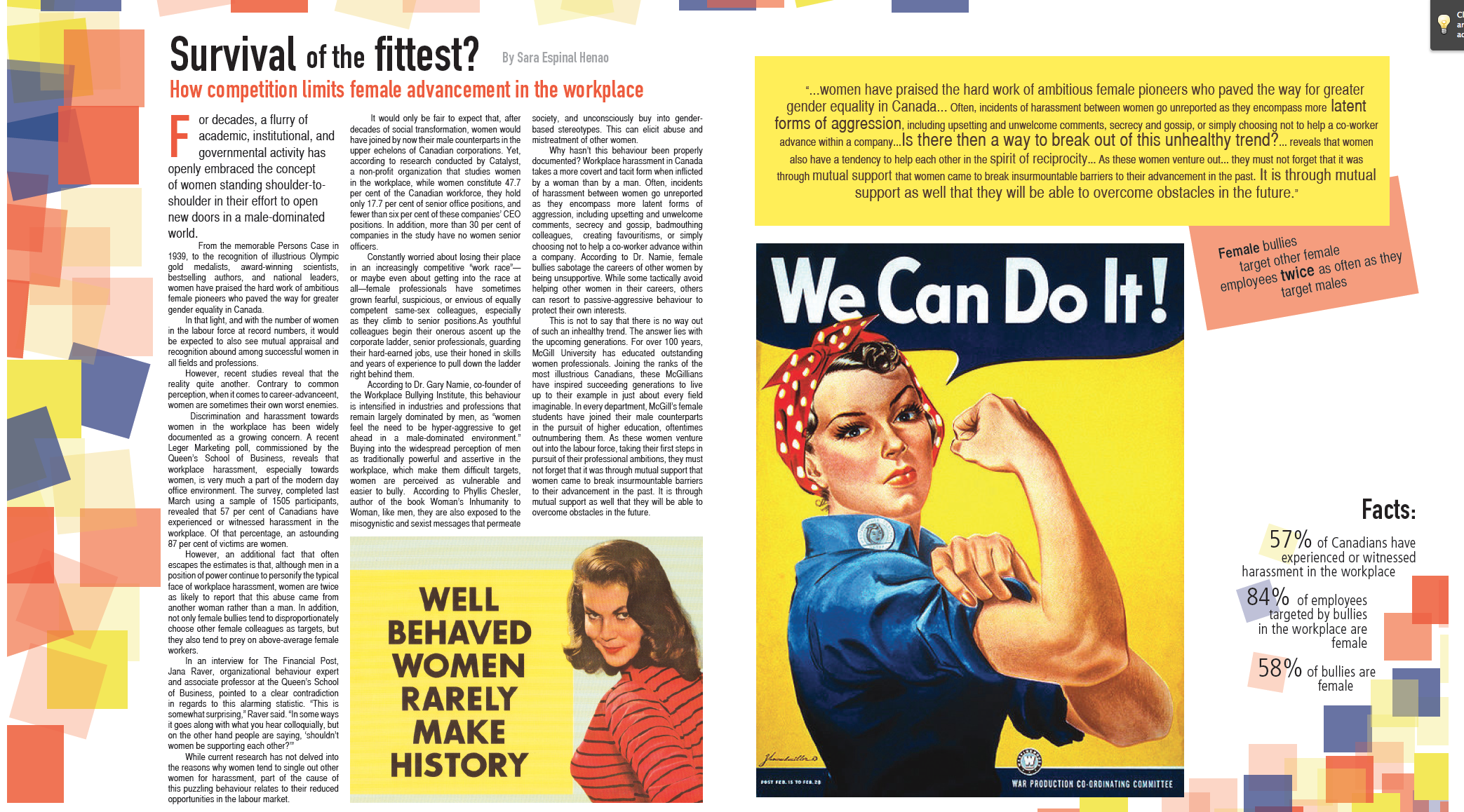
Survival of the Fittest?

For decades, a flurry of academic, institutional, and governmental activity has openly embraced the concept of women standing shoulder-to-shoulder in their effort to open new doors in a male-dominated world.

From the memorable Persons Case in 1939, to the recognition of illustrious Olympic gold medalists, award-winning scientists, bestselling authors, and national leaders, women have praised the hard work of ambitious female pioneers who paved the way for greater gender equality in Canada.

In that light, and with the number of women in the labour force at record numbers, it would be expected to also see mutual appraisal and recognition abound among successful women in all fields and professions.

However, recent studies reveal that the reality quite another. Contrary to common perception, when it comes to career-advanceent, women are sometimes their own worst enemies.

Discrimination and harassment towards women in the workplace has been widely documented as a growing concern. A recent Leger Marketing poll, commissioned by the Queen’s School of Business, reveals that workplace harassment, especially towards women, is very much a part of the modern day office environment. The survey, completed last March using a sample of 1505 participants, revealed that 57 per cent of Canadians have experienced or witnessed harassment in the workplace. Of that percentage, an astounding 87 per cent of victims are women.

However, an additional fact that often escapes the estimates is that, although men in a position of power continue to personify the typical face of workplace harassment, women are twice as likely to report that this abuse came from another woman rather than a man. In addition, not only female bullies tend to disproportionately choose other female colleagues as targets, but they also tend to prey on above-average female workers.

In an interview for The Financial Post, Jana Raver, organizational behaviour expert and associate professor at the Queen’s School of Business, pointed to a clear contradiction in regards to this alarming statistic. “This is somewhat surprising,” Raver said. “In some ways it goes along with what you hear colloquially, but on the other hand people are saying, ‘shouldn’t women be supporting each other?’”

While current research has not delved into the reasons why women tend to single out other women for harassment, part of the cause of this puzzling behaviour relates to their reduced opportunities in the labour market.

It would only be fair to expect that, after decades of social transformation, women would have joined by now their male counterparts in the upper echelons of Canadian corporations. Yet, according to research conducted by Catalyst, a non-profit organization that studies women in the workplace, while women constitute 47.7 per cent of the Canadian workforce, they hold only 17.7 per cent of senior office positions, and fewer than six per cent of these companies’ CEO positions. In addition, more than 30 per cent of companies in the study have no women senior officers.

Constantly worried about losing their place in an increasingly competitive “work race”— or maybe even about getting into the race at all—female professionals have sometimes grown fearful, suspicious, or envious of equally competent same-sex colleagues, especially as they climb to senior positions.As youthful colleagues begin their onerous ascent up the corporate ladder, senior professionals, guarding their hard-earned jobs, use their honed in skills and years of experience to pull down the ladder right behind them.

According to Dr. Gary Namie, co-founder of the Workplace Bullying Institute, this behaviour is intensified in industries and professions that remain largely dominated by men, as “women feel the need to be hyper-aggressive to get ahead in a male-dominated environment.” Buying into the widespread perception of men as traditionally powerful and assertive in the workplace, which make them difficult targets, women are perceived as vulnerable and easier to bully.  According to Phyllis Chesler, author of the book Woman’s Inhumanity to Woman, like men, they are also exposed to the misogynistic and sexist messages that permeate society, and unconsciously buy into gender-based stereotypes. This can elicit abuse and mistreatment of other women.

Why hasn’t this behaviour been properly documented? Workplace harassment in Canada takes a more covert and tacit form when inflicted by a woman than by a man. Often, incidents of harassment between women go unreported as they encompass more latent forms of aggression, including upsetting and unwelcome comments, secrecy and gossip, badmouthing colleagues,  creating favouritisms, or simply choosing not to help a co-worker advance within a company. According to Dr. Namie, female bullies sabotage the careers of other women by being unsupportive. While some tactically avoid helping other women in their careers, others can resort to passive-aggressive behaviour to protect their own interests.

This is not to say that there is no way out of such an inhealthy trend. The answer lies with the upcoming generations. For over 100 years, McGill University has educated outstanding women professionals. Joining the ranks of the most illustrious Canadians, these McGillians have inspired succeeding generations to live up to their example in just about every field imaginable. In every department, McGill’s female students have joined their male counterparts in the pursuit of higher education, oftentimes outnumbering them. As these women venture out into the labour force, taking their first steps in pursuit of their professional ambitions, they must not forget that it was through mutual support that women came to break insurmountable barriers to their advancement in the past. It is through mutual support as well that they will be able to overcome obstacles in the future.


Marc-Olivier Vachon led McGill with three points in the victory. (Luke Orlando / McGill Tribune)
a, Sports

Fast start key in battle; Redmen defeat Waterloo

In the wake of a thrilling victory over the York Lions on Friday, the Redmen were back in action on Saturday evening to take on the Waterloo Warriors at McConnell Arena. From the drop of the puck it was clear that the men in red carried the momentum they had established a day earlier, as they defeated the Warriors 5-2.

McGill (5-3) came out flying, and remarkably capitalized twice in the first three minutes of the game. Patrick Delisle-Houde scored the fastest goal in Redmen history—only 16 seconds in—while Mathieu Pompei followed up with his first of the year, just two minutes later. The initial tally materialized when the puck was dumped into the attacking zone off the opening face-off. Delisle-Houde pounced on a juicy rebound and stuffed it into the open cage. The goal invigorated the team as well as the large crowd. The Redmen outshot Waterloo (5-3) 13-6 in the first period, en-route to a strong 3-0 lead.

In the second frame, McGill found itself in a bit of penalty trouble, but Redmen goaltender Hubert Morin was able to weather the storm for his teammates. He carried them through to the end of the period with a total of 11 saves, allowing just one goal. In particular, he answered the call on several occasions when the Warriors had the Redmen defencemen on their heels, deep in the zone. After the game, he talked about his performance and applauded his teammates’ effort on the penalty kill.

“The goalie has to step up when there is a [penalty kill],” Morin said. “[My teammates were] blocking shots, cutting the line, and doing a great job in front of me.”

Luke Orlando / McGill Tribune

Waterloo made things interesting in the third period as defenceman Steve Whitely cut McGill’s lead to 3-2. However, the Redmen persevered during the gut-wrenching moments of play as the Warriors pressed for the tying goal. The Redmen exemplified this determination by scoring two insurance goals in the final two minutes of the game. Marc-Olivier Vachon assisted both of these goals to cap off a three-point night, holding onto his status as McGill’s leading scorer. Vachon was named the first star of the game, but complemented his teammates’ abilities to finish plays.

“I have to give credit to my teammates, because they’re the guys that put it in the goal,” Vachon said.

Redmen Head Coach Kelly Nobes was pleased with his team’s effort and mentioned that McGill’s quick start helped pave the way to the victory.

“We wanted to get on [the Warriors] early,” he said. “They played Trois-Rivières into overtime last night and had a three hour bus ride afterwards, so we wanted to get off to a quick start.”

Nobes also noted that the team’s fatigue helped Waterloo generate some chances midway through the game. Fortunately, Morin was on his game.

“We stopped moving our feet a bit in second period but got back in it in the third,” he said. “Hubert [Morin] had another solid night tonight, in particular in the second period.”

The Redmen now have an opportunity to rest and recuperate for a few days before they hit the road to take on the Western Mustangs in a national championship rematch on Nov. 9 in London, Ontario.

a, Sports

Point Counterpoint

The NBA has recently seen an emergence of ‘superteams’ that feature small groups of incredibly talented players. As larger markets, such as Los Angeles and Miami, continue to attract these stars, the league loses parity. This begs the question of whether or not this strategy is necessary to win an NBA title. Two Tribune contributors weigh in…

FOR Superteams

It’s simple. The numbers don’t lie. In this day and age, if you want to win an NBA championship, you need a star-studded lineup.

Many fans want to hang on to the notion that a championship can still be won with hard work, determination, and a solid foundation backed by a great coach. This idea worked as recently as the early 2000s, as evidenced by the Detroit Pistons. But in today’s NBA, talent surpasses everything else.

When the Miami Heat first assembled their trio of superstars, critics quickly jumped to the conclusion that the collection of egos and lack of team chemistry would prevent them from advancing deep into the playoffs. Despite all the criticism, the Heat managed to put together an impressive season and  reached game seven of the NBA finals. The more impressive feat was that they accomplished all of this in their first season as a team and with an inexperienced head coach.

The point is, even though the Heat lacked the coaching and team chemistry everyone said they needed to succeed, they still managed to be an NBA finalist by relying solely on talent. Then, last season (the second year of the big three), the Heat developed the little chemistry they needed and hoisted the Larry O’Brien trophy.

Many fans wonder how the league got to this point. How can just a few individuals dictate the outcome of a team sport? The truth is that there are a few ‘elite’ players in the league, and any of them can dominate a game and carry their respective teams. Unfortunately, for the majority of the league’s teams, it’s these players who have sent the NBA along this ‘superteams’ course.

Take a look at what happened with Dwight Howard and the Orlando Magic last season. In less than a year, Howard managed not only to get his coach fired, but also his general manager, all while toying with Magic fans about whether he would stay or leave in the off-season—Quite frankly, he never planned on staying.

Once the offseason arrived, Howard had complete control over his future destination (the Los Angeles Lakers), should he become a free agent the year after. This put teams at risk for trading for him for one season, before seeing him leave in free agency. This is why teams need to build such stacked lineups. With stars controlling the dynamics of free agency and trading, it has become more important than ever to create enough cap space and to assemble other top talents to attract these athletes.  Players like Howard and James want to play with their friends and play for contenders. Their desires can be turned into realities because they control the deck.

It wouldn’t be surprising to see the top 15 players in the league play for four teams by the end of the decade. If you’re a basketball fan, you had better hope that your team gets in on that action. Otherwise, the chances of your team winning a championship diminish to nil.

— Michael Ghofrani

AGAINST Superteams

‘Superteams’ have become part of the NBA culture. Over the past couple of seasons, a number of teams have acquired some of the league’s best talent to play together. We all remember LeBron James’ infamous decision to join Dwyane Wade and Chris Bosh in Miami. More recently, we watched the Los Angeles Lakers acquire both Dwight Howard and Steve Nash to complement Kobe Bryant.

Yet, history has indicated that amassing talent is not a guaranteed path to the Larry O’Brien trophy. Regardless of the big names, it has been demonstrated countless times that, to succeed, a team must have the perfect alignment of team chemistry, a strong head coach, and players who fill certain roles.

The 1996-1997 Houston Rockets led by Hakeem Olajuwon, Clyde Drexler, and Charles Barkley were a favourite to win the championship. The 2003-2004 Los Angeles Lakers were basically a shoe-in for the title, led by Shaquille O’Neal and Kobe Bryant, along with stars Karl Malone and Gary Payton. The 2010-2011 Miami Heat had the highest expectations placed upon them after signing both James and Bosh to join Wade. However, despite the teams’ superstar-heavy lineups, they all failed to hoist the trophy at the end of the season.

Furthermore, concentrating the NBA’s elite talent amongst a few teams is not in the league’s best interest. The NFL famously sports the “any given Sunday” approach, in which small market teams are in the mix for the title just as much as larger market teams. In the NFL, there is more parity, which is something that the NBA needs. Nobody enjoys watching the Miami Heat absolutely beat down the Charlotte Bobcats. Teams like Charlotte, Milwaukee, and Sacramento cannot compete with the likes of L.A., Miami, and Boston. The league becomes predictable and these smaller markets lose out on meaningful basketball.

Spreading the best talent between many teams, and having team-grown stars such as Bryant, Tim Duncan (of the San Antonio Spurs), Paul Pierce (from Boston), Kevin Durant (of the Oklahoma City Thunder), and Derrick Rose (with the Chicago Bulls), makes for a more interesting and competitive league, thus creating fiercer rivalries, and more loyal fan bases. The satisfaction of watching Michael Jordan lead the city of Chicago to a championship after seven tough years, of Hakeem Olajuwon finally breaking through for Houston, or Dirk Nowitzki carrying his team to the top after toiling for 12 years in Dallas, are the truly inspirational stories and are etched into basketball legend. Taking a shortcut and being disloyal to fans by forming a ‘superteam’ appears pathetic and dishonours the game of basketball.

Ultimately, while the big names may fill seats and garner television viewers, winning a championship still boils down to the basics of basketball: great team chemistry and the right conditions. History has shown that meshing talent together to form a ‘superteam’ does not necessarily guarantee a championship. It’s more important to play basketball the right way.

— Remi Lu

Winner: FOR Superteams

It’s becoming clear that teams without a small collection of superstars cannot compete for an NBA championship. After winning a title last season, the Miami Heat are a model from which large market teams wil strive towards in the future. Unfortunately for smaller markets that can’t attract as many big name stars, years of mediocrity await, while only a select few teams compete for championships year after year.

a, Sports

Goliath prevails: Laval ends Redmen season

Occasionally, David beats Goliath, but usually the bigger, stronger, better force has its way. Such was the case on Saturday afternoon as the Redmen saw their season come to an end in a 46-9 loss to the Laval Rouge-et-Or. Playing in its first playoff game since 2006, with only a 2-7 record, McGill was outmatched by a Laval squad that has captured two Vanier Cups in the same time period. Though the Redmen will rue what could have been if not for some key missed opportunities, making the playoffs this season has been a big step towards renewed prominence.

Despite the significant gap in talent between the two sides, McGill held its own in the first half, showing some of the promise that has been evident at times for the developing team. The Redmen jumped out to an early lead thanks to a 41-yard field goal by Sammy Rassy. Rassy would prove to be McGill’s highest—and only—scorer in the game, adding two more field goals in the first half, from 40 and 33 yards respectively.

The turning point in the half, and the game, came seven minutes into the first quarter. Tied 3-3, McGill seemed to have taken advantage of a back-and-forth field position battle when Redmen punter Thomas Silva pinned the Rouge-et-Or on their seven-yard line. However, the Redmen’s positive momentum was lost on the first play of the ensuing drive, as Laval quarterback Tristan Grenon connected with J.S. Haidara for a 103-yard touchdown pass. The score put Laval up 10-3, a lead that would never be relinquished. Laval added another major score, and McGill conceded a safety to make the halftime score 19-9.

The second half was marked by missed opportunities for the Redmen, which allowed Laval to blow the game wide open. The third quarter began on a positive note for McGill, who stopped Laval on their first drive of the half. Rookie running back Guimot Mota exploded for a 37-yard run that placed McGill in the Rouge-et-Or red zone with a prime chance to cut into the Laval lead. However, the Redmen were forced to kick a field goal, which Rassy missed off the left upright. McGill missed another opportunity after stopping Laval running back Guillaume Bourassa for an eight-yard loss. A roughing the passer penalty on the next play erased the positive defensive play, and the drive culminated in another Rouge et Or touchdown. Laval added 20 points in the final quarter for a final score of 46-9.

Despite two interceptions, McGill quarterback Jonathan Collin completed 20 passes for a total of 215 yards. Nearly half of those went to Dallon Kuprowski, who hauled in 116 yards in the loss. Laval, however, was able to crush the Redmen both in the air and on the ground, totaling 342 passing and 260 rushing yards.

As another season concludes for McGill, it seems that hope has been restored within the club. RSEQ all-stars Laurent Duvernay-Tardif and Shaquille Johnson will both return next season and could lead the team to even greater success.

Despite a 2-7 record in 2012, the Redmen can take solace in the fact the team played hard against teams of much higher quality, and lost close games to those lower in the standings. Though reaching the level of the Rouge-et-Or in the near future is unlikely, gradual progress will be enough for a team far removed from its greatest days.

Laval will take to its home field again next Saturday in the Dunsmore Cup, welcoming the Sherbrooke Vert-et-Or in the RSEQ championship. The winner advances to the Uteck Bowl, one of two national semifinals before the Vanier Cup on Nov. 23.

a, News

Costopoulos announced as new Dean of Students

Last Thursday, Provost Anthony Masi announced the appointment of Andre Costopoulos to the position of Dean of Students. Costopoulos’ term will begin Nov. 15, and end June 30, 2016.

Costopoulos will take over for Associate Dean of Students Linda Starkey, who had been serving as the temporary Dean of Students since Aug. 1, 2012.

“The Dean of Students has primary responsibility for protecting student rights, fostering academic integrity, and providing impartial oversight of the Code of Student Conduct and Disciplinary Procedures,” Masi wrote in the MRO announcing Costopoulos’ appointment.

In an interview with the Tribune, Costopoulos—who is currently the associate dean of arts and a professor of anthropology—shared his reasons for applying for the position.

“It wasn’t an easy decision … but I think it’s something that I need to do right now,” he said. “It’s an important moment in student affairs right now at the university. I think there is a lot of work to do … and, well, I want to facilitate that.”

Costopoulos also outlined the challenges he expects to face in his new role.

“The Dean of Students is part of all the [university] groups in some ways, and has to represent each of them to all the others, [which is a] big challenge,” he said. “And [I will go] from having 7,000 students to worry about, to having [around] 34,000. It’s daunting.”

Costopoulos also addressed the revision of the Code of Student Conduct, as recommended by Dean of Arts Christopher Manfredi’s recently published Report on the Open Forum. Costopoulos said he wants to participate in the process as much as possible and stressed the importance of patience in such an undertaking.

“Before you make an actual change to … the Green Book, you want to think very carefully through the potential unintended effects that it [could] have,” he explained. “That’s the purpose of all these endless committees. [It] all takes time, but that time is not wasted.”

Costopoulos said his goals include enhancing communication between different members of the McGill community and increasing recruitment and retention of Indigenous students and first generation university students.

“There are some obstacles to participation in higher education,” Costopoulos said. “That’s always been a problem that’s [been] important to me, and I want to see what I can do to … maybe remove some of those obstacles, or at least minimize their impact.”


Heather Munroe-Blum discusses the events of the semester with student media. (Alexandra Allaire / McGill Tribune)
a, News

McGill Principal hosts campus media round table

On Nov. 2, Principal Heather Munroe-Blum spoke with the McGill Tribune, the McGill Daily, and Le Délit about the Fall semester and her expectations for her last year as principal.

McGill Daily: A lot of people have described the report [on past McGill asbestos research] as being self-serving and without transparency. I just want to know how McGill responds to that, and to multiple criticisms of the report.

Heather Munroe-Blum: In fact, the report has been very well received and followed a good process, and in the context of academic review—which is peer review—we feel very comfortable that a very objective review was done.

MD: Do you know why an external report was not done for this?

HMB: Because we have processes and procedures that we use, and the entire research enterprise is governed on a peer review basis and through the policies and constructs that we have in place.

Le Délit: What will be McGill’s role in the upcoming [provincial] education summit promised by Pauline Marois?

HMB: We certainly plan to make representation at it. We’re working to make suggestions about how the summit should be held, but it’s not at all clear what the structure or format will be … the needs and contributions and accountabilities [of a university] depend on the mission and culture and history of an institution, so we really want a multi-dimensional framework to the summit. We hope very much [for] the participation of students and professors, and I hope Quebeckers—maybe leaders from other sectors of Quebec society [too]. I think it would be terrific if we had some people from outside of Quebec as well, who deal with these issues.

McGill Tribune: Are there plans to address the recommendation of the report [on asbestos research] that the Board of Governors avoid investing in asbestos companies? 

HMB: That’s not something you can do without having a formal motion come forward and so forth, so that will depend on people bringing it forward. We do have a Committee of the Board on socially responsible investment, [but] the issue of managing investment portfolios is a complicated one. … It’s an easy thing to say, [but] it’s very complicated when you understand that a majority of investment tools today are big conglomerate investment tools. … The simple answer is we know of no current investment in asbestos, and we have no plans to go out and seek investment in asbestos.

MT: How have you made progress towards accomplishing your goals for your last year as McGill’s principal?

HMB: We’ve made good progress on our recruitment and on our strategic enrollment plan … I’d say my biggest goal that I set out with in 2003 when I became principal that I still haven’t completed is that every qualified student will be able to come to McGill independent of financial needs. I believe firmly [in] increasing student aid and bringing tuition to effective levels, and then having philanthropy and having governments stay the course. Neither tuition nor philanthropy should displace government support. … But then we need those who benefit from an educated population and those who benefit themselves directly—economically and otherwise—to pay a fair share of that; and so we’ve got to make progress on that and I’m hoping we still will this year. And for me, a big part of that as well is making sure the fees our students at McGill pay stay here to their benefit.

MT: Students are currently planning a McGill [education] summit before the provincial one. Is there anything the administration will do to facilitate or promote discussion on campus before the provincial summit?

HMB: We’ve been talking a lot with the student leadership about that … we think it’s a good idea, and I think it depends what it is, what the aims of it are, [and] which constituencies of the university will participate with it. … Once that’s determined, it’ll be clearer how we and others might participate [in] that. But certainly our idea was that if we have ideas where we can collaborate ,we would like to do that. And I think it’s a great idea to have discussions within the university about the summit, and I think there will be different points of view … about what will come out of the summit, but if there are one or two or three things where all of our constituencies can agree … it would be fabulous to focus on that as well.

—This interview has been edited and condensed by Erica Friesen.

a, News

McGill refunds tuition increases for Quebec students

Last Friday, Deputy Provost (Student Life and Learning) Morton Mendelson announced that McGill would refund tuition increases for Quebec students over the weekend. The university will wait to hear from the provincial government before crediting the accounts of out-of-province and international students.

Last year, the former Liberal Quebec government implemented an annual tuition increase of $250 for a period of seven years, starting in Fall 2012. When the Parti Québécois (PQ) won the provincial election in September, Quebec Premier Pauline Marois announced plans to cancel this increase, even though universities across the province had already implemented it.

In his statement, Mendelson said the process of crediting Quebec students’ Minerva accounts with the refunds would be completed by Monday, Nov. 5.

“We will await final word from the government regarding tuition for students who pay Canadian or international rates before adjusting their accounts,” he wrote. “The government … [has] signaled to us its intention to keep fees for out-of-province and international students relatively stable but has not yet advised us of its final decision.”

Although the PQ announced the fee’s cancellation in September, the Quebec government did not give McGill any final decision regarding the rollbacks until last week.

In a meeting with campus media this past Friday, McGill Principal Heather Munroe-Blum suggested that the timing of the election was a factor in the two-month wait.

“We need to understand that [this] government [came] in virtually at the start of the school year,” she said. “You wouldn’t imagine everything would be really clear right away, and, as you saw, the government made a lot of commitments during the election, and worked to come out with a position on those themes they were elected on … I think it’s not unusual that we reached October before we heard from the government.”

Munroe-Blum said she could not estimate how long the Quebec government will take to finalize tuition rates for out-of-province and international students.

Robin Reid-Fraser, vice-president external of the Students’ Society of McGill University (SSMU), said she thought many students at McGill would be pleased now that McGill is taking direct action to refund the tuition increase.

“For Quebec students, I imagine it is a relief to know that the cancellation of the tuition hike that was initiated nearly two months ago has finally been implemented at McGill,” Reid-Fraser said. “For out-of-province and international students, we’ll be staying alert to what the situation is with those fees.”

a, Opinion

Time for academia to embrace Wikipedia

As the years go by and Wikipedia continues to grow in scope and size, it has emerged as a great paradox of the digital age. Although the site, which turns 12 years old in January, is far and away the most expansive reference work in the world and is available in over 200 languages, it has been unable to find good standing in the academic community as a credible source. It is certainly understandable that academia would be leery of a source open to editing by anybody in the world. However, Wikipedia is showing signs that it has begun to outgrow its reputation as a haven for vandalism, slanted rhetoric, and misinformation. While the transition won’t be easy, it may be time for some educators to begin to reconsider their ban on the informational juggernaut.

An Oct. 25 article in The Atlantic entitled “Surmounting the Insurmountable: Wikipedia Is Nearing Completion” makes the claim that Wikipedia is reaching the end of its developmental stage, and a great many of its articles are nearing completion. Of course, this holds only for entries whose content remains static; those covering topics of a historical nature or certain areas of science. The article points to the Wikipedia page on the War of 1812 as a prime example. The bulk of  this 14,000 word entry was written in 2006. Since then, users have continued to make edits and dispute various points on the entry’s 200,000-word discussion page. In 2008, there were 256 users actively editing the page; today, this number has dwindled to 28.

This decline indicates not a decreased interest, but an equilibrium which has been reached within an article where nearly all questionable facts have been verified, nearly all debatable points have been debated, and nearly all contentious language has been sifted out by the spectrum of backgrounds and political views reflected in the editor-base. This equilibrium is the essence of crowd-sourcing, combing over the individual’s biases and resulting in a product that satisfies all parties. It is in this sense that an article can be considered completed.

The use of the word ‘completion’ here must come with a caveat. By its nature, Wikipedia is a living body of work that is constantly expanding and updating. Developments in the news typically generate their own respective entries in very little time, and the related discussion pages are constantly active for those articles which do continue to change. For these active pages, equilibrium cannot be reached, as each development brings with it a new set of discussions and deliberations. In this respect, they can never be ‘completed’ in any real sense. ‘Completion,’ in the context of Wikipedia, refers to the point where the site need only keep up with the world’s information, rather than catch up with it.

The next step for Wikipedia, as The Atlantic piece correctly asserts, is to bolster its wealth of information with credible academic citations. Additionally, articles that are strictly historical and have shown a decrease in editing should be ‘semi-protected’—a term on Wikipedia which restricts editing privileges to registered users only. This greatly reduces the likelihood of vandalism, or of somebody editing without consulting the talk page. These stabilizing policies would lend Wikipedia much needed legitimacy in academic circles.

Beyond the fear of inaccuracy, there are very few reasons for the academic world not to embrace Wikipedia. It doesn’t infringe on any existing informational sources, as it doesn’t offer enough of a breakdown on topics to serve as a replacement for textbooks, nor does it offer critical analysis in the same way that a scholarly article does. Wikipedia would exist within academia simply as a foundational core of facts and figures on a wealth of topics, a more thorough version of a traditional encyclopedia.

Unfortunately, the site’s use will continue to meet resistance because it does infringe on one critical deep-seated aspect of academia: elitism. The world of academia exists, as it always has, as a hierarchical structure. Credibility is measured largely by individual accomplishment, publications, tenure,  and seniority. What Wikipedia represents is the notion that credibility can exist in the collective. Although its editor-base includes academics and other qualified individuals, its credibility is not quantifiable. For the academic community to acknowledge its legitimacy would be an admission that knowledge does not belong exclusively to institutions of higher learning.

Academia should acquiesce to the powerful collaborative tools such as Wikipedia. However, in a realm that is not known for its acceptance of change, I wouldn’t hold my breath.

a, Opinion

Safe Spaces on campus do not repress free speech

Last week, the Justice Centre for Constitutional Freedoms (JCCF) issued a report on the state of campus free speech in 2012, in which the Calgary-based libertarian think-tank examined the degree and limits to free speech at Canadian universities. The overwhelming majority of schools in the report received failing grades. McGill’s administration received a D, while the Students’ Society of McGill University (SSMU) received an F. Such low grades warrant further examination. While the report covers a series of topics, its authors seemed to take particular issue with McGill’s Safe Space policy.

The Tribune finds this preoccupation surprising. Though a number of issues raised in the report merit a closer look, McGill’s support for Safe Spaces—inclusive environments which discourage sexist, racist, and homophobic expression—is not one of them. According to the report, McGill’s Safe Space policy limits the speech of those who use terms deemed ‘offensive.’ While this sort of negative reinforcement may restrict the speech of students who choose to use certain hurtful terms, the Tribune believes that Safe Spaces offer an important element to the discourse on campus—they provide context and a sense of inclusion. They certainly do not pose a threat  to freedom of speech in the way that the administration’s Provisional Protocol or SSMU’s Equity Policy may.

[pullquote]To cite Safe Spaces as a major source of repression of free speech conveys a false sense of conflict and oppression.[/pullquote]

The Equity Policy, which limits freedom of speech by the ambiguous marker ‘progressive,’ has far heavier consequences than Safe Spaces do. While students may be reprimanded for using hurtful or offensive terms in a Safe Space, they are not prevented from expressing dissent. The Equity Policy, on the other hand, could lead to a withdrawal of funds from groups and individuals that do not align with SSMU’s idea of ‘progressive’ that year. There has already been at least one instance of this, as outlined in the report.

Overall, the report sensationalizes an issue that has not been pressing on campus. To cite Safe Spaces as a major source of repression of free speech conveys a false sense of conflict and oppression.

This editorial board does not believe that free speech has been significantly repressed by limitations placed on hurtful or discriminatory terms. This newspaper is free to publish material written by its editors and contributors. That our content is mindful of many of the same rules as those found in Safe Spaces does not mean that the Tribune feels coerced. Rather, we are glad to be a part of a community that fosters discourse about the realities faced by the few.

Programs like Safe Space do not exacerbate tensions on campus, they alleviate them. The purpose of the program is to educate people on what others may find offensive. Rather than enforcing a rigid standard for what students can and cannot say, Safe Space cultivates an atmosphere of acceptance.

Although the report expressed some legitimate concerns regarding SSMU’s Equity Policy, as well as the undue limits on free expression imposed on our community by the administration’s Provisional Protocol, its criticism of Safe Spaces is both unfounded and wholly misguided. To lump it in alongside the Provisional Protocol, and more serious violations of freedoms of speech and assembly bespeaks a severe misunderstanding about free speech on the part of the JCCF.  This kind of sensational reporting begets hostility, not the other way around.

a, Opinion

The Tribune’s stance on the November referenda

Question regarding the CKUT Fee Increase — YES

This question proposes a $1 increase in the opt-outable student fee of McGill’s campus-community radio station, CKUT.

CKUT’s $4 fee has not increased since 1988. An increase indexed to inflation would bring their fee to $7. As a student-run media outlet that also depends almost entirely on student fees, we at the Tribune understand how important funding from student fees must be to CKUT. Running a radio station has undoubtedly become more expensive since 1988.

At a university which has no program in radio production or broadcasting, CKUT is, in many ways, the only place for McGill students interested in radio to learn and perfect their skills.

The Tribune wholeheartedly supports CKUT’s request for this small fee levy, and encourages readers to vote YES.

Question regarding the M-SERT Fee Increase —YES

Similar to the previous question, this one proposes a fee increase of $0.50 for the McGill Student Emergency Response Team (M-SERT). M-SERT previously received $0.25 per student through SSMU’s ‘Safety Network.’

Considering the multitude of services M-SERT provides to the McGill community—from subsidized first aid classes to emergency first aid services at events, in residences, and across campus—this modest fee increase proposal is easily justified.

We support M-SERT’s ambition to expand while continuing to provide the same level of service. An expansion in both their services, as well as their first aid supplies, benefits the whole McGill community.

The Tribune fully supports M-SERT’s fee increase proposal, and encourages readers to vote YES.


Read the latest issue

Read the latest issue