Latest News

Arts & Entertainment, Music, Pop Rhetoric

Bring more big-name musical acts to Montreal

Montreal is often overlooked when it comes to big-name concert tours. Despite its vibrant music scene and energetic crowds, many artists don’t think to stop in Montreal when booking their Canadian tour stops. Meanwhile, cities like Toronto and Vancouver are popular tour destinations. What do other cities have to offer that Montreal does not? 

Popular artists such as Olivia Rodrigo have commented on the electrifying energy and enthusiasm that Montreal’s crowds bring to a show. The city also hosts a wide variety of concerts and festivals, from techno events such as Piknic Électronik, to the annual Montreal Jazz Festival, to festivals highlighting Francophone artists, demonstrating that there is an audience for any artist, regardless of style or genre.

Montreal hosts millions of spectators every year at these festivals, and their popularity is only expanding over time. However, the city’s enthusiasm for its music scene extends beyond festivals; local scene bands, live music in bars, and concerts by big and small artists alike captivate its residents year-round. It is this open-mindedness and vast interest in live music that makes Montreal a city eager to receive larger artists. 

Furthermore, Montreal’s geographic location is ideal for hosting out-of-town audiences from smaller cities in Eastern Canada and even those from the U.S., in places like Boston and New York City. While it might seem far to have to travel from Montreal to Toronto to see a popular artist or band perform live, it is nothing compared to the distances those who live in Quebec City, or even in the Maritimes, must travel. Such trips are long, pricey, and often unfeasible for the average concert-goer. By adding tour stops in Montreal, top-tier artists can increase accessibility for fans across Canada.

In general, Montreal is a more affordable city than Toronto, with prices being on average 10 per cent lower. For the artist, this can mean spending less on venue rental fees and on hiring production staff. For the audience, it means that finding transportation, lodging, and food won’t be as costly, leaving more of their budget for the concert tickets themselves. This price difference between the two cities can be reflected in ticket prices as well. 

Montreal is likewise well-adapted and accustomed to hosting substantial crowds while still offering reliable services. The city is home to Place des Arts, a large concert hall located in the Quartier des Spectacles, which has a total capacity of 8000 seats and hosts many performances and artists every year.

Centre Bell is another notable venue that can welcome bigger artists. The recent Charli XCX and Troye Sivan Sweat Tour held in this arena transformed the space’s stage with different light displays and impressive set pieces made of scaffolding. The result was an outstanding experience for the fans, and it illustrated the city’s ability to organise thrilling and remarkable concerts. This makes Montreal a city capable of—and accustomed to—organising distinguished cultural events.

Not only does Montreal have the capacity to coordinate important concerts for bigger artists, but its population is also adapted and open to them. With a metro area population of 4,342,000 people in 2023, Montreal is the second largest city in Canada—and inhabitants aged 25 to 34 years old are the city’s largest age group. Younger people tend to attend more concerts as they are usually up-to-date on trendy artists and follow pop culture through social media. The social aspect of concerts also tends to appeal more to younger generations, making them the perfect target audience for big tours.  

Montreal’s demographics, its location, its passion for live music, and its ability to organise larger events while maintaining a reasonable price for its services make it a hidden hosting gem for the worldwide famous artists that tend to overlook this city. 

Features

Rallying to Resilience

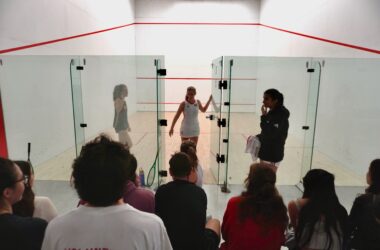
My sweaty palm grips the racquet, the noise around me blurring. I can hear my heartbeat ringing in my ears. I step onto the court and focus on hitting my targets in the warm-up, listening to the sound of the ball making contact with the front wall. Bam. Bam. Bam. I notice the details of each shot. Where is my racquet making contact with the ball? How is the height and the pace? How can I adjust? The referee calls time, and warm-up ends. The racquet spins, dropping to the ground and landing on the down symbol. I have the first serve. I step into the service box, bouncing the ball three times, each time reminding myself that I am ready. I know where to place the ball and what to do. I toss the ball and my racquet makes contact. The match begins. 

Ever since I can remember, sports have been a huge part of my life. From gymnastics to karate, to running, basketball, and squash, I was always the kid in school joining every sports team. My dad introduced me to squash—he picked it up in his 20s recreationally, and by the age of seven, I picked up my first racquet. My brother then got involved in squash at our local squash club, and soon after, I followed in his footsteps. I played my first tournament at 10 years old—although I lost almost every single match, I was mesmerised by the sport. I remember watching the older players compete for provincial and national championships, particularly the under-19 girls division. I kept thinking,“I want to be this good someday.” 

From my first tournament, I was hooked. I started playing a couple of times a week in my local squash program and playing more tournaments, determined to improve my game. I moved up to playing provincially, then nationally, and now at McGill. Along the way, squash became a core part of my identity. When I was asked to introduce myself or say a fun fact or favourite hobby, the first thing that came to mind was squash. Squash also became a sort of family tradition. My parents, brother, and I would go to our local squash club every Christmas and New Year’s Day. If you walked into our dingy hole-in-the-wall club on an empty Christmas day you’d be sure to find us fiercely battling it out on court. These were also usually the only times my brother and I would let my dad win (he would say otherwise). 

Throughout my middle and high school years, I played and competed at a high level, representing B.C. and Canada at competitions. My fondest memory was travelling to Amsterdam to represent Canada in the Dutch Junior Open, playing against top-level junior players from around the world. It felt amazing to be surrounded by other athletes playing the best they could. I was inspired and full of motivation. Along the way, I’ve watched my peers drop like flies at each level. I’ve wondered: What has kept me playing? 

Like many athletes, I’ve hit roadblocks and points of burnout in my sport. COVID-19, which halted group practices and competitions, was detrimental to every student-athlete.

Ava Bicknell, U2 Arts and Co-Captain of the McGill Women’s Squash Team, told  The Tribune, “I couldn’t train during COVID. I didn’t play for two years so I lost interest in the sport. I found it hard to be motivated because I couldn’t play.” For many athletes like Ava, this was a harsh reality. The pandemic deeply affected athletes’ motivation and interest to keep going, making many lose their momentum. The pandemic was also difficult for young woman athletes in particular. Even before the pandemic, one in three girls in Canada quit their sport during their late teenage years. The loss of community exacerbated the high dropout rate of woman athletes.

COVID was also a time of reflection for many athletes. For me, the pandemic was the first time I was forced to step back from my sport. It made me realize how much I love to play, but also how stressful and anxiety-inducing tournaments could be. My teammates seemed to be reevaluating their interest in squash too—many quit after the lockdown. I had to ask myself the hard questions: Do I want to keep playing? Do I miss playing or is this feeling a longing for an old habit? In this time of reflection, I realized how much I had grown to love squash and training towards a new goal, tournament, or ranking. I did not want to stop. I worked with my coach online to do as much off-court training as possible, improving my game’s physical aspects, speed, strength, and endurance. Once lockdown ended, I realized that I had been longing to get back on court.

However, just two months after I started training again, I faced my biggest roadblock—the nightmare every athlete dreads: Injury. I sprained my ankle in practice and couldn’t play at my maximum capacity for six months. The two weeks of not being on court felt gruelling. Every day, I would go to the squash club and spend my time biking while I watched my teammates practice. I was devastated. I felt like all my progress had been lost from one stupid mistake. I went from feeling like I was playing my best in a practice match, to being unable to walk off the court. My time away from squash reinforced the love I had for my sport, motivating me to push myself to work smarter and play harder.

Getting back to training and competitions months after my injury was challenging. I was behind where I needed to be. I was also gearing up for my recruiting year, where I would begin talking to coaches in the U.S. about playing Division One squash. I was extremely frustrated with my performance and my recovery time from my injury. My love for squash began to fade. 

Recruiting wasn’t going well either. With the long-term effects of the pandemic, it was harder to get into international tournaments and to compete against American players who already had exposure to college coaches. I kept telling myself it would work out, and I would achieve my goal of playing Division One squash, but in the end, it didn’t. I was devastated. This is what everyone I was competing against wanted; why couldn’t I have it too? 

My frustration carried on into my last year of high school. As I began to near the end of my junior squash career, I started feeling burnt out. I didn’t enjoy competing anymore. What was the point? I felt disincentivized to play because it felt like there was no future for me in the sport. On top of this struggle, many of my teammates had quit, altering the social dynamic, and making training less enjoyable. After my last provincial championships, I took my first voluntary break from squash. I stopped training five to six days a week, let myself rest, and distanced myself from the sport.

I came to McGill last fall, knowing I would join the Women’s Squash Team. My brother was already on the Men’s team, and I hoped it would be a positive social experience, but I assumed it wouldn’t be such a big part of my life anymore. 

I was wrong. As soon as I stepped back on the court, my heart pounded out of my chest, my palms turned sweaty, and butterflies swirled in my stomach. In that moment, I remembered why I love to play. 

But, while many athletes come into university with this same mindset, their ability to follow through and continue playing is dependent on many factors. What makes or breaks someone’s experience with sports, especially in university?

For many athletes, including myself, the likeability of the sport is tied to the team’s dynamic. Lilly Breton, U3 Arts and a former player on the McGill Women’s Field Hockey Team, told The Tribune that after her first year, she “just felt like it was a different dynamic with the girls, and I didn’t really like to feel in competition with my teammates, like we’re a team, but it was […] a super stressful and anxiety-inducing environment.” Players like Breton often decide to leave their teams, rather than continuing in unpleasant conditions.

On the flip side, the strong community in the squash team brought me back to the sport. My love for squash stemmed from my teammates. I loved being in my first all-girls team, having strong woman athletes around me, all training for a mutual goal. I got lucky enough to join a team where I met some of my best friends.

McGill Tennis Coach Lutwin de Macar told The Tribune that athletes’ relationships with their sport are “about the people, about the energy, about the atmosphere; whether you’re varsity, whether you’re not, […] you could still make a great experience out of it.” As de Macar reflects, at any level of sport, the community and the energy athletes are surrounded by can make or break their motivation to play. 

Also, the flexibility with my training and keeping a good balance between school, sports, and socializing has been crucial. With just team practices, I could play as little as three times a week, allowing me to focus on my school and social life. But the entire team drives one another to improve, and nearly every day, I’m either training on the court with my teammates or hitting the gym alongside them. With the squash team, I’ve been able to balance my training and my game around my priorities. Now I not only play for McGill but also for Team Quebec. Seeing how all these small adjustments improve my game pushes me to keep going. I love reflecting upon how much I have improved by staying consistent, and how much the hard work has paid off.

Finally, falling back in love with my sport has been tied to having a competitive challenge. While McGill’s squash team isn’t varsity, we compete at a varsity level against other Canadian teams in the Ontario Jesters University Squash League. The McGill women’s team won the Ontario University Association (OUA) League for the first time in McGill history, beating the crowd-favourite Queen’s University. Now, every time I walk past the courts, I smile when I see our first-place banner hanging. We may not be receiving the recognition or funding we aspire to have from McGill Athletics to become a Varsity team, but we are competing at a high level. 

Institutions play such an important role in how athletes view their relationships with their sport, especially in university. For young woman athletes, this can be the ways in which our school represents and supports us—in funding or spirit. 

Breton discusses how with field hockey, “There’s no extra support, especially when it comes to funding […] It all comes out of pocket. It’s super expensive compared to the men’s high-level sports, [because] they have funding. They have […] five physios [in] a team, they have all these different resources. So at least for field hockey, I think that’s why a lot of girls dropped out […] there was just no point.” 

Breton emphasized that McGill Athletics and their lack of support for women’s sports teams can affect how woman athletes view themselves and their relationships with the sport, especially when men’s teams take precedence. Support from institutions can be a huge incentive or a massive hardship, which can be a deciding factor for young women already struggling to stay in the game. 

For all athletes, love for your sport comes and goes, and sometimes the sacrifices we make feel bigger than our return on investment. But finding a sport where you love to compete and can’t imagine your life without it makes everything worthwhile. Being surrounded by teammates who are just as excited to win that big match or help you pick yourself up after a tough loss is what makes it worth it. So to you, squash might just be hitting a ball against a wall, or that court you walk by on the way to the B2 Gym. But for me, squash is my challenge. It pushes me to be mentally and physically tough, a sport that has brought my family closer and has allowed me to form some of my closest and most meaningful friendships. This is what has shaped my relationship with my sport.

McGill, News

Indigenous performers and vendors shine at 23rd annual Pow Wow

On Friday, Sept. 20, the First Peoples’ House and the Office of Indigenous Initiatives hosted McGill’s 23rd annual Pow Wow at the Tomlinson Fieldhouse. The six-and-a-half-hour event saw Métis Jigging, Inuit throat singing, Haudenosaunee social dancing, and multiple Intertribals, with drumming from the RedTail Spirit Singers, Ottawa River Singers, SpiritWind, and Spirit Wolf. The Pow Wow, open to the McGill community and the general public, also hosted dozens of vendors, ranging from creators selling jewellery to an information and fundraising booth supporting the Kanien’kehá:ka Kahnistensera (Mohawk Mothers), who are currently involved in a lawsuit with McGill over potential unmarked graves on the site of the university’s New Vic Project

The event began with a Grand Entry, in which participants entered the center of the Fieldhouse while dancing, followed by opening words from organizers and the two masters of ceremonies, Lance Delisle and Marie-Celine Charron Einish. The opening also included a Flag Song, which featured the pinning-up of flags representing the Haudenosaunee Confederacy, the Every Child Matters campaign, Pride, and more. 

Over the course of the day, speakers underlined that the Pow Wow was about joy and community. Amanda James, one of the performers of the Jingle Dance, explained to The Tribune that the Pow Wow is a celebration of Indigenous cultures.

“[The Pow Wow is] for people to have a look into our culture and to see what we’re about, and that we’re still here and we’re still dancing, and our culture is alive and well,” James said.

Over 25 vendors from across Canada were present at the event. Raphaëlle Langevin was selling earrings, bracelets, and other accessories which she said were inspired by animals and traditional motifs at the event. Langevin explained that her business, Matsheshu Créations, has been following the Pow Wow Trail, setting up booths at various Pow Wows throughout the summer. She noted that the event had the potential to foster connections and learning with non-Indigenous people.

“[A] Pow Wow is a great place to meet both Indigenous and non-Indigenous people. Part of our mission is to create bridges with non-Indigenous people, and I think that this is a great place for that,” Langevin explained.

Take Back Tekanontak, a group of community members in support of the Mohawk Mothers, were also present at the Pow Wow alongside Mohawk Mother Kahentinetha. Marjolaine Arpin, who was tabling with Take Back Tekanontak, spoke to The Tribune about how she found it ironic that McGill is hosting an event celebrating Indigenous life and culture, whilst simultaneously litigating against the Mohawk Mothers.

“McGill is a colonial institution and it plays [at] reconciliation, […] Indigenous celebration, and respect. That’s only a facade. So it’s really appalling and disgusting and heartbreaking to be honest, because it’s re-traumatizing,” Arpin said. 

Others emphasized that the Pow Wow was an opportunity to learn from each other and learn more about local Indigenous cultures. Spenser Mandy, U3 Music, spoke to the responsibility that non-Indigenous people share in learning about the traditional Kanien’kehà:ka territory that McGill’s campus operates on.

“Since I’m studying in Quebec, I thought I should know a bit about the traditions of the people that are from the land that I’m studying on,” Mandy said. 

Giselle Alfred, member of the Indigenous Student Alliance, was tabling for the group at the event. In an interview with The Tribune, Alfred explained that she saw the Pow Wow as an opportunity to learn about Indigenous cultures other than her own.

“I’m very much a guest on this land, just like a lot of others,” Alfred said. “I myself am from British Columbia, and that’s where my Indigenous ancestry comes from. So for me, I’m just grateful to be able to witness and experience [the] beautiful Indigenous [cultures] here.”

Lacrosse, Sports

Redbirds lacrosse secures win by five-point margin against Trent

Following their three-point win against the Carleton Ravens (1-3) on Sept. 15, the Redbirds lacrosse team (4–0) took the field again to face the Trent Excalibur (4–1) on Sept. 21. Simply comparing McGill and Trent’s game statistics, the game was predicted to be a tough one. Trent held the first standing in the Canadian University Field Lacrosse Association (CUFLA) rankings with 56 goals for and 27 goals against, resulting in a 29-point difference. In comparison, McGill has an 11-point difference, with 31 goals for and 20 goals against. Furthermore, Trent scored higher than Queens, which seemed to be McGill’s toughest game to date this season. However, both Trent and McGill came away from Carleton with the same score, providing some hope for the Redbirds. 

Fourth-year midfielder and faceoff specialist Samuel MacDonald reflected on the game in an interview with The Tribune.

“This year we’ve been pretty focused. And we came ready. We didn’t want to let them win and run over us again, so we brought it to them and pulled out a win,” he said.

The game started off slow as each team had trouble breaking the other’s line of defence. 

While Trent scored first, first-year attackman Liam Miletich quickly tied it up within the minute before MacDonald won the face off and carried the ball down the field to sink his own goal. 

“I honestly just try and stay focused as best I can, [and to] not let whatever’s going on around us [affect me], whether we score, they score, we kind of just want to win the ball,” MacDonald said, reflecting on his mindset during the goal. “Then whether they let me go [through the defensive line], sometimes they don’t, but I had the space there, and I just shot and got lucky.”

Just 30 seconds after MacDonald’s goal, third-year midfielder John Miraglia scored his own. With a minute left in the quarter, first-year attackman Zach Bye buried the ball into the net, setting the score at 4-1. 

Set up with a pass from third-year midfielder Joshua Jewell, first-year midfielder Torsten Blodgett brought the Redbirds’ goal tally to five in the second quarter. Minutes later, Jewell got a good look and scored an unassisted goal. Trent attempted to tie up the game, earning three points and starting the third quarter 6-4.

Four minutes into the second half, Jewell scored yet again before both teams resumed the struggle to make a successful shot. Eventually, breaking through Trent’s defensive line and ripping a shot, Bye scored the final goal of the first half with just seconds left. 

“Zach Bye wants to score as many goals as possible, and it doesn’t even need to be him,” said Head Coach Nicolas Soubry when asked about the freshman. “He just wants our offense to score as many goals. He hates losing the ball.” 

With the score at 8-6, both teams continued to grapple for the win. After five minutes of back and forth, third-year attacker Mark Symon caught a high pass and immediately threw it into the goal. In that same minute, fourth-year midfielder Alexander Erbstein saw an opening to score unassisted and seized it. Just outside the crease, Bye fell hard in the seventh minute of the quarter before getting his revenge by scoring his third goal of the game. Bye explained his philosophy on bouncing back from a tough hit.

“The game’s only 60 minutes, and there’s only one a week,” he said. “So it’s like, try and give everything I have during the game, and then I have enough time to recover for the next game.”

Moment of the game: With seconds left in the quarter, Bye fell, got up, and successfully made a Hail Mary, giving McGill a two-point lead over Trent for the first half.

Quotable: “[Zach Bye is] a stud. He’s been really good this whole year, and today they locked him off. But whether he was scoring goals or not, he still fed our other guys and we got goals and made offense otherwise.” — Faceoff Sam MacDonald. 

Stat corner: The Redbirds have started their 2024 fall season off strong with a conference record of 4–0. 
The Redbirds (4–0) will play next on Wednesday, Sept. 26 against Bishop’s University (4–1).

McGill, News

Office of Indigenous Initiatives kicks off 13th annual Indigenous Awareness Weeks

McGill’s Office of Indigenous Initiatives (OII) commenced its 13th annual Indigenous Awareness Weeks with an opening talk given by Laara Fitznor, formerly with the University of Manitoba, on Sept. 19. The event, held in the Faculty Club, was titled “Engaging Indigenous Philosophies and Practices for Mutual Respect and Leadership across University Landscapes.”

To open the event, the emcee of the evening, Faculty of Education assistant professor Geraldine King, introduced Faithkeeper Otsi’tsaken:ra (Charlie) Patton to the podium. Otsi’tsaken:ra provide the Ohen:ton Karihwatehkwen or the “words that come before all things,” first in Kanien’kéha followed by a version in English. He recognized and offered gratitude to the trees, sky, water, and other elements of the natural world. He also spoke to the diversity of Indigenous cultures across Canada.

“Amongst our nations we all have different ways that we understood [the creation of the earth] in the languages, in the way we sing, in the way we drum, the way we dance. It’s all about giving thanks for what the Creation has given us,” Otsi’tsaken:ra said.

King then invited McGill President and Vice-Chancellor Deep Saini and Provost and Executive Vice-President (Academic) Christopher Manfredi to share words of welcome.

“[Indigenous Awareness Weeks] has helped foster an environment in which McGill’s Indigenous community members are represented, recognized and celebrated,” Saini said. “We are a proudly diverse university of which our First Nations, Métis, and Inuit community members are an integral part. We have so much to learn from one another and events such as this—which allow us to exchange openly and respectfully on important issues—deeply enrich and strengthen our community.”

The theme of this year’s Indigenous Awareness Weeks is recognizing trailblazers. Fitznor, the keynote speaker of the evening, was a professor at the University of Manitoba and the University of Toronto before her retirement in 2019. Fitznor is a member of the Nisichawaysihk Cree Nation in Northern Manitoba. She spoke about her family history and how it has shaped her understanding of how Indigenous knowledge can be included in academic contexts. 

“Family ties [and] reminders of cultural and land responsibilities [are] a backdrop for understanding education,” Fitznor said.

She shared stories about microaggressions that she faced in the workplace and urged allies to show up for their Indigenous co-workers in a tangible way.

“Don’t just say ‘I support you,’” Fitznor said. “Get involved, but don’t lead the way [….] Stand behind us. Work with us, but never ahead of us.”

She also encouraged the roughly 30 attendees to take the lessons they learned from the talk into their daily lives outside of the two weeks dedicated to Indigenous awareness at McGill.

“I think it’s amazing that we have that focus […] of gathering minds and hearts for different activities that can be shared with people,” Fitznor said. “Everyone that’s in this room, your work is to take that forward to the other folks around you, whether it’s with your family or friends, your coursework, and your research, and your community work [….] What [will] you do with what you learn?”

To close out the event, King invited professor Robert Spade from the Schulich School of Music to perform an Anishinaabe honour song. He introduced the song by saying that it recognizes the gift of life.

“Your life is precious. You are pure, however you are today. You have achieved it already. You have it. We are not deficient, and today is not an accident. You belong. You belong here,” Spade told the crowd.

The Indigenous Awareness Weeks will continue until Oct. 2 with talks on Inuit education, Mohawk governance, and Ojibwe Anishinaabe art among others. On Sept. 30, the Faculty of Education will hold its sixth annual Skátne Entewathahíta – We Will Walk Together event for the National Day for Truth and Reconciliation.

Know Your Athlete, Sports

Know Your Athlete: Chloe Renaud

Chloe Renaud, U3 Arts, is a talented midfielder on the McGill women’s soccer team who has been making her mark both on and off the field. Having been named the Réseau du sport étudiant du Québec (RSEQ) Player of the Week within the first week of the season and the McGill Player of the Week two weeks in a row, Renaud is undoubtedly a star on the Martlets squad. 

Renaud’s love for soccer began at a young age, drawing inspiration from her older brother who played before her. At the age of six, she joined her first team, Club de Soccer Spatial de St-Hubert. She developed skills quickly and rose through the ranks of her local team, eventually representing both Quebec and Canada at national and international levels between the ages of 15 and 18.

“Eventually I started to get better, more competitive, so all [of] my high school and Cegep, I worked towards a [sports academy] before I came to university to be a varsity athlete,” Renaud told The Tribune

The Martlets soccer team is starting the season strong with a current record of 5–0–0. Renaud believes the team has shifted its mindset from previous seasons and is determined to compete for a spot at Nationals. Despite settling for a draw against Laval—the best team in the league last year—on Sept. 15, the Martlets put their best foot forward, with Renaud at the forefront of their 1-1 tie. 

“I think we gained a lot more confidence,” she explained. “I remember before playing Laval on Friday, we played Bishop’s, and we scored the first goal, and then just before going to the half break, they scored. Last year, if we got scored on just before going to the second half we would have been a little bit shaky and [maybe] started to doubt ourselves. But this Friday, we felt a sense of calmness, like, ‘okay, we got this, we’re gonna score.’”

Balancing her studies in psychology and soccer commitments has been no easy task for Renaud. The demands of high-level soccer training and competition, combined with the coursework required for a university degree, can be overwhelming. However, she has managed to excel in both areas through careful planning, time management, and a strong support system.

“It’s definitely tough to juggle everything, but I’m passionate about both soccer and psychology,” Renaud said. “I’m grateful for the support of my family and friends who have helped me stay focused and motivated.” 

Renaud’s dedication to her goals has not gone unnoticed. She often finds herself in the spotlight for her performances on the field, like with recognition by the RSEQ and McGill Athletics in recent weeks. 

As Renaud looks to the future, she is excited about the potential for growth in women’s soccer in Canada. The upcoming Canadian professional women’s soccer organization, the Northern Super League, represents a significant step forward for the sport, offering woman athletes new opportunities and increased visibility. She believes that this league will inspire more young girls to pursue their dreams in soccer and will help to create a more equitable and inclusive environment for women in sports. It is also her aspiration after university to join the league as a professional soccer player. 

“There’s a pro league in the U.S. and also [a few in] in Europe, but we don’t have one in Canada, and that’s when we lose a lot of talent, because everyone’s going to the U.S. or Europe.” Renaud said. “So this lets them develop assets within the country and keeps them within the country.”

To young woman athletes looking to continue their athletic journeys in university, she imparted some words of wisdom: “If you know that this is what you want to do, then just work your ass off, and every day it will pay off.”

Recipes, Student Life

Two cozy recipes to start the fall off right

Now that the Fall equinox has officially passed, it’s time to head to the store for some cinnamon, nutmeg, and cloves to make sure your kitchen smells better than a pumpkin-spiced latte. 

For those who need a dose of sugar to start the day off right: Oat Chocolate Chip Cookies

As I returned to Montreal for the new school year, I wanted to change up my regular diet, which was made of the same ingredients used over and over again. Since breakfast is the most important meal of the day, I decided that my transformative journey would start there. The fact that fall is about to enter the scene got my cinnamon addiction running again. Here are some ideas The Tribune recommends trying.

As a snack, dessert, or for breakfast, cookies can never go wrong. Chocolate chip cookies are basic, but what if you were to add oats to change the texture? Here is a quick and easy way to rediscover chocolate chip cookies.

Ingredients:

  • 1 ½ cup of flour
  • 2 cups of oats
  • 1 tsp of cinnamon
  • ½ tsp of baking powder
  • ½ tsp of salt
  • 1 cup of sugar 
  • 6 tbsp of melted butter
  • 2 eggs
  • 1 cup of milk 
  • 1 tsp of vanilla extract
  • 2 cups of chocolate chips

Steps:

  1. Preheat the oven to 400°F (200°C).
  2. Mix the flour, oats, cinnamon, baking powder, salt, and sugar in a bowl.
  3. In a second bowl, whisk the eggs. Add the milk, vanilla extract, and melted butter and pour the mixture into the first bowl with the dry ingredients. 
  4. Mix and add a bit of milk if necessary.
  5. Separate the mixture in tablespoon scoops and shape it into balls. Place 4 cm apart on a sheet of parchment paper.
  6. Bake in the oven for around 15 minutes.

For those who cannot wait for the season to kick in: Apple Cake

Nothing screams fall more than an apple-based recipe. Whether you’re hosting a gathering with friends and family or simply trying to enjoy a delicious dessert, an easy and quick cake recipe is the perfect way to embrace the new season. The Tribune presents a homemade apple cake recipe that truly captures the essence of fall. 

Ingredients:

  • 2 large apples or 3 small apples (the number of apples depends on your personal preference, however, The Tribune recommends adding a maximum of three large apples for the best flavor)
  • 1 tsp of lemon juice
  • ½ cup of unsalted butter
  • ½ cup of granulated sugar 
  • 2 eggs
  • 1 ¾ cup of all-purpose flour
  • 2 tsp baking soda or powder 
  • 2 tbsp honey
  • 1 tbsp of maple syrup
  • ¼ tsp of salt
  • 2 tsp of ground cinnamon

Steps:

  1. Preheat the oven to 350°F (175°C). 
  2. Peel your apples and cut them into small cubes. 
  3. In a separate bowl, cream the butter and sugar together.
  4. Add in the eggs, one at a time. Then, add your all-purpose flour, baking soda, honey, salt, ground cinnamon, and diced apples.
  5. Spray an eight-inch rectangular cake pan with baking spray and transfer your mixture to the pan.
  6. Bake for 40 minutes or until well-cooked (insert a toothpick into the center of the cake; if it comes out clean, your cake is ready).
  7. Let the cake cool for 15 minutes and taste it! The Tribune recommends eating the cake hot. You may also remove the cake from the pan after 15 minutes and place it on a serving plate.

Note: You may also add pecans to the recipe and/or substitute the granulated sugar with brown sugar for a different flavor.

Album Reviews, Arts & Entertainment

The Dare revives indie sleaze with ‘What’s Wrong With New York?’

⭐⭐⭐ (out of 5)

The Dare has been everywhere this summer. He produced “Guess” off Charli XCX’s BRAT, which has gone on to be the album’s highest charting song with a feature from Billie Eilish, and he opened several times for Charli’s tour. After this sudden rise from obscurity, The Dare is looking to take advantage of his current wealth of attention with his debut album: What’s Wrong With New York?

When I first saw The Dare (stage name for Harrison Patrick Smith) live on stage at the inaugural Palomosa Festival, my immediate thought was how much he looked like LCD Soundsystem’s James Murphy: Signature black suit, black tie, and sunglasses. It makes sense, then, that What’s Wrong With New York? would be a revival of the indie-sleaze aesthetics of the early-2000s, of which LCD Soundsystem were pioneers. Smith even delivers his vocals in the same whiny, snotty way Murphy was known for, all the while using suspiciously similar dance-punk instrumentals. Through rich synths, retro drum-machine sounds, and distorted bass transport, the album transports its listeners to the 2005 New York City club scene. The lyrics are desperately debaucherous, as Smith pants about women and drugs. An ode to hedonism in all its forms, the album is limited by its unoriginality, yet still produces a cohesive and entertaining result.

There are some true high points on the tracks “Girls” and “Good Time.” “Girls,” Smith’s breakout hit, is a breathlessly raunchy dance track whose beauty lies in its simplicity, with list-form lyrics about the titular subjects recited over a single catchy synth riff. The result is the horniest, most straightforward song in recent memory, but also one that unfailingly gets stuck in your head. “Good Time” follows the same pattern: Hedonistic lyrics with a confident half-sung delivery, repetitive but catchy synth lines, and even an added chorus. The surrounding production is masterful, leading to a colossal and exhilarating sound.

Unfortunately, the rest of the songs fail to stand out to the same degree. On “Elevation,” Smith tries his hand at singing, and while his voice isn’t bad, the song is uninteresting and falls flat. It’s the longest song on the album, and it really drags on. The drums are just a repeated eighth-note pattern, the synths are similarly bland and monotonous, and it has perhaps the most predictable chorus of all time. The back half of the album feels somewhat rushed and formulaic, like Smith pumped out the songs to cash in on the success of “Girls.” Each track might have stood well on its own, but after eight of the same songs in a row, it starts to get old.
This isn’t to say the album is bad; it’s hugely enjoyable if you lean into the sleaziness Smith is so obviously trying to evoke. Smith manages this masterfully—the unabashed confidence of The Dare smacks you across the face on every song. The depravity of the lyrics and the griminess of the instrumentals are crafted with drug-fueled nights out well in mind. What’s Wrong With New York? isn’t meant to be anything groundbreaking, and it is best experienced when the listener turns their brain off and focuses on having a good time.

Campus Spotlight, Student Life

Putting down roots: An introduction to Little Forests McGill

The lush canopies of Mount Royal may be the most quintessential of Montreal’s renowned green—and soon to be red and orange—spaces; but thanks to one McGill club, students and city residents alike may soon have new woods to admire in their downtown backyard. 

Little Forests McGill, a student association founded in 2022 with the goal of integrating nature into urban areas, is working to plant one of Canada’s few Miyawaki Forests in Montreal. Originally pioneered by Japanese botanist Akira Miyawaki, these forests were conceived as densely planted, biodiverse hubs of multi-layered greenery. Designed to be tailored to a specific region’s native species, climate conditions, and available land, these forests are ideal for cities’ often-limited horizontal space. Once planted, they require only up to two years of watering and weeding before becoming entirely self-sustaining. Not only do Miyawaki forests provide birds, pollinators, and other local wildlife with sustenance and shelter, residents also benefit from carbon dioxide absorption, reduced noise and air pollution, and cooler temperatures. 

While most popular in Japan and India, Quebec has gained several Miyawaki forests over the past decade. Since 2021, community initiatives in Rosemont–La Petite-Patrie, Pierrefonds-Roxboro, Boisbriand, and Verdun have successfully planted Miyawaki or other similar micro-forests in Montreal and its surroundings. 

In an interview with The Tribune, club president Kimsoo Gopnik described the club’s efforts to jumpstart one of these forests. The first two major steps of their initiative have been to find an available plot of land suitable for planting and to secure funding from sponsors—steps that the group hopes will be completed in time for this spring when they can begin soil testing, sapling purchasing, and ultimately, planting. Thus far, finding a planting site has proved to be easier said than done. 

“The ideal area [of a Miyawaki forest] is 100 square meters but that’s harder to find in a busy city,” Gopnik explained. “Technically it can be done in as little as three square meters but it’s just not going to have the same benefits as the larger forest does.” 

Nonetheless, Gopnik expressed that the club was entering a promising period of discussions with holders of two sites, one bordering McGill’s Macdonald Campus and the other downtown. 

“We have very optimistic landowners who are open to work with us, to collaborate, so that’s very very exciting,” she added.

Finding sponsors from local businesses is also challenging. While they generally receive positive first responses, Gopnik shared that many businesses are hesitant to commit to collaboration until specific budget estimates can be provided; estimates that will only become available once a planting location is settled on. 

Nonetheless, Little Forests has succeeded in obtaining sponsorship from Services d’arbres Primeau—a tree-planting company that has agreed to provide the project’s wood chips, compost, water supply and expertise once tree planting begins. The club’s funding team has also begun the process of grant-writing and considering McGill’s Sustainability Projects Fund, which awards community applicants working on sustainability projects with funding of up to $400,000 CAD. 
For students looking to contribute to the Little Forest project, Gopnik recommended applying to one of the newly available executive positions posted on the club’s Instagram page, including sponsorship, finance, and event-planning roles. Options for more laid-back involvement include attending the club’s monthly general meeting and subscribing to the club newsletter. Most importantly, once tree planting starts, the club will call for volunteers on all their platforms. And when that time comes, Gopnik says, “we’ll definitely need all hands on deck.”

Out on the Town, Student Life

Beyond the McGill bubble

The McGill bubble is a perpetual plight. When a semester ends and the most recent round of exams is behind us, we often come up for air only to realize that we’ve seldom escaped the same few blocks between Boulevard Saint-Laurent and Rue Sherbrooke. Despite living in a lively, ever-evolving city, it can be hard to break out of routines and find new adventures in Montreal. Exploring beyond the bubble doesn’t have to be complicated. Here is an afternoon itinerary of shopping and snacking in Mile End. 

Boulangerie Guillaume  

5170 Boulevard Saint-Laurent 

Start your time in Mile End with a trip to this esteemed Montreal bakery. Inside its signature industrial-style space, you’ll find an array of unique artisanal loaves of bread and pastries to  choose from. Pick up a snack—such as the white chocolate and vanilla mushroom-shaped brioche—and don’t leave without selecting fresh bread to bring home. Arrive early to claim their popular fig cheddar baguette before it sells out! 

Price: $ 

Seconde  

5274 Boulevard Saint-Laurent  

Seconde is an upscale vintage clothing store that perfectly captures the Montreal-chic you’ve  been admiring around campus. With its elegant selection of clothing, jewelry, and accessories, each item is curated with impeccable attention to detail, making their collection truly stand out.  

Price: $$  

Annex Vintage 

5364 Boulevard Saint-Laurent  

This Mile End gem blends vintage boutique and gift shop to create a haven of second-hand  clothing, local art, self-care products, and fragrant home items. This is the perfect spot to find  affordable, one-of-a-kind fashion, and charming gifts. 

Price: $$  

Brookies  

162 Rue Saint-Viateur Ouest 

After browsing numerous clothing racks, you may be ready for a pick-me-up. Brookies—true to  its name—offers a variety of cookies, from their signature marriage of brownie and cookie to unique flavors like raspberry matcha. Made with high-quality ingredients, these treats couldn’t be better for indulging in a sweet break from a busy day. Choose one—or a few—of their delicious offerings to fuel up for the exploring ahead. 

Price: $  

Boutique Take 3 

5594 Boulevard Saint-Laurent  

Mile End’s artsy boutique culture is epitomized in Boutique Take 3, where the racks shine with an expert mix of eclectic and chic clothing. The store’s selection exemplifies a careful curation of items and a conscious commitment to supporting local artists. Their unique offerings promise an  experience that is both elegant and effortlessly stylish.  

Price: $$  

Dragon Flowers  

173 Rue Bernard Ouest  

With the help of her daughters, Tamey has run this beloved Mile End staple for over 30 years.  Whether you’re looking for a skillfully arranged bouquet or a brand new houseplant to brighten  your space, Tamey will be knowledgeable, helpful, and remarkably kind. Treat yourself or  someone you love to a nice flower arrangement—it’s a guaranteed feel-good. Plus, supporting a small business will make your purchase feel even more rewarding.  

Price: $$  

Empire Exchange 

5225 Boulevard Saint-Laurent 

As Annex Vintage’s sister store, Empire Exchange serves as another gorgeous stop to browse a  melange of old and new. The front of the store offers eco-friendly kitchen products, gorgeous  glassware, and colorful candles. Toward the back, you’ll find radiant racks of second-hand goods, including a section of affordably priced designer brands. On Thursday, Friday, and Saturday, you can call ahead and reserve a spot to exchange your clothes for cash or credit.

Price $$ 

Argent Tonic  

5171 Boulevard Saint-Laurent  

Argent Tonic’s handmade gold and silver jewelry showcases gorgeous natural stones, which make for exquisite eye candy. With their inventive designs and slightly hammered finishes, the pieces are undeniably special. Due to the craftsmanship, the products come with a higher price tag, but they’re perfect for a special occasion—or a window shopping session! 

Price: $$$

Read the latest issue

Read the latest issue