Latest News

McGill, Montreal, News

Pro-Palestine protests rally against McGill University and Legault

Content Warning: Descriptions of Israel-Palestine conflict, mentions of death, violence, and mourning

Hundreds protested against McGill University’s administration and Quebec Premier François Legault on Friday, Oct. 20, condemning Israel’s airstrikes in Gaza and the suppression of Palestinian voices on the university’s campus.   

Friday’s Montreal protests came after two weeks of Israeli and Palestinian demonstrations globally following an escalation between Hamas and the Israeli government. According to Reuters, the Oct. 7 Hamas attack killed an estimated 1,200 Israelis, with more than 200 taken hostage. As of Oct. 23, Israel’s retaliation had since killed more than 5,000 Palestinians and displaced at least 1.4 million people in Gaza.   

McGill students and staff gathered at 2 p.m. on campus for a protest organized by Solidarity for Palestinian Human Rights (SPHR) McGill. 

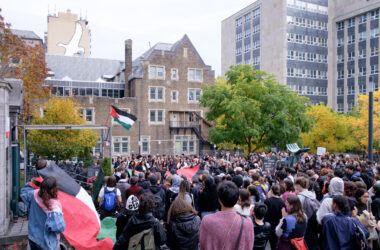
Speakers stood by the Y-intersection in front of a Palestinian flag and pro-Palestine banners with the backdrop of the McGill Arts building behind them. The around 200-person crowd, mostly students, waved hand-drawn signs. Passersby watched from a distance, while a half-dozen police officers remained around the perimeter. 

“Free free,” a SPHR member said into a microphone, kicking off the protest. “Palestine,” the crowd responded. 

“We are here today because it is our right and duty to support the people of Palestine,” the speaker continued. “What we are witnessing today is a genocide.” 

Between chants, the speaker asserted that McGill had targeted SPHR McGill in its recent emails to staff and students. The speaker also denounced McGill’s partnership with Israel’s Tel Aviv University and McGill’s history of oppression. They turned and pointed to the flower bed in front of the Arts building that is the burial site of the university’s namesake and founder, James McGill, who enslaved at least two Indigenous children, and three people of African descent.  

McGill University media relations, when asked for comment about SPHR McGill’s protest, referred The Tribune to an Oct. 20 communication from Angela Campbell, Associate Provost of Equity and Academic Policies, and Fabrice Labeau, Deputy Provost of Student Life and Learning. They called for the community to “show compassion for one another even when [they] feel scared, shocked, or outraged by current events.”

“While this is a very big ask, especially if these sentiments are rooted in personal experiences and circumstances, it is essential for our ability to function as a campus community,” Campbell and Labeau wrote.

McGill’s Provost and Vice-Principal (Academic) Christopher Manfredi denounced SPHR McGill’s social media posts in an Oct. 10 message to students and staff and ordered them to stop using the university name.

SPHR McGill responded to Manfredi’s message in a public statement on Oct. 19 condemning the McGill administration. 

“In the face of active genocide against Palestinians in Gaza, rather than offering its Palestinian students and allies support, McGill is doubling down on its complicity with the Zionist state of Israel. Intimidated by the presence of our activism, the McGill administration is attempting to erase SPHR McGill’s right to represent the students of our university, pressuring SSMU to revoke our name and penalize us,” the group wrote.

The group commented on the protest in a statement to The Tribune on Oct. 23, affirming their previous public statements against the university and citing a letter of support signed by 28 McGill staff. They also called students to join them on Oct. 25 to walk out of their classes at 1:30 p.m. in solidarity with Palestine. 

After the first speaker, the crowd heard from other SPHR McGill members, representatives from the Palestinian Youth Movement (PYM), the Association of Graduate Students Employed at McGill (AGSEM), and a McGill professor. The speakers voiced their support for SPHR McGill and rallied for Palestinians. The Delegates’ Council of AGSEM voted on Oct. 18 to approve two separate motions in solidarity with Palestine and SPHR McGill.

Prior to the student protest on the McGill campus, the PYM led a protest at 1 p.m. which started in front of the U.S. Consulate General at the corner of Rue Stanley and Rue St. Catherine. Chants of “Free free, Palestine” echoed as around 100 people gathered to protest the Canadian and American governments’ support of Israel.

(The Tribune)

The crowd grew to around 300 people by 2 p.m. and made its way toward Premier François Legault’s office on Rue Sherbrooke to join members of Independent Jewish Voices (IJV)—a grassroots Jewish organization that advocates for peace in Israel-Palestine—who were blocking the entrance to the building. A heavy police presence, with officers on foot, bikes, horses, and in cars surrounded the area while Rue Sherbrooke was blocked off from Rue University to Rue Stanley. 

“In partnership with the Palestinian Youth Movement [….] We’re calling on Legault to pressure the Canadian government to send immediate humanitarian aid to Gaza to acknowledge and respond to rising Islamophobic violence in Quebec and Canada,” a member of IJV told The Tribune while blocking the entrance to Legault’s office. 

“We’re calling Legault to recognize and respond to that rising Islamophobic violence here in Quebec and call on the Canadian federal state to do the same in Canada. And we are calling on Legault to push the Canadian government to acknowledge its complicity in the unfolding genocide in Palestine,” they continued. 

According to a CBC article on Oct. 23, the Canadian government has previously said that Israel’s actions against Palestinians do not constitute genocide

As the protest gathered around Legault’s office, PYM representative Sarah Shamy, BA ‘21, also called for justice for people in Gaza, and led protesters to chant “End the siege on Gaza now!” and “End the bombing now!” 

By 3 p.m., the SPHR McGill protest wrapped up and the protesters marched to join the PYM and IJV protest outside Legault’s office. The crowd moved through the Roddick Gates before being met with cheers as they stood opposite the PYM and IJV protest before merging into one. 

(The Tribune)

“I don’t want another genocide committed in the name of Jewish people. Certainly not in my name,” an IJV member and McGill PhD student told The Tribune. “I find McGill’s response to these events to be incredibly one-sided and narrow-minded. They’re actively erasing the voices of Palestinian students on campus and of students who support them.”

The protest started to thin out around 4 p.m. Since the crowd was small enough to fit on the sidewalk in front of Legault’s office, Rue Sherbrooke was slowly reopened to traffic by police. The PYM organizers called the remaining protesters to stage a sit-in in front of Legault’s office. They stayed seated for several hours as parked police cars surrounded them. Supporters taped signs to the front door of Legault’s office before the protest ended peacefully at 7 p.m.

(The Tribune)

“It makes me feel very energized and hopeful because, you know, day after day, when we organize a protest, even when it’s under extreme[ly] short notice, hundreds and thousands of people show up,” said Shamy, reflecting on the protest. “So it definitely makes me feel hopeful that even though our states are turning a blind eye, the people are refusing to.”

The office of Premier Legault and The Students’ Society of McGill University did not respond to The Tribune’s request for comment before the time of publication. 

Resources: 

For faculty and staff:  

For students:  

  • The Student Wellness Hub offers counselling services for students located in Montreal.  
  • Keep.MeSafe is a service accessible 24/7 whenever you need to speak (or text) with a mental health professional for support. You can access Keep.MeSafe from anywhere in the world.

This piece was updated at 11 p.m. on Nov. 13 to fix a capitalization error and to revise the estimated Israeli death toll. On Nov. 10, Israel lowered its estimated death toll following the Oct. 7 attack from 1,400 people to 1,200. 

Student Life

A look at Quebec’s reduced tuition policy: Stories from France and beyond

Since 1978, the Quebec government has upheld several bilateral student mobility agreements with foreign French-speaking countries. They signed the first of these with the French government in August 1978, and later signed another with the Belgian government in 2018, allowing French-speaking Belgians to attend the university at a discounted rate. Although these policies aim to increase student mobility, they have an underlying goal: To promote the French language in Quebec. 

Under these agreements, some foreign students holding a French or Belgian passport are eligible to receive a significant discount on Quebec’s international student tuition fees. Instead of paying the standard international rate of $42,190.38 for a Bachelor of Arts degree, French and French-speaking Belgian students can instead benefit from the province’s out-of-province tuition of $11,426.28—a 73 per cent discount. Because of the policy, ever-increasing numbers of Francophone students are drawn to McGill each year, which plays out in the makeup of the school’s student population. Together, McGill’s French and Belgian students represent a combined 18.6 per cent of the total international student population—making it one of the largest international communities at the university. 

To better understand these agreements’ impact on McGill’s student population, four francophone students shared how the tuition exemption policies have benefited their educational opportunities and fostered a strong francophone community at the university.

Paul Boura, U2 Finance

As a France-born Malaysian, Boura’s dual citizenship allowed him to benefit from Quebec’s bilateral agreement with the French government. Wanting to pursue a degree in management, he explored educational opportunities abroad, but options in France were limited and not entirely suited to his needs. McGill compelled him with its high-standing reputation, international student population, and low cost. The $11,000 annual tuition rate, combined with Montreal’s relatively low cost of living, enabled him to pursue an affordable, international undergraduate experience. 

He noted that French students, especially in Management, are “very close to each other.” 

“When I hear French being spoken, I am drawn to it,” Boura added. “Although I can say that McGill’s high French population facilitated my integration and making friends here, it did also restrict me from meeting other types of people and going outside of my comfort zone.” 

Lisa Matmati, U2 Political Science

Matmati is a second-year French student, raised both in Lyon, France, and San Francisco, USA. Her dual citizenship deeply influenced her selection of a post-secondary institution. Despite living in France at the time, she hoped to pursue a university education in English. However, she found all of these boxes difficult to check; the desire to study in English combined with her hope to pursue an international education was not easy to find. 

“Outside of France, your options of where [to go] are limited [by] price, distance and what you want to study,” Matmati explained. “Before Brexit, a lot of people went to the UK, since it’s close to home and prices were feasible, but that is no longer the case. Being American, I did want to find a North American type of school system without having to pay the cost of American schools.”

Matmati shared that without the tuition exemption for French students, she never would have considered McGill. 

“It simply wasn’t feasible for my family,” she said. “As an international student, going to and from Montreal is already a huge expense—flight tickets aren’t cheap—so if you add that to international tuition fees, it would’ve been way out of budget.”

Mathieu Fouilloux, U2 Joint Honours in Economics and Finance

Fouilloux was born in France and lived in Singapore and other cities before coming to Montreal. Despite growing up outside of France, his French citizenship made him eligible for Quebec’s international tuition fee exemption. 

Like many, Fouilloux admitted to being surprised by the number of francophones at McGill, and he recognizes that it made a positive difference in his student experience.

“I was expecting a much more anglophone experience,” he shared. “Although meeting other French-speaking students wasn’t my primary goal, being surrounded by people who spoke my first language felt comforting.”

Fouilloux shared that his first-year living situation played into his socialization patterns at McGill.

“I lived in New Residence Hall when I was a first-year, where there was a particularly high concentration of French-speaking students,” he said. “Not only did that help me create a sense of community, but I also reunited with people from my international schools that I hadn’t seen in 10 years. It really reinforced a sense of belonging between French people from international schools.”

This speaks to how big and diverse the francophone community is; that subgroups of French people from different backgrounds emerge within the larger French student population.

Olivia Neuray, U2 International Development 

Born and raised in Brussels, Belgium, Neuray moved to Canada at the age of 17 to pursue her undergraduate degree at McGill University. She highlighted the affordability of the tuition cost—in contrast with that of England—as a decisive factor in her choice to attend McGill. Neuray also cited the increased cost for European students to attend English universities due to Brexit.

Neuray insists that the influence of a student’s francophone surroundings mostly depends on the type of person they are. 

“If a francophone student only feels comfortable with French-speaking people, then I think they’ll be more prone to seek out a community of other French people,” Neuray said. “Personally, I don’t feel that way, but I was still naturally drawn toward francophone students nonetheless.”

In Neuray’s case, the high concentration of French-speaking students at McGill has had a dual impact on her experience as a francophone student. 

“Although I love the bond I have created with my [French] roommates, I didn’t travel across the world to end up spending most of my time with people from my country, or from a neighbouring country,” Neuray said. 

These international student mobility agreements have, amongst other things, revealed how the impact of tuition fees extends beyond the simple matter of access to education; they have broader demographic and social consequences on student bodies. While 2,000 French and Belgian students benefit from Quebec’s low out-of-province tuition, similar agreements with non-European French-speaking countries are seemingly nonexistent. How would McGill’s population look different if Haitian, Vietnamese, Moroccan, and Senegalese students were offered the same policies? Student population numbers from countries such as Nigeria (81) or Lebanon (119) are equivalent to or higher than McGill’s Belgian community. Yet, they face higher financial barriers when pursuing an education in Quebec. This begs the question as to what efforts have been made in this sense, or why the Quebec government has yet to undertake student mobility agreements with other countries.

The question of attracting francophone students remains a central issue in Quebec. A recent provincial policy proposal intends to double tuition fees for incoming out-of-province students and threatens to unbalance the distribution of McGill’s student demographic. Just like in 1978 and 2018, if enacted, this policy will change the face of who can and will be a McGill student. 

Know Your Athlete, Sports

 Know Your Athlete: Zach Gallant

For many USPORTS hockey players, their dreams of playing professionally ended upon their enrolment in post-secondary education. However, for McGill’s Zach Gallant, the dream is still alive. 

Hailing from Oakville, Ontario, the Redbirds’ forward had a rather unorthodox path to McGill. Prior to being picked fifth overall in the 2015 Ontario Hockey League (OHL) draft by the Peterborough Petes, Gallant was set on going to play National Collegiate Athletic Association (NCAA) hockey in the U.S., as the prospect of playing professionally was still up in the air. 

“I had just come off shoulder surgery [heading into the draft],” Gallant told The Tribune. “Going into that season was the first time I really trained in the summer so I felt really good [and] I played [for Ontario] in the Winter Games that year, and we won gold. [….] I really wanted to go to college, but being drafted so high kind of put me on the trajectory to play in the NHL.” 

The decision to play for the Petes proved to be the right choice as the Detroit Red Wings drafted Gallant 83rd overall right before he graduated high school in 2017. Following the Red Wings’ development camp, the team elected not to sign him, prompting Gallant to head back to the Petes for his first season as captain in 2018-19. Unfortunately, seven games into the season, Gallant suffered another injury that required ankle surgery. Having only played 30 games that season, Gallant elected to play in the Eastern Coast Hockey League (ECHL) so the Red Wings could get a better look at his playing style. So, Gallant played four games with the Toledo Walleye before heading back to the Petes for his final year in the OHL. 

“The Coast [ECHL] is a real big grind,” Gallant said. “You travel a lot, you don’t really live in the best apartments, you’re not making a ton of money, and that’s when I originally applied to McGill [….] But lucky enough, in the summer, I had gotten an invite to [the] San Jose [Sharks’] development camp, and they offered me a deal after that camp, which kind of changed my trajectory.” 

Gallant then signed an entry-level deal with the Sharks in 2019 and headed back to Peterborough to play in his final year of eligibility with the Petes while enrolling in a few courses at Trent University to jump-start his degree. However, Gallant’s final season was cut short by the COVID-19 pandemic. 

“It was just such a killer,” said Gallant. “We were really good. Mason McTavish was on pace for 30 goals as a 16-year-old, Nick Robertson scored 55. We had a lot of buzz.” 

With school being pushed online, Gallant enrolled at McGill in 2020 while playing in the American Hockey League with the San Jose Barracuda

“The players are just so good,” Gallant explained. “The difference between guys playing the AHL and the NHL is so slim. I really didn’t love the travel aspects of being on the road all the time, and being at the rink and then being at home, so I thought it was time to mix it up and go to school.” 

Prior to the 2023-24 McGill hockey season, Gallant was sidelined for 18 months between his last game with the Barracudas and his first game with the Redbirds. In accordance with the USPORTS rules, athletes that play professionally must sit out a season prior to becoming eligible. 

But this year of ineligibility did not hinder Gallant’s positive McGill experience. Despite being on the older side as a 24-year-old U3 student, Gallant has enjoyed his time studying finance and accounting, and the journey of returning to the life of being a full-time student. 

Gallant is planning to graduate in 2025 with one remaining year of eligibility, and is not quite sure what the future holds for him. 

“I still think I want to be an athlete and play hockey because I won’t be able to do it forever,” Gallant concluded. 

Whether that means playing in North America or Europe, Gallant is open to any path that will keep him in the game.

Arts & Entertainment, Books

The luck of receiving Voltaire’s archive

Elegant script, frayed edges, the occasional hole, and sketches of the man himself. Letters signed Voltaire, V, or—occasionally—Volt. 

Université de Sherbrooke professor Peter Lambert-David Southam has gifted McGill a stunning manuscript collection of 290 documents including handwritten letters, correspondences, and fragments of Voltaire’s work. Curated by Ann-Marie Holland in collaboration with professor Nicholas Cronk and digitized by faculty and students at the Université de Sherbrooke, these documents allow us to gaze into Voltaire’s life—particularly his time at the Château de Ferney. Four generations of Southam’s family lived in the Château after Voltaire, which is how the collection was assembled and brought to Québec. 

As Cronk noted during his lecture on Oct. 28, “The McGill Library has now become one of the world’s major centres for the study of Voltaire.” 

But why care about manuscripts today? Cronk made a case in his lecture. 

An 1841 letter has “Open Cautiously” written on the envelope. “Mr. Reed, who lives in Leeds” sent a letter to novelist Maria Edgeworth, begging for a signature. She wrote back with a signed reply—written on the inside of the envelope, knowing that if he ripped it open in his enthusiasm, he would destroy the signature.

An Ariosto manuscript at the Biblioteca Ariostea is smudged at the bottom. Over 200 years after its writing, Alfieri visited and loved the manuscript so much, he signed it like a visitor’s book (generally frowned upon today, but the librarians made an exception for Alfieri). He cried, smudging the ink.

These remnants let us see a different side of the author’s life, one unpublished, uncirculated, unremembered. Authors are often so much more than what they publish—we go far beyond the selves we choose to present to the world.

Voltaire—whose given name was François-Marie Arouet—was an enormous celebrity as well as an amusing character in his time. He won the lottery multiple times—but not through luck. He and a group of friends discovered that the prize fund exceeded the cost of each ticket. So they proceeded to divide and conquer: Buy every single ticket, split the profits, laugh at the authorities, repeat. But what about the parts of his life that society didn’t see? 

“In the French sphere, we’re all familiar with those writers mainly in the 19th through 20th centuries: Flaubert, Proust, Valéry, who kept enormous numbers of manuscripts, they kept all their work in drafts… Sadly—or maybe happily—you can’t do that for Voltaire,” Cronk said.

There are exceptions. A famous scene in Candide involves the titular character encountering an escaped enslaved person. He sobs. A manuscript was found in the 1950s, written the year before publication. This scene isn’t there—it was added later. 

The Collection allows us to connect with a different side of Voltaire. These are letters he wrote to friends, fans, and loved ones (Voltaire often gave his work to “women admirers”). There are holes. No margins. Cheap paper. But we can also see the inverse: Instances of extreme formality, almost forced and very funny. 

Voltaire wrote a letter to the (extremely Catholic) Queen of France seeking her approval of La Henriade (an epic poem criticizing the Catholic Church). The letter-writing convention of the time indicated that the more space left after the address, the more respect for the receiver. He left nearly a full page of space. She never answered. 

The Collection offers incredible insight into Voltaire’s later years: Who he was writing to, what he was writing, how. Strings of poetry, history, fun, official correspondences, and mistresses weave a tapestry of not only his essence as a person and author, but his everyday life. 

Fragments of quotidian life allow us to connect with the past on another level. These documents bring us to the fantastic—but also disconcerting—conclusion that authors are everyday people as well.

 Selected works from the collection can be viewed in the ROAAr Reading Room without appointment from Mon.-Thurs., 10 a.m.-6 p.m. with a piece of government or student ID.

McGill, News

Education professors apply to become McGill’s second faculty union

In November 2022, Quebec’s Tribunal administratif du travail (TAT) certified the Association of McGill Professors of Law (AMPL) as the bargaining unit representing the Faculty of Law’s tenured and tenure-track professors, a first in McGill’s history. Less than a year later, the Faculty of Education, almost double the size, has followed suit.  

The Association of McGill Professors of Education (AMPE) was created on July 4, 2023, and applied to the TAT for certification on Sept. 21, 2023. Dennis Wendt, Interim President of AMPE, says the demand for a union grew stronger within the faculty as dissatisfaction accumulated. 

“There are different concerns that different faculty [members] have. If there is a grand narrative, it’s dissatisfaction. And, if there’s one thing that stands out more than anything, I think, is workload,” Wendt told The Tribune. “Any one thing is not a problem, but it’s like death by a thousand paper cuts, and so we have one thing after another after another laid on us, but nothing’s ever taken away.”

Helena Silen, U2 Education, is the vice-president of Academic Affairs at the Education Undergraduate Society of McGill (EdUS). She expressed solidarity with the Education professors on behalf of the EdUS and stressed the importance of fairly compensated faculty for students’ learning conditions. 

“As students, I think the bottom line is […] that a happy teacher and a teacher who has the bandwidth and support to be present in the classroom will lead to a better class,” Silen said. “So, it makes me happy to think that they could be more fairly compensated.”

According to Wendt, teaching is only 40 per cent of a professor’s duties. Research occupies another 40 per cent of their workload, and the remaining 20 per cent is dedicated to service and community contributions. 

Wendt argues that the expected workload exceeds the time and effort professors are compensated for. In part, he attributes this issue to changes in course-relief policies, which temporarily release professors of certain teaching duties following awards, research grants, or major administrative roles. Wendt told The Tribune that the administration has “cracked down” on granting course releases in the recent past, to the professors’ dismay.

AMPL President Evan Fox-Decent has found that since unionizing, the faculty has more equal footing against McGill. The union is currently in negotiations with the university over their first collective agreement.

“AMPL is thrilled that another faculty at McGill has decided to take better control of its own governance, and is confident that our colleagues in the Faculty of Education are going to find, as we have, that the opportunities available to professors, once they organize into a certified Faculty Association, are unlike opportunities that are otherwise ever available to them,” Fox-Decent said in an interview with The Tribune.

The path to faculty-level certification was laborious for AMPL, with the university contesting the certification in a year-long legal battle and appealing to the Superior Court of Quebec for judicial review of TAT’s certification decision. Given the administration’s litigious approach to AMPL’s certification, Fox-Decent anticipates a similar attitude towards AMPE. However, he remains hopeful that the precedent law professors set will relieve the need for long litigation. 

“It’s regrettable because it’s a distraction. It costs money […] so it deprives us of a certain amount of resources and time and it expresses a regrettable attitude on the part of McGill toward some of their colleagues,” Fox-Decent said. “But it is what it is. It’s going to run its course, McGill is going to lose. And eventually, they’re going to have to just come to grips with the fact that two of their faculties now are organized, and it’s possible that others will be in the future.”

On Oct. 11, McGill informed AMPE of their decision to contest the union’s certification. In a statement to The Tribune, McGill’s media relations office reiterated the university’s commitment to Quebec’s Labour Code, but refrained from disclosing more.

“We, as an employer, are limited in what we can communicate during a unionization drive, in order to not be perceived or construed as interfering with the employee’s freedom of association,” McGill Media Relations Officer Frédérique Mazerolle wrote. 

The hearings regarding AMPE’s certification will commence on Nov. 9 before the TAT.

Research Briefs, Science & Technology

Unlocking the brain’s potential through neuroplasticity and amblyopia treatment

The term ‘neuroplasticity’ never fails to incite intrigue. It involves structural and functional transformations within the brain as a way to adapt, often in response to interactions with the environment. Over the past decades, the concept of neuroplasticity has gained substantial traction in neuroscience, offering novel insights and opening up new possibilities. 

Professor Robert Hess, Director of Research in McGill’s Department of Ophthalmology, recently published a paper in the Journal of Physiology investigating how the potential of exposure to darkness could impact neuroplasticity in adults.

Hess has dedicated his academic career to neuroplasticity, driven by his interest in amblyopia, a condition where the brain’s inability to adequately process input from one eye causes it to favour the other. The main cause of amblyopia does not lie within the eye itself but instead resides in the brain’s visual cortex. 

“[W]e can recover [visual] function because the hardware hasn’t been lost; it’s just that the software needs to be changed,” Hess said in an interview with The Tribune.

This notion of ‘software’ change is at the heart of neuroplasticity: An idea that Hess and his colleagues pursued in 2011 in their efforts to treat amblyopia in young children. They created innovative therapies, including movie and video game interventions developed in collaboration with the gaming giant Ubisoft to remarkably improve eye coordination and vision. 

In his new study, Hess investigated the impact of a 60-minute period of complete darkness on neuron activity and visual plasticity in the adult human cortex in both normal-sighted and amblyopic adults. In the brain, the transmission of information occurs through the firing of neurons as they communicate with one another. To successfully fire, the cell must be depolarized by excitatory stimuli, while the cell becomes hyperpolarized from inhibitory stimuli, leading to decreased activity of communication.

“Previously, people had shown that this works only in juvenile animals [like] kittens, and mountain primates too, but to my knowledge, not in adults,” Hess said.

He explained that past research, which demonstrated improvement of visual function in kittens following ten days of complete darkness, partially inspired his recent study. However, it is believed that neuroplasticity is most effective during critical periods—developmental periods that end when an organism reaches adulthood.

“So this is where this sort of metaplasticity comes in: There is a degree of plasticity that is over, and you can’t reactivate it, but you can modulate it. You can extend it a bit,” Hess said.

Following the 60-minute dark exposure, the researchers measured the excitatory and inhibitory balance in the primary visual cortex using magnetic resonance spectroscopy (MRS). They found that this period of dark exposure strengthened the local excitability in the primary visual cortex and boosted visual plasticity in normal-sighted adults only, while in amblyopic adults, plasticity remained unaffected.

Interestingly, the researchers concluded that the amount of brain chemicals called ‘excitatory neurotransmitters’ did not have a strong correlation with enhanced plasticity. Instead of chemical quantity, what mattered was how much these chemicals changed, suggesting that the physiological basis of plasticity in humans is more complex than the relationship of cortical excitation and inhibition.

“This is a first attempt in an area that is developing and that we know so little about, but could be important,” Hess said. 

Hess encourages everyone to have the “confidence to ask the questions that you might think shouldn’t be asked,” firmly believing that “there is no such thing as a stupid question.” 

His lab is always seeking participants for ongoing research experiments. With unwavering enthusiasm, he anticipates that this involvement will shed more light on the adaptability of the human brain at any age and contribute to the discovery of more effective treatments for disorders such as amblyopia.

Behind the Bench, Private, Sports

Let’s reel in the disappointment surrounding Kim Ng’s departure from the Marlins

On Oct. 16, Major League Baseball’s Miami Marlins announced that they would be parting ways with Kim Ng, the first woman to hold the position of general manager (GM) in any of North America’s four major men’s sports. In a statement, Marlins’ chairman and principal owner Bruce Sherman announced that while the club had exercised its team option on Ng’s contract for the 2024 season, Ng had opted to decline her mutual option. It has since been reported that the organization was seeking to hire a President of Baseball Operations––an intermediary between ownership and the GM––to whom Ng would have reported directly. The tone of coverage surrounding Ng’s departure has been largely critical of the Marlins, suggesting that Ng deserved better treatment from the club. However, this sequence of events is neither outlandish nor does it undo any of the progress achieved by Ng and other women currently occupying or pursuing front office roles in professional sports.

Ng was originally hired as the Marlins’ GM in 2020, a significant development for women and people of colour in professional sports as the first person of East Asian descent to take on the role. Following former President of Baseball Operations Michael Hill’s departure from the club, Ng worked alongside former New York Yankees shortstop Derek Jeter, who officially held the position of CEO and oversaw day-to-day baseball and business operations. When Jeter left Miami before the 2022 season, his position remained vacant for the 2022 and 2023 seasons, leaving the club without a CEO or a President of Baseball Operations. 

The Fish could have filled Jeter’s position by hiring an external candidate or promoting from within the organization. In the latter case, Ng, as the highest-ranking baseball operations executive outside of ownership, would have been a logical choice. However, Sherman and the Marlins opted for the former, exercising their club option that would have kept Ng as GM for 2024. While some pundits have criticized the Marlins for looking for a new President of Baseball Operations and making Ng second-in-command, the decision is unsurprising considering the club’s previous organizational structure and the current industry standard. While the Marlins decision not to promote Ng merits criticism given Sherman’s praise of her work as GM, the club is within their right to search externally for a President of Baseball Operations. 

The desire to keep Ng in her role as GM should be viewed as a recognition of her success. In 2023, the Marlins reached the postseason for the first time in a 162-game campaign since their 2003 World Series triumph. Ng bolstered the club’s roster by acquiring batting champion Luis Arráez and oversaw a successful 2023 trade deadline, bringing in Josh Bell and Jake Burger, who both provided a much-needed boost to the team’s offense and played a pivotal role in the team’s quest for the postseason.

Ng’s reasoning for declining her mutual option remains unclear. In a statement, Ng said she and Sherman were unaligned in their views on the future of the team’s baseball operations, however, this ambiguity does not clarify to outsiders why the ties severed. A source close to Ng has stated the decision was related to the Marlins’ budget constraints, with the club’s payroll ranking in the bottom third of the league for the entirety of Ng’s tenure. Ng, who had previously worked in the New York Yankees’ front office, might have been dissatisfied with the Marlins’ inability to lessen the gap in payroll with high revenue clubs, making it more difficult to extend player contracts after arbitration or lure big ticket free agents. 

In any case, Ng is a highly capable baseball executive with a proven track record at the sport’s highest level. Whether she finds employment with another Major League club or in the league office, her presence as a front-facing figure with the Marlins represented a refreshing change of pace in a historically white male-dominated field. The Marlins did what they believed to be in the best interest of their organization. While the end of this chapter may be disappointing for some, Ng’s time in Miami remains significant for women and people of colour pursuing careers in professional sports.

Science & Technology

Exploring the groundbreaking architecture at the “Design for the Global Majority” exhibition

As the global housing crisis worsens, a revolutionary project spearheaded by the Minimum Cost Housing Group (MCHG) at McGill’s Peter Guo-hua Fu School of Architecture promises to reverse the narrative. “Design for the Global Majority,” an exhibition happening on campus from Oct. 2 to 27, showcases affordable and sustainable housing designs tailored to the needs of low-resource communities across the developing world and beyond. 

The Tribune attended the opening keynote lecture on Oct. 19, 2023, Thousand Million Clients, by Vikram Bhatt, Professor Emeritus at McGill and former Director of the MCHG, in conversation with Ipek Türeli, Associate Professor at McGill and Canada Research Chair in Architectures of Spatial Justice, and Robert Mellin, retired Professor in McGill’s School of Architecture. 

“According to the United Nations sustainable development goals observatory statistics, between 2014 and 2018, the population of the urban poor grew from 23 per cent to almost 25 per cent […] the number is bigger than 100 million, ” Bhatt said during the lecture. “And by 2030, it’s assumed that [the global urban population] will be six billion, and six out of 10 people will be living in the cities. It’s critical, I think, that architects, urban designers, and planners engage in this.”

Türeli acknowledged the rising issues in urban settlements and drew connections to the group’s “Design for the Global Majority” project across five thematic areas: Upcycle, Harness, Plan, Leverage, and Hack.

The MCHG has concentrated on experiments with low-cost building materials and repurposing waste, aiming to develop ecological autonomous housing for under-resourced populations, which are sustainable because of their independent energy and water supplies. The extensive research on upcycling materials such as sulfur concrete eventually led the group to a new goal: Reducing the operational and environmental costs of buildings while also resolving household challenges of sanitation. To this end, the MCHG built and tested eight solar still variations, devices that harness solar energy to purify water through evaporation and condensation. 

Moreover, in building the ECOL House, one of MCHG’s first major operations, the group harnessed natural resources to resolve water and power issues in a decentralized, small-scale, and low-cost approach. They collected rainwater for showering and hand-washing, and converted the used, dirty water back into drinking water using the rooftop solar stills they designed. As for electricity, they harnessed wind energy by installing a wind machine next to the house, which provides electricity for radios, pumps, motors, and lights.

Stop the Five Gallon Flush!” is one way that the MCHG has tackled household sanitation challenges with an ethic of environmental conservation. In 1973, when Bhatt was a McGill student, the MCHG was already engaged in investigating alternatives to the unsustainable standard flush toilet model.

“Do we want to send one litre of solid waste with 20 litres of water every time we flush? Should we not be looking at alternate systems? And there was tremendous interest in this,” Bhatt recounted. “Suddenly, these ideas which were there [became] very successful.”

The MCHG designed a minimal freestanding sanitary unit, reducing water waste by combining the toilet and the washbasin. The publication, “Stop the Five Gallon Flush!”, catalogued the group’s various designs of alternative waste disposal systems, selling 5,000 copies and becoming an exemplar within the field of water conservation. Additionally, the MCHG’s various designs in the early 1970s had caught the eye of international organizations such as the United States Agency for International Development (USAID) and the World Bank, seeking out the group as they looked for low-cost infrastructure and sanitation solutions.

Indeed, the MCHG’s work is not merely limited to regions perceived as the developing world. “Design for the Global Majority” is not simply a project about housing, agriculture, and urban sanitation, but a sustainable housing solution to the ever-increasing urban population problem in Canada and around the globe. With continued research, development, and support, the designs and methodologies pioneered by the MCHG team have the potential to redefine the landscape of affordable housing worldwide.

Science & Technology

Micronutrients: Friend or foe?

McGill’s Department of Global and Public Health hosted a seminar on Oct. 18 with Dr. Brian Ward, former director of the J.D. MacLean Centre for Tropical Diseases and professor in McGill’s Faculty of Medicine and Health Sciences. Dr. Ward gave an eye-opening talk titled “Micronutrients and microbes: Some things we know and many things we don’t.” 

Micronutrients often refer to vitamins—including vitamins A through E and K—or minerals such as iron, zinc, and iodine. Although humans need them in very small amounts, they are critical to overall health and disease prevention in the body.

Diet is the primary source of most micronutrients, but other sources include sunlight, which enables the production of vitamin D in our skin.

“The gut microbiome contributes significantly to our access of several micronutrients, particularly the B vitamins, via the metabolism of the bacteria,” Dr. Ward explained.

Because micronutrients play essential roles in various bodily processes, including immune and bone functions, micronutrient deficiencies can lead to health problems.

For example, Joseph Bramhall Ellison established the association between vitamin A deficiency and measles. “In 1937, [he] found that if you give cod liver oil, a dietary supplement that is extraordinarily high in vitamin A, to babies, you could reduce mortality from measles by 80 per cent,” Dr. Ward noted. 

50 years later, scientists repeated this experiment in South Africa and demonstrated a 50-per-cent reduction in mortality rate for children with severe measles.

Unfortunately, micronutrient deficiencies can pose notable dangers for people in certain occupations that necessitate strong visual acuity at night.

“Our eyes contain rods responsible for vision at low light levels. These rods are particularly sensitive to low vitamin A levels, so one of the first signs of vitamin A deficiency is night blindness,” Dr. Ward explained. “This is why pilots in World War I and later have been routinely tested for vitamin A deficiency.”

Dr. Ward also highlighted that a surplus of micronutrients can be just as dangerous as a deficit.

“If you don’t have enough iron, you’ll have anemia and neurodegeneration. If you have too much iron, you’ll have arthritis, liver disease, and overwhelming infections,” Dr. Ward noted. “Similarly, if you don’t have enough zinc, you’ll have mental lethargy. If you have too much zinc, you’ll have nausea, vomiting, diarrhea, and an increased risk of prostate cancer.”

Having established the critical role that micronutrients play in our health, Dr. Ward gave an overview of the history of nutritional science, concluding by looking ahead to his hopes for the future of the discipline. 

From around 1850 to 1960, the field was just beginning to come into its own. “In this era, research scientists were discovering new micronutrients and figuring out how to prevent individual nutritional deficiencies,” Dr. Ward said.

Between 1960 to 1990, public health messaging emphasized the qualities of individual nutrients, but in the present era—1990 onward—the focus has shifted to overall dietary patterns. More positive messaging around diet, such as the Mediterranean diet—a primarily plant-based diet featuring the consumption of whole grains, olive oil, fruits, vegetables, beans, and nuts—has emerged.

Over the next two decades, Dr. Ward anticipates that the gut microbiome will become a focus in the world of nutritional science.

“The gut microbiome has vital impacts on the activities of the brain, heart, lungs, liver, pancreas, bone, muscle, skin, kidneys, and bladder, but very little is known about the micronutrients supplied through the gut microbiome,” he said.

Dr. Ward ignited the audience’s thinking by posing a few crucial questions to guide future research on human health.

“How does the gut microbiome react to micronutrients? Do micronutrients interact with other micronutrients? If you have the wrong gut microbiome, does it reduce the absorption of micronutrients?” he asked.

In his closing remarks, Dr. Ward pointed to the need for more research to investigate how micronutrients act alone, in concert with one another, and in concert with the gut microbiome. 

Student Life

Is Columbus Café & Co Montreal’s newest go-to study café?

Montreal’s café scene welcomes a newcomer—or rather, seven of them. Many may recognize the Columbus Café & Co yellow grizzly bear logo that seems to have suddenly popped up on street corners across downtown and the Plateau within the past year. 

The brand launched in France in 1994, becoming a pioneer in the French Coffee shop business. Since then, it has expanded to hold over 200 locations in France, Belgium, and now, North America. 

After opening their first North American location on Mont-Royal Avenue, the brand has been rapidly expanding across Montreal, and now has seven franchises along the city’s busiest commercial centres. With so many locations, I figured that there must be something special about this French coffee chain, so I popped into a few to try some food and drink, and to check out the overall vibes.

Menu

The overall food and drink selection is solid enough to fuel a study session or a quick snack break, but not impressive enough to seek out on its own.

On my first visit to the Robert Bourassa location, I ordered a “maxi” sized latte and a Cajun chicken sandwich before sitting down with a friend to study. The latte was a great deal for its size at around six dollars, and it was probably the largest latte I’d ever seen. The espresso was smooth and slightly bitter, with hints of citrus. Plenty of milk and milk alternative options were available upon demand.

The Cajun sandwich, on the other hand, was not as impressive. Despite looking and smelling amazing, with spiced chicken breast, sun dried tomatoes, and aioli, the sandwich was quite dry, likely because it was pre-made and reheated upon ordering.

At the St. Catherine’s location, I ordered a passionfruit and ginger iced tea and a heart cookie. The tea was amazingly refreshing, an exciting combination of both sugar and spice. The chocolate and peanut butter cookie was a nice balance to the tea, though it didn’t last long on my plate.

Next time I go, I’ll definitely try their cheesecake—it looked so decadent on display!

One of the Café’s specialties are its pastries and muffins, which are baked daily behind the bar, distinguishing it from other cafés that outsource their pastry making. Columbus also boasts a decent variety of pre-made sandwiches and wraps. The overall selection is very similar to the wide assortment at Milton B and the prices are pretty much on par with the famous Milton-Parc study spot.

Environment

The Columbus Café & Co locations are very much work-oriented cafés. The high-ceilinged, spacious interiors are lined with many tables, booths, and high-tops. The music is soft and inobtrusive, and the overall noise level is pretty low for a café.

I was pleased to find outlets near most tables, as computer charging is often the limiting factor in long café work sessions. Against the grain of cafés that only remain open until the late afternoon, the hours are generous, open at the Robert-Bourassa location from 7-9 p.m. on weekdays and 9-7 p.m. on weekends.

Expansion

The brand has lofty goals to expand within its Canadian markets. On Oct. 17, the company’s Canadian sector announced a partnership with Indigo Books & Music Inc. Customers can expect to see the coffee chain in the beloved Canadian bookstore within this year.

The New Go-To?

At less than a five-minute walk from the downtown campus, the Robert-Bourassa location is often full of McGill students studying or collaborating on group projects. This comes as no surprise; Columbus’ vibes are very conducive to schoolwork and will prove to be a trusty change of scene from the library, especially as we near finals season.

Read the latest issue

Read the latest issue