


Latest News

Cross-Country / Track, Sports

McGill cross-country finishes season strong at U Sports Nationals

On Saturday, Nov. 12, the McGill cross-country team headed east for the U Sports Championship meet in Halifax, Nova Scotia. With the aftermath of Tropical Storm Nicole hitting the area early on Saturday, the weather was absolutely abysmal. Heavy rain and winds of up to 80 kilometres per hour were reported by the race announcers as the runners laced up to get going. While first-year Sophie Courville and third-year Ann-Rebecca Drolet were the only runners for the Martlets, the Redbirds represented McGill as a team after placing second in the RSEQ championships.

The men’s eight-kilometre race set out first, with the Redbirds’ top runner, third-year Matthew Beaudet, settling in at the top of the pack right from the get-go. 

Mitchell Kirby of Queen’s University made the first big move of the race, separating himself from the front pack and taking an early lead around 10 minutes in. Kirby didn’t hold first for long, though, as the chase pack, including Beaudet, quickly caught up to regain the lead. In an interview with The McGill Tribune, Beaudet explained his strategy for this year’s race.

“My goal for the race was to finish on the podium, so I ran pretty aggressively instead of adopting the more conservative strategy I ran with last year where I was just aiming for a top 10 finish,” Beaudet said. “I was in the lead group of four which had a good lead 7.5 kilometres into the race.” 

Unfortunately, with around 500 metres to go, things took a turn for Beaudet and he was not able maintain his pace to finish with the top pack, instead falling back several places.

“I hit a wall and had trouble breathing and finished pretty slowly and got passed by a bunch of people there to finish 10th,” Beaudet explained. “Although the final placement was disappointing, I was happy with how I ran as I know running with confidence and taking risks will eventually pay off.”

Other notable performances on the Redbirds’ side included third-year Tom Secheyron’s 27th place finish, and Noah El Rimawi-Fine and Jack Stanley’s 55th and 57th place finishes, respectively. Fourth-year Felix Bedard rounded out the Redbirds’ top five to put McGill in ninth place overall, the same place in which they qualified. 

With rain continuing to flood the course and winds so strong you could barely stand, the women’s eight-kilometre run kicked off at 1 p.m. 

A large front pack formed, led by runners from Université Laval and the University of British Columbia. Leading the Martlets was Courville, settling into the front half of the competition. 

Courville, a physiology and mathematics student, explained how despite the weather, her first U Sports experience was exhilarating.

“It was not easy because of the rain which made the course extremely slippery, and huge gusts of wind, but with all the spectators it helped a lot,” Courville said. “It is one of the highest levels I have ever raced so it was interesting to measure myself [against] older and more experienced runners from around the country.”

While Courville was pushed towards the back at the beginning of the race, she quickly found her stride and made the most of her circumstances to gain places.

“[I] was able to move up gradually during the race and make my way to 62nd which I was pretty content with,” the first-year continued. “I think as a first U Sports experience, I couldn’t have asked for better and I am excited to level up and be more competitive in the next years.”

Courville and Drolet worked together throughout the race to finish 62nd and 89th respectively, roughly 45 seconds apart. 

“[I] worked with Ann-Rebecca […]for a fair portion of the race which helped to have a mark in this new field,” Courville said. “She also did great and as the captain of the team led us all season to having a great race today.”

With the winter months steadily approaching, the McGill runners will move indoors and switch to the track. Their first meet of the indoor season, the McGill Open, will take place on Nov. 26.

Letters to the Editor, Opinion

Letter to the Editor: The Tribune flirts with anti-Semitism

Dear Tribune,

It’s a frightening time to be a North American Jew. Kanye West’s rants are only the most visible example of the shocking re-entry of anti-Semitism into the American public sphere. Last week, I exchanged worried messages with friends after the Newark FBI warned of a “broad threat to synagogues” in New Jersey (thankfully, the threat was mitigated).

The spontaneity and indiscretion of Kanye West or Marjorie Taylor Greene risks distracting from what has been a strategic decision by the top minds of American conservatism. They adopt their model from Hungary’s Viktor Orbán, whose racist, anti-Semitic, and anti-democratic movement was propelled through propaganda casting George Soros, a Hungarian-born Jewish philanthropist, as a nefarious manipulator of Hungarian institutions and politics. One term remains inescapable in descriptions of both American and Hungarian anti-Soros dogwhistles: The “puppet master,” an anti-Semitic trope dating from the late 18th century that has since become a central image of anti-Semitic ideology.

The trope has distinctly ethnonationalist implications—right-wing American politicians can therefore threaten Jews in their own society in the same breath as they admire far-right currents in Israeli society. For many on the left, the association between pro-Israel politics and the attacks on Soros demonstrate that modern anti-Semitism is exclusively a problem of the right. But the pro-Israel shell of right-wing anti-Semitism has begun to crack. Kanye West took aim at Jewish Zionists” in one of his rants. Candace Owens, a pundit at the far-right Daily Wire and defender of West’s comments on Jews, recently shared a tweet from hard-left anti-Zionist Max Blumenthal dismissing criticism of Kanye West as a ploy of the “Zionist enterprise.” 

Here we see the overlapping connotations of “Zionist”: On the one hand, a word for a particular ideology and movement, on the other, a code denoting unwanted Jewish influence. Indeed, the infamous anti-Semitic forgery, Protocols of the Elders of Zion, is purported to describe Jewish plans for world domination as discussed at the first Zionist congress. Playing on this double meaning, antisemites with varying perspectives on Israel will often target Jews by condemning “Zionist” influence. Labelling all opposition to Zionism as anti-Semitism is a transparent and unjustifiable effort to suppress Palestinian advocacy. Nevertheless, where the term “Zionist” is today abused or attached to common anti-Semitic tropes, it becomes apparent that the left and right have both contributed to the construction of a language of anti-Semitic dogwhistles.

Look no further than the recent article in The McGill Tribune on a donation to McGill by Jewish philanthropist Charles Bronfman! I struggle to find daylight between anti-Soros canards and Students for Palestinian Human Rights’ (SPHR) unchallenged assertion, quoted in the Tribune, that McGill administrators are “puppets to their Zionist donors.”

This dangerous rhetoric has no place in student life. The Tribune owes its Jewish readers an apology and the promise that the next time we open the paper, we won’t be confronted with the same language disrupting Jewish life across North America.

When Tucker Carlson interviewed Kanye West a few weeks ago, he did not challenge West’s hateful rantingFox News just cut out the most overt anti-Semitism in favour of coded anti-Semitism that matched Carlson’s rhetoric. The example of Carlson and West demonstrates the insufficiency—and dishonesty—of merely scanning for blatant bigotry. The invocation of these tropes and their approval by editors across the Tribune hierarchy reflect systemic problems.

This week’s incident should be taken as a signal to revisit the Tribune’s uncritical relationship to politically-aligned student groups like SPHR. Among other things, what institutional atrophy brings us to the point where a News article will adopt SPHR’s prejudicial framing based on a written statement—without so much as an interview?

With frustration,

Benjamin Wexler, U2 Arts

Opinion

Oil and soup don’t mix: Why souping paintings is harming climate activism

On Oct. 14, British climate activism group Just Stop Oil entered the spotlight by throwing a can of tomato soup on Van Gogh’s famous Sunflowers painting at the London National Gallery. Although the glass-protected painting was unharmed, the action spurred a wave of outrage, to which the protesters systematically responded with a signature phrase: “What is worth more, art or life?”

To this I ask: Why do I have to choose? Why can’t I have both art and life? It seems obvious that we should not have to choose between the two, and that artistic creation is another powerful means for activism. 

Yes, I might be critical about the means used by Just Stop Oil to spread their message, but the case for their ideas needs to be made. It is important to stress that the painting was intentionally left unharmed in order to shine light on a hypocritical contradiction within our society. As soon as people learned that activists had thrown soup on a Van Gogh painting, social media was flooded with reactions of horror. In the meantime, 10 million children in Pakistan were in urgent need of lifesaving support caused by one of the most devastating climate disasters in the country’s history—but the outcry was not nearly as loud. 

This raises questions about Just Stop Oil’s actions and subsequent condemnation, as maybe they are not directly the problem. In fact, maybe the problem is the media’s reaction, insensitive to the message conveyed and only focusing on an unharmed painting. Maybe the problem is headlines such as “Climate activists throw soup at Van Gogh’s ‘Sunflowers’” and articles devoid of nuance that only portray the group’s vandalism without mentioning what they are protesting against: The hundreds of licences about to be distributed by the British government for North Sea oil and gas projects. Most people who have heard about the soup incident have never heard about the British government’s disastrous intentions, which shows the failure of modern journalism to take decisive action in the fight for the climate. It is obviously easier for journalists to feed into the scandal and the instant buzz rather than tackling the real issues at play. 

However, for anyone who did not research the group’s action further, Just Stop Oil’s last strike is just provocation for the sake of provocation, which, unfortunately, only leads to further discrediting of climate activism led by young figures. For those doubtful of recent climate movements, attacking such a beloved painting reinforces their depiction of climate activism as being performative.” The clock is ticking, and groups like Just Stop Oil do not have the time to wait for journalists to change their methods. Instead, it is time they focus on spreading their actual message, by learning how to frame issues so that they are properly covered by the media and sticking with traditional protest methods against the British government.


I am not arguing that climate activism must be clean and non-disruptive in order to be successful. Yet, I draw the line between disruption and destruction. The assault of a painting, even symbolically, is where activism loses its meaning, where it becomes nothing more than a bad publicity stunt meant to be trending on Twitter and disappear the day after. Better examples of climate activism have been seen here at McGill. Divest’s occupation of the Arts Building in March 2022 to demand the university cut their investments in fossil fuels, is a case in point. This action was the illustration of what climate activism should look like: Disruptive, thought-provoking, and pressuring the actual targets. So, I say, take to the streets, block the cars, scream as loud as you need so that people hear you. But—please don’t take my art, for oil and soup don’t mix.

Research Briefs, Science & Technology

Pneumococcal vaccination coverage concerningly low among at-risk adults

In the past few years, we have all become intimately familiar with upper respiratory infections. With the annual cold, flu, and respiratory syntactical virus all on the rise, and the ever-present threat of COVID-19 looming over every crowded room, there is a lot to worry about during the upcoming winter season. Luckily for us, many of these diseases are preventable through widespread vaccination. 

Streptococcus pneumoniae, commonly called pneumococcus, is one of these vaccine-preventable diseases. Pneumococcal infections have many presentations—the most common being pneumonia, an infection of the lungs. However, it can also present as meningitis, bronchitis, eye infections, septic arthritis, and other types of infections. While symptoms differ depending on the infected region of the body, pneumococcal pneumonia symptoms include fever, shortness of breath, chest pain, and chills. It spreads through respiratory droplets containing bacteria, direct oral contact with an infected person, or contact with contaminated material. 

While pneumococcal infections are most common in children, they are more likely to result in hospitalization and death among adults over 65 and people with chronic medical conditions. While a reliable and effective vaccine against pneumococcus exists, McGill researchers recently published a study in PLOS One that found concerningly low pneumococcal vaccination rates among at-risk populations. 

“There is very little discussion about this intervention among the general public and especially among those who are at highest risk,” wrote Dr. Giorgia Sulis, a postdoctoral researcher at McGill who worked on the study, in an email to The McGill Tribune. “Knowing what proportion of high-risk individuals are not getting the vaccine and understanding their characteristics—e.g. where they live, what is their income or education level, what is their health status, etc.—are key steps to take action and improve vaccination coverage rates.”

Dr. Sulis and her colleagues found that 45.8 per cent of participants in the study who were 65 or older and 81.3 per cent of participants aged 47 to 64 with a chronic health condition self-reported that they never got the pneumococcal vaccine, despite being eligible and at high risk of complications if they contracted the disease. Participants from across Canada were sourced through the Canadian Longitudinal Study on Aging. Researchers collected data on the vaccination status of participants via survey. Participants who had gotten a flu shot or who had an appointment with a family doctor in the past year were more likely to have received the vaccine. There was some provincial variation in vaccination rates—Quebec, Alberta, and Manitoba had the highest pneumococcal vaccination rates, while Newfoundland and Labrador, New Brunswick, and Prince Edward Island had the lowest.

The researchers also found that of the participants who received the flu vaccine, 32.6 per cent of those over 65 and 71.1 per cent of those between 47 and 64 years of age with a chronic medical condition did not receive the pneumococcal vaccine. Missed opportunities for vaccination were also seen among participants who had visited a family doctor within a year of the study, with 44.8 per cent of those over 65 and 80.4 per cent of all those with a chronic medical condition missing out on this vaccine. 

According to Sulis, who is also a member of the International Tuberculosis Centre, the main barrier to at-risk groups receiving the pneumococcal vaccine is a lack of awareness. 

“Past surveys in Canada and elsewhere have shown that one of the main reasons for not getting a pneumococcal vaccine is never having heard of it. I think this speaks to the widespread lack of information about pneumococcal vaccination programs and who is eligible to receive this vaccine,” Sulis wrote. 

Other barriers include the cost of the vaccine—not-at-risk people in Quebec must pay $49 to receive it—and limited availability of the vaccine in pharmacies and doctor’s offices. So then, how can vaccination rates be improved?

“It is essential to talk about pneumococcal disease and pneumococcal vaccines so that people learn about this issue and become aware of the benefits of getting vaccinated,” Sulis explained. “Almost everyone has heard about influenza, but very few can say the same about pneumococcus, right?”

In Quebec, the pneumococcal vaccine is free for people over 65 or who have chronic medical conditions. To find out how to receive the vaccine, contact your doctor or pharmacist. Call Info-Santé at 811 to find the closest location with pneumococcal vaccines available.

Arts & Entertainment, Books

‘Friends, Lovers, and the Big Terrible Thing’ is a moving, yet disappointing memoir

When thinking of Matthew Perry, it is nearly impossible to separate him from his popular role on the hit TV show Friends. While his name has largely been synonymous with Chandler Bing, it also is associated with a much more stigmatized term—addict. In Friends, Lovers, and the Big Terrible Thing, the Canadian-American actor holds nothing back when chronicling his mental health challenges. He shares his crushing abandonment issues with unabated honesty and doesn’t shy away from the mistakes he has made in his life. It is no easy feat to admit to suffering from addiction, let alone delving into the difficult process of getting clean, all while living in the public eye. Though there are many things to take away from this memoir, we cannot ignore one statement—could he be any stronger?

Throughout the memoir, Perry emphasizes time and time again that he should be dead. The actor recounts his copious use of narcotics, opiates, and alcohol, along with many trial-and-error stints in different rehabilitation centres. Considering the media’s distortion of mental illness, Perry’s frank retelling of his substance use disorder remains an incredibly courageous act. Given the severity of his affliction, the fact that he is still working towards self-improvement today proves that he is a fighter at heart.

Naturally, this cycle of rehab and relapse was not the only one Perry became trapped in. He recalls letting fear get the best of him and destroying multiple relationships, including his romances with actresses Julia Roberts and Lizzy Caplan. Readers have a front-row seat to the unreliability in his love life, and the author divulges many regrets regarding his failed romances.

Unfortunately, Perry’s acting credentials and flawless comedic timing do not equate to great writing. The book reads very disjointedly, with no discernible timeline. Between paragraphs, Perry jumps from his childhood in Ottawa to his time filming The Whole Nine Yards to his experiences during the COVID-19 pandemic, all without warning. Readers find it difficult to determine whether Matthew was 15 or 50 in certain scenes, and the confusion is only cleared up by several overt contextual cues. Additionally, his complaint of making only $50,000 for a project after making millions per episode on Friends seems in poor taste. 

Perhaps the most surprising part of the autobiography is the sheer amount of Canadian content: Matthew was born in Montreal, and he even references McGill University. He reveals his quotidian life in Ottawa, including his surprising connection to the late Prime Minister Pierre Trudeau and his son Justin, whom he claims to have once physically fought. Sadly, the finer details of this altercation remain shrouded in mystery.

Interestingly enough, Friends does not play as big of a role in Perry’s narrative as fans might think. He does talk about how the TV show changed his life—especially his bank account—but audiences looking for hot gossip from the set will be sorely disappointed. He speaks about his former castmates and crew members with fondness. The only tumultuous memories included are those caused by Perry himself—he recalls falling asleep during a scene and having to be nudged awake by Matt LeBlanc—which are interesting but not buzzworthy. All that to say, Perry still engages his audience. His distinct voice manages to captivate readers, even if it is being used to take strange digs at Keanu Reeves that he refuses to elaborate on.

Fundamentally, Friends, Lovers, and the Big Terrible Thing is exactly what you would expect from Matthew Perry: An exhausting and heartbreaking book that blends comedy and brutal honesty. Even so, the writing comes off a tad lacklustre and inconsistent throughout the narrative. He’s a talented, but broken man, and he appears to be taking his time putting himself back together. Even if he can be out of touch or self-centred, his frankness and vulnerability are brave and commendable. So whether you love or hate him, let’s wish Ms. Chanandler Bong the best.

Friends, Lovers and the Big Terrible Thing by Matthew Perry is available wherever books are sold.

McGill Recommendations, Student Life

Tips to survive the impending Montreal winter

With the temperatures steadily dropping and the leaves quickly disappearing, it’s time we accept the inevitable: Winter is coming. If it’s your first winter here, you’re in for quite the treat. If it isn’t, then great—I hope you remembered your jacket. 

After some 12 years of living in Montreal and experiencing these gruelling winters, I’ve grown accustomed to the bitter winds that slap me in the face on a brisk winter morning, the feeling of snow melting into my “waterproof” boots, and the sun setting before I’ve even had a chance to grab a second coffee. Not only is it the most brutal season of the year, but it’s also the longest. So, it’s important to know what to expect and how to deal with winter when it arrives. “Attache ta tuque,” as the Quebecois say. 

Punctuality is overrated; dressing appropriately is not

The key to preventing a “winter burn-out” is merely this: Staying warm. So let’s not beat around the bush—if you want to be fully functioning by the end of the season, first things first: Wear a coat! A winter one. I know it can be hard to make the distinction between what is considered a “fall coat” and a “winter coat,” so let me help you out. If your coat looks like one of those light, skinny ones middle-aged people buy when they’re having a midlife crisis, then that’s probably not what you should be wearing when it’s -15 degrees Celsius outside. Get yourself a proper coat—the thick, padded, warm, insulated-to-the-teeth kind that shields you from the cold.

Along with coats, hats, too, are a must. It’s one thing not to wear gloves and shove your fingers in your pockets, but there really is no equivalent for your head, nose, and ears—let’s stop pretending that pulling your hood over your head does the job. While you’re at it, maybe consider investing in a scarf or even a pair of earmuffs. The bottom line is: Don’t rush out the door in minimal winter clothing. Take time to bundle up—even if it might cost you a few extra minutes of your day.

Getting around town in the wintertime

To the students who plan on boycotting public transport, thinking they can walk instead… well…good luck. Walking is certainly doable when you live within a five-block radius of campus, but if you’re located anywhere beyond that, you might want to consider investing in an OPUS card. With over 215 bus lines and 68 metro stops across the island, the public transport network saves Montrealers a lot of trouble when it comes to getting around. And here’s a not-so-secret-secret for you: McGill students get access to an OPUS card with discounted student fares, which you can order through Minerva! 

Resisting the urge to hibernate

Let’s face it: Joining the squirrels in hibernation has never looked more appealing. Now, however tempting this may be, it’s essential to get outside and spend time with friends. The city has many outdoor activities to keep you occupied, which are often free and accessible. If you’re steady on your feet, there’s skating at parks such as La Fontaine and Maisonneuve—they offer skate rentals. Or perhaps if you’d rather hurtle 100 miles an hour down a hill—then maybe sledding is for you. If you need a break from your studies, you could enjoy a scenic walk up Mount Royal or attend events hosted by the city’s annual “Montréal en Lumière.”

Winters in Montreal are certainly not for the faint of heart, especially when they last until late April, but you will quickly get used to them. Just remember to wrap up and get outside when the sun’s out. Reserve the Netflix days for blizzards and freezing rain storms—did I mention those? Oh, right… anyway, don’t worry, you’ll survive. And before you know it, the warm weather will return, and you will be back on campus, in the sun, waiting in line for a hot dog again.

Art, Arts & Entertainment

Oh, the tattoos we’ve inked

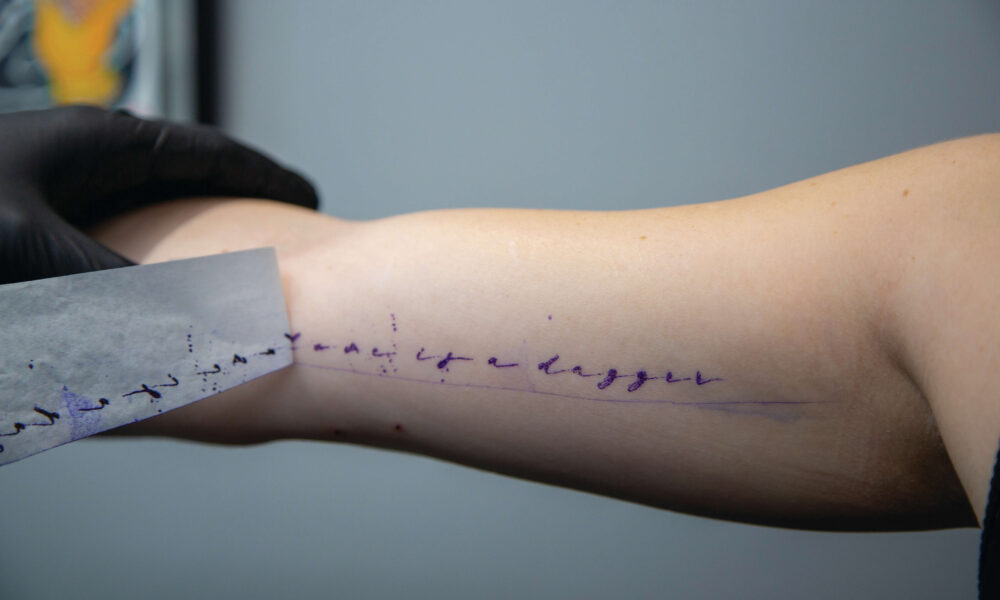
An ornate stone house with a plaque reading “Fais-Moi L’Art Gallery” sits on the corner of Rue Cherrier and Saint André, spilling light onto a quiet, dark street. It is the opening night of Poline Harbali’s exhibit They wrote the countries borders on my skin, and all the commotion is inside. People huddle around curated displays featuring photos and journal entries, chronicling the tattoo journeys of 10 women and non-binary people. Working with Poline Harbali, these individuals each designed a tattoo invoking the spirit and personal importance of their Canadian immigration story. Taking four years to complete, her exhibit highlights the immigration journey and its diverse challenges.

“The first three years were about meeting all the participants and researching all the materials,”  Harbali explained in an interview with The McGill Tribune. “I didn’t know exactly what I wanted to do visually. It was more about […] creating a link with them and working on the tattoo.” 

The project is divided between two rooms, each with its own focus. In the first, transcripts of interviews with the participants and working designs of the tattoos are displayed on the walls. A true chronicle of the process, this space shows the ups and downs of the journey. The second room, using multimedia, immerses the audience into a tattoo session with the participants. It can be jarring; a tattoo table covered in sheets and imitation blood placed in the centre captures the eye. There are, however, more subtle aspects as well: 10 screens lining the wall show the participants’ eyes, and by donning headphones, one can listen to the tattoo gun’s whirl, the light breathing of participants, and ambient music which all together give the impression of being inside the tattoo parlour.  

The women and non-binary people Harbali covers in the exhibit have immigrated from countries such as Lebanon, Senegal, and Guatemala. Originally, she had interviewed people of all genders, but in seeing common themes amongst these two groups, Harbali decided to narrow her search.

“[A]fter many interviews, I realized we, like women and non-binary people, have the same relationship to our body in public spaces, like our body is not really our body,” said Harbali. “It’s always something people command and see and discuss so something in common between all of them came out. [Tattooing is an] act of reintegrating our own bodies and not having to ask for permission.”

Harbali’s own journey with tattooing started in concurrence with this project. She remarked that during the immigration process, feeling passive and alone, she wanted to get tattooed to have power over her own body and feel stronger. She learned how to tattoo for the project because she felt it created a more intimate link between herself and the participants. Harbali worked with each person to fashion a design reflecting their immigration journeys. She emphasizes, however, that the design itself is not what’s important.

“It’s not really about the design of the tattoos because it’s very personal, and this is their own story,” said Harbali. “It’s more about the relationship between the body as immigrants and the tattooed body, like why do you want to get tattooed as part of your immigration journey?”

“[Tattooing is an] act of reintegrating our own bodies and not having to ask for permission.”

Harbali said she hasn’t seen any common themes emerge among the many immigration processes and hopes the project reflects that diversity.

“This is […] 10 stories amongst thousands…but all of those stories are very different. Some of them have very difficult times during the immigration processes, others [did not],” Harbali concluded. “[There’s] not just one [story] about immigration, there are many.”

They wrote the countries borders on my skin by Poline Harbali will be displayed at the Fais-Moi L’Art Gallery until Dec. 30

News, SSMU

SSMU’s VP Operations and Sustainability executive position remains vacant despite attempts to fill it 

Since the resignation of Anuradha Mallik in 2017, the Students’ Society of McGill University’s (SSMU) vice-president (VP) Operations and Sustainability position has been vacant. The SSMU Legislative Council approved a motion in January 2022 to remove the position from the SSMU Constitution. The motion, however, was never ratified through a referendum, despite it being the required procedure for amending the SSMU Constitution per section 20 of the governing document.

In an email to The McGill Tribune on behalf of the entire executive team, SSMU President Risann Wright explained the position’s origins and why SSMU has since phased it out.

“The role was established in 2016, following the reorganization of the vice-president (Finance and Operations) role,” Wright wrote. “In 2017, the former VP Operations and Sustainability resigned from the position in the summer, and the Executives and the Board opted to not re-elect the position for that year. Following this, the subsequent cohorts of executives have approved motions to not elect a VP Operations and Sustainability role via the Legislative Council and Board of Directors (BoD), and the responsibilities have been absorbed by the executive committee.”

Ahead of the 2022 SSMU executive election, Alice Clauss, U3 Arts and Science, submitted her nomination packet to Elections SSMU with the intent of running for VP Operations and Sustainability. She was informed, however, that the position would not be included in the election, despite it being mandated by the SSMU constitution to hold a seat on the BoD.

According to Sarah Paulin, 2021-2022 SSMU VP Internal, the VP Operations and Sustainability portfolio needed to be more substantial to warrant a full-time executive role. Paulin explained that the responsibilities of the position were redistributed amongst other executives and full-time SSMU staff to compensate for its removal. 

“After […] COVID started, we found […] ways through hiring more full-time staff and redistributing the positions within the executives, that having a VP Operations would just be a financial strain on the company,” Paulin said in an interview with the Tribune. “So we figured, why pay another salary when we’ve already found a way to manage without a [seventh] executive?” 

Clauss believes this decision violates SSMU’s constitutional mandate to fill all executive positions or otherwise ratify any motions to amend the constitution through a student referendum. She brought the issue to the SSMU Judicial Board at a hearing on April 5 to determine whether SSMU’s decision not to run the election was unconstitutional and if the role should be reinstated. Six weeks after the hearing, the Judicial Board released their ratified decision, determining that the role would not be reinstated and that SSMU’s decision to not run the position was constitutional. The decision stated, “the Board of Directors’ decision supersedes what is written in the SSMU Constitution.” 

In an interview with the Tribune, Clauss said she finds SSMU’s internal structure to be overly bureaucratic and believes that SSMU’s actions demonstrate a lack of accountability.

“It’s really important that our students’ Society is accountable to us; it’s a student society,” Clauss said. “The reason I went through this process is I thought it was important to try to find that accountability there. And then in an ideal outcome, it would have ended up with that role being returned and then having that more focused attention on the environment and sustainability at SSMU.”

Clauss argues that SSMU must dedicate a full-time executive position to adequately address environmental concerns.

“Sustainability is a very important concept right now,” Clauss said. “Imagine all the different sustainability initiatives that could have been happening if it had been […] someone’s sole duty.”

The Tribune reached out to all current SSMU executives to learn more about how the Society has reallocated the VP Operations and Sustainability’s salary and responsibilities, but none responded.

Research Briefs, Science & Technology

What’s in your water? This revolutionary AI technology breaks it down

Across the planet, corporations and municipalities account for over 30 per cent of accessible and renewable freshwater usage. They generate colossal amounts of wastewater containing various concentrations of elements such as copper, zinc, titanium, and mercury, which unfortunately make their way into our drinking water. 

Now, instead of worrying about what’s in your next glass of tap water, imagine you could point your phone’s camera at it and know exactly what substances lie within. It sounds like complete science fiction, right? As crazy as it may seem, a team of McGill researchers recently published a ground-breaking paper documenting a new technique that may be able to detect these substances in waterways in real-time. It involves combining artificial intelligence (AI) with the company’s digital in-line holographic microscopes, also called nano-DIHM technology. 

This amalgamated AI-nano-DIHM technology is made up of two essential parts: Hologram recording and reconstruction. With hologram recording, the nano-DIHM shoots out a beam of light through a pinhole that hits a water sample. From there, the object produces a magnified diffraction pattern that is recorded by a computer. The hologram is then reconstructed and processed by two aptly-named aquatic AI software programs—Octopus and Stingray. 

Hundreds of previously recorded holograms were used to train Octopus and Stingray; by the end of the process, each program could accurately determine the composition of whatever sample was placed in front of them. The AIs registered an accuracy of over 99 per cent when tested on their ability to identify oil droplets in mixtures of metal oxides. 

The software does not just define a sample’s composition but also assists researchers in describing the water’s characteristics. 

“For the contaminants […] the things you do not know exist, [the software] would be able to identify it,” said Parisa Ariya, a professor in McGill’s Department of Chemistry and Department of Atmospheric & Oceanic Sciences and one of the lead researchers of the study, in an interview with The McGill Tribune. “By classifying the things you know […] the things you do not know can be identified physically, so it has a lot of potential.”

However, the water composition identification goes beyond describing physical characteristics such as size and shape.

“We are working at doing chemical composition as well [as] it allows, for example, [for the further study of fields] from medicine and pharmaceutics to aerosol and climate change, to pollution in air and water,” Ariya explained.

More remarkable is nano-DIHM’s processing speed—its limits are based solely on the computational power provided. 

“This technology allows us to do two things—one of them is form a sensor that will be detecting contaminants [using] AI […] in the blink of an eye, 32 milliseconds, and we can do better than that,” Ariya said. 

Like many recent technological advances, Ariya’s research began because of COVID-19. The research took inspiration from another of the researchers’ papers that focused on using nano-DIHM on aerosolized particles

“COVID served as a catalyst,” Ariya said. “We wanted to serve humanity better, and we […] also […] got our alarms up. We knew that a […] major part […] was airborne, and we wanted to provide solutions.”

Nano-DIHM is not without competitors. The image resolution of nano-DIHM is worse than that of the previous method of choice—scanning transmission electron microscopy (S/TEM). But S/TEM microscopes are not portable and are far more expensive. They can weigh up to 80 kilograms, be half a metre tall, and cost anywhere from $60,000 to $250,000 USD

Since nano-DIHM is physically much smaller than S/TEM and can work with live and moving samples—such as rushing water—scientists can bring nano-DIHM on-site and perform the technique there, hopefully decreasing the timeline for data collection and analysis. The possibilities do not end there.

“Oil spills happen around the world very, very often, [so hopefully] we can look into [spills] for forecasting as well as […] how we can actually sustainably remove it, and how much […] less energy […] we can use,” Ariya said.

Research Briefs, Science & Technology

Innovative algorithm develops theories on rules of human language

Over the last several years, artificial intelligence (AI) has made huge strides forward in the areas of language modelling and translation. Recent improvements are exemplified by the accuracy of machine translation services such as Google Translate, the ability of devices like Amazon’s Alexa to interpret and respond to instructions given in conversational speech, and the automated production of summaries based on a source text. 

However, traditional language-modelling AIs still require exposure to massive amounts of examples, often in the millions, to learn how to understand or produce language. Additionally, while these AIs do develop an understanding of language rules, exactly how this understanding works remains unclear. 

“There’s been this huge and quite breathtaking improvement in the performance of things like language models […] but what they do internally, the kinds of implicit theoretical representations that they learn, are just not available for humans to read,” explained Timothy O’Donnell, assistant professor in McGill’s Department of Linguistics, in an interview with The McGill Tribune.

O’Donnell recently co-authored a research article published in Nature Communications describing an innovative approach to training AI to understand the rules of human language. O’Donnell and his team of researchers from McGill and the Massachusetts Institute of Technology focused on an area of linguistics problems in morphology—a branch of the discipline that seeks to understand the internal structure of words. The team looked more specifically at patterns of sound change within languages and they took morphology problem sets from standard introductory textbooks as their testing grounds for the AI. 

To solve these simple linguistics problems, the researchers developed an AI that could turn them into complex logical expressions, which could then be understood and solved by a computer.

“We took a problem that we can read, we transformed it to an extremely complicated logic problem, which we can’t,” O’Donnell said. “If you looked at it, you would have no idea what was going on. But there’s specialized software that’s really good at solving these kinds of logic problems.” 

By transforming linguistics problems into logic problems, O’Donnell and the researchers could train their model to develop morphological rules and patterns using significantly fewer examples than traditional AI techniques would usually require. 

Another advancement is that its output is completely human-interpretable. In other words, the system creates rules that can be read and understood by a human researcher. Taken as a whole, the process is remarkably similar to the way that human linguists develop theories about language. 

“We are very inspired by the way in which […] professional linguists proposed theories,” O’Donnell said. “If you go and you’re studying a new language somewhere, you collect some data, and then people immediately, even when the datasets are relatively small, start proposing theories of phonology and the morphology of these new languages.” 

This software could even be considered a “theory builder,” or an AI that analyzes a set of data and is able to develop its own scientific theories to explain the data. Models like this, which are also being worked on in other scientific fields, have the potential to drastically change the way that researchers develop theories. 

“One of my collaborators called it thinking prosthetics, so, a way to extend the ability of researchers to think by using automated tools to help them search for good theoretical proposals,” O’Donnell explained.

This particular model is still functioning at a fairly basic level and being tested mostly on pre-determined examples. However, given the speed of development in AI right now, one can imagine a near future where researchers are assisted by, or even surpassed by, this type of theory-building AI.

Read the latest issue

Read the latest issue