


Latest News

McGill, Montreal, News

Montreal shelters lead the city in second annual Every Child Matters March

On Sept. 30, hundreds of people gathered in front of the George-Étienne Cartier monument at the foot of Mount Royal before marching through Montreal to commemorate the National Day for Truth and Reconciliation—also known as Orange Shirt Day. Since 2021, Sept. 30 has marked a federal statutory holiday, although the province of Quebec does not officially recognize it. The event, organized by the Native Women’s Shelter of Montreal and Resilience Montreal, featured speeches and performances from many Indigenous community members, such as Kahnawá:ke Grand Chief Kahsennenhawe Sky-Deer, Inuk musician Elisapie Isaac, the Generational Warriors group, and the Travelling Spirit Drum group.  

Many of those who attended the walk wore orange t-shirts to honour the Indigenous children who were taken from their homes and forced to assimilate under Canada’s residential school system—many of whom were abused and never returned home. Marchers traversed Milton-Parc, where a disproportionate number of unhoused Indigenous people reside, and paused for speeches in front of McGill’s Roddick Gates before concluding the event at Place du Canada. Chants like “no pride in genocide” and the call-and-response “when I say land, you say back” echoed through downtown Montreal. 

Steve McComber, a Mohawk elder from the Kahnawá:ke Nation and a speaker at the event, emphasized that the path towards Truth and Reconciliation requires a commitment to learning about the injustices that Indigenous communities have suffered.

“Becoming aware of what is the truth, is the beginning to reconcil[ing],” McComber said in an interview with The McGill Tribune. “Our people lived under oppressive policies for generations, but people are not aware of that. So once people become aware, [then it will be] the beginning for things to change.” 

Nakuset, the executive director of the Native Women’s Shelter of Montreal and one of the march’s organizers, believes that attending Truth and Reconciliation Day events is a significant first step that non-Indigenous people can take to become educated and more active in the fight against anti-Indigeneity.  

“I want [settlers] to be here so they can listen to the messages that everyone will be giving,” Nakuset said in an interview with the Tribune. “Everyone has a different message […] for people to absorb it and to do better as opposed to deflecting, ignoring, and walking away, which is what we usually get.”

On the same day, McGill’s fourth “We Will Walk Together/Skàtne Entewathahìta” took place at the Education Building from 10 a.m. to 12 p.m. The event featured speeches and performances from Associate Provost (Indigenous Initiatives) Celeste Pedri-Spade, Alex Allard-Gray, and other Indigenous community members. Local Indigenous vendors and artisans and the Indigenous Law Association, which held an Orange Shirt sale, attended to fundraise for organizations such as Resilience Montreal. 

Olivia Bornyi, U2 Arts and a member of McGill’s Indigenous Initiatives Unit, led the programming and the communications committee for the event. Bornyi believes that Truth and Reconciliation Day is “integral to students’ education” and hopes that McGill’s event starts a conversation about the historic oppression of Indigenous peoples. 

“I would have liked to see a little bit more student turnout, but we did get a fair bit,” Bornyi said in an interview with the Tribune.  “It’s a very emotional day for many members of the Indigenous community, which is very important to recognize.”

Philippe Haddad, 2L, used his position as a member of the Rugby Leadership Group to get his teammates to attend the event. Haddad called on the McGill community to become more “active participants rather than complicit bystanders” by engaging in conversations about Indigenous rights. 

“Many [dissociate] from Truth and Reconciliation by regarding it as a legislative issue,” Haddad said in a statement to the Tribune. “As an educational institution, McGill should be highlighting safe spaces for dialogue and storytelling […] specifically for Indigenous folks, providing alternatives to settler-colonial educational structures, and freeing itself from settler-colonial influence in […] governance as a first step to addressing a prevalent imperialist mindset.”

Album Reviews, Arts & Entertainment

‘Hold The Girl’ explodes with originality, but is lost among the debris

Back in 2020, Rina Sawayama released her debut album, SAWAYAMA, and entered pop consciousness like how one would kick down a door: Fierce and unapologetic. Her sophomore endeavour, Hold The Girl, has Sawayama looking back through the very same doorway, retracing her footsteps down the path of her childhood. Released Sept. 16, the record is a loving and forgiving ode to her younger self, thematically orbiting around her experience growing up as a queer, Japanese, first-generation British immigrant woman. 

 Hold The Girl is at its best when it is conceptually and sonically focused, as exemplified by the ABBA-interpolated lead single, “This Hell,” the otherworldly “Frankenstein,” or the frenetic “Imagining.” By interweaving a wide array of genres––hyperpop and rock in the span of two songs––Sawayama embodies her ambitious and striking nature as an artist. Hold the Girl twists, turns, and constantly surprises the listener. But the record occasionally gets lost in its own maze and loses coherency throughout its 46-minute run-time, such that softer tracks like “Catch Me In The Air” fall flat instead of offering a peaceful break. The thematic thread attempting to hold the album together loosens with every startling sonic shift, and sitting through the entire thing can quickly become overstimulating.

Despite this, Sawayama’s insistence on honesty and innovation is commendable, providing a refreshing addition to pop music in an era where, as Beyoncé famously said, “[p]eople don’t make albums anymore.” Hold The Girl and its tracks evade the allure of creating a song around one catchy line intended to go viral on TikTok and instead offers a driven project stuffed with introspection and excitement—even if it occasionally bursts at the seams.

For those who appreciate pop music, Hold The Girl is a goldmine—you just need to dig. 

Hold The Girl is available to stream on all streaming platforms

Research Briefs, Science & Technology

Honey, I shrunk the brains!

Aging is one of the few truly universal experiences, yet it is one of those things that no one really looks forward to. Along with visible signs like wrinkles and grey hair, however, comes a more insidious and harder-to-combat symptom: The decline of brain function. But according to a new study from a team of McGill researchers, the link between aging and cognitive decline may not be as clear-cut as previously believed. 

Jamie Snytte, a third-year PhD student in clinical psychology at McGill, supervised by Dr. Natasha Rajah and Dr. Signy Sheldon, along with other colleagues, published a study centred around memory and its relation to brain volume. Snytte collected memory data from 125 adults by having them perform memory tasks—like showing a face on a screen and having the participants attempt to recall where the face was shown. 

Those who performed worse on these tasks were mostly shown to have a lower volume of brain matter in their hippocampus. The volume of the hippocampus is directly related to brain function and one of its main roles is to consolidate information from short-term to long-term memory. A decrease in hippocampal volume has been associated with decreased memory function in older adults. 

Snytte and his team measured the subjects’ performances on memory tasks, then measured the volume of the participants’ hippocampi and calculated the differences between participants. The researchers found that the hippocampi of participants who had trouble remembering details were smaller. The grey matter volume was lower in these participants, meaning that their hippocampi were just smaller than those of higher-scoring participants. 

Contrary to popular belief, this study suggests that old age is not in and of itself the cause of decreased cognition. Rather, it is the breaking down and atrophying of memory-related structures in the brain that lead to the decline. Not everyone will experience memory loss at the same time or to the same degree of severity. 

In an interview with The McGill Tribune, Snytte explained that atrophy in the brain is a normal part of aging.

“In healthy aging, there are lots of brain structures that tend to change, that tend to atrophy,” Snytte said.

According to Snytte, this atrophy can be measured in three main ways.

 “You’d look at the size [of the brain]—the amount of neurons or brain cells within a certain structure and how that changes,” said Snytte. “You can look at changes in brain function—so how much does a certain brain area activate, how much blood does it require to complete a certain task. And you can also look at white matter tracts, [which] are paths that connect different brain areas.”

Although the prospect of cognitive decline may seem like a dreary fate, Snytte’s team found something else in their studies: Other parts of the brain were able to step in and take over to make up for the decreased function in the hippocampus.  

“You can see stories of patients who are missing a big chunk of their brain, but their cognition is totally preserved,” Snytte explained. “They can do this by activating other brain regions, and this is usually called compensation.” 

Pinpointing areas of brain degeneration is an important step in finding successful treatments for degenerative cognitive diseases. It is also a fascinating look into the complex nature of our brains. Our brain has a backup generator of sorts, preventing the worst effects of the cognitive decline that come with aging, pushing us onwards with quite literally fewer brains, but just as much ability. 

Arts & Entertainment, Theatre

‘Meet Me’ provokes reflection through interactive theatre

In the “post”-#MeToo era, consent, sexual misconduct, and cancel culture have become hot-button topics present throughout news articles, thinkpieces, movies, and TV shows alike. From fiery op-eds insisting that there is a stark difference in severity between sexual assault and sexual misconduct to columnists who disavow complaints about ‘cancel culture’ as an excuse to avoid accountability, it seems that everyone has a different approach to these contentious topics. 

Enter Meet Me, an interactive new play presented by Live Action Theatre Project and Teesri Duniya Theatre. This intimate production engages audiences in conversations about sexual harassment and power dynamics directly by having them follow one of the play’s three characters for the entire show. Audience members accompany their assigned character to the show’s three distinct settings, witnessing their unique perspective of an evening where a sexual encounter goes terribly wrong. 

Along with seven others, I followed Gemma (Darragh Mondoux), an accomplished young artist and academic eager to make an impression on her attractive new co-worker Qas (Zeshaun Saleem). Throughout the play, each character consults their audience on how they should proceed, allowing you, as an audience member, to collectively shape the course of the narrative in real time. For Gemma’s group, this meant weighing in on everything from which outfit she should wear for drinks with Qas and her academic mentor Roslyn (Leigh Ann Taylor) to how she should respond to a breach of her consent. 

Audience members were given earbuds and a cell phone specially programmed to display social media posts, texts, voicemails, and video calls from the other characters, providing additional context that could influence the group’s decisions. With this unique structure offering a choose-your-own-adventure experience, audience members inevitably butt heads if they disagree on how exactly the adventure should play out. But in the show’s press release, Meet Me director Rosaruby Kagan expressed her acceptance and enthusiasm for these potential conflicts. 

Meet Me is an opportunity to get people together who may not share the same political beliefs or ideology, to talk about the divisive theme of call-out culture and responsibility for one’s actions,” Kagan wrote. “I am hoping people will leave the play understanding on a visceral level why someone might make choices that they themselves wouldn’t.” 

Though there were a few small disagreements within my group, we often came to a consensus about how Gemma should proceed after Qas violated her consent during a sexual encounter. Instead, moments of potential conflict mainly emerged during the play’s outdoor transitions. 

Meet Me is created in the style of promenade theatre, in which a show guides audience members to different locations from scene to scene and encourages them to participate in the performance itself. In my case, this meant following Gemma on foot to her artist’s studio (a room in the Armstrong Building decorated with black and white portraits) and the campus bar (Morrice Hall 017). Those in Qas and Roslyn’s respective audience groups followed their assigned character as they moved between the campus bar and a third location. 

The journey down McTavish between scenes was short, but there were still plenty of interruptions from passersby. A perplexed dog-walker strolled straight through one scene, and a few confused students stopped to giggle and gawk at a passionate make-out between Qas and Gemma by the McTavish Gates before hurrying past. 

These moments certainly caused some awkwardness amongst the crowd, but they also intensified the play’s authenticity. The production’s setting is a university campus, so it makes sense that other students would notice if two individuals started to go at it out in the open. Furthermore, staging this moment—a precursor to the sex scene where Qas violates Gemma’s consent—in such a public space is unfortunately pertinent given the pervasive nature of sexual violence at postsecondary institutions.   

In presenting this striking energy alongside its open discussion of consent, violation, racism, and cancel culture, Meet Me proves to be a thought-provoking, engaging theatre experience that will keep audiences thinking long after the metaphorical curtains close. 

Performances of Meet Me run until Oct. 8 at TNC Theatre, 3485 McTavish (Morrice Hall). Tickets can be purchased by calling 514-848-0238 or online (Students: $20 ; Regular: $30).

Research Briefs, Science & Technology

Mapping behaviour using genetic biomarkers

What if you could visibly lay out your entire genome sequence in front of you and see almost everything that explains who you are, from your eye colour to whether you’re an introvert or an extrovert? If this were true, we look at someone’s genes and calculate whether they will develop attention deficit hyperactive disorder (ADHD) and offer them treatments right away. Unfortunately, accurately reading biomarkers isn’t as easy as laying the genome out like a map. Luckily, there are researchers working on ways to solve this problem. 

Dr. Patricia Pelufo Silveira, an associate professor in McGill’s Department of Psychiatry, is one such researcher. Pelufo Silveira, along with the help of Dr. Cecilia Flores, a professor in the Department of Psychiatry, developed a novel genetic scoring technique called expression-based polygenic risk score (ePRS), which they are using to score impulsive behaviour. 

“High impulsivity has been associated with several psychiatric disorders,” Flores said in an interview with The McGill Tribune. “Many times, it’s used as a trait of vulnerability.”

Their technique involves studying an entire gene network associated with DCC, a gene shown to influence impulsivity. Flores has researched the DCC gene extensively and found that it has a profound impact on guiding growing axons towards assembling the nervous system. The researchers used gene expression datasets from mice and identified the genes that had correlated co-expression with DCC. Then, a program  filtered the genes according to the ones most expressed during the first 18 months of life, creating a DCC co-expression gene network. The genes were then mapped and weighed based on their effect on the brain, resulting in the genetic risk score. 

“We know that [DCC] is very important in the maturation of impulse control,” Flores said. “We also identified where in the brain that the function of this gene is important for the development of impulse control.”

EPRS goes much deeper than previous genetic scoring methods, such as the original polygenic risk score (PRS), which determines whether one is at high risk for a given disorder by looking at known, correlated genes. So, instead of connecting a gene to a disease like PRS does, ePRS connects a gene to other genes.

“The main difference is, instead of marking risk for disease, we’re marking variation in a biological process,” Pelufo Silveira said in an interview with Tribune

“It’s not only the genetic variance in a person and associating [that] with a disorder, but it’s how that variance influences the gene function of a process in particular brain regions,” said Flores. 

Not only is ePRS much more accurate, but it is also excellent at controlling for genetic factors such as ethnicity. 

“We want what we call external validity, to be valid to many different groups independent of their genetic background, but when you’re using genetics, this is difficult because people’s [genetic markers] vary depending on their ancestry,” Pelufo Silveira explained. “[ePRS] is strong enough to predict this difference across different ancestries.”

Flores and Pelufo Silveira also considered external factors such as social environment or drug exposure, which Flores stressed as being extremely important when researching ePRS in a clinical setting.

“You [want to] have more than one metric for each individual [which] really personalizes the intervention, that’s the goal,” Flores said. 

Given that everyone is impulsive to some extent, Flores says that a holistic approach is key when distinguishing between normal impulsivity and harmful impulsive behaviour.

“A single trait is not enough, you need information about other aspects to form a diagnosis; [some behaviours and circumstances] are red flags.”

In the future, Pelufo Silveira hopes that ePRS can be used to identify other biomarkers, not just those for impulsivity.

Along Party Lines, Montreal, News

Along Party Lines: Quebec’s provincial election results 

This article was last updated at 12 p.m. on Oct. 4.

Voters streamed into polling stations to cast ballots in Quebec’s provincial election on Oct. 3. Polls closed at 8 p.m., concluding five weeks of campaigning dominated by issues such as language and minority rights, Indigenous issues and separatism, and housing and healthcare. The McGill Tribune followed the results as they rolled in to explain what they mean for the McGill community and beyond. 

The Coalition Avenir Québec (CAQ), led by incumbent Premier François Legault, surpassed the 63 seats needed to win a majority government and will lead the Quebec National Assembly for the next four years. The Liberal Party of Quebec (PLQ) held on to their status as the official opposition party. Québec solidaire (QS) secured 11 seats, or 15.42 per cent of the popular vote, which means they narrowly missed the threshold to maintain official party status. Conservative Party of Québec (PCQ) and Parti Québécois (PQ), however, failed to achieve official party status. The newly-formed Bloc Montréal, led by McGill alumnus Balarama Holness, BCL/JD ‘20, also failed to secure a seat in any of Montreal’s ridings despite running on a platform based on representing the city’s interests. 

Daniel Béland, McGill professor and director of the McGill Institute for the Study of Canada (MISC), explained what a CAQ reelection means in a statement to the Tribune

“The CAQ has an even stronger majority of seats than in 2018 and the opposition is considerably weaker […] in terms of number of seats,” Béland wrote. “This is likely to mean ‘more of the same’ for the next four years in terms of both policy and politics. The opposition might struggle to keep this strong government accountable and social movements might have to organize to offset this.”

Voter turnout was similar to the last provincial election in 2018, with around 68 per cent of the eligible population casting a ballot. Béland noted that the statistic was better than Ontario’s provincial election in June 2022, which saw its lowest voter turnout in history at around 43 per cent. He added that “analysis will be necessary to know turnout among university students but on-campus voting like we saw at McGill this year is a step in the right direction.”

Reflecting on the election results in an interview with the Tribune, Maxence Regaudie, BEng ‘18, expressed conflicting emotions about the CAQ’s victory. He specifically took issue with Legault’s nationalist language law, Bill 96

“Economically speaking, [the CAQ] have been doing great things so far. They want to invest in technology, and they actually get shit done,” Regaudie said. “Socially speaking, I just cannot relate to [the CAQ’s] idea of what they think Quebec should be. I do not think it is the right approach. I think pushing any sort of bill against English and trying to villainize English people, it just feels wrong.”

Jennifer Maccarone, incumbent Liberal Party member of the National Assembly (MNA), was elected for the Westmount-Saint-Louis riding, where McGill is situated. This will mark the second term in office for Maccarone, who won the riding’s seat over Jacques Chagnon in 2018, who had held the position for 33 years. Maccarone made her debut in provincial politics as the President of the Quebec English School Boards Association (QESBA) in 2015. Her platform focuses on access to education and she opposes Bill 96. Maccarone has also pledged to follow her party’s platform to address the housing crisis, which she recognizes as a pressing issue for students and young people. 

McGill, News

Students weigh in on new Conservative leader Pierre Poilievre

On the heels of Pierre Poilievre’s victory in the Conservative Party of Canada’s (CPC) leadership election, polling and party data indicates that huge waves of voters are purchasing political party memberships and supporting the Conservatives under his leadership. On campus, the Conservative Students’ Association (CPC McGill) is also reporting a growth in membership.

On Sept. 10, Poilievre was elected leader of the Official Opposition after a record-setting victory in the Conservative leadership race, earning 68.15 per cent of the vote on the first ballot—an immediate victory requiring no subsequent rounds of voting. Poilievre’s platform centres on limited government intervention. He promises to promote free speech, build more pipelines, cut the carbon tax, and protect the rights of firearm owners. 

Another shift marked by the leadership race was the number of registered party members who voted. September’s leadership election saw a voter turnout of around 675,000 compared to approximately 270,000 in the 2020 race. 

In an interview with The McGill Tribune, Kelly Gordon, assistant professor of political science at McGill, attributed much of Poilievre’s success to his ability to run an efficient campaign, as well as general fatigue with previous Conservative leaders and current Prime Minister Justin Trudeau. 

“He ran a really sophisticated digital campaign, he was tapping into a lot of salient issues in the political zeitgeist,” Gordon said. “I think maybe the [CPC] is sick of losing. They lose a lot, and so are maybe ready to mobilize around somebody like Poilievre.”

Gordon noted that the CPC’s high polling stats could not, however, be entirely attributed to Poilievre’s tactical political manoeuvrings. Canadians are increasingly feeling the deleterious effects of economic downturn, which Gordon believes Poilievre is tapping into to garner youth support. 

“I think part of it is a frustration with the Liberal Party, and [part of it is] this kind of political moment,” Gordon said. “Soaring costs of living, unaffordable housing, and all of these things that sort of disproportionately affect youth. So it is not surprising that there is some kind of political mobilization happening right now, and maybe [Poilievre] has been able to sort of tap into the youth because of the issues that we are facing right now.” 

Nathaniel Saad, U3 Management and president of CPC McGill, told the Tribune that the CPC was not the only organization to notice growing engagement with the conservative platform.

“I was actually really shocked,” Saad said. “Just as the [CPC] got record numbers of membership in their ranks for this leadership election, we actually more than doubled our membership in the last few months.”

Whereas Saad conveyed optimism about the CPC’s growing popularity on campus, Peter Cocks, U3 Arts and Liberal McGill co-vice-president Communications, is unimpressed by Poilievre and unconvinced of the CPC’s ability to capture McGill students’ political interest.

“Conservative McGill is going to have to sell to [the student] body a candidate who can not answer any questions on […] issues of abortion, gay marriage, cannabis legalization,” Cocks said. “And even if he does give an answer, it is not going to look pretty to the student body at McGill.”

Like Cocks, Angelica Voutsinas, U3 Arts and president of Liberal McGill, is concerned about the potential ramifications of the social conservative movement both on campus and across Canada.

“All of a sudden we are seeing this dramatic shift to the right that is tapping into a base of people that are going to want their views represented,” Voutsinas said in an interview with the Tribune. “I think that could be a scary thing, depending on how it all plays out.”

For his part, Saad noted that the McGill conservative community remains hopeful about the direction of the CPC, Poilievre as a leader, and the growing conservative movement on campus.

“There’s a wide range of opinions in the conservative club, but I can definitely say that the majority of us right now are optimistic,” Saad said. “We are eager, we are excited to see what [Poilievre] is going to do in the House of Commons.”

Out on the Town, Student Life

Jacopo lacks the quality to justify its prices

My parents were in town last week, so we did the classic rounds of the city. Old Port, St. Laurent, a tour of McGill campus—you know the drill. They’ve never been to Montreal before and, indeed, they had their observations: “Are there any old people here?”—yes, you! “Has anyone ever tried poutine twice?”—Well, try it again after two bottles of wine at 3 a.m. and get back to me. 

We walked through Old Montreal quite a few times, which is not the regular spot for McGill students, granted. But occasionally—for birthdays or anniversaries, or if the family is in town—you might head down for dinner or drinks, or if you’re lucky, both. 

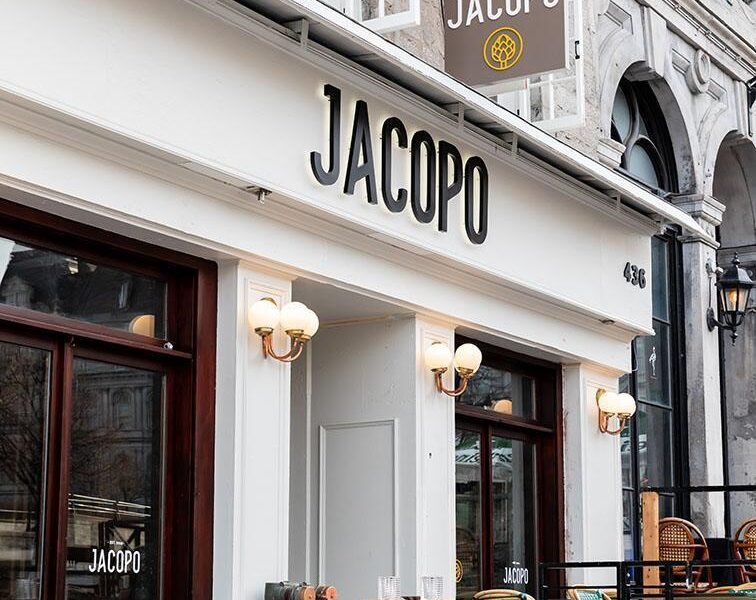
We passed by Jacopo on Jacques-Cartier—right in the centre of the tourist district. I pointed it out as a fairly well-known new Italian restaurant, often featured in Montreal’s eating-out guides. My dad looked at the menu and saw the suppli al telefono dish, which just took him back to Rome. I booked a table for the next day. 

Don’t be under any illusions: Tourists do not lead to better restaurants. Most of them walk in tired, maybe jet-lagged, with no idea what time it is, and will eat anything. So as long as they get to tell the server their life story, they will have a good time. 

Jacopo has an upmarket, stylish feel, which is well-catered for these worldly travellers looking for that hip Montreal vibe. There were wooden beams, a bar with colourful drinks, and a rustic stone wall that just takes the average Joe back to their 2017 summer holiday in Italy like a large glass of Chianti in the sun. There was also a seating area outside, but it was a bit nippy. 

The interior design came together too well not to be professionally designed—a common trend for restaurants these days. And the reason why is simple: The feel of a restaurant is important. I’d just prefer if this feel was created by their cooks, and not their interior designers. 

The waitress came over and well, we didn’t click. How do I put this: I said spaghetti, she said penne or something like that. Judge a chef by how they chop and a server by how fast they can bring a soft drink—and my diet coke sang Happy Birthday to the nearby table before it made its way to me. 

Jacopo was founded in 2019, so it’s still technically a new kid on the block. But its menu had the swagger of an established restaurant. The octopus salad looked good, as did the squash ravioli. Of course, the calamari fritti is a classic, and there was also the fish of the day and roasted chicken. We ordered the suppli al telefono and the bruschetta al pomodoro to start. 

Now the suppli al telefono is a clever dish. It’s from Rome originally and is effectively a ball of mozzarella wrapped in rice and bread crumbs, and then fried. The idea is when you break it in half, the cheese will droop like telephone wires. 

Jacopo’s take on the classic was disappointing. With little to no rice and breading so oily that it was sickening, it felt more like a greasy snack at a frat party—certainly not the standard for a $26 starter in Old Montreal. The bruschetta, though, was actually pretty tasty. The tomato, basil and red onions worked together nicely to pack a punch. Bizarrely, they served it with the same bread as the bread basket—toasted focaccia. 

For my main, I got the grilled lamb chops with truffle polenta and vegetables. Generous would not be a word I’d use to describe it, nor impressive—insipid is more appropriate. The lamb was overcooked and the polenta looked like porridge from the trenches and didn’t taste much better. I felt sorry for the vegetables—they should have stayed in the ground. And for $42 before tax and tip, I think not. 

At the end of the day, Jacopo’s problems all come back to one thing: The quality of their dishes. It’s just not good enough. Jacopo can hire interior designers until they’re puce in the face, but it’s not going to do diddly squat for grilling lamb chops. 

Score: 2 / 5 stars

Alternatives nearby

Stellina – a new pasta restaurant 

Barraco – European cocktails & food

News, SSMU

SSMU General Assembly discusses menstrual health initiatives and reimbursement procedures

The Students’ Society of McGill University (SSMU) held its Fall 2022 General Assembly (GA) over Zoom on Sept. 29. With roughly 25 attendees—including the six SSMU executives and the SSMU Speaker and Parliamentarian—the semesterly meeting failed to meet quorum, which requires a minimum of 350 attendees to pass any motions. During the GA, each of the executives presented a report on their current projects and introduced upcoming initiatives. As this was the first GA of the 2022-2023 academic year, each executive also prefaced their presentation with a brief explanation of their role and portfolio within SSMU.

SSMU President Risann Wright presented the forthcoming pilot Groceries Program, which aims to provide groceries to students facing food insecurity. Wright reported that a pilot run of the project would take place during the Fall 2022 semester to determine what a longer-term program would look like in the future. She also shared that she would be updating SSMU’s five-year plan—a framework designed to guide the organization’s decisions based on its long-term goals. 

Vice-president (VP) Finance Marco Pizarro then drew attention to the surplus of funding currently held by many services at McGill, including for each of the eight SSMU funds that finance student projects. These funds include the Club Fund and the Mental Health Fund.

Next, VP University Affairs (UA) Kerry Yang discussed various menstrual health initiatives in his presentation. In particular, he highlighted a plan to “revamp” the monthly menstrual product pick-up program to provide biodegradable and reusable products, such as menstrual cups, to students free of charge. Yang also discussed SSMU’s intentions to provide free menstrual products in a greater number of McGill buildings but did not provide a timeline for reaching this goal. 

“The team is hard at work [distributing] products across campus, and we are expanding to new locations,” Yang said. “Although the locations that we [currently] have are pretty good, we want to  reach a [few] more people.” 

During their presentation, VP External Val Masny reported on various community relations programs that SSMU is currently engaged in. In particular, Masny highlighted SSMU’s work on a project to build affordable housing for McGill students that will be available in 2026. SSMU is partnering with organizations such as L’Unité de travail pour l’implantation de logement étudiant (UTILE), the Popular University Student Housing (PUSH) fund, and the Native Friendship Centre to complete the project.

Following VP Student Life Hassanatou Koulibaly’s report on clubs and services, Leon Picha, U3 Management and President of WALKSAFE, asked about SSMU’s system for reimbursements for costs incurred when volunteering at the society’s services.

“For WALKSAFE, as an example […] we have to ask [those being reimbursed] for an itemized receipt [to give to SSMU] but also […] a bank statement, which can be partially invasive,” Picha said. “I was wondering if there is any way to possibly show a little bit more trust to our volunteers.”

Koulibaly responded to Picha by confirming that SSMU is exploring alternative options for facilitating reimbursements but provided no further detail. Pizarro also suggested that volunteers block out unnecessary personal information on the banking statement before sending it to SSMU to help address privacy concerns.

Picha remarked that in previous years, bank statements were not required by SSMU for reimbursement and questioned their necessity. Pizarro responded that the measure was crucial for accounting purposes during the summer auditing period.

Moment of the Meeting:

While presenting the report of the SSMU Board of Directors (BoD), SSMU President Risann Wright highlighted BoD’s decision to approve a plan to allocate $65,000 to provide students with reusable menstrual products. 

Soundbite:

“We are studying the urbanism and mobility plan of Montreal [.…] Affordable student housing is more than this project and these various partnerships. It is also about education and advocacy mobilization.” 

–VP External Val Mansy on SSMU’s affordable housing initiatives

Campus Spotlight, Student Life

Bustling, beautiful, and Black: McGill’s Black Marketplace

You could hear the music floating out from down the hall, and of course, anyone passing by could see displays with brightly-coloured crafts and cosmetic products practically jumping off of them. To really capture the essence of the Black Marketplace, you had to have been there. 

Organized by the Students’ Society of McGill University (SSMU) Black Affairs team, the first Black Marketplace brought local Black entrepreneurs, business owners, and community members to campus for Black McGill students and others to explore the wide range of goods and services on offer. 

The SSMU ballroom was transformed into a ring of tables, each covered with the wares of different Black-owned small businesses from around Montreal. Davido and Burna Boy were serenading as people strolled, shopped, and got to know a little bit more about each business and the entrepreneurs who took leaps of faith to turn their dreams into reality.

In between acquiring a hand-made Cameroonian bracelet and a fruit-charmed anklet, I caught up with a few of the business owners myself.

A duo of best friends was selling jewelry for their company, Noir Essentials. I stopped by their table and, after telling me about their business, we quickly got wrapped up in celebrity gossip, chatting like old friends.

This is, for Ebonee Myers, co-owner of the company, one of the biggest draws to running a small business. 

“Meeting people is probably the best thing,” Myers told me. 

Myers started Noir Essentials, a jewelry and athleisure-wear company just six months ago in March 2022. She runs the entire operation by herself and admits that, while keeping up with trends and administrative work can be hard, her love for custom jewelry and the incredible people she’s met along the way keep her going.

I then stopped by Nathan Garrett’s table, drawn in by silky durags embroidered with images of Stephen Curry and The Weeknd. Talking to Garrett was the most inspiring thing; you could feel his intelligence and creativity spilling into every word. He told me about his company, Empire Durags, which sells durags and sweaters with custom embroidery––all made by him. 

“[The best part of running my business] is all the things I’ve been learning about myself,” Garrett said.

Being the only person behind the company, which started in 2017, Garrett found himself lacking feedback, doubting himself, and having to figure things out alone. Studying others’ successes, asking “why can’t it be me?”, and plain old discipline taught him more every day and encouraged him to continue working harder.

I also had an incredible time talking to Yveline of YDS beauty. She had a huge smile beaming across her face, and her energy was infectious. We gushed at her display table overflowing with the most beautiful array of press-on nails you’ve ever seen. Like, Euphoria-level nail art. With my jaw firmly on the ground, we chatted for a few moments about how she created this empire of French manicures and sparkly 3-D embellishments. 

Yveline fell in love with doing nails in high school but found herself and her business in a tough spot when the COVID-19 pandemic hit. While lamenting to her Twitter followers and surfing social media, she was struck with the answer: Press-on nails. She leveraged her online following to launch YDS into what it is today, creating an entire sub-section of the business with easily removable and reusable nails. 

Like Garrett, Yveline advises future business owners to focus on growing both as a person and as an entrepreneur. “You have to always be learning,” she said.

Though many attended the event to shop and browse, walking around and chatting with everyone felt like a gift just for me. It wasn’t only the beyond-inspiring entrepreneurial spirit that overflowed the room, it was the pride and celebration of Blackness, too, in the university space. The event was an incredible way to kick off the year––and we can only hope that we’ll be seeing another Black Marketplace very soon.

Read the latest issue

Read the latest issue