

Latest News

Commentary, Opinion

More pedestrianized streets, please

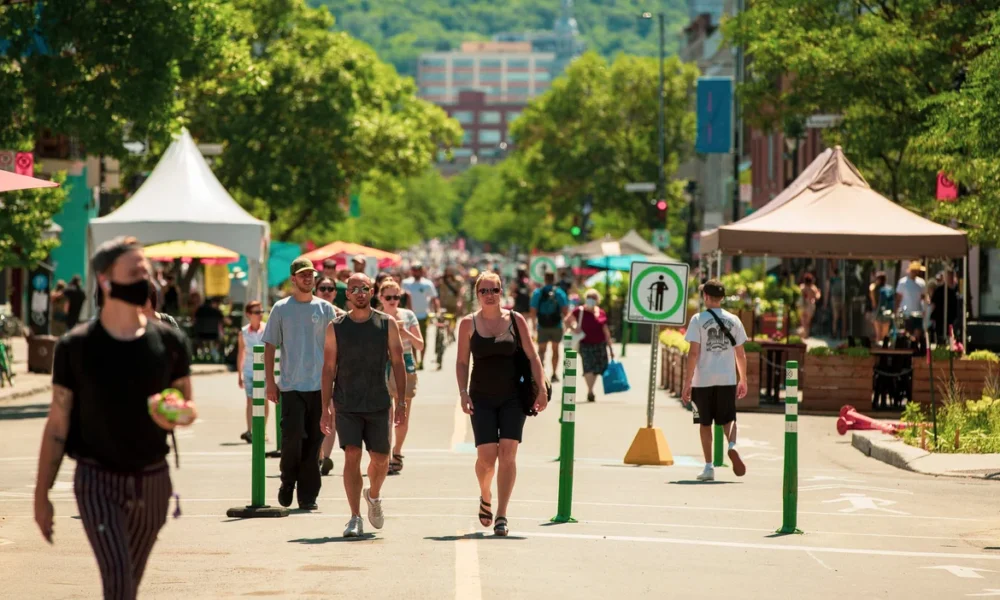
It’s a beautiful day: Birds chirping overhead, cyclists zooming by, neighbours and shopkeepers chatting, people enjoying shawarma and poutine on benches. No, you’re not in a park. You’re in the middle of the Plateau, on Mont-Royal Avenue—and there are no carbon-dioxide–spewing vehicles in sight.

Montreal’s pedestrian-only streets, which can be found across the island from Verdun to Little Italy, create a unique ambience that gives the city its charm, beauty, and grit. Car-free spaces provide significant social and economic benefits, and on top of that, more space for bikes and pedestrians encourages people to ditch their cars, lowering the city’s carbon footprint. Montreal’s pedestrian streets are a great example of smart urbanism, and the city ought to expand the program and make the pedestrian streets a year-round phenomenon. Further, other North American cities should take a page out of Montreal’s book and develop their own pedestrian street programs.

Montreal’s long-term, summer-wide pedestrian streets were initially conceived to provide space for outdoor social interaction during the COVID-19 pandemic. Due to the popularity of the program and its economic benefits, such as increased business activity and rising property values, the city chose to extend it. Mayor Valérie Plante announced in April that the city would be spending $12 million to pedestrianize streets over the next three summers.

Pedestrian streets, along with their aesthetic and environmental benefits, are an economic boon for cities. According to Luc Rabouin, the mayor of the Plateau-Mont-Royal borough, the pedestrianization of Wellington Street last summer brought in 17 per cent more shoppers and visitors. Furthermore, average property values along a street rise as the street becomes more walkable. Compared to the auto-oriented sections of cities and towns, walkable areas bring in more taxes due to a higher rate of economic activity. 

This is only common sense: As streets become safer and more inviting, people choose to shop and walk along them. They spend more time passing storefronts and perusing windows. The streets become social and economic hubs, tying neighbourhoods together. 

Considering their environmental benefits, it’s hard to see why some people might oppose efforts to pedestrianize cities. While critics posit that the reduced space for cars disincentivizes economic activity, studies have shown that travellers that walk or take public transit spend more per month at local businesses than drivers. Critics also argue that pushing cars off main thoroughfares will intensify traffic elsewhere in the city. However, when cities prioritize walking and public transit, people are encouraged to switch from driving to these alternatives, meaning traffic levels in the city should decrease because fewer people are using their cars. This effect has been demonstrated in cities such as New York City and Madison, Wisconsin. 

One concern that’s especially pertinent for Montreal is that, if the pedestrian streets remained open all year round, they wouldn’t see use in the cold months. But just as Montrealers flock to parks when the snow falls with their sleds, skis, and skates, they would take advantage of car-free streets, too. 

Montreal’s pedestrianization pilot program is a step in the right direction—hopefully Toronto and Vancouver will follow suit. But the program should be greatly expanded. First, the pedestrian streets should become permanent parts of the cityscape, not just summer treats. Imagine the convenience and advantages that would come with pedestrian and bike-friendly avenues crisscrossing the city year-round. Projects in cities such as New York City and Boston have transformed ugly and congested streets into mixed-use transit, bike, and pedestrian boulevards. Montreal should also create more public squares, which yield many of the same benefits as pedestrian streets. At some of the most notorious and awkward intersections in New York City where diagonal streets meet the grid, cars are pushed to the side to make way for pedestrian-friendly plazas. It’s fairly cheap to do this: Some new street furniture, lighting, planter boxes, and sidewalk paint or pavers will do the trick.

Considering how easy and beneficial it is to reorient cities from cars to people, Montreal should double down on its efforts and continue to prove that it’s the coolest city in Canada.

Hockey, Sports

Nick Suzuki’s captaincy transcends Quebec language politics

On Sept. 12, the Montreal Canadiens announced the appointment of 23-year-old Nick Suzuki as the 31st captain in franchise history. The standout centre from London, Ontario, joins a decorated list of Habs captains, including hockey legends Maurice Richard and Jean Beliveau. Chosen over his more veteran teammates like Brendan Gallagher,  Suzuki’s age highlights the team’s commitment to a strong young core. The selection also makes Suzuki the youngest captain in franchise history and positions him at the forefront of the changing face of hockey.

As one of the NHL’s founding teams and a member of the Original Six, the Montreal Canadiens provide a beacon of unity for the francophone community within the hockey world. Les Canadiens de Montréal have long been tied to the province’s cultural identity as even the team’s nickname, the Habs or Les Habitants, refers to French settlers in the Quebec region. 

As seen with the recent passing of the controversial Bill 96, Quebec’s administration has further ingrained language laws as a political priority. Since the departure of the Nordiques in 1996, many fans see the Canadiens as the symbolic core of Quebec’s identity in the sports world. As a result, the election of Suzuki, a non-bilingual Ontarian, to Quebec’s highly prized NHL team has been highly controversial. It has been through both congratulations and thinly-veiled criticism of Suzuki’s lack of French-speaking ability that provincial politicians have extended the age-old debate about bilingualism to their hockey team.

With the 2022 Quebec general election coming up on Oct. 3 and candidates on the campaign trail, many leaders addressed the news during their press conferences. Incumbent premier François Legault from Coalition Avenir Québéc not-so-jokingly suggested that Suzuki work on his French. Leaders of the Parti Québécois, Quebec Liberal Party, and Québec solidaire all pressed Suzuki to up his French game, proving the issue to be a sentiment that cuts across party lines.

Regardless of linguistic outcry, a Suzuki captaincy represents a positive step forward for Japanese representation within hockey. With only seven active NHLers of Asian descent in the 2021-2022 season, Suzuki’s new position breaks barriers in the predominantly white sport. In 2020, a group of young Japanese hockey players on the Japan Selects came to Quebec to see Suzuki in action. Their coach, Taro Kurokawa, emphasized Suzuki’s impact on the youngsters, calling Suzuki a “big source of pride” for the Japanese community.

Suzuki understands the magnitude of his presence in hockey and has stressed his desire to be a role model and to help kids reach their NHL dreams in any way he can. While hockey is not yet considered a major sport in Japan, it’s made leaps and bounds over the past decade, with the women’s team qualifying for the past three Olympics and youth hockey programs growing across the country. Suzuki’s new role within the Canadiens organization is diversifying the league and creating a path for other kids of Asian heritage to play at the highest level. 

Hockey culture is characterized by a desire to remain insulated from broader social and political issues. Despite this, Suzuki’s lack of bilingualism has catapulted him into the centre of a highly polarized political debate that he is slowly but surely navigating. Although  Suzuki is still young, he seems poised to ascend to the next step in his career with his newly appointed captaincy. He simultaneously acknowledged the validity of both politicians and Quebeckers’ perspectives on the French language, respectfully addressing his lack of fluency and his desire to improve. Additionally, as the Canadiens’ Hockey Is For Everyone ambassador, Suzuki plays an important role in the drive to foster a more inclusive environment within the sport. 

Only time will tell whether Suzuki’s captaincy will be the change the Habs need to be successful in the 2022-23 season, but his ability to address contentious political issues like language head-on  leaves many looking forward to the young star’s future.

McGill, News

Revised McGill sexual violence policy allows survivors to know disciplinary results of their cases

Content Warning: Mention of sexual violence

Survivors who report allegations of sexual violence to McGill can now request information about the specific disciplinary or administrative action taken by the university against their aggressor.  Quebec’s Act respecting access to documents held by public bodies and the protection of personal information had previously prohibited higher education institutions, including McGill, from sharing such information to protect the accused person’s privacy. However, Bill 64, which the National Assembly passed in September 2021, mandates universities to share these details with survivors as of Sept. 22, 2022. 

McGill’s revised Policy against Sexual Violence captured these legal changes during its triennial review, held over the Winter 2022 and Summer 2022 terms. The updated Policy, which also included changes to reflect the university’s new internal resource for reporting—the Office for Mediation and Reporting (OMR)—was passed by the McGill Senate on Sept. 21. 

The change will only apply to survivors who file a report under the Policy after Sept. 22 and whose case results in a finding of sexual violence following the university’s investigation process, according to McGill media relations officer Frédérique Mazerolle.

Previously, survivors would only be told  their case ended—no further detail about disciplinary consequences would be disclosed unless the accused person gave their permission to do so. In an interview with The McGill Tribune, Stella*, a survivor who filed a report under the Policy in Fall 2020, explained that not knowing the specific disciplinary action imposed on an aggressor can take an extreme mental toll. 

“[Being reprimanded] could literally mean ‘oh, just rewatch the It Takes All of Us training’,” Stella said. “Then you think about all this trauma I have been through, the fact that it scares me to look at myself in the mirror, or that I am shaking or having nightmares every night. 

Is that all it’s worth? Just redoing a seminar on saying no and asking for consent? Or are they expelled? [….] If you do not know that, you are still going to be looking for them behind your shoulder constantly.”

Stella added that being left in the dark can also make it hard to feel safe while attending school.

“No matter what, you’re not going to fully recover,” Stella said. “They are changing your life forever and you want to know what the school [is] doing to protect you because you are a student and you chose to go to this institution to study, to get involved, not to experience this.” 

In an email to the Tribune, Émilie Marcotte, a sexual violence response advisor at the Office for Sexual Violence, Response, Support and Education (OSVRSE), believes transparency is crucial throughout the reporting process to ensure survivors feel safe when coming forward.  

“Rather than being left with uncertainty, knowing the disciplinary results will help finalize the reporting process for a survivor,” Marcotte wrote.  “Seeing the concrete outcomes that emerge from that initial act of reporting provides further accountability and can help the survivor in regaining a sense of agency.” 

Rachael Diotte-Lyles, advocacy branch representative at the Sexual Assault Centre of the McGill Students’ Society (SACOMSS), believes that the policy change creates a safer campus environment for survivors and that it could make survivors more likely to report instances of sexual violence. 

“It was difficult for survivors to justify going through [the reporting] process and reliving traumatic memories when, even if it was determined that sexual violence occurred, they would remain in the dark about the disciplinary results,” Diotte-Lyles wrote in an email to the Tribune. “Through this change […] the University is taking steps toward making survivors a priority.”

*Stella’s name has been changed to preserve their anonymity. 

Those wishing to report an instance of sexual violence at McGill can contact OMR at [email protected]. Those in need of counselling can reach out to OSVRSE at [email protected]  514 398 3954 or SACOMSS at [email protected].

McGill Recommendations, Out on the Town, Student Life

 A student’s guide to Montreal nightlife

Whether it be a Sunday evening or a Friday night, the streets of St. Laurent and Crescent are filled with crowds of people queued up to get into some of Montreal’s most famous clubs and bars. When living in a city known for its nightlife, it can sometimes be tricky to pick the best place to go to for a night out. To help you plan your nights in advance, the Tribune has put together a list of clubs that are a must-try for McGillians. 

1. Café Campus

Located at the intersection of St. Dominique and Prince Arthur—just off of hectic St. Laurent Boulevard—this nightclub is notoriously popular amongst McGill students. Boasting a two-story dance floor and multiple bars, this is definitely the place you want to be to show off those freshly-learned moves and get shwasted under the glitzy red lights. 

With Retro Tuesdays, Thursdays 2000, and X-Large Fridays and Saturdays, there is a theme for everyone to enjoy. The tickets, at $16 including taxes and fees, can be bought online and the price is the same every night. The drinks are a bit expensive, but they’re worth it to experience their famous retro nights at least once. 

2. Muzique

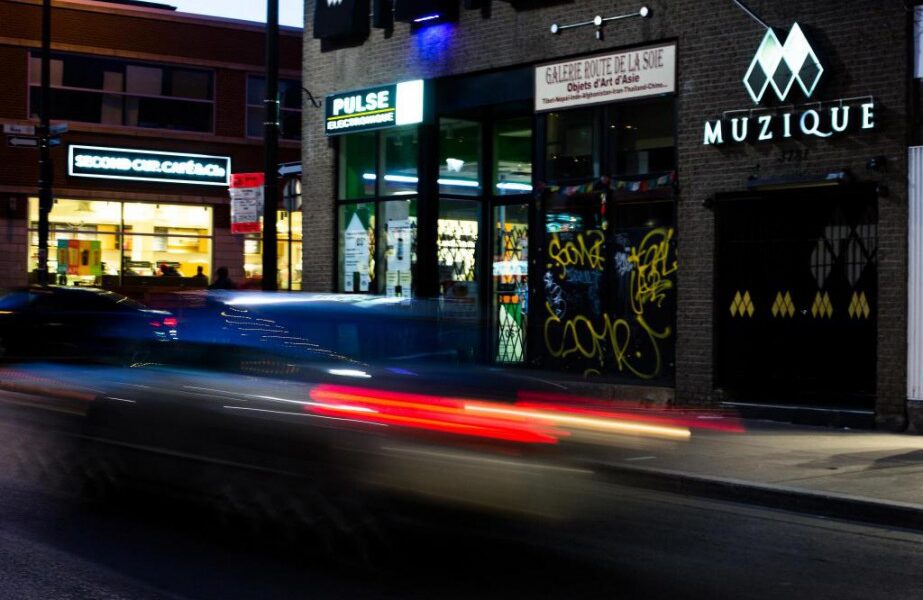
Muzique is another popular dance club, located at 3781 St. Laurent Boulevard, which you can’t miss due to the long queues outside it every weekend. It has two big rooms for dancing and lounging, and a rooftop where you can get a glimpse of the cross on Mount Royal—but drinks cost $1 more for the terrace view. It tends to get crowded on Friday and Saturday nights, so if you’re going with a group, it might be worthwhile to reserve a table and score some extra space for yourself. 

You will find a diverse range of music to dance to, as the DJs draw from all kinds of genres and places around the world. They offer a coat check and, although the drinks are already not too pricey, there is also a special discount for women before midnight. If you’re interested in attending one of the events they host, consider going to their 13th anniversary event on Oct. 4 where Fedde Le Grand will be performing. 

3. Mad Hatter

For a more chill night out, head to the Mad Hatter Pub, at 1240 Crescent Street. This pub offers a wide range of drinks as well as some delicious Canadian cuisine for when hunger takes over. Although this is more of a sit-down place, the music can reach high volumes, prompting people to have their own small and impromptu dance parties. 

Mad Hatter is a fun place to go to with a group of friends as it has some pool, foosball, and ping-pong tables that can bring out your competitive side. While the prices are reasonable and it’s not too heavy on the pockets, it is currently offering a “Jack’s 777 special” on Wednesday nights, which means you can order a special Jack cocktail, a Jack burger with fries, or two shots of Jack for $7 each. 

4. TRH Bar

With a skating bowl, a terrace, and a bar, this place hosts an interesting mixture of people that you must experience at least once. Located at 3699 St Laurent Boulevard, TRH––pronounced “trash”––often has a queue on weekends. Although it is known as a skater’s bar and those with skateboards get to skip the line, non-skaters can have just as much fun here. 

The music tends towards hip-hop and electro and it has limited spaces to sit, so you’re made to stand and vibe with the tunes. Often you’ll find some experienced skaters showing off their entertaining moves in the bowl, guaranteed to keep you entertained for a while. It’s really popular for serving PBRs so if that’s your taste, this will be the perfect fit!

Along Party Lines, News

Along Party Lines: Quebec’s major parties on housing and healthcare

This week on Along Party Lines, The McGill Tribune examines where Quebec’s major political parties stand on housing and healthcare ahead of the provincial election on Oct. 3.

Housing in Quebec

Over the past several years, Quebec has faced a housing shortage compounded by skyrocketing rents and asking prices, limited subsidized housing, and low vacancy rates. Some politicians have proposed measures to combat the shortage, including eliminating the welcome tax—a fee home buyers must pay to municipalities—to increase affordability, and creating a vacancy tax to encourage owners to rent out property.

Healthcare in Quebec

The COVID-19 pandemic showcased the province’s healthcare system failings, including long wait times in emergency rooms and waitlists for surgeries due to understaffed hospitals and low bed availability. The shortage of doctors and nurses has forced those already on staff to work mandatory overtime and has even led to hospital closures

Coalition Avenir Québec (CAQ)

Premier François Legault, the CAQ’s leader, has promised to build 11,700 new units of social housing and to subsidize 7,200 units if re-elected. The CAQ’s platform does not contain any policies addressing the vacancy rate or welcome tax.

In response to low hospital bed availability, the CAQ has proposed using home hospitalizations, where patients are treated virtually, as an approach for certain types of care. The party supports a healthcare system that uses a mixture of private and public providers, and has suggested creating private “mini hospitals” for frontline care. Legault has promised to recruit an additional 660 doctors and 5,000 other healthcare workers over the next four years.

Liberal Party of Quebec (PLQ)

The PLQ plans to provide more affordable housing by building 50,000 units of social housing over a 10-year period. Party leader Dominique Anglade has promised to remove the welcome tax for home buyers and to impose a vacancy tax for non-resident owners. 

To combat hospital wait times, the party plans to purchase 4,000 additional hospital beds to increase hospital capacity. The PLQ has also proposed increasing the number of students in nursing and medical programs and collaborating with private providers to decrease the backlog of patients awaiting surgery.

Conservative Party of Quebec (PCQ)

The PCQ does not support subsidized social housing and, instead, promises to offer government allowances to increase affordability. The party’s platform has no policies on the welcome or vacancy tax. 

Éric Duhaime, the PCQ’s leader, supports competition between the private and public healthcare sectors to reduce wait times. The PCQ plans to launch a pilot project of a completely private hospital and wants to allow citizens to purchase private health insurance as a supplement to public insurance. The party promises to raise the number of admissions to Quebec medical schools from 300 to 500 per year.

Québec Solidaire (QS)

QS has promised to build a total of 50,000 social housing units if elected. QS spokesperson Gabriel Nadeau-Dubois plans to convert new buildings, such as offices, into community housing, and promotes alternative types of homeownership, including housing cooperatives. QS’s platform also includes a policy to create a 0.5 per cent to one per cent tax for vacant units.

QS plans to increase the involvement of Local Community Service Centres (CLSCs) for minor health concerns to alleviate the strain on hospitals. The party also proposes hiring 900 more psychologists and 1,000 other mental healthcare workers in public clinics and hospitals.

Parti Québécois (PQ)

The PQ, led by Paul St-Pierre Plamondon, supports the construction of subsidized housing, such as housing cooperatives. The party promises to tighten regulations on real estate speculation, but its platform does not contain specific policies that address this, the welcome tax, or the vacancy tax.The party is opposed to private healthcare organizations, and instead advocates for universal healthcare. If elected, it would also raise the number of admissions to healthcare programs in the province and use CLSCs to treat non-severe medical emergencies.

A previous version of this article incorrectly stated that high vacancy rates were contributing to Quebec’s housing shortage. In reality, low vacancy rates for residential units are associated with rising rents and therefore the housing shortage, while high vacancy rates are present among commercial units. The Tribune regrets this error.

Science & Technology

34th edition of Soup and Science delivers lots of science, but no soup

The 34th edition of Soup and Science, an event for prospective undergraduate researchers and curious students organized by McGill’s Faculty of Science, made such a comeback that the in-person registration was full. During the week of Sept. 19, The McGill Tribune attended two fascinating talks about the medical uses of Viagra and the transformation of sensory input into behaviour. 

Viagra: An affordable treatment for asphyxiated newborns 

While Viagra, scientifically known as sildenafil, is most known for its use as a treatment for erectile dysfunction in men, it has also proven to be an effective treatment in newborns with high blood pressure in their lungs. 

Dr. Pia Wintermark, a neonatologist and an associate professor in McGill’s Department of Pediatrics, discovered along with her team that sildenafil treatment may decrease the effects of brain injury in newborns suffering from oxygen deprivation or asphyxiation. Using a rat model of birth asphyxia, they demonstrated that sildenafil acts by creating new neurons and decreasing inflammation in the brain. Currently, Wintermark and her team are conducting a clinical trial in Uganda where access to total body cooling—the standard treatment for asphyxiated newborns—is limited. 

During her talk, Wintermark also addressed some of the questions that many undergraduate students interested in research may have asked themselves. To get started, students should find a topic they are passionate about and a lab in that respective field. They should then send an email to the principal investigator to express their interest, while keeping in mind that researchers have very busy schedules. According to Wintermark, motivated undergraduate students stand out by being enthusiastic about the work being done in a prospective lab. 

“Never stop at the first obstacle. [You have to] cope with [any potential setbacks] and find solutions,” Wintermark noted. “Be ready for some work.”

Cracking the (neural) code: Understanding how the brain perceives and reacts to the environment 

Maurice Chacron, a professor in McGill’s Department of Physiology, studies how information from the environment is processed in the brain to ultimately generate behaviour.

He began his talk by claiming that cracking the neural code—the neuronal instructions that give rise to behaviour—is a greater challenge than trying to crack The Da Vinci Code Cryptex, a locked object that stores secret messages.

The brain perceives and interprets sensory input from the environment to produce an output that acts on this environment. Together, these millions of information transfers comprise the neural code. Each individual’s internal state, influenced by our emotions and physical health, affects perception, making the decoding of the neural code an even more complex undertaking. 

“Our state of mind influences our perception and reactions to our environment,” Chacron said in his talk. 

Chacron used population coding strategies to investigate how the perception of sensory information engenders behaviour. This technique of representing stimuli through the combined activities of neurons is appropriate for the study of behavioural responses, since an enormous population of neurons is responsible for something as complex as behaviour.

Chacron says that trying to understand the transformation of sensory input into actions is like trying to see and identify an entire painting in the dark with a tiny flashlight. 

“Machine learning tools will help us understand the brain but will not get us [all the way] there,” Chacron said.
Even though his lab uses computational modelling, a key characteristic of their methodology is their multi-disciplinary approach that combines recordings of electrical activity in neurons with studying behaviour in weakly electric fish and macaque monkeys, in addition to computational analysis.

Baseball, Sports

Albert Pujols and Aaron Judge are making history without chasing it

The last half-decade of big league baseball has been riddled with sweeping rulebook changes, suspensions, and blockbuster trades that have kept the sport in constant flux. Amidst the chaos, one of baseball’s purest elements—the home run—has convincingly held its place at the core of the sport. The 2019 season alone saw four teams shatter the previous single-season home run record of 267, with the Minnesota Twins leading the way at 307. Now, three seasons later, Albert Pujols and Aaron Judge are close to inscribing their own names into the long ball history books. 

Pujols, now in his 22nd and final season, sat just two home runs shy of 700 heading into the Sept. 23 matchup against the Los Angeles Dodgers. With one bomb in the second inning and another in the fourth, Pujols joined Hank Aaron, Babe Ruth, and Barry Bonds in Major League Baseball’s highly exclusive 700 Home Run Club

Judge, not to be overshadowed by the greatness of his elder statesmen, sits at 60 homers and needs just one more to tie Roger Maris’ single-season record with the Yankees. If Judge reaches the magic number 61, this would put him seventh on the all-time dinger list and first among players with a clean performance-enhancing drug record. These historic seasons have not been in vain either, as both Pujols’ St. Louis Cardinals and Judge’s New York Yankees sit atop their respective divisions with less than two weeks of regular-season baseball remaining.

In a league with a 146-year history, it can be easy to get lost in the prestige of the record books, but the reality is that these historic pursuits by Pujols and Judge are unfolding in front of our very eyes with legitimate implications heading into October. As tempting as it is to fixate on the record-breaking numbers themselves, the nightly performances that have defined this season for Pujols and Judge deserve their own close attention. Pujols’ 695th career homer was a two-run, pinch-hit blast that broke a 0-0 stalemate in the bottom of the eighth against the Chicago Cubs. Judge’s 60th homer was part of a five-run ninth inning that gave the Yankees their 89th win of the season and allowed them to regain a comfortable lead in a highly competitive American League East division. Pujols and the Cards are eyeing a return to the glory of their 2011 World Series win, while Judge and the Yankees seem dead set on ring number 28.

Regardless of what takes place between now and game one of the playoffs, the 2022 MLB season has been historic. Two generational talents—one well into his prime and eyeing a triple crown, the other a clear-cut hall of famer on an impressive farewell tour—are moving towards the mammoths that came before them. Every game has become a spectacle, every at-bat a chance to earn immortality in baseball’s record books. And yet, Pujols and Judge don’t seem to be as enamoured with the historical context as the rest of us. Despite announcing that 2022 would be his final season, Pujols himself made it clear that he’s not chasing anything at this point in his career. After all, he’s a two-time World Series champ, a three-time National League MVP, and a six-time Silver Slugger award recipient who quite literally has nothing left to prove. For Judge, the individual accolades are no doubt sweet, but as a Yankee, winning will always be the ultimate end. 

In an era spoiled with so much talent, it is easy for baseball fans to overlook the gravity of the two stars’ remarkable athletic feats. Numbers and record books aside, what Albert Pujols and Aaron Judge have accomplished and continue to accomplish is worthy of our praise and attention. As Judge continues his superstar ascent and Pujols marches into October for one final run at a ring, we should all pay close attention to the fleeting moments of baseball history that may lie ahead.

McGill Recommendations, Student Life

Fitting out the fall semester

Thrifting for fall statements 

Yes, it’s only the end of September, but it’s already time to start getting your winter coats out. There are two main contenders for your go-to fall jacket in 2022. If you’re running late to class or need to layer up before going out on a Friday, an oversized leather jacket is the perfect option. It isn’t, however, the only lightweight fall coat that’s in style right now. Courtesy of Matilda Djerf, purchasing a pricey oversized blazer is a great excuse to start investing in timeless pieces and becoming more sustainable. 

Concerned that leather jackets and oversized blazers are just simple microtrends? You don’t need to commit. Thrift stores in Montreal are leather jacket havens, where you can find authentic leather jackets for as little as 15 dollars or seek out an old office blazer to keep around for a few years until they come back in style. 

Finally, the most notable fall trend of 2022: Loafers. A timeless shoe that never goes out of style but comes back in style every once in a while. They are for sure back this season and another easy find at your local thrift store. 

The necessity of neutrals 

The biggest challenge with lightweight jackets is their lack of insulation. Layering up underneath is the only way that you can make them work come the winds of October and November. Neutrals and basics are must-haves every season of the year, but especially in the fall. For one thing, they allow for aesthetically pleasing outfits. Second, with fluctuating temperatures and confusing weather patterns, layering is key so that you aren’t freezing in class, or worse, drowning in a pool of sweat. Basics include, but are not limited to, cable-knit sweaters, cardigans, fitted turtlenecks, plain tees, and tanks. Pair your neutrals with a funky accessory or clothing item and you are set. 

Fall flares 

Still adjusting to the start of a new semester? Wearing comfy clothes will help. The yoga flares made a return in the early 2000s and never left, so it might be time to hop on the trend if you haven’t already. Any sweater or hoodie with a pair of black yoga flares and you’ll already look more put together than the other 15 students who also woke up late and only had three minutes to put an outfit together. Their versatility makes them a go-to item for grabbing a coffee, heading to the gym, or attending lectures. You can dress them down in a pair of sneakers or dress them up with some platform boots—really, anything can work. You can get them cheap on Amazon or you can invest in some Lululemons if you want a long-lasting product. Even better, there are some super flattering waisted crossover V-shaped flares you can get at either Aerie or Aritzia. 

The power of fall accessories 

Accessories are an essential part of fall ’fits. When October and November roll around, additional measures must be taken to keep warm. Even in September, McGill students have been spotted wearing scarves around campus. Keeping your neck warm reduces muscle fatigue and tension because it helps maintain blood circulation. After hovering over your laptop for hours or taking notes at your desk until 2 a.m., your neck needs some relief! Scarves are convenient and contribute to your outfit in so many ways: A pop of colour, a touch of sophistication, a light-weight addition—allowing for tons of creative ways to wear them. 

Accompanying your scarf, you can wear a pair of fingerless gloves. Only really an option for fall or spring, fingerless gloves keep your hands moderately warm while offering some dexterity for typing and other manual tasks. Take advantage of the warm fall weather and wear your winter clothes as mere accessories rather than necessities––it won’t last long!

Features

Assimilation in  21st-century Quebec

On the first Monday of October, all those eligible to vote in the province of Quebec will head to the polls to elect members of the National Assembly of Quebec. The party that wins the most seats in the National Assembly will form the government, and their leader will become our new Premier. In 2018, that party was the centre-right Coalition Avenir Québec (CAQ), and the controversial François Legault became our Premier.

If someone were to ask Legault what he thought was the crown jewel of his last four years in office, I bet he would say Bill 96. Legault has made it clear that he is proud of the so-called protection that Bill 96 will provide for the French language in Quebec. While the legislation will forcibly increase the use of French across the province, the Bill primarily sends a message to all non-francophones that they are not welcome. Legault’s government is using the Bill to legally implement its racist ideology—cultivating the systemic racism that the Premier claims does not exist in Quebec.

Bill 96 will not affect everyone equally. Francophones are virtually unaffected—except for limited access to English CEGEPs—and some anglophone residents, specifically those whose parents attended English high schools in Quebec, are expected to be able to receive services in English by claiming the status of a “historic anglophone.”

The future of living in Quebec for Indigenous peoples, however, remains disturbingly unclear. Currently, there are no exceptions or provisions written into Bill 96 for Indigenous peoples, for many of whom French is their third language. 

As it stands, the Bill will erect a slew of barriers to quality education, fair legal dealings, and proper patient-centred healthcare for Indigenous peoples. For example, Indigenous students will have to compete for a spot in an English CEGEP, as the total number of students enrolled will be capped at 17.5 per cent of the province’s total student population. Once accepted, they will have to complete three 45-hour core curriculum courses delivered in French. 

When it comes to the justice system, the Bill requires all provincial court documents to be in French and no longer requires judges to be bilingual. This violates the legal principle that an accused person has the right to be understood by a judge and to understand legal proceedings.  

Crucially, Indigenous communities’ access to healthcare will further deteriorate in an already racist system. Joyce Echaquan’s death in September 2020 and a recent report revealing racism, sexism, and other forms of oppression rampant at the McGill University Health Centre (MUHC) serve as reminders of the fatal consequences of the government’s refusal to recognize our discriminatory health care system. In November 2020, the Conseil des Atikamekw de Manawan and the Conseil de la Nation Atikamekw proposed Joyce’s Principle in response to Echaquan’s death. The Principle, based in part on the United Nations Declaration on the Rights of Indigenous Peoples (UNDRIP), calls on the Quebec government and health care system to recognize traditional Indigenous medical practices and beliefs in an institutional setting so that culturally safe medical care can be provided. On Nov. 25, 2020, the CAQ government rejected the motion to adopt Joyce’s Principle.

Under Bill 96, the inequities of access will worsen. Doctors and other health care providers will be required to provide medical care to Indigenous peoples in French—compelling patients to learn and translate medical terms in, what is often, their third or fourth spoken language. This means they will receive substandard care and will be more at risk of exposure to undesirable medical burdens, such as unintentional injuries, unnecessary complications, and inappropriate prescriptions. This is something Richard Budgell, an assistant professor and current history PhD student at McGill who focuses on Inuit health care, is acutely aware of.

“Not surprisingly, people see good care as happening in their first or at least their second language,” Budgell said in an interview with The McGill Tribune. “The second language for most Inuit people in Quebec is English, not French. So people are going into a health care system […] seeking care in a minority language [….] We do not often remind ourselves that we are speaking a language of colonialism. We are not speaking Inuktitut.”

While not a physician himself, Budgell comes from a line of health care workers—both his father and grandfather worked in health care in their Inuit community in Labrador. Budgell was hired by McGill in 2020 and began teaching a one-credit graduate course called “Inuit health in the Canadian context” in Winter 2022. Before working at the university, Budgell worked as the executive director of the First Nations and Inuit health branch of the federal government, which provides funding for some medical services and programs to First Nation and Inuit communities across Canada. Budgell stresses that the provincial government’s infringements on Indigenous peoples’ right to self-determination have resulted in the racist system we know today. 

“As a fundamental starting point, the system was not designed by us,” Budgell said. “In the case of Inuit who live in Nunavik, the Nunavik Regional Board of Health and Social Services is largely managed by Inuit, but it is nevertheless part of the provincial system. So obviously, it has to obey provincial laws, and Bill 96 is now law.”

Though different Indigenous communities operate their own hospitals, such as the Kateri Memorial Hospital Centre that serves the Kanienʼkehá:ka community of Kahnawake, rural and Northern communities struggle with critical shortages of medical personnel. The lack of professionals forces people to migrate to urban centres, where more robust services are offered in exchange for mistreatment and marginalization.

“The MUHC is a big […] centre for the treatment of Inuit coming from Nunavik,” Budgell explained. “All of the hospitals of the MUHC are referral centres for people coming from Nunavik [….] There are, unfortunately, very very few health care practitioners, nurses, and doctors who speak Inuktitut [….] I have to say that when I started hearing about [the racism at the MUHC], it was like, unfortunately, this is not surprising.”

Budgell believes that recognizing the differences between First Nations, Métis, and Inuit people is crucial to being able to provide culturally safe health care. With Bill 96, however, the province is isolating Indigenous peoples in the health care system and further ingraining the systemic racism that already exists.

“I think it’s vitally important that when we’re talking about cultural safety, in relation to Indigenous people, that we be more specific,” Budgell said. He believes that using an umbrella term like Indigenous “sometimes allows us to be a little bit lazy. Because then, you know, people can say, ‘Oh, we’ve covered the Indigenous training.’ Well, for any person from any Indigenous background, they immediately think, okay, ‘What does that mean? Who are you talking about?’”

The relative lack of Indigenous health professionals and, therefore, culturally safe health care can be traced to barriers in the medical education field created by Quebec’s language laws. As a member of the Kanienʼkehá:ka Nation and a second-year medical student at Université de Montréal, Frédérique Gauthier-Bisaillon has witnessed the inequities that language laws enforce firsthand. 

Since starting medical school, Gauthier-Bisaillon has travelled throughout Quebec, visiting different First Nations communities and working in their medical centres. While discussing Bill 96, which she called “outright racist,” Gauthier-Bisaillon told me a story about an Indigenous woman she met who was barred from her career in nursing after years of schooling. 

“She did all her exams, everything to be a nurse [and passed],” Gauthier-Bisaillon explained. “She wanted to go back to her community to work, and because she didn’t pass her French test, she could not practice in her community. French was her third language. I think that you can see in this case that there is such a big injustice that Bill 96 will just reinforce.”

Gauthier-Bisaillon was one of many who attended a candidate debate on Sept. 20 hosted by the Assembly of First Nations Quebec and Labrador (AFNQL). The discussion aimed to raise awareness of Indigenous issues ahead of the provincial election on Oct. 3. Candidates from several major parties in Quebec, including CAQ candidate and current Minister Responsible for Indigenous Affairs Ian Lafrenière, Québec solidaire candidate Manon Massé, Parti Québécois candidate Alexis Gagné-Lebrun, and Quebec Liberal Party candidate Gregory Kelley attended—the Conservative Party of Quebec did not send a candidate to participate. The debate focused mostly on governance and self-determination, territories, resources, and economy, health and education, and the protection of language and culture. Some of the more oddly contentious topics addressed were the existence of systemic racism in Quebec, Bill 96, and the general need for consultation with First Nations and Inuit communities on any laws that impact them.

Many of the answers given throughout the night were exactly what one would expect from politicians: Lots of talk about creating change but no concrete plans on how to actually do it. 

Marie-Ève Bordeleau—the first Cree woman to ever become a lawyer in Quebec—in her role as moderator of the event, asked candidates whether their parties would acknowledge the existence of systemic racism in Quebec. Gagné-Lebrun, Massé, and Kelley all readily did, but Lafrenière ignored that part of the question. Instead, he chose to focus on the CAQ government’s creation of a three-hour training program titled “Formation sur la sensibilisation aux réalités autochtones” or “Indigenous Awareness Training”. The program is supposed to teach health care workers about the importance of understanding Indigenous culture when treating an Indigenous patient—fittingly, it does not have an official English translation name and cannot be accessed by the general public. 

Lafrenière’s responses did not gain popularity throughout the remainder of the debate. When Bordeleau asked whether the CAQ would be willing to grant Indigenous people exceptions from Bill 96, Lafrenière answered that the CAQ would not change Bill 96 but is open to creating new laws that would protect Indigenous languages and cultures. Many First Nations chiefs have proposed amendments to the Bill but have been ignored by the government

“My colleague [Manon] Massé mentioned the importance of diplomacy earlier and she is completely right,” Lafrenière said.* “We know that there are problems with certain sections of Bill 96 […] so we said ‘let’s take the time to sit down with the Premier and with First Nations chiefs to find a solution that will respond to the concerns raised by the First Nations’ [….] Diplomacy is important and we do not want to strain those relationships so we will keep working towards a solution.”

Indigenous communities are not hopeful. In an interview with the Tribune after the debate, Chief of the AFNQL Ghislain Picard said he did not believe in Lafrenière’s stated intentions to find alternative ways of protecting Indigenous culture. He feels that the supposed plan to revise Bill 96 in accordance with Indigenous voices will resemble the trajectory of another problematic piece of legislation—Bill 15. 

Bill 15 was unanimously adopted by the National Assembly of Quebec on April 12 in response to the killing of a seven-year-old girl by her father back in 2019. While the goal of the Bill was to facilitate the process of removing children from abusive homes and placing them in foster care, it imposed colonial ways of parenting on Indigenous families and disregarded the rights of Indigenous governments to oversee their communities.

 “We went through the same exercise, we agreed to sit down, we agreed to do the work, to provide propositions and amendments to Bill 15,” Picard said. “And at the end of the day [the government] decided to proceed without any consideration for amendments to the act.”

Picard would much rather see Indigenous communities make legislative decisions for themselves rather than be forced to obey and adapt the ways they live to laws they had no meaningful part in creating.

“I know Mr. Lafrenière also suggested that if [our] concern is Indigenous languages and culture, [the government] will present a Bill for that. We don’t want that. We can do it ourselves. We can adopt our own laws. What we need for you to do is to respect the right that we have and that is where we don’t hear anything from government,” Picard said. “On Bill 15, the argument we had with [the Social Services Minister] was that he said ‘we are waiting for you to have more autonomy.’” 

“We don’t want more autonomy; we want full autonomy. There is a world of difference between the two and that is really where [the Quebec government] is not wanting to go.”

Gauthier-Bisaillon echoed Picard’s sentiments, adding that it is exhausting and discouraging to always find herself in a position where she wonders what rights of hers she may not have for much longer.

“What we have heard tonight was a lot of ‘oh yeah, we are going to change [Bill 96],’ but why didn’t [the government] think of that first?” Gauthier-Bisaillon said. “The same thing happens over and over again. We are thought of last, after the fact.”

On Oct. 3, as all of us who can legally vote head to the polls, we need to remember that it is our responsibility to uphold principles of justice, equality, and freedom to self-determination—for all communities, not just our own. As Picard argued, the conversation about Indigenous rights should not be treated as tangential to the rest of Quebec politics. We must remember that the land we live on is unceded and that First Nations, Métis, and Inuit people are the ancestral owners of this land we call Quebec and Canada. We are only visitors on this land, yet we impose our beliefs and values, and we strip the traditional custodians of their rights to self-determination. 

We allow our medical systems to abuse Indigenous people seeking help and design our judicial system in a way that actively works against them. Then, when we are shown exactly what our policies do, we take to social media and proclaim solidarity with Indigenous people. What we should do is make space for Indigenous voices in our governments and on our medical boards. Let them be the ones to determine how they will be governed and how their societies will be organized. We must overhaul our colonial mindset and totally abandon this 21st-century assimilation project.

*Debate conducted in French and translated by the author.  

Montreal, News

Students march in protest at annual climate strike, renew calls for McGill to divest

Divest McGill, a student activist group on campus, held a rally and march for the climate on the afternoon of Sept. 23. They started at the bottom of McTavish Street before leading sign-wielding and chanting students up to the George-Étienne Cartier Monument at Parc Jeanne-Mance. There, the McGill group joined the tide of Montrealers attending the annual global climate strike, organized by Fridays for Future

At the rally, Divest called on McGill to retract its investments in fossil fuels and to recognize the harm that their investments are causing to the environment and to Indigenous communities. Spokespeople for Divestalso stressed the importance of standing against the construction on the Royal Victoria Hospital site, where McGill plans to excavate grounds suspected of containing the unmarked graves of Indigenous children.

Divest was joined by the Association of Graduate Students Employed at McGill (AGSEM), which passed a mandate on Sept. 20 to go on strike for the climate on Sept. 23, even though their affiliate union, the Confédération des Syndicats Nationaux, had advised against it.

But according to Kiersten van Vliet, PhD candidate in Musicology and AGSEM Mobilization Officer, striking was imperative due to the urgency of the climate crisis.

“Climate actions like these have not been a part of the labour movement because our employers do not see the connection between climate justice and labour rights,” van Vliet said, addressing the crowd at the rally. “But climate justice is labour justice [.…] There is no economy on a dead planet.”

Before leaving campus for the city-wide protest, McGill protestors were joined by contingents from Concordia University and Dawson College. Laura Doyle Péan, 4L and Divest member, told The McGill Tribune that they believe inter-university solidarity is a powerful tool for the climate justice cause. 

Doyle Péan explained that after Divest’s occupation of the Arts building last year, similar protests were held at Concordia and Université de Montreal (UdeM). After the UdeM occupation, students were able to get a commitment from the university to divest from fossil fuels. Doyle Péan emphasized that the multi-school network that activists have built was a key driver of this step forward.

“It brought me a lot of joy today to see AGSEM on strike and to see Concordia and Dawson students coming up to McGill so that we could march together, because the links we are building are essential to the work that we are doing,” Doyle Péan said.

Lola Milder, U2 Arts and member of Divest, said that after Divest’s occupation, the group’s focus has shifted more towards democratizing the university and community building.

“I think climate strike days are a unique moment for people to feel connected to a community of people that have the same frustrations, or motivations,” Milder said in an interview with the Tribune. “I hope that people will be inspired to action, feel a sense of community, and be confident in returning to it, whether that is through coming to a Divest meeting or joining another community organization.” 

Aglaé Lambert, U2 Environment, was among the thousands who took to the streets. She explained in an interview with the Tribune that her motivations for attending reflect her hopes for the future.

“I want a more just world for every person,” Lambert said. “I want the world that we have to be possible for the next generation. I feel anxious and stressed about the future. But I know at the bottom of it there is something we can do.” According to Doyle Péan, Divest’s next rally will be held on Oct. 26 in collaboration with the McGill Radical Law Students’ Association (Radlaw) to stand in solidarity with the Kanien’kehá:ka kahnistensera, who are currently taking legal action against the New Vic project.

Read the latest issue

Read the latest issue