Latest News

Behind the Bench, Sports

Sports are political: Standing up for Azeez Al-Shaair

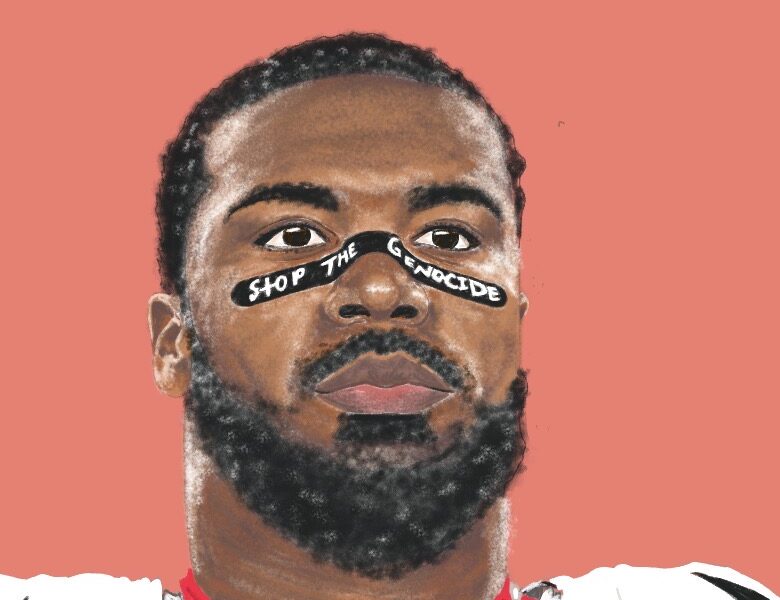
On Jan. 12, the Houston Texans dominated the Pittsburgh Steelers en route to a 30-6 victory in the Wild Card playoff game. After the game, Pro Bowl linebacker and defensive captain Azeez Al-Shaair appeared on ESPN for an interview with the words “Stop The Genocide” written in white letters across his eye black. 

Al-Shaair was fined $11,593 USD by the National Football League (NFL), which called his show of solidarity a “violation of the NFL uniform and equipment rules.” This is the standard fine for a first-time violation of the personal message policy—the same fine that San Francisco 49ers star Nick Bosa received for wearing a Make America Great Again hat during a post-game interview, and also the same fine Dallas Cowboys receiver George Pickens received for writing “Open Fucking Always” on his eyeblack. 

The NFL is notoriously strict on uniforms. Former NFL lineman Isaac Rochell shared that he had been fined twice for uniform violations, totalling over $11,000 USD—once because his socks were not covering his knees, and on another occasion because his undershirt was visible below the cutoff of his jersey. The league’s most infamous fines came against two Pittsburgh Steelers in October 2015. Defensive back William Gay received a fine for wearing purple cleats as a show of support for domestic violence victims—Gay’s mother was killed by his stepfather when he was seven years old. Meanwhile, running back DeAngelo Williams was fined for writing “Find the Cure” on his eye black, honouring his mom who died of breast cancer.

Al-Shaair knew the fine was coming, and seemingly accepted it as the price of his activism. He has consistently been a vocal advocate for peace in the region, being one of only two NFL players to sign the Athletes for Ceasefire letter directed toward U.S. President Joe Biden in 2024. Additionally, he supported the Palestine Children’s Relief Fund during the NFL’s My Cause My Cleats campaign. 

Al-Shaair has received criticism for his activism online, with author Kevin Deutsch going so far as to say that Al-Shaair’s message is one spread “by those who seek a genocide of Israelis” and that his message has “helped fuel widespread discrimination, vandalism, harassment, and violence against Jews globally.” Al-Shaair has publicly condemned the attacks of Oct. 7 and violence against Israel, stating, “on either side, people losing their life is not right. In no way, shape or form am I validating anything that happened.” He simply does not want to see children die because of where they were born, stating “I have no affiliation, no connection to these people other than the fact I’m a human being.”

Despite Al-Shaair and Bosa’s differing views, both should be allowed to use their platform to speak about politics. The NFL has tried to remove politics from sport in order to appease a certain ‘shut up and dribble’ crowd, something that is, frankly, wrong. Sports, as a source of soft power, are political in nature. Whether it is the NFL constantly pushing the American flag and military imagery upon fans or nation-states attempting to distract from abhorrent human rights violations, sports are constantly used for political gain. Qatar hosted a World Cup in stadiums built by exploited migrant workers through a system akin to modern-day slavery. Meanwhile, Saudi Arabia is trying to become the global centre of sport while simultaneously killing its own citizens in order to clear land for megaprojects. Even in 1936, Nazi Germany hosted the Olympics as a massive propaganda campaign to make Germany appear peaceful. 
Even in less intentional examples, such as Canada winning the Four Nations Faceoff or Shai Gilgeous-Alexander winning NBA MVP, sports have the power to make us proud of where we come from and shape national identity. Sports are woven into the fabric of our societies, as are the politics that shape them. Al-Shaair understands that his activism may make sports fans uncomfortable, but his opinions should never cost him thousands.

Commentary, Opinion

Quebec language laws over-police bilingualism instead of protecting the French language

Since the Legault administration adopted the 1977 Charter of the French Language, only students possessing a Certificate of English Eligibility can attend anglophone elementary and high schools. Not possessing the certificate has further limited access to anglophone education at the Collège d’enseignement général et professionnel (CEGEP) level since the passage of Bill 96 in 2022. With Legault’s resignation this January, the next Premier now has an opportunity to preserve linguistic heritage without fostering a narrative of division. Strategies framing English as an adversary to French are unsuitable in a province where bilingualism is vibrant, and linguistic plurality should, as a result, be particularly celebrated. 

The Coalition Avenir Québec (CAQ) government uses education to advance a francophone protectionist agenda. Requiring an English eligibility certificate limits students’ right to choose their language of instruction in a bilingual province. This restriction is part of a wider trend of reforms that suppress linguistic plurality in a misguided attempt to preserve francophone culture. 

Students can only obtain an English eligibility certificate if they have attended an anglophone school in Canada for the majority of their education, or if a parent, sibling, or close relative has received their education in English in Canada. 

Students holding the certificate have priority admission to anglophone CEGEPs and, if admitted, complete their education by passing the English Exit Exam. Non-certificate holders, //even if attending anglophone CEGEPs//, are instead required to pass the French Exit Exam—and take additional classes to prepare for it. This adds an unfair workload and undue stress for non-certificate holders, making it harder for them to succeed academically. 

The certificate requirement impedes students from choosing which language they will use to pass their exams, and which language to strengthen through mandatory language-learning classes. It also hinders students from accessing specific CEGEP programs simply because they might only be offered in English.

With a certificate requirement, education goes from being a choice to a product of cultural inheritance. First-generation Anglophone Canadians are thrust into an education system in a language they may not be proficient in on account of their families not meeting the historical criteria for English education. In a system where the right to study in English is inheritance-based, immigrants whose families received their education in English outside of Canada do not meet the requirements for certificate eligibility. This lowers their chances of accessing English CEGEPs, and the pressure to be fluent in French complicates their adjustment to a new environment. 

Pushing Francophone students to receive their education in French also disadvantages them if they aim to improve their English by attending an anglophone CEGEP. Regardless of how fundamental the French language is to Quebec’s culture, the government cannot disregard the province’s prevalent bilingualism nor undermine the importance of English as a skill in academia, work, and international communication. 

The certificate policy also affects teachers in English CEGEPs who lack French proficiency—at risk of losing their jobs if they cannot switch to teaching in French. Additionally, if Anglophone students do not get their certificate in time, they lose the right to pass eligibility on to their children, further entrenching the difficulties of accessing education in English.

Policies that promote French learning are necessary in an unequivocally bilingual province. However, the CAQ government has repeatedly opted to actively disadvantage the anglophone community in their mission to defend French as the sole official language. Bill 96 imposed enrollment caps on English CEGEPs, cut their funding to support French CEGEPs, and raised international tuition at English-speaking universities like McGill to deter non-Francophones from applying. The certificate is yet another policy that weakens Anglophone institutions in favour of Francophone ones—deluded in its idea that protecting French requires suppressing English. 

A government confident in its linguistic heritage would invest in French fluency without foreclosing students’ access to English—recognizing that in a bilingual province, the two languages can coexist and even strengthen one another. After all, attending an English CEGEP does not isolate students into a purely English-speaking community—and forcing Anglophone students to study in French will not erase their original linguistic identity. 

Off the Board, Opinion

Pics or it didn’t happen

If I met Timothée Chalamet in Bushwick and didn’t post a selfie of us on Instagram, did I even meet him? Pics or it didn’t happen

At the heart of this question lies the same trepidation: Whether experience exists without witness. 

Galileo Galilei says, “Tastes, odors, colours, and so on […] reside only in consciousness. If the living creature were removed, all these qualities would be wiped away and annihilated.” 

On consciousness, Immanuel Kant says, “I have no knowledge of myself as I am but only as I appear to myself.” Is consciousness starting to predominantly exist in the digital world? Did I even go on a run if I didn’t make a Strava post about those 10 kilometres? 

Ocean Vuong writes, “I touch the world not as myself but as an echo of who I was. Can you hear me yet? Can you read me?” 

By nature, experience is fleeting. We are not meant to remember each and every moment perfectly, but the desire to commemorate endlessly is encapsulating. Now that it is possible to capture, track, log every event on the internet, to do so has become almost addictive. 

Unlike a scrapbook, documenting our lives on social media inherently invites feedback from those around us—the validation that what we did was cool, fun, appealing. The innate desire to remember our lives has rotted into the desire to be remembered for these events. Music, movies, experiences, hobbies all become intertwined with identity itself: A friend once told me, “My Instagram is my whole identity.” 

In an attempt to immortalize human experience, digital tracking has transformed how we understand our experiences. As a society, we are moving towards a Black Mirror-esque lifestyle where the concept of 24/7 recordings through our eyes is not totally unfathomable. By making ourselves overly digitally accessible, we are losing the essence of real human interaction. Spending a concert recording it, to post with a tastefully placed emoji later, strips you of the experience of closing your eyes, throwing your hands in the air, and truly feeling the music with a bunch of strangers who all have at least this one thing in common. The authentic human experience is being boxed into a digital consciousness that ceases to exist beyond the online realm. After all, it really is that damn phone

Instead of keeping track of every like and dislike, logging every book, movie, or running trail, we need to start leaving our day-to-day lives up to the imagination of those around us—no more Spotify Wrapped or Goodreads reading challenge. 

Jean Baudrillard skillfully warns, “We live in a world where there is more and more information, and less and less meaning”—a condition reflected in our compulsive need to document rather than experience.
Between ChatGPT and Instagram feeds and hours of doomscrolling on TikTok, it is easy to fall victim to the endless information at our fingertips. In a time where anything and everything is accessible with one Google search, find solace and meaning in disallowing yourself to float into the infiniteness of digital consciousness. Do not let your human experience exist solely in the ripples of social media. Live with intention and lean into the analog life.

Features

Medical revision: Putting women in the narrative

To be a woman is to live within systems designed without your body in mind. Whether or not this divide is felt or acknowledged is a far more personal question, but regardless, the reality remains: The marginalization of women is fundamentally ingrained in Western society. From endless bathroom queues to uncomfortable seatbelts calibrated for male bodies, the male lived experience is systemically privileged in all aspects of life—even the most mundane. 

This foregrounding is not always benign. It is more than a general inconsideration of the female social experience—the lack of free and available menstruation products in public restrooms, and the absence of garbage cans in restroom stalls for sanitary products, for example—it is a pervasive diminution of women’s physical and mental agency. 

This marginalization is especially prominent in the medical sphere, a sector historically designed by men, for men. Women’s pain is frequently ignored or dismissed as ‘exaggerated.’ Their concerns are attributed to menstruation or anxiety, and diagnostic criteria and treatments centre on male symptomologies, rendering women’s experiences as secondary within their own care. 

Systemically, this places women in the centre of a social schism: Women face pressure to remain healthy, yet are continually prevented from accessing adequate health resources when they have medical concerns. While progress has been made, the medical system is still failing women—especially Indigenous women and women of colour

To gain true social equality, medical biases must be addressed. 

//Women and the medical gaze//

Women have been notoriously excluded from medicine throughout history. McGill’s first graduating medical class to include women —Winifred Blampin, Jessie Boyd Scriver, Mary Childs, Lilian Irwin, and Eleanor Percival—was after WWI in 1922. This exclusion was rooted in the misconception that women are inherently more emotional and irrational, a belief used both to bar them from medical training and to justify their absence from clinical research 

Phoebe Friesen, an Associate Professor in McGill’s departments of Social Studies of Medicine and Equity, Ethics and Policy, discussed this gendered history in an interview with //The Tribune//.

“Traditionally, the notion of hormones disrupting the sort of normal state of a body constantly in a woman’s body was seen as noise,” Friesen explained. “So we have this really again, another sad history where a lot of experiences, symptoms of women in health have been dismissed or have been entangled with stereotypes like an emotional woman, a dramatic woman, an attention-seeking woman, a woman who’s faking it.”

While women are no longer deemed irrational by virtue of their sex, these stereotypes are still dangerously prevalent in medical atmospheres. There are countless recorded instances of women being turned away from medical care with their pain ignored, as doctors—both male and female—have operated under these faulty assumptions. With gender biases so deeply ingrained in medical curricula and interactions in medical schools, all doctors—regardless of sex or gender—are susceptible to undermining concerns expressed by women. 

Studies have consistently shown that women receive lower doses of pain medication in the emergency room compared to men experiencing comparable pain levels. The Victoria State Government’s state report on the gender pain gap concluded that 71 per cent of women and non-binary individuals seeking care felt dismissed by their providers. 

These stereotypes are particularly dangerous for Indigenous women, women of colour, and women from other marginalized communities. The intersectional nature of oppression compounds practitioner biases, preventing women from getting the care they need. According to a report published by the U.S. Centres for Disease Control and Prevention in 2019, maternal mortality rates are directly correlated to race: Non-Hispanic Black women had a maternal mortality rate 2.5 times higher than that of white women.

//Getting a (mis)diagnosis//

Women’s enforced absence from the medical sector resulted in male physiology being exclusively studied in medical education, while women were continually excluded from scientific study and clinical trials. 

“The history of medical research is just a sad story of the ‘normal’ body being a man’s body,” Friesen said. “So I think it made sense to early researchers, who were primarily men, to focus on the standard male body and utilize them as human participants in research, and it wasn’t until later that people started to recognize how profound the harms were to women.”

This perspective was corroborated by Sara Bishop, a Vancouver-based occupational therapist, who explained how our medical system privileges male symptomatology. When a diagnosis comes before a plan of action, having sex-specific symptomologies is critical to an accurate diagnosis—something our medical system is clearly missing.

“If the diagnostic manual is based mostly on men’s issues and how these issues present to men, then, therefore, some of the symptoms can be missed, because those symptoms are going to present differently in a man versus a woman,” Bishop explained in an interview with //The Tribune//. “But the manual where we, especially doctors, refer to is, I believe, based on men’s symptoms, and so right off the get-go, it’s hard for a woman to get the diagnosis, and therefore the correct treatment that would follow.”

She went on to describe her experience working with people with autism, noting the higher rates of misdiagnosis in girls as opposed to boys. One study showed women are 31 per cent more likely than men to receive an alternate psychiatric diagnosis prior to an autism diagnosis.

“[In girls], autism is often diagnosed as anxiety, depression, or OCD. Girls are given every other kind of mental health diagnosis, and autism is not even considered as a diagnosis,” Bishop said. “It’s treated with antidepressants or anti-anxiety medication, or sometimes ADHD medication, and it’s not helping, and it’s because the real diagnosis is something like autism or some sort of neurodivergency.”

Friesen further explained that, in addition to neurodivergencies and mental health conditions, this pattern of gendered misdiagnoses is prevalent with physical conditions. A salient example is that of heart attacks. Women experiencing heart attacks and other cardiac events are often //sent home// because their symptoms don’t line up with the symptoms //men// display during cardiac events. According to the University of Alberta, 53 per cent of women with heart-attack symptoms are dismissed and left undiagnosed despite seeking care.

This creates a devastating feedback loop, wherein a woman’s pain is not taken seriously, she is sent home without further investigation, and her pain propagates. After being dismissed, women begin to feel discouraged by the lack of support they have received and hesitate to seek out medical care.

“And then also sometimes people, just like in the desperation to be taken seriously, look for their own sort of objective reports to demonstrate their suffering,” Friesen said. “We see people paying out of pocket to get extra blood tests, so that they have something to take in to show, like, ‘look, here’s something real that shows that I’m suffering’ if they’re just continuously being dismissed.”

These extra, out-of-pocket fees add up; in 2023, CNN reported that women in the United States spent approximately $15.4 billion USD more than men, despite ‘equitable’ insurance coverage. This, when coupled with the gender wage gap, showcases just how inaccessible healthcare is for women. 

//Forging autonomy//

It was only in 1986 that the U.S. National Institute of Health (NIH) adjusted its guidelines to recommend that women be included as subjects in clinical trials. Since then, the field has been made more accessible. Women can now work in the medical field and participate, both as scientists and subjects, in clinical research.

However, while progress has been made, there is still much work to be done. While women are now studied in a clinical setting, this research is not always done with patients’ consent.

Informed consent is one of the cornerstones of the modern medical system; it is required for participation in any check-up, exam, procedure, or clinical trial. Further, consent critically affirms respect for all persons involved. Yet despite the moral underpinnings of consent, while under anesthesia, women are frequently given pelvic exams without having given prior, explicit consent.

Friesen explained how medical students on OB-GYN rotations are asked to do pelvic exams on anesthetized patients before their surgeries; patients have no way of knowing if these exams are taking place. 

“[They are] just using an unconscious body as a teaching tool without [the patient] knowing. And it’s, like, maybe one of the most vulnerable unconscious [bodies], naked from the waist down, faces sometimes covered,” Friesen said. “You don’t need, for the patient’s benefit, several extra pelvic exams by students, who are […] just there to observe.”

Friesen explains that this practice is often defended through claims of ‘students needing to learn,’ however, a desire for education should never override a patient’s right to clear and informed consent. There is no other sector of medicine where consent is breached so clearly and continually. Even //when// women are afforded adequate care, how can we expect them to trust a system that repeatedly violates their boundaries and autonomy?

“Sometimes people talk about ethical erosion in medical school. Just like some things fall away depending on what you learn, often in this sort of hidden curriculum,” Friesen explained. “This is a very implicit lesson about consent, about which bodies can be utilized as teaching tools without consent. And in other cases, you ask for consent.”

//Hear hoofbeats, think horses//

Hear hoofbeats, think horses, not zebras’ is a common refrain in medicine, urging clinicians to pursue the most statistically likely diagnosis rather than a rare one. While this may seem practical, it can have devastating consequences, especially for women.

When providers default to common diagnoses over serious medical concerns, they overlook critical symptoms in favour of simpler, less dangerous, and often inaccurate explanations. 

“A lot of things are dismissed from women as anxiety, depression, menopause, and menstrual problems,” Bishop said. “All of these things are kind of considered first before necessarily looking at other diagnoses or comorbidities.”

Treating women’s concerns as inconvenient or routine not only delays proper care but entrenches a cycle of dismissal that prevents adequate treatment altogether. 

Gabriella Giorgi, a U3 student studying English and Environmental Sciences, shared her experiences with medical dismissal in an interview with //The Tribune//.

“One time, I had Lyme and pneumonia at the same time,” Giorgi said. “I was very little, but I remember that I was in pain for, like, a year, and [doctors] kept just being like, ‘It’s growing pains.’ And my mom was like, ‘No, like, you need to test her for Lyme.’ And finally, she made them, and I had Lyme, and I had had it for a year. Then [my mom] was like, ‘Can you also test for pneumonia?’ And they [said] ‘No, she just has Lyme. That’s what it is.’ And my mom was like, ‘No, you’re [dismissing her] right now. You said that about Lyme.’ [Meanwhile] I had both of them.”

This was not an isolated incident for Giorgi. Growing up, she suffered from severe stomach aches, with her pain progressing, and further symptoms such as dizzy spells, migraines, and heart palpitations. Yet she was ignored by her doctors when she voiced her concerns. 

It was only once Giorgi started //passing out// that she was referred to both a cardiologist and a neurologist. But these specialists, both of whom were male, were no different than the doctors she had seen before: They ignored her concerns, simply chalking her symptoms up to “just anxiety.”

Strikingly, this pattern of dismissal changed as soon as her father—as opposed to her mother—advocated for Giorgi. 

“I went back with my dad for a follow-up a few weeks later. And it was very different, like, even just having a male figure there, and they ran, like, a bunch of tests and stuff.” 

All it took was having a man voice her concerns, and diagnostic progress was suddenly a conceivable option.

//The prognosis//

Giorgi’s story is not unique. There are innumerable stories of women facing similar circumstances: Women being told they are exaggerating, that they just have anxiety, that their pain is a joke. But women’s pain isn’t the problem; the medical system is squarely at fault. 

To be treated, women’s pain first needs to be recognized for what it is: Valid. Women’s symptomatology needs to be understood in its own right, not only perceived through the lens of male presentations, and as Bishop explained, the diagnostic manuals need to be updated to reflect these differing symptomatologies. 

“If you’re given the wrong diagnosis, then that leads to the wrong treatment, which takes time away from that girl’s life, where they could be feeling better,” Bishop said. “So if the DSM-5 could be revived, and the studies could be done on girls and women, then that would lead to [a] better diagnostic manual.” 

Women need to be heard. Women need to be given the attention and care that men are arbitrarily afforded, and this care must be granted without sacrificing a woman’s dignity, autonomy, or boundaries. It is critical that we continue to advocate for women’s lived experience within the medical system: That we support policies which address healthcare inequities, challenge our own biases about how women experience and express pain, and lobby for consistent application of consent policies in OB-GYN rotations. Medical care must be made equitable for all, and this simply cannot be achieved when women are continually pushed to the periphery of medical studies, practices, and treatment. 

Montreal, News

Ligue des droits et libertés explains challenges with the Combatting Hate Act 

On Jan. 15, the Ligue des droits et libertés hosted a webinar titled, “Bill C-9: A threat to our liberties.” Bill C-9, also known as the Combatting Hate Act, was first proposed by Minister of Justice Sean Fraser in September in the House of Commons. The proposed legislation would amend the Canadian Criminal Code, primarily by criminalizing hate-motivated conduct with the aim of protecting access to religious sites, schools, community centres, and other spaces used by identifiable groups. Under this proposal, it would be a crime to willfully intimidate and obstruct people from accessing such places or to promote hatred by displaying certain terrorist or hate symbols in public.

While this act was introduced amid a rise in hate crimes in Canada, many civil societies across the country have criticized its anti-constitutional nature, questioning whether it would risk criminalizing Canadians’ rights to peaceful assembly and freedom of expression. Lynda Khelil, the webinar’s host, began by highlighting how presentations like this one inform the general public of legislative proposals that often go unnoticed.

“We have found that very few people are aware of the content of this bill,” Khelil said. “Bills are not issues that the general population pay attention to often […] but it concerns society as a whole because obviously, in many cases, it contains provisions that affect our rights and freedoms.”

The first panelist to speak was Anaïs Bussières McNicoll, director of the Fundamental Freedoms Program. She explained that many Canadians question the purpose of Bill C-9, as there are existing provisions in the Canadian Criminal Code that prohibit intimidation, harassment, and death threats.

“If someone has reasonable grounds to fear for their own security, it constitutes criminal harassment,” Bussières McNicoll explained. “What does the federal government want to further criminalize through Bill C-9? What effect could this have on peaceful protestors?”

Bussières McNicoll then highlighted how the bill’s content is loosely defined, granting police and security forces disproportionate power.

“Protests have created dissatisfaction among certain groups, and this is a provision that could easily be interpreted by police, targeting protests that are peaceful but disruptive, or offensive for some,” she said. 

Bussières McNicoll continued to emphasize the general public’s role in upholding Canadian constitutional rights.

“We are talking about a provision that will open the gate to police officers having great discretion to act in a prejudiced way without clear guidelines, leading to the criminalization of groups who already experience excessive police surveillance and inappropriate racial profiling,” she said. “We must be capable of tolerating discourse that is seemingly unpopular, that may seem unjustified or often outside of certain limits [….] We must say no to the criminalization of behaviour that is non-violent or non-threatening, simply because it displeases certain people.”  

The second panelist was criminal and immigration lawyer Lucia Flores Echaiz, who explained that the current Criminal Code already targets the incitement of hateful propaganda and hate speech. Bill C-9 aims to broaden what constitutes a hateful symbol. Under the proposed legislation, a symbol principally associated with a terrorist entity listed by Public Safety Canada would not be allowed in public spaces, including in the virtual world. She highlighted the unreliability of this list.

“The process for listing an organization [as a terrorist entity] is opaque and arbitrary,” Flores Echaiz said. “It is the result of a discretionary decision by the Minister of Public Security [.…] The government of Canada even recognizes that a listed entity does not necessarily mean that they committed a crime [….] It is almost impossible to be removed from the list.”

Flores Echaiz continued to argue that while courts have the power to push back against the bill, it nonetheless poses a threat to freedom of expression and the distribution of power.

“Even with the adoption of this bill, I hope the judges will be able to say no [in Court],” she said. “The police are the ones applying the law, and even if a person is acquitted at the end […] they would have experienced an arrest, potentially deprived of their liberty for a certain period of time […] the bill allows a great discretionary power to the police, and this is what concerns us here.”

*All quotes were translated from French.

Science & Technology

Yes, your city moves differently on special event days

As major cities develop increasing dependence on shared micromobility—namely, e-scooters and e-bikes—urban planners face the challenge of understanding the fluctuating demand for these modes of transport. While daily travel patterns remain relatively predictable, special events such as festivals, parades, and protests regularly disrupt urban mobility. These events can attract large crowds, alter street access, and influence how people move through urban spaces. However, their direct impact on shared micromobility remains poorly understood. In a recent study, Dan Qiang, a PhD candidate in McGill’s Department of Geography, aims to address this gap.

“My PhD research focuses on something I call ‘mobility vitality,’ which [describes] how dynamic and active different places are,” Qiang wrote in an email correspondence with The Tribune. “Rather than relying only on static indicators, I look at mobility patterns as a behavioural lens on the city. That includes shared micromobility like bike-share […] that reflect how neighbourhoods ‘pulse’ across hours, days, and seasons.”

Her study focuses on Washington, D.C., a city known for its civic, cultural, and political events. Using high-resolution data from nearly 9.5 million shared e-bike and e-scooter trips collected between 2023 and 2024, researchers explored whether special events directly cause changes in micromobility usage or whether other factors, such as weather, seasonality, or holidays, explain the observed patterns.

The research team categorized events into three types: Government-authorized large events, such as parades, marathons, and major festivals; independently organized small events, including concerts, exhibitions, and workshops; and government-registered protests. For each event, they compared micromobility trip destinations within 500 metres of the event location to matched control periods when no event was taking place in the same area.

What distinguishes this research from earlier studies is its use of Double Machine Learning (DML). Unlike traditional statistical approaches that rely on correlations, DML allows researchers to control for many interacting variables simultaneously, such as weather, gas prices, time of day, neighbourhood infrastructure, and sociodemographic characteristics. Using this method, it is possible to isolate the causal effect of a specific event. Qiang noted that although DML does not outright solve the problem of unobserved confounding variables, it helps estimate their effect more concretely. 

Results showed that previous research underestimated the impact of special events’ shared micromobility thus far. Large events caused an average increase of more than 230 micromobility trips per event. Festival-related and entertainment-oriented events were found to be the most influential, sometimes generating several hundred additional trips near event venues.

Small events also increased micromobility usage, though to a lesser extent. On average, they led to approximately nine additional trips per event. The study further revealed that not all event types have the same effect. Although festivals and entertainment events consistently increased ridership, small art events showed no significant impact.

One of the most notable findings concerns protest events. Although initial correlations suggested that protests reduced micromobility usage, Qiang’s analysis found no significant effect after accounting for confounding factors.

The study also found that large events interacted strongly with the built environment. Infrastructure features such as bike lanes, sidewalks, and proximity to transit stations played a meaningful role in supporting increased micromobility use. In contrast, small events were influenced mostly by environmental factors, including event duration, season, and weather conditions, rather than surrounding infrastructure.

“Small events can often be absorbed by the existing system without stress, but large events push the system closer to its capacity limits. As capacity nears its limit, infrastructure shifts from being a passive background factor to the primary constraint,” Qiang wrote.

The findings carry important implications for urban planning and mobility management. Qiang argues that cities should adopt tailored strategies when preparing for events. For large events, investments in temporary infrastructure, parking zones, and coordination with transit systems may be most effective. For smaller events, operational measures, such as fleet redistribution or targeted incentives, should be sufficient to accommodate demand.

Ultimately, this study provides a strong foundation for understanding how special events reshape urban travel behaviour. As cities continue to host more frequent and diverse events, studies like these will be essential for designing transportation systems that are both resilient and responsive to consumer needs.

Student Life, The Tribune Explains

The Tribune explains: Symposiamania

It is a truth universally acknowledged, that a single student in possession of good research must be in want of a symposium in which to present it. Publishing and presenting research as an undergraduate is one of the most enriching opportunities students can pursue. Not only do they demand a level of academic rigour—driving students to hone skills in analysis, scholastic prose, and research methodology—but they also provide a fantastic environment to build your CV and make connections with peers, professors, and other scholars in your field. Even if you have next to no interest in pursuing professional academia, the benefits of the publishing and presenting process will aid you in any pursuit to come. 

For many, however, the process of publishing and presenting a paper at an undergraduate symposium or colloquium remains enigmatic, especially for those who are not part of their departmental association or research journal. In hopes of demystifying the elusive research symposium, The Tribune has compiled everything you need to know to disseminate your research as an undergraduate. 

The Submission

Before you can walk into a conference, scholarly guns blazing, to lay down your contributions to the canons of human thought, it will be helpful to review the listed criteria for the specific symposium or journal you’re interested in. Most, if not all, prefer and prioritize original research and longer essay formats, typically in the 10-20 page range (give or take, depending on the time, page, and length constraints of the particular symposium or journal). Many symposia and journals will also list a theme or relevant subjects of study they seek in the selection process. If you want to publish a paper you wrote for a class you took, this will most likely mean it should be from a 300-level course or above and within the A to A- grade range. Hence, the B- paper you pulled an all-nighter to write in first year about postcolonial subtext in Shakespeare’s The Tempest is probably unfit. 

Poetics of the Periphery, the upcoming symposium produced by The Channel Undergraduate Review and Canvas—for example—sought papers 2,000-3,000 words in length written for art history, communications, English literature, theatre, or cultural studies that analyze embodiments of oppression and exclusion in imaginative expression, representations of life-worlds typically ignored by mainstream academia, and investigations of recondite aesthetics. 

The Editing Process

Just because your paper has been selected does not mean the process is over. Often, in this stage, you will work with an editor, or a team of editors, to refine and rework some, if not all, of your paper. The editing stage is intensive, but it does not mean that your research was wrong, lacking, or unthorough. Rather, the focus here is to produce the best possible version of your original work. Remember: Your research, despite coming from you, is separate from you. Any critique of it is not a critique of you as a person, student, or writer. 

The Presentation

Here comes perhaps the hardest part—defending a thesis in front of an audience, some of whom may include experts in your chosen field. Though this is a legitimately scary thing to do, don’t fret—there are plenty of tips to ensure your presentation goes smoothly. The first key is to practice. Whether in front of a mirror, classmates, or friends, practicing your presentation is the best way to prepare for a symposium. Having someone to ask clarifying questions will allow you to refine parts of your research that may be ambiguous or in need of revision. Incorporating your personality into the presentation and making eye contact with audience members will keep your listeners engaged and enthralled. 

With these tips, you’ll be ready to take any symposium by storm and show the world who the next best armchair analyzing, tobacco pipe-smoking academic truly is.

McGill, News, The Tribune Explains

The Tribune Explains: McGill Abroad

McGill Abroad is a program offered by the university that allows students to travel internationally for their studies or for an internship. Students may study at one of McGill’s partner universities, earning transferable credits while paying the same tuition as a full-time McGill student. No matter which international university-sanctioned activity students wish to participate in, The Tribune explains how McGill Abroad works, and what students must know before travelling abroad.

How do you go on exchange? 

There are several steps that must be followed before students can go on exchange. The first is to explore McGill exchange partners, which are compiled in a list that students can filter by region, destination, and faculties offered. 

The next step is to complete an application to the McGill exchange program, which is submitted through Minerva. Eligible applicants will be offered a nomination to a partner university. After accepting their nomination, students will receive instructions on how to apply for admission to their specific host university. 

If accepted to their host university, students must then register for their new courses and pay their McGill tuition. Once these steps are completed, students are ready to embark on their study abroad program. 

How do you transfer credits from your exchange university?

To obtain transfer credits, students must consult course requirements and have their studies pre-approved by McGill before going on exchange. Courses must meet content and credit equivalency requirements, which may be verified with the Course Equivalency Database.

Grades earned at an exchange university will not be calculated into students’ McGill CGPA. After their exchange, students must submit the Credit Assessment Form on Minerva approximately four months after the end of their studies.

Where can you find opportunities for an international internship?

McGill offers several resources for students looking to intern abroad. Vault is a website accessible only to McGill students which offers international internships and job opportunities. Other avenues for international internship opportunities include International Experience Canada, Canada World Youth, and the Programme de stages en organisations internationales  (French only). 

Arts students wanting to complete an internship abroad may consult the David M. Culver Center Arts Internship Office for internship postings. Here, students can view postings and apply for internships for Summer 2026. 

What prerequisites are necessary to go abroad? 

To apply to the McGill Exchange program, students must first fulfill several criteria. Eligible students must have a CGPA of at least 3.0, meet faculty-specific requirements, complete at least 24 McGill credits before their semester abroad, and verify their personal information in Minerva. 

Beyond these prerequisites, students must complete Pre-Departure Orientation, a course offered through MyCourses. The course covers logistical information necessary to study abroad concerning pre-departure preparations and the eventual return to McGill. The course is offered on a monthly basis but it is recommended that students complete it three to six months prior to their time abroad. 

What is the timeline for the application processes? 

After students have chosen their host university, they must submit their applications. While the application deadline for going on exchange in the Fall 2026 Term has already passed, students may begin applying for exchange in the Winter 2027 Term in April. Eligible candidates will then be nominated to exchange partner universities by February for Fall and full-year exchanges, or by early August for Winter exchanges.

Students must then independently apply for admission to the host university. Host universities will notify McGill students of their acceptance in a few months following their application.

Students wanting to complete an internship at the David M. Culver Centre Arts Internship Office must submit their applications by Feb. 8. The office will notify students if they are selected for an interview; if chosen, they have three days to accept the offer.

For more information regarding McGill-sanctioned activities abroad, visit the McGill Abroad website and consult their FAQ page.

Basketball, Sports

Concordia Stingers narrowly dribble past Martlets Basketball in annual Shoot for the Cure game

Love Competition Hall was packed on Jan. 15 as fans gathered to watch McGill’s Martlets Basketball take on the Concordia Stingers. The cross-town rivals played in the 19th edition Shoot for the Cure game. The campaign is organized by U SPORTS in support of breast cancer awareness, with participating teams raising funds for the Canadian Cancer Society.

For some players, the event is more than just a tradition. Guard Daniella Mbengo, U4 Arts, told The Tribune about the cause’s personal significance. 

“My mom had breast cancer two years ago,” Mbengo shared. “I think it touches every one of us in different ways, whether it’s family, friends, or grandparents. It’s an important cause to bring forward.”

The Martlets showed their support not just in their fundraising efforts, but also on the court. The team wore pink shirts during the warm-up and pink hair accessories throughout the matchup as small reminders of the game’s significance. Other McGill athletes were in the crowd supporting the home favourite, as the game marked the launch of the new McGill Women in Sport (WiS) program logo. 

The first quarter started with the Stingers winning the jump ball and taking the first possession. While the Martlets started at a possession disadvantage, they opened the scoring in the first 40 seconds, taking the lead with their first shot of the match. For the remainder of the period, Concordia came out offensively strong, forcing quick turnovers and fast plays, giving them a 26-18 lead over the Martlets. 

In the second quarter, the gritty home team pushed to close the gap between itself and the Stingers. The period had lots of back and forth, with the Stingers and Martlets battling it out to score, the former team hoping to widen the gap while the latter aimed to keep the game close. Ultimately, Concordia retained its lead, finishing the half 45-37.

After halftime, the Stingers started the period with possession, taking their chances to put up more shots. The Martlets’ cohesion was clear on court as they fought for rebounds to close the point gap. Just three minutes into the period, the home team scored three baskets, narrowing the point margin to two points. However, the Martlets failed to capitalize. A dominant performance by the Stingers placed them 10 points ahead by the end of the third quarter.

The final quarter brought energy from the crowd, with supporters and teammates cheering, “Let’s Go Martlets.” Within three minutes and two seconds, the Martlets narrowed the gap to one point, with Mbengo as a lead scorer, racking up eight points within the quarter. The Martlets were unable to power ahead of the Stingers in the last few minutes of the game as the visiting team came back to win 80-74 at the end of the forty minutes. 

While the game was not what the Martlets hoped for, they were able to capitalize on some big moments for crucial points, Head Coach Rikki Bowles reflected. 

“Our goal is to get better every game and every week. We know what hurt us today, and so we’ll have to make some adjustments,” she said. “I want them going out there feeling free, not worried about making a mistake. At the end of the day, it’s a game, and I hope they have fun when they’re out there.”


Quotable:

“This season and also past years, we’ve had this same group of people and with key additions throughout the years. We’ve already built something great, and we allow ourselves to be right out there by just learning and keep getting better. Our objective is always to win.” — Guard Lily Rose Chatila, U3 Science, on the team’s goals for the rest of the season.

Stat Corner

Forward Emilia Diaz-Ruiz, U1 Engineering, was named Player of the Game. Diaz-Ruiz scored 14 points, two blocks, and nine rebounds.

Moment of the Game

In the last minute of the game, centre Kristy Awikeh, Master’s in Science, hit a three-point shot to lessen the point gap with the Stingers to one.

A previous version of this article stated that Daniella Mbengo was U3 Arts. In fact, Mbengo is U4 Arts. The Tribune regrets this error.

Editorial, Opinion

McGill’s newly-proposed identification policy is a form of carcerality

McGill regularly presents itself as an open and accessible campus, dedicated to offering the “best possible education” while ensuring academic freedom, equity, and inclusivity. Yet the university’s newly proposed Identification Policy for Access to Properties Owned, Occupied, or Used by the University, presented to the McGill Senate on Jan. 14, is grounded in a different premise altogether: That the university’s openness is contingent upon identification, monitoring, and the ability to regulate who inhabits its public spaces. Presented informationally to the Senate, the policy now moves directly to the Board of Governors for approval.

The proposed Identification Policy would empower “authorized personnel” to demand students, faculty, or visitors to produce McGill or government-issued identification and, if necessary, remove face-coverings for identity verification. The policy outlines several “legitimate purposes” for requesting ID: Supporting the integrity of campus or online activities, upholding university policies, ensuring the physical safety of community members, and protecting McGill property.

Although McGill frames the proposed Identification Policy as a neutral tool for campus safety, it extends discretionary surveillance powers across campus. In practice, this framework risks uneven enforcement while independently discouraging student organizing and entrenching a carceral approach to campus governance. 

Sponsored by Vice-President Administration and Finance Fabrice Labeau, the policy was framed as a measure to codify existing practices of identity verification and surveillance that have been occurring without a basis in explicit policy. Framing the policy as a mere formalization not only exposes that surveillance practices have been operating without formal authorization and policy grounding, but also trivializes the devastating consequences the policy would have if approved.

Unlike exam invigilation, where identification serves a clear and narrow function as an administrative safeguard, the security-related justifications identified under the policy as ‘legitimate purposes’ are vague and become a coercive demand in public campus life. 

The policy offers no criteria for determining necessity, no requirement that requests be expressly justified at the time they are made, and no immediate mechanism for challenge. Instead, it concentrates discretion in the hands of the individual enforcing it—an arrangement that directly violates McGill’s own commitments to equality and due process. 

The most consequential provision of the proposed policy is its authorization to demand the removal of a mask or face covering. This marks a shift in how presence on campus is regulated. Identification is no longer limited to confirming who someone is in a specific context, such as an exam, but extends to making individuals visibly identifiable in public university spaces. 

Mask removal changes the stakes of identification; once a face is revealed, anonymity is lost beyond the immediate interaction. For protestors, this risk is particularly acute, as anonymity often functions as a basic safeguard against retaliation, doxxing, or disciplinary targeting. The policy offers no guidance on how such risks are to be mitigated, nor does it account for how compelled visibility reshapes who feels safe participating in on-campus organizing. 

Although the policy includes provisions for religious accommodation—such as allowing identification in a private space or before a person of a particular gender—these measures do not prevent harm. Instead, they shift the burden onto the individual being stopped, who must submit to additional scrutiny to justify their presence on campus. In doing so, the policy treats masking as a problem to be managed rather than a practice grounded in health, safety, or religious reasons. In Quebec, provincial legislative acts such as Bill 21 and Bill 9 have repeatedly targeted Muslim people—particularly Muslim women—to sustain scrutiny over religious visibility and practice. In this context, discretionary enforcement of face-covering rules cannot be treated as neutral and is closely intertwined with the broader Islamophobic discrimination that is disguised as secularism

This burden is amplified by the policy’s lack of meaningful oversight. While McGill states that “authorized personnel” will be adequately trained to know when it is appropriate or lawful to request identification, the proposed policy provides no mechanism for verifying whether a request was legitimate at the moment it was made. This lack of clarity is compounded by the broad range of individuals who qualify as “authorized personnel.” Campus security officers—often employed through third-party contractors—are granted the same discretionary authority as exam invigilators and faculty acting in official capacities, without equivalent standards of transparency or accountability. Further, where students may be required to identify themselves on demand, “authorized personnel” are not required to provide identification in return. In practice, the policy concentrates enforcement power in such “authorized personnel.”

If McGill wishes to maintain credibility as an “open and accessible campus,” the minimum conditions are evident: Those empowered to demand identification must themselves be clearly identifiable, face-covering removal should not be treated as a routine enforcement tool, and policies governing protest must not hinge on discretionary interpretations made in the moment. 

An open campus does not treat anonymity as a threat. Until McGill reconciles that contradiction, this policy acts as a mechanism of control, not of safety.

Read the latest issue

Read the latest issue