

Latest News

McGill, News, SSMU

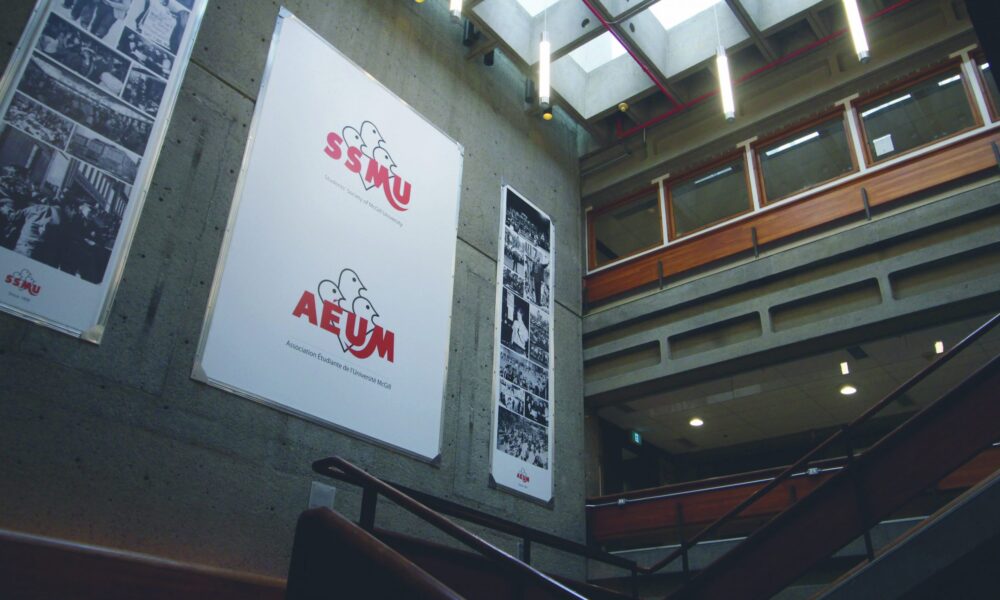
Student activists protest SSMU decision to drop Palestine Solidarity Policy

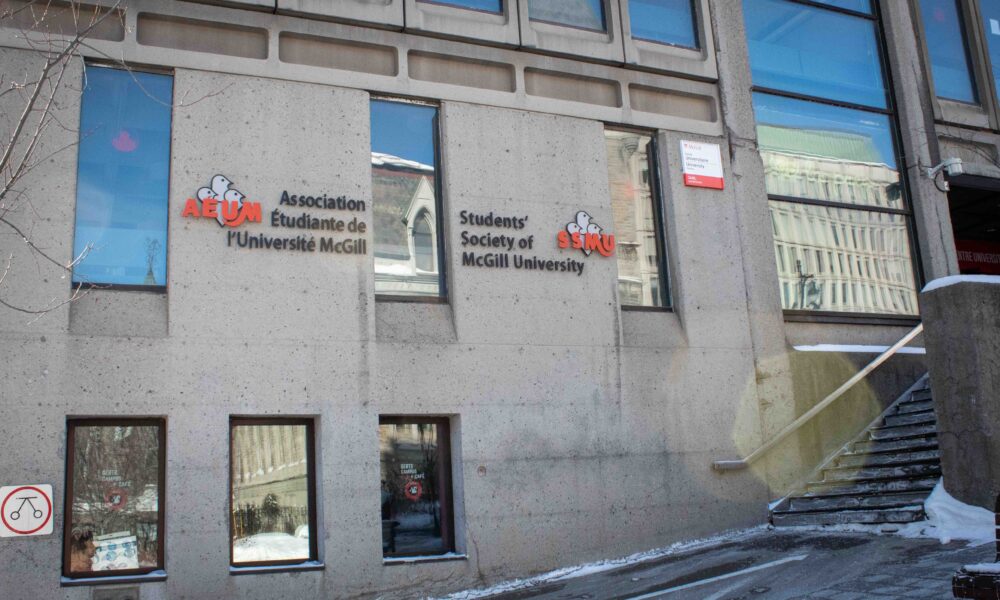
The Students’ Society of McGill University (SSMU) announced in a statement on April 22 that they would not be adopting the Palestine Solidarity Policy, despite 71.1 per cent of voters endorsing it in the Winter 2022 referendum. The Policy would have mandated the Society to condemn the surveillance of Palestinian and pro-Palestine members of the McGill community, publicly assert its support for the cause of Palestinian liberation biannually, boycott companies complicit in the Israeli occupation of Palestine, and pressure the McGill administration to do the same. 

The decision to drop the Policy came after sustained pressure from the McGill administration. On March 24, McGill’s Deputy Provost Fabrice Labeau sent an email to students that denounced the Policy as divisive and polarizing. Labeau explained that the administration found the Policy to be in violation of the university’s values and SSMU’s constitution. According to Labeau, if the policy was implemented, the university would end its Memorandum of Agreement (MoA) with the Society, which formalizes their relationship. The university gave SSMU 30 days to remedy the alleged violation of its constitution, or 90 days to submit the dispute for arbitration. 

On April 22, when the SSMU concluded its internal investigation of the alleged MoA violation, the SSMU Board of Directors (BoD) announced that it had also found the Policy to be at odds with the SSMU Constitution, the SSMU Equity Policy, a 2016 SSMU Judicial Board ruling, and Quebec law. SSMU has therefore complied with the administration’s demand to revoke the Policy.

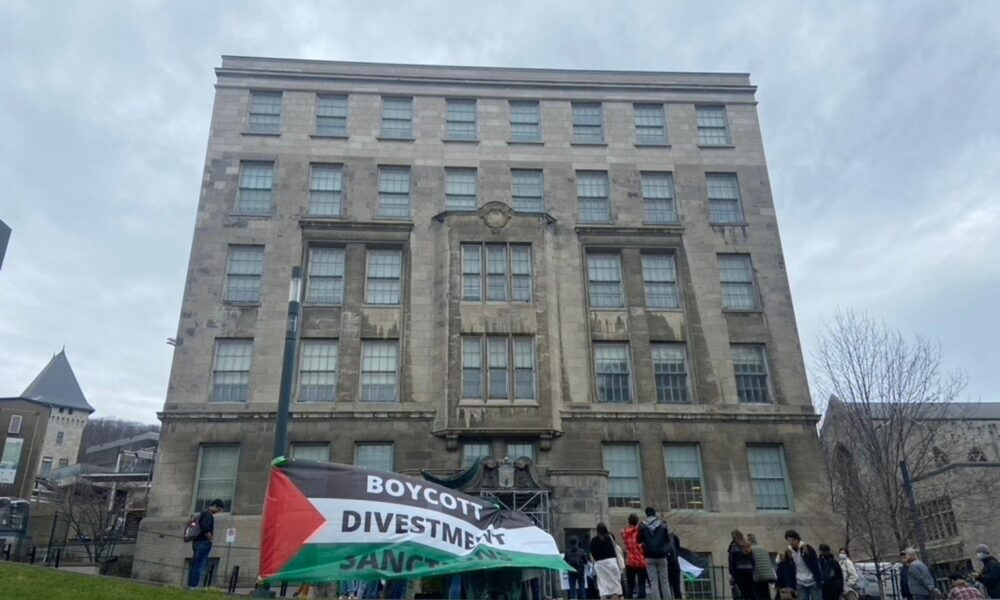
Students for Palestinian Human Rights (SPHR) McGill held a rally on April 25 in front of the James Administration Building to show support for the Policy and to protest SSMU’s decision. Before the rally, Noor,* a member of SPHR, voiced their dismay in an interview with The McGill Tribune

“We do not recognize the SSMU Board of Directors’, or as we like to call them the board of dictators, decision to repeal or overturn this policy because it is a complete attack on student democracy and it completely dismisses the entire referendum vote,” Noor said. “We do not recognize it, and we urge students, as well, not to recognize the board of dictators’ decision [….] We are just really ashamed that the student union chose not to represent us.”

Noor believes that SSMU should have stood its ground when faced with pressure from the administration. They also think the Society timed its announcement to be released during the final exam period when students are preoccupied with  studying—a sentiment shared by others who attended the rally. 

“I think pressure from the admin definitely played a big role. I wouldn’t be surprised if [the] McGill administration was down [SSMU’s] throat,” Noor said. “[The SSMU BoD] could have easily said that it was constitutional, which it is, and went to arbitration, but they chose to overturn a democratically elected policy.”

Sarah Abdelshamy, a former member of SPHR and current organizer with the Palestinian Youth Movement, stated at the April 25 rally that she believes McGill’s intervention in the referendum was motivated by the interests of shareholders as opposed to the well-being of its students. 

“They say that this motion is divisive without acknowledging that our campus has been divided for decades now—precisely because we do not have any motions or mechanisms that protect us,” Abdelshamy said. “For years now, students on campus have been harassed, doxxed, harmed, and targeted, and the administration turns a blind eye to it. The only division that this motion causes is between the university and its donors—the only relationship that the administration is capable of or desires to protect and uphold.”

In an email sent to the McGill community on April 26, Labeau applauded SSMU’s decision. While Labeau condemned the surveillance of pro-Palestinian students on campus and recognized the importance of student activism, he reasserted McGill’s stance against the adoption of the Policy.   

In a speech at the SPHR rally, Islamic studies professor Rula Jurdi Abisaab criticized the administration for its rhetoric surrounding the Palestine Solidarity Policy. 

“As an educator at McGill, I caution against the statements used by the administration, such as ‘a culture of ostracization and disrespect,’ to suppress the results of the democratic elections of McGill students,” Abisaab said. “Such phrases gravely misrepresent the aims of the Palestine Solidarity Policy and promote inadvertently a passive coexistence with injustice.”

Abisaab, also a signatory of the open letter from McGill faculty and staff endorsing the Palestine Solidarity Policy, further reaffirmed her admiration for the students championing the Policy. 

“I support our students’ use of legitimate civil and democratic means to dissociate themselves from ideas and institutions that have promoted racism, dehumanization, and violence,” Abisaab said. “Our undergraduate students are to be praised for embracing democratic ideals of human dignity, freedom, and equality at McGill.”

Former SSMU President Darshan Daryanani, who was recently impeached, also spoke at the rally. He praised the Palestine Solidarity Policy for changing the discourse about Palestine on campus. 

“I publicly defended and endorsed the Palestine Solidarity Policy. Personally, I agree with all the calls to action, and your 71 per cent overwhelming majority vote only made it easier to defend it,” Daryanani said. “Right now, more than ever, I urge you to continue to speak up because your voice matters.” 

The Tribune reached out to the SSMU BoD for a statement on the decision-making processes that led to the nullification of the Palestinian Solidarity Policy. All executives declined to comment.

*Noor’s name has been changed to preserve their anonymity.

News, SSMU

Students vote to remove SSMU President Darshan Daryanani after tumultuous year in office

*Content warning: Gender violence, sexism, harassment

Students’ Society of McGill University (SSMU) President Darshan Daryanani was impeached in a Special General Assembly (GA) on April 11. The three-hour meeting culminated in the approval of a motion to remove Officer Daryanani from his post, which surpassed the required two-thirds majority with 351 votes in favour, 27 opposed, and 22 abstentions. In the following online ballot held from April 14 to 18, the GA’s decision was ratified, with a McGill undergraduate voter turnout of 12.6 per cent.

Allegations of discrimination, the ill-explained five-month absence of Daryanani, and repeated testimonies about a toxic work environment at SSMU fuelled much of the controversy surrounding the Society over the 2021-2022 academic year. Demands for transparency and accountability accumulated over months: Public mentions of impeachment were first made on Nov. 11, 2021, the fifth Legislative Council (LC) from which Daryanani was absent. A motion that would have mandated Daryanani to hand in a letter of resignation passed in LC on Nov. 25, but was ultimately postponed by the Board of Directors (BoD). 

Daryanani’s reinstatement on Feb. 14 dominated the conversation at both the Feb. 17 LC and the Feb. 21 Winter GA. At the annual Winter GA, Councillor Pérez Tiniacos asked the executives if they would resign upon receiving a letter from the LC stating that executives and councillors do not feel safe with the executive’s presence in SSMU. Such a letter would require the support of at least 50 members of the Society. All executives said that they would resign, while Daryanani did not directly address the question in his response. 

“If I [resigned] as soon as I received a suspension letter, I wouldn’t be here today,” Daryanani said at the annual Winter GA. “But like I said, the reasons to suspend me were deemed inadmissible and unfounded.”

In late February, 12 councillors put forth a petition to hold a Special GA that would address the possibility of impeaching Daryanani. The document received over 200 signatures, easily surpassing the mandated 50 required by the SSMU Constitution.

On April 11, hundreds of McGill undergraduates gathered on Zoom to deliberate Daryanani’s removal—an event that quickly devolved into chaos. The volume of last-minute sign-ups delayed the meeting by nearly 45 minutes, but quorum was maintained due to sizable student interest— a first in recent McGill history. 

An hour into the scheduled start, Pérez Tiniacos, who moved the impeachment motion, introduced the grounds of ‘impropriety’ that he and other councillors believe warranted Daryanani’s removal. He emphasized that SSMU representatives no longer saw Daryanani as a leader, but as an obstacle to the Society’s operations. 

“To some, this impeachment may not make a lot of sense, especially seeing how late it is in the school year,” Pérez Tiniacos said. “But let me remind you, it will cut off the President from whatever is left of his $30,000 salary paid by student fees, it will invalidate his title as President, it will provide safety to all the workers, and ease the transition to next year’s Executive Committee. But most importantly, it will show the student population this type of behaviour is not tolerated within the SSMU and that we hold everyone accountable for their actions.”

Daryanani stated that he saw the meeting as an opportunity for him to question the true motives of SSMU members and the BoD in introducing this motion. He then directly addressed those individuals and questioned whether his impeachment was warranted.

“Why did [the BoD] suspend me for nearly five months? Prior to my suspension, why did I not receive any sort of warning, and why did nobody even bother to talk to me?” Daryanani asked. “On what basis have [the councillors] convinced 231 signatories to call for my impeachment? [….] Do [students] think it is reasonable for me to have been unjustly suspended from an elected position for five months, only to be reinstated, and then again removed for no clear reason?”

In the question period that followed Daryanani’s statement, SSMU VP Internal Sarah Paulin invited the movers of the motion to respond. Councillor and seconder Nathaniel Saad expressed concern about whether the President had read the motion, which defined the charges against him as “a failure to observe standards or show due honesty or modesty; improper language, behaviour, or character.”

“[The President’s language attempts] to discredit the Board of Directors by answering criticism with criticism, but never actually presenting a counter argument,” Saad said. “[The basis for impeachment] is clearly in the motion and we’ve been saying it for the last two months.” 

The Special GA also served as an opportunity to discuss the resignation of VP External Sacha Delouvrier, announced at the April 7 LC, which occurred before his impeachment process could begin. The councillors that created the petition for Daryanani had also created one for Delouvrier. According to Pérez Tiniacos, Delouvrier stepped down after receiving the document from councillors. Delouvrier stated publicly at the April 7 LC that his departure was for health reasons.

Member of the gallery Mikael de la Brindille requested examples to support the claims of impropriety against Daryanani, questioning how members were expected to vote on impeachment when requests for evidence were regularly denied on the basis of confidentiality. 

“I totally understand the frustration,” Councillor Mary Zhang said. “However, I would like to reiterate that the topic at hand is extremely sensitive to the people that are concerned [….] We should not have to hear [dehumanizing details] just to make a call [to] action in the right direction.”

Following the request for evidence, Councillor Charlotte Gurung shared her account of the Feb. 21 GA, when interactions with Daryanani left her uncomfortable and anxious because she felt his behaviour was aggressive and his tone threatening. She also implored the audience to consider how having personal, distressing interactions aired to a crowd of 370 could worsen the situation for those involved.

Member Ghida Mawlawi, on the other hand, urged the attendees to consider Daryanani’s viewpoint.

“No one mentioned the fact that an independent investigation […] found those claims were unfounded,” Mawlawi said. “Has anyone considered that Darshan’s tone was angry because he had just been suspended for four months for no reason? I don’t know if you guys are noticing, but it feels like all of you are ganging up on President Daryanani.”

Daryanani also expressed disappointment at the process. According to Daryanani, when he filed a complaint against another executive for racially targeting him, the executive received equity training rather than a suspension and public scrutiny. 

Following its approval at the Special GA, the motion to impeach Daryanani required ratification by undergraduate students before it could officially take effect. At 5:05 p.m. on April 18, Elections SSMU certified that students had approved the motion to remove Daryanani from office and he was impeached, effective immediately. 

“We’re all very happy that the motion was officially ratified,” Pérez Tiniacos told the Tribune. “But more than just a celebration, I think this also has to be a point of reflection on how this environment within the SSMU that was perpetuated was definitely not the first.”

As stipulated in the motion, the president’s portfolio—as well as that of the VP University Affairs and the VP External—has been divided up amongst the remaining executives, who have effectively been working as a three-person team since February. The remaining executives will also undertake the training for incoming executives as a group, and are looking into consulting previous office-holders for help with the transition. 

“Something we’re going to be stressing a lot for next year’s execs is ‘take care of each other,’” Sader said in an interview with the Tribune. “You cannot talk about a lot of things to your partners, your friends, your family. You can only talk about it to each other; you need to be able to rely on each other [….] I’m confident in the next year’s execs that they’ll be able to do an excellent job—they all seem to be kind people, and that’s what’s important. Hopefully, they’ll be able to work together and kind of stick through it together.”

McGill, News, SSMU

Faculty and staff sign open letter endorsing SSMU’s adoption of Palestine Solidarity Policy

An open letter published in The McGill Daily on April 5 endorsed the Students’ Society of McGill University’s (SSMU) adoption of the Palestine Solidarity Policy. The letter, titled “Support SSMU and the Palestine Solidarity Policy,” was signed by 103 McGill faculty and staff members. It came after an email from the McGill administration that publicly denounced the Policy and threatened to terminate its Memorandum of Agreement (MOA) with the SSMU on March 24. In a statement released on April 22, SSMU announced that it would not be ratifying the Policy, as the SSMU Board of Directors determined that it goes against its constitution, Equity Policy, a 2016 Judicial Board ruling, and Quebec law.

In the open letter, professors and staff applauded the work of Solidarity for Palestinian Human Rights McGill (SPHR) in creating the Palestine Solidarity Policy and students for passing it with a 71.1 per cent majority. The letter also stressed the importance of maintaining independent democratic channels, such as SSMU referenda, for students to push for meaningful change on campus. 

Michelle Hartman, professor of Arabic Literature at the Institute of Islamic Studies, told The McGill Tribune in an email that she believes it is important for faculty to support students when the administration attempts to suppress student political activism. 

“The attempt to shut down a student union policy like this by a university administration runs against everything a university is meant to do and stand for,” Hartman wrote. “So many professors that I spoke to were outraged about how the university administration responded in such a threatening and heavy-handed way to a student initiative—especially something that is standing for social justice. I find it egregious that the administration would try to shut down students engaging in activism and solidarity on one of the most pressing and urgent causes of our time.”

Associate professor of political science William Clare Roberts echoed Hartman’s sentiment—he feels the university’s threat to terminate its MOA with SSMU goes against its commitment to collegial governance. Roberts also noted the importance of showing solidarity with Palestinian people. 

“I’m incredibly proud of the students who brought the resolution to the student body, and of the voters for passing it by such a large margin,” Roberts wrote in an email to the Tribune. “Solidarity with the Palestinian people, and efforts to address their displacement and dispossession by Israel’s apartheid policies, are morally and politically righteous. In no other case are invasion, occupation, and oppression so protected from criticism and opposition. No one can deny that Israeli policy is unjust, but the demand to do something about it, to withhold support and cooperation from universities and corporations that collaborate, is always greeted by hysterical reactions.”

In an email statement to the Tribune, SPHR said that support from faculty and staff helped keep the Palestine Solidarity Policy relevant. They also commended students’ efforts to promote social justice and human rights.

“[Support from faculty and staff] shows the administration that we are not alone in our indignation towards their threats,” the group wrote. “It moreover demonstrates to the majority of McGill students, who demonstrated their support for the Palestinian liberation struggle in the Winter referendum, that they are supported by academics and professors.”

In an email to the Tribune, McGill media relations officer Frédérique Mazerolle reiterated the administration’s stance that the Policy is at odds with McGill’s mission of inclusivity.

“Robust debate is key to what we do and who we are as a university,” Mazerolle wrote. “But such debate cannot be carried out at the expense of respect and inclusion. Initiatives that create excessive polarization in our community and encourage a culture of ostracization due to students’ identities, religious or political beliefs, are in contradiction with the university’s values of inclusion, diversity, and respect.”

Arts & Entertainment, Film and TV

‘Human Resources’ may not top ‘Big Mouth,’ but it impresses nonetheless

In the mythical world of Big Mouth’s spinoff series, the department of Human Resources in question may appear like any other: Employees attend boring meetings, unpaid interns pretend to take minutes, gossip is exchanged in the elevator, and love triangles brew between coworkers. But viewers should not let this department’s name obscure its important purpose. In this series, Human Resources has a purpose far greater than filing complaints. Rather, its employees are tasked with the important responsibility of dispensing and controlling the emotions of each human alive on Earth.

The animated Netflix series, which premiered on March 18, follows an array of different creatures, each embodying a different human dimension of human personality as they navigate office life. These creatures include mosquitos for anxiety, glowbugs for love, and rocks for logic. The show centres around the office intern, Lovebug Emmy (Aidy Bryant), after she is abruptly assigned to her first human client, Becca (Ali Wong). As the season progresses, Emmy grows into her role as a lovebug and fosters new relationships with Becca and her other coworkers. The show also features returning creatures from Big Mouth, like raunchy hormone monsters Maury (Nick Kroll) and Connie (Maya Rudolph).

Human Resources diverges from Big Mouth in its decision to focus on the lives of adults instead of adolescents, expanding on the diversity of human experiences that it explores. For example, the series follows Becca as she copes with postpartum depression and feelings of shame for not feeling an immediate connection to her baby. Another particularly touching storyline follows an elderly woman with Alzheimer’s disease, Yara (Nidah Barber), who revisits old memories of her young romances accompanied by her lovebug, Walter (Brandon Kyle Goodman). Through Yara’s story, the series illustrates the complicated and bittersweet nature of experiencing love while coping with dementia. Meanwhile, Yara’s son Amir (Ahmed El-Mawas) cares for her with the help of his logic rock, Pete (Randall Park). At the same time, he tries to avoid the creature representing grief—a seemingly docile sweater—which grows violent each moment it’s ignored. Through focussing attention on the complexity of adult emotions and experiences, the series highlights how the responsibilities associated with maturity can impact mental health. Because they must provide for their family and earn money, humans in Human Resources tend to prioritize certain feelings over others to an extent that the younger characters of Big Mouth do not. By representing love, grief, anxiety, and shame through exuberant creatures, the show lends a lightheartedness to these dark subjects while simultaneously treating characters affected with empathy and understanding. 

One of the most disappointing features of the show is its attempt to incorporate returning cast members Maury and Connie as side characters. Because the focus in Big Mouth is on humans, the hormone monsters are almost always portrayed alongside their restrained clients. This contrast between ordinary human characters and the obscenity of their hormone monsters was a crucial part of Big Mouth’s humour. But in Human Resources, they mainly interact with each other or other hormone monsters. Creators likely chose to include them in the series to please returning fans of Big Mouth, but it has the consequence of diluting the entertainment factor of Maury and Connie. Without their more serious characters to balance their crass humour, their obscenities don’t stand out. Instead, their normally sharp, punchy jokes are wasted on each other and conversations quickly get stale. 

Human Resources likely wasn’t created with the expectation, or intention, of upstaging Big Mouth. It’s difficult to create a new show distinct enough from the original to stand alone while still appealing to returning viewers. Given the creative limitations associated with creating a spinoff series, Human Resources ‘s explorations of new human perspectives, without sacrificing the entertainment audiences expect, is particularly impressive. Talented voice actors, a colourful animation style, and smart writing also endow the show with a humour that balances being lighthearted and sharp. Though it does suffer by isolating Maury and Connie from the other characters, the show’s depth adds to the Big Mouth universe, and the humour with which it approaches sensitive topics make it worth a watch. 

Commentary, Opinion

Campus conversations: Resistance

Resisting silence

Sepideh Afshar, Opinion Editor

Resistance, to me, is to be vocal about the injustices you see and experience. For about a year, I was part of a sorority at McGill. In this predominantly white space, I found myself silenced concerning the overt racism I was experiencing. I felt that my whole social circle, which was primarily made up of people in Greek life, would ostracize me if I spoke out about the way I was personally experiencing the institutionalized racism I had been so vocal about in the past. I put so much effort into trying to justify my silence to myself, effectively voiding the sorority girls and advisors around me of any responsibility. For months, I was wracked with guilt. I felt personally responsible for the racism any marginalized people joining the sorority might face—because at that point, I had become the token person of colour. I had students telling me they felt safe joining because of my presence and the positive experience I painted sorority life to be. Over time, this guilt wore me down and took a real toll on my mental health. I had joined with a fierce confidence that I could eradicate racism in Alpha Phi, naive to the institutionalized racism I was unprepared to tackle. It was only when I was disciplined, partly for the pro-Palestine content on my Instagram, that I realized the fiery resistance I had in me when I joined the sorority had turned to complicity. So I resisted in the only way I could think of: Speaking out. 

I posted about my negative experiences on social media and made sure everybody around me knew of the terrible things I faced while part of Alpha Phi. Silent resistance, especially concerning issues that so many work hard to bury, is not enough. When I finally felt confident enough to speak on my experience, it was not just for myself. My goal was not to receive an apology or to get revenge on an organization that took so much away from me––I just could not recognize the Sepideh who was silent in the face of oppression. Once I left the sorority, I regained that spark. I know the importance that my voice holds and the impact that it can have and for that reason, I continue to be vocal. I talk and post about my experiences and I write articles about issues that matter to me because that is what I know resistance to be. 


Queering resistance 

Aubrey Quinney, Opinion Editor

If I had to sum up my time spent at university, it would be three years of unlearning harmful social constructs and building an identity that I can truly call home. Even as my degree comes to an end, I can confidently say that I am still building that home, brick by brick. McGill threw a whole set of challenges my way, which I only overcame with the help of friends and a partner in crime. Throughout the process of overcoming experiences of gender dysphoria and internalized oppression, I have learnt that resistance comes in more shapes than one. 

At first, I believed resistance was only needed in the face of harmful social constructions which marginalized individuals like myself. I learnt of gender fluidity and found a meaningful connection with not only the non-binary label, but a whole set of theories linked to the topic, such as gender performativity. I saw gender everywhere and worked tirelessly to unlearn the wrongs I saw all around me. Throughout my second year of university, my passion for gender and sexuality rights burned and I felt restless to change the world. 

Midway through my third year, however, I began to feel a growing pressure in my mind to unlearn all the progressive conceptions I had newly built. It became increasingly hard to not see genders walking down the street. Especially as my classes became more specialized, my understanding of how the problematic world worked took a toll on my optimism. An anger roared inside me; I was constantly having to choose between fight or flight. Only those closest to me would hear society get the better of me when I pondered escaping to Bermuda.

On top of societal expectations chipping away at me, gender dysphoria started to creep back into my life, and this time, in one of the most intimate areas—sex. I have felt dysphoria with my upper body for several years. It was only when I met my partner that I started to experience gender euphoria. In my final year, however, I no longer felt comfortable during sex, often letting the moment die out. It was only thanks to my partner’s creativeness in queering sex, blending so-called male/female boundaries, that I rekindled that side of myself. 

So while challenges can come from many places, resistance usually comes from two: Yourself and relationships with those closest to you. As my time at McGill comes to an end, I feel pride in resisting those challenges, and thankful for those who helped me through them. 


Notes on fake resistance

Matthew Molinaro, Opinion Editor

Resistance has to be real, any potential stakeholder in a collective political uprising will tell you. That means there remains an excess of fake resistance to be disavowed. Much of it rose to the surface in 2020. Take how in the span of four days, and in the height of the Black Lives Matter uprisings, Prime Minister Justin Trudeau paused for 21 seconds in front of journalists and kneeled in front of his workspace—or rather, Parliament Hill. Not real: These actions, performed for happiness-focussed and order-seeking Canadians, symbolize how catering resistance to an audience undermines radical, meaningful measures.

This resistance is performative, self-serving, narrow-minded, superficial, exclusive, static. They tell you if you want to see fake resistance, go to Twitter leftists, or washed up celebrities, policing each other over terms that will be irrelevant in 10 years; look at your radicalized, convoy-supporting high school classmate’s Instagram stories; scroll through your family members’ Facebook. The results jar you, and shortages of fake resistance are yet to be seen in this stage of the pandemic.

I wonder if I’m a fake resistor. Elite university life intentionally separates itself from grassroots organizing. I’m still navigating what it is to exist in all-Black spaces one day, and spaces where I’m the only one the next. The stories of racism and microaggressions I’ve dealt with at McGill and in my lifetime are far too common, too easy to overcome to make me a real resistor—even if they’re wrong, everyone knows questions like ‘what are you,’ ‘where are you really from’; everyone knows that no one, from the state to private business owners, leaves Black men alone, unsupervised, uncontrolled. We begin to have nothing left to do but laugh and indulge in fake resistance. I tell myself it’s natural to think that.

The words of others, the people whose resistance is as real as it comes, give me solace in these doubts. The masterful Toni Morrison reminds us that we should insist on being shocked, on never being immune, on being surprised at the success of racist systems. The fact that fake resistance even becomes common suggests an immunity we ought not to have in the face of injustice. Even as McGill works its way to institutionalizing anti-racism efforts, if we lose our shock—if we give in to fake resistance and how it stymies any effort to mobilize the masses—we lose our power.

Features

It’s a lot, and it’s honest work

I don’t remember when I first learned about the existence of sex work. Certainly, I learned about sex at some point in a middle-school classroom, probably among a group of snickering teens. Yet the idea of sex as a job did not exist in my mind until cinematic depictions introduced me to the stereotypical image of a sex worker: A woman in the night, heavily made up, dressed up in provocative clothing, standing at the corners of dark streets and getting into strangers’ cars. At the time, I didn’t see this as work. I saw what she did as a shameful, criminal act;, almost a threat to society. Because I believed that sex work was not an “admirable” profession, I did not see it as a profession at all. It was incongruent with my perception of how a job should be. It took the longer portion of my life to understand that no matter my opinions on the task itself, sex work is real work. 

The moral status of sex work has long been debated, both by a sex-conservative establishment and revolutionary feminists. Is it sex? Is it work? Can it be both? These are questions that have divided feminist circles for the last century. Some feminists, whom critics accuse of participating in “carceral feminism,” advocate for increasing legal penalties. For them, sex work and sex trafficking live on the same spectrum of degradation and exploitation. Many carceral feminists, like the radical feminist Catherine MacKinnon, or the anti-prostitution advocate Julie Bindel, believe that sex work should be outlawed altogether, with the ultimate goal of abolition. Some advocate for harsher prison sentences for those selling sexual services, even if the services are their own, in an effort to completely eliminate sexual labour. 

Clearly, there are problems with this framework. But on the other hand, critics of carceral feminism can sometimes veer into a romanticized version of sex work—one in which exploitation is notnever a factor. In the book //Revolting Prostitutes: The Fight for Sex Workers Rights//, activists and sex workers Juno Mac and Molly Smith argue that this philosophical binary creates two inverse images of sex workers: The “happy hooker,” an empowered, often young, white woman who participates in sex work as a form of liberation and autonomy, versus the young girl, stolen from her bed in the middle of the night and forced into sex trafficking. Ultimately, these two characters form a reductive dichotomy of sexual labour. The first image ignores the realities of migrant women, for instance, who are coerced or threatened into exploitative sexual labour because of their potentially unstable immigration status. The second image paints all sex workers as helpless victims and strips them of their autonomy. The truth of the matter is that there is no one kind of sex work. Safe and well-compensated sex workers exist, as do unsafe and worried sex workers who exist in volatile spaces with poor working conditions. 

Sex work is what McGill law professor Angela Campbell calls a “morally ambiguous” profession. As she wrote in her 2013 book, //Sister Wives, Surrogates and Sex Workers: Outlaws by Choice?//, prevailing perceptions of sex work are dominated by a choice-coercion binary.

“I think we think of people as enlightened or as exploited and subject to [societal] pressures,” Campbell said. But, she added, “Any of us can be subject to forces that feel coercive.”

Whether or not something is coercive depends on who you ask. To those with the privilege of a secure, legally unambiguous job, the complex choice to enter sex work can look like a product of exploitation and restriction. But Campbell pointed out that activities deemed degrading by some, like selling services on the street, can be viewed entirely differently by those actually working.

“There are people who appear to be in circumstances that are very limiting, when in fact they exercise incredible resilience and resistance in their own communities,” Campbell said.

At least in some ways, sex work has become more normalized in recent years. Nathan*’s path into sex work began during the pandemic. He explained that returning to his home country of Malaysia with a schedule full of online classes presented him with a newfound amount of free time.

“Everything was up in the air, school became ridiculously easy and all of a sudden I had all this time,” Nathan said. “A pimp in Malaysia reached out through my Instagram […] and asked if I’d be interested in doing this and I thought ‘Why not?’ I had nothing to lose if I tried it out. If I like it, then it’s money.”

For Nathan, sex work tends to be transactional, rather than something sexually fulfilling for the service provider.

“When we have sex with our clients, it’s a service in exchange for something else,” Nathan said. “You’re offering something that you wouldn’t normally do and you’re doing it for the perks, not for the pleasure [….] When you really think about it, what’s the difference between sex work and just giving somebody a regular massage?”

But, of course, the two professions aren’t the same in the eyes of the law. “[By] taking it one step further and making it an erotic massage, suddenly it’s sex work and it’s illegal,” he added.

Despite its history of being stifled and criminalized, sex work remains one of the oldest professions in the world. In Canada, the history of sex work legislation is impressively convoluted and ambiguous. The first recorded sex work laws were introduced in Nova Scotia in 1759, but the legislation was centred on removing “vagrants”—anyone considered undesirable—from the street. The real legislative history began after the Canadian Confederation was formed in 1867, when these vagrancy laws were combined in the Canadian Criminal Code with more sweeping laws that forbade brothels and pimps from employing women. Since then, legislators have expanded the definitions of criminal conduct; by 1985, the Parliament passed a law that barred public communication for the purposes of “prostitution.” Finally, in 2014, after a Supreme Court overruling of previous sex work laws, Canada implemented Bill C-36. This bill followed the lines of the Nordic Model framework, meaning that the purchase—but not the selling—of sex is illegal.

On the surface, the Nordic model seems like the ideal compromise for both sex work critics and advocates: Punish the buyer, but not the seller; protect the woman, arrest the man. But although the Nordic model has been hailed by many as the ultimate fix to sex work legislation, it only increases financial precarity for sex workers. If one half of the transaction is outlawed, how is a sex worker supposed to find the means to live? The Nordic model criminalizes a central the entire goal of sex work—the compensation. Thus, even though the selling of sex is not illegal, sex work falls into a grey category of illegal occupations. Secrecy is incentivized in this model, since a sex worker who exposes an abusive client to arrest risks losing income. The ultimate result is that sex workers are at much higher risks of experiencing labour violations. 

More recently, advocates for sex work have moved away from the word “legalization” toward the word “decriminalization.” The distinction is crucial. Legalization typically involves the regulation of certain streams of sex work. However, exactly what kind of sex work is allowed is up to legislators, who can potentially criminalize many categories of sex work. On the flip side, decriminalization implies fully removing sex work from the list of criminal offences and treating sex work just like any other type of work. This would open the doors to labour rights for sex workers, as their form of employment would fall under the Canada Labour Code. 

“When sex work is viewed as criminal, sex workers’ clients and other third parties are constantly trying to evade law enforcement, and when you’re evading law enforcement, it means that you’re in isolation, you can’t access services you need,” explained Jenn Clamen. “It means you don’t tell people you’re working in the industry.”

Clamen is the National Coordinator for the Canadian Alliance for Sex Work Law Reform (CASWLR) have been working nonstop to help provide the support and resources that sex workers need. The organization formed in 2012 in the middle of a constitutional challenge called the Bedford case. The case was initiated by Terri Jean Bedford, a Canadian dominatrix, initiated the now historic 2007 lawsuit, who arguinged that Canada’s anti-prostitution laws were unconstitutional in a historic 2007 lawsuit. After a seven-day trial in 2009 and a year of judicial deliberation, Bedford and her two colleagues, Valerie Scott and Amy Lebovitch, won the suit in its entirety, and it was their work that led to the eventual Supreme Court decision to overturn previous sex work laws in 2013.
Since we continue to live in a country where sex work is criminalized, organizations like the Canadian Alliance for Sex Work Law Reform (CASWLR) have been working nonstop to help provide the support and resources that sex workers need. Despite the fact that the selling of sex is not criminalized, sex workers continue to fear the police, and rightly so—over-policing of sex workers remains a critical issue. And uUltimately

Behind the Bench, Sports

McGill must stop resisting before Athletics ceases existing

As another school year draws to a close, it offers an opportunity to reflect on the areas of the McGill community that have evolved—as well as those that have stayed tragically stagnant. A year marked by the return to in-person classes, sports games, social events, and cycles of relaxed restrictions followed by lockdowns has brought a whirlwind of changes to student life. However, for Divest McGill, the year has looked frustratingly similar to every other: Strong student support and protests backing their fight for change, and those in power refusing to budge. 

To make matters worse, this year has also shown that the administration’s refusal to divest is beginning to form cracks across other areas of student life at McGill. Their unwillingness to compromise is having unintended consequences for students, including in areas such as McGill Athletics and Recreation (A&R). 

Divest McGill and McGill Athletics are, on the surface, two organizations few would guess are interconnected. But due to student tactics to get the administration to divest, compounded by the McGill administration’s unwavering stance, A&R is getting hit where it hurts: The balance sheet.

In Winter 2019, the Students’ Society of McGill University (SSMU) Legislative Council put the renewal of the Athletics Facility Improvement Fee to referendum. The 10-dollar fee created in 2004 went toward maintaining and improving the facilities, and the renewal would have funded air conditioning for the fieldhouse and locker rooms. However, since the fee renewal came amidst the #ChangeTheName movement, a counter ‘No’ campaign was heavily supported by students, including Indigenous students, who pointed out that approving this fee would allow McGill to continue to fund their programs under a racist team name and mascot. The referendum question ultimately failed with 58 per cent voting ‘No,’ and the Athletics Facility Improvement fee was removed from student fees for the next five years. 

“This means that there is a loss of $500,000 per semester for the Athletics department,” Evelyn Silverson-Tokatlidis, Varsity Council president, said in an interview with The McGill Tribune

As the administration dragged their feet on changing the varsity team name, the loss was compounded by SSMU identifying blocking ancillary fees as an effective way to apply pressure on the university to divest. As a result, the Legislative Council passed a Policy on Moratorium on McGill fees until Fossil Fuel Divestment. This meant that for the next five years, no new ancillary fees—which serve programs such as the McGill Writing Centre and the World University Services Canada Refugee Program, as well as  A&R—could be added to student’s bills until McGill divests, with the Athletics Facility Improvement fee locked on the outside. 

A total of $1,200,000 would be withheld from Athletics and Recreation over the next five semesters. 

Since the university does not provide funding for the facilities of A&R, the implications of this moratorium has wide-ranging impacts. Facility upgrades such as air conditioning in the fieldhouse and gym that would benefit all students, not just athletes, have been pushed back. Longer-term projects, such as the renovation of the locker rooms, fieldhouse resurfacing, and turf improvements all have uncertain timelines because of inadequate funds.

“Almost a quarter of the student body uses McGill athletics facilities,” Silverson-Tokatlidis said. “The refusal to divest by McGill is impacting the quality of these facilities for a huge amount of the student population.”

In an interview with the Tribune, Joseph,* a representative from Divest McGill and a varsity athlete, explained how the facilities are in dire need of improvement, making it harder for them to train and enjoy their time as a student athlete.

“We understand that there are updates to the Athletics facilities that are urgent. My coach talks about them and how much money needs to be put into it,” they said. “Being an athlete has created my identity, it has made me who I am. But the fact that McGill is refusing to divest means they are refusing to provide the services the athlete community needs. Everyone needs to get behind divestment.”

On Feb. 17, 2022, the Legislative Council met to discuss, amongst other things, putting the Athletics Facility Improvement fee back up to vote in the Winter 2022 referendum. The motion was postponed indefinitely. The current SSMU representative for Athletics, Sêdami-Habib Djossou, went into the meeting with the goal of getting the fee reinstated.

“My main aim was to make an amendment to the moratorium, not remove it,” he said. “The amendment would make an exception to the Athletics Facilities Fee because of the intense impact the moratorium is having on Athletics and Recreation. The renovations are essential, and we may have to discontinue some services in order to afford them.”

The amendment argued that the self-funded A&R program is being financially targeted due to McGill’s refusal to divest, a decision that they have no control over.

“If I am honest, the question period was really tense,” Djossou continued. “There was a huge concern about what the amendment would do. A member of Divest McGill said that if we allow the amendment to go through it will push the message that we don’t care that much. It will undermine all the efforts made so far.”

Joseph, who also attended the meeting, was frustrated that a student group and Athletics were positioned on opposite sides of the issue. 

“It felt as though the discussion was being framed as Athletics against Divest,” they said. “It was very difficult for me, being attached to both. Ultimately, the Divest [argument] was that it would ruin the momentum of the campaign.”

With the issue yet again at a standstill, it is easy for both sides in the Legislative Council debate to point fingers at one another—and this would certainly be convenient for the McGill administration. The administration’s refusal to divest is pitting students against each other, when energies should be focussed on holding those with power to account.  The more energy spent by students fighting amongst themselves, the less is spent on collective action.

However, both groups are keen to show that the issue is not with each other. The moratorium does not represent one group of students seeking to worsen the university experience for another group. Instead, it represents a blatant refusal from the administration to ethically invest its money, with students ultimately shouldering the cost. Universities all over the country, including Concordia, UQAM, University of Toronto, uOttawa, University of British Columbia, and many more, have divested, or at least pledged to—. What, then, is McGill’s excuse?

The Athletics Facility Improvement fee will not be reinstated this year after the motion was postponed, and it will take nothing less than divestment for the student group to lift the moratorium. At this point, any amendment to the moratorium will be seen as a victory for the administration. With the clock ticking for both the Athletics and Recreation budget as well as our planet, McGill needs to make the smart choice to divest from fossil fuels, and invest in the future of our athletes.

*Joseph’s name has been changed to preserve their anonymity.

Read the latest issue

Read the latest issue