


Latest News

McGill, News, SSMU

McGill threatens to terminate MoA with SSMU over the approval of Palestine Solidarity Policy

On March 21, the Palestine Solidarity Policy question on the Students’ Society of McGill University (SSMU) Winter 2022 Referendum passed with a 71.1 per cent majority. The following day, however, Deputy Provost Fabrice Labeau informed SSMU that the university found the policy to be in violation of SSMU’s constitution and provided SSMU with a notice of default in accordance with the Memorandum of Agreement (MoA) between SSMU and McGill. Labeau then publicly announced in an MRO email sent to all McGill students and staff on March 24 that the university threatened to terminate its agreement with SSMU if the alleged violation is not remedied. 

The approved Palestine Solidarity Policy mandates that SSMU institutionalize its support for Palestinian and pro-Palestine students by creating a Palestine Solidarity Committee. The policy was subject to much controversy during the Winter 2022 referendum and is now facing more as the university administration weighs in on its legitimacy.

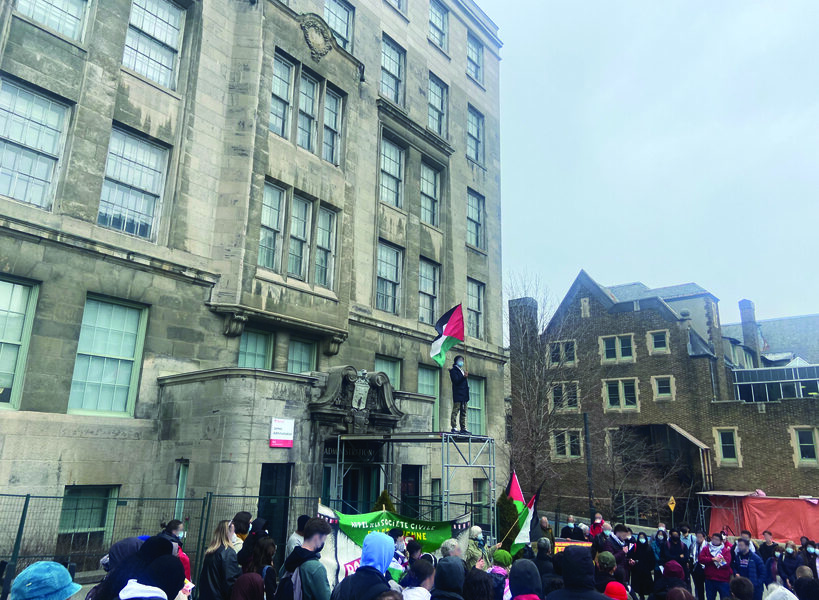
On March 25, approximately 100 members of the McGill community gathered outside the James Administration Building in protest of the university’s disavowal of the Palestine Solidarity Policy. The demonstration featured speeches from several student groups on campus, including Independent Jewish Voices (IJV) and Solidarity for Palestinian Human Rights (SPHR) McGill, as well as SSMU president Darshan Daryanani, former SSMU president Bryan Buraga, and former McGill University Board of Governors (BoG) member Ehab Lotayef. 

Chanting “Free Palestine,” Daryanani began his address to the crowd. He decried McGill’s decision to interfere in the democratic processes of a student association, calling it an overstep on the part of the administration. 

“[As] the Students’ Society of McGill University, we require a certain degree of autonomy to effectively carry out [our] roles and we fear that the statement made by McGill University severely encroaches in this ability,” Daryanani said. “At this time, regardless of the communications sent by the McGill administration, the Palestine Solidarity Policy remains in force. Despite the pressure from the McGill administration, we will not stand down. We will do everything in our power to defend and implement this democratically approved policy.”

Lotayef applauded Daryanani and the students present at the protest for resisting the administration’s demands. In May, 2021, Lotayef stepped down as a member of the BoG after the board refused to table his motion for an equity statement. After the rally, he told  The McGill Tribune that he was “disgusted” by the administration’s continued refusal to acknowledge the crimes committed by the Israeli regime, despite their history of speaking out against other international human rights issues. 

“The student body should be totally independent and putting such a pressure is shameful,” Lotayef said. “When we are seeing the whole world encouraged to speak up in support of Ukraine, [to] deny Palestinians the right to pass a motion that is not attacking anyone, it’s disgusting [….] Those who will be offended by this motion are those who are saying we support apartheid. Apartheid that has been acknowledge by Amnesty and by Human Rights Watch.”

Dana,* a member of SPHR McGill who attended the rally, was outraged that Labeau stated that the Palestine Solidarity Policy would “bring more division” to the McGill community. Dana believes the administration intentionally taints conversations around Palestine with accusations of antisemitism to deter people from the issue. 

“There is a really really big line between antisemitism and anti-Zionism,” Dana said in an interview with the Tribune. “McGill constantly and repetitively blurs that line which is a danger to Jewish students on campus as well as pro-Palestinian students. The administration is scared that because of this policy, the donors and collaborations they have with Israeli or pro-Israel corporations will back out. That’s what we want. We want them to divest from these institutions that are complicit in settler-colonial apartheid.”  

Socialist Fightback Club president Lucas Marques also spoke at the protest. In an interview with the Tribune, he criticized McGill for “blackmailing SSMU” in an attempt to infringe on the democratic rights of the student body.  

“Ultimately, this is a threat to student democracy and our power comes from our ability to withhold ourselves from going to class,” Marques said.” I think SSMU should be unequivocal and call for a strike if that is what is needed.”


*Dana’s name has been changed to preserve their anonymity.

McGill, News

Floor fellows rally as bargaining for collective agreement with McGill continues

On March 24, the Association of McGill University Support Employees (AMUSE) held a rally outside of the James Administration building to bolster support for the floor fellow’s bargaining team. Floor fellows, upper-year students who work in McGill residences, have been on strike since March 18 over failure to reach a collective agreement with the university. The rally eventually relocated to outside University Hall, where the bargaining team met virtually with Susan Campbell, interim senior director for Student Housing and Hospitality Service (SHHS), and other administrators in an attempt to negotiate a new agreement. Among the floor fellows’ top priorities are higher wages, retroactive pay, and an updated meal plan. 

Both students and members of the Association of Graduate Students Employed at McGill (AGSEM) joined the rally in support of floor fellows and AMUSE in their bargaining efforts with McGill. 

“I’m here in solidarity,” said Lucas Marques, member of AGSEM and of McGill’s Socialist Fightback Club, in an interview with The McGill Tribune from inside University Hall. “It’s absolutely unacceptable what McGill has been offering the floor fellows. My dean [David Eidelman] makes almost $900,000 in compensation, Suzanne Fortier makes almost $860,000 in compensation.”

Because no agreement was reached between the bargaining team and the administration at the March 24 meeting, the strike will continue. According to James Newman, MA ‘20 and president of AMUSE, actions are planned for the near future to show that floor fellows are willing to stand their ground until they reach a fair deal with McGill. Overall, he believes the strike has been a powerful mobilizing force that has helped garner support for the floor fellows throughout the McGill community.

“This week has been spectacular,” Newman told the Tribune, referencing the open letter in support of the AMUSE negotiation team addressed to McGill. “We went from about 600 signatures before the strike started […] to over 1,500 [….] We’re mobilized, we’re motivated, but we are also distraught at the situation going on in residence.”

The “situation” Newman was referring to is the recent spike in COVID-19 cases within McGill residences, which he sees as further evidence of the need for better working conditions for floor fellows. According to Newman, COVID-19-positive students have been told to use shared bathrooms and dining halls, and McGill’s testing program for those in residence is being scaled-down to just the Carrefour Sherbrooke site. Newman believes that McGill’s decision to loosen COVID-19 restrictions in residences at this time is dangerous both for students and floor fellows.

“Things are really hunkering down right now as a result of the ongoing case-breaks that are plaguing McGill,” Christian Tonnesen, U4 science and vice-president floor fellow, elaborated. “I know that many floor fellows are concerned about the possibility of working in these conditions [….] As it currently stands, we as employees are being asked to live and work in conditions that place us at increased risk of contracting COVID-19, which seems to be a flagrant disrespect of Quebec labour safety codes.”

At the beginning of their strike on March 18, floor fellows left residences and stayed in hotel rooms until March 21—paid for by the Public Service Alliance of Canada, AMUSE’s parent union. Tonnesen explained that because St. Patrick’s weekend is a particularly busy time for floor fellows, they hoped their action would resonate with McGill. According to Tonnesen, the university did not communicate with students in residence about the fact that floor fellows would be away.

“Per strike rules, the only people that were allowed to work our roles were those above us in the chain of command, meaning that only Residence Life Managers (RLM) could take our spot,” Tonnesen said. “However, I saw no communications from McGill to students about the fact that floor fellows would be on strike, which seems concerning given how active of a weekend St. Patrick’s Day weekend usually is.” 

In an email to the Tribune, McGill media relation officer Frédérique Mazerolle provided an identical statement to a previous request for comment regarding the ongoing bargaining between AMUSE and the McGill administration. 


“Both parties have come to agreement on all non-monetary elements within the collective agreement,” Mazerolle wrote. “It is our hope we will reach a fruitful agreement as quickly as possible.”

McGill, Montreal, News, SSMU

‘Living with Law 21’ panel tells personal narratives of Bill 21’s multifarious impacts

On June 16, 2019, the Coalition Avenir Québec (CAQ) government implemented Bill 21, which banned public sector employees from wearing religious symbols at work. Since then, many McGill students and staff have critiqued the secularism the Act purports to uphold, drawing particular attention to its effect on racial and gender minorities. In their latest efforts to educate and mobilize others against the Act, the McGill Institute of Islamic Studies, the Students’ Society of McGill University (SSMU), McGill Coalition Against Bill 21, and the Muslim Students Association of McGill University (MSA McGill) hosted a joint panel on March 24 titled “Living with Law 21: Second-class citizenship in Quebec today.”

Weeam Ben Rejeb, 1L, one of the event organizers, explained to The McGill Tribune that the McGill Against Law 21 Coalition identified a critical need for public awareness while distributing “No to Law 21” buttons to the McGill community last fall.  

“The majority of people that we spoke with had no idea that this law was in effect or what are the impacts and implications of the law,” Ben Rejeb said. “We wanted to organize this event to give a chance for folks interested in learning more to come and learn from our panellists, and to raise awareness. We wanted to provide a forum for learning and discussion where people can learn and also hear about practical ways that they can help in the fights against the law.”

The panel reflected an array of expertise and experiences, bringing together academic Zeinab Diab, lawyer Faiz Lalani, previous public sector employee Fatemeh Anvari, and community leader Rabbi Lisa Grushcow.

First to speak, Anvari recounted the events of Dec. 2021, when she was removed from her position as a third grade homeroom teacher at Chelsea Elementary School for wearing a hijab. Although she spoke from personal experience, she implored the audience to think of her story in the context of broader society, and consider their own positionality within it. 

“If the experiences I shared of loneliness, pain, fear, sadness, and disappointment do not resonate with you in a similar sense or context, I invite you to look at whether this is due to a privilege,” Anvari said. “Now that this privilege exists for you, what do you choose to do with it? How do you choose to be, and how do you choose to exist, and co-exist?” 

Next to speak was Rabbi Lisa Grushcow, BA ‘96, a senior Rabbi at Temple Emanu-El-Beth Sholom. Rabbi Grushcow acknowledged the importance of sharing experiences such as Anvari’s, echoing her belief that resistance to the law is and should be shaped by stories. 

“It’s about us, as another religious minority, as people who often […] dress in a certain way as part of the practices of our faith,” Grushcow said. “It’s [also] very clearly a case of Islamophobia, of targeting Muslim women in particular.” 

The panel’s two legal experts—Zeinab Diab, a Ph.D. candidate at the University of Montreal, and Faiz Lalani, BA ‘10, BCL/LLB ‘14 and partner at Davies Ward Phillips & Vineberg LLP—spoke about the technical dimensions of Bill 21, describing practical steps one can take to resist the bill.

“If you can, donate to the cause, write to the politicians, and participate in local politics, because that will have a tremendous impact,” Lalani said. 

Rabbi Grushcow added that this panel was preaching to the choir. She urged attendees to open dialogue with people outside of the space in order to continue pushing for change.

“We need to be taking on this bigger societal project of getting in conversations with people with whom we disagree,” Grushcow said. “For us in this room who are advocates of diversity and pluralism, maybe it’s even more incumbent upon us to find ways to start those conversations.” 

Commentary, Opinion

The adoption of the Palestine Solidarity Policy is a historic victory

On March 21, the Palestine Solidarity Policy was overwhelmingly approved by the undergraduate students of McGill University in the Winter 2022 Referendum, garnering a 71 per cent “yes” vote. 

The policy mandates the Students’ Society of McGill University (SSMU) to campaign for McGill University to condemn Canary Mission and other surveillance against Palestinian students, as well as boycott and divest from corporations or institutions complicit in settler-colonial apartheid against Palestinians. Furthermore, the SSMU will form a Palestine Solidarity Committee, which will be tasked with implementing the policy, and whose decisions will be subject to ratification by the student body via future referenda. The committee will also issue at least one public statement each semester, including a statement on Nakba Day, reaffirming the SSMU’s solidarity with Palestinian students and Palestinian liberation.

Just before voting commenced on March 14, the SSMU Judicial Board staged a last-ditch attempt to remove the policy from the referendum. Following our swift denunciation of this brazen violation of the democratic process and public outcry, Elections SSMU restored the policy to the ballot and issued a semi-apologetic statement. At this time, the Judicial Board has still not publicly apologized for its disgraceful undermining of student democracy.

Unfortunately, bodies within the SSMU have frequently engaged in the silencing of Palestinian students. Last year, members of the Board of Directors repeatedly delayed the ratification of the Divest for Human Rights Policy, and later refused to ratify a Nakba Day statement, which had been approved by the SSMU Legislative Council. As for the Judicial Board, its decision to strike down a BDS motion as “unconstitutional” in 2016 struck a devastating blow to free speech and political organizing on campus for many years. The Judicial Board’s more recent attempt to derail the Palestine Solidarity Policy indicates that SSMU officials have not forsaken the temptation to abuse their power.

We fully expected that the administration, in collaboration with off-campus organizations, would do everything in its power to overturn the democratic voice of the students. It therefore came as no surprise when Deputy Provost Fabrice Labeau hurriedly sent out a mass email demanding that the SSMU overturn the Palestine Solidarity Policy and threatening to terminate the Memorandum of Agreement with SSMU. As justification, he claimed that the policy violates the SSMU Constitution, since it “echoes key tenets of the Boycott, Divestment, Sanctions (BDS) movement.” However, the Judicial Board issued three separate rulings in 2021, all of which affirm the constitutionality of political campaigns against corporate or state entities, including BDS-related campaigns. 

None of these undemocratic actions should surprise anyone, given that the McGill administration has always fought tooth and nail against efforts that challenge its complicity in settler-colonial apartheid against Palestinians, just as it continues to stubbornly reject divestment from the fossil fuel industry. Indeed, only after sustained student activism did McGill finally cut its ties with institutions and corporations profiting from the South African apartheid regime in the 1980s. 

In response to Labeau’s cowardly email, SPHR McGill organized a victory rally in front of the James Administration building on Friday, March 25. The presence of over two hundred students, staff, faculty, and community members represented a powerful rejection of the Deputy Provost’s attack on student democracy, as well as a celebration of this unprecedented victory. We now fully expect the SSMU to follow through on its promise to strongly resist the McGill administration’s shameful intimidation, and continue implementing the policy.

We cannot overstate the importance of this historic victory for Palestinian students at McGill University, and for the Palestine solidarity movement across Turtle Island. For two decades, Palestinian students at McGill have worked tirelessly to educate their peers about the complicity of this institution in settler-colonial apartheid. Time and time again, their activism has been met with censorship, blacklisting, and repression from an openly hostile McGill administration. 

During the referendum, our comrades at Divest McGill, the Black Student Network (BSN), CKUT Radio, and other anti-colonial and social justice communities reminded us of the strength of their solidarity by wholeheartedly embracing the Palestine Solidarity Policy. While we champion the cause of Palestinian liberation, we must never forget its place within the broader, global struggle against colonialism, racism, imperialism, militarism, and capitalism. 

On March 21, the students of McGill University showed that no blacklist, no threat from the McGill administration, and no smear campaign is strong enough to defeat the popular power of students, when these students choose to reject their University’s active participation in the settler-colonial oppression of the Palestinian people. 

McGill, News

Divest occupation packs up camp after positive COVID-19 case

After spending 11 days inside, Divest McGill took their occupation of the McCall MacBain Arts building outdoors on March 17. The student group set up tents to block the Y-intersection, preventing vehicles from using the pathway to get to the Arts building. Divest purposely planned the move outside on a warm day so that the group could interact with the students who gathered on campus to enjoy the weather.

Members of Divest painted banners, set up a station to give free haircuts, and distributed pamphlets to passers-by, including to campus tour groups with prospective students. Francis Dinh, U1 Science, was one of the students who stopped to listen and learn on his way to class. He spoke with the Tribune at the Y-intersection after a few conversations with Divest McGill members handing out pamphlets.

“Divesting from fossil fuels is really important,” Dinh said. “All the big names have already divested, like Harvard. I think that most people don’t care enough about the situation [….] So it is important for people to know as much as possible.”

Alex,* an organizer with Divest, described the long-term goals of the occupation.

“One of the goals of our occupation is to push and fight for university divestment from the fossil fuel industry, specifically the top 200 fossil fuel industry companies and TC Energy, which is currently funding the CGL [Coastal Gas-Link] pipeline in Wet’suwet’en territory,” Alex said. “Additionally, one of our long-term goals is to fight for democratization, and build a foundation for a more democratic university from the ground up.”

Divest’s occupation, Alex elaborated, has been focussed on interacting with the McGill community and demonstrating what community conversations and consultation looks like in real time.

“An occupation is an effective way to start building that foundation for democratic university because we are able to talk to people at all hours of the day, and reach people that otherwise might not be able to attend our events or figure out what’s going on,” Alex said. “The act of […] now moving out of the Arts Building is simply an extension of that effort to build a grassroots democratization and divestment movement. We are going to be able to talk to people that otherwise might not have even known that this occupation has been going on.”

Divest chose not to contact the McGill administration prior to or during the occupation, and the administration had not reached out to the occupiers either. Though administrators did not interact with the activists, McGill media relations officer Frédérique Mazerolle shared a statement to the Tribune about the occupation.

“Over the last couple of years, CAMSR [the Committee to Advise on Matters of Social Responsibility] has sought and welcomed comments from the McGill community—namely representatives of student associations who shared their support for the resolution adopted by Senate, and representatives of Divest McGill who shared their view on the effectiveness of divestment in responding to the threat of climate change—as well as subject matter experts,” Mazerolle wrote. “The University recognizes and supports the rights of its students to peaceful protest on campus.”

The occupation came to an abrupt end on March 18 when a positive COVID-19 case among someone who occupied the autonomous zone—a term Divest used for the space being occupied—led Divest to leave the Arts building in the interest of public safety.

“On Friday, March 18, Divest made the challenging decision to pack up camp and cancel the events we had planned after someone who had slept and spent considerable time in the autonomous zone tested positive for COVID-19,” Divest said in a group statement to the Tribune. “However disappointing, the swiftness of our decision reflects the purpose of this occupation: We sought to enact the structures and relationships we wish for the university at large. Under our vision, public health and well-being are of the highest priority.”

*Alex’s name has been changed to preserve their anonymity. 

Features

The right to be forgotten

Last semester, I travelled to Toronto by train to see a concert. My friend and I stayed at a modest Airbnb in someone’s suburban basement to save some cash. When I arrived, I hopped in the shower to wash off the grime and sweat from the five-hour train ride and was greeted by a plethora of shampoos and conditioners to choose from. There must have been at least 10 different bottles. So I grabbed a bottle of volumizing Pantene, one that I’d never seen before, and lathered up. 

Emerging from the shower, I dried my hair and was astounded at how shiny and soft it felt. “Hey, this shampoo is really amazing,” I told my friend. I didn’t mention its brand, its scent, or its colour. All I said was “this shampoo.” 

Two days later, back in Montreal, I was scrolling through my Instagram feed when an advertisement for the exact shampoo, brand and type, came up. I immediately felt a jolt of fear—the kind of panic that takes hold when you realize that you changed your clothes in front of the window, or when your music starts playing out loud instead of through your headphones. Sure, I’d encountered targeted ads that were scarily accurate, or that seemed to intuit my wants or needs––it’s not unusual to mention a brand name one day only to have it appear as an advertisement the next. But to receive an ad for a shampoo that I’d only ever used once in my life and had never looked up on the internet—it felt like an invasion of not only my privacy, but my mind. If my phone was not listening to my conversations, then how had Instagram’s, and by extension, Facebook’s, insidious algorithm pinpointed the exact product I happened to like out of an array of products displayed to me at the Airbnb? 

I still don’t have an explanation as to why. Though it may have been a coincidence, this chilling experience spurred a me onto a research frenzy into just how customized advertisements have become. By now, most college-aged students like me have been submitting their data, with or without their consent, to big tech companies like Facebook and Google for years. 

Much of modern marketing is built upon behavioural advertising. In this model, companies and third-party platforms build a profile of you based on your internet activity. What you like, what websites you visit, what ads you click on, what you watch on Netflix—all of this information is collected and used to recalibrate the content shown to you. Even more invasive metrics, like cursor movement and how long you linger on a certain page, are considered fair game.

Typically, digital marketing agencies are hired as intermediaries that craft many of the ads that appear on our endless Facebook, Twitter, or TikTok scrolls. One such Montreal-based agency, Turko Advertising, works with clients like Bell, Narcity Media, and Iris. When I spoke to the founder, Remi Turcotte, he told me that marketing techniques play on emotional triggers to encourage sales. In scarcity marketing, for example, companies signal that an item is only available in limited quantities. Advertisers can also give out special offers or coupons to encourage customers to reciprocate in kind by making purchases.

“It’s about serving the right ad to the right person at the right time,” Turcotte said. “In a macro mindset, the idea is to create a message that is going to be appealing to the target customer [….] You want an ad experience that is optimal.” 

One way to personalize ads is to know where the customer is, and therefore, what products and stores are nearby. Tracking an individual’s location data is what allows apps like Waze, owned by Google, to suggest ads based on what they will encounter while travelling from point A to point B. With location services turned on, we are consenting to our every step being tracked for profit.

According to Renee Sieber, an associate professor in the Department of Geography and president-elect of the McGill Association of University Teachers (MAUT), prediction becomes more robust when companies amalgamate the data of many individuals in a given location and make decisions based on meta trends. 

“It is amazing how many apps demand location information from you whether or not it’s obvious why they would need that information from you, ” Sieber said. In fact, tracking longer-term movement data of a group of users can lead to raking in more profit. 

If you’ve ever opened up Instagram in class, chances are that companies have used your geophysical and temporal data to optimize ads accordingly. If you’re a student, they might show you stationery, laptops, or other school supplies. Tracking doesn’t stop when you leave the classroom. Companies are already one step ahead of you and will figure out what you want next—fast food deals for lunch, for example. During Reading Week, when hordes of McGill students travel in the same short period of time, companies will start promoting ads for suitcases, vacation deals, or other relevant travel items. 

Personally, I don’t find the idea of sharing my location that disturbing; apps on iOS are typically legally required to notify me when my location is being tracked, with some exceptions. But I’d never understood the extent to which companies fuse that data together, layering individualized data points with the rest of the population in order to piece together the clearest picture of my personality. 

Tracking users’ movement is not only restricted to the physical realm. Nowadays, almost all websites use cookie tracking to save users’ log-in info, track their browsing history, and sell info to third-party companies. Cookies, which are small morsels of text data downloaded onto your computer when you access a website, are the main way your behaviour is tracked on the internet for ad personalization. Third-party cookies can even integrate data about your online shopping across multiple websites. 

“This is how websites know that you were there and keep you logged in,” Turcotte explained. “This also helps third-party platforms and ad servers follow you because your navigational information is stored in a cookie.” 

The myth that our phones are listening to us is a cogent response to the larger age of surveillance, but it’s ultimately untrue. When companies can access your location and internet activity, they don’t need to listen to know everything about you—they already have everything they need to know. In fact, voice-activated smart devices, like Amazon’s Alexa or Apple’s Siri, only record audio after detecting the “wake word.” Jonathan Sterne, a professor and James McGill Chair in Culture & Technology, explained that even though our phones aren’t recording us, our voices still make their way into advertising infrastructure., explained Jonathan Sterne, a professor and James McGill Chair in Culture & Technology.

“[T]here are cases where companies actively listen to people,” Sterne wrote in an email to //The McGill Tribune//. “Every time someone calls in to a customer support line and hears that their call will be ‘recorded for quality assurance,’ their own voice is being recorded by the company, and likely profiled and added to a database.” 

Many of these voice profiling technologies are not only inaccurate, but also plagued by biases—speech recognition tools often fail to recognize English spoken with a non-Western accent as well as common dialects like African American Vernacular English (AAVE). Racial and ethnic bias is everywhere in tech, from the Anglo-centric way that keyboard letters are encoded to the mostly white faces that facial recognition software is trained on. Although tech companies have faced increasing scrutiny about their questionable commitments to equity, it remains difficult to tackle systemic problems when their leadership remains overwhelmingly white.

Sieber says that though most people think of artificial intelligence as a neutral tool, this is a misconception—the biases of our society trickle down into our technologies as well. And as digital marketing companies get better at integrating ads into social media feeds, it becomes more difficult to view ads with a critical lens. In fact, we are increasingly exposed to native advertisements, where content creators integrate ads into the middle of YouTube videos or podcasts without disrupting the flow of regular content. The conversational nature of such ads inherently exploits the trust we put into our favourite creators to have their viewers’ best interests in mind. While this kind of deception might be obvious to hyper-online young adults, it’s not necessarily clear to people who are less digitally literate.

“There is a digital native versus digital immigrant problem,” Sieber told me. “There are people who were born to the devices and the platforms and there are people who came to them [….] I think that people are aware of the amount of data that is being shared. The question is whether they care enough to do things like block [tracking].”

“Ultimately, the problem here is corporate secrecy, and the fact that people are able to sign away so many of their digital rights in the name of convenience,” Sterne wrote. 

But in this modern age of capitalist conception, convenience is a very powerful thing. If people believe they benefit from advertisements anticipating their wants and needs, then the question of privacy violation is moot. Convenience is not the only thing companies are trying to sell—modern wellness culture is constantly striving for optimization in all its forms. It wants to sell you the best life possible—just look at the rise of mental-health apps, scheduling software, and expensive juicers. 

Our current situation may be unprecedented, but it’s not unanticipated. In 1974, sociologist Steven Lukes theorized about three dimensions of power, the last of which feels the most prescient for our age. In this third dimension of power, a group of people are under the control of another group and they acquiesce to this domination. Crucially, in this situation, they even believe that this type of domination improves their lives. 

“A lot of companies will say we’re doing this not to spy on you, but to customize your [user experience] and therefore be able to sell you more products,” Sieber said. “Don’t you want products that are specifically targeted to you?”

Intuitively, yes, but the answer will vary depending on who you ask. There are many people who are particularly wary of Big Tech’s surveillance and opt out of social media or using a smartphone at all—but this, too, reflects its own kind of privilege. The livelihood of an UberEats driver, on the other hand, relies on the locational, targeted advertising of our age. A low-income single mother may appreciate targeted ads for diapers on sale—maybe they even serve as a helpful reminder. Who gets to opt out of surveillance capitalism? Rich people have the right to be forgotten, but people working multiple jobs, older people unfamiliar with technology, and working immigrants may not have the luxury of free time to look into how their data is being shared and how to avoid giving it up. “The right to opt out of these things implies that you were fairly secure in what you’re doing,” Sieber said. 

Facebook and Google may not just be exploiting your penchant for high-waisted jeans—they could be exploiting traumatic events in your life. Anything is fair game to these companies; they can give you ads about next steps to take after having a miscarriage, or how to cope with the death of a loved one if they figure out that such an event happened to you. Racial and demographic biases are also built into marketing algorithms, so opportunities for employment or financial advancement may target certain groups and not others. Ads even cater to stereotypes of a certain group’s purported interests—women tend to get less political content on Facebook than men, for example. Political echo chambers of misinformation, as we’ve seen with the COVID-19 anti-vaccine movement, can push those who are teetering on the ideological brink into an abyss of misinformation. In many instances, right-wing lobbies have even funded ads spreading scientific inaccuracies.

As with many other forms of activism, individual actions like buying flip phones and deleting your Instagram account aren’t enough to bring down Big Tech because these companies will still hold the power to track and control everyone else. There must be limits and regulations set at the structural level to protect user privacy for those who want it, and greater transparency for those who are not privileged enough to be internet-literate. The trade-off between greater corporate surveillance and everyday convenience is currently placed on individual users rather than governments. “[I]t’s on us to figure out whether we want to be inconvenienced,” Sieber said.

According to Turcotte, the era of granular behavioural profiling based on browsing data might be coming to an end. Indeed, Google announced that it would be phasing out third-party cookie tracking on its Chrome browser by the end of 2023. Thanks to consumer protection laws and bolstered data privacy laws, tech companies and advertising agencies like Turko will have less to work with going forward. It seems that mid-sized and small companies will have to pivot toward brand loyalty through email lists and personalized offers. 

“We’re going [away] from tracking user actions,” Turcotte said. “If you look further into the future, you won’t know whether a person […] clicked on that page or went here.”

But with billions of dollars in their coffers, companies like Google and Apple will always be poised to win the battle of digital privacy and can take advantage of all the legal loopholes to get there. 

As for my own interaction with websites that exploit my data, I’m not sure where to go from here as a consumer. I went through all of the “interests” that Facebook had collected on me and removed every single one. I turned off tracking on Twitter, I disabled sharing between apps on my iPhone. But I still have trouble explaining why I truly care about companies using my data to sell me products. I don’t think that keeping my data off the grid will improve my life, but it calls into question the idea of free will. What does it mean to want something when all your wants and needs are fed to you? After all, I did end up buying that shampoo. 

What kind of person does that make me? I guess you’ll have to look at my targeted ads. 

Editorial, Opinion

Hear ye, hear ye: Floor fellows’ collective agreement is long overdue

On March 18, nearly two years after the expiration of the Collective Agreement (CA) between McGill and the Association of McGill University Support Employees (AMUSE) expired, a town crier announced that floor fellows would be going on strike to push the administration toward negotiations for better wages and working conditions. AMUSE comprises two units: Unit A, which represents non-academic staff, and Unit B, which represents floor fellows. The McGill administration’s failure to compromise on a new CA with AMUSE is reprehensible. The delay and pushback keeps floor fellows in precarity, jeopardizes student experiences, and highlights the administration’s lack of care for floor fellows’ labour. 

Because the previous CA expired on July 2, 2020, floor fellows have been working on the basis of a grey interim agreement, meaning that the expired rules and regulations are still in effect. For the past two years, floor fellows wages have remained fixed at 2020’s $13.50/hour rate for an expected 13 hours of work per week, along with their plan allocation of $4,575. AMUSE proposed a wage increase to $18/hour. In response, McGill proposed $13.64. Recently, however, they lowered their initial offer to $13.50, a move that provoked floor fellows to strike. With talks over a new CA having dragged on for years, floor fellows have every right to go on strike to pressure McGill to cede to their demands for liveable wages and better working conditions.

The delay in reaching a CA highlights McGill’s exploitative and neglectful attitude toward floor fellows’ labour. On paper, their responsibilities include going on duty, scheduling and attending meetings with the residence life manager (RLM), and planning inclusive activities to help students settle in at university. However, this list fails to account for the wide-ranging informal duties: For example, floor fellows often expend additional emotional labour by making themselves available to students outside of on-duty hours. When negotiating with the union, McGill must bear this context in mind and value floor fellows as much as students do. 

During the pandemic and following the resignation of an RLM, floor fellows took on additional management responsibilities, such as handing out warnings to students who violated safety restrictions in an effort to curb COVID-19 transmission. That floor fellows had to navigate COVID-19 outbreaks, often without proper PPE, on top of their pre-existing duties is all the more reason to support their calls for better wages and working conditions. Especially as inflation and taxes rise in Quebec, McGill’s stubbornness to grant pay increases for liveable wages denigrates floor fellows’ livelihoods and devalues their labour. 

On top of the fight over wages, another disadvantage of the interim agreement is the allocated meal plan credit which pays for less than two meals a day. Given that the CA is expired, it cannot keep pace with rising prices: Floor fellows currently receive a fully paid meal plan valued at $4,575, the price of the plan in 2020, which is $1,000 less than the updated 2022 meal plan. Additionally, McGill only allocates $100 a month to floor fellows working in Solin Hall, which makes up a mere third of the estimated monthly groceries expenditure in Quebec. On top of rising food prices in dining halls and paying taxes for their rent, floor fellows will essentially be working for free if they do not receive a wage increase. In addition to having the fees of living in residences deducted from their paychecks, it is often a challenge to make ends meet. 

Most importantly, McGill’s two-year delay to reach an agreement over fair pay and proper working conditions showcases its lack of acknowledgement toward the unique role that floor fellows play in the institution. Floor fellows are among the first impressions first year students have of the university and they play a pivotal role in their support systems, especially for international students. They go above and beyond to ensure that all first-year students feel safe and welcomed in the university space. 

While McGill comes to terms with the floor fellows’ strike and demands for their CA, McGill students can play a crucial part in supporting their initiative. Students can amplify and support AMUSE’s campaign, especially on social media, by engaging with its events like the floor fellows’ strike. Fundamentally, floor fellows are students taking up extra responsibility to support those around them, and they deserve respect, fair pay, and safe working conditions. 

A previous version of this article stated that floor fellows live free of charge in McGill residences. In fact, the Student Housing and Hospitality Services deducts a fee of living in residences from the floor fellows’ paychecks. The Tribune regrets this error.

News, SSMU

Sudden removal of Palestinian Solidarity Policy from SSMU Referendum causes controversy

The Students’ Society of McGill University (SSMU) Winter 2022 Referendum spurred confusion and outrage among students after the Palestinian Solidarity Policy question did not appear on the ballot. Elections SSMU had previously approved the question, but when the polls opened on March 14, the question was not on there. 

After Solidarity for Palestinian Human Rights (SPHR) McGill announced that the question had been removed, Elections SSMU published a statement explaining that the removal was due to an interim order from the SSMU Judicial Board. SPHR and other student groups immediately protested the removal of the question, and later in the day, Elections SSMU decided to reinstate it and launch a new ballot, discarding the previous one. Accordingly, the voting period for the referendum, which was initially scheduled to close on March 18, was extended to  March 21. 

The Palestinian Solidarity Policy directs SSMU to boycott and divest from all organizations that profit from or are complicit in what scholars, international organizations, and human rights activists characterize as a settler colonial apartheid state in the occupied territory of Palestine. It further mandates that SSMU condemns the surveillance and doxxing of Palestinian and pro-Palestine students by organizations such as Canary Mission. Lastly, the policy directs SSMU to demand the same from the McGill administration.  

Jaylynn Barth, chief electoral officer (CEO) at Elections SSMU, explained in an email to the Tribune that on March 11, three days before the start of the polling period, a petition against the Palestinian Solidarity Policy and the process through which it was approved for the referendum was filed. Barth did not disclose who filed the petition. 

Under the SSMU Internal Regulations of Elections and Referenda, all referendum questions must be approved by the CEO, unless a question seeks to alter the SSMU Constitution in which case it must be approved by the SSMU Board of Directors. Elections SSMU had not deemed the Palestinian Solidarity Question to be seeking a change to the SSMU constitution and had consulted with only the Judicial Board before approving the question. 

According to Barth, the petitioner was concerned that the question required approval by the SSMU Board of Directors. Barth says the Judicial Board had ordered that the question be removed from the ballot until “a legal determination on the merits of compliance can be rendered” by the Board of Directors. Yet, after considering the tight timeline and the “balance of inconvenience and harms” caused by the removal, Barth decided to reinstate the question. She emphasized that the SSMU Board of Directors’ “legal determination,” could potentially invalidate the question after the results of the referendum have been released.

Section 10.3 of the Rules and Regulations of Practice for Judicial Board Procedures mandates that J-Board provide an Executive Summary of the written reasons for an Interim Order. The SSMU Judicial Board has yet to share one. 

Malaika,* a member of McGill 4 Palestine, was frustrated by Elections SSMU’s communication of its decision to remove the item from the ballot. They believe the decision may have been politically motivated.

“We took this as an unfair and arbitrary decision to censor us without any formal explanation,” Malaika said in an interview with the Tribune/. “If they do further scrutinize our question, I can’t help but think that this was only to pacify us.”

In an interview with the Tribune, Omar,* a member of SPHR, said that they find Election SSMU’s decision to hastily intervene in the referendum to be disturbing, citing the many violations of SSMU regulations that such an intervention might entail.

“Both [the Judicial Board and Elections SSMU] acted outrageously, and have done tremendous harm to the integrity of the SSMU’s democratic process,” Omar said. “We have not had a proper justification from Elections SSMU. We have not received any communications from the Judicial Board at all. With the rush of the referendum and the campaign, we haven’t been able to follow up but it’s also their responsibility to be communicating with us and they are not.” 

The Tribune reached out to the Judicial Board as well as  SSMU vice-president Internal Affairs, Sarah Paulin, for a statement on the decision making processes that led to the question’s removal from the ballot. Both declined to comment. 

The results of the referendum were published on March 21, shortly after the polls closed at 5 p.m. The question of Palestianian Solidarity Policy passed with 71.1 per cent in favour.

*Malaika’s and Omar’s names have been changed to preserve their anonymity.

Basketball, Sports

Redbirds bring Lengvari Cup home in narrow 58-57 win against Stingers

Love Competition Hall was packed for the annual Lengvari Cup as McGill’s Redbirds (12-0) faced off against the Concordia Stingers (6-6) in an enthralling game. 

Second-year Haris Elezovic opened up the scoring with a layup, but the Stingers quickly answered with a three-pointer. The first quarter featured an intense defensive press on both sides, keeping the score low until the pace quickened and a successful turnover by Sam Jenkins helped Sidney Gauthier land a reverse layup with under a minute left. The first quarter ended with a two-point lead for Concordia at only 12-10.

The Stingers were the first to strike in the second quarter due to a McGill foul that gave away two free throws. But Elezovic helped to bring the Redbirds’ score up with a quick layup, then daringly blocked an attempt by the Stingers, earning him the cheers of the crowd. 

With less than four minutes left in the first half, forward Kevin Li sank a three-pointer, bringing the Redbirds even with the Stingers at 21-21. However, the Stingers quickly responded and by halftime the score was 28-21 for Concordia.

McGill returned from halftime rejuvenated, ready to face the Stingers and the invigorated crowd. Jenkins scoring first seemed to be a good omen for McGill, but the third quarter proved to be a tough battle.

The Stingers brought their score up to 35-23 with a series of successful shots. The Redbirds fought back with Elezovic scoring off of a bullet pass from teammate Cameron Elliot, followed by a layup from Jenkins. However, the Stingers continued to gain headway, leading McGill 48-30 with just under three minutes of the quarter left. 

Luckily for the crowd, the Redbirds were not discouraged by this gap as a dunk from Zachary Lavoie-Toure, a three-pointer from Jenkins, and five points from Li allowed the team to reach the fourth quarter down by only 10 points. 

In an interview with The McGill Tribune, Li recalled how he approached the final quarter.

“We have a group of guys that know how to win so I wasn’t worried about the score even when we were down by like 15 in the fourth quarter,” Li said. “Everyone on the team contributed [to] the win.”

The smooth gameplay of the Stingers in the fourth quarter was no match for the Redbirds’ determination as they slowly but surely closed the gap with points from Jenkins, Quarry Whyne, and a crowd-pleasing three from Jamal Mayali

With three minutes left and a score of 56-52, tensions were high on the court—it was still anyone’s game. Following a shot from Whyne that brought the score up to 54 for the Redbirds, he easily scored two free throws with 50 seconds left after a foul from the Stingers. The crowd erupted as the score was finally even. With 3.9 seconds remaining, a McGill foul gave the Stingers a one-point advantage. However, with less than 2.8 seconds left, the Stingers received a technical foul and Whyne was given two free throws.

The competition hall was dead silent as the 6’4 shooting guard successfully made his first throw without batting an eye. When Whyne sank the second shot, the crowd erupted into cheers as the Redbirds were victorious, 58-57. George Lengvari, an alumnus of both McGill and Concordia and long-time benefactor of both universities, handed the Redbirds their trophy for the second year in a row. In a post-game interview, Whyne explained how the Redbirds were able to make such a comeback.

“We felt confident going into the game,” Whyne said. “However […] we dug ourselves a hole early on. Nonetheless, once again we were able to show how resilient our group is, and with the guidance from our coaches we were able to overcome that deficit and win in the end.”

This impressive comeback from the Redbirds at a critical moment of the game is a sure indicator of the team’s spirit and their willingness to fight. It is also promising for the upcoming RSEQ championships, as the team remains at the top of the rankings this season.

Stat Corner: Haris Elezovic was the key to McGill’s offence, scoring a game-high 14 points during the game.

Quotable: “This will help us get ready for the playoff game next week too. We are looking to beat Concordia again at their gym tomorrow to make history.” — Fourth year forward Kevin Li

Moment of the Game: With 2.8 seconds remaining, Quarry Whyne made two free throws, securing the cup for the Redbirds and maintaining their undefeated streak of the season.

Read the latest issue

Read the latest issue