Latest News

Album Reviews, Arts & Entertainment

‘Donda (Deluxe)’ is hardly an upgrade

Choosing to not leave his fans waiting, Kanye West released the deluxe version of his album Donda on Nov. 14, 11 weeks after the original, adding five new tracks. This release reinvigorated fans’ appetite for Ye, but only one memorable song serves to fill it; the new tracks leaving listeners only partially satisfied and with an unfulfilled desire for more.

“Life Of The Party” is the strongest of the new tracks. The production is both a new direction and a return to form for Kanye—the beat is melancholic and minimalist, with a chipmunk soul sample layered beneath a jazz bass and subtle soul beat. André 3000 and Kanye’s verses stand in a stark, yet harmonized, contrast. André’s muted, free-flowing delivery gives way to Kanye’s verse; his entering line “Straight from Shibuya, on some zen” has a hard-hitting cadence evocative of Late Registration-era Ye. The emotionally charged lyrics seamlessly combine with the beat into a song destined for the repeat button. 

“Up From The Ashes” and “Never Abandon Your Family” are certainly interesting, but not incredible. While the tracks’ themes of religious renewal and family are profound, the songs themselves fail to stand out, lacking a distinct sound or character. 

In true Kanye fashion, the last two tracks seem to be included for reasons other than musical value. “Remote Control pt 2” shortens Kid Cudi’s verse for the sole purpose of extending the infamous “Globglobgabgalab” sample. “Keep My Spirit Alive pt 2” is simply the version included on the original song’s release with KayCyy featured on the chorus; Kanye originally replaced these vocals with his own for undisclosed reasons. While fans of Kanye’s humour may appreciate the comedic value of the extended sample and fans of KayCyy’s vocals may be satisfied, the updated tracks fail to add anything new. 
While Donda (Deluxe)’s new tracks do not detract from the original album, they fail to contribute to it in a meaningful way. The new songs feel tacked on, with only “Life Of The Party” distinguishing itself. A deluxe album should seek to add musical value to an album, not just more tracks; Donda (Deluxe) fails to contribute much of either.

Science & Technology

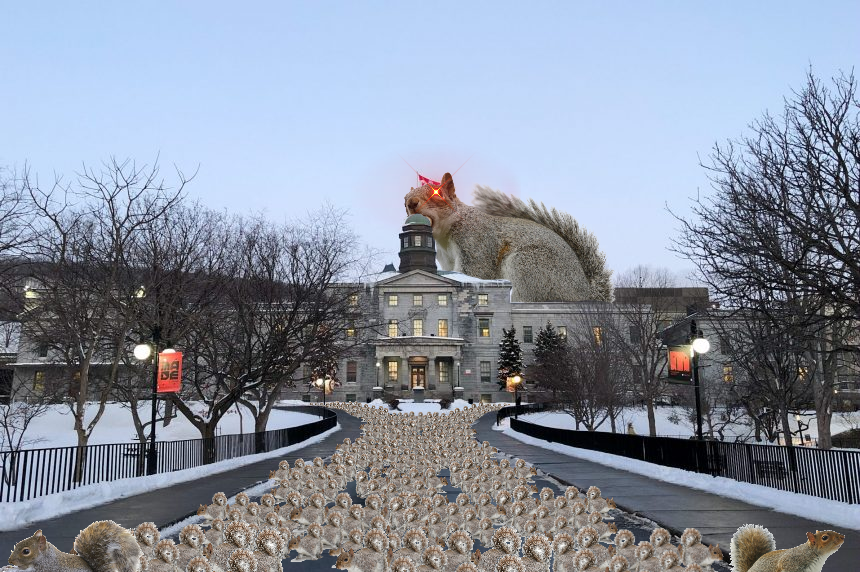
Cloudberry 101: The ecology of the urban squirrel

Although the eastern grey squirrel (Sciurus carolinensis) is native to eastern North American regions such as Montreal, their adaptive traits allow them to thrive elsewhere, like British Columbia or Europe, where they are categorized as an invasive species. Despite their name, some have dark brown or black coats. But common to each, regardless of colour, is their most notable feature: Big, bushy tails. The etymology of the word “squirrel” comes from the Greek skiouros, from skia, meaning “shadow,” and oura, meaning “tail,” presumably in reference to the shade their fluffy tails cast while they sit with them tucked above their heads.

Do they take a winter break?

Not quite. Eastern grey squirrels do not hibernate in the winter, but they are less active. They bulk up, eating in excess to put on fat in advance of the colder months to weather frigid nights and foraging sessions. In addition, their fur gets thicker and longer, and they may move from summer leaf nests to insulated dens in the hollows of trees. 

Chowing down

The eastern grey squirrel has a versatile palate, allowing them to thrive in multiple habitats, including urban ones. As the seasons change, so do their diets. They forage for nuts, seeds, buds, and the flowers of trees, but they are not herbivores, as some might believe—baby birds, eggs, insects and worms are also on the menu. Bird feeders also act as veritable seed buffets, especially in winter when food is scarce. Even as they raid feeders, eastern grey squirrels play an important role in seed dispersal, as they bury more nuts and seeds than they can inevitably eat or recover. Contrary to popular belief, they do not find their stashed goods through memory, but with their highly developed sense of smell.

(Corey Zhu/ McGill Tribune)

Squirrely behaviour

It is also the eastern grey squirrel’s sense of smell that allows them to communicate amongst each other, primarily through twitching and chattering noises. Although generally not aggressive, they are territorial, and will alert nearby squirrels if they sense a predator nearby. Since the eastern grey squirrel can travel up to 25 kilometres an hour, they are often spotted whizzing around campus. The flight initiation distance, or distance from which an animal will flee from perceived danger, is shorter with urban squirrels because they are more acclimated to the presence of people and are therefore unafraid to get close to humans if it means snagging a snack.

What about Cloudberry?

Cloudberry is a white squirrel made popular by the McGill Reddit page, where students share photos of sightings. In North America, white squirrels are very rare—but most still count as eastern grey squirrels. There are a few different genetic aberrations that can cause the pale coats. Some white squirrels are albinos, meaning they have a mutation on a gene that codes for pigmentation and thus possess red eyes in addition to pale coats. Others are white morphs, who have a different mutated gene which leads to a partial loss of pigmentation, called leucism. Unlike albinos, they retain their black eyes. Cloudberry is not an albino squirrel, but a leucistic one. 

Run, Cloudberry, run

Although leucistic squirrels usually do not survive long in the wild since their white coats make them ultra-visible to predators, many still thrive in urban spaces—and the McGill campus, with its proximity to Mont Royal, green space, and food sources, is no exception. Despite these benefits, the eastern grey squirrel has many defence mechanisms to help protect it from predators. When climbing or descending a tree, they move head first, which allows them to slide inconspicuously around the trunk to keep out of the sight of danger. Alternatively, they can remain motionless against the bark, which makes them difficult to see. Even if a predator catches them, eastern grey squirrels are willing to lose their tail sheath and some vertebrae to escape. For this reason, it is not uncommon to spot a squirrel with only a partial tail.

Martlets, Sports, Volleyball

Martlet Volleyball ends 2021 on a high note, beating Laval 3-2

The McGill Martlets (7–3) faced the Laval Rouge et Or (6–4) in their second meeting of the season on Nov. 28. With persistence and pace, the Martlets emerged victorious. Winning three sets to two, the result placed them third in the RSEQ standings, now two points ahead of Laval.

During their first meeting of the season on Oct. 29, Laval won three sets to one. Charlene Robitaille, a fourth-year nutritional science student and middle blocker for the team, remarked that targeted practice has allowed the team to improve since then.

“For the last two weeks, we really concentrated on defence, being aggressive on the first contact, and improving serves,” Robitaille said in an interview with The McGill Tribune. “Last month, when we faced Laval, our serves were easy to return so they were in control. It was a great win tonight and the goal is to continue to practice a lot and to fight, be present, and stay together.”

The match was a hard-fought battle that sent spectators on an emotional roller coaster. The Martlets came out strong in the first set with a quick 6-3 lead, sparking confidence in the team as they dominated the set 25-17.

The second set proved to be a closer competition as the Rouge et Or adjusted—the two teams were neck-and-neck. The Martlets were relentless as their eyes glared with hunger for victory. However, after a Laval time-out, the Rouge et Or regrouped and came out to win the second set 26-24.

With the teams tied 1-1, McGill found a way to break through Laval’s defence, which led to a dominant 25-13 set win for the Martlets. Second-year setter Audrey Trottier had a great impact in the third set, making an amazing block followed by a spike of her own, leading Laval to call another timeout.

Though McGill was looking for the game-winning set in the fourth, the Rouge et Or fought hard to stay in the game. Miscommunication from the Martlets resulted in a 26-24 Rouge et Or set win to force a fifth set. Nevertheless, the Martlets proved that they came to win as they maintained a lead throughout the whole set (15-12) to seal their seventh win of the season.

Two incredible performances paved the way for the Martlet victory: Charlene Robitaille had herself a game, stacking 15 kills with a whopping 0.414 hitting percentage along with four aces. Victoria Iannotti, a third-year software engineering student and power-hitter for the team, led the team with 19 kills on a 0.372 hitting percentage and 16 digs.

Coach Béliveau was pleased with the team’s performance, but noted that there is always room for improvement.

“Today my team did an outstanding job on defence, it was amazing,” Béliveau said. “We still have a lot to improve. I am happy with our serving. Our digs were good today but I think we can do a little better towards the centre of the court eventually. I am happy to see improvements in aspects that we worked on.”

The Martlets will now have a little over a month off from competition before taking on first-place Sherbrooke on Jan. 7.

Moment of the Match:  Third-year Victoria Iannotti buried a huge spike at the end of the fifth set to clinch the win for the Martlets.

Quotable: “For many players, because of the pandemic, it was their first time stepping on the court. They did really well under this pressure and I am happy we came out with the victory.”

-Coach Béliveau on the team’s performance.

Stat Corner: The team had a season-high 57 kills and 73 total points.

Science & Technology

No such thing as empty land: Agricultural expansion and displacement in South America’s Gran Chaco region

The destruction of the world’s rainforests has long been framed as an environmental problem. Extractive logging, mining, and agricultural practices have led to the loss of millions of acres of wildlife and have emitted massive quantities of carbon dioxide (CO2) into the atmosphere.

But for years, activists have argued that there are deep human costs to rainforest destruction as well. Many people who live in these regions have seen their homes destroyed, resources depleted, and lifestyles pushed further to the fringe—all while government and corporate powers dismiss these groups as too small to be worth political consideration. 

According to a new study published by researchers from Germany, Argentina, the Netherlands, and Canada, including some from McGill, the human costs of deforestation and agricultural expansion in the Gran Chaco region of South America may be even more devastating than initially thought.

Using satellite imaging technology, the research group identified and tracked the number of homesteads in South America’s Gran Chaco region over a course of 30 years to trace changes in the number of forest-dependent inhabitants. Between 1985 and 2015, they found that the number of people living in this region declined by 20 per cent, from 28,000 to 23,000 homesteads. Most of the exodus occurred in areas that saw the rapid agricultural expansion of activities like cattle grazing, crop planting, or logging.

Yann le Polain de Waroux, an associate professor in McGill’s Department of Geography, explores the way that different social, political, and industrial actors interact at natural frontiers. Le Polain de Waroux has spent time studying different players in the  agricultural expansion conflict, looking at both industrial-scale South American farming companies and local Indigenous groups.

“I’m interested in spaces where there’s incredible tension between groups with different objectives,” le Polain de Waroux said in an interview with The McGill Tribune. 

Gran Chaco certainly fits the bill. The region has been a site of intense conflict for decades between industry and forest-dependent peoples, including mestizos, or mixed European-Indigenous homesteaders, and Creole groups, who are the direct descendants of original Spanish settlers who have long traditions of living off the land. 

Over the last few decades, the amount of uncultivated land in Gran Chaco has dramatically declined. With increased global demand for beef and crops like soy, South American farmers have sought new land to maintain supply. The public narrative surrounding this shift often claimed that these lands belonged to no one, and that there was no harm in converting it to agricultural use. However, le Polain de Waroux points out that this narrative was never based in reality.

“These territories have often been constructed by outsiders as empty [land],” le Polain de Waroux said. “This [research] shows that there is a real loss to people when we expand.”

Though some of the displacement of forest-dependent peoples is driven by the lack of basic resources like formal education or electricity, as well as the exodus of young people seeking work in the city, many living in Gran Chaco say the recent intrusion by outsiders is to blame.

“The majority perceives it as an attack on their livelihoods and their territories,” le Polain de Waroux said. “Some see [the displacement of forest-dependent peoples] as inevitable, but still as encroachment.”

Those most at risk—the Indigenous and Creole populations—are also those with the least social and political capital. In recent years, there have been efforts by environmental non-profits and grassroots organizers, such as the World Wildlife Fund and The Nature Conservancy, to preserve the land that these groups depend on. However, le Polain de Waroux maintains that the future of Gran Chaco is uncertain. 

“In terms of what I think will happen, there’s good reason to think that expansion of cattle lands and croplands will continue at the expense of woodlands,” he said. “[But] there’s also good reason to think there will be some woodlands that will be preserved.”

Le Polain de Waroux cited the success of social movements in promoting protective laws, pointing to a landmark 2010 law in Argentina that placed restrictions on the legal methods and limits of clearcutting. Another recent law in Paraguay requires that 25 per cent of all privately owned rural land be kept as forest. 

Still, will this fragmented land be enough to support communities who depend on it? 

“It’s extremely hard to say,” said le Polain de Waroux.

When it comes to solutions, le Polain de Waroux stressed that preserving the livelihoods of forest-dependent peoples is not a problem that can be solved through individual action alone. He explained that when responsibility for these problems is shifted to consumers, it can create feelings of guilt, which are counterproductive.

“These problems are collective action problems,” le Polain de Waroux said. “Perhaps [we should] recognize that some of this is happening and we have zero control over it.” 

In addition to choices made by Canadian consumers, Russian demand for beef and Chinese demand for soy are two major economic factors driving the expansion of South American agriculture.

Ultimately, le Polain de Waroux believes that change must happen at the institutional level. One way forward is demanding greater transparency in supply chains so that consumers and regulators understand the social and environmental impacts of agricultural products. 

Demand for agricultural goods is predicted to increase by 70 per cent by 2050. Policy makers and agribusiness will need to innovate their practices in order to meet demand for food without doing further damage to the world’s forests and those who depend on them.

“There’s no such thing as empty land,” said le Polain de Waroux.

It’s a truth that policy makers would do well to remember.

Features

No, I will not curb my enthusiasm

I always freeze up whenever I’m asked to describe myself. From introducing myself at the beginning of each elementary school year to writing college essays in high school, I consistently clam up in confusion when forced to encompass myself in a short paragraph. While basically everyone I know has experienced this sudden sort of panic, for me, it felt different. As I got older, I came to increasingly associate my internal ambiguity with religion, something that I was constantly surrounded with in my hometown. The majority of my classmates followed different sects of Christianity, often talking in class about their church programs and trips. I, on the other hand, was a barely -practicing atheist Jew. Though there were other Jewish kids in my school, the ones I was close to were not very religiously inclined either. I wasn’t close enough with the others to discuss that aspect of our identities.

The struggle to define my own Jewish identity was mostly self-imposed as an adolescent. Certainly I was privileged to not have personally faced antisemitism in school. But my Jewishness was often treated as a punchline by myself, my friends, and my family. When I received my acceptance—with a scholarship—to an overtly Christian college in Nashville, my mother and I made sardonic comments about how religious diversity might have played a role in their offer. 

Different events in history pushed me to further consider that aspect of my identity. From a young age, I was taught about World War II and the Holocaust. My grandmother often told me stories about my grandfather, who immigrated to Ellis Island from Germany as a teenager. He was rejected from the army multiple times because he was an “enemy alien,” though he ended up getting drafted anyway. Books, too, connected me to that time: Over the years, I wrote different school papers on novels about the Holocaust like //Number the Stars// by Lois Lowry, //Night// by Elie Wiesel, and //The Book Thief// by Marcus Zusak. 

The scale and horror of the Holocaust was inescapable in the books I read for school, as well as the countless other films, TV shows, and theatrical works that came generations later. It wasn’t something that I wanted to ignore, or thought should be ignored, but I found it depressing that almost all of the Jewish stories I heard as a child all tied back to the era of World War II.

Art, Arts & Entertainment

‘Reversible Lining’ turns tables while turning heads

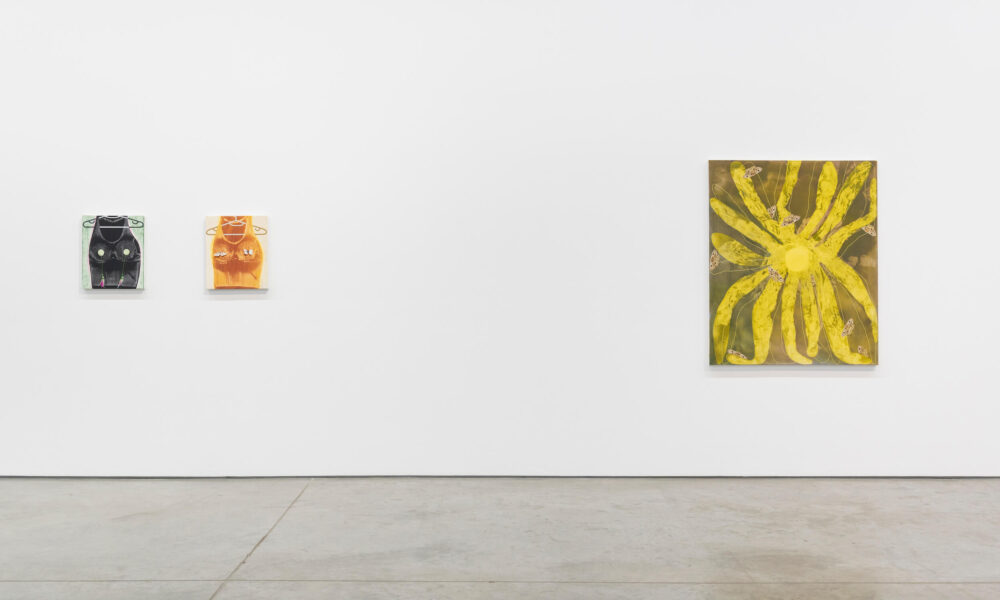
Since Nov. 11, the Bradley Ertaskiran art gallery has been housing Reversible Lining, a solo exhibition by painter Veronika Pausova that draws visitors in by asking them to question their own realities. Combining surrealist whimsy with intricately detailed realism, Pausova carries viewers on a journey that blends truth with fiction while challenging the wandering eyes of a patriarchal society.

Pausova is a Prague-born artist, currently working and residing in Toronto, who creates pieces and collections that work with themes of storytelling and narrative. In the case of Reversible Lining, Pausova drew inspiration from a Romantic-era legend closely associated with the creation of Mary Shelley’s Frankenstein. One night, while vacationing together in the Villa Diodati castle in Switzerland, Shelley joined her husband, Percy, and other celebrated artists in a scary story challenge. After becoming too frightened, Percy raced out of the room, claiming to have imagined that one of the women had eyes atop her breasts. 

Moved by this sublime tale, Pausova jumps into a fascinating exploration of the male gaze and what happens when that judgemental perspective is inverted, shifting the judgement back against the judge. Along the way, she toys with the dichotomy between reality and imagination, teasing its boundary through a combination of realist techniques and surrealist humour. This juxtaposition comes to life in many forms over the spread of Reversible Lining, playing with the viewer through symbols like expertly painted fingers emerging from garden hoses. 

The pieces that most directly reference Percy Shelley’s visions showcase simple tank tops resting on hangers, adorned with different ornaments such as eyeballs and flowery tassels resting over the bosom. While the shirts are the subjects of the paintings, these unexpected decorations are what truly captures the viewer’s attention. Pausova markedly references the viewer’s own gaze in a piece depicting a tank-top with moths perched upon the breasts, evoking the age-old expression of “a moth to a flame” in relation to the viewer’s guided attention. 

Through Pausova’s hand, clothing becomes a background to attention-grabbing details, facilitating one’s eye straight to the breasts. In doing so, she demonstrates how self-presentation becomes unimportant when the eye already intends to objectify. Absent in every piece are the bodies of those who wear the shirts, perhaps showcasing how the male gaze reduces a human being to only their body. By forcing the viewer to participate in this practice of objectification, Pausova illustrates how ingrained the act is in our society. 

As she forces readers to confront their own roles in perpetuating the male gaze, Pausova also makes viewers uncomfortable, as eyeballs stare back at visitors from their position on the shirt’s bosom. The stares feel withering, like the eyes are returning any and all judgement. Pausova thus raises the question of what happens when the male gaze is reciprocated.

Pieces throughout the exhibit reference other forms of self-presentation. Whether it is chipped nail polish on a toenail or a focussed attention to the design of shoes, these details have a realistic style reminiscent of photography. The photorealistic elements of the paintings coincide with more simple, abstract shapes and lines, leaving viewers puzzled as to whether the piece they are observing is truly a painting or a collage. The destabilized line between art and reality challenges the viewer’s conception of what is objective and subjective. 
Reversible Lining continues until Dec. 18. The exhibit is open access, and can be found at 3550 Rue Saint-Antoine O, easily accessible through the metro’s green line.

Arts & Entertainment, Film and TV

‘Get Back’ is a time capsule of a pivotal breakup in music history

Warning: Spoilers ahead

Before John Lennon, Paul McCartney, George Harrison, and Ringo Starr were The Beatles, they were The Quarrymen—a happy-go-lucky skiffle group. With Starr joining in 1962, The Quarrymen became The Beatles and catapulted into stardom. They will always be known for bringing some much-needed flair and gaiety to rock and roll in the 1960s. 

In 1966, Lennon, with harmless intentions, declared The Beatles to be “more famous than Jesus,” sparking extensive outrage. Afterwards, The Beatles struggled to regain their rhythm, only performing once before breaking up. The weeks leading up to their final bow in 1969 were taped, and are now viewable as a docuseries. Directed by Peter Jackson, Get Back revives The Beatles’ last weeks together through hours of undisclosed tapings and audio recordings, initially conceived for the band’s 1970 documentary Let it Be, which was released alongside their 12th and final studio album of the same name. This mini-series is lengthy—consisting of three two-and-a-half to three-hour episodes—but enjoyable for any ‘60s to ‘70s era rock fan. The series was released on Disney+ over the course of Nov. 25-27. 

The ultimate difference between Let it Be and Get Back is that the former is a documentary, and the latter is a documentary behind that documentary. The viewer is not watching The Beatles scramble to finish their penultimate album and prepare for their last live show; rather, they are practically with the band in London, sitting in Twickenham (and Apple) Studios, trying to piece together a perfect farewell as if it was their own. Get Back is a fly-on-the-wall experience, intimate and raw. The series is particularly difficult to watch because each artist is so clearly out of sync with one another that an immaculate ending is not feasible—the viewer watches on as The Beatles come to terms with this for themselves. Sandwiched between awkward moments are periods of brief levity, where the boys lounge and laugh while smoking like chimneys. These bits, however, are few and far between. Michael Edward Lindsay-Hogg, director of the Let it Be documentary, does an impeccable job capturing those shots—zooming in on Harrison’s face when his ideas were ignored, or capturing Lennon’s gaze being anywhere except where it should be. But, to fully appreciate these moments, the viewer must be completely engaged at all times; since the sound quality is lacking, some of the most decisive shots are completely silent. Get Back demands dedication and patience from viewers because of the eight-hour runtime. The series could be half as long without losing much substance, and it still would capture the discomfort of a band desperately trying to end on a high note. 

The last hour of the series delights the viewer with footage from The Beatles’ final concert upon the rooftop of Apple Studios in London. The lead-up to the showing was messy, with the last-minute venue choice encapsulating the chaos of The Beatles’ last days together. Despite the organizational hurdles, the concert feels playful and irreverent, which was what made these artists famous in the first place. Lindsay-Hogg’s cinematography is phenomenal, from capturing footage of fans climbing to nearby rooftops, to honing in on McCartney’s eyes lighting up as he performs live for the first time in years. There is something profoundly cathartic, as a Beatles fan, to watch them perform “I’ve Got a Feeling” for the last time. 

It’s no coincidence that Get Back was the album’s working name before it became Let it Be. The docuseries represents the trials and tribulations not only of being in a boy band for nearly a decade, but of realizing that nothing could be done to revive its spirit. The Beatles’ breakup is still widely misunderstood in the media, tainted by false speculation and racist underpinnings of John and Yoko Ono’s relationship. Get Back pulls back the curtain to reveal that no individual or isolated incident, nor problematic bandmate (or partner) alone led to their breakup. The real reason is quite simple: Like most good things, it had to come to an end. 

Sports

Under the influence of beer pong

The aromas of warm beer and sweat fill the air as loud cheers regularly erupt from a corner of the party. People rejoice as one team loses, and another team rushes to play against the winners. The festive and joyful atmosphere is the result of a game of beer-pong—a university classic.

Beer pong, also known as “Beirut,” is a timeless party game. All it requires is plastic cups, ping-pong balls, a table, and an endless supply of beer. The game can easily be played in teams of one, two, or more—friends and strangers alike.

A game of beer-pong is also a great way to meet new people. Whether you cannot aim correctly to save your life or you make your shot every time, you’ll either be congratulated by other drunk newbies or receive some well-needed tips from veterans. 

Just like in other popular games like UNO, players often vehemently disagree about the rules. However, most have a general understanding of its basic tenets: Your shot doesn’t count if your elbow is past the table, and you can ask for the cups to be rearranged during the game. Common disagreements include whether the other team is allowed to blow on the ball to get it out of the cup, how many balls are allowed during a rebuttal, and whether it counts if a ball bounces before it lands in a cup.

Many around campus consider themselves beer pong aficionados and routinely play the game during parties. Marie Delivre, U2 Arts, explained why beer pong is the perfect party activity in an interview with The McGill Tribune.

“For me, beer pong is a must-have for any college party,” said Delivre. “It can fulfill so many aspects of having a good party in a single game. Having a beer pong table is an instant facilitator to make friends or drinking buddies. Anyone can join and play as it is a rather easy game with simple rules.”

Anyone who has attended parties involving beer pong has witnessed how viciously competitive it can become. During these games, where the fate of your honour and pride are vested in the bounce of an orange ping-pong ball, the ups and downs can bring out a lot of emotion. Octavio Gamet, a U2 Arts student, describes himself as one such fierce competitor.

“I love beer pong because it allows me to get drunk while at the same time being able to play a competitive game,” Gamet said in an interview with the Tribune. “When in teams, it creates a group spirit, so we can either win together and scream our heart out when claiming victory, or lose together and get wasted. A single game is such an emotional roller coaster as any ball thrown has an impact on the game.”

Beer pong is a game for all. Everyone has to start somewhere and other players are welcoming to all levels of talent. 

“A lucky beginner can always have a shot at victory, so the game is not exclusive to students who have experience playing,” Delivre said.

The topic of experience brings about the age-old debate of whether beer pong is a game of luck or a game of skill. U1 Engineering student Benjamin* argues that the game takes a bit of both, and that a little alcohol always helps. 

“Beer pong definitely requires skill,” Benjamin said. “I’ve noticed a huge improvement in my games ever since I started playing more, so I’m sure there is a correlation. However, there is also a fair amount of luck involved.” 

But not all success comes down to skill, according to Benjamin.

“The game also needs you to believe in yourself and not be psyched out by the other team. Yet, I’m sure that the biggest impact on performance is not due to skill or luck, but rather due to the amount of alcohol consumed,” he said.

When playing your next game of beer pong, remember that you are participating in one of the greatest traditions of higher education. And whether you attribute your talent to luck or skill, remember to keep your elbows behind the table.

*Benjamin’s name has been changed to preserve his anonymity.

Arts & Entertainment, Film and TV

‘Firebird’ is a stunning, emotionally vulnerable portrait of the cold war

Warning: Spoilers ahead

For over three decades, the ​​image+nation Film Festival has worked to promote local and international queer filmmakers, and this year is no exception. From Nov. 18-28, the festival played a variety of international 2SLGBTQIA+ films at the Centre PHI, including Firebird//, an Estonian film based on Sergey Fetisov’s memoir The Story of Roman, which featured on Nov. 24. This timeless adaptation is a tragic love story with gorgeous cinematography and compelling lead performances.

Set on an air force base in Soviet-occupied Estonia, Firebird tells the story of troubled soldier Sergey (Tom Prior), who falls in love with his superior, Roman (Oleg Zagorodnii), while fending off the romantic advances of his friend Luisa (Diana Pozharskaya). The film follows the young couple as they face a multitude of challenges, including the KGB, lofty career goals, and a plane crash. Tested by time, Roman and Sergey’s five-year love story takes them across the Soviet Union, where they fight for their love without being discovered.

The film’s highlights are grounded in Prior’s performance. Effortlessly conveying a newfound sense of confidence as Sergey distances himself from his military life, Prior delivers a dynamic performance that matures as time passes in the film. His performance is magnificently complemented by Zagorodnii’s; the two have an electric chemistry that pulls the audience in and leaves them emotionally torn by the end. The instantaneous connection between Sergey and Roman is exhilarating to watch and is never diminished—both actors play their characters with the same love and passion from the moment they meet through to the end of the film. 

The film’s cinematography especially stands out. Director of photography Mait Mäekivi takes time to show the beauty of the wartorn Estonian forests throughout the film. Shots linger on subjects and scenery, slowing the film down to allow for a break in dialogue and action. Diverse, changing colour palettes reflect the emotional states of different characters. For example, the lighting grows warmer as Sergey distances himself from his life in the military but darkens when he is pulled back into it during an encounter with an old colleague. The cinematography works in conjunction with Prior’s phenomenal acting to merge character, setting, and time into a visually stunning experience.

The beautiful camera work is complemented by the score and soundtrack. Composer Krzysztof A. Janczak seamlessly integrates the soundtrack into the film to express the intense emotionality of the film. It feels as if the landscapes and score are in perfect harmony, the music corresponding with the changing colour palette and typography. The score is not only emotionally moving but auditorily diverse, making use of a variety of orchestral instruments throughout the film. The constant rotation of instruments perfectly reflects the emotional growth of the characters. The soundtrack adds gags and references that work to alleviate tension and bring a sense of calm or joy to the screen. Firebird may have the best needle-drop of 2021, using “Rasputin” by Boney M. during a scene in the fourth act.

Firebird was an exceptional choice on behalf of the festival—the captivating lead performance and eye-catching cinematography will move audiences. Once again, the image+nation Film Festival has delivered an excellent precedent for international queer cinema.

News, SSMU

Queer McGill, SSMU, and UGE form coalition against proposed Bill 2

Content warning: transphobia

On Jan. 29 of this year, a Quebec Superior Court ruling declared six provisions of the province’s Civil Code unconstitutional and discriminatory against the 2SLGBTQIA+ community. In response to an order by Quebec Superior Court judge Gregory Moore, Justice Minister Simon Jolin-Barrette proposed Bill 2 at the Quebec National Assembly on Oct. 21. Though the bill was intended to revise the Civil Code’s sections on 2SLGBTQIA+ issues in accordance with the Superior Court ruling, Bill 2 has been widely criticized for being regressive and has thus been tabled while awaiting public consultation.

Three McGill groups—the Students’ Society of McGill University (SSMU), Queer McGill, and the Union for Gender Empowerment (UGE)—have formed a coalition under the leadership of Queer McGill’s Trans Working Group to advocate against the bill.

The McGill Coalition Against Bill 2 opposes the distinction between sex and gender on legal documents that Bill 2 would implement, as it will automatically “out” individuals whose gender identity differs from their sex assigned at birth. The coalition also objects to the bill’s proposal to require surgery to change their sex on their birth certificate, because it creates pressures to undergo a sterilizing procedure and assumes that sex defines gender identity. The coalition also protests a section of the bill that would designate a male or female sex to intersex newborns, heightening the risk of surgical intervention on infants.

Arwyn Regimbal, U1 Social Work and a member of the coalition, feels that Bill 2 is a misguided response to the Superior Court ruling that provoked it. 

“Reading the judgement and comparing it to the bill, you can see that there was some intention to negate rights,” Regimbal said in an interview with The McGill Tribune. “[Bill 2] interprets the judgement in such a narrow way that on the surface it technically complies with it but when it comes to the spirit of what is being done, it’s quite regressive and actively harmful.”

Cal Pease, U3 Science and resource coordinator for Queer McGill, explained that the coalition intends to fight Bill 2 through a three-pronged program that raises awareness, provides resources to those affected by it, and demands changes be made. The coalition has also been advocating for a wider condemnation of sections 23, 24, 26, 30, 33, 41, 42, 43, and 247 of the bill, including putting pressure on the McGill administration to issue a statement. 

“We call on McGill to publicly denounce these sections of the bill and [to] take a more active stance against transphobia,” said Pease in an interview with the Tribune. “I think a lot of the advocacy on campus is coming from a grassroot perspective, which is wonderful, but it would be good to have that reflected in the administration as well and [to] have [their] support.”

Yara Coussa, U3 Arts and arts representative to SSMU, echoed Pease’s frustration with McGill’s silence. Coussa believes that McGill’s inaction demonstrates compliance with transphobia.

“No statement, no message of support,” Coussa said in an interview with the Tribune. “Even if [McGill] did not want to be overtly political, they could have sent out a message of support for trans people. That has not been done.”

Despite the absence of a comment on the bill or statement of support from McGill, the coalition is committed to providing resources for the transgender, intersex, non-binary, and other gender-diverse communities on campus. 

“We have been coming up with various resources and putting them together on a website,” Pease said. “Arwyn made a flow chart about changing your name and sex in Quebec for people who are interested in doing that now, in case the bill takes effect. We are also trying to direct people to the resources that already exist on campus like Queer McGill and UGE.”

If you would benefit from support at this challenging time, please note that the following resources are available to assist you:

Trans Lifeline: 877-330-6366

Keep.meSafe (24/7 access to licensed counsellors available to all McGill students.)

Peer Support Centre at McGill

More at McGill Students Against Bill2

Read the latest issue

Read the latest issue