Latest News

Features

Beyond the answer sheet

“Math is everywhere. To varying degrees, of course, but math is just something that’s everywhere,” Professor Limin Jao, assistant professor and assistant graduate program director in the Department of Integrated Studies in Education, said in an interview with The McGill Tribune.

She’s right, of course. There’s math in our kitchens, on our walks to school, and in the way the clouds move. It’s everywhere, and though many of us try our best to live in denial, it will always be everywhere.

Student Life

Dean Buddle talks Reddit, podcasting, and student outreach

As part of his duties as Dean of Students, Christopher Buddle shares weekly wisdom with McGillians through his Dean’s Corner newsletter. The column has garnered attention across campus, even leading to the new #buddlehuddle moniker for his student outreach efforts. Buddle sat down with The McGill Tribune to discuss the #buddlehuddle and his greater role as Dean of Students.

McGill Tribune (MT): What inspires the advice you give to students?

Christopher Buddle (CB): “[Dean’s Corner] serves a number of purposes [….] In many cases, it’s just kind of what I see as issues with students or in academia that maybe I can offer some advice or opinions [on], or highlight services [for….] I have a long […] list of different ideas, and I basically think about what’s going on around campus and what might be good advice or things to talk about at that time.  I always try to time some around midterms to [recommend] resources [….] Sometimes I just give advice from experience. I did that a couple weeks ago with a post called ‘Learning to Fail.’ I failed courses in my undergraduate [career], and it’s okay to fail. In fact, it’s normal for students to struggle academically now and then, and that doesn’t define you. That’s part of what it is to be a student and go through a transformation.”

MT: Do you have a favourite Dean’s Corner installment?

CB: “I made this [post], ‘Hey Prof Dude: How do we help students write effective emails,’ and I actually got pushback from students saying, ‘Well what about profs? Because they write horrible emails’ [….] We all have to be respectful and think about how we communicate with people all the time, so I loved that one [….] People still write me [emails addressed], ‘Hey, Prof Dude’ on purpose.”

MT: How did you find out about the Buddle Huddle?

CB: “I think it was embedded in the comments on Reddit. After I wrote the ‘Learning to Fail’ [post], some people questioned why the Dean of Students wrote them an email about failing. One of the comments was something around [joining the] #buddlehuddle, and I read it and thought, ‘well, that is outstanding,’ because that’s actually what I want to do. I want to find a way to connect with students. I think I can own that hashtag, [and it will] be beneficial in connecting with students.”

MT: Are there any plans to use a #buddlehuddle in the future to better connect with students?

CB: “Yes, I think [there are….] I’m constantly looking for ways to engage and to be accessible, and so, the ‘Buddle Huddle’ idea is one step in that journey. I’m thinking of starting a podcast in January [….] My goal […] is to answer questions that people have about the university [and] about the Dean’s office. I know students listen to podcasts, so I’ve got to go to where students are [….] I think I’m going to pursue a lot of those things. I think it’s great, and I’m not sure it’ll succeed. Some things work [and] some things don’t, but, who knows? I’ll try.”

MT: If you could only give one piece of advice to McGill students, what would it be?

CB: “[I would like students to know that] thinking and doing beyond the classroom is important [….] I don’t mean to not concentrate on academics, but, beyond the classroom [this might mean] finding your community. We all need friends [….] Loneliness and isolation are huge concerns for me among our students, so [a main focus is] how […] we facilitate getting beyond the classroom and developing that community, whether it’s support, whether it’s a club or activity, or whether it’s finding out what resources are available.”

Men's Varsity, Sports

Stingers snap Redmen rugby’s undefeated record

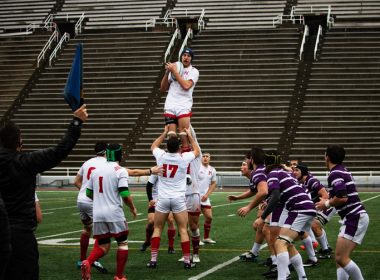
On Oct. 19, the McGill Redmen (4-1) faced off against the Concordia Stingers (5-0) at Molson Stadium. Both teams entered the arena undefeated: Deadlocked in a tie for first place in the RSEQ and playing for sole possession of the top slot in the conference. McGill was slow to start, and their valiant second half effort was ultimately insufficient, falling to Concordia by a score of 22-15.

The Stingers opened up the game with a quick 12-0 lead. However, McGill battled back: Third-year hooker Alex Pantis wrangled a try for the Redmen, ending their dry spell. Throughout the half, tensions spilled out onto the field, resulting in penalties for both sides. Ultimately, the penalties cost McGill points, which came back to haunt the Redmen later in the game. The Stingers closed out the first half with a comfortable 19-5 lead.

After halftime, a determined McGill team took the field. First-year fly-half Owen Cumming and third-year flanker Pierre Grison helped drive McGill’s offence, each picking up a try in the half. The Redmen played phenomenal defence, too, giving up only six points to the Stingers in the final half. Despite their efforts, the Redmen couldn’t take advantage of the offensive and defensive surge, and the Stingers took home the victory by a 22-15 score.

“I thought we played very well in the second half,” Redmen Head Coach Ian Baillie said. “[We] took too many penalties. That cost us the game, but we moved the ball. We scored some really nice tries, and we looked good out there.”

McGill will be looking to bounce back from their loss in their upcoming game against the Sherbrooke Vert et Or (3-2) at Stade de L’Université in Sherbrooke on Oct. 28. This will be their last game of the season before the playoffs begin in November.

“We can use this game [against Sherbrooke] as a really good opportunity to come back from this game [against Concordia],” Pantis said.

Overall, the Redmen remain positive and are focused on their upcoming match and the playoffs.

“I think we’re going to go far,” Grison said. “We’re going to put in the work to achieve what we want to achieve, which is to win.”

Moment of the game

In the closing minutes of the game, the Redmen secured possession and Grison barrelled past defenders to ring in one last try for McGill.

Stat corner

McGill held Concordia to 22 points, Concordia’s lowest offensive total this season.

Quotable

“When we play our game, like we saw in the second half, it’s something else. We’ve just got to stick to our game.” – Fly-half Owen Cumming

Science & Technology

Bridging gender inequality one Wikipedia article at a time

In honour of Ada Lovelace Day (ALD) on Oct. 9, people connected over their laptops to help close the gender gap on Wikipedia. ALD honours Ada Lovelace, a brilliant mathematician—often considered the world’s first computer programmer—as well as all women in the fields of science and technology.  

This year, the McGill library, in partnership with Broad Science, 500 Women Scientists Montreal, and the Science and Policy Exchange celebrated ALD by hosting Montreal’s first-ever Wikithon, an event where people can come together to learn about and edit Wikipedia. Wikipedia is a free encyclopedia with content that users can freely contribute to. The website is an integral tool for many university students with over 40 million articles. Its cultural significance is evidenced by the fact that the easiest way to explain Wikipedia is via a Wikipedia article itself.

The ALD Wikithon enabled students to come together and edit pages to make the global encyclopedia more gender-equal, since over 90 per cent of the encyclopedia’s content is male-authored. The hope is that this will lead to more articles on female pioneers in STEM, such as Donna Strickland, who have comparatively fewer articles than their male counterparts.

Donna Strickland, who won a Nobel prize [and was the] third woman in physics to win it, didn’t even have a Wikipedia page till last week,” Rackeb Tesfaye, the founder of the podcast Broad Science, said. “She was told that she wasn’t notable enough to be on Wikipedia.What notable means, not only on Wikipedia, but in our society, […] what we deem to be valuable and who [we deem] a scientist, definitely needs to be [redefined].”

When Wikithons first began in 2012, women only represented 15 per cent of all Wikipedia biographies; now, in 2018, that number has only increased to 17 per cent. In trying to boost these statistics, McGill’s Wikithon mirrored similar global events held throughout the week in honour of Ada Lovelace and female contributions to science.

“[It’s a] nice introduction to editing Wikipedia pages,” Mitaali Taskar, U2 Science, said.  “[I got to] look up incredible women I would not have known about otherwise.”

To edit Wikipedia, users must first create an account and a username. Coding is not required since the interface provides a text-based editing layout. The website gives users a user page to practice edits, and recommends that new users edit at least 10 articles so that Wikipedia can differentiate real users from bots.

While events like McGill’s Wikithon aim to introduce newcomers to Wikipedia’s editing process, many people see Wikipedia editing as much more than a hobby; almost all of the edits on Wikipedia are made by a select 1,500. Jess Wade, a well-known Wikipedia editor, has written over 270 articles dedicated to female scientists in the past year. Her goal is to ensure that all women who have made important contributions to science get the recognition they deserve.

“I kind of realized we can only really change things from the inside,” Wade said in an interview with The Guardian. “Wikipedia is a really great way to engage people in this mission because the more you read about these sensational women, the more you get motivated and inspired by their personal stories.”

Opportunities to change the article content of Wikipedia are available to everyone.

“It’s nice to know that you don’t have to be an expert [in] something to change the page,” Maryse Thomas, a PhD candidate in neuroscience, said. “You can just do research and feel confident enough in yourself to go ahead and make […] a major edit.”

Science & Technology

Putting your footprint in your mouth

In light of growing global concerns about oceanic pollution, Mathilde Jutras, a PhD student in McGill’s Earth and Planetary Sciences Department, produced a video proposing a solution to the continuously worsening ocean environment: Labelling consumer products with their carbon footprint. Jutras suggests that products should be labelled to indicate the carbon dioxide emissions from production and transport as well as colour-coded to indicate low, medium, or high levels of emissions.

Jutras entered her video in the Oceans Youth Innovation Challenge, which called for participants from each of the G7 countries to submit a solution to an ocean-related challenge that they were working to address. She was one of two winners of the challenge, both of whom were given the chance to attend the G7 Environment Ministers’ Meeting in Halifax, Nova Scotia Sept. 19-21 this year. The other contest winner, Kaoru Yokono from Japan, proposed packaging-free areas in stores and the standardization of non-plastic packaging among retailers.

Jutras made her video entry out of a desire to make science more accessible in the fight against climate change and oceanic pollution.

“I realized the importance of science, especially in the communication between scientists and decision makers,” Jutras said. “I saw this opportunity and thought it would be a really good chance to see what the decision makers think, how [the decision making process] works, and how scientists can make their work useful to decision makers.”

Jutras found her time in Halifax to be an eye-opening experience. Although a large portion of the G7 meetings were closed, she attended several environmental outreach events and presentations during the coinciding Oceans Partnership Summit and Inspiration Expo.

“It was really interesting to attend the Oceans Partnership Summit on the first day and to see discussions with people from such different backgrounds […] trying to reach a consensus,” Jutras said.

Jutras noted the diversity of voices and the range of perspectives from which attendees approached climate change. She was pleased to see the variety of stakeholders present to take a multi-disciplinary approach to waste management, one of the leading causes of pollution.

“There are people who are all about technology, saying that we can [make] plastics that are 100% recyclable,” Jutras said. “But [someone else pointed out] ‘the problem is, in Southeast Asia, they have so much plastic being consumed and they don’t have the infrastructure to recycle. So even if industry does [make] recyclable plastic, it’s just going to go in the trash anyway, or directly into the rivers.’”

Even if producers want to help slow down climate change by doing the right thing, they face constraints.

“There are some companies that want to do stuff that’s better [for the environment], but they don’t have money and can’t get money from the banks to start a project,” Jutras said. “So [the man at the conference] was attacking [the problem from] the financial side [….] I thought that was really interesting and it inspired me.”

Although oceanic protection and the broader topic of climate change can seem daunting, local and national governments, industries, institutions, and individuals all have the power and responsibility to tackle these issues.

“One of the things I realized is that not a lot of people will make a major change, but everyone will make a small change,” Jutras said. “And, if everyone is trying to make a change, it will make a big impact.”

McGill, News

Indigenous support inside and outside classrooms

McGill’s School of Social Work held a panel on the indigenous student experience at McGill on Oct. 13, featuring speakers from Indigenous Access McGill (IAM) and indigenous students. The event is part of the celebration for the School’s 100th anniversary.

Nicole Ives and Wanda Gabriel, associate professors from the School of Social Work, spoke about why IAM, a community and academic-oriented support program, is an important initiative at McGill. It has previously assisted 18 indigenous students and is currently helping 13.

One of the areas [in which] we found support was needed was this disengagement […] from the education process,” Ives said. “The past is based in colonization, residential schools, and day schools. Education was primitive and did not give the students what they needed.”

IAM is defined by three core components: Curriculum development, student assistance, and summer support. It offers an indigenous field course to bring McGill and the Kahnawá:ke community closer together in reconciliation and action. It also provides summer orientations that give incoming indigenous students an opportunity to see what university is like.

The student support creates what Gabriel calls ‘cultural buffers’ to allow students to participate in a classroom setting without feeling the shame of not having all the answers.

[There are] not many faces that are our own,” Gabriel said. “Pressures [are] experienced in class […from] being the only indigenous person in the classroom. When Indigenous issues come up, that student is asked to speak for all of the indigenous people.”

Alex Gray (BSc ‘ 18) , spoke of his experience as an indigenous student during lectures.

I can remember taking a global health course,” Gray said. “Oftentimes, when indigenous issues came up, I felt like [I was] representing all of [my] people. You get your heart pumping, you start to sweat a little, and it’s not a fun experience. You feel compelled to talk [….] You’re not just in a post-secondary institution representing yourself, you are representing your community. ”

Gray also felt the burden of correcting misconceptions.

It can be very awkward as an indigenous person,” Gray said. “Whenever your culture is mentioned or your people are mentioned, it’s in the form of stereotypes.”

Even when correcting stereotypes, Gabriel sees that it is difficult for people to express themselves as an Indigenous because their very culture has been broken.

When you have a sole student being asked, ‘what does the indigenous world think,’ they won’t have all the answers,” Gabriel said. “When that kind of pressure is put on over and over, it brings lots of stress.To have these places where we can see ourselves within the university, to see people that are sharing the same journey, is so important.”

Gray, who is also member of the Medicine Bear drum group, credited the First Peoples House as a helpful resource in his time at McGill.

A number of us met through First Peoples House, and there was a growing interest in getting a drum group going,” Gray said. “Bringing the drum out […] is an easy way to make a space, especially in a colonial body such as McGill, into something more welcoming to Indigenous peoples.”

The indigenous experience has always involved barriers, yet Gabriel puts faith in initiatives like IAM to rise to the challenge.

“We have to keep pushing with determination, [though] we are born into struggle and resistance,” Gabriel said. “Our people survived cultural genocide through determination and [resilience]. After all of these actions to eradicate our people, we’re still here [….] There needs to be further dialogue of what comes up for non-indigenous professors when they are teaching indigenous material. There are ways to teach about indigenous studies by coming from this perspective—the honest perspective—not Canada’s little secret.”

Student Life

LGBTQ+ McGillians making history

Throughout October, the Institute for Gender, Sexuality, and Feminism (IGSF) has organized a diverse spread of events, featuring famous LGBTQ+ speakers, professors, and authors, as part of McGill’s inaugural LGBTQ+ History Month. This achievement has initiated a conversation about LGBTQ+ culture and knowledge on campus, and the events have highlighted the achievements of the LGBTQ+ community. In celebration of this initiative, The McGill Tribune reflects on LGBTQ+ McGillians who have made history on campus and beyond.

Will Aitken

Originally from the United States, Will Aitken is one of Canada’s most celebrated openly-gay film critics as well as a highly-regarded novelist and journalist. He graduated with an MA in English literature in 1975. In 1973, Aitken co-founded Montreal’s first LGBTQ-oriented bookstore, Librairie L’Androgyne, located on Crescent Street before its closure in 2002. He has worked as a film critic and journalist for various news outlets including the BBC, CBC, and National Public Radio. Additionally, Aitken taught briefly at Dawson College and continues to write in the Montreal area. His most recent book, Antigone Undone, was shortlisted for the 2018 Hilary Weston Writers’ Trust Prize for Nonfiction.

Charline Labonté

An alumna of McGill’s Physical Education program (BEd’12), and former Martlet, Charline Labonté enjoyed an impressively-decorated hockey career. Labonté played for the Canadian Women’s Hockey team in the 2006 Turin Olympics, and her impeccable goaltending helped Canada win the gold medal. Later, Labonté won ‘Top Goaltender’ at the IIHF Women’s World Championships in 2009. When she publicly came out as lesbian in 2014, Labonté thanked her Team Canada and Martlet teammates for their support, acceptance, and love. Labonté retired in 2017 with three Olympic gold medals, two world championships, and six world silver medals.

Suniti Namjoshi

Born in Mumbai in 1941, Namjoshi is an internationally-acclaimed author, poet, and fabulist. In 1972, her thesis on the poetry of Ezra Pound earned her a PhD in English literature from McGill. Namjoshi has produced a dynamic body of literature, publishing  novels, poetry collections, scholarly articles, and over a dozen children’s books. Her 1981 anthology, Feminist Fables, is critically acclaimed as a scintillating reframing of traditional fables that encourages female empowerment. Much of her work explores themes related to gender and sexuality  and actively challenges sexism, racism, and homophobia. Between 1995 and 2001, Namjoshi held the position of Honourable Research Fellow at Exeter University’s Centre for Women’s Studies.

Alan Emtage

One of the founding fathers of the modern internet, Alan Emtage (BS’ 87, MS’91) earned two degrees in computer science from McGill. After graduation, Emtage went on to invent Archie, the world’s first internet search engine. Emtage was also a founding member of the Internet Society, a multi-national nonprofit committed to improving internet standards, policies, and access. Previously, Emtage has stated that he felt isolated as a child, due to his LGBTQ+ identity, which encouraged him to pursue solitary interests including computer science and technology. He is currently chief technical officer at web engineering company Mediapolis, which, among other projects, operates popular LGBTQ+ internet forums.

Brian Lewis

A professor with degrees from Harvard University and Oxford University, Brian Lewis currently teaches in McGill’s History and Classical studies department, specializing in British History and sexuality studies. In his History of Sexuality survey course, Lewis often ‘comes out’ to his students. He finds this practice liberating and an effective way to create a safe space for his students. An author of multiple books in his field, Lewis remains a notable LGBTQ+ scholar and teacher and is a favourite professor among history students.

Science & Technology

Orgasm equality is a long time coming

Many women are familiar with the frustration of finishing a sexual encounter without actually finishing. This disparity between men and women’s sexual satisfaction, colloquially known as the ‘orgasm gap,’ refers to the fact that  men are far more likely to orgasm than women in heterosexual encounters. In a recent study from The American Association of University Women examining 800 college students, 91 per cent of men reported that they usually or always experienced orgasm during sex, while only 39 per cent of women could say the same. The orgasm gap is not an individual problem, but rather a function of western sexual culture.

Mayte Parada, a sexologist and postdoctoral research fellow in McGill’s Department of Neuroscience and Psychology, looks at intimacy to explain why heterosexual men are the most likely to experience orgasm, followed by gay men, lesbians, and, lastly, heterosexual women.

“One of the theories [of why] lesbians are more likely to experience orgasm [than heterosexual women] is because they have more of a connection with their partner and are more comfortable communicating what they like and don’t like,” Parada said.

A paper published by Meredith Chivers, an associate professor in the Department of Psychology at Queen’s University, reaffirms the importance of having an intimate connection. Chivers explained that communication between heterosexual partners can increase a female’s likelihood of a to experience orgasm. Chivers said that, for many women, sexual pleasure requires more than just physical stimulation.

A recent study from McGill’s Laboratory for the Biopsychosocial Study of Sexuality investigated the orgasm gap further. Researchers found that the subjective experience of orgasmic pleasure and satisfaction depend more on psychological and psychosocial factors than on physical ones. These could include the quality of a couples’ relationship and their emotional intimacy.

Despite these recent scientific endeavours, the physical mechanics of female pleasure remain shrouded in mystery. In fact, the female orgasm remains one of the most poorly understood sexual responses, since past sex research predominantly focuses on male sexuality. For example, labs previously only used male rats when conducting sex research, until they realized that the findings in males were not representative of the female population.  

“Researchers are still studying what purpose [orgasm] serves in women,” Parada said. “If people are enjoying themselves and communicating, orgasm doesn’t have to be the be all and end all.”

According to Parada, the orgasm is a poorly-understood sexual response because it actually isn’t that important for sexual satisfaction.

“A lot of people […] don’t have sex just for orgasm,” Parada said. “Different phases of sex are what people are aroused by, and the activity itself [is] what people [find] most enjoyable.”

Regardless of the emphasis on orgasms, the topic of sex and promiscuity is still extremely gendered and worth exploring from a female perspective. Even though society is becoming more progressive and permissive, topics of sex and its idiosyncrasies are still difficult for some people to discuss without embarrassment, ignorance, or cultural taboo coming into play. As a result, women can find themselves with a shortage of opportunities to learn about sexual pleasure.

“This stuff is important to research and know about,” Parada said. “Because, without sex, we wouldn’t be here.”

Montreal, News

Montreal’s second Demonstration Against Racism draws support across city

For the second year in a row, the Demonstration Against Racism drew around 3,000 protestors on Oct. 7. The protest was co-organized by the Anti-Capitalist Convergence (CLAC), Montreal Antifasciste (ANTIFA), Food Against Fascism, Solidarity Across Borders, and Industrial Workers of the World (IWW). Protesters moved into the streets around 3 p.m., gathering at the moving truck provided by ANTIFA, which was filled to the brim with speakers. It blasted out three main speeches, touching on the normalization of racism, colonialism, and disappointment in the recent Quebec elections.

Despite not being the official reason the march was called, the newly-elected CAQ was the main target of the protest. Shouts of ”Francois Legault has got to go rose through the air as the masses of people snaked through downtown.

The CAQ has proposed several changes to Quebec’s immigration policies, including a ‘Quebec values test,’ which Legault has stated will test whether or not immigrants agree with Quebec’s Charter of Human Rights and Freedoms and will guage their grasp of conversational French. It is still unclear what would happen to those who fail the tests, as the CAQ has stated that it is, ultimately, Ottawa’s responsibility to deal with unsuccessful attempts.

Bénédicte Santoire, a protester and Université de Montréal (UDeM) Master’s student, said that she had known about the protest before the election, but Legault’s victory spurred her to come out.  

“I just don’t like their position on the [Quebec values test], on immigration,” Santoire said. “[The CAQ is] a right-wing party. I disagree with their core beliefs.”

The protest was an opportunity to raise awareness for many causes to be heard. Nicholas Gibbs was a black NDG resident shot on Aug. 21 in a police altercation. During the demonstration, his nephew called the Montreal Police (SVPM) the “biggest gang in the city,” stating that the police had unfairly profiled his uncle due to his previous convictions and that they were lying about his uncle being armed the night he was killed.  

The protest followed ANTIFA’s truck down Boul. René Lévesque, mostly broadcasting chants like “so-so-so-solidarité” and “say it loud, say it clear, immigrants are welcome here” while intermittently relaying speeches from members of the community. In front of Complexe Des Jardins, a large banner read “JUSTICE POUR NICHOLAS GIBBS: another racist murder by SVPM.”

“When we separate, when we show hate, we hate on each other. They love that because we’re divided,” Gibbs’ nephew said. “They’re the biggest gang in the city, they’re the biggest gang and when we’re like this, when we’re together like this, I can guarantee you on my life, none of us will get profiled. We need more of this.”

The nephew claimed that the city’s police intend to divide residents, revealing the need to stand in solidarity. This speech was followed by chants such as “tout le mode déteste la police” (“everybody hates the police”) directed at the police officers blocking off the roads for the protest.

The demonstration ended with speeches from members of the community and leaders of the co-organizing groups sharing messages against racism, Islamophobia, capitalism, colonialism, and fascism. Graham Bélanger, a first year fashion design student at LaSalle College, captured the crowd’s mood.

“It’s really important [that] citizens engage,” Belanger said. “Democracy can be very corrupt sometimes, and this is our last chance as people to gather and push it in the right direction.”

Student Life

Implications of the ‘Freshman 15’

Incoming university students are susceptible to gain weight, due to the change in lifestyle that university precipitates, such as diet modification, lack of exercise, stress, and alcohol consumption. But, the infamous ‘Freshman 15’ are more of a playful alliteration than a representation of reality. According to National Center for Biotechnology Information, only 50 per cent of students gain weight during their first years, and even then, they only gain about 2.7 lbs on average. Nevertheless, the myth persists within contemporary culture and has many tangible consequences on first-year students.

The idea of the Freshman 15 is so entrenched in popular culture that most students have heard of the phenomenon far before they’ve even begun to think about university. In movies and TV shows, first-year weight gain is a recurring gag. For example, on the hit television show Gilmore Girls, as the protagonist Rory Gilmore prepares to leave for university at Yale, her family jokes about her possible weight gain.

Catherine Dillman, U1 Arts, notes that the idea of weight gain isn’t always threatening until students begin to receive personal warnings about it. When friends and family offered her advice about life at university, many cautioned her to be wary of weight gain, and others even deemed it unavoidable.

“[I was told to] beware of the Freshman 15,” Dillman said. “‘Make sure you exercise, make sure you eat well’, but I would also [hear] that it’s inevitable, there’s nothing you can do about it. The food the [cafeteria] offers isn’t very healthy, but because we’re aware of it, you always want to try to eat healthier, [especially with] the […] pressure of everyone talking about the Freshman 15.”

While trying to stay healthy is wise, weight is an unreliable indicator of overall health. Research suggests that half of ‘overweight’ people are actually metabolically healthy, while a quarter of those considered ‘slim’ have two or more cardiovascular risk factors. However, for many students like Dillman, weight is often the only quantifiable measure of health that they have access to, and its importance, in turn, is overstated. Consequently, weight gain is concerning for many students because so much of self-esteem can come from body image.

Fortunately for some, the Freshman 15 puts a healthy amount of pressure on them to pay attention to their nutrition. Adin Chan, U0 Arts, explained that, while his family did express concerns for him to eat healthily, he was not worried about weight gain. He views gaining weight as inconsequential, rather than shameful.

“My family was just worried that I wouldn’t eat vegetables, not so much gaining weight, [and personally] I would not be concerned.” Chan said.

The opposite is true for many femme-identifying first-years, who express far more concern for their weight. For them, ‘getting fat’ is emblematic of straying from an ideal body type. Lena Kozarov, U0 Science, and her friends discussed their fears of gaining weight before leaving for university, a fear which she attributes to social media. Kozarov views the constant digital onslaught of perfectly-edited images as partially responsible for female insecurities because  they set standards that are impossible for university-aged students to attain.

“Me and my friends from high school would […] be like, ‘Oh, Freshman 15, you gotta be careful, you gotta watch out,’” Kozarov said.  “No matter how healthy you eat, no matter how much you work out, that comparison [to those on social media] is always in the back of your head, like, ‘I could be doing better.’”

First year is hard for everyone, and the constant fear of weight gain, whether placed upon students by well-meaning family members or gleaned from popular culture, only makes the transition to university harder. The Freshman 15, though grossly overstated, is not in itself a bad thing—it is reflective of the problematic stigma of weight gain. Though it can help to encourage healthier eating habits, more often than not it leads to feelings of inadequacy and shame and could even push students to develop unhealthy relationships with their bodies. The most stressful thing about first year should be midterms and exams, not worrying about a number on a scale.

Read the latest issue

Read the latest issue