

Latest News

Art, Arts & Entertainment

Birds Crossing Borders bridges the gap between Syrian and Canadian communities

Since 2017, over 6,100 Syrian refugees have arrived in Montreal. With her multimedia exhibition, Khadjia Baker puts a name, face, and voice to six of these individuals. Her captivating and powerful audio-visual installation, Birds Crossing Borders, premiered on Sept. 13 at the theatre and gallery, Montreal Arts Interculturels. A Kurdish-Syrian who witnessed the Syrian civil war firsthand, Baker presents a collection of stories from Syrian refugees living in Montreal to chip away at the myth of refugees as radical extremists.

In Birds Crossing Borders, Baker displays the anecdotes and narratives of Syrian men and women new to Canada on three televisions and two projectors of different sizes in a dim gallery. Two of the films, “Powerful women looking for freedom” and “Family of recently arrived refugees,” offered audiences insight into the humanity and wounds of Syrian refugees through first-person storytelling. The short films last anywhere from approximately 13 minutes to an entire hour. Baker creates a moving multi-sensory experience that transports viewers into the lives of each storyteller.

The screens of the installation stand in each corner of the room, alongside plexiglass boxes filled with clear water and tubes that connect each box in the centre.

“The movement of the water through these vessels is a conceptual reflection on displacement and the dynamics of belonging in one’s home,” revealed Baker’s exhibition introduction.

The first box fills up with a red liquid, which slowly passes through each plexiglass box. Using simple objects found in a chemistry lab, Baker comments on the connectedness of human movement and the relationship to new land and new people.

Zain Merhaba, a 27 year-old Master’s student from Aleppo studying childhood education, had one of the most gripping narratives on offer. While other storytellers spoke French or English, Zain told her stories in a Syrian dialect that reminded me of my own Lebanese family, and made her seem familiar. Zain shared her experiences as a school teacher and hospital volunteer during the war, how she looked to children for hope, and the difficulty of having to learn a new language.

As someone who has experienced the effects of displacement—my siblings having been forced to flee Lebanon in 2006 due to military conflict—Zain’s experiences resonated with me. The sense of solidarity I felt was a feeling Baker had set out to evoke.

“[The exhibition] aims to develop healthier relations with displaced people from the Middle East as a way of avoiding social separation and conflict,” Baker’s introduction stated.

The exhibition’s interview storytelling technique offers a unique perspective into the lives of Syrian refugees at a time when their perspectives are often forgotten.

“One-sided images from Western news media intensifies the paranoia around ‘alien newcomers,’” the introduction read.

Baker’s small yet forceful exhibition dismantles barriers created by popular news sources, giving full attention to the Syrian refugees themselves, rather than political sensationalism. Her collection of films showcases a raw and unscripted perspective of these six men and women. The installation takes away viewers’ ability to respond, and instead, it requires that they listen.

Although I experienced Khadija Baker’s Birds Crossing Borders with no other patron in the gallery, it did not feel like I was alone. As a person of Lebanese descent who appreciates the effect that displacement can have on a family, I left the exhibition having been transported somewhere familiar.


Birds Without Borders runs from Sept. 13 to Oct. 13. at MAI. Tickets are free. For more information, go to http://www.m-a-i.qc.ca/event/birds-crossing-borders.

Student Life, The Viewpoint

Viewpoint: Add-drop is over, now what?

With the end of Open Air Pub comes a bitter awakening: The end of add-drop. Goodbye to missing class because it’s syllabus week; so long to lounging on Lower Field; and adios to putting off that textbook purchase until you figure out if the class is for you. With the end of the add-drop period comes the fresh reality of readings starting to pile on, assignment notifications popping up, and the symphonic hum of clacking keyboards throughout campus.

The start of classes invites a common mantra among students: “This is the year where I try to stay on top of everything.” That ‘everything’ can be a long list: Don’t miss class; do work out, complete readings on time, be prepared for conferences, and make something healthy for dinner.

As someone who has difficulty adhering to these ‘September standards,’ I constantly find myself paying the price in October. Missed readings abound, my lecture notes aren’t up to par, and my fridge is empty. Getting organized with a few simple routines can make a world of difference when it comes to your own health, hectic periods of the school year, or even your day-to-day understanding of your courses.

More than supporting academic success, keeping organized during the semester can be a form of self-care. A bit of planning at the start of the semester can minimize frantic McLennan all-nighters.

The following is a list of my most useful organizational tricks that I hope to adhere to, to make this semester, the semester that I finally stay on top of my studies.  

1. Plan out important dates

Upon receiving your course syllabus, mark all the significant due dates on your calendar: Midterms, papers, presentations, and anything else with a due date—write it down! By recording these dates, you’ll have peace of mind knowing exactly how your assignments interfere with one another and how much time you have between deadlines to shoulder the workload. It also ensures that you don’t get caught off-guard by a surprise deadline.  

2. Part 1: Attend class. Part 2: Attend class, on time.

This sounds simple, but go to class. Don’t hit snooze on your alarm. Sometimes lecture recordings fail to upload or the audio malfunctions. To truly get the most out of a course, the best strategy is to actually attend it. That way, you will understand the material better, and you won’t need to worry about scrambling for notes or explanations of concepts once midterms roll around.

3. Don’t be afraid to handwrite notes

Sometimes jotting it down old-school is the best way to help your brain soak up course material. Even if it means rewriting typed notes onto paper later on, the process of writing out concepts can be therapeutic, but also forces you to think through the material on a deeper level, more so than a mad-dash typing spree usually allows.

4. Make a realistic study plan

A mile-long to-do list can be overwhelming. Break down the work, day-by-day, into more manageable pieces. Make an approachable to-do list of the subjects you are going to tackle, or the specific chapters you are going to cover. An achievable plan also helps you to monitor your progress, ensure you’re staying on track of your goals, and feel triumphant in finishing your entire workload.

5. Helpful resources to support your focus if you need it

If your own pure motivation isn’t enough against the lure of social media, websites like KeepMeOut and Chrome extensions like Self Control filter out the distractions for you. Sometimes, digital horse-blinders can be the best way to make sure you stay on track.

Keeping these helpful tips in mind, I hope that this newfound sense of organization will help me keep both my assignments and my stress-level under control. Careful planning, while ridding myself of the Fieldhouse-sized pile of last-minute assignments on my desk, is invaluable. So long, add-drop; here’s to this semester, the semester.

Football, Point-Counterpoint, Sports

Point-counterpoint: The case for Le’Veon Bell

Running back Le’Veon Bell, in search of a $17 million contract, and the Pittsburgh Steelers have reached an impasse in contract negotiations. Should Pittsburgh acquiesce to the back’s demands?


Pay the man

Gabe Nisker

When Los Angeles Rams running back Todd Gurley signed a four-year, $60 million contract this past July, the NFL world turned on its head. He’s good, and now he’ll be getting paid accordingly. So, why can’t Le’Veon Bell get the same respect?

Typically, running backs don’t earn this kind of money, since their careers tend to be shorter. Furthermore, they have always taken the back seat compared to more prestigious positions, particularly quarterbacks. But, in the age of concussion protocols and rising safety concerns, football is changing. With new rules to protect offensive players and few running backs of Bell’s calibre, there is no better time than now to invest in Bell.

The business side of professional football has always seen the ball carrier as an expendable asset—if one gets hurt or performs poorly, the team can cut its losses and move on to the next one. But there’s a strong case for paying for a great one, since the running back can be the x-factor position for any team.

Pass-throwers are still the key in a passing league, but runners like Gurley, on teams that don’t have Tom Brady, Aaron Rodgers or Russell Wilson, are the players who actually win games,” Mike Freeman wrote for Bleacher Report in response to the Gurley deal.

Le’Veon Bell is a winning player, and his impressive statistics rightfully rank him in the top tier of the league’s running backs. Fans and teams wait forever for the chance to have players of his calibre; the Steelers would be wise to lock Bell into a long-term contract and give him the money he deserves.


An Overrated Athlete

Sam Wendel

Le’Veon Bell is, undoubtedly, one of the top running backs in the NFL right now. Last season, he was third in rushing yards and scored the fifth most touchdowns among running backs. But, he does not deserve the jaw-dropping $17 million that he is asking for.

Bell’s argument is that, as a lead running back and a number two receiver, he deserves guaranteed pay on par with his Steelers teammate, wide receiver Antonio Brown. However, his 7.7 yards per catch in 2017 show that he is not particularly efficient in the receiving game, while just two receiving touchdowns suggest he couldn’t finish the job through the air either. His statistics simply don’t support his claim of being a number two receiver.

Bell’s rushing numbers do not support an unprecedented contract, either. He ranked  third in yards per game and his 4.0 yards per attempt last season were merely average. It’s hard to argue that Bell is the best at his position. Consequently, he does not deserve to be paid as such.  

Lastly, Le’Veon Bell’s injury-prone history and off-field issues suggest the Steelers should not guarantee him such a contract—he is not on the field enough to warrant it. In almost every season since his debut, Bell has dealt with serious injuries, including knee and groin problems. Additionally, in the 2015 and 2016 seasons, Bell was suspended due to substance abuse issues. Given his history of missing playing time, this is not the running back to invest in.

Ultimately, Bell is not a generational running back, he is no great receiver, and he is prone to missing games due to both injury and suspension. Currently, Bell is paid $14.5 million. He should take that paycheque and walk away happy, because he might not even be worth that much.


Editor’s choice:

He’s not worth it. Bell has been good, but he’s not enough of a difference-maker to deserve the extraordinary contract he’s asking for.


Editorial, Opinion

Senate should not have to overstep to amplify student voices

On Sept. 12, McGill’s Senate passed a motion endorsing McGill’s divestment from corporations involved in the production, transportation, or sale of fossil fuels. The Senate’s decision puts pressure on the Board of Governors (BoG), which ultimately has the power to divest, but has already refused to do so twice before. The Senate, a governing body primarily concerned with academic affairs, exceeded its jurisdiction to stand in solidarity with students. The breach speaks volumes: Governing organizations should not have to overstep their mandates for student voices to be heard.

This development is the result of years of grassroots activism on campus, and the Senate is the latest and most powerful in a series of campus bodies to support divestment, including the McGill Association of University Teachers’ (MAUT), the Faculty of Arts, and the Student’s Society of McGill University (SSMU). Fossil fuel reserves must be managed more conservatively to prevent further irreversible climate change, as the exploitation of fossil fuels has serious implications for widespread environmental pollution, ecosystem degradation, water contamination, and greenhouse gas emissions. Given the plethora of well-documented environmental benefits and growing campus-wide support, The McGill Tribune’s own endorsement is overdue. That Senate, McGill’s second-highest governing body, has chosen to reach beyond its mandate in support of divestment, is even further proof of a growing campus consensus, one which the BoG willfully continues to ignore.

Whereas the Senate is only mandated to govern academic policies such as curricula development, the BoG—McGill’s highest governing body—manages the University’s corporate interests and affairs. The BoG, however, has little student representation: Only two of its 25 voting members are student representatives. The Committee to Advise on Matters of Social Responsibility (CAMSR) advises the Board on socially responsible investing, and has recommended that McGill not divest twice before. CAMSR’s terms of reference currently do not prevent them from endorsing investments based on political affiliations. Nine of CAMSR’s 10 members sit on the BoG, and there is only one student representative. This represents a conflict of interest, as both CAMSR’s composition and the manner in which its members are selected mean that the committee is inevitably affiliated with BoG politics.

Even CAMSR’s terms of reference themselves are open to sporadic change at the whims of the BoG. In March 2018, the Board attempted to cripple CAMSR’s ability to advise on socially responsible spending by proposing that it be prohibited from endorsing investments based on social causes.

Additionally, CAMSR only holds closed meetings. With a lack of student representation on the committee itself, and no easy way for students to voice their concerns and opinions about the Committee’s suggestions, CAMSR cannot take into account the desires of the entire McGill community. Strict limitations on press access to its sessions limits measures for holding the committee accountable. 

The Senate is supposed to be apolitical, but so is CAMSR. Faculty endorsements have been insufficient in convincing the BoG that divestment is in the university’s interest. The BoG’s rejections of divestment prove that it does not represent community demands. The BoG solely represents McGill’s corporate demands, not the demands of the community—that needs to change.

McGill has expressed its commitment to achieving carbon-neutrality by 2040. If the university truly wants to reach this goal, then divestment is a crucial step. The move to divest is not merely an environmental issue, but a proof of institutional transparency. CAMSR needs to open its doors, and if the Committee is to act as the BoG’s social conscience, it also needs to act in accordance with student and scientific consensus.

In the meantime, the Senate’s decision should be celebrated as the result of the hard work of student-led activism. Students are largely responsible for the success of the divestment movement on campus, and it is imperative that they continue mobilizing to hold their institutions responsible.

Divest McGill Illustration
McGill, News

McGill Senate votes to support divestment from fossil fuels

The McGill University Senate—the governing body responsible for academic policy on campus—approved a motion endorsing divestment from fossil fuels on Sept. 12. Senators also delivered four annual progress reports relevant to academic matters, including an update on the Policy on Harassment, Sexual Harassment and Discrimination Prohibited by Law.

Determination of the Senate’s authority in an endorsement of divestment

Divestment refers to abstaining from investing in companies that profit from fossil fuels through extraction, distribution, and sale. Before voting on the motion, Principal Suzanne Fortier questioned whether it fell within the Senate’s sphere of influence. As the highest governing academic body, the Senate’s mandate lies in determining academic policy such as curricula development and the administration of student services like mental health. McGill Statute 6.3.8 does, however, allows the Senate to exceptionally step outside of its mandate.

“[The Senate can make] representations, through the Principal, to the Board of Governors as may from time to time become necessary or desirable, touching any claims and needs of the University or any part thereof,” Statute 6.3.8 reads.

Christopher Manfredi, provost and vice-principal (Academic), expressed reticence for the Board to pronounce themselves on divestment, perceiving it as a dangerous overreach on their part.

“I would submit that the purpose of Section 6.3.8 of the Statutes […] should be understood as filling gaps in the procedures, not as a means of circumventing [them],” Manfredi said. “Members of the community may be dissatisfied with the Board’s response to their representation, but this is not sufficient reason to deploy Section 6.3.8 [….] It would violate a fundamental aspect of the division of authority on which the bicameral nature of the university’s governance structure depends.”

Show of support for McGill’s divestment from fossil fuels

After lengthy debate, a large majority of senators voted to discuss the matter of divestment. Gregory Mikkelson, associate professor in the School of Environment, presented the motion and cited the University of Edinburgh and the Universities of California network as examples of academic institutions that have successfully divested. He also noted that many McGill networks had already expressed support for divestment, namely the Students’ Society of McGill University (SSMU), the Post-Graduate Students’ Society (PGSS), and the McGill Association of University Teachers (MAUT), as well as the Faculty of Arts, the Faculty of Law, and the School of Environment.

Yves Beauchamp, vice-principal (Administration and Finance), clarified the university’s investment strategy and warned that it might take some time for the impact of divestment to be visible.

“We have 45 managers at McGill to [whom] we are providing part of that 1.6 billion dollars [the size of McGill’s endowment as of Apr. 2017] and those managers are investing in different indexes,” Beauchamp said. “We don’t control the companies in which we invest and some of the investments we have to lock for five or 10 years. Even [if] we decide to divest tomorrow, we won’t see the impact [for a while].”

The motion carried, requiring that Fortier represent the Senate’s decision at the Board of Governors in the future.

Report on the harassment and discrimination

Associate Provost (Equity and Academic Policies) Angela Campbell presented the annual report on harassment and discrimination, which collects figures on complaints brought to the Senior Equity & Inclusion Advisor and their outcomes. The report notes a significant increase in the number of cases arising under the Policy during the 2017-18 academic year, 78 against an average of 33 per year over the course of the past five years.

“That’s a very large number,” Campbell said. “So, the question is of course why [….] My strong sense is that it is because of the enhanced awareness about these issues and greater propensity on the part of the individual to raise it to people in authority.”

The next Senate meeting will take place Oct. 24.

A previous version of this article stated that the vote to endorse divestment took place on Sept. 13. In fact, it took place on Sept. 12. The Tribune regrets this error.

Sports

Redmen lacrosse seize narrow win in home opener

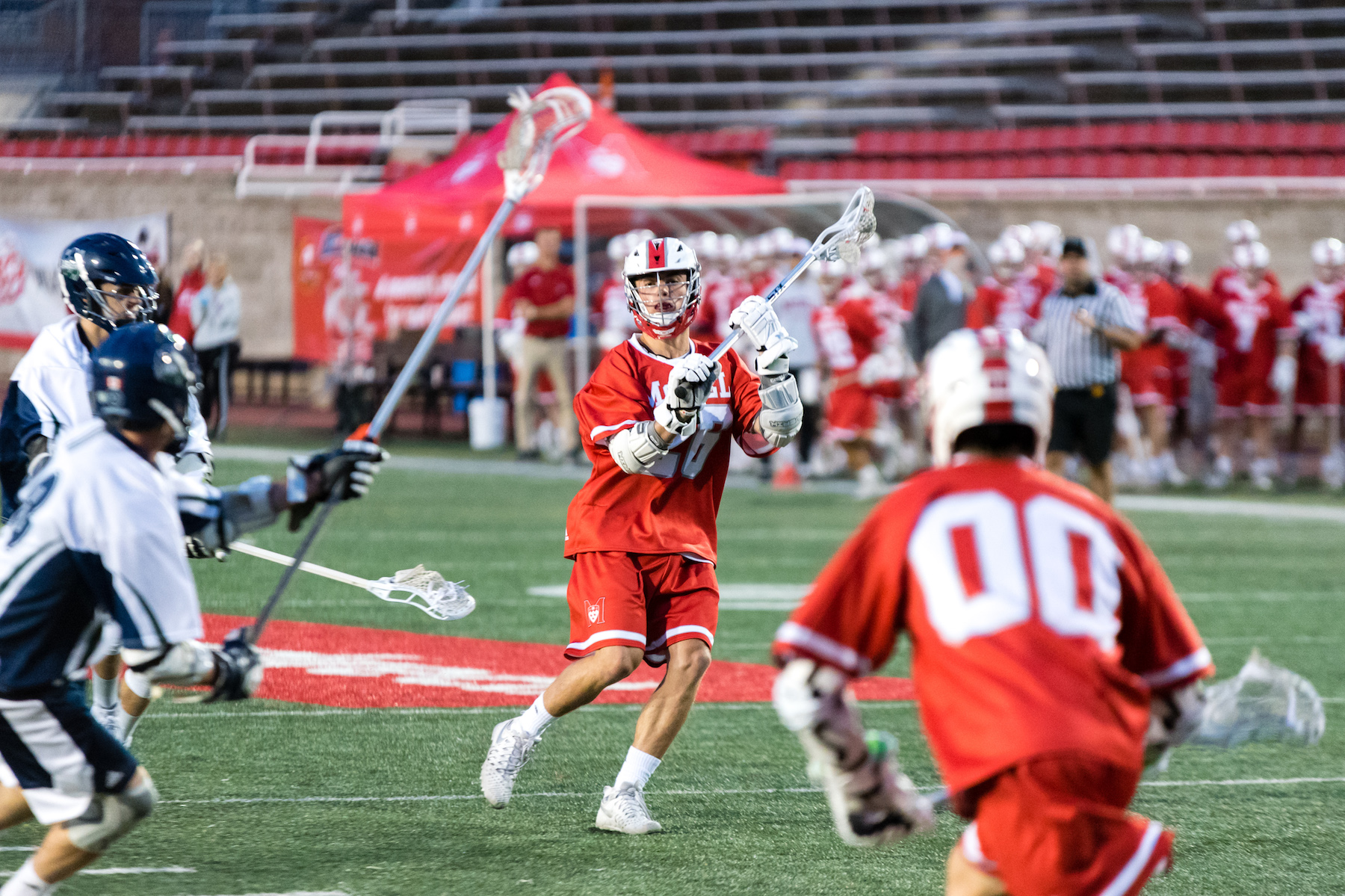
On Sept. 8, lacrosse fans packed Molson Stadium to watch the McGill Redmen (1-0) face off against the Nipissing Lakers (0-1). Ultimately, McGill came out on top in double overtime, 13-12.

“The [result of the] game was unexpected,” second-year transfer midfielder Cougar Kirby remarked. “Nipissing was never really good in the past, and we just underestimated them, but we came back and fought hard, and we won the game.”

The Redmen spent the first quarter tweaking untested lineups and strategies drafted during the preseason. Despite the constant changes, McGill still managed to lead 3-2 at the end of the quarter.

“The guys are pretty good at adjusting on the spot,” Assistant Coach Nick Soubry said. “If things aren’t going right, we’ve got to fix [them]. We’ve just got to be a bit better mentally, think about what we’re doing, and how we can be a bit more sharp and connect all those passes.”

After working out the kinks in the first quarter, McGill recovered in the second, scoring six more goals before halftime and taking a 9-4 lead into the break.

However, the Redmen’s play became careless in the second half, and the lead quickly slipped away. To further contribute to the Lakers’ comeback attempts, McGill served seven of their ten total penalties in the second half, leaving them a man down often. It took two overtime periods for the Redmen to draw out the one-goal lead they needed to win that day.

“We started to maybe take a few more shots than we should have, and it caused the ball to come to the defensive end,” fourth-year defenceman Paul Rougeau said. “We weren’t playing disciplined enough, and we ended up being [a] man-down most of the game [….] When you’re playing a man down, and there’s an extra guy on the field, it makes it easy for a couple goals to sneak in.”

McGill won its subsequent game against the Queen’s University Gaels with a final score of 10-9 on the following day. The Redmen will next visit the nation’s capital to face the Ottawa Gee-Gees (1-0) and the Carleton Ravens (0-1) on Sept. 15 and 16 respectively.

“We’re now 2-0 but we have a lot of work to do,” Head Coach Tim Murdoch said. “There aren’t very many teams in this league that you can expect to beat these days. You need to come with your ‘A’ game all the time.”

Stat Corner: Seth Obadia, a third-year transfer from NCAA D1 school Lafayette College, wowed the crowd with six points—five goals and an assist—for his McGill debut.   

Moment of the Game: Halfway through the fourth quarter, midfielder Cougar Kirby broke down the right side then cut inside to set up a cannon shot into the back of the net.

Quotable: “[Lacrosse] is the fastest game on two feet. Footwork is the core of it all, it’s the number one thing you have to have to play lacrosse.” – Kirby on outmaneuvering the Lakers.

News

Université de Montréal kicks off the provincial election

In advance of the upcoming Quebec provincial election, Parti Québécois (PQ) leader Jean-François Lisée spoke about about public transportation, unpaid internships, and the role of science in society at the Université de Montréal’s (UdeM) Ernest-Cormier amphitheatre on Sep. 11. The event was organized by the Fédération des associations étudiantes du campus de l’Université de Montréal (FAÉCUM), the University’s student-union federation. A second event, featuring Québec Solidaire (QS) co-spokesperson Gabriel Nadeau-Dubois, is scheduled for Sept. 24.

“There are two phenomena that are transforming our reality, and which we must attack before it’s too late,” Lisée said. “These are the environment and the climate crisis and [economic] inequality.”

The PQ leader emphasized his party’s education policies—most notably, their plan to make CEGEP and university free for the bottom 50 per cent of Quebecers by income. Funding would come from initiatives like the proposed ‘glutton tax’ on high-earning CEOs.

“Education is the absolute key to social mobility,” Lisée said. “Education must be the nation’s permanent priority.”

Outside the amphitheatre, several students cited this policy as a key reason for their support for Lisée. Tobie Raphaël Godue and Sophie Lemieux, second and third-year students in UdeM’s Faculty of Law, were motivated to join Lisée’s campaign because of his priorities.

“Free tuition for the middle and lower classes is important,” Godue said. “We need to give everyone the ability to become educated, and to become well-educated [….] It’s something that motivates me, working for education for everyone.”

Lemieux underlined the reasoning behind the PQ’s promise to pass a bill establishing a minimum level of funding for education.

“It’s to assure that, ver the years, if we lose an election or not, there won’t be cuts to education like what happened in the last [Parti Libéral du Québec] mandate,” Lemieux said. “I think it’s a concrete and very interesting measure.”

The crowd at UdeM included politically unaffiliated students who came to educate themselves about their options for the Oct. 1 election. Despite not being deeply engaged in the election, first-year UdeM political science student Marc-Antoine Héroux is still impressed by Lisée.

“Because I’m a political science student, I wanted to get more involved,” Héroux said. “I think he’s [Lisée] set his sights higher than the rest of the candidates. He’s running the best campaign.”

However, not everyone is as impressed with Lisée and the PQ. Lisée’s campaign endured controversy on Sep. 7 when Jewish NGO B’nai Brith revealed in an open letter to Lisée that Michelle Blanc, PQ candidate in the riding of Mercier, had posted “racist, anti-Semitic” content online. Examples listed included a Tweet that read “[expletive], I forgot to celebrate Hitler’s birthday” and a blog post titled “Am I a racist?”, wherein she expressed a desire for the Hasidic Jewish community of Outremont to disappear.

Lisée dismissed B’nai Brith’s concerns in an interview with The Montreal Gazette three days later.

“It’s clearly an attempt at intimidation, and them wanting to involve themselves in the political process, as is their right,” Lisée said. “Ms. Blanc has the right as did hundreds of thousands of Quebecers to criticize a religion.”

Daniel Minden, VP Communications for Hillel McGill, a Jewish student group, is disappointed by Michelle Blanc’s comments. However, he is willing to attribute it to misguidedness and drew attention to her outreach to LGBTQ2 Quebecers.

“Mme. Blanc’s tweet about Hitler’s birthday seems to be a poor attempt at dark humour but does not constitute hate speech in our view,” Minden wrote in a message to The McGill Tribune. “Without a doubt, Mme. Blanc’s article from eleven years ago made unfortunate generalizations about the Hasidic community with which we disagree, although we do not believe they cross the line into anti-Semitism. We hope Mme. Blanc chooses her words more carefully and deliberately in the future.”

Commentary, Opinion

Getting a seat: The struggle of course registration at McGill

For McGill students, getting into a crowded course often takes more ambition and artistry than the class itself. Securing a spot might require skipping one class to head to another professor’s office hours, refreshing Minerva every two minutes, or carving hours out of a busy schedule to sit in line for a meeting with an advisor. As a result of these intricacies, only students with hours of extra time or consistent access to technology get a shot at crafting their ideal schedule. McGill fails to recognize this reality and should create procedures to make courses more accessible for students.

Even once students master Minerva’s far-from-user-friendly interface, there’s no way to get around the all-consuming, round-the-clock task of web-page refreshing that comes with getting into an in-demand course. Get a Seat, an app that notifies students when there is an opening in a class at the price of $1 per course, can help ease this burden. However, the app only helps those who have continuous access to the internet. Students with jobs or classes that uphold strict no-technology policies may miss out on opportunities to enroll in the classes they want.

The McGill course-selection assistance web page specifies that if a student needs a class to meet a degree requirement, they must email the instructor to explain their situation and request a code for Minerva. Because certain classes are reserved exclusively for students from specific faculties, students in multi-faculty programs like Urban Systems—which includes courses in management and architecture, among others—often face difficulties getting into courses. Moreover, issues arise when multiple students pursue reserved seats in the same class, burdening already-busy professors with floods of emails and lowering students’ chances of getting a reply, much less a spot in the class.   

On top of diligently refreshing Minerva and emailing professors, getting into classes may require attending office hours and meeting with advisors. Students often try to bolster their chances of registering for a popular course by building a relationship with a professor during their office hours and being overly keen in class. Sometimes meeting with professors outside of class can mean other classes get neglected, setting students back at the end of add/drop, regardless of whether or not they got into their intended class. Meeting with an advisor may also be necessary, but lengthy waits for advising waste time in students’ busy schedules. These time-consuming meetings may give students competing for registration in a course a serious advantage, but for individuals with commitments such as part-time jobs, these surplus steps to secure a seat may not be realistic and can cause them to miss out on a class. This system ends up putting students who support themselves, as compared to students with financial assistance, at a disadvantage

McGill promotes course registration as a simple, step-by-step process, when, in reality, it requires more emotional labour, time, and knowledge than the school accounts for. Other universities also fall short in offering students an accessible registration process. At Concordia, for example, the excessive traffic on the school’s registration website makes getting a seat so difficult during regular hours of the day that students stay up late, refreshing the website in hopes of landing a seat in their prospective class. At the University of Toronto, students turn a profit by selling spots in crowded courses to their desperate classmates.

Being upfront about the process of getting into classes would be a helpful first step for McGill in making student registration less overwhelming. Additionally, McGill administration should be more considerate of students in programs like Urban Systems, for whom a significant proportion of classes come from other faculties. Minerva could improve by accommodating higher levels of student traffic. Creating more and larger classes to meet the trend in student demand would also be a helpful long-term goal for the university. In the meantime, students can help themselves by being realistic about how much time they’re willing to commit to getting into their dream classes and having a couple of backup courses lined up in case their attempts fall short.

McGill, News

McGill’s Forgotten Freshmen: forgotten no more

The Facebook error that has plagued McGill students for over a year has been fixed. The error prevented McGill students from accessing the McGill Facebook community, which is supposed to be open to anyone with an “@mail.mcgill.ca” email. Access to the community is necessary to view and create posts in faculty groups, McGill Free and For Sale, Textbook Exchange, and various club groups. As a result, students unable to access the online community found it difficult to communicate with extracurriculars and stay up-to-date on events.

While some clubs have open groups, many choose to keep group membership limited to the McGill community as this protects from spam posting and irrelevant content. For groups involving personal information such as McGill Housing, a closed group that connects McGill students looking for roommates and apartments, it is also important that only McGill students have the ability to post in the group. As a result, some groups were reluctant to make their groups open to the public, which ultimately barred many McGill students from popular forums.

The solution came from exchange student Paul Estephan. When he heard about the glitch, he contacted a friend who worked at Facebook to see if they could fix the error.

“Essentially[,] the domain ‘mail.mcgill.ca’ wasn’t listed as a valid domain for the group,” Estephan wrote to The McGill Tribune. “[My Facebook contact] added ‘mail.mcgill.ca’ as a domain, so everyone who had ‘mail.mcgill.ca’ on their email linked to Facebook could join [the McGill community].”

It is unclear whether the error is now entirely resolved, or how it originated. It has affected students across Canada, including at Bishop’s University, Concordia University, McMaster University, University of British Columbia, and University of Toronto. At McGill, students had tried contacting Facebook as well as McGill’s IT services to fix the issue. In an email to the Tribune, McGill IT wrote that they were unable to offer any assistance to the affected students as Facebook’s McGill community is neither affiliated with nor endorsed by McGill. Danah Al Megbel, one of the affected students, was dissatisfied with McGill’s lack of proactivity on the issue.

“It was very frustrating because I knew that the [McGill Facebook community] had so many different opportunities that I was technically allowed to use, but couldn’t,” Al Megbel said. “McGill didn’t help in making the situation better or solving the problem.”

First years and other incoming McGill students were among those primarily affected, prompting Keating Kenna Reid, U1 Arts, to create a Facebook group in protest. The group, titled “McGill’s Forgotten Freshmen”, currently has 896 members. Although the error is now solved for the majority of students, including Reid, a few are still having trouble accessing the community.

“I feel like it’d only be right to pass the torch to the still-forgotten freshmen,” Reid said. “I hope they keep being a pain to whomever they need to [in order] to get the issue fixed.”

Although the group started out as a place for affected students to share ways they had tried to fix the error and their frustrations about the problem, it evolved far beyond its original mandatemore recent posts show clubs promoting events, students sharing lease opportunities, and student society candidates campaigning. Although Reid is glad to finally be part of McGill’s Facebook community, he has mixed feelings about the error’s resolution.

“It’s kind of bittersweet,” Reid said. “I think the real McGill community was the friends we made along the way.”

Science & Technology

Exercising your right to a better brain

While it might be difficult to consciously visualize how to balance on a bike or catch a ball, a recent study at McGill sheds light on the role of exercise in motor memory, or learning how to perform a skill instinctively. Individuals normally pick up motor memory through repetition, but exercise can reportedly speed up this process, with possible implications for future physical therapy regimens.

Using a visuo-motor video game in which participants tracked a moving target by adjusting grip force, researchers found that those who had exercised immediately after learning a new skill performed better in a skill level assessment than those who had not. Study co-author Marie-Hélène Boudrias, assistant professor at the McGill School of Physical and Occupational Therapy, believes that exercise consolidates motor skill memories by stimulating circulation.

[Improved motor skill retention after exercise] is due to an increase in metabolism,” Boudrias said. “You can also think about it as increased blood flow, increased  glycolysis, possibly bringing fresh blood to parts of the brain. The exercise change[s] the way your brain consolidates the memory of what you’ve just learned.”

Although exercise decreased the brain activity of participants overall, brain signals were more concentrated in areas of the brain dedicated to learning the motor task, which meant that the brain was more efficient in delegating tasks to relevant neural circuits.

“It seems that exercise maximizes the resources you’re dedicating into something you’ve just learned,” Boudrias said.

Boudrias mentioned that her co-author, Assistant Professor Marc Roig, is currently delving further into the medical applications of their research. The results of the study suggest that, for people who have suffered a stroke,  incorporating exercise into therapy sessions could help them regain lost motor skills. Strokes can severely damage brain function and quality of life, and patients are in need of motor memory, as they may have trouble grasping objects or walking. It often takes around six months of physical therapy to regain these capabilities.

“Let’s say there’s an exercise program or rehabilitation program where you’re relearning how to do things such as walking, or keeping your balance,” Boudrias said. “If [patients] could do a short bout of exercise after their session, they could potentially retain better what they have just learned.”

In addition to implications for stroke rehabilitation specifically, the study also highlighted an important link between sleep and memory. Regardless of whether or not they exercised, participants best performed the newly-learned motor skill after a good night’s sleep.

“The motor skill retention was not better eight hours after the exercise, unlike [after] 24 hours [where participants had the chance to sleep],” Boudrias said. “Sleep helps consolidate this memory [so that], 24 hours later, you’re better at extracting this memory.”

For students, this means that getting a good night’s sleep is actually better than pulling an all-nighter to study for finals. Bennet Desormeau, co-author of the study and Master’s student at Université de Montréal, noted that  students can easily incorporate cardiovascular exercise such as running, swimming, or biking into their lives to help nurture a healthy memory.

“Drawing from first-hand experience, it was always clear to me that exercise promoted physical and mental wellness,” Desormeau said. “Acute cardiovascular exercise can be a useful tool in the retention of motor skills, which each of us makes use of daily.”

While the importance of a healthy lifestyle might be obvious, it is often easy to overlook these habits when academic and social responsibilities take their toll.

“You can put your brain in a state that is optimized to learn,” Boudrias said. “What you put in your body, the amount you sleep, the food you eat, […] there’s an ensemble of variables that might contribute to [learning].”

Read the latest issue

Read the latest issue