

Latest News

Basketball, Sports

DeMar DeRozan, Kevin Love, and opening up about mental health in the NBA

Athletes do not often publicly expose their perceived weaknesses, physical or otherwise, for others to see. So when Toronto Raptors superstar shooting guard DeMar DeRozan tweeted about his struggle with depression during the NBA All-Star Weekend in February, his words sparked a difficult—and extraordinary—discussion. With that red-eye tweet during a weekend designed to celebrate the NBA’s finest, DeRozan unintentionally helped others to acknowledge their own struggles with mental health. In response to DeRozan’s statements, fellow All-Star Kevin Love composed a heartfelt essay outlining his own battles with mental health and anxiety.

I knew on some level that some people benefited from asking for help or opening up,” Love wrote in The Players’ Tribune. “I just never thought it was for me. To me, it was form of weakness that could derail my success in sports or make me seem weird or different [….] Call it a stigma or call it fear or insecurity […] but what I was worried about wasn’t just my own inner struggles but how difficult it was to talk about them.”

Revelations regarding anxiety and depression from NBA players signify a greater point on how men address their bouts with mental health. Being “tough” and failing to confront one’s problems is a road that men, especially those who epitomize masculinity, continue to haphazardly trudge through.

In broad strokes, NBA stars are cartoonishly presented akin to superheroes. They are in peak physical condition, famous worldwide, and extravagantly wealthy. To some, these NBA players are role models. In a global sport where millions watch their every move, the NBA and its players are uniquely aware of their public perception in a way most other leagues and their athletes are not. LeBron James and Stephen Curry, the league’s two most widely recognized players, leverage their status to discuss social issues.

On the flip side, these NBA players are also perceived by the general public as the apex of what it means to be a man. Hyper-masculine attitudes persist in basketball and make it difficult for some to address “un-masculine” topics. Love compares learning how to be a man to mastering a playbook: “Be strong. Don’t talk about your feelings. Get through it on your own.

Following that playbook, therefore, means being steadfast on the traits that make one manly: Always show strength. Weakness is the antithesis of what an NBA player is supposed to represent. Add the stigma surrounding mental health to these principles, and players are strongly dissuaded from confronting their battles.

DeRozan and Love, however, display another side to this coin. People make erroneous assumptions of the type of lives these figures lead without considering the notion that they, like everyone else, go through their own battles. No matter how much fame, fortune, or physical fitness a person may have, anyone can be predisposed to mental illness.

As the two stars point out, acknowledging one’s internal battles is not a sign of weakness, but of strength. Not feeling able to talk about mental health is the weakness in itself: It robs us the opportunity to reach out to those in need and robs others of the chance to support us.

“It’s not nothing I’m against or ashamed of,” DeRozan told the Toronto Star on Feb. 25. “At my age, I understand how many people go through it.”

Displaying one’s vulnerabilities is difficult, but the words Love and DeRozan imparted broke barriers that both their fellow players and our broader society can benefit from. Like any physical injury, psychological injuries can and should be mended. Seeing two incredibly accomplished athletes reveal their struggles allows those who look up to them to face mental issues in their own lives. The two essentially implore their fans to challenge the status quo and question the notion that men can’t talk about their feelings or ask for help. Though the players provided the assist, it rests on everyone’s shoulders to carry the conversation.

Joke

First-year intramural team, Threezus, falls to 0-6 in gritty affair

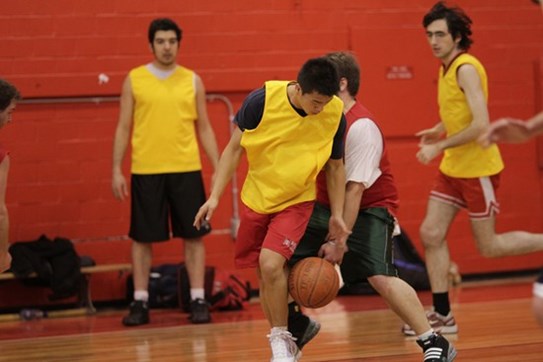
In another riveting Open B intramural game, Threezus (0-6) fell to Love Competition Ball (6-0) 86-35.

When Threezus forward Jeffrey Smith, U0 Arts, joined his intramural basketball team for the winter season, it’s safe to say he didn’t know what he was getting into. The McGill Tribune was unable to attend any of the team’s practices, as it has opted to keep their training sessions closed to media.

Like many intramural teams, the 10 first-year students on the roster seem to believe they’re better than they are. Threezus team captain Leo DiNardo put together his roster of friends and residence-mates on a whim, picking short guards and surprisingly not-much-taller forwards and centres. In their matchup with last year’s Open B champions, Love Competition Ball, Threezus was simply overwhelmed by the height, speed, and skill of their opponents, losing by a 51-point margin in the final game of the regular season.

When they briefly took a 3-0 lead, hooting and hollering could be heard on the Threezus bench. A quick 19-0 run by Love Competition Ball, however, took the bounce out of the game. DiNardo called a timeout in an attempt to regain momentum, then subbed all five bench players into the game—himself included

“It wouldn’t be fair to start myself,” DiNardo later explained.

Slapping his hands on the floor, DiNardo verbally expressed his readiness to play defence. By the time he’d finished slapping the floor, his man had already blown by, scoring an easy lay-up.

Threezus forward Ronald Scott, his high school basketball team’s statistics manager, was very clear that, while the team lacks any applicable skill, they’re certainly louder, more passionate, and definitely more positive than any of their competition.

“Last semester, a guy crossed me over so hard that I literally broke my ankles,” Scott said. “But that didn’t happen this semester, so who’s the real winner here?”

After putting up a combined eight points in the first half, Threezus turned their attention to their most pressing issue: Defence. During the two-minute halftime break, the team discussed maybe switching to zone defence at some point because what they’re doing now certainly isn’t working.

“We just have to communicate better in the future,” DiNardo said. “They got out and ran and we have to stop those transition buckets.”

Threezus is a team that can be prescribed with the classic case of overconfidence. In their attempts to prescribe their defensive deficiencies, they neglected the offensive end where they’ve gone as cold as the Montreal January. The high-school to university intramural jump wasn’t as kind as they hoped.

Next up for Threezus is midterm season, while Love Competition Ball will move onto the Open Intermediate B quarterfinals next weekend. That should be more fun to watch.


Notable

Threezus forward Jeffrey Smith debuted a fresh pair of Velcro kicks that you just have to see to believe.

Quotable

“I read this thing somewhere, it went like this. ‘Finish last in your league and they call you an idiot. Finish last in medical school and they call you a doctor.’ I think that might be relevant here, somehow.” – Threezus team captain Leo DiNardo

Stat Corner

Love Competition Ball scored an Open Intermediate B record 79 fast break points.

Joke

McGill Food and Dining Services to host a Real Food Week

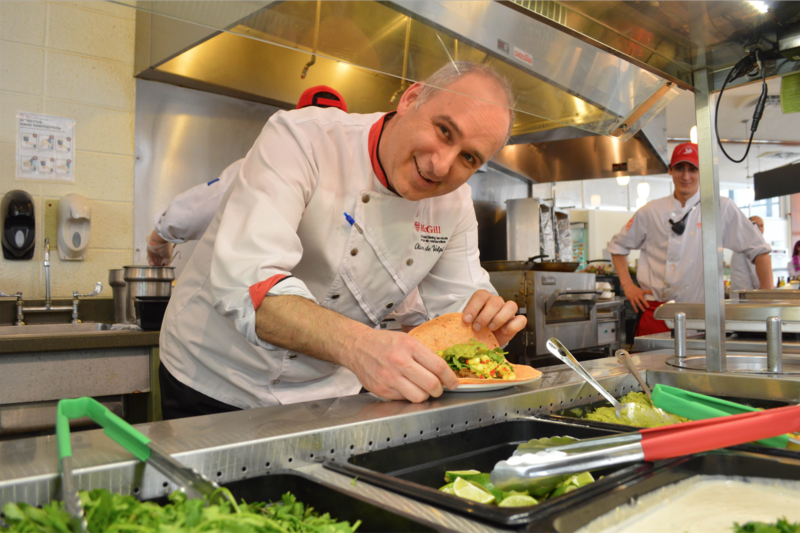
McGill Food and Dining Services often hosts themed food events, such as Tropical Dinner, Taste of Greece, Seoul Food, Vietnamazing, and Taste of India. Now, it has decided to take its theme in a different direction. For the first time in McGill history, cafeterias will hold a Real Food Week, to give students a taste of edible food. This initiative follows the event Sustainable Eating: Last Week’s Leftovers, after student complaints that the food was too similar to regular cafeteria days.

“Preparing for Real Food Week is going to be a real challenge,” Director of Food and Dining Services Shirley Temple said in an interview with The McGill Tribune. “We are going to have to make an effort to use all real ingredients like actual fruits, vegetables, and dairy products. We are going to have to stop getting all of our produce from decade-old cans, and make sure any products we use have not yet passed their expiration dates […] it’s going to be tough. These aren’t things we’re used to thinking about.”

Since this is the first time that McGill Food and Dining Services has decided to embark on a challenge of this magnitude, it created a feedback form for students in residence to express their desires for the week.

“I was pleased to see that almost all students in residence filled out this form,” Temple said. “Over 96 per cent wanted to see a pinch more spices so that the food tastes slightly less cardboardy, while just over 94 per cent wanted to feel safe knowing that they will not get sick after eating, and finally, almost 100 per cent of students don’t remember what fresh fruit and vegetables taste like.”

Temple is open to hosting more themed events in the future, but with certain conditions attached.

“Of course we will try to integrate some of the feedback,” Temple said. “One of our goals for this week is to bring back those nostalgic memories of edible food for students, so we will definitely look into bringing a variety of real vegetables and fruit to campus. However, our kitchens are adamantly against the use of spices and seasoning. We have never have used them, and we never will. It’s just not in our beliefs or value system. We destroyed our last spice rack in 1831, and we never looked back.”

Even though Food and Dining Services is maintaining its flavourless mandate, students are excited about the prospect of food slightly less likely to make them ill.

“At the McGill cafeterias, you are getting more than just a meal, you are also getting food poisoning, or nausea, its almost always one or the other, or even both for the adventurous eater,” U0 Arts and Molson Hall resident Arnold Palmer said.

Real Food Week is set to take place in the Fall 2018 semester, at the Royal Victoria College Cafeteria. If the initiative turns out to be a success, Food and Dining Services will continue it as an annual event, and may even start integrating real food into the cafeterias’ daily menus.

This article is a work of satire and is part of the Tribune’s 2018 Joke Issue.

Joke

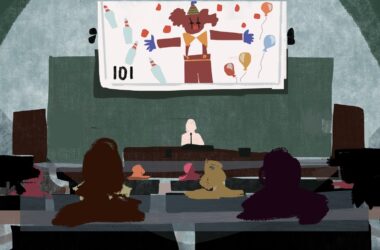
U0 science student still trapped in the Adams Auditorium disaster zone

This excerpt belongs to a series of documents recovered from the FDA stairwell. They are speculated to originate from during the Adams Auditorium Ceiling Tile Blitzkrieg.

As I write this, I am currently trapped in the fifth row of seats in the Adams Auditorium. I wish I could leave–I wish I could be free to toil through WebWork in Schulich, or even feel the crunch of snow beneath my feet again–but as the ceiling tiles fall left and right, I find myself paralyzed with fear, unable to run as a precariously bent tile looks greedily towards the ground.

It all began last Monday. It was a day like any other, and as I sat in my usual spot in Adams, I noticed that something seemed off. Maybe it was the fact that the newly installed projector suspiciously ceased to function. Maybe it was the giant X made of yellow caution tape thrown across the entire fourth row. Or it may have been the mysterious water that seeped through the ceiling tiles. Regardless, no one could have seen what was coming next. As I found myself dozing off through the third clicker question of the lecture, an unmistakable, unforgettable thud was heard throughout the auditorium. I will never forget that sound. An entire ceiling tile had fallen onto the roped off seats and landed violently on the ground, just like Aja did in the premiere of RuPaul’s Drag Race All Stars 3.

Since then two more tiles have fallen, the puddles keep growing, and the water is slowly rising. I am now ankle-deep in brown water. I don’t know how much longer I can hang on. There are only so many empty Roddick Roast cups I can use to collect the dripping water. At this point, the question is no longer “Will another tile fall?” but “When will the next fall?” I have fashioned a hat out of one of the many “McGill 24” posters to offer myself meager protection from the falling debris and the dripping water. The ink that once proudly read “Thank You to Our 30,000 Donors for Keeping Our Campus Beautiful” has long washed away, leaving only streaks of red and white on my sorry face. The syllabus says that there’s a General Chemistry 2 lecture scheduled here at 10:05, so I will shoulder this burden for as long as I am able. IF YOU FIND THIS PLEASE SEND HELP.

This article is a work of satire and is part of the Tribune’s 2018 Joke Issue.

Joke

New class on cannabis to be taught by Ontario hash lord Doug Ford

Recreational marijuana is set to be legalized in Canada this summer, and not only are more people rolling fatties, but schools throughout Canada, such as Durham College and Niagara College, are offering classes focused on cannabis. As a result, McGill Principal Suzie Porpier recently announced that in the Fall 2018 semester, the Arts department will be offering just such a course.

“We’re extremely excited to be offering a comprehensive marijuana education class for our students who were total nerds in high school and never learned how to smoke on their own,” Porpier said.

Interested students in the coming months will be able to add AGRO 420: Cannabis Culture: An Introduction to Dank to their Minerva course lists.

What separates McGill’s approach to marijuana education is that rather than focus on marketing strategies or business tactics, AGRO 420 will focus on proper usage techniques, cannabis culture, and stoner identification. The course will be taught by the illustrious leader of the Progressive Conservative Party of Ontario himself, Douglas Ford. Ford is particularly qualified to teach the class, due to his previous career as an Ontario hash dealer. In an interview with The McGill Tribune, Ford outlined some of the specifics of the course work and class structure.

“Students will learn how to make a gravity bong out of only a cooking pot and an empty wine bottle, stoner style standards such as huf socks and thrasher hoodies, and how to delineate between ‘Gas,’ ‘Mid,’ and ‘that reggie,’” Ford said. “Students will also be instructed on other cannabis-related terminology, like ‘ripped,’ and ‘stoned,’ and how to properly respond when someone says, ‘Yo dude it’s already been an hour, this edible isn’t working, I’m taking another.’”

Ford further explained AGRO 420’s hands-on approach to learning. A good portion of the class will be devoted to proper rolling techniques, covering joints—both king size and regular—as well as a variety of blunt wraps of different brands. The course will feature a special guest lecture from University of Colorado Professor Nicholas Fern, on the rolling of backwoods blunts. Furthermore, the class’ final exams will be marked collectively, pass or fail. Students will be assessed on their ability to effectively hotbox the entirety of Leacock 132 within the given time period.

McGill administration and faculty are extremely excited about this opportunity to offer students real life skills, such as finally being able to answer affirmatively to the age-old question “Can someone make a bowl out of this apple?”

“Once the class registration opens up, I might even kick-back and light up a fat doink myself to celebrate,” Porpier said. “We’re extremely excited to have such a prominent and world-renowned individual in the field teaching the class.”

In the meantime, students will continue to prepare with rigorous extracurricular coursework, hunkering down in their dorms, rather than Redpath or Schulich, to study for this particular class.


This article is a work of satire and is part of the Tribune’s 2018 Joke Issue.

Joke

Canadiens trade Bergevin to Sabres for bag of pucks

The Montreal Canadiens announced Thursday that they have traded General Manager Marc Bergevin to the Buffalo Sabres for a bag of practice pucks that were found in the back room of the KeyBank Center. This news comes after months of speculation from fans and critics, who have long suspected that Bergevin’s subpar performance as GM would force the Canadiens to make a move.

“He’s had some good moments over the years, but recent performances have been undoubtedly underwhelming,” Canadiens owner, president, and CEO Geoff Molson said. “We felt that Marc needed a change of scenery in order to improve his performance. Buffalo will give him that opportunity.”

Many of Bergevin’s critics have pointed to poor trades and free agent signings—such as those of Jonathon Drouin and Karl Alzner—as reasons for his departure. Compared to the talent the Habs gave up to acquire the two players, both have underwhelmed this season.

“His performance as GM has deteriorated in recent years,” Montreal Gazette sports reporter Pat Hickey said. “Everyone is criticizing him, and I think it’s getting to the guy.”

Following the announcement, the Sabres faithful has erupted with rage on social media platforms. Even Buffalo Head Coach Phil Housley has voiced his criticism of the trade.

“I really think Montreal cheated us on this one,” Housley said. “We give up an entire bag of pucks and Marc is all we get for it? We could have gotten a good practice or two out of those pucks. It’s absolute robbery.”

Housley will likely try Bergevin out on the Sabres’ fourth line for a few games prior to the end of the season. If they’re lucky, they might get a goal or two out of him before Buffalo misses the playoffs for a seventh consecutive season. If not, he should be a strong veteran presence for rookie Buffalo GM Jason Botterill, who has not yet learned how to destroy a franchise.

This article is a work of satire and is part of the Tribune’s 2018 Joke Issue.

Joke

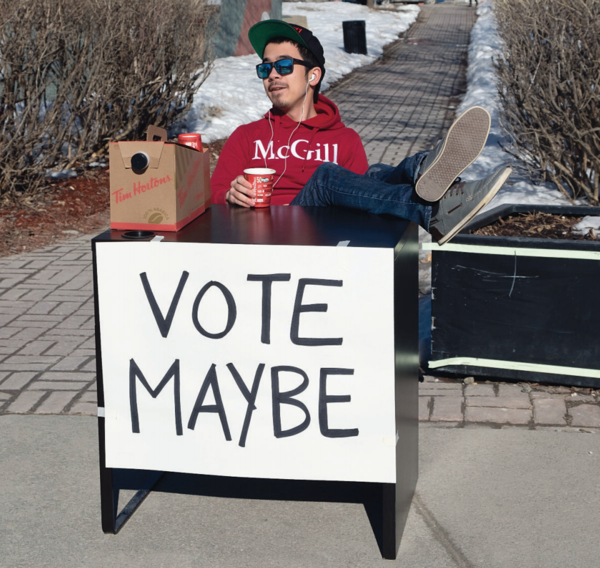
‘Maybe’ campaigners firmly resolve to decide SSMU’s fate at some point soon

Coinciding with the recent rare appearance of the Super Blue Blood Moon on Jan. 31, SSMU’s fate will be decided on April 1 when students vote on whether they would like to see its home, the University Central building, immolated in a ritual bonfire hosted by the McGill Outdoors Collective (MOC) or spared until Jan 31, 2037, when the next Super Blue Blood Moon is prophesied to appear.

In anticipation of the existence referendum, both “Yes” and “No” campaigns have begun distributing materials, lobbying students at some of the busiest points on campus, performing ceremonies at dusk, and setting up campaign stands at the O-intersection. However, on the morning of March 24, a third group of students discreetly erected their own booth at the O-intersection bearing a banner with only two words: “Vote? Maybe.”

Ian Decisiv, a U4 Economics student who enrolled an extra year to find the perfect major, said he decided to help organize the “Maybe” campaign after months of careful consideration.

“I finally reached that point where I said, ‘have I had enough of SSMU?’,” Decisiv managed to explain despite severe anxiety. “What is the point of SSMU even? Other than its services, especially mental health stuff. I mean, I personally have never used them, but a lot of people I know have said they were really helpful. I don’t know, immolation seems like a lot, but so is paying to subsidize the VicePresident Internal’s asbestos habit.”

Indie Firenze, U2 Psychology and co-organizer of the “Maybe” campaign, explained in an interview with The McGill Tribune that she has never entered University Central and did not participate in Frosh during her freshman year.

“A lot of people in my residence were worried that I missed out on Frosh, but I really didn’t care about it either way,” Firenze mumbled. “Like, I’ve had beer before, thanks. Anybody who stays friends with their Frosh team past second year is weird anyways. The campaign? Sorry, I’m not actually sure what ‘SSMU’ is. Isn’t that something you need to call an HVAC technician to fix?”

Ever since it was first erected, the “Maybe” booth has hosted aggressive attempts by members of both the “No” and “Yes” campaigns to persuade its supporters. Members of the “Yes” campaign in particular insist that if they could engage apathetic students in the “Maybe” movement, SSMU could potentially affect campus life in a fractionally less underwhelming way.

“SSMU has made negligible to mild impacts on the lives of almost every student,” Zac Charine, SSMU President and “Yes” campaign chairperson, asserted smarmily, later noting that this is mostly due to Gorts bar, and that the mild impact is typically a short hangover. “We’re so important. How can the ‘Maybe’ campaign ignore our advocacy initiatives? We are the only people who could possibly speak on behalf of the student body, and the administration listens to us at least 10 per cent of the time.”

Rich White, an organizer of the “No” campaign who became infamous for pledging to never have friends outside of Management and Engineering, detailed why he decided to advocate to burn down University Central once and for all.

“Much like members of the ‘Maybe’ campaign, I rarely if ever have actually set foot in the SSMU building,” White said with a blank stare, chuckling. “But I like to see things burn, and I hate you all. I hate all the clubs that have rejected me. I hate the Arts students that wouldn’t be my friends, and I even despise the ‘Maybe’ campaigners for their sense of belonging. I want you to watch as the precious memories, connections, and experiences you created at SSMU are reduced to soot and ash, and vanish from existence for eternity. I want to see you weep. Also, huge thanks to the MOC for offering to host the ritual bonfire.”

This article is a work of satire and is part of the Tribune’s 2018 Joke Issue.

Joke

Bull & Bear meeting raided by police; Wildlife Act violations suspected

Montreal police were called to Cybertheque Pod #4 in the Redpath basement Thursday after receiving complaints of intimidating and disruptive behaviour by two student magazine employees. Witnesses reported hearing grunts, dominance challenges, and heated debate over fiscal policy.

Police arrived on the scene to find a meeting of a bull and a bear. They refused to comply with officers’ requests to disperse, citing “the importance of press freedom.”

A tense standoff ensued as police attempted to negotiate. Officers sent in hay and berries—in an attempt to calm the animals’ nerves—to no avail. After repeated bluff charges from the bull and bear, police were forced to call animal control for back-up. Help arrived as bylaw officers brought bear spray and red handkerchiefs. After a minute of chaos, the animals were restrained. The beasts have been charged with causing a disturbance and violating the Canada Wildlife Act.

“Thankfully, the situation was defused without any serious injuries or death,” a Service de Police de la Ville de Montréal (SPVM) spokesperson said. “But we were very lucky. Who knows what could have happened if this bull got all over campus. This incident really underscores the importance of not letting aggressive, multi-tonne animals enrol in university.”

The wild creatures’ counsel views things differently. “This is yet another example of the police in this province disrespecting the rights of journalists,” Marc Ferdinand, the lawyer representing the pair, said. “It’s as if they’d never heard of the Chamberland Commission.”

Canine Journalists for Free Expression (CJFE), a press-freedom advocacy group that specializes in bull publications, echoed these sentiments.

“People like to dismiss animal media as ‘not real journalism,’ but that’s simply untrue,” CJFE wrote in a statement to The McGill Tribune. “By bridging the taxonomic gap between them, this bull and bear duo has produced some of the most insightful think-pieces on smoking I’ve ever read. They deserve constitutional protection as much as any of us.”

Neither the bull nor the bear provided comment, as neither can speak. A bail hearing is scheduled for next week.

This article is a work of satire and is part of the Tribune’s 2018 Joke Issue.

Joke

Freshmen forgotten no more

As the cold spring air brings Montreal more snow, and students retreat to their beds in the short break between midterms and finals, some students refuse to relax. McGill’s Forgotten Freshmen refuse to be complacent in their own misery.

The group started in order to “[raise] awareness of the pitifully broken McGill Community Facebook group,” resulting from a glitch in Facebook’s system that didn’t allow certain students with McGill emails to join the university’s online community. Now, the Forgotten Freshmen have metamorphisized into a political movement. Tired of being left out of McGillrelated memes and notifications about the nearest samosa sales, the 817 members have decided to march on Service Point on Apr. 5 at 12 p.m. sharp, and stage a sit-in until they’re added to the official community.

When asked why being a part of the McGill Facebook community mattered, Matthew Hearty, U1 Management, brought to light the underlying problem of discrimination.

“I failed a class last semester because the professor was useless and the student study groups were a part of the Facebook community,” Hearty said. “But more than academically, it has affected me socially. I was three days late to the whole “hygiene de vie” joke, and by that time it was already dated. Whenever I referenced it, I got eye rolls and scoffs, instead of the laughs that early adopters generated. My boyfriend broke up with me because of my outdated humour. With bad grades, no friends, and no significant other, what do I have left? The McGill Facebook community has taken everything away from me.”

A peek into the Forgotten Freshmen offices, located in the basement of the University Centre—they haven’t yet been told that it’s closing down—shows extensive preparation for this march. Signs bearing slogans like “we will not be forgotten” and “I’d rather be a bumblebee” litter every corner, while a list of ways to get into the community—legal and illegal—hangs behind the door. One of these, “talk to Facebook execs,” has been crossed out multiple times, perhaps due to the failure of their last attempted revolt; on Feb. 8, they decided to shout at the Facebook representative at Techfair, as reports indicated that that representative was personally responsible for the glitch due to a rumoured grudge against McGill’s own Suzanne Fortier.

“Yes, I do remember the very vocal students who attended the fair,” the Facebook representative said. “Unfortunately there seems to be an error in the McGill system itself. McGill should perhaps consider looking more deeply into this issue which seems to plague hundreds of McGillians.”

Compared to that previous attempt, this uprising seems different. For one, all 817 members are attending, at least according to the Facebook event, though staff assume that about 400 will actually turn up. Additionally, Second Cup will provide refreshments. “People often forget about us as well,” said a Second Cup customer service representative. “Starbucks and Timmies take up all the media attention; we know what feeling left out looks like, and so we’re sponsoring this event, in the hopes that marginalized voices will finally be heard.”

This article is a work of satire and is part of the Tribune’s 2018 Joke Issue.

Joke

Tre Mansdoerfer congratulates Corinne Bulger on not having to be SSMU President

On March 21, Elections SSMU announced that Tre Mansdoerfer, U2 Engineering, is the president-elect of the Students’ Society of McGill University (SSMU) for the 2018-2019 school year. With a differential of only 69 votes between the two candidates, Mansdoerfer explained that while he remained hopeful throughout election night, he eventually had to muster the pride to call his opponent and concede.

“Obviously I wish the results had gone the other way,” Mansdoerfer said in an interview with The McGill Tribune. “But Corinne ran a hardfought campaign, and no one is more qualified to be one of the 27,525 students who does not have to publicly represent this decaying institution.”

While Mansdoerfer is disappointed by the election’s outcome, he has total faith in Bulger.

“Again, Corinne is one of the kindest and most hardworking people I know,” Mansdoerfer added. “She has earned every opportunity to not have to interact with a group of politically-ambitious, borderline-sociopathic 20-year-olds.”

Bulger, U2 Arts, said she appreciates Mansdoerfer’s support, and acknowledges that he was equally as worthy a candidate.

“With a voting participation of only 16.5 per cent, the election results really could have gone either way,” Bulger said. “Tre has contributed so much to the McGIll Community over the past three years, and I really wish there was room for two of us to avoid Legislative Council.”

Mansdoerfer says he’s trying to remain positive regardless, focusing his energy on some of the job’s more exciting projects, like avoiding asbestos-related illnesses, and working to solve the Palestinian-Israeli conflict once and for all.

“Right now I’m just trying to focus on teambuilding,” Mansdoerfer said. “I really hope to have a more cohesive executive than last year’s.”

In addition to Mansdoerfer, the newly-elected executive team is comprised of an accused Zionist spy, as well as an alleged anti-semite.

“Accessibility, transparency, and accountability,” Mansdoerfer keeps repeating dead-eyed.

At press time, Mansdoerfer was seen preemptively drafting a tell-all to the Bull & Bear and whisper-shouting “institutional memory” under his breath.

This article is a work of satire and is part of the Tribune’s 2018 Joke Issue.

Read the latest issue

Read the latest issue