Latest News

Sports

Highlights from the 2018 MIT Sloan Sports Analytics Conference

In the Boston Convention and Exhibition Center with only four hours of sleep to my name, I wasn’t optimistic about what I saw on the morning of Feb. 23. The 2018 MIT Sloan Sports Analytics Conference (SSAC) wouldn’t begin for another 30 minutes, but M.B.A. candidates, predominantly from institutions like MIT and Northwestern University, and leading sports executives alike wasted no time settling in. In a half-full walkway, I passed by countless sports technology booths, plenty of old business partners reconnecting, and the conference’s first job interview—of many.

I gathered my bearings and proceeded to the third floor to secure priority seating for the grand opening in the Bill James room, where seated attendees continued to chat about job openings and summer internships. The abundance of suits and business card exchanges made me anxious—I came for a sports conference, not a job fair. However, once the event officially commenced with a hilarious new installment of Bleacher Report’s “Game of Zones,” I rejoiced in learning the event was, indeed, for me.

What followed was a choose-your-own-adventure-style journey through a sports nerd’s wonderland. At any given time, a conference-goer could choose between attending one of a handful of panels, walking through the “trade show,” browsing research paper competition finalists, or rubbing shoulders with prominent sports executives, media personalities, and athletes.

Panels catering to both sports and business managers filled the conference’s two-day schedule. Topics ranged from social media to player advocacy to eSports analytics, and A-listers from the sporting world filled the slate for each talk. Even Barack Obama was announced to speak at the conference—but that’s all that media and attendees like myself are allowed to say about the mysterious post-lunch panel on that Friday.

The trade show featured booths from a wide range of organizations. FiveThirtyEight and ESPN Stats and Info brought representatives to speak about their platforms and services. Outside upstarts like edjSports and LBi Dynasty sent tablers, but I didn’t get a chance to ask how they came up with their names. There was even a PS4 set up with a virtual reality Home Run Derby game demo—in case conference-goers were looking to build up confidence for an upcoming interview by mashing some homers.

Outside the Bill James room, finalists in the SSAC research paper competition assembled abbreviated presentations on poster boards. If you squinted, the gallery looked like a high school science fair held in a grand ballroom with floor-to-ceiling windows overlooking downtown Boston. But, despite the amusing spectacle, I can assure you that trying to understand how Voronoi tessellations are used to create weighted heat maps in soccer matches is a great way to keep your intellectual ego in check.

Throughout the event, you couldn’t help but notice SSAC’s sheer star-power. The corridor was consistently littered with industry giants mingling with one another after panel appearances, flanked by colleagues who still attend the conference for mere enjoyment. That Friday, I got off an escalator behind ESPN’s Mina Kimes to walk past fellow ESPN writer Kevin Arnovitz and former Philadelphia 76ers GM Sam Hinkie. The next day, I watched an amalgamation of NBA icons in Arnovitz, Shane Battier, and Jalen Rose cross the same 10-foot area within 15 seconds while taking my lunch break.

All things considered, the conference’s best feature was this sudden immersion into a world of sports figures, big and small. I got to speak with the smartest writers in sports—some of whom I’ve followed for years—while strolling between events. Then I watched normally-anonymous executives reveal that they are far more than some collective, robotic decision machine. I welcomed the revelation that bosses like SSAC co-founder Jessica Gelman, Boston Celtics Assistant GM Mike Zarren, and Houston Rockets Executive Vice President Gersson Rosas had genuinely charming personalities—these are some people I can get behind.

At the end of the day, spectator sports boil down to fandom—whether for teams, individual athletes, or otherwise. That weekend, I stumbled into discovering my fandom for Gelman, Zarren, Rosas, and many more. Developing a loyalty to sports figures who wear jeans, sweats, or suits at game-time instead of a uniform probably takes sports nerd-dom to its logical end—but is perfectly fitting for an event that Ringer CEO Bill Simmons once dubbed “Dorkapalooza.”

Basketball, Sports

NBA midseason report

With a successful All-Star game in the rearview mirror, it’s time to take a look at what’s happened in the 2017-18 NBA season thus far.


Eastern Conference

Head Coach Brad Stevens and the Boston Celtics adjusted quickly to Gordon Hayward’s season-ending injury and remain in the thick of the conversation in the Eastern Conference. With the new-look Cavaliers squad holding the third seed and working to figure things out on the fly, the Toronto Raptors and Celtics—currently jostling for the conference’s first seed—are in great position to make a run at the NBA finals, making the Eastern Conference more competitive than it’s been in quite a while.


Western Conference

One bright spot to date is in Minneapolis. Tom Thibodeau is prepared to work his Timberwolves starters hard for ideal playoff positioning—but they’ll have to do it without the injured Jimmy Butler, who tore his meniscus in his first game after the break. Beyond the Houston Rockets and the Golden State Warriors, the order of teams holding seeds three through eight change daily, since they’re separated by only a couple of games.


Most Valuable Player: James Harden, Rockets

Near-unstoppable when Harden, Chris Paul, and Clint Capela are on the court, the Houston Rockets sit atop the Western Conference after the All-Star break, albeit barely ahead of—you guessed it—the Warriors. All three players have been key to the Rockets’ success, but none more so than Harden, who’s looking to add the MVP trophy to his mantle after his two previous runner-up finishes in the voting. He’s averaging 31.5 points per game, with a sparkling 60-point triple double—one of the best games in NBA history by some metrics—to highlight the first half of the season.


Most Improved Player: Victor Oladipo, Pacers

Paul George was “dumped” for Oladipo and Domantas Sabonis last offseason in a trade that the Oklahoma City police investigated as a robbery. The smooth-singing Oladipo is back in front of his college fans and proving the doubters wrong. Oladipo earned his first All-Star berth this season, averaging 24.4 points per game—with an average of 4.8 on the fast break, which is the second best mark in the NBA. With his help, the Pacers have a better-than-expected 34-25 record, good for fifth place in the Eastern Conference.


Rookie of the Year: Ben Simmons, 76ers

Take your pick—Ben Simmons or Donovan Mitchell. Both are having incredible rookie seasons. Simmons is a do-everything machine for the playoff hopeful process-trusters in Philadelphia, while Mitchell is a budding star, helping keep the Jazz in the playoff hunt, even after widespread changes. However, Simmons takes the edge so far: He’s a gifted all-round talent who puts up a more efficient game than Mitchell. Simmons is averaging 16.7 points, 7.7 rebounds, and 7.4 assists per game, and his defensive contributions outweigh those of his Utah rival.


Coach of the Year: Dwane Casey, Toronto Raptors

The first-place Raptors are third in the NBA in point differential, behind only the Rockets and Warriors. The team’s depth of young talent has been a key factor in its success this season. The “bench mob,” as forward CJ Miles has nicknamed it, currently ranks as one of the league’s best five-man units. Even as questions of playoff performance float back to the surface, the new-look, ball-moving, three-point-shooting offence commands your attention. The Raptors are poised to make waves, and Casey deserves credit for his role in making it happen.


Unless otherwise noted, all statistics are from NBA.com

McGill, News

Vigil for Tina Fontaine calls for individual and institutional change

Two weeks after Gerald Stanley’s acquittal for the murder of 22-year-old Cree man Colten Boushie in Saskatchewan, a Manitoba courthouse acquitted Raymond Cormier of the murder of 15-year-old Tina Fontaine, member of the Sagkeeng First Nation. Montrealers gathered to mourn Fontaine, Boushie, and other Indigenous people denied justice in Canadian courts at a vigil in Cabot Square on Feb. 24.

Ellen Gabriel, a Kanehsatà:ke activist and the first speaker at the event, emphasized Canada’s culpability in allowing crimes against Indigenous victims to go unpunished.

“The [United Nations] treaty bodies have told Canada that they must implement a process and measures that provide safety and security [for] Indigenous women and girls,” Gabriel said. “And it says that if any private individual inflicts harm upon Indigenous women and girls, then the state is responsible to provide the measures needed to bring the guilty to justice. And it has failed once again.”


The event, which was organized in part by the Native Women’s Shelter of Montreal (NWSM), ended up drawing extensive press coverage and a crowd of about 400 people, according to the CBC. Both NWSM Executive Director Nakuset and Students’ Society of McGill University (SSMU) Indigenous Affairs Commissioner Carlee Kawinehta articulated the need for settlers to educate themselves about Indigenous peoples’ history and lived experiences, both in school and independently.

“I have children, and you wouldn’t believe [what] they’re taught [in school],” Nakuset said. “As someone who runs an organization […] I advocate all the time on behalf of the residents that come in, but I go home and then I have to advocate on behalf of my children. So it never ends when you’re Indigenous, you just have to keep educating and keep advocating all the time.”

Kawinehta added that non-Indigenous McGill students can begin by following the news and reading about initiatives for missing and murdered indigenous women. According to former Minister for the Status of Women and current Minister of Employment Patty Hajdu, Canadian Indigenous women like Fontaine are at disproportionate risk of experiencing violence, and as many as 4,000 have gone missing or been murdered since 1980.

“It’s not a one-time thing, this isn’t a unique case, and [McGill students] should know the names,” Kawinehta said. “I think we’re doing things in the university context, and it’s not working [….] It has to be on a personal level. McGill students, on a personal level, need to learn about these things, reach out to those resources that we have.”

Gabriel also named numerous tools for Canadians to educate themselves, such as the Stolen Sisters report and the Royal Commission on Aboriginal Peoples. She and other speakers delivered resounding calls for change.

“We didn’t riot when the verdict came down for Colten Boushie, and we’re not rioting today, because we are always calling for peace,” Gabriel said. “This is why I’m asking you, as citizens of your country, let’s put politics aside [….] Let’s look at the humanity of this. And let’s bring some changes, some fundamental changes, to respect the human rights of Indigenous children.”

In his speech, Kanehsatà:ke activist and filmmaker Clifton Ariwakehte Nicholas praised the vigil’s large turnout, but stressed that attendance alone would not resolve the issues Canada’s Indigenous communities face.

“I’m happy that there are moral people that still exist in this country, that you’re here today,” Nicholas said. “I’m here because I want to incite you to action. I want you to be loud, to be consistent with your loud voices. Talk about justice. I am completely sickened by what I’ve been witnessing. Just a week ago, I was here talking about Colten Boushie, and [now] I’m here again.”

McGill, News

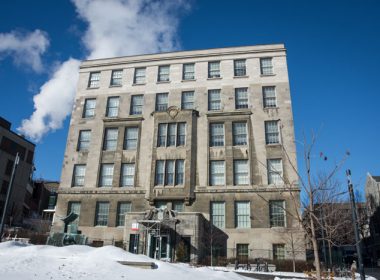
Duff medical building faces water leaks, damaged lab equipment despite ongoing repairs

In January 2018, a demolition project to replace the heating, ventilation, and air conditioning (HVAC) system in the Lyman Duff Medical Building sixth floor mechanical room caused a water leak in the north-east staircase. The leak has posed an inconvenience for staff in the building, which has a history of construction problems, and is home to many laboratories for a number of departments.

Partly funded by the Government of Canada’s Strategic Investment Fund, Duff’s refurbishing is one of several McGill construction projects aimed at improving outdated facilities. According to Jasmin Chahal, a Ph.D. candidate in Microbiology and Immunology (MIMM) and Lyman-Duff representative, new ventilation systems were necessary to avoid potentially dangerous consequences after a ventilation pipe installation in December 2017 interfered with the functioning of fume hoods in Duff.

“We have toxic chemicals in the fume hoods and then sometimes, due to ventilation, the fume hoods just stop working,” Chahal said. “We realized [the malfunction] when we started smelling the chemicals. What we did at the time [of the incident] was [that] we’d do our work and then just shut [the fume hood].”

One month later, in January 2018, water began leaking into Duff auditorium B23 due to the building’s roof deterioration and corroding corrosion. In an email to The McGill Tribune, Facilities Management and Ancillary Services Communications Manager Julie Fortier confirmed that the faulty pipes have since been replaced and that more permanent solutions are being considered for the neglected roof.

The replacement of the roof at the Lyman Duff Building is on our priority list,” Fortier wrote. “The University has about 1.3 billion dollars worth of deferred maintenance work, so it is difficult to say at this stage when we will be able to proceed with that project.”

According to Chahal, the building has faced infrastructural problems for several years. Over one year ago, a hot water pipe burst overnight, flooding Duff room 600 and damaging an MacBook computer, four desk chairs, and lab notebooks.

“Our lab was big and everything got damaged,” Chahal said. “[The water] came from a very dirty pipe so it was dusty and dirty. We work with RNA, and RNA is very unstable […], so we couldn’t work with RNA at all for a week at least.”

Construction projects in Duff and other buildings on campus cause countless logistical difficulties for students, beyond the risks that faulty handiwork pose. For example, laboratory construction in the Stewart Biology Building that began in May 2017 has led many first-year biology labs to be relocated to the Duff Building.

The Duff Building HVAC renovations are expected to finish in December 2018. However, Microbiology and Immunology Graduate Student Association (MIGSA) President Patrick Lypaczewski is skeptical of the completion date, considering the university’s history of delaying construction timelines.

“[The changing deadlines is a topic] that keeps coming up during staff meetings,” Lypaczewski said. “It isn’t just that the admin isn’t telling the students enough. It’s also that the admin and the profs don’t know enough. McGill can’t control what the [construction] companies do but they can give clear instructions as to communications.”

Out on the Town, Student Life

Le Doggy Café fills the dog-shaped holes in students’ hearts

After a long week at school, nothing compares to spending some quality time with puppies and their unconditional love. Although owning pets is impossible for most students living away from home, Le Doggy Café, located on St-Denis Street, provides a temporary fix. Not only does this café have enough space to work and eat at the same time, it is also filled with dogs bouncing from person to person to receive pats.


While food and animals don’t often overlap, the environment at Le Doggy Café doesn’t feel unsanitary or uninviting. The staff keep the space clean by abiding to a few rules that other cafés do not.

“We have a ‘dog café’ licence,” Le Doggy Café owner Gabrielle Aubin said. “There are a few rules that we have to follow that are added on to the regular [restaurant health code]. Our kitchen has to be closed, we can’t have an open pass for the food.’”

On a regular day, the café welcomes customers to bring their dogs to meet others. Those who don’t own a pet can still drop by to get their fill of doggy kisses, and most owners are happy to introduce their pets to dog-lovers. Many come bearing funny anecdotes about their pets current and past, uniting strangers over a shared love of dogs.

For Ana Paula Sánchez, U1 Arts, bringing her dog to the café was an unforgettable experience.

“I went on a Friday morning so it was pretty quiet,” Sánchez said. “But an elderly woman came with her granddaughter in the hopes to see some dogs. I don’t think I’ve ever seen anything cuter than them playing with my shih tzu, Pepper, and pug, Raisin. It’s just really nice in general to bring in my dogs into a café, that way I can spend more time with them but also see them interact with other adorable dogs.”

Once a week, Le Doggy Café hosts Les Samedi Puppy, or Puppy Saturdays, which it advertises as an opportunity for puppy owners and their puppies to meet. The café also invites people to come with full-grown dogs, and is just as welcoming to those who come without a dog at all. According to Aubin, the weekly event began as a way to appease customers’ requests to see more puppies.

“Last year we did a puppy casting and it was the most popular [event] we ever had,” Aubin said. “We kept having people asking us if there were days dedicated to puppies, so we put two and two together and created Les Samedi Puppy.”

For Jade Perraud, U2 Arts, Le Doggy Café’s Les Samedi Puppy is a great way to de-stress in the midst of a busy semester.

“It’s definitely one of my favourite places in town,” Perraud said. “Going there is like therapy and there’s always the cutest variety of dogs hanging out.”

So if you’re feeling stressed this semester and need a dog to pet, consider making a trip over to Le Doggy Café. Enjoy some quality time with the most café-cultured dogs of Montreal.

Science & Technology

Observing our cosmic past

Of all the questions discussed by theologians, philosophers, and scientists, perhaps the most enduring and enigmatic is: Where did the universe come from? Lyman Page, professor of physics at Princeton University and co-winner of the 2018 Breakthrough Prize in Fundamental Physics, is a part of a team that has brought humanity one step closer to finding an answer to this question.

On Feb. 21, AstroMcGill invited Page to give a public talk on his groundbreaking research in observational cosmology and to explain the most recent theories in this field.

Page’s presentation focused on this oval-shaped, infrared-looking photo which represents a simulated cosmic microwave background (CMB), created using data from the Wilkinson Microwave Anisotropy Probe (WMAP), a spacecraft that measured the conditions of the early universe. Simply put, it is a heat map of the beginning of the cosmos.

The most well-supported birth-story of the universe is the inflation model. This theory suggests that from a very high-temperature, high-density state, some process amplified quantum fluctuations to an enormous scale at an insanely fast rate. During this original inflation, the universe was so hot and full of energy that electrons couldn’t attach to protons to form hydrogen or other basic elements. As the universe expanded, it cooled, allowing atoms to form. In his lecture, Page explained some of the after-effects of this process.

“When the electrons are bound up with the protons [in the formation of atoms], they don’t scatter [electromagnetic] radiation, and so the universe becomes transparent,” Page said. “The radiation decouples from the matter, the matter then goes on to form […] all the structure of the universe, us, stars, galaxies.”

The radiation emitted from this stage makes up the CMB, and measuring it is the closest we can get to observing the Big Bang. The expansion of the universe has stretched the wavelengths of this radiation, transforming it from bright light into microwaves. Page and his colleagues essentially captured tiny fluctuations in the temperature of these microwaves from all directions to create a full-sky map of the oldest light in the universe. For frequent TV-watchers of the late 1990s, Page explained how most of us have already detected CMB.

“Roughly one per cent of that fuzz on your TV [so-called white noise on old satellite TVs] is from radiation leftover from the Big Bang,” Page said. “[And] what we do is […] build various versions of very fancy TV receivers and point them around the sky and measure the change in the amount of buzz we detect.”

Page and his fellow physicists have used this picture of the birth of the universe to deduce, with great accuracy, things such as the age of the universe (13.77 billion years) and the quantities of its constitutive parts (4.6 per cent atoms, 24.0 per cent dark matter, and 71.4 per cent dark energy). Yet, many mysteries remain unsolved. What are dark matter and dark energy? Truthfully, we don’t know yet. That means the fundamental properties of 95.4 per cent of the observable universe are unknown to us. But, thanks to Page and his colleagues, we now very accurately know what we don’t know; a Socratic step in the right direction.  

For readers with an interest in the topic, click here for a recording of the lecture.

Science & Technology

Agricultural technologies are changing the future of farming in Africa

On Feb. 22, Entrepreneurship & Investment For Africa (EI4A), a volunteer-run organization in Quebec promoting African entrepreneurship, held an open networking session at WeWork L’Avenue with PS Nutraceutical International Limited (PSNIL), one of Africa’s most innovative agribusiness start-ups based in Nigeria. Businesses in the agricultural domain, or agribusinesses, provide the necessary supplies for farms to function, such as machinery and seeds. EI4A’s event showcased a number of food-production technologies that have the potential to improve the future of farming in Africa and the world.

In 2016, Olisaeloka Peter Okocha co-founded PSNIL Samson Ogbole, on a mission to create, modify, enhance, and protect the environment and total well-being of humanity. The global economic crisis and the surge in hunger, especially in Africa, require systems which will fast-track food production without harming the environment. Okocha joined the conference via video chat, to present his company’s technology and share his experiences in developing his business ideas in the challenging but rapidly growing African agribusiness sector. These technologies include hydroponics (growing plants in water), aquaponics (growing plants on water with fish in the water), and aeroponics (growing plants in the air).

“We wanted a self-sustainable system in which water is constantly reused and recycled and never wasted,” Okocha said. “We chose to use technology that could produce food that is healthy and organic.”

Okocha and Ogbole questioned whether food in Nigeria and other parts of Africa was available, affordable, pesticide and herbicide-free, and if the food supply was consistent. The duo started the company with the intention to develop and set up small-scale agricultural technologies for everyone to be able to practice agriculture. They partnered with individual researchers to explore the nutritional benefits of various foods. Additionally, the company wants to research and develop more uses for agricultural produce, such as the development of alternative medicines.

“The technology is not new,” Okocha said. “Aeroponics was developed by NASA, but when the individual who invented the technology was contacted, he did not believe it could be used beyond growing leafy greens and vegetables. Being the stubborn individuals we were, we thought that we could study the technology and improve upon it and apply it to our own indigenous crops and vegetables in Nigeria. We are constantly tweaking and trying to improve upon the system.”

The start-up believes in working toward an agricultural system that maintains the environment, rather than destroying it. Soil-less farming technology, for example, enables consumers to buy affordable, organic foods year-round. Not only does this automated farming system reduce the amount of labour required to produce crops, but it also eliminates the need for insecticides or herbicides for crop-growth, as they are grown within a controlled growing environment.

Merging agriculture with technology is the key to increasing efficiency in the sector. For example, aeroponics technology allows plants to grow in the air without soil, and only requires minimal water usage. Additionally, in aeroponic greenhouses, plants can be grown on multiple layers of soil, while traditional farming is limited to only one. Okocha described the efficiency of the new agriculture technologies.

“A benefit of the aeroponics and hydroponics systems is that you can be a commercial farmer within a small fraction of space,” Okocha explained. “You can take advantage of the vertical space and grow about two to three acres worth of crops on less than an acre of land.”

Increased efficiency will lead to food self-sufficiency, and in turn will create excess food which can be exported, generate foreign exchange, and bolster economies. Okocha highlighted the steps his company is taking to keep up with market demands.

“It is important that we are constantly innovating so we are exposing our technology to tertiary institutions to see if there is a way to improve upon it,” Okocha emphasized. “They say data is the new oil, so we are constantly doing data collation to try and make this a sustainable new farming strategy.”  

EI4A will be hosting more networking sessions throughout the year, which will be posted regularly on their Facebook page.

News

Montreal protesters call for the release of activist Ahed Tamimi

On Feb. 18, protesters gathered at Norman Bethune Square to condemn the ongoing incarceration of 17-year-old Palestinian activist Ahed Tamimi. After a video of Tamimi slapping an Israel Defense Forces (IDF) soldier circulated on social media, she was arrested at her home in the West Bank village of Nabi Saleh on Dec. 19, 2017. Several members of her family have also since been arrested. Tamimi is one of over 300 Palestinian children currently under the Israeli military’s detention.

Following a Facebook event calling for a worldwide show of solidarity for Tamimi, Montreal was one of several cities to witness protests on Feb. 18. Tadamon!, a Montreal-based collective that works for self-determination, equality, and justice in the Middle East, jointly organized the protest with chapters of Students in Solidarity for Palestinian Human Rights (SPHR), including the one at McGill.

Chantelle Schultz, U3 Arts and SPHR McGill member, helped organize the protest as a way of expressing her personal support for Tamimi.

“I felt it was my obligation to do something,” Schultz said. “To show people that we care. Showing Ahed and all Palestinians that we stand in solidarity with them, and showing the Israeli state that we are watching, we are listening, and we refuse to accept what they’re doing.”

The Israeli occupation was presented at the protest as a political rather than religious issue by organizations like Independent Jewish Voices (IJV) McGill, a Jewish group whose mandate is to support a just, humanitarian, and legal resolution to the Israel-Palestine conflict. A member of the group present at the rally, who chose to remain anonymous, felt it was important that Jewish students in particular speak out against the Israeli government’s actions.

“I think it’s very important that Jews, especially Jews living in the diaspora, show that they do not condone what the State of Israel is doing,” the member said. “As a Jew, I am entirely and completely opposed to the Israeli state’s policies, actions, and colonial project.”

Overall, the protest drew people from different backgrounds. Montreal resident Ines El Jhadab does not belong to any movement or activist group, but was nonetheless compelled to join the event for humanitarian reasons.

“We cannot stand by and be spectators and observers,” El Jhadab said. “In 20 years, 30 years, when the next generation asks us, ‘what did you do?’ and we say ‘nothing,’ it will be impossible to live with.”

Protesters rallied behind Dolores Chew, a regular attendee of protests for Palestinian liberation, as she delivered a speech about the injustices of colonialism.

“Even when Palestine drops out of the news for us over here, Palestinian people need to live the daily indignities of occupation,” Chew said. “Palestinian children and teenagers, along with their families, have to suffer humiliation at the hands of Israeli soldiers, most of the soldiers themselves being close in age to Ahed, but with the crucial difference [being] that the soldiers have complete power of life and death over Palestinian children.”

Chew conveyed her disgust with the IDF’s ability to invade Palestinian homes, terrorize children, and shoot civilians.

“This is the Israeli state declaring ‘we can do this to you, and we can get away with it,’ but Ahed and her generation have said ‘no you cannot, and you will not,’” Chew said. “This is no childhood for Palestinian children. It is the occupation that makes fierce warriors like Ahed Tamimi. The children of Palestine declare to the world that the struggle will continue. Their generation will keep the flame of justice alive.”

Referencing the Israeli police force’s recent recommendation to indict Israel’s Prime Minister Benjamin Netanyahu, Chew said she expects change. However, she warned the audience that Netanyahu will likely strike out against Palestine in retaliation.

“Prime Minister Netanyahu is facing the greatest crisis of his career and will stop at nothing to divert attention from himself, to make himself appear the saviour of the people of Israel,” Chew said. “But time is running out for you, Mr. Netanyahu, as it is running out for the occupation.”

Chew ended her speech with an expression of love and solidarity for Ahed and anti-occupation movements at large.

“The Zionist state is desperate and the illegal detention and trial of Ahed is testimony to that,” Chew said. “Ahed, we send you our love and deepest solidarity. You will be free. Palestine will be free.”

Out on the Town, Student Life

Montreal’s best spots for soup when you’re feeling under the weather

It’s the most stressful time of year—midterms and deadlines are rearing their ugly heads, and to make matters worse, flu season is in full swing. Comfort food helps, but knowing where to find it amid Montreal’s many restaurants is a challenge. To help students battle the last of the winter blues, The McGill Tribune compiled a list of Montreal restaurants to turn to when searching for the ultimate comfort food: Soup.

Pho Rachel – 14 Rachel Street East

Price rating: $
Veggie/vegan friendly? Yes

A 25-minute walk from campus, this Vietnamese restaurant is a great go-to for those feeling under the weather. The staff are friendly, the portions are generous, and the soup is so rich and flavourful that it’s sure to revive the part of your soul that died somewhere on the third floor of McLennan last week. Try the chicken pho with homemade noodles, or the vegetable pho if you don’t eat animal products, and be sure to pair your order with the salted lemonade, a Pho Rachel specialty.  

Hof Kelsten – 4524 St. Laurent Boulevard

Price rating: $$
Veggie/vegan friendly? No

Although this Jewish bakery is best known for its brunch fare and desserts, there’s nothing better than their classic matzo ball soup if you’re feeling sick. Since this savoury, satisfying dish is made with chicken and bone broth, it’s not suitable for vegetarians. However, if you’re OK with eating meat and can’t convince your grandmother to come cook for you, Hof Kelsten’s matzo ball soup is the next best thing. For an extra touch of comfort, be sure to try one of their famous pastries—the chocolate babka never disappoints.


Yokato Yokabai – 4185 Rue Drolet

Price rating: $$
Veggie/vegan friendly? Yes

Located on the corner of Rachel and Drolet Streets, this Japanese restaurant is easy to pass without noticing due to its plain exterior and tucked away door. Upon entering, you’ll find an elegant space with a streamlined ticket-based ordering process serving only one thing: Ramen. On their tickets, patrons are asked to customize their ramen dish, first by choosing between tonkotsu bone broth and vegetable-based broth. While many vegetarian broths are watery and less flavourful than their meat-based counterparts, Yokato Yokabai’s has a rich, salty, umami flavour. Customers can top off their soup with extras including tofu, chicken teriyaki, and seaweed before garnishing the ramen noodles with pickled ginger and chili oil. After you’ve finished your soup, be sure to indulge in some green tea ice cream for dessert—a sweet treat despite the bitter cold.

Kantapia – 364 Sherbrooke Street West

Price rating: $
Veggie/vegan friendly? Yes

Just a few blocks from campus on the corner of Parc and Sherbrooke, Kantapia is popular among McGill students for its uniquely colourful decor and unbeatable Korean comfort food. If you’re feeling sick, skip the bibimbap (rice bowl) and order some of their spicy ramen or soondubu jjigae (tofu stew) instead—your sinuses will thank you. The red chili paste in the broth will leave you feeling warm and cozy, but be sure to bring tissues or consider ordering takeout to avoid offending fellow diners with your runny nose.


Science & Technology

Awe-inspiring Canadian whales

Marine biology fans celebrated World Whale Day on Feb. 18, commemorating the curious creatures and raising awareness for their protection. Whales play a vital role in the oceans’ functioning and carbon storage. Unfortunately, these mighty ecosystem engineers are threatened by whaling, habitat loss, and pollution.

Canada’s coastlines are home to more than 30 species of whales, from the scarce North Atlantic right whale to the gnarly narwhal. In belated celebration of World Whale Day, here are five of the more iconic species that inhabit Canadian waters.

Blue whale

The largest animal alive, the blue whale can grow up to 30 metres long and weigh over 150 tons. Its tongue alone is roughly the weight of an elephant, and its heart is the size of a small car. Blue whales are baleen whales, cetaceans that have keratin plates instead of teeth to capture prey via filter feeding. Consuming up to 40 million krill per day, these animals are found in every ocean on Earth and migrate thousands of miles each year.

An estimated 95 to 99 per cent of the blue whale population was lost to whaling between the 17th and 20th centuries. The International Union for the Conservation of Nature (IUCN) currently lists the blue whale as endangered. However, its global population is slowly recovering, currently estimated to fall between 10,000 and 25,000 individuals.

Humpback whale

Another iconic baleen whale, the humpback is famous for its song. Since humpbacks don’t have vocal cords, the low noises that they make are produced by pushing air out of their blowhole. While researchers are unclear on why they make these sounds, they appear to be involved in mating rituals. Humpbacks can also propel their entire bodies out of the water, or breach, a behaviour that is associated with communication, territoriality, playfulness, and even the removal of parasites.

Also notable is their unique mode of feeding. Humpbacks herd their prey by blowing bubbles around them and capture fish by making loud vocal sounds and slapping their fins against the water to drive them to the surface and immobilize them.

Sperm whale

With its block-shaped head, the sperm whale has the largest brain of any animal and is the deepest-diving marine mammal in the world. A toothed whale, it hunts in pitch-black waters, relying on echolocation to capture its prey, which includes octopus, various fish, and even giant squid. The sperm whale’s name comes from the spermaceti organ in its large head, which produces a white waxy substance that was originally mistaken for sperm but is actually used for buoyancy and echolocation.

Beluga whale

A close relative of the narwhal, the beluga whale undergoes a Gandalf-like transformation throughout its life: Born a dark gray color, it later turns white.

Though the beluga is toothed, it swallows its prey whole. Also known as the “sea canary,” it’s highly vocal and can live in pods of up to 100 whales.

Belugas are relatively small and have a thick layer of blubber to keep them warm in freezing Arctic waters. Unfortunately, they are particularly susceptible to the effects of pollution. The contaminant levels in the bodies of St. Lawrence belugas were once so high that the carcasses were considered to be hazardous toxic waste. They remain one of the most contaminated marine mammals.

Orca

The orca, or killer whale, is not actually a whale, but a dolphin. Nevertheless, it deserves recognition on this list.

This distinct black and white whale is an apex predator, meaning that it has no known threats in the animal kingdom. With an extremely powerful jaw, it feeds on a variety of prey such as fish, squid, seals, birds, whales, and sharks. Reptiles, polar bears, and moose have even been found in the stomach of orcas.

Orcas are extremely intelligent with complex social structures that have been compared to the cultures of humans and elephants. Though ferocious hunters, they do not pose a threat to humans. While the reasons behind their lack of appetite for humans are not entirely known, some theories suggest that we don’t resemble their typical food source. Or, maybe, we just don’t taste very good.

Read the latest issue

Read the latest issue