


Latest News

McGill, News

Le James Bookstore to relocate to 680 Sherbrooke

McGill’s Le James Bookstore on avenue du Parc is scheduled to move its operations to its other location on Sherbrooke Street during the summer of 2018. Currently, the store on avenue du Parc sells textbooks and course materials while the one at 680 Sherbrooke sells more general merchandise such as apparel and accessories. But after buying the entirety of the office space at 680 Sherbrooke this past summer, McGill intends to renovate the Sherbrooke location and sell books there as well.

This is the second time the bookstore has changed its location in the past two years. In 2016, the store moved to its current location as a result of the university’s decision to use its former space at 3420 McTavish for the Desautels Faculty of Management Master of Business Administration Program, now called the Armstrong Building. Students’ opinions about this 2016 relocation have been mixed, according to Ashley Prodisteanu, U2 Education student and sales associate at the store on avenue du Parc for two years.

“We’ve gotten a lot of complaints about [the avenue du Parc store], saying that it’s too far,” Prodisteanu said. “I think that it’s a great idea that we’re moving since it will be more practical, especially being in the same location with the clothing store.”

The size constraints on avenue du Parc have caused excessive queuing during the textbook rushes at the start of every semester. According to Phillipe Saad, U2 Arts student, this has made the purchase of course materials a negative experience.

“It takes a while to get my books and I’ve always tried to avoid getting them the first week because it takes like an hour,” Saad said.

Now, as part of the upcoming relocation of the avenue du Parc bookstore, McGill will expand the 680 Sherbrooke location by connecting the bookstore to the floor below. The university hired a retail consulting firm to redesign the new space and plans to better accommodate the peak season by doubling the number of cash registers and creating more space to line up. The additional space will also be used to display more textbooks. Further, the bookstore plans to adapt to demand fluctuations over the course of the semester by providing more merchandise as students stop buying physical textbooks.

“What we want to make the new bookstore is a place where students actually want to go and where it feels like it’s part of the McGill community,” General Merchandise Manager Caroline Desroches said.

Desroches is optimistic about combining the stores in one central location.

“[The move] will also be good for the employees because they are going to form a team again,” Desroches said. “We’re going to have to evaluate [whether we need to employ more students] when we are there. Obviously, at rush and peak time, we need additional bodies.”

McGill aims to minimize disruption from the bookstore renovation on campus. Construction began on Feb. 12, with the 680 Sherbrooke bookstore closing for the next 19 weeks. In the meantime, it will be replaced by the smaller McGill Boutique, located on the same floor as the bookstore at 680 Sherbrooke. The boutique will make up for its small capacity by selling merchandise online as well as in store.

Meanwhile, the new bookstore will not affect any academic activities in 680 Sherbrooke, including the Ingram School of Nursing. The seasonal Le James Bookstore trailer will continue operating and will be marketed toward customers attending particular events on campus, such as graduation.

Aside from the new physical space of the store, Desroches explained that new products will be on display for the next school year. She recommended that students check Le James Bookstore’s social media for updates.

“We’re going to try some new brands that we haven’t tried before so I think everybody should keep a look out for that,” Desroches said. “We really have more flexibility with what we do now.”


Arts & Entertainment, Film and TV

Cinema Politica shines light on the margins

Cinema Politica is a nonprofit network that collects and screens independent documentary films. Its weekly screenings embody the network’s slogan, “screening truth to power,” with films that show solidarity with oppressed voices who often go unheard in mainstream media. The McGill Tribune looks at two of their most recent films, examining stories not often told.

Memories of a Penitent Heart is a heart-wrenching portrait of intergenerational trauma

Sophie Brzozowski

Filmmaker and scholar Cecilia Aldarondo didn’t intend to unearth several decades worth of family conflict when, in 2012, she decided to investigate the life of her estranged uncle. Neither did she anticipate making a documentary that would one day qualify her as an activist. Cinema Politica screened Aldarondo’s 2016 debut film Memories of a Penitent Heart on Feb. 15 at the Maxwell Cummings Auditorium as a part of Concordia University’s annual lecture series on HIV/AIDS. The film follows Aldarondo as she uncovers the life of Miguel Dieppa, an uncle she never knew, who died of AIDS in 1987.

Part tragic love story, part redemptive quest for justice, Aldarondo’s film catalogues the two distinct yet equally-significant lives that Dieppa led. In one, he was a successful Broadway actor, a staple of the New York theater community, and a loving partner to monk-turned-bartender Robert Aquin. In the other, he was the devoted son of a pious Catholic family in Puerto Rico. Neither his partner nor his illness were mentioned in Dieppa’s obituary—even in death, his family refused to accept his sexuality.

“There was a narrative in my family around [Dieppa’s] death, particularly around the fact that he’d died on Easter Sunday,” Aldarondo said during a Q&A that followed the screening. “My grandmother would talk about how miraculous this was. She thought it was a sign, a really big sign.”

In many ways, the crux of Dieppa’s story occurs in the weeks leading up to his death when, at his mother’s request, he saw a priest and confessed to sins of homosexuality. Through a combination of interviews and archival footage, the film captures the torment Dieppa experienced in life: Being torn between two separate worlds and two separate value systems that seemed impossible to reconcile. The question of whether Dieppa’s confession was for himself or for his mother’s sake remains unanswered.

“The film doesn’t resolve this question. I don’t know whether he repented or not,” Aldarondo said. “We can all speculate, everyone around Miguel was speculating on his behalf, but ultimately, to me the bigger question is what did he need? [.…] He did what he needed to do to die in peace.”

Memories of a Penitent Heart is a film that examines the injustice and shame surrounding the AIDS crisis, told through the story of one family. It is a complex and personal documentary that examines the intersection of family, religion, and politics.

Although she considers herself “a recovering Catholic,” Aldarondo confessed that the process of making the film forced her to reconsider her own ideas about religion. Some of the documentary’s most moving scenes were centered on her encounters with Dieppa’s former partner, Robert Aquin, who returned to Catholicism after Dieppa’s death.  

“Some of my favourite [art inspired by the AIDS crisis] is some of the most blasphemous and angry at the Church,” Aldarondo said. “But I think we have this secularization around the narrative of AIDS, and the way in which we talk about this notion that religion was only ever bad for queer people […] the process [of making the film] forced me to see things in a more nuanced way, and if that makes me a little softer and weaker, then I’m ok with that.”

Though Aldarondo was careful never to excuse her family’s intolerance, she made sure to depict it in all its complexity, acknowledging that it was the product of a generational divide and uncompromising faith.

While only 72 minutes in length, Aldarondo’s documentary manages to capture multiple generations worth of pain and grief. Memories of a Penitent Heart is a film about the importance of forgiving without forgetting. It’s also about the eternally-grey area that is the intersection of sexuality and religion, and how it is in many ways futile to fully reconcile the two, but decidedly more important to try.

Complicit investigates the human cost of modern technology

Andrea Kilajian

Complicit, directed by Lynn Zhang and Heather White, had its Montreal premiere with Cinema Politica on Feb. 5.  The documentary focuses on the dangerous conditions factory workers face in Shenzhen and Guangzhou, China, featuring footage shot over the last three years.  

Working in extremely arduous conditions, the electronics factory workers repeat the same task thousands of times a day. During their 13-hour shifts, workers are exposed to benzene—a chemical waste product with cancerous effects. Because of this exposure, many of the workers develop leukemia, with this health crisis only growing.

Complicit follows the story of many migrant workers of different ages who are victims of benzene exposure. Many of the victims are under the age of 30, and live in fear and anxiety.

Shang Jiouajioua is one of the 12 million Chinese teenagers who have left home to find work. Finding solace with other youth fighting the same cancer, Jiouajioua and her friends are afraid of burdening their families with their conditions, and come together to fight against the global electronics industry.

“When I wasn’t sleeping or eating, I would be wiping something,” Shang Jiouajioua said in one interview with the filmmakers. “It was the only thing I did. There was no ventilation or windows.”

To assemble products like the iPhone, Apple deals with Foxconn, the world’s largest contract electronics manufacturer. Despite employing 1.3 million workers in 2015, Foxconn factories exhibit an extreme lack of safety measures and horrible working conditions.

“It’s because of Apple that I am dying,” Ming Kunpeng, a 26-year-old leukemia patient and former factory worker, said.

Yi Yeting is a victim of this poisoning himself and has dedicated much of his life to a movement against harmful working conditions. Although he was barred from leaving China because of this “controversial” plea for basic human rights, he was able to raise  awareness of the dangers of benzene exposure from his hospital bed by speaking at a human rights conference in the United States via Skype.

“I don’t want my children to be sick because of working conditions I had,” Yi Yeting said.

His main objective is to establish stricter constraints in Foxconn’s contracts with its clients, emphasizing the necessity of bans on benzene and n-hexane, another dangerous chemical prevalent in factories.

According to Chinese government officials, one person is poisoned by toxic chemicals, notably benzene, every five hours; however, experts say that the frequency is higher. In 2010, there were 14 reported suicides in the electronics manufacturing industry, revealing Foxconn’s overbearing psychological and physical impacts on its workers.

Complicit sheds light on the dangerous world Chinese factory workers step into every day. It provides an insider look on how to fight against the use of benzene.

Private, Science & Technology

The quickest way to someone’s heart is through your wallet

As society progresses, our definitions of love have broadened and blurred into a kaleidoscope of facts and figures. Nowadays, a human can love a human, an animal can love an animal, a human can love an animal, an animal can love a 2-D character—the list goes on and on. Obviously, there is also a growing variety of ways to express love. But what do these acts of love mean, and why do we do them?

Valentine’s Day—the very embodiment of commercialized romance—has companies leaping at the chance to encourage consumers to purchase gifts for their loved ones. Gifting, however, has a biological significance. While some consider these celebrations a superficial insult, rites of gift giving and receiving may in fact have an evolutionary lineage. Professor Gad Saad, research chair in Evolutionary Behavioural Sciences at Concordia University, explained that gift giving is ingrained in our biological blueprint.

“When you have sexually reproducing species, each sex looks for certain attributes in the opposite sex for specific evolutionary reasons,” Saad said. “The male typically will engage in what’s called nuptial gift giving. The idea in the human context is to demonstrate cues of generosity, of investment, of concern, […] cues that are attractive to the opposite sex.”

Nuptial gift giving, which in the animal kingdom refers to the act of males giving tokens or food items to females as part of their courtship ritual, is most prevalent among insects and birds. Its role in the evolution of courtship rituals is a hot research topic for many biologists.

However, some researchers believe that the gifts given on Valentine’s Day are a separate idea from giving nuptial gifts. According to Simon Reader, an associate professor in McGill’s Department of Biology, genetic evolution has very little to say about the origins of Valentine’s Day rituals, which are almost entirely the result of cultural evolution.

“There are examples [that] look like gift giving in non-human animals, including many insects,” Reader wrote to The McGill Tribune in an email. “In these species, individuals that provide gifts tend to be more likely to mate successfully. However, I am doubtful whether these behaviours in animals say anything useful for understanding human gift giving or Valentine’s Day.”

Nowadays, ‘advertisements’ and ‘consumerism’ are words that are almost synonymous with Western culture, especially when these ads relate to romance. De Beers Jewellers notably capitalized on the power of advertising in the 1930s, when their ad campaign invented the tradition of diamond wedding rings and gave the gem new cultural significance.

Yet despite how capitalism has played its hand in the game of artificial love, Saad explained that the very act of giving gifts remains a primal instinct cultivated by sexual selection. Although the gifts themselves may change, the desires that motivate this ritual of courtship remain true to nature. According to the National Retail Federation, in the U.S., people spend upwards of $19.6 billion on Valentine’s Day alone.

“It’s not the specific chocolate or flowers or diamond rings that’s evolutionary,” Saad noted. “That’s modern culture. And that’s what Valentine’s Day isit’s an opportunity to reaffirm the fact that ‘I am attentive enough to go out, spend my time, spend my money, demonstrating to you that I care about you and want to invest in you.’ And that’s something that’s really desirable in terms of human courtship.”

McGill, News, SSMU

Report on anti-Semitism discussed at Board of Governors meeting

The McGill Board of Governors (BoG) convened on Feb. 15 to discuss the University’s report on allegations of anti-Semitism, the new Vision 2020 Climate and Sustainability Action Plan, the new Committee to Advise on Matters of Social Responsibility (CAMSR) terms of reference, and budget affairs. Two hours of the BoG’s three-hour meeting were made open to the McGill community and press. Other topics discussed during the open community session included the national and international rankings of McGill’s schools and faculties and concerns regarding McGill’s rate of tenure and tenure-track hiring.


BoG affirms stance on report on anti-Semitism

Most of the BoG’s conversation regarding former ombudsperson Spencer Boudreau’s report on allegations of anti-Semitism at the Student Society of McGill University’s (SSMU) Fall General Assembly occured during the board’s private session. However, during the community session, members of the BoG, including Principal Suzanne Fortier, reaffirmed their support for Boudreau’s conclusion that allegations of anti-Semitism were unfounded but understandable given the divisiveness of campus discourse on the Israel-Palestine conflict.

Derek Nystrom, associate professor of Cultural Studies and BoG member, said the events which preceded the investigation contributed to broader concerns about political discourse on campus.

“It is important to treat these allegations [of anti-Semitism] seriously,” Nystrom said. “I also believe that genuine political differences should be vented as freely as possible.”


Presentation on Vision 2020

François Miller, manager of the McGill Office of Sustainability, delivered a report on the Vision 2020 Climate and Sustainability Action Plan announced on Nov. 28, 2017. Under Vision 2020, McGill plans to achieve carbon neutrality by 2040 and earn a Platinum Sustainability Tracking, Assessment & Rating System Rating by 2030.

In his presentation, Miller outlined concrete steps McGill intends to take to reduce its carbon footprint in the coming decades. Among the most important of these is improving sustainability-related Key Performance Indicator (KPI) metrics and decreasing greenhouse gas emissions.

“In order to have increased accountability and transparency, we will report to the Board of Governors our sustainability ratings every three to four years,” Miller said. “Our greenhouse gas emissions will be provided on an annual basis to the board, and one of the KPIs is the level of implementation of the actions embedded in this action plan.”


CAMSR changes postponed

Representatives from Divest McGill, a student organization that advocates against McGill’s investment in fossil fuel companies, were present at the BoG meeting in anticipation of continued discussion on proposed changes to the CAMSR Terms of Reference that began in December 2017.

Divest McGill submitted two questions to be answered at the community session. The first concerned the definition of ‘social and political causes’ in which the proposed CAMSR terms of reference would prohibit university investment. The second concerned the extension of the period for reviewing the terms of reference from three to five years. According to Annabelle Couture-Guillet, U2 Environment student and member of Divest McGill, the extension of the review period threatens on-campus activism.

“The review of the terms of reference can affect processes that regulate not only divestment issues but anything related to social responsibility at McGill,” Couture-Guillet said. “The fact that we typically do our degrees in three to four years is a constraint. Reviewing the terms every five years would mean not [every student] is getting the chance to engage with the process.”

However, the BoG refused to answer any questions related to the CAMSR Terms of Reference, deferring them to the CAMSR meeting on Feb. 20. A Dec. 12 meeting of the BoG was adjourned early following protest by Divest McGill.

A vote on the proposed changes, initially scheduled for the Feb. 15 meeting, was postponed to the Board’s next meeting on April 26.

Commentary, Opinion

Collaborative work develops valuable skills

For most students, working solo from the comfort of their bed is infinitely more appealing than trudging to a Cybertech pod on Sunday morning to meet their peers for a group project. However, despite the added challenges, collaborative projects can be some of the most rewarding assignments both in terms of academics and life skills.

On Feb. 12, Times Higher Education released an article covering a 2017 study by Bart Rienties, professor of learning analytics at The Open University, that found student satisfaction was unrelated to academic success. Specifically, the study noted that students were more likely to succeed academically when working in groups, yet enjoyed collaborative learning less. The 111, 256 study participants overwhelmingly preferred working alone; however, as Rienties points out, working with others is an invaluable part of education.

When incorporated thoughtfully, group work enhances university curricula. Although student qualms deserve to be heard, frustration—due to logistics or collaborative clashes—is simply part of the group work package. Thoughtfully-planned assignments and fair, reflective grades ensure that group work contributes positively to student learning.

Group projects develop skills that students can gain from individual work that will benefit them at McGill and after graduation. Coordinating time schedules and assigning tasks among group members may be hectic, but the organizational skills that group projects require hold value at jobs across the board. Being able to effectively manage the added variables that come from working with others is a crucial skill for many careers.

In most jobs, group work isn’t just common, it’s inevitable. Careers in business immediately come to mind: In the era of communicative technologies, cross-company collaboration is the new norm. Many studies find that  employee collaboration sparks creativity, and pooling knowledge and skill sets leads to a better product than individual work. Other fields, like medicine and law, also heavily rely on teamwork. Professionals on surgical teams and legal teams require the capacity to work effectively with others on an assignment in order to get their job done.

When effectively managed, collaborative work adds a beneficial dynamic to learning environments.

Moreover, working with others pushes students to think flexibly and teaches crucial problem-solving skills. Exposure to different personalities can also boost creativity and empathy, and generally help to practice keeping an open mind. Unlike individualistic work, when students work together they seek outcomes that benefit not only themselves, but other group members. This change in motivation promotes empathy. Further, gaining exposure to classmates’ different modes of thought helps students see beyond their own point of view. For example, when trying to select the most important aspects of a topic to share in a presentation, students’ differing views may boost new perspectives in fellow group members. Additionally, contrasting mindsets have the added benefit of fostering creative friction within a group, meaning opposing ideas can pull out unique new interpretations.

While juggling numerous schedules, booking rooms in the library, and compromising on great ideas can be frustrating, these annoyances are simply part of the challenge of developing collaborative abilities. No new skill comes effortlessly, and working effectively with others is no exception.

Dissatisfaction from logistical challenges is one thing, but another source of common student discontent with collaborative work—the possibility of unfair grading—presents a genuine reason to reconsider evaluation methods. Group projects aim at bringing different minds together to create a collective product. However, a single product should not be conflated with a reason to assign a single grade, as is often the approach in faculties like Arts where group work is the exception, not the norm. Although being rewarded or punished as a group is part of collaborative work in life, students’ marks often play a large role in determining their futures. Marks should reflect student contributions, and professors are responsible for ensuring that individuals are recognized accordingly. Effective grading systems requires team feedback sheets—indicating who did what—or anonymous responses from group members to help gauge what mark each student merits. Collaborative assignments should be a chance for students to learn from each other, not an opportunity for professors to homogenize individual student capacities and contributions.

Student frustration with group projects is part of learning to work effectively with others—an invaluable skill for life beyond university. When effectively managed, collaborative work adds a beneficial dynamic to learning environments.

Johanna is a U1 student majoring in Philosophy with a double minor in Political Science and Gender Studies.


Hockey, Martlets, Sports

McGill Martlet hockey victorious in season finale

In their last game of the regular season, the McGill Martlets (9-9-1), defeated the Carleton Ravens (3-15-2). In the fast-paced affair, the Martlets comfortably outperformed their opponents, winning 3-2.

In the first stanza, the ice seemed tilted toward Carleton’s end. McGill dominated the game, trapping Carleton in their own zone for long stretches at a time, employing their speed to win races and battles for the puck. McGill drew first blood when first-year forward Christiana Colizza redirected a point shot fired by third-year rearguard Zoe Todd past the Carleton netminder.

The Ravens responded only a few moments later, when a forward managed to fire a shot past second-year McGill goalie Tricia Deguire. Later in the frame, McGill was issued the only penalty of the period, but the Martlet penalty kill unit was exceptional, extinguishing the Raven’s efforts.

After a goal from first-year forward Marika Labreque moments into the second stretch, it appeared that McGill was about to run away with the game, as they continued their solid play from the first period. However, their speed faded, and Carleton managed to hang on and stay in the game. The Ravens evened the score midway through the period at 2-2 after a Carleton attacker jammed in a loose puck during a pile-up around the net. At the second intermission, the team focused on returning to their first-period form.

“We wanted to stick to the game plan,” Head Coach Peter Smith said. “We didn’t make a lot of tactical changes, but the girls needed a reminder at the end of the second period that they needed to start playing fast the way that we normally do. And they did.”

In the final period, Smith’s motivational impact was evident: McGill regained their speed from the first and put together many excellent scoring opportunities. The Martlets look the lead with the go-ahead goal on the powerplay when Labreque batted in a loose puck for her second goal of the night. For the remainder of the period, the team was unable to extend their lead, but ultimately outlasted their adversaries, hanging on to defeat the Ravens 3-2.

With the regular season behind them, the Martlets have turned their attention towards the RSEQ playoff, where they will face off against the Université de Montréal (UdeM) Carabins (14-2-4) in the first round.

“Our last few games haven’t been as meaningful as they could [have been],” Smith said. “I think our group is really looking forward to starting the playoffs and getting going and playing against a solid team, and we’ll be set to go.”

Despite losing to the Carabins 10-0 in their last meeting on Feb. 11, the Martlets believe that they are ready to take on the division-leading Montreal squad.

“After our loss last time against Montreal, we had our things we wanted to focus on to improve going into playoffs and I think we […] worked on those and got them done,” alternate captain and third-year forward Olivia Atkinson said.

The Martlets will play UdeM on Feb. 22 at Arena CEPSUM, before returning to McConnell Arena on Feb. 24. If necessary, the series will conclude at the Arena CEPSUM for the final game of the series on Feb. 25.


Moment of the Game

During a Martlet power play in the third period, second-year forward Jade Downie-Landry launched a shot toward the net. Through a logjam of bodies, it found its way to first-year forward Marika Labreque’s stick, and she potted the game-winning goal and her second of the night.

Quotable

“We know what we have to do. We’re playing Montreal obviously, and it wasn’t a good game last time, but we know where we […] broke down against them last time and I think we know where we need to focus on to come out on top.” – Alternate captain and forward Olivia Atkinson on the Martlets playoff matchup against the Carabins.

Stat Corner

With a 41-18 margin, the Martlets more than doubled the Ravens shooting output.

Martlets, Men's Varsity, Sports

Banner year for McGill swimmers at RSEQ Championship

From Feb. 2 to 4, the McGill swimming team competed at the RSEQ Championships in Sherbrooke. Thanks to their prior results at this season’s four RSEQ Cups, the Redmen sat in first place in the conference with a slim two-point lead over the Université de Montréal (UdeM) Carabins. The Martlets also faced strong competition: The Carabins had won seven of the last eight women’s Provincial Championship titles—and the Université Laval Rouge et Or women were vying for another second-place finish after narrowly beating out the Martlets at last year’s championship.

Similar to last season, the UdeM women’s side were crowned provincial champions. This year, however, the Martlets secured second place over the Rouge et Or. Meanwhile, the Redmen held steady and took home the first-place banner.

McGill also celebrated a number of individual honours. First-year David Brenken was awarded Rookie of the Year at the Championship Cup and McGill Head Coach Peter Carpenter—who coaches both the Redmen and Martlets—won Coach of the Year. Ten McGill swimmers were named first-team all stars and 11 made the list for second-team.

“It was very, very gratifying to perform as well as we did at provincials,” Carpenter said.

UdeM has an incredibly dominant women’s team, powered by both Olympians and a deep roster that put them out of McGill’s reach. Therefore, instead of aiming to topple the Carabins at the beginning of the 2017-18 season, the Martlets instead put their minds to avenging their 2017 third-place finish behind Laval. They proved successful in achieving this goal, defeating Laval at every cup and completing their sweep in this competition.

The Redmen’s season goal from the start, meanwhile, was taking home the first-place banner. McGill has fielded strong teams in the past, but with the combination of determined veterans and strong rookies, this squad knew that the provincial title was within reach.

Carpenter attributed the team’s success to its collective work ethic and team dynamic.

“University swimming is the greatest example of turning an individual sport into a team sport,” Carpenter said, explaining the impact that teammates can have on each other throughout a grueling season.

Carpenter pointed back to a speech about dedication that Bradley Crocker, now in his fifth year of university swimming, made at a retreat in September. The talk was a clear example of the impact that teammates can have on each other.

“[Crocker told the team that], for each person, when they’re making a decision that’s going to impact their swimming, [to] ask themselves if it’s something that will benefit the team in the long run,” Carpenter said.

Five months later, it’s easy to see the effect that Crocker’s words have had. Carpenter is proud of his athletes’ efforts—both as individuals and as a team—and the incredible chemistry they have put together.

“[They’re] such a good group of people who genuinely care for each other and I think that’s the biggest thing,” Carpenter said. “The chemistry that they’ve developed is the best I’ve ever had.”

Twenty-eight McGill swimmers qualified for the U-Sports National Championships, which will take place in Toronto this year, starting on Feb. 22. Until then, the athletes will use their time in the pool to fine-tune their strokes as they look to put the finishing touches on a strong season.

Album Reviews, Arts & Entertainment

Album Review: Belle and Sebastian – How To Solve Our Human Problems (Part 3)

Scottish indie darlings Belle and Sebastian have returned with a musical gift for the new year: Since December, the Glasgow six-piece band has released an EP every month, culminating with the final release of How To Solve Our Human Problems (Part 3) on Feb. 16.

While the EP shares its name with the 1970 book on Buddhism by Tibetan Monk Kelsang Gyatso, it doesn’t try to lead its listeners toward enlightenment. Rather, it serves as a collection of vignettes that addresses the multitudes of adulthood: love, morality – all the classics. The EP is an ongoing dialogue between listeners and the many narrators, all centralized around classic themes of what it means to be human—our anxieties, our fears, who and what we love. Amplified through Belle and Sebastian’s eclectic sound that melds folk with chamber pop, How to Solve Our Human Problems tackles universal experiences through the voices of specific narrators.

The EP’s greatest strength, and one that frontman Stuart Murdoch and his motley crew have refined over two decades, is the vivid narrative that each self-contained song creates. From the love-struck flatmate in “Best Friend,” to the remorseful ex-lover in “Too Many Tears,” Murdoch has an undeniable ability to create endlessly sympathetic, albeit nameless, narrators, borrowing from unconventional genres. In the brash opening lines of “Best Friends” he sings, “Here we are just trying to be flatmates / Here we are just trying to sophisticate/ Be an adult, trying not to fall in love.” The beginning’s snappy delivery bears a definite resemblance to the typical musical theatre ballad. Of course, this similarity is unsurprising, considering Murdoch’s past foray into the movie musical format with 2014’s God Help the Girl.

Over the past two decades, Belle and Sebastian have become staples of the alternative folk circuit. However, this EP proves that they haven’t faded from the limelight.

Basketball, Sports

The new-look Cleveland Cavaliers

In early February, sitting at a 30-22 record, the 2017-18 Cleveland Cavaliers season appeared to be a dud: Despite LeBron James, the best basketball player in the world, leading the way, Cleveland was stuck fighting for the third spot in the notoriously weak Eastern Conference. It appeared that the team that had made it all the way to the NBA finals last year was gone, replaced by a squad of ancient stars without any chemistry. Yet, with the trade deadline’s passing on Feb. 8, that all looks to have changed. Cavaliers General Manager Koby Altman pulled the trigger on a series of trades that will reshape this NBA season, and perhaps save the Cavaliers from an extended tanking period in the future.

Altman shipped out Isaiah Thomas, Dwyane Wade, Jae Crowder, Iman Shumpert, Channing Frye, Derrick Rose, and the Cavaliers’ 2018 first round pick. Prior to the trade, each player had been fairly ineffective during the season: It soon became clear that the Boston Celtics ecosystem that made Thomas and Crowder into stars could not be replicated in Cleveland. Similarly, Shumpert and Frye saw their respective performances regress from last year, and both were relegated to bench roles. Wade, at 36 years old, is a dinosaur who can occasionally turn back the clock—but he didn’t do so nearly enough to help the Cavs. Finally, after a sordid injury history, Rose was a shell of his former self. All in all, these players had nothing to offer Cleveland and its playoff ambitions, and Altman made the right call in trading them for players who have the potential to make a difference.

In return, the Cavaliers received Utah Jazz guard Rodney Hood, Sacramento Kings guard George Hill, Los Angeles Lakers forward Larry Nance Jr., and Lakers guard Jordan Clarkson—all young talents or reliable veterans. After playing in Gordon Hayward’s shadow in one of the NBA’s smallest markets, Hood is one of the league’s most underrated players. This season, he has posted career-high marks in points per game and three-point shooting. Similarly, Hill—also with a career-high three-point percentage this season—provides the behind-the-arc shooting and defence at point guard that the Cavaliers badly need. Meanwhile, Nance and Clarkson are both energetic young players who can come off the bench without letting up on offence and defence. If James leaves town this summer as a free agent, they will turn into some of the Cavs’ next franchise cornerstones.

These players address fundamental issues within the Cavs roster. In the modern NBA, any team that hopes to win the championship needs players who can shoot from distance. Cleveland originally tried to solve this issue by bringing in J.R. Smith and Kyle Korver. While both players are good shooters, Smith shoots way too often and Korver not often enough. Furthermore, both are fairly one-dimensional, and Korver is a defensive liability. By adding Hood and Hill, however, the Cavaliers bring firepower to their squad without sacrificing defence or play-making.

Without Kyrie Irving, the Cavs have trotted out weak point guards for the entire season, as Rose remained on the bench, and Thomas was simply ineffective since returning from injury in January to relieve the 36-year-old Jose Calderón. By adding Hill and Clarkson, Cleveland fills that hole, taking pressure off of James and allowing him to be more of a wing player—a position where he flourishes.

Additionally, the Cavaliers struggled at defence. Though Kevin Love has received a lion’s share of the blame for years, others were not pulling their weight either. Tristan Thompson posted stats close to his career lows in most defensive categories, while their guards only added to the bleeding. Nance, however, is a defensive weapon who alters shots and racks up 1.4 steals and 0.5 blocks per game—which could finally shore up a weak defensive front court.

On paper, all of Altman’s transactions make sense, and their effects have shown up on the court: The Cavaliers are undefeated since the trade deadline, including a huge 22-point win over the Eastern-favourite Celtics. Clearly, the new guys are here to play. With their help, LeBron and the Cavaliers are, once again, real contenders in an increasingly interesting East. The basketball world is still reeling from the trades, but the new-look Cavs mean serious business.

McGill, News

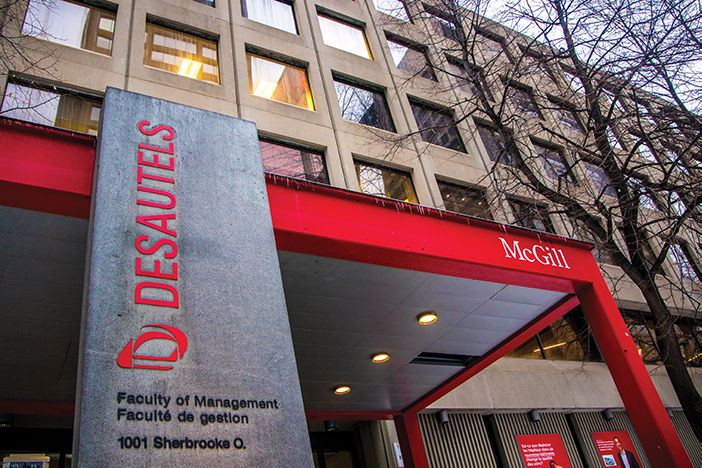
Desautels MBA Program ranked best in Canada

McGill’s Desautels Master of Business Administration (MBA) program was ranked first in Canada and 78th in the world in the 2018 Financial Times (FT) Global MBA ranking. Desautels was one of only three Canadian schools to make the top 100 list, alongside Rotman School of Management at the University of Toronto and Western University’s Ivey School of Business, which were ranked 86th and 90th respectively.

Alumni responses made up the most important ranking criteria, including “weighted salary” and “salary increased.” Altogether, these factors comprised eight of the 20 criteria and 59 per cent of the total rank. FT surveyed alumni to identify their average income three years after graduation and the average increase in salary after completing their MBA. The class of 2014 was examined for this year’s rankings.

Other criteria included the number of women in the program and faculty, and the percentage of international faculty members and students. FT also considered the program’s value for money, calculated using current salary and the cost of the program, as well as the prestige of research conducted at the institution in question, based on the number of articles published in internationally-recognized journals.

For Joshua Morton, a MBA student at Desautels with a concentration in Global Strategy and Leadership, the relatively small class sizes made the program more attractive than others he considered.

“I personally like developing more relationships with my classmates,” Morton said. “For me [the size of the program] really does influence how you interact with people. It means that you develop deeper relationships rather than a surface, in-class sort of thing. Everyone here is very open to helping each other and working together on things, and to me that’s also a big benefit of this program compared to others.”

Desautels also prides itself on educating a large number of international students, with almost half of its MBA students coming from abroad and a significant number from India and China.  

“I liked the idea of the diverse nature of the program, we’re very international and so getting many different perspectives, and the way people think of things really comes up in the classroom a lot,” Morton said. “The value of what a MBA program really does comes from what the people around you bring to it, and it’s a much more valuable experience for you, and it is a much more valuable experience for your peers, when everyone has something to bring to the table.”

Montreal’s linguistic and ethnic diversity also sets Desautels apart from other Canadian institutions.

“[Something] that’s special about [McGill] is that we’re sitting […] as an English institution in a French-speaking city,” Alfred Jaeger, academic director for the MBA program said. “The whole multi-cultural, multi-lingual aspect that we almost take for granted [sets Desautels apart from other Canadian schools.]”

In addition to hosting many international students, Desautels’ MBA program also boasts nearly gender equal classes. Desautels was ranked first in North America for percentage of female students, percentage of international faculty and students, international mobility of students after graduation, post-graduation salary increase, career progress, and aims achieved.

“[Something] I am very proud of is, this year we have almost a balanced class in terms of male-to-female ratio,” Associate Dean of Desautels’ MBA program Steve Fortin said. “Our women last year and the year before were very active in the program. We have a ‘Women in Business’ club that is very, very active.”

Fortin is optimistic about what Desautels’ rankings mean for the future of business.

“We care about research, and we’re trying to train people in the best possible way we can for the business world of today, [but also] the business world of tomorrow,” Fortin said.

Read the latest issue

Read the latest issue