

Latest News

Student Life

Fashion with an ethical passion: A McGill graduate on running her own slow-fashion startup

Finding a path after graduation isn’t easy. But Tessa Battistin has found hers. After graduating from McGill with a Bachelor of Arts in 2017, she founded the sustainable fashion brand Asset Designs, based in Montreal. She uses silk-screen printing to adorn T-shirts, bags, and pouches with her own art and poetry.

Battistin has been silk-screen printing since 2012, when her high school art teachers taught her the technique that she would come to love. She had always been a visual artist, but this method offered her a chance to experiment with textile practices. At the time, as a hobby, she printed her designs on standard Gildan t-shirts that she bought wholesale at just two dollars a piece.

She brought her silk-screens along with her to university and continued to print T-shirts in her RVC rez room for friends—and eventually friends of friends, once her talent spread by word of mouth. Once demand for her products began to grow, she created a website to display her creations. However, Battistin had never considered turning her leisurely interest in the art of T-shirt making into an environmentally-conscious brand until she researched the field out of personal motivation.

”I tried to redo my wardrobe sustainably back in 2015 and I realized I really couldn’t afford anything sustainably-sourced, because it’s super expensive,” Battistin said. “[It’s] really an issue that no one is saved from, this problem of where they buy their clothing [….] People care a lot about what they put into their bodies, but not necessarily what they put on their bodies.”

Following this realization, Battistin started paying more attention to the kinds of products her company was using. At that point, she made a conscious effort to try to print on ethically-sourced T-shirts made in working environments with fair wages and high quality working conditions. She entered the McGill Dobson Cup—an annual start-up contest organized by the McGill Dobson Centre for Entrepreneurshipin her senior year, and ultimately reached the semi-final round. She credits one of the competition judges’ encouragement with her decision to commit to her business full-time. 

“It started off as an art project […and then] became a sustainable brand,” Battistin said. “[Now] it’s a lot more of a platform for activism [….I can] explore these issues and educate people about the clothing industry and sustainability.”

Although cotton cannot grow in Canadian soil, every other step in the manufacturing process of Asset Design’s products takes place in Canada. The facility that knits, cuts, and dyes all of the T-shirts Battistin uses is located in Scarborough, Ontario. Once they have finalized the T-shirts, they ship the blank canvases to her studio in Montreal’s Mile End, which reduces the entire process of making Battistin’s T-shirts to three physical stops. This model is more sustainable than the fast-fashion supply chain model that many large corporations use, which involves a myriad of different stops and a significantly higher amount of Carbon dioxide emissions as a consequence.

Beyond selling products that she sources and makes, keeping in mind their carbon footprint, Battistin sees Asset Designs as a medium for her to advocate for more sustainable practices in the fashion industry and our consumption of its products. These practices are part of a model referred to as ‘slow fashion.

“Slow fashion [encourages] a circular economy,” Battistin said. “[A product is] made, it’s used, it’s reused, and [then] repurposed and recycled [….In a linear economy] things seem disposable when they’re so cheap.”

Battistin believes that her voice and brand can contribute to the collaborative effort necessary to reform our current consumption model.

“The main problem with the fashion industry is that it needs […] an interdisciplinary approach to solving the social justice issues associated with it, the environmental issues associated with it,” Battistin said. “And we need people who are interested in technology and engineering to offer solutions for textile recycling that are more easily accessible and cheaper than what we have available right now.”

Battistin is conscious that such a large issue as encouraging equitable and sustainable practices in the fashion industry can be intimidating for students. She wants her brand and voice to foster an inclusive space for anyone seeking to learn about how to make the fashion industry more sustainable. She encourages students to pursue grassroots solutions like browsing second-hand shops, or organizing clothing exchanges with friends to give used clothing a second life. Above all, Battistin advocates for more consumer awareness: The key to a more sustainable fashion industry lies in educated and deliberate choices on the part of customers.

“It’s really up to the consumer to decide [what] they want their money to support,” Battistin said.  “[…There] are small ways that we can tackle [the issue of sustainability in fashion] to feel like we have more control over the situation.”

To learn more about Asset Designs and ethically-sourced clothing, check out Battistin’s own clothing swap and documentary screening at Maison Notman House on Feb. 22.


Off the Board, Opinion

Precarious perils: Entering the gig economy

It’s no secret that finding steady, full-time work as a young person in Canada is becoming more and more challenging. Gone are the days where an undergraduate degree alone could land you multiple job offers in your field of study. Now, for many students, an undergraduate degree holds as much clout as a certificate from Mavis Beacon Teaches Typing. This sentiment is backed up by some fairly disconcerting numbers: A 2017 Statistics Canada report pegged the youth unemployment rate at 10.3 per cent, roughly double the national average unemployment rate of 5.7 per cent.

If students are able to find jobs upon leaving university, there is no guarantee that this work will be relevant to their degree, or even full-time. The “gig economy”—more formally known as precarious employment—is a term used to describe a labour market where many jobs are short-term contracts or freelance work as opposed to full-time permanent employment. “The Side Hustle” has become a popular way for young people to describe what it is like entering the 21st century work scene.

The recent shift in labour standards toward more precarious employment is disproportionately affecting youth seeking work: A 2015 study by Statistics Canada found that 29.9 per cent of people age 15 to 24 had only temporary employment, as opposed to the national average of 11.3 per cent. The public and private sector alike have adopted this approach to reduce the cost and liability of hiring full-time employees. Short-term contracts allow employers to terminate employees without notice while not paying for health insurance, paid vacation, or sick days. This shift is leaving young Canadians overworked and underpaid—all in the name of profit. Companies need to take a more holistic approach when hiring young Canadians: Employees are investments in the future of any company, and they should be treated as such.

It is challenging to quantify just how many young Canadians work in the gig economy, but the metric of underemployment can be used to get a better sense of the scale of precarious employment. Underemployment occurs when a person is working in a job that either doesn’t allow them to meet their personal financial needs, or for which they are overqualified. A Canadian Labour Congress report from 2014 calculated that the youth underemployment rate is 27.7 per cent. This means that there are thousands of young Canadians who are forced to work multiple jobs for which they are overqualified just to stay afloat.

Companies need to take a more holistic approach when hiring young Canadians: Employees are investments in the future of any company, and they should be treated as such.

Short-term contracts and freelance work associated with precarious employment are taking a toll on many caught in this sector of the economy. A 2013 study by economist Wayne Lewchuk on precarious labour in Ontario found that respondents who were not employed full-time were under more stress and in poorer health than their regularly-employed counterparts. People who find themselves in precarious working situations also earn less on average than peers who have full-time work. Compounding the issue of a lower income is the variability of income from pay period to pay period in a precarious job. Large shifts in monthly income greatly hinder a person’s ability to rent an apartment, make car payments, or support themselves financially.

Although precarious employment may be attractive to employers who are looking to cut costs at the expense of their employees’ incomes, not offering full-time employment is a short-sighted approach. According to a 2015 study from the Social Market Foundation, employees who are happy with their employment situation are more productive and valuable employees. Employers need to consider the intangible value of having full-time employees with longer tenures, rather than simply looking at the upfront cost. In an interview with Steve Paikin, Angella MacEwen, Senior Economist for the Canadian Labour Congress, supported this long-term, holistic approach to employment: “When you have the mutual investment, mutual loyalty [of full-time work], that pays off for the employer in terms of lower turnover, higher productivity, and in terms of being able to plan long range.”

Ultimately, the problem of precarious employment cannot be solved solely through legislation. It requires corporations to fundamentally change how they view their employees—as long-term commitments with long-term value. The temptation will always exist for companies to cut labour costs at the expense of workers, but this practice is not just bad for the youth of Canada—it’s also bad business.

Daniel Lutes is a Web Developer at the McGill Tribune.


Arts & Entertainment, Music

Son Lux charts a dissonant journey in ‘Brighter Wounds’

Son Lux is incapable of making an uninteresting song. On their new album, Brighter Wounds, Rafiq Bhatia’s hypnotizing guitar licks, Ian Chang’s slurred drumming, and founder Ryan Lott’s warbly falsetto and intricate production give listeners a glimpse into the eclectic future of music.

The trio are known for a wide array of innovations in electronic music. Perhaps most noteworthy, however, is their experimentation with complete sonic unpredictability. Brighter Wounds is no exception. Its sound design is wholly unique: Each of the 10 songs are characterized by a distinct blend of drums, synths, guitar, and other tones, with Lott’s piercing vocals as their pivot. The album’s bold pairing of orchestral and electronic elements is without compare.

Theatrical and evocative, the album is a murky mix of dread and poise. The lyrics of Brighter Wounds trace the tragic journey of an unnamed protagonist “out of the dark day into the brighter night.” Son Lux’s engaging and poetic songwriting employs a narrative depth normally reserved for higher forms of literature.  

“Forty Screams,” the opening track, indulges in painful sorrow. The lyrics are apologetic, defeated, and retrospective. The same tone unfolds in the album’s monumental single, “Dream State.” This hypnagogic ode to childhood propels the album’s plot, posing a host of unsettling questions that the character desperately attempts to remedy throughout the rest of Brighter Wounds; namely, “will we survive in this, our new wilderness?”

Experimental slow jam “Labor” is where the character’s story begins to unravel. During its brief refrain, Lott’s vocoded vocals implore the character to come to life, and leave the listener teetering between turmoil and tranquility.

But it becomes abundantly clear in “The Fool You Need” that unease is Son Lux’s bread and butter. Vaguely hopeful but unmistakably dark, the track features Lott’s sharp vocals cutting through clanging drums and forlorn tones swimming around the stereo field.

Slipping deeper into melancholia, “All Directions” describes a struggle to remain emotionally cognizant. Sonically true to its name, it seems to place its listener in a chamber with orchestral drums, strings, and twinkling synths swelling and striking from every angle.

“Surrounded” lifts the album from its gloom, though not towards hopefulness—rather, towards overwhelming awe and disarray. This track best highlights Chang’s drumming virtuosity and Lott’s ever-impressive sound design, particularly during its concluding drum solo.

Brighter Wounds finishes with “Dream State (Brighter Night),” a revitalized rendition of the earlier track of the same title. Suitably named, the track escapes the album’s sonic darkness but not its thematic pain and grief; it perfectly captures the irony of escaping a dark day to a brighter night. The listener is left feeling lifted, although like they have taken one step forward and two back. It is the perfect ending to an album that rejects resolution.

Compared to their past projects, Son Lux seem to have begun to more heavily embrace huge shifts in dynamics in Brighter Wounds. Within many tracks, the band crafts phrases in which sounds blend and intermingle into a single massive crescendo. A number of others, notably “Surrounded,” implement industrial drums and atonal phrases. Lotts also tinkers with vocoders throughout the album. However, despite these experiments, Son Lux have largely compounded on the most appealing elements of their music in the album; Fans of classic Son Lux tracks, like “Easy,” and “You Don’t Know Me,” will not be disappointed.

Though listeners might be able to draw parallels between certain tracks and the work of other artists, the album as a whole cannot be neatly defined or classified. Despite being unquestionably avant-garde, Brighter Wounds manages to retain a satisfying compositional structure. A testament to Son Lux’s work ethic and attention to detail, each item on the track list necessitates multiple listens, but can also be enjoyed without toilsome effort from the listener. For fans new and old, listening to Brighter Wounds is a must.

Martlets, Sports, Volleyball

Citadins upset McGill Martlet volleyball in bitter struggle

The Université du Québec à Montréal (UQAM) Citadins (6-13) took the McGill Martlets (14-6) to task at the Feb. 16 Beach Night match, packing Love Competition Hall with McGill and UQAM fans alike. Scraping ahead at every crucial moment, the Citadins maintained control of the game, which culminated in a surprising 3-0 UQAM victory.

“It’s kind of unexpected,” fifth-year middle Érika Cournoyer said. “We worked hard in practice, but it just didn’t show up as we wished on the court.”

The first set was tight from the beginning, with blocks on both sides making for hard returns. However, UQAM pulled ahead of McGill in the middle of the frame and came out on top 25-22. Though the Martlets are comfortably seated in a playoff position, their opponents were fighting to secure a spot in the postseason, keeping the Citadins focused and motivated throughout the entire game.

“They’re actually playing for fourth place, so for a spot in the playoff,” fourth-year middle Myriam Robitaille said. “They had a really good second [half of the] season, and [they’re] going to be a team to respect for sure.”

In the second and third sets, the Martlets’ inability to return mid-range drives and deep spikes left them vulnerable to the Citadins’ strong attack. Many times, their dives and digs fell short, costing McGill dearly during critical points. The Martlets broke free from an 8-8 tie in the third set, but their lead proved fleeting, ultimately losing the final set 21-25.

“We have to [make] our first-contact passing a little closer to the net so we’re not putting ourselves in a tough situation to be able to hit and use the height we have,” Head Coach Rachele Beliveau said.

Against the backdrop of the Beach Night match, the Martlets paid homage to Cournoyer, Robitaille, and fifth-year libero Marjolaine Ste-Marie, who are all graduating after this season.

“All of them have contributed really well to the program, made the program grow, and it’s always hard to see them leave,” Beliveau said. “But at the same time, this is life, so they’re going to move on to something new.”

After Friday’s upset, the Martlets went on to sweep the Ottawa Gee Gees 3-0 on Feb. 17, a marked improvement over their previous 3-2 victory against the Gee-Gees on Jan. 28. Going into their playoff matchup against the Laval Rouge et Or, which is slated for the first weekend in March, McGill will focus on returning to an unpredictable playing style to stay one step ahead of their rivals.


Moment of the Game

The final McGill offensive began when second-year power Claire Vercheval spiked the ball off the UQAM blockers and out of bounds to break an 8-8 tie in the third set.


Quotable

Even if they’re in [fourth place], they’re gonna show up, so we always have to be ready to play teams like this.” – Fifth-year middle Érika Cournoyer on UQAM’s grit and the upcoming challenge of the postseason


Stat Corner

Martlets fourth-year Myriam Robitaille served a game-high five aces.


Montreal, News

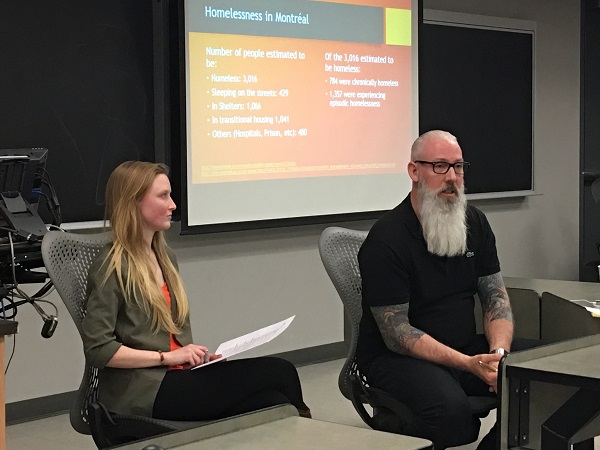
Montreal city councillors discuss policies to support homeless communities

5 Days for the Homeless McGill (5D4H) held a panel on Feb. 5 in the Bronfman building to discuss support for Montreal’s homeless population, featuring talks from Montreal City Councillors Benoit Langevin and Sterling Downey. 5D4H Co-Executive Director Meghan Bottomley moderated the public event. Speakers addressed homelessness in relation to topics like social resources, lobbying, and restoration.

Social Housing

Bottomley first directed attention to the Liberal government’s 10-year $40 billion affordable housing commitment and how the strategy will affect Montreal’s urban development. Langevin, city councillor for Bois-de-Liesse in northwest Montreal, anticipates that the city will have to spend more on affordable housing than the surrounding suburbs due to high demand. He also emphasized that ongoing negotiations between private actors and the provincial government prevent city officials from accurately predicting the investment size.

“Social housing cannot be built without the private sector because you need to have a project that is submitted by the contractor to your borough or to the city for a large-scale construction,” Langevin said. “[Montreal is] still negotiating […] with the provincial government as to how much money [from the national housing strategy] will be under the responsibility of the city of Montreal.”

Downey, city councillor for Desmarchais-Crawford south of downtown, and Projet Montreal’s spokesperson on homelessness, added that there are legal loopholes that allow contractors to forego contributing funds into the housing financial aid program, as mandated by the city’s inclusion plan. He aims to resolve this discrepancy by ensuring that affordable housing projects are built on unpolluted foundations.

“Our role [as city councillors] is to monitor construction so the government can invest money [in social and community housing],” Downey said. “We have to make sure that there’s land to build on. We have to make sure that the land is accessible, that there are partners [to propose affordable housing projects].”

Homelessness and Police

Bottomley asked how police interactions can mitigate tensions between law enforcement officers and homeless individuals.

“Whenever I go into the metro station and I see someone who’s homeless, I always see a police officer.” Bottomley said. “What can the city do in terms of the police force to improve relations [with] the homeless community […] and take these things more seriously? [….] Is there are way the city can enforce or change the policies in investigating [discrimination against the homeless]?”

In response, Langevin noted that police interventions often focus on redirecting homeless individuals from public spaces to shelters. Pointing to available funds from Montreal’s falling crime rates and the subsequent cuts in police force size, Langevin supports hiring more social workers who can understand the turmoil a homeless person is going through.

“The speed, that pace from [going from living on the streets to living in housing] can take […] a week, 4 years, or 30 years, and you can’t rush that process,” Langevin said. “I don’t think that even our outreach workers or our police officers are not sufficiently aware of the [cultural] values that makes every intervention very different from [the] other.”

Addressing similar concerns over cultural values, Downey affirmed that law enforcement officials must respect Indigenous values and culture when interacting with the homeless. He commended Clinique Droits Devant’s focus on rehabilitation over criminalization on public space occupation offenses. In addition, Downey believes that Équipe mobile de référence et d’intervention en itinérance (EMRII), a Service de police de la Ville de Montréal division that refers homeless individuals to appropriate services, has trained officers to sensitively approach those living in the metro. He believes that the real problem is the lack of first responders who are trained to deal with people with different backgrounds

“Our police services are where we need to invest more in,” Downey said. “We need to continue to educate our services and make sure they know how to deal with [specific situations]. Dealing with someone who’s white, for example, and homeless, and someone who’s First Nations and homeless [require] two different approaches.”

Creative, Sports

McGill Tribune Sports Podcast: Sweeping statements with curling correspondent Matt Sussman

A writer at Deadspin and Baseball Prospectus, Matt Sussman lent us his knowledge on Olympic curling and MLB free agency. Matt discusses the mixed doubles curling tournament, covering everything from the Canadians taking home gold to the bad boy of curling. He also breaks down the stories to watch in the men’s and women’s team curling tournaments. And finally, speaks about the lack of activity thus far in this MLB offseason.

Produced and edited by Selwynne Hawkins & Tristan Surman.
Music provided by Selwynne Hawkins.

Arts & Entertainment, Music

First Aid Kit heals all wounds at MTELUS

Swedish sister-duo Klara and Johanna Söderberg, along with their band First Aid Kit, stopped off at MTELUS on Feb. 6 for the touring of their new album Ruins.

The venue was packed with excited folk young and oldmany of whom had been waiting for the band’s next visit to Montreal since the group’s first trip to the city in 2014. Their performance made up for their long absence with an almost two hour set, enchanting the audience with poetic lyrics and unique vocal harmonies. Surprisingly enough, the sisters did not grow up listening to country music, and were first exposed when they began exploring Townes Van Zandt’s heroically tragic songs, Emmylou Harris’ powerful solo voice, and Johnny Cash’s pairing of simple chord arrangements with his deep voice. First Aid Kit combines all of these elements through simple chords arranged with a range of rich percussion sounds to complement their voices.

The opener, Van William, is a Californian alternative indie vocalist and guitarist, and close friend of Klara and Johanna. Although they are similar in terms of their musics’ indie-folk genre, the Söderbergs’ vocals completely contrasted Van William’s in power and reach. William’s voice sounded wispy and he was overpowered by his band, whereas First Aid Kit had a steady, clear, and powerful sound. For the encore, both acts returned to the stage to perform a collaborative rendition of Van William’s “Revolution”.

First Aid Kit kicked off their set with several songs from Ruins, and later included some old favourites from 2012’s The Lion’s Roartheir first album to gain serious recognition. Perhaps it was Klara’s funky Swedish dress, or Johanna’s angelic hair flipping that kept all eyes on them as they moved and swept across the stage. Their quirky presence topped off their incredible vocal ranges and unusual harmonies that effortlessly weaved in and around their sound. Klara is the main power behind the vocals, but the full sound comes when accompanied by Johanna’s elastic voice, Scott Simpson on drums, Melvin Duffy on pedal steel guitar, and Steve Moore on keyboard and trombone.

In between some of the more upbeat melodies, the sisters performed an angry song entitled “You are the Problem Here.” It specifically addressed the perpetrators of rape with powerful lyrics like “I hope you fucking suffer.” In their introduction to the song, they spoke directly for the need to shine the spotlight on the rapists and away from survivors. They released this song on International Women’s Day in 2017, after hearing of another rape case where the perpetrator’s sentence did not fit the crime committed. They purposefully disrupted the flow of the set’s digestible melodies to share this important message. It marked a turning point in the concert, as though they were properly warmed up and ready to deliver an unforgettable performance.

The band also played a tribute to Leonard Cohen, who has been a big influence on them. When he died in 2016, the Söderbergs organized a memorial concert for Cohen in Sweden. They performed Cohen’s song “If It Be Your Will” in the encore, but halfway through the song, Klara forgot the lyrics and soon picked it up during the chorus. The encore was fun and playful and they completely played off Klara’s forgetfulness making the entire experience an intimate one.

Seeing First Aid Kit puts into perspective how rare it is to find a group that sounds better live than on their recordings. The Söderbergs tracks do not do their powerful voices and dynamic bond justice. The last songs were the most emotional, as the genuine love the sisters’ have for singing together left tears in people’s eyes.

Creative, News, SSMU

SSMU Council – February 8th Recap

Get the information you need on VP Finance Esteban Herpin’s accusation of VP External Connor Spencer and VP University Affairs Isabelle Oke of mismanagement of funding for AVEQ.

“SSMU VP External and the VP University Affairs paid for [the SSMU conference hosted for AVEQ] using their SSMU credit cards for over $4,000 of expenses, which consisted mostly of hotel rooms and food,” Herpin said. “Nowhere in the SSMU operating budget were these funds approved or budgeted for.”

Video by Tristan Surman

Arts & Entertainment, Music

Trib Mix: Anti-Valentine’s Day

Oh, Valentine’s Day; a day filled with intimate grossness wrapped in a nice expensive Hallmark card. If you have loved and lost, or never even loved at all, get down in the dumps with our 13-track anti-Valentine’s Day playlist. This melancholic playlist features moody melodies from the sweeping strings of Outkast, to the sweet serenade of Karen O. Let’s face it, with every heartbreak comes a cascade of memories. So buckle your seatbelt because you’re headed for a rollercoaster of emotions. By the end of your ride, you’ll have lived out your pity party and left it on “read.” Now, sit back, and get ready to wallow.

Laughing Matters, Opinion

Valentine’s Day, we need to talk

Dear Valentine’s Day,

Hello, it’s me. We meet again. You’d think that by our 18th anniversary I’d have gotten used to you. Apparently not—I still don’t like you, and wish that you would go away, but like that guy in my class who will not stop DMing me, you’re incredibly persistent. Maybe this letter will convince you to do us both a favour, and shoot yourself with Cupid’s magical arrow.

I’d like to start with a point that some may consider trivial, but not me: Whenever you’re around, chocolate prices skyrocket—just like my confidence after a cute guy smiles at me. If you’re all about love, why are you such a capitalist? I’m just a broke student who needs chocolate to cheer herself up. Why are you gouging my sweet, calorific source of joy? Just let me eat in peace, and no one gets hurt.

Secondly, you’re a terrible guest. Everyone knows that you’re coming and they start preparing to deal with your demands of constant gifts and over-the-top displays of affection, which seem to increase monumentally every year. Long gone are the days when a box of chocolates was enough for a potential suitor. Now, every V-day gift has to be perfectly ‘gram-worthy, such as a bacon-rose or sushi-lilac bouquet. In the same way that every bad guest unapologetically clogs toilets, you clog my Instagram feed. Gifts, diamonds, truffles—the stream of pink is endless. That’s not to mention bouquets. Oh, the bouquets: From red roses to edible arrangements, there never seem to be enough ostentatious, ridiculously-overpriced, soon-to-be-trashed, bouquets.

I propose a drinking game: Everytime the words “partner in crime,” or “I don’t want to imagine my life without you,” or “you complete me,” come up on my feed, I’ll take a shot.

The pictures aren’t even the worst part—that prize belongs to their captions. Consequently, I propose a drinking game: Everytime the words “partner in crime,” or “I don’t want to imagine my life without you,” or “you complete me,” come up on my feed, I’ll take a shot. I’ll probably be blackout drunk in 10 minutes, but at least then I won’t have to remember reading through a two-paragraph ode to someone’s three-week old relationship with a “perfect gentleman” of a boyfriend—who I know for a fact hit on me last night at Gerts.

I’m generally a pretty happy-go-lucky person, but Valentine’s, you bring out the worst in me. I’ve started scoffing at even perfectly-realistic romantic comedies. I roll my eyes at the couples cuddling in the Students’ Society of McGill University (SSMU) lounge. I even judge the gifts my friends’ significant others get them—while still eating all the expensive chocolate contained in said gifts. Let me be clear: I’m not relationship-hungry, I don’t have cuffing season blues, and I’m not a crazy cat lady. I just think that you’re overrated and always in my face, and I need some space. We have a toxic relationship. I need to cut you out of my life. I promise, it’s not me, it’s you.

Love,

A disgruntled and perpetual third-wheel

Sanchi Bhalla is a first-year business student with an unmatched love of novelty phone cases. She can be spotted anywhere on campus where doggos run wild.


Read the latest issue

Read the latest issue