Latest News

Student Life

Can we switch positions? Six horrible sex positions to avoid this Valentine’s Day

It’s Valentine’s eve! That means you’re probably preparing for a night of romance and doing the dirty with that special someone tomorrow. If you’re feeling especially confident, trying to impress your partner with some new moves, or are simply feeling tired of missionary, this day is the perfect occasion to try out some wacky sex positions—assuming your partner is consenting to switching things up. In order for you to have the best sex possible, The McGill Tribune has compiled a few positions to avoid this year, as they will no longer be fun after about 20 seconds.


“London Bridge”

This one’s for bendy babes only. First of all, I have literally never met someone with both the flexibility and strength to be the base for this nifty position. Honestly, if your partner is talented enough to support you in this way, I say marry them. After this experience, I would trust them with anything.


“Head spinner”

I have no idea what is going on here. This position looks like one person really wanted a hug but the other was pushing them away, prompting the first to latch on to them in tears. Also, once you finally find the correct way to align your bodies to be in this position, you will probably be too tired to do it.


“Bumper Cars”

This position is just an absolute mess. The imagery resembles two people who are tied together in a pool, trying to break free from each other by doing the front crawl. Not only will your arms get extremely tired from being in what seems to be a very long plank, but I have no idea how this position could feel good for either person.


“Lusty Leg Lift”

Ok, unless you are some sort of gymnast, there is no way you’ll be able to perform this position without pulling a muscle. Also, this only really works for people of very specific heights; if either of you are just a bit too tall or too short, things will definitely get ugly. Be careful not to fall down or accidentally kick your partner in the face.


Shower sex

I am 100 per cent convinced that people who say they’ve had good shower sex are lying. Although the water will be hot and steamy, the sex probably won’t be. However, if you’ve been eyeing your partner’s fancy shampoo collection, this is a great way to get your hands on that.


“Down Stroke”

If you’re in the mood to risk your life, try this one out. I could see this position going really well if you were in space and didn’t have to deal with gravity, but here on Earth, your legs will slowly slip off of your partner’s shoulders until you’re laying on the ground, questioning why you thought this would ever work in the first place.


“Bent Spoon”

You know when you’ve been having really bad sex for 45 minutes and you’re not really into it anymore so you eventually just roll over and go to sleep? This position looks like that. Also, whoever’s on top in this position will absolutely feel too self-conscious about putting too much weight on the bottom partner for this to be pleasant for either person.

Science & Technology

Inspiring the aspiring: AsapSCIENCE at SUS Academia Week

The dynamic and informative SUS Academia Week, which ran this year from Feb. 5 to Feb. 9, came to an enlightening conclusion on Friday night. Mitchell Moffit and Gregory Brown, self-proclaimed ‘science communicators’ and creators of the popular science YouTube channel AsapSCIENCE, presented this year’s keynote lecture, “Into the Future with AsapSCIENCE.”

With over seven million subscribers and almost one billion video views, AsapSCIENCE has become one of the most-followed producers of science content across any platform. Moffit and Brown, who created the channel in 2012, release weekly episodes on a variety of scientific topics that range from how the brain responds to drugs, to the physiological and social ramifications of human colonization of Mars.

Upward of 150 students, as well as numerous members of the Montreal community, attended the presentation, which focused on how Moffit and Brown started their YouTube careers and the future of online science education.

Brown was first introduced to YouTube while working as a high school teacher in Folkestone, England.

“It got me thinking that I could take my interest in science, art, and teaching education and make something out of it,” Brown said.

Brown realized the effectiveness of this interdisciplinary approach after noticing that his students were interested in watching educational content that was presented creatively on YouTube.

“Videos like that are an opportunity for somebody who thinks science is too boring or too hard to say ‘hey this is actually really relatable,’” Moffit said. “We take these [types of] concepts and put them into one-minute videos.”

Brown and Moffit both received their Bachelor of Science in Biological Science from the University of Guelph in 2011 and 2010, respectively. While students, they developed a passion for teaching science to their peers, employing collaborative learning strategies to enhance their own education as well as others. According to Brown, AsapSCIENCE has evolved in tandem with their personal growth, reflected in the content they put out. As Brown describes it, their original videos have matured to include increasingly political subject matter.

“Using a scientific angle allows us to educate our audience on what is happening in the world,” Moffit said.

Moffit has worked alongside famed scientist and television personality Neil deGrasse Tyson as well as actress Emma Thompson to create documentaries on a variety of social issues. The AsapSCIENCE team has addressed everything from Indigenous rights issues in northern Canada to the inner workings of Greek refugee camps.

Looking to the future, Moffit believes that the Internet is key to opening the floodgates that will reach worldwide audiences.

“The Internet provides people from all over the world with access to content that would otherwise be inaccessible,” Moffit said.

Science’s popularity and relevance feeds their channel’s growth.

“Science is becoming increasingly prevalent in pop culture [and it’s] something that people are wanting to make more content about,” Brown added.

The creators view YouTube, alongside other multimedia platforms, as essential to the future of learning in all fields of study, non-exclusive to subjects in science.

“Even if you’re not one to teach science, but you’re keen to teach something you are passionate about, the Internet is [your] opportunity to share that with the world,” Brown said. “There is so much room for more channels like this.”

Soccer, Sports

Champions League round of 16 preview

The 2018 Champions League knockout rounds promise to be some of the best in recent memory. In Manchester City, the Premier League offers at least one threatening title contender. Barcelona remain strong as ever, while slumping Real Madrid are out to prove their worth. With Jupp Heynckes back from retirement and at the reins, Bayern Munich have gained steam in the Bundesliga and look to reach the same level his last squad attained. Finally, clubs like Basel and Besiktas bring an underdog element to the highest level. With that in mind, The McGill Tribune previews each matchup for the upcoming round of 16.


Juventus vs. Tottenham Hotspur

The round of 16 kicks off with Tottenham facing last year’s finalists, Juventus. The latter look promising in this draw, only having lost Dani Alves and Leonardo Bonucci from last year’s Champions League final team. Massimillio Allegri’s Juventus are currently one point out of first in the Serie A, and are in the semi-finals of the Coppa Italia. While the Italian side appears solid again this year, Mauricio Pochettino’s Tottenham should not be ruled out. Despite their current fourth-place position in the Premier League, Spurs were strong enough to beat Real Madrid to secure first in their group in the fall. Harry Kane has been dominant again this year for Tottenham, with 23 goals on the season so far. This draw will likely be decided based on the success of each manager’s defensive tactics and the ability of their teams to replicate them on the field.

Prediction: Juventus


Paris Saint-Germain vs. Real Madrid

The face-off between Real Madrid and Paris Saint-Germain (PSG) promises to be the best draw in the round of 16. The Spanish side have been in poor form this year, increasing pressure on Manager Zinedine Zidane, who has already admitted that the outcomes against PSG should decide his future at the club. However, Cristiano Ronaldo and the rest of the Madrid side should not be underestimated. Ronaldo, current holder of the FIFA Ballon d’Or, helped lead this same team to their second straight Champions League trophy last year. On the opposite side, the French club has dominated with an attacking front led by Edinson Cavani, Neymar, and Kylian Mbappe. PSG’s number 9 leads the team with 28 goals across each competition, their 222 million-Euro Brazilian has 27 goals, and their promising 19-year-old striker has 15 goals this season. This draw has the potential for many spectacular goals.

Prediction: Paris Saint-Germain


Roma vs. Shakhtar Donetsk

Fans of Roma and Shakhtar should be relieved that their sides managed to escape draws against stronger European sides. In past years, neither team has been very successful at this stage in the Champions League. Despite Chelsea’s interest in Roma’s Edin Dzeko, the club managed to keep their star player over the winter transfer period. Shakhtar, on the other hand, sold their star midfielder Fred. Though Roma finished first in their group in the fall, they currently sit in fourth place in the Italian Serie A. On the other hand, Shakhtar remains first in the Ukrainian Premier league, three points ahead of Dynamo Kiev. Both of these clubs are known for their passionate fans, and the support they receive during each leg may well be an influential factor in this draw.

Prediction: Roma


Manchester United vs. Sevilla

Sevilla are currently struggling in sixth place in La Liga. The Spanish side scraped through the group stage—winning only two games and twice tying Liverpool. While they haven’t been convincing this season, they did win twice against Atletico Madrid to reach the Copa del Rey semi-finals. Still, Sevilla face a big challenge in Jose Mourinho’s Manchester United squad, who are currently second in the Premier League and have the potential to thrive in this tournament. Mourinho coached his side to a Europa League title last season, and many United fans will be hoping for another strong European performance this season. Their new signing, Alexis Sanchez, may provide the slight advantage necessary to push United through to the next round.

Prediction: Manchester United


Barcelona vs. Chelsea

Chelsea are probably kicking themselves for conceding three goals at home to Roma in the group stage, condemning them to finish second. As a result, they now face the monumental task of dismantling La Liga leaders Barcelona. One of the toughest round of 16 draws, this fixture won’t be an easy match for either team. Luckily, Chelsea have two former Barca players of their own—Pedro and Cesc Fàbregas—who know the Spanish side’s strengths and weaknesses well. But, although the Blues have had a decent season, Barca have more star power in almost all areas of the pitch, emerging from the group stage unbeaten with only one goal against. What’s more, their domestic goal differential is twice as large as Chelsea’s, and with new Manager Ernesto Valverde under pressure to continue the club’s recent history of success, it will take quite a stroke of brilliance for Chelsea to make it past Barcelona.

Prediction: Barcelona


Liverpool vs. Porto

After losing their star number 10 to Barcelona during the winter transfer window, Liverpool are out to prove that their now fab-three—Mohamed Salah, Roberto Firmino, and Sadio Mané—can still keep the goals flowing. In the group stage, they scored 23 goals—a feat surpassed only by PSG’s 25. Liverpool’s recent achilles heel, however, has been their inability to hold things together at the back end. One potential defensive solution for the Reds lies in newly-signed centre back Virgil van Dijk. Porto, on the other hand, have a similar penchant for scoring goals, but a significantly better domestic track-record in terms of goals against. Currently Portuguese league-leaders, Porto should be taken seriously; however, competition is admittedly less tough in the Primeira Liga than in the Premier League. When these two attack-minded teams go head to head, the question won’t be if goals are scored, but how many.

Prediction: Liverpool


Manchester City vs. Basel

Manchester City have been nearly unstoppable this season. Although they haven’t yet faced particularly tough Champions League competition, they’ve lost only once in Premier League play, scoring 79 goals in the process. So far, Manager Pep Guardiola has been successful in replicating the dominance he achieved at Barcelona; however, Manchester City are relatively new to the European football top tier, and have never actually won a Champions League title. That all might change this year, as City have received yet another favourable draw for the round of 16. This is undoubtedly a game of contrasts—the market value of City’s squad is estimated at 529.26 million pounds—which is over 12 times that of FC Basel. For their part, Basel are not the highest-scoring team by any stretch, but they did manage a 1-0 win over Manchester United in the group stage, showing their potential to compete against big opponents. The key for their defence will be to figure out how to contain an attack headed by Sergio Aguero and Raheem Sterling, neither of whom are easily contained.

Prediction: Manchester City


Bayern Munich vs. Besiktas

Like Barcelona, Bayern have a well-established core in the likes of Arjen Robben, Jérôme Boateng, and Thomas Müller, all of whom were a part of the side’s 2013 Champions League-winning squad. After narrowly missing out on first place in the group stage to PSG, Bayern have nonetheless secured a relatively favourable draw. Besiktas’ first place finish ahead of both Porto and Monaco in the group stage is impressive in its own right, and summer acquisition Pepe from Real Madrid brings valuable Champions League experience to the team. Yet, while Bayern sit 18 points clear atop the Bundesliga, Besiktas are languishing in fourth in the Turkish Süper Lig, suggesting that Besiktas’ odds are slim. Although Manuel Neuer’s prolonged recovery from foot surgery is a blow for Bayern, their comfortable position in the Bundesliga leaves them the option of resting key players during league games in order to save their star power for the European stage.

Prediction: Bayern Munich

Sports

NHL midseason report

The halfway point in the 2017-18 National Hockey League (NHL) season has come and gone, marking a perfect time to reflect on the season so far, and consider how the intriguing postseason will shape up.


Biggest Surprise: Vegas Golden Knights

No expansion team—in any of the four major North American leagues—has ever finished their inaugural season with a winning record. No one thought an inexperienced squad like the Vegas Golden Knights would be any different. Then, after the Knights won their first three games, people started to take notice. Despite losing each of their top three goaltenders, their record is currently 36-15-4, tied for the league’s second-best mark as of Feb. 13. No one could have possibly predicted it, but this rag-tag band of outcasts looks to be contenders.


Biggest Disappointment: Edmonton Oilers

This season was supposed to be the one for the Edmonton Oilers. After last spring’s push to the Western semi-finals and their first playoff appearance in nine years, the Oilers seemed primed to make a run for the Stanley Cup. Then-20-year-old superstar Connor McDavid had just won the scoring race, Cam Talbot had established himself as a top goaltender, and several rookies were looking to make an impact. However, the Oilers got off to a poor start, and haven’t had a sniff of the playoff picture ever since. With two months remaining in the regular season and at 23-28-4, most analysts are counting them out. Whether they will be able to recover is anyone’s guess.


Hart Trophy (Most Valuable Player): Nathan MacKinnon, Colorado Avalanche

The Avalanche have made an impressive leap this year—moving from the worst record in the last 15 years to playoff contention—and MacKinnon is the reason why. He leads the team in scoring with 24 goals and is near the top of the entire league. MacKinnon carries the team, and while he likely won’t be winning the scoring race this season, he is still extremely valuable. Without MacKinnon, the Avalanche would likely be doing worse than they did last year, making him more impactful than any other player in the league this year.


Vezina Trophy (Best Goaltender): Andrei Vasilevskiy, Tampa Bay Lightning

The Tampa Bay Lightning have been absolutely dominant this year, thanks in part to their high-octane offence. But, even with their success up front, no team can be powerful without a good goalie. Vasilevskiy has most definitely played the part: Among starting goalies, he’s first in wins, first in save percentage, second in goals against average, and has backstopped his team to first overall. These are the makings of a Vezina winner.


Calder Trophy (Best Rookie): Mathew Barzal, New York Islanders

Barzal and Vancouver Canuck Brock Boeser, two 2015 first-round picks, have both had impressive first seasons. They are one and two on the rookie points board and have dominated the Calder conversation. Boeser leads in goal-scoring by a wide margin despite playing for the struggling Vancouver Canucks, but Barzal has been better all-around, particularly as a playmaker. Ultimately, that versatility gives Barzal the edge—at this point—for a race that will come down to the wire.


Stanley Cup Final: Tampa Bay Lightning vs. Nashville Predators

With stellar scoring, defence, and goaltending, the Lightning have been dominant this season, on top of the league for all but two days. Tampa Bay will be playoff favourites all the way through the Eastern Conference, but the West is a tighter battle. Vegas should be a playoff favourite, and the Winnipeg Jets could make a deep run should their players stay healthy; however, the most likely Western Conference champions are the Nashville Predators. Nashville went on an improbable run to the finals last season, and have only improved since—particularly after captain Mike Fisher returned from retirement. They’ve held steady near the top of the Western Conference and will look to ride that to the final. This matchup would be a very tough series for either team, but the Lightning’s supremacy in almost every department prevails over seven games.


2018 Stanley Cup champion: Tampa Bay Lightning.

Arts & Entertainment, Music

From the viewpoint: Rostam brings new songs—and a string quartet—to La Sala Rossa

Former member of Vampire Weekend, Rostam Batmanglij—performing under his stage name, Rostam—headlined at La Sala Rossa on Feb. 5, touring behind his first solo album Half-Light, released last September. It was, as he proudly noted, the first-ever Rostam show in Canada.

The night opened with a performance by Joy Again, a rambunctious five-piece band hailing from Philadelphia. True to their name, the music was happy and consistent. Not only was the band pumped that their Philadelphia Eagles had won the previous night’s Super Bowl, but they were even more excited to have escaped the tyranny of American liquor laws and be able to legally drink on stage. The lead guitarist celebrated by sipping a beer on stage between riffs.

Between the two acts, the venue filled with an eager, chattering crowd. When Rostam walked onstage, he was joined by a drummer and, remarkably, a full string quartet. It is rare to see two violins, a viola, and a cello gracing the stage of La Sala Rossa, but the arrangement was a master stroke.

Half-Light’s sound is a mix of graceful strings, a hallmark of early Vampire Weekend songs like “M79,” as well as their more heavily-produced rhythms. These styles are held together in a restless, productive tension on each song of the album. Behind the string quartet and a MacBook, Rostam was able to effortlessly reproduce this unique style in person.

Opening with “Don’t Let It Get To You,” Rostam rolled off tune after tune from his album, clearly showcasing his skill at writing pop songs. Early highlights were the rhythmic “Never Going to Catch Me” and the infectious “Bike Dream,” with lyrics detailing the many sides of a romance: “Two boys, one to kiss your neck / And one to make you breakfast.” Even the string quartet danced in their seats.

La Sala Rossa’s intimate gave Rostam a chance to banter with the audience, and revealed the talented musician to be an equally charming guy. At one point he announced, “If you’re here, it’s because you know how good my frittata is.” If only, Rostam.

In working with Vampire Weekend, Rostam has typically been credited as an  instrumentalist and producer, but in his solo work, he steps fully into the vocal limelight. Rostam’s voice is a broad, sensitive instrument, sliding almost lazily between notes and moods; on slower songs such as “Sumer” and “Don’t Let It Get To You,” his vocals expanded to fill the intimate space with warmth and brightness.

Before performing “Wood,” Rostam asked if there were any Persians in the audience. Rostam himself was raised by Iranian-immigrant parents in Washington D.C., and though all his vocals exhibit this influence, on “Wood” he embraces the rhythms and sounds of his Middle Eastern heritage more fully. In comparison with his more concise pop songs, “Wood” takes its time, building up string riffs only to strip them away again.

The highlight of the show came after the encore, when Rostam performed a new, unreleased song, a cover of Nick Drake’s classic “Pink Moon,” before closing with a final reprise of “Don’t Let It Get To You.” It was the audience’s clearest glimpse into his restless and brilliant musical mind.

Between the final songs, Rostam shrugged and said: “We just love making music.” The tightly-packed audience nodded appreciatively; they loved hearing it.

Art, Arts & Entertainment

Little corporal, big world

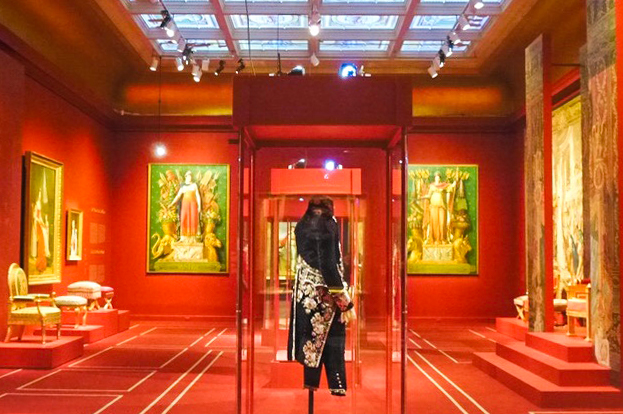
The Montreal Museum of Fine Arts (MMFA)’s Napoleon: Art and Court Life in the Imperial Palace offers a scale and quality of artwork exhibited in is immediately reflected upon entering the museum. The second floor of the Michal and Renata Hornstein Pavilion is transformed into a replica of Tulieries Palace under the direction of Sylvain Cordier, curator of Early Decorative Arts.

A project nearly five years in the making, this exhibition was no small undertaking: Guests can peruse roughly 400 artworks and objects derived from the Ben Weider Napoléon Collection, the largest of its kind in North America. The sheer volume and splendour of the assembled works is impressive enough on its own, yet Cordier and Nathalie Bondil, chief curator of the MMFA, have managed to construct a clear chronology to this exhibit, elevating patrons from mere viewers to active participants.

Within Napoléon, two narratives run parallel to one another: Daily life at the Imperial Palace, and the rise and fall of Napoléon Bonaparte. The exhibition invites viewers to draw comparisons between the progression of a day’s labour to the gradual decline of the First Empire. The layout of the exhibition mimics the apartments of the Tuileries, with each room dedicated to one of the six Grand Officers of the household, each of whom helped to construct Bonaparte’s image of power.

Beginning in the Imperial Household, the first room examines how Bonaparte’s public image was disseminated with the help of the Household staff through visual propaganda, marking the start of the Empire. The exhibition then transitions into a room dedicated to the Grand Master of the Imperial Hunt, a not-so-subtle nod to the Napoleonic Wars that plagued Europe during the Empire. This room examines the country life of the French imperial family and its supporting nobles, and how the upper class distracted themselves as young men died en masse across the continent. Through the Grand Chaplaincy, the Grand Marshal, and, ultimately, to Bonaparte’s exile on the island of Elba, the exhibition demonstrates the impressive group effort that went into presenting one man to the world.

In every painting, every crucifix, there is a hidden meaning imbued—that of control and subjugation. As a ruler, Napoléon expertly crafted a royal image that drew from his predecessors of the Ancien Regime and from the Roman Emperors to reinforce his mythic rule. This image, cultivated with the help of a team of advisors, was evident even in Napoléon dress and household decor, like the tableware and furniture. These were exclusively created by the Sèvres Porcelain Manufactory. A simple tea service is elevated with gilded gold, imperial eagles, and patriotic French symbolism of the revolution, such as the fleur de lys. This abject display of wealth enforced Bonaparte’s status as the reigning power in the empire.

Bonaparte’s authority is seen in larger works as well; the Portrait of Napoléon in Ceremonial Robes (1805) by François-Pascal-Simon Gèrard immediately draws the attention of visitors. With its tight composition and Greco-Roman influences, this painting epitomizes the ethos of Napoleon’s cult of personality. The son of a minor noble who quickly rose to military power during the Terror of the French Revolution, Bonaparte established a new dynasty, and quickly expanded his reach to create the largest land empire in 19th century Europe. Propaganda often showed Bonaparte’s military might, and paintings such as that by Gerand were meant to enforce absolutist presence.

Napoléon’s ornate and opulent rooms of deep mahoganies and mauves are filled floor to ceiling with imposing, austere portraits. It’s not difficult to imagine daily life at the Tuileries: A life of hunting, excess, and boredom. The exhibition succeeds at bringing this narrative to life through its inclusion of decorative arts. I found myself in complete awe as I stood beneath the Altar Fixtures for Wedding of Napoléon and Marie-Louise, later for the Chapel at Tuileries (1809). Underneath the silver cross and candle holders, which Georges Rouget detailed in a painting, I realized that the narrative that was presented was no longer a figment of a history textbook. The graphic emotion evoked by such banal objects allows modern viewers to engage in a discourse with the recent past that remains rooted in our contemporary values.


Napoléon: Art and Court Life in the Imperial Palace runs from Feb. 3 to May 6. Tickets are available at https://www.mbam.qc.ca/en/exhibitions/on-view/napoleon/

Commentary, Opinion

The spectre of anti-Semitism haunts BDS

At a recent forum of McGill’s Task Force on Respect and Inclusion, Associate Professor Laila Parsons defended the existence of the Boycott, Divestment, and Sanctions (BDS) movement against Israel at McGill. Parsons claimed that “BDS is a normal method of activism, [and] the University’s condemnation of the BDS [movement] exacerbated the tensions,” referring to the ongoing debate surrounding the BDS movement. Her characterization of BDS is more than just plain wrong. Parsons fails to recognize the ways in which BDS and anti-Semitism intersect—a phenomenon that is particularly evident at McGill.

BDS activism at McGill has long been a vehicle for anti-Semitic vitriol. In 2015, even before the McGill BDS Action Network was formed, The McGill Daily was forced to apologize when one of their BDS-supporting editors objectified Jewish students based on their religious garb by tweeting about “sitting in a section of kippas” at a General Assembly vote on BDS.

To borrow Parsons’ words, tensions were truly exacerbated last year. On Feb. 6, 2017, Igor Sadikov, a BDS Action Network member and then-SSMU councillor and director, tweeted a violent threat against Zionists. At a subsequent Legislative Council meeting, Sadikov openly questioned if Jews constituted an ethno-religious group.

Sadikov’s tweets and comments are unequivocally anti-Semitic. I have argued that, at this juncture, the smart move for BDS supporters would have been to condemn and distance themselves from Sadikov. Instead, BDS supporters celebrated Sadikov with increased fervour. They threw the full weight of their movement behind him. They lined up to defend Sadikov because they shared his views: If they let Sadikov go down, BDS activists would go down with him.

To understand this point, it is important to place BDS in the larger context of the long, violent, and ever-changing foundations of anti-Semitism. John-Paul Pagano, a Brooklyn-based writer with a specialty in the foundations of anti-Semitism, points out that anti-Semitism is, at its core, a “conspiracy theory about the maleficent Jewish elite.” Unlike other forms of racism, anti-Semitism “punches up.” It views Jews not as inferior beings to be dominated, but as an all-powerful group that dominates non-Jews.  Pagano finds this common thread in all instances anti-Semitism, regardless of the philosophical movement, time period, or geographical location.

This conception makes it dangerously easy for anti-Semitism to seep into modern leftist activism: Because anti-Semitism is based on a conspiracy theory that Jews are all-powerful overlords, the necessary conclusion is that the non-Jews should resist them. Thus, as Pagano puts it, it is “easy to disguise [anti-Semitism] as a politics of liberation, or at least, to embed anti-Semitism quietly in efforts for social justice,” because anti-Semitism enables the conflation of Jews writ-large with an all-powerful group of oppressors. As a result, BDS campaigns have become mired in anti-Semitism across Canada, where pro-BDS students derailed a vote to commemorate the Holocaust; in the United States, where a BDS vote was strategically scheduled on the Jewish holiday of Passover, when most Jewish students couldn’t attend; and in Europe, where Jewish students face anti-Semitic slurs and are forced out from campus clubs.

Until they reckon with the mess they’ve caused, BDS activists don’t deserve space to spread anti-Semitism—at McGill, or anywhere.

Last semester’s “Democratize SSMU” debacle is a perfect example of anti-Semitism rearing its head within pro-BDS activism. The group was forced to apologize for the blatantly anti-Semitic rhetoric in its campaign against ratifying several SSMU Board of Directors members with perceived ties to Jewish groups. The material in question has been conveniently deleted, but in its apology, Democratize SSMU expressed its remorse for “tropes of Jewish people as corrupt and politically powerful.” These are more than “tropes.” They are textbook anti-Semitic conspiracy theories. As Pagano’s analysis reveals, this is a way of thinking inherent to Jew-hatred.

To this day, despite the one-off, half-baked non-apologies, McGill BDS supporters have refused to reckon with their movement’s vile anti-Semitic undercurrent. They steadfastly believe in the nobility of their project. They are fighting for the little guy. They are anti-imperialists. They can do no wrong. Any criticism is merely an attempt by powerful groups to silence them and pro-Palestine advocacy. But, BDS’ mission to support the rights of Palestinians has fallen by the wayside. In reality, the noble BDS crusade at McGill has served only to target Jews.

Sadly, Parsons’ comments fall within this same pattern of anti-Semitism apologia: Proclaim the absolute innocence of BDS, and blame anyone but yourself for the harm done to countless Zionist and Jewish students. Until they reckon with the mess they’ve caused, BDS activists don’t deserve space to spread anti-Semitism—at McGill, or anywhere. Faculty members like Associate Professor Parsons who defend BDS are complicit in this hatred.

Simon Paransky graduated from the McGill University Faculty of Law in December ’17.

Editorial, Opinion

Textbook costs need more than a textbook solution

Post-secondary textbooks are expensive. Any McGill student can attest to this: For many, spending hundreds of dollars at the bookstore is an unfortunate reality of every semester. Others turn to scouring the internet for alternatives and older editions of required texts, or pawning off last year’s gargantuan, intro-level books on the McGill Textbook Exchange Facebook group. Some students simply forgo a required text altogether.

As with any hurdle that comes with being a McGill student, students across faculties and demographics have innovated their way around outrageously-priced books, which range from $50 to $450 for books for a single course. Yet, the fact remains that the price of textbooks is an enduring financial barrier preventing students from making the most of their degrees. At best, the steep price of textbooks discourages students from the extra reading and work that contribute to and sometimes, are necessary for success in a class. At worst, it is a serious barrier that may prevent students from taking a given course or pursuing a degree at all.

This is not a new problem on campuses, but with the rising costs of overall tuition at Canadian universities, it has only become more urgent. As a result, Students’ Society of McGill University (SSMU) Vice-President (VP) University Affairs Isabelle Oke is raising awareness about Open Educational Resources (OERs)—free, online educational resources developed by professors and faculty internationally—and encouraging McGill to contribute to these resources and consider them as a cheaper alternative to print textbooks. Professors, faculty departments, and administrators should follow students’ lead. It is time to innovate solutions to the problem of textbook costs, in order to relieve some of the burden from students.

Part of the problem lies beyond the University; textbooks are expensive because the very small number of academic publishers that dominate the market can make them expensive and incorporate cost-raising extra features to edge out their few competitors. Still, this should not preclude McGill from making changes that are within its scope to alleviate some of the financial burden for students. McGill does have some resources in place to address the problem already, such as alternatives to buying new textbooks: Students can take some course books out from the library, and the McGill library’s online database provides a range of online material.

However, these solutions are far from surefire. As they do not carry enough copies for an entire class, course reserves rely on the majority of students buying their textbooks. The helpfulness of these alternatives also varies significantly across courses and departments. A political science undergraduate student may be able to find most of their required readings on WorldCat, but for a physical science major with latest-edition textbooks required each semester, it is a different story. Some professors are aware of this bind for students, and tailor their syllabi accordingly; however, others do not, or cannot, because their courses demand the use of textbook problem sets, for example.

Professors, faculty departments, and administrators should follow students’ lead. It is time to innovate solutions to the problem of textbook costs to relieve some of the burden from students.

McGill can do better for its students at the level of individual instructor and departmental choices as well as in broader administrative reform. Faculties and departments should consider OERs and other options available to improve access to course resources. The McGill administration should also look at facilitating solutions. Even in the absence of decisive reform, simply consulting with faculties, departments, and students about areas of greatest need, and the feasibility and effectiveness of solutions, could go a long way.

Change need not come exclusively from the administration, though. As the key decision-makers on required course materials, individual professors and departments stand to have the most immediate impact on student textbook costs. Professors should certainly assign the reading materials that they see fit for a course. However, they should be flexible about the version of a textbook students can use. Moreover, as part of the selection process of these materials, instructors must keep students’ finances in mind. If a professor chooses to require the latest edition of a very expensive textbook, then that decision should be based not only on the material’s merits, but its merits relative to costs to students. Departmental oversight of textbook choices should enforce this principle across course sections.

The cost of textbooks is a real and enduring burden that acts as a barrier to learning for post-secondary students, at McGill and elsewhere. It is high time that the University take more concerted, consistent steps to alleviate it.

Commentary, Opinion

Gender-neutral bathrooms have impact beyond the stall

In October 2017, the Social Work Students’ Association (SWSA) launched a campaign to designate the bathrooms in the School of Social Work’s Wilson Hall as gender-neutral, meaning that students of any gender would be able to use any bathroom they please. On Jan. 9, the campaign succeeded, and most of the building’s bathrooms have been degendered. The impact of deconstructing gendered bathrooms at McGill goes deeper than just making students more comfortable in the moment. It creates a public space where compulsive gender performance—that is, alignment with a binary gender—is less necessary, altering the gendered architecture of the school. In the context of the gendered bathroom’s history, this is especially notable.

Most humans living before the Victorian era, when the private bathroom first entered the scene, would be baffled by the SWSA’s victory. Until 1739, public facilities in the Western world were not only, in some circumstances, communal, but also reserved for men. Men in ancient Rome sat alongside each other in communal public toilets, and public women’s toilets were unheard of. In the United States, bathrooms were not legally segregated by gender until the early 1900s, as a manifestation of the idea that men and women belonged in separate spheres, intellectually and spatially.

The short history of gendered toilets teaches us, first, that washrooms are a place where public notions of gender are expressed, and second, that these notions of gender are dependent on social context beyond the stall.

If the public washroom is a place where acceptable gender performances are reinforced, as Sheila Cavanagh argues in her book, Queering Bathrooms: Gender, Sexuality and the Hygienic Imagination, then the SWSA’s grassroots initiative challenges the social control of gender on campus. In degendering its bathrooms, the SWSA deconstructs gender roles instead of reinforcing them, and opposes a history in which gender politics and taboos play out in the washroom. This has positive implications not just for individual students, but for McGill’s campus culture as a whole.

By affirming trans and gender non-conforming individuals— thereby making them feel safer at school—the change in physical space created by the SWSA contributes to creating a larger academic environment that does not rely on notions of binary gender.

By affirming trans and gender non-conforming individuals— thereby making them feel safer at school—the change in physical space created by the SWSA contributes to creating a larger academic environment that does not rely on notions of binary gender. Degendered washrooms tacitly encourage people of all genders to contribute in an academic context, by creating an inclusionary physical environment that allows trans and gender non-conforming students to feel more comfortable. As the history of washrooms shows, a shift in washroom culture can be indicative of a shift in wider cultural factors—factors that also influence academia and student life. Although a small detail such as degendered bathrooms may not seem revolutionary to unaffected students, it is a signpost of larger social change on campus. For example, the breakdown of the bathroom binary could occur alongside the breakdown of homogenous academic norms that prioritize the perspectives of straight, white, cisgender men. The creation of physical learning spaces that allow for a multiplicity of student identities might encourage such diversity in academic research.

As laudable as the achievement of the SWSA is, it was an entirely student-driven initiative. Similar grassroots movements at schools such as Brown University and Wesleyan University have also been student-run. Tellingly, the only floor in Wilson Hall that has retained its gendered bathrooms is reserved for administrative offices. Administrators at McGill should support their students in reworking their spaces to fit their needs and provide resources to enact lasting institutional change, rather than acting apathetic or hostile. Degendering bathrooms stands to positively impact all members of the McGill community, not just students.

Gendered bathrooms are neither natural nor necessary, and they are bastions of a gender ideology that hurts McGill students. The SWSA has it right: It is time to reach the next phase in the history of bathrooms.

Grace Gunning is a U3 History major, occasional artist, and columnist for The McGill Tribune. She enjoys climbing, gardening, and cheesy 80’s sci fi.


Arts & Entertainment, Music

Where do I begin: King Gizzard & the Lizard Wizard

With a name like “King Gizzard and the Lizard Wizard,” a band is likely to be either out-there and silly, or innovative and revolutionary. Luckily for the music world, this group delivers on both accounts.

Formed in Melbourne in 2010, King Gizzard and the Lizard Wizard is a seven-piece ensemble that includes two singers, two drummers, and three guitarists. The group is signed to their own label, Flightless Records, owned by drummer Eric Moore.

Since their debut, King Gizzard has released 13 albums, with five albums promised—and delivered—in 2017 alone. Those albums genres’ include, but are not limited to, jazz, folk, psychedelia, progressive rock, and metal.

If one can get past their admittedly-ridiculous name, King Gizzard deserve exploration from all listeners. They are transforming the music scene by bridging genres and releasing an unreasonable amount of music, all while not taking themselves too seriously.

Integral to the band’s aesthetic is their tongue-in-cheek attitude. It manifests in bits and pieces of their music, but can also stretch across entire tracks. This can result in the group repeating a single lyric ad nauseum—à la “Rattlesnake” or “Trapdoor”—until the words ring in your head; at other times the group will sneak in goofy riffs that harken back to carnivals or reuse old, tired motifs that spring to life in their new context.

With their dizzying and, perhaps, overwhelming discography, the question of where to start listening can be daunting. While tastes differ, the three albums below are a starting point for newcomers, each representing a different genre.

Without further ado, the best album to start with is Paper Maché Dream Balloon (2015). This folksy acoustic album begins with my personal favorite King Gizzard song, “Sense.” The track is defined by a smooth saxophone line and the unusually subdued voice of the band’s frontman Stu Mackenzie. Paper Maché is a departure from King Gizzard’s typically heavier and more distorted sound. Other tracks that shouldn’t be overlooked include “Bone” and “Cold Cadaver.”

Next is the third of five albums released in 2017, Sketches of Brunswick East. This mellow psychedelic jazz album was created in collaboration with the Melbourne-based Mild High Club. The name is in reference to Miles Davis’ Sketches of Spain, while also paying homage to the Melbourne neighborhood. The album’s standout track is the six-eight metered “The Spider and Me” that includes samples of running water, birds chirping, and bandmates laughing. While the whole album is a jazz-infused extravaganza harkening back to the Rhodes keyboards and experimental improvisation of the golden era of jazz, its shining moments include the laid-back “You Can Be Your Silhouette” and instrumental “Rolling Stoned.”

Lastly, the fifth of five promised albums for 2017, Gumboot Soup, was squeaked out on Dec. 31. This album is an anthology of B-sides from the four albums that preceded it, yet coalesces as something greater than that. The first track, “Beginner’s Luck,” begins sparsely with Mackenzie’s reverb-affected and distorted voice asking to the listener to gamble, then breaks into an upbeat verse. As the chorus arrives, Ambrose Kenny-Smith’s sultry voice warns the listener to avoid hubris. Another notable track, the relatable “I’m Sleeping In” is a fitting anthem for lazy mornings during this gloomy and frigid semester.

King Gizzard has also released several metal and progressive rock albums. If these genres are your cup of tea, check out Murder of the Universe, Nonagon Infinity, Flying Microtonal Banana, and Polygondwanaland.

Regardless of your musical preference, there’s something in King Gizzard and the Lizard Wizard’s discography that is sure to catch your ear. If the three albums mentioned above don’t do it for you, check out some of their other albums such as Oddments, with its groovy, indie sound, or the long-form jazz album Quarters. Whether you’re already a diehard fan or if you can’t find a single song that appeals to you, King Gizzard is bound to drop a least another album with a fresh, genre-blending sound before the year ends that could easily become your new favorite.

Read the latest issue

Read the latest issue