Latest News

McGill, News

Faculty and student committee to review Student Life portfolio

The position of Deputy Provost Student Life and Learning (DPSLL) will come under review as current DPSLL Ollivier Dyens’ plans to allow his contract to expire on July 31.

“Beginning in early 2018 I will undertake a comprehensive review of the scope and orientation of the Student Life and Learning (SLL) portfolio, with the support of a committee comprised of faculty, staff and students from across the University,” Provost and Vice-Principal (Academic) Christopher Manfredi wrote in a Dec. 31 email to the McGill community. “I am undertaking this review to ensure that McGill University has the best possible organizational structure with respect to our suite of student support services.”

The committee, to be chaired by Manfredi, will reassess the SLL mandate to provide services to the McGill community, including housing, recreational opportunities, and medical services.

Dyens will continue to serve as DPSLL while the committee’s review is underway. In an email to The McGill Tribune, Dyens reflected on his five-year tenure.

“[The] Deputy Provost position is both an exciting and challenging post and I found both immense satisfaction [in] the things we were able to accomplish and some frustration when things didn’t work so well,” Dyens wrote. “I fully support the Provost’s initiative to revisit the role, and I look forward to what changes come as a result.”

During his tenure as DPSLL, Dyens focused his efforts on improving safety during orientation week, securing financial aid, and developing various on-campus projects like Skills 21 and Building 21. However, Dyens has also drawn criticism from members of the McGill community for his office’s numerous efforts to restructure McGill’s Mental Health Services.

Athar Ejaz, U3 Engineering, who received psychiatric treatment during the reorganization of Mental Health Services toward a stepped-care model in Fall 2016, explained the difficulties patients faced with the new model.

“Institutionally, I would say somebody who didn’t know anything about mental health but knew a lot about accounting, efficiency, and pure performance […] was in charge of this policy,” Ejaz said. “It’s [the administration’s] dream. We have no waiting times, but we’re not seeing doctors any more.”

In an email to the Tribune, Director of Counselling Services Vera Romano expressed doubts over whether changes to the SLL portfolio would appease students who are dissatisfied with Counselling Services.

“Like other universities, we continue to face the challenge of insufficient resources to meet increasing demands,” Romano wrote. “These are less [of] a problem in terms of the administration of SLL than they are a matter of Québec government funding for mental health services. A change in the portfolio will not address this problem.

Romano says that it is important that the McGill community provide input in the DPSLL portfolio reassessment process in order to effectively improve Counselling Services.

“It will be important to follow the work of the working group that Provost Manfredi is assembling, and to listen to what members of the McGill community, especially students, have to say about any changes that ought to take place in the SLL portfolio,” Romano wrote. “We don’t want to get ahead of that important work, but we will have input into that process.”

Football, Sports

Super Bowl LII predictions

Just 13 years ago, the New England Patriots took home the Lombardi Trophy against the Philadelphia Eagles in Super Bowl XXXIX. Two familiar faces remain from the original matchup: Patriots quarterback Tom Brady and Head Coach Bill Belichick. Those two look to further cement their legacies as the greatest of all time at their respective positions with a sixth championship, while the underdog Eagles are eager to bring the franchise’s first Super Bowl victory home to Philly.


Philadelphia Eagles

After losing star quarterback Carson Wentz in the regular season, the Eagles head into Super Bowl LII led by a backup quarterback in Nick Foles and a cutting-edge football tactician in Head Coach Doug Pederson. That duo has worked together to form a surprisingly strong passing attack with the help of weapons like Zach Ertz, Alshon Jeffery, and Jay Ajayi.

However, Philly’s defence has been the real difference-maker in these playoffs. Named Football Outsiders’ second-ranked defence, the unit has conceded just 17 points and added three takeaways in its two postseason games. Aside from defensive tackle Fletcher Cox, the Eagles lack the defensive star power of teams like the Jacksonville Jaguars, but make up for it by fielding 11 reliable defenders at all times. Against a New England offence that picks on mismatches as well as any team, to have no such weaknesses is a greater strength than to have a handful of stars.


New England Patriots

The latest edition of New England’s long line of Super Bowl teams includes an interesting blend of faces old and new. As always, Brady and Belichick will lead the Patriots charge, likely with the help of Rob Gronkowski and Danny Amendola. This season’s addition of Brandin Cooks, on the other hand, brings a new dimension to their passing game.

Stephon Gilmore brings a similar injection of life to the New England defence, pairing with Malcolm Butler to form one of the best cornerback tandems in football. Unfortunately, the strengths stop there for the Patriots defence—likely the worst unit on the field for either team. The unit held its own against limited competition in its run to the Super Bowl, but Pederson’s creativity and offensive weapons will provide a new, formidable challenge.


The Tribune picks:


Sports

Which All-Star game shines brightest?

All-Star season is upon us. It’s the time of year when sports fans get together and celebrate the proud North American tradition of watching the top stars of our favourite sports face each other to determine not that much. However, not all four major league sports are created equal: Due to their unique formats, some All-Star games are far more entertaining than others.


  1. NFL

American football is a perfectly fun sport to watch, but let’s face it—the Pro Bowl isn’t. The game takes place the week before the Super Bowl, so stars like Tom Brady are preoccupied with bigger things, and those who aren’t playing are already on holiday. Though there is now a relatively-small monetary prize, there is otherwise no major incentive for either team to win. In such a contact-heavy sport, players don’t want to go all-out against each other when there isn’t much on the line. All together, these factors contribute to a bland final product.


  1. NBA

The NBA All-Star Weekend, and its entertaining set of skills competitions, just misses second place. With much of each event centred around the stars themselves, the league gets to display the players’ creativity.

The game itself is filled with a continuous highlight reel of flashy passes and spectacular dunks at the cost of any semblance of defence, so some fans enjoy it much more than others. This season, the NBA switched to a player draft format similar to what the NHL used to have. However, the NBA did not televise the event, a sore point among fans. The dunk and three-point contests have gotten somewhat tired over the years, and with players’ personalities coming to the forefront, performances—like the Shaq-lemore stunt of 2014—can become draining.


  1. NHL

An event of many faces, the NHL All-Star Weekend has historically pitted the league’s two conferences against each other, including a short stretch where two players were selected as captains and would draft teams from the All-Star pool in a televised event. The current format, however, is the most unique of all four leagues. A 10-player team is selected to represent each of the four divisions. Instead of one full-length game, the stars play three short tournament matches for a monetary prize. These feature three-on-three hockey instead of the standard five-a-side, which supposedly elevates the excitement. However, the game itself often lacks hitting and defence—two of the sport’s most entertaining elements.

The skills competition is well worth watching. Players compete in a number of events, such as hardest shot and fastest skater, giving fans a spectacle unlike in any the other league.


  1. MLB

The MLB All-Star break boasts perhaps the best skill competition, where the Home Run Derby encourages baseball’s biggest sluggers to pound as many balls as possible into space. Whoever hits the most home runs wins, while players can earn extra points for distance, which provides fans with constant entertainment value.

Baseball doesn’t require a team to have perfect chemistry, so players can provide a worthy product without any prior experience with their teammates. Furthermore, although the MLB no longer uses decides home-field advantage with the All-Star Game, the game’s quality drops off less from its typical product than in the other sports. The MLB doesn’t have to rely on gimmicks or odd formats to make its game entertaining.


A previous version of this article incorrectly stated that the MLB All-Star Game still determined World Series home-field advantage. In fact, the MLB started using regular season records to determine home-field advantage in 2017. The Tribune regrets this error.

McGill, Montreal, News

Threat of fentanyl looms over recreational drug users on campus

After several reports of overdoses in Quebec caused by fentanyl—a synthetic opioid that can be deadly, even when ingested in minute doses—Dr. Carole Morissette, the medical chief of Montreal Public Health, issued a public warning on Jan. 12 urging recreational drug users to abstain from using cocaine and other powdered drugs that can easily be laced with fentanyl in its powdered form. The drug cannot be detected with 100 per cent accuracy by any testing method.

Powdered drugs include any stimulant, depressant, or hallucinogen which can be ingested through insufflation—snorting or sniffing. This includes cocaine, MDMA, Adderall, and ketamine.

In a recent poll conducted by The McGill Tribune about powdered drug use at McGill, 42 students shared their experiences using powdered drugs at parties, with friends, and when alone at home. Thirty one per cent indicated that they take no precautionary measures when using powdered drugs, and only 19 per cent said they use a testing kit. Forty per cent of respondents take no precautions when buying powdered drugs and 52 per cent said they have not changed their drug habits in response to the fentanyl crisis.

“I believe that people at McGill think [the fentanyl crisis is] only something happening in Vancouver,” an anonymous respondent wrote.

Deputy Provost (Student Life and Learning) Ollivier Dyens approved funding for Student Health Services (SHS) purchases of naloxone, a drug capable of reversing opioid overdoses, and training for students, faculty, and staff on when and how to administer it. According to Director of SHS Hashana Perera, SHS does not often treat students who are under the influence of powdered drugs. However, she expects that the service is preparing for that to change.

“Here in Montreal, we saw fentanyl coming from Western Canada and anticipated its arrival,” Perera said. “We are not surprised, but nonetheless, it is hitting us hard, so we are taking action.”

Perera explained that it is impossible for users to determine whether a fatal dose of fentanyl has been laced into their powdered drugs.

“Just like when you bake a loaf of banana bread, some pieces have more chocolate chips,” Perera said. “This is similar to fentanyl. When it is laced into [a batch of] powdered drugs, the amount [contained] can be different [for each buyer].”

Perera expressed concern about the potential effects of fentanyl on students, and is currently preparing information campaigns about the drug explaining the symptoms of and how to manage a fentanyl overdose. Perera explained that fentanyl poses an immediate risk to any powdered drug user.

“Just as it is a part of everyday life in Western Canada, I worry [fentanyl] will become everyday life in Montreal,” Perera said. “I worry for the student population. The students should not [be comforted by the false] assurance that they are not a user of fentanyl.”

Medical services provide some assistance in the face of a growing fentanyl crisis. In an email to the Tribune, Alexander Dow, U3 Engineering, affirmed that the McGill Student Emergency Response Team (M-SERT) is prepared in the case of an overdose at organized drinking events such as Faculty Olympics and Carnival, where Dow worked as a committee organizer and witnessed substantial powdered drug use.

“If we believe someone is at risk of overdosing […] M-SERT is equipped with fentanyl drug response kits and we ensure immediate responses if necessary,” Dow wrote.

Promisingly, Dow noted that he has seen less powdered drug use at organized drinking events since the fentanyl crisis reached Montreal.

“It has made participants more wary [of] doing drugs,” Dow wrote. “So less people have been doing it than in previous years.”

Arts & Entertainment, Theatre

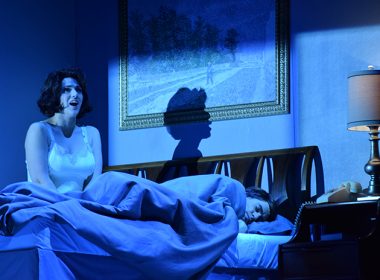
AUTS’ ‘Into the Woods’ offers comical and action-packed escapism

Lately, it seems we’re all forced to face a little darkness every day. When the sun sets at 4 p.m., and January feels never-ending, students can use a good chuckle and a few dance numbers—all of which the Arts Undergraduate Theatre Society (AUTS) provides in spades with its wonderfully charming rendition of Stephen Sondheim’s Into the Woods (1989).

Before the play even begins, Katie Miller’s set design is striking, its grandness and whimsy filling  Moyse Hall. While often underappreciated, set design can make or break an audience’s immersion, and here the set does not disappoint. The homes of Cinderella (Sunny Sheffman), the Baker (Cathal Rynne) and his wife (Emma Corber), Jack (Matt Milton) and his mother (Maya Lewis), all evoke the musical’s eccentric, though gloomy, Brothers Grimm motif.

Unfortunately, the costume design does not fit the set’s aesthetic. Hip and flashy, almost none of the costumes fit the dark, fantastical theme of Into the Woods. From Eva B sweaters, to ‘90s-styled sneakers, to bright socks of every colour in the rainbow, these costumes are a bold production choice and ultimately poor addition to the play. There are exceptions, however, including Rapunzel’s Prince (Eddy Yang), Cinderella’s Prince (Alexander Grasic), and Little Red Riding Hood (Claire Latendresse), whose costumes amuse without distracting from the setting.

The rest of the production’s technical work is amazingly quick and creative, the most prominent example being when the Wolf (Lucas Amato) disguises himself as Little Red Riding Hood’s grandmother. Befittingly reminiscent of moments from The Rocky Horror Picture Show, a screen obstructs the actors so that they can only be seen through animated dancing shadows.

Melissa McCracken’s choreography is another strong point of Into the Woods. The dancing is in sync, precise, and playful, particularly in the song “Ever After.” The quick and whimsical nature of the performance’s dances follow the music closely, at some points feeling as if the musicians and actors are part of the same mind and body.

Ben Barton Creelman’s outstanding musical direction allows the musicians to stay in sync with the actors. Even with only 12 musicians, Creelman’s musical ensemble sounds like that of a much larger orchestra, delivering a vivacious and lively tune for every scene. Nevertheless, the music would not be as magical without the actors’ impassioned singing. Almost every actor fills the room with their voice, especially in the duet, “It Takes Two.” Corber and Rynne take the song’s rather drab lyrics and sing it in perfect key, conveying the sense that perhaps their characters are truly in love.

Through a constant delivery of humour, an effective technical background, impressive instrumentation, and expert singing and dancing, AUTS’ production is a lively and cheerful rendition of the Sondheim classic.

Into the Woods is presented at Moyse Hall from January 25 – 27 and February 1 – 3, with performances beginning at 7 p.m. Tickets can be purchased online at autstheatre.ca

Editorial, Opinion

Task Force on Respect and Inclusion must start and end with student experiences

The Principal’s Task Force on Respect and Inclusion held an open forum on Jan. 24. It was the first of a series of student consultations about diversity and respectful expression at McGill, and how to best ensure that student life is inclusive of all students. The Task Force is to submit a final report of its findings to the McGill administration on April 27.

After a Fall 2017 semester marked by allegations of anti-Semitism on campus and Students’ Society of McGill University (SSMU) infighting—all falling along familiar fault-lines—as well as provincial legislation targeting female Muslim students, it’s easy to be skeptical of the promise of an administration initiative purporting to make campus a nicer place. Compared to other schools’ recent attempts to address tolerance and free expression more explicitly, the Task Force’s mandate to “operationalize McGill’s core principles” reads broad and ill-defined.

But, the issue of respectful, inclusive debate on university campuses is extremely broad and inherently ill-defined. It demands grassroots consultation and investigation, not top-down statements of principles—the University of British Columbia’s middling and widely-criticized statement on free expression has done little to mitigate campus divisions on the subject. The McGill Task Force presents a platform for discussion about what inclusivity on campus actually means, for all students and student groups—including and especially those whose voices are not often heard on campus. While it’s unclear what the initiative will ultimately accomplish, the Task Force correctly understands that Canadian universities must consult students first and foremost if they are to increase tolerance and inclusion on their campuses.

McGill is not alone in attempting to address these issues. Recent controversies blurring the lines between free expression and bigotry on campuses have prompted other North American schools to speak up in defence of free speech, to varying reception. The University of Chicago’s renunciation of safe spaces made waves in August 2016, while the University of British Columbia’s statement has been criticized across the political spectrum.

Such statements only reiterate the same, exhausting impasse that the debate on campus tolerance and free expression keeps coming up against: The value of free speech versus the value of safe spaces. Convening a task force may be a strategic PR move, but to the McGill administration’s credit, it also demonstrates a willingness to listen before speaking out, and at least an attempt to understand the contours and consequences of inclusivity on campus as told by its most important stakeholders—students. Given McGill’s varied track record when it comes to student outreach and consultation, that initiative should be commended.

For the Task Force to succeed in elevating student voices, it must encourage and include all student voices.

For the Task Force to succeed in elevating student voices, it must encourage and include all student voices. That requires amplifying those voices typically sidelined by more pervasive campus issues. Student groups embroiled in the Boycott, Divestment, and Sanctions against Israel (BDS) debate can and should use this platform to share their perspectives. At the same time, conscious effort must be made to include students with experiences of exclusion that are not often at the forefront of campus debate. If the Task Force wants to start a comprehensive discussion about free expression and respect at McGill, it is integral to include LGBTQ+ students, Indigenous students, students of colour, and other underrepresented and marginalized communities on campus in this conversation. Identifying areas on campus that are consistently less inclusive than others—organized drinking events are one timely example—is likewise essential.

Moreover, students themselves must be open to participating in that discussion. The Task Force is a good first step on the McGill administration’s part toward bettering the spaces that we learn and debate in, and understanding student experiences with them, but these efforts cannot end with its conclusion. Respect and inclusion on campus fundamentally come down to the actions of students themselves. Whatever principles a school aims to maintain, campus culture is ultimately a product of the campus community that lives and shapes it.

Watch McGill students reflect on inclusion and respect on campus here:

Features

Learning to learn

During exam season, endless streams of students file into McGill’s Tomlinson Fieldhouse, their heads bent low over their notes, desperately cramming crucial information into their minds. They spend hours studying with cue cards, storyboards, mind maps—anything to help them remember for the duration of their exams and then to forget.

On McGill’s website, the “About” page lists “10 Points of Pride” including the University’s competitive advantage among peer institutions, and recognizes “the finest students” as those who earn “prestigious awards and prizes for academic and athletic achievement.” This is likely the first impression of the school for many potential students, and it is immediately clear that McGill values education as performance and competition over curiosity and learning.

McGill is unquestionably an academically stimulating environment, owing its reputation to its 50 research centres and institutes, its variety of academic programs, and its rich history. McGill’s prestige has allowed it to secure top spots in national and international rankings.

Despite this reputation, the learning experience for many students at McGill is hindered by the stifling effects of high-stakes tests. In 2003, the McGill Journal of Education published a critique of standardized testing, claiming that it was ineffective at revealing potential, and useless at measuring progress.

Yet, 15 years later, large-scale assessments continue to dominate our course frameworks. The majority of courses at McGill follow a well-known grading scheme, comprised of a few quizzes or assignments, a midterm, a term paper, and a final exam. This structure is useful to objectively measure scores through brute comparison, but neglects the notion that all students learn and express themselves and their intelligence differently. Knowledge is broadly seen as an external force which professors can quantify and categorize to evaluate their students.

Alicia Barry

Alicia Barry, U2 Arts, balances her schoolwork with creative writing and has published her poetry in the student publication F Word for the past two years.

“Our evaluation scheme is not a determinant of our intelligence or capabilities,” Barry said. “Measuring how much one can memorize will not effectively help them learn in the end. To throw everything you learned in one semester into a three-hour exam is unrealistic and meaningless.”

Not only do high-stakes tests erase the deeper meaning from learning, but they are also detrimental to students’ mental health. Canadian campuses have seen a significant increase in students with anxiety, depression, and suicidal ideations. According to a 2017 survey of students at 15 Canadian universities conducted by the Toronto Star and the Ryerson School of Journalism, campus mental health offices have seen a 35 per cent increase in the demand for their services over the course of the previous five years. Last year, a survey by the Canadian Association of College and University Student Services also revealed that 13 per cent of students said they had seriously considered suicide, 3.5 percentage points more than three years earlier. According to Barry, the academically-demanding atmosphere at McGill contributes to students’ mental health troubles.

“I feel like, going to McGill, there is this sense of ‘you need to do well, or else you’re not going to succeed,’” Barry said. “There is this immense pressure to perform academically, with this highly competitive spirit, so my motivation is kind of this self-loathing that I need to do well in this or I won’t amount to anything in life.”

“We’re lifelong learners, and we have to be flexible learners.”

Susanne Lajoie

Susanne Lajoie, Canadian Research Chair Tier 1 and Educational and Counselling Psychology professor at McGill University, is an expert in the development of advanced learning technologies. Lajoie is interested in the ways in which emotions can enhance the learning experience. Lajoie views education as an ongoing process rather than as a one-stop venture.

“Anyone who is in university today knows that, even when you graduate, there is so much information that is ongoing and updated,” Lajoie said. “You have to keep learning your whole life, it does not stop when you graduate.”

The educational system is intended to prepare students to make their place in a world which is changing faster than ever before.

“The most important skill in the 21st century is learning to learn, and that’s where the notion of creativity comes into play,” Lajoie said. “We’re lifelong learners, and we have to be flexible learners.”

By relying so heavily on one-size-fits-all testing methods, McGill restrains students’ potential and makes them less adaptable to new environments. Instead of learning through interest, students learn through fear.

Lajoie uses different theories of learning and emotions to create new forms of technology to improve teaching and learning in different domains. She is currently developing a simulation which acts as a virtual hospital experience, where McGill medical students receive imaginary patients and must formulate diagnoses. Facial movement detectors and electrodermal bracelets measure users’ confusion, nervousness, stress, surprise, and other behavioural emotions relevant to the context of learning, to establish the relationship between their emotions and their performance. The simulation assesses learning through a unique and dynamic process and provides ongoing feedback.

“One of the best ways for teachers to create interest is by providing choice,” Lajoie said. “[It is important to offer] different types of assignments that are still equivalent in terms of grading but have different avenues to immerse [students] in the material.”

“Arts-based critical practices help interested students stay on top of course content, explain what they have learned, and experiment with engaging, interactive, and accessible forms of expression.”

Hayley Mortin

Hayley Mortin, U3 Arts, currently feels that her classes do not offer enough of a variety of assignments. Outside of her studies in psychology, she paints, draws, and is affiliated with groups such as the Fridge Door Gallery and folio magazine.

“It’s nice that there are those little pockets [of creative activity], but it’s very statically separated from academics,” Mortin said. “I often think to myself as I leave the library: ‘Now I’m going to go do something creative.’”

Mortin’s favourite course at McGill is ANTH 408, or “Sensory Ethnography,” because of the unique way in which it is taught. The class gives students space to choose their preferred method of learning, and create projects using film, photography, and sound.

“Having the choice to begin with is completely imperative to how well I’m going to do in the course, to be honest,” Mortin said. “It doesn’t need to be big, a five per cent assessment can make all the difference in helping students realize the meaning behind the course material.”

Professors also see the value in adopting divergent testing methods.

Casey McCormick

Casey McCormick is a course lecturer in the Department of English at McGill, and recently completed her dissertation on the history of television finales for her PhD in Cultural Studies.

“I definitely had a very traditional education at Georgia State University,” McCormick said. “All of my assignments were very, very similar academic papers [….] I lost my creative voice as a writer. I wish I had more opportunities to do different kinds of writing.”

According to a 2016 survey conducted by Adobe across the United States, United Kingdom, Germany, France, and Japan, 65 per cent of students agree with McCormick and believe that their university stifles their creativity.

“I felt like it sucked out the creativity from my writing style, and it wasn’t until I was deep into my PhD that I got my creative voice back,” McCormick said.

Since completing her PhD, McCormick has aimed to move away from writing academic papers and toward arts-based critical practices, by utilizing multimedia to frame arguments.

“Maybe I [wouldn’t] have felt so burnt out [by] academia if I was exposed to these different expressive forms,” McCormick said.

McCormick keeps her own university experience in mind when trying to create dynamic modes of engagement in her classrooms. In addition to incorporating blogging, Twitter hashtags, and Facebook discussion groups into her courses, she also introduced the Social Media Artifact assignment to McGill as part of the course ENGL 391, or “Special Topics in Cultural Studies: Netflix,” in 2016. The assignment puts students to the task of analyzing course content through social media platforms such as Instagram and Tumblr. Artifacts are assessed based on creativity, mechanics, and relevance to the course material.

“Overall, the response from students has been very positive,” McCormick said. “Many people talk specifically about the online component as refreshing and engaging. Of course, it’s not going to work for every single student, that’s why it’s hybrid, why I offer a wide range of spaces to make students feel comfortable.”

Arts-based critical practices help interested students stay on top of course content, explain what they have learned, and experiment with engaging, interactive, and accessible forms of expression. To structure her grading scheme, McCormick gives students a wide range of assignments so that they have multiple opportunities to succeed. She weighs most assignments in the 10 to 25 per cent range to relieve pressure on students.

“That’s one of the purposes of having so many different kinds of assignments, it’s so that students can learn to learn in the way which suits them best,” McCormick said.

“I learned that learning and torture are not the same thing.”

Brayden Culligan

Brayden Culligan, U3 Arts, has discovered the benefits of creative learning both in and out of the classroom. Over the course of his time at McGill, he has worked with several organizations, including the McGill Office of Sustainability, to help inform and engage their audiences through multimedia. In Fall 2017, he took CCOM 314, or “Communicating Science,” which gives students an opportunity to communicate scientific problems through a variety of creative multimedia projects, such as podcasts.

Adobe’s 2016 survey revealed that 69 per cent of students believes that being creative like the projects included in CCOM 314 call for, helps make people better workers. Culligan thinks that if a larger variety of testing methods were implemented at McGill, the positive impact could extend far beyond the classroom.

“I find creative expression to be more enjoyable and a better way of learning,” Culligan said. “The conversation about the value of creativity in everyday life is an important one. I hope it encourages someone to pick up the paintbrush, keyboard, or whatever they’ve been putting down for too long.”

Nikolas Provatas

Nikolas Provatas, Canada Research Chair in Computational Materials Science and Engineering Tier 1, was also inspired to explore creative learning methods as a result of his experiences as a student in higher education. When an undergraduate student in the class of 1988, he found the learning experience confining.

“Back when I went to school, you worked alone and didn’t ask any questions because you didn’t want to look stupid,” Provatas said. “[I] suffered in absolute silence and alone. I felt it was my fault. At some point when I started to be self-sufficient, solve my own problems, figure things out, I realized it was because I was cutting through the opaqueness that teachers threw at me. I learned that learning and torture are not the same thing.”

Provatas now teaches undergraduate and graduate courses in physics at McGill, and runs the annual McGill Physics Hackathon. He launched the Hackathon in 2016 and it became an immediate hit. The Hackathon gathers fanatics of the discipline in a 48-hour sprint to solve problems in computational physics. It uses the same principles of teaching, but provides no university credits. Students participate and learn not because they are forced to, but because they enjoy the challenge.

The 2017 Physics Hackathon gathered elementary, secondary, and university students in a welcoming environment encouraging creativity, collaboration, and discovery. Judges evaluated students on whether they could understand the assigned problems, if they had the programming skills to debug code, and if they could sell their ideas to a panel of judges from academia and industry.

Provatas created the Hackathon as an antidote to his own discouraging experience as a student in higher education.

“I vowed to myself that if I were to ever become a [professor], I would throw away the archaic system of learning,” Provatas said. “I have known professors who said that students are meant to suffer. To me, it was a sort of therapy to make sure this system isn’t transferred to the next generation.”

The opportunity provides tangible outcomes for them to create original software, win prizes, connect with tech recruiters, and get a glimpse of the tech industry.

“I like to think of learning as a kind of play,” Provatas said. “In terms of atmosphere, it’s been electrifying,”

Students would greatly benefit from McGill creating more opportunities for students to directly embrace their passions. As students discover their talents and interests, they should be able to pursue them without feeling restricted by curriculum boundaries. Courses at McGill need to catch up to increasing demands for interdisciplinary learning from students and experts in the field.

“At the end of the day, we’re here to have fun, and there are no stupid questions,” Provatas said. “If you’re struggling, don’t worry, everyone is struggling.”

There are more creative approaches to learning than crowding students into a massive room, rushing them through an exam, and having the results determine even a fraction of your future.

“The best thing we can do is provide a relaxed and yet competitive atmosphere motivated by problem solving,” Provatas said. “Learning as fun.”

Arts & Entertainment, Film and TV

The most egregious snubs of the 2018 Oscars

The Academy Awards are awful. This is not up for dispute. They’re trying to get better—this year’s nominees present a definitively more inclusive list than in years past—but at its heart, the event is a self-congratulatory, out of touch, typically-discriminatory money grab that almost always awards the wrong thing. Nevertheless, it will inevitably elicit coverage from every media outlet that also denounces the ceremony on the aforementioned grounds. Talking about movies is fun. So, without further ado, The McGill Tribune has compiled a list of the most glaring snubs from this year’s nominations.

Best Foreign Language Film: Raw (France, dir. Julia Ducournau)

In her feature-length directorial debut, Julia Ducournau spins a grisly and emotionally-charged coming-of-age tale. Garance Marillier plays Justine, a vegetarian freshman at veterinary school who is forced to eat a raw rabbit kidney in a hazing ritual, and soon begins to develop a craving for flesh.

Raw is truly the best descriptor of the actors’ candid performances (particularly Marillier’s), the cold and derelict interiors of the campus’ buildings, the kinetic and claustrophobic cinematography, and the unflinchingly gruesome portrayals of Justine’s metamorphosis. With a slow pace and sparse dialogue, Ducournau  makes a bold statement about the pain and trauma of loss of innocence in a society that treats women as objects without desires.

Best Animated Short Film: World of Tomorrow Episode Two: The Burden of Other People’s Thoughts (dir. Don Hertzfeldt)

Kobe Bryant was nominated for this award. 81-points-in-a-game-Kobe Bryant. Settled-rape-allegations-out-of-court-Kobe Bryant. Nominate literally anyone instead of Kobe Bryant, but especially nominate Don Hertzfeldt. If World of Tomorrow Episode Two: The Burden of Other People’s Thoughts sounds like a lot for a title, the film’s ideas are also a lot for its 23-minute runtime. Akin to its brilliant predecessor, Episode Two takes the unscripted dialogue of Hertzfeldt’s five year-old niece, Winona Mae, as the launching pad for a ridiculous, life-affirming odyssey through memory, grounded in the experiences of Emily Prime (Mae) and her clone (of a clone of a clone of a clone, from the future) (Julie Potts). Mae for Best Actress is another blurb entirely. Episode Two finds Hertzfeldt perfecting his signature blend of childlike wonder, affectless stoicism, and iTunes visualizer-level backdrops. It lands in a good spot somewhere in the vacuum between Kubrick, Adventure Time, and Camus.

Best Original Song: The Pure and the Damned – Oneohtrix Point Never (feat. Iggy Pop) (from Good Time)

As funny as a Sufjan Stevens (Call Me By Your Name) acceptance speech would be, there’s no way it could top an Iggy Pop acceptance speech. Good Time’s “The Pure and the Damned,” produced by Oneohtrix Point Never with lyrics by Iggy, is a beautiful, shattering piano ballad that accompanies the best final scene of 2017. The song takes the template of Johnny Cash’s “Hurt” (old singing man and younger producing man), and ups the weird ante with minimalist piano and wacky synths. The fantastically terrifying video uses non-film footage featuring an extra veiny CGI Iggy Pop, a bloodied wolf puppet, and Robert Pattinson wearing what looks to be a counterfeit sleeveless Baltimore Ravens/Orioles shirt.

Best Original Screenplay: Wind River  (dir. Taylor Sheridan)

The final installment of Taylor Sheridan’s American Frontier trilogy (following 2015’s Sicario and 2016’s Hell or High Water) was woefully forgotten after receiving an eight-minute standing ovation at Cannes. The crisp cinematography, Nick Cave-scored soundtrack, and chilling performances by Elizabeth Olsen, Gil Birmingham, and Jeremy Renner, make it a seemingly obvious contender. A neo-Western set in a blizzarding Wyoming stage, Wind River documents the investigation of the brutal homicide of a young Native American woman. Sheridan uses this singular event as a microcosm to the larger issue of missing and murdered Indigenous women. In the wake of the #MeToo movement, the inclusion of this narrative would have been incredibly powerful.

https://www.youtube.com/watch?v=zN9PDOoLAfg

Best Documentary: Casting JonBenét (dir. Kitty Green)

Casting JonBenét made a splash when it first came out last April, but deserves more official credit than the 15 minutes of fame it received. Unlike the dozens of other JonBenét Ramsey films, Casting Jonbenét offers a multiplicity of narratives that expose and support each other to uncover new layers of understanding about the mysterious 1998 murder of the American six-year-old beauty queen. The documentary films the interview and audition process of these actors trying out for the roles of JonBenét’s nuclear family using local actors who remember the event when it occurred. As these individuals are questioned about their own theories of the murder, the documentary lays bare America’s obsession with cold cases and biases towards the creation of the perfect suspect.

Best Picture: “Una” (dir. Benedict Andrews)

In Benedict Andrews’ adaptation of David Harrower’s play Blackbird, Rooney Mara stars as Una, a young woman who confronts her childhood neighbour and abuser, Ray (Ben Mendelsohn, of Rogue One: A Star Wars Story). Set almost entirely in an empty factory warehouse, “Una” plays out like an intricately choreographed dance between Mara and Mendelsohn, wandering through a labyrinth of corridors and storage rooms as they revisit the painful and murky past. Andrews refreshingly avoids stereotypes of the helpless victim and remorseless predator, instead crafting a believable and heart-wrenching (albeit toxic) relationship between the two characters.

After a year when sexual harassment and violence have been at the forefront of popular discourse, “Una” is potent and relevant, boldly exploring the blurred lines of consent, healing from abuse, and reclaiming one’s self-worth.

Best Actor: Robert Pattinson in Good Time (dir. Josh and Benny Safdie)

Aside from being perhaps the most underrated and spectacular movie of 2017, the Safdie Brothers’ Good Time brought us the year’s best performance from the most unlikely of indie movie stars. Good Time is a manic take on the classic New York street thriller, and Robert Pattinson’s leading turn as sociopath criminal Renaissance man Constantine Nikas is the film’s furiously beating heart. Pattinson spends the movie carefully balancing Connie’s unflinching manipulative cool with a subtly accumulating sense of desperation. The result is a masterful performance which holds together an invigorating and understatedly moving thriller. After Good Time, Pattinson deserves to be remembered as the inventive talent that he truly is, rather than just a teen vampire hunk. The Academy should recognize as much.

Science & Technology

Meet the virus responsible for this year’s deadly flu outbreak

As January comes to a close, the seasonal flu once again runs rampant across campus. The Centers for Disease Control and Prevention (CDC) under the U.S Department of Health and Human Services has deemed the 2017-2018 flu season as the worst in almost a decade. In North America, flu season typically occurs between the months of October and May, peaking in January or February. In Canada alone, this season has seen 24,749 positive cases and 110 deaths confirmed as of Jan. 20, according to the Canadian FluWatch report.

The viruses currently circulating include the Influenza A strains H3N2 and H1N1 and two lineages of influenza B strains, B/Yamagata and B/Victoria. A and B strains differ based on the hosts that they infect, with A strains infecting both humans and animals and B strains only affecting humans. H3N2, the most dangerous strain in circulation, is notorious for the severity of its symptoms and is responsible for the high death toll of this year’s flu season. According to Maziar Divangahi, assistant professor of Medicine at McGill, the reason behind H3N2’s severity lies in its origins. Zoonotic viruses—those transmitted from animals to humans—are initially more dangerous, and gradually become less severe after passing through the human population.

“This is kind of an evolution, and any virus that suddenly comes from animals [and can be transmitted] to humans is very pathogenic,” Divangahi told The McGill Tribune. “But if it gets passed on and on to the humans, then it becomes a seasonal flu [….] If you want to predict the severity [of each coming flu season] you have to look at this cycle, how [it] could continue, and [how it] could be prevented.”

Observing these cycles and the prevalence of different influenza strains around the world is crucial to the development of vaccines, which are typically cultivated in chicken eggs. Influenza vaccines introduce weakened strains to the body, allowing a person’s immune system to create antibodies that, in the event of exposure to the real disease, combat infection.

Despite the fact that H3N2 is included in each year’s flu vaccine, its mutation rate is very high. As a result, wild viruses differ greatly from the ones grown in labs that are used to make vaccines.

“H3N2 doesn’t grow very well in chicken eggs, […] so when you have a season of flu by H3N2, your vaccine is not very protective,” Divangahi said.

According to the CDC, the current vaccine for H3N2 viruses is only 33 per cent effective, while vaccines for influenza B viruses are effective 54 per cent of the time. Mutations within the H3N2 strain also alter its protein structure, making the virus more harmful. Under normal circumstances, the human body traps flu viruses in the upper airway—but H3N2 has developed the ability to penetrate the lungs, which causes an extreme reaction to the virus from the immune system.

“When people get really sick it’s not because of the virus, it’s because of your [dysregulated] immune response,” Divangahi said. “You’re not supposed to have the virus deep in your lungs, and [this causes] the immune response to go nuts. It says, ‘Well, what’s going on here.’ […] We need to find out the timing and the regulatory mechanism that could shut that down.”

As the race to develop an effective vaccine continues, Divangahi’s lab is looking into developing drugs that suppress the immune system’s intense reaction to infectious diseases such as influenza and tuberculosis.

“A vaccine for influenza definitely is the ultimate goal, but we still need more time to generate an effective vaccine for every single strain of the virus,” Divangahi said. “[Until then], can we find a targeted therapy to regulate these immune pathologies?”

And, more importantly, can we find it before it’s too late?

Commentary, Opinion

Your freedom to disagree does not guarantee you the right to public funds

On Dec. 15, Prime Minister Justin Trudeau’s Liberal government announced changes to the Canada Summer Jobs funding application to ensure that applicant organizations support LGBTQ and reproductive rights. This action sparked outrage from the New Democratic Party (NDP), religious groups, and free speech advocates alike.

After mass condemnation from across the political spectrum, the Liberals simplified the guidelines on the application website. While the attestation remains in place, the party clarified that an organization that does not support gay marriage or abortion may still receive funding, as long as its activities do not actively seek to infringe upon an individual’s rights. However, in order to secure funding for summer positions, an organization would have to attest that it supports reproductive and LGBTQ rights. What critics fail to realize is that the government is under no obligation to fund organizations that will promote an anti-human rights agenda.

Trudeau has enforced a staunch pro-choice Liberal party platform since his election in 2015, but this most recent move transcends party lines, because it also prevents Conservative and NDP members of parliament from financially supporting anti-abortion groups in the Summer Jobs program. As a result, the Liberals make it clear that support for these rights should no longer be concentrated in feminist and gay rights groups, but is to be expected of any organization. This further prioritizes reproductive and LGBTQ rights as human rights—as they are already defined by Canadian law—boldly advancing these long-marginalized causes.

Some have argued that forcing attestations of support will lead to a chilling of the debate surrounding reproductive rights, and could lead to the censure of other groups that do not toe the Liberal party line. However, the issue cuts to the heart of a much larger debate surrounding reproductive and LGBTQ rights in Canada. For decades, one’s right to a safe and legal abortion has been restricted to the sphere of women’s rights, separate from broader notions of human rights. The same applies to LGBTQ rights. It was easy in the past for socially conservative groups to exercise their right to free speech, while simultaneously discriminating against LGBTQ people or campaigning against reproductive rights. But, by encompassing women and the LGBTQ community—and their distinctive rights—into the concept of human rights, Trudeau reshapes the conversation.

Those concerned with the free speech and personal conscience implications of the changes should recognize that this new attestation does not silence the many communities who are anti-abortion or anti-LGBTQ. The ability to personally oppose abortion and LGBTQ rights remains legally protected in the right to freedom of belief. However, acts of restricting access to an abortion clinic or discriminating against LGBTQ patrons are not. An organization should not receive funding for a program that could violate another Canadian’s human rights, be it their right to marry or their right to receive an abortion.

What critics fail to realize is that the government is under no obligation to fund organizations that will promote an anti-human rights agenda.

The line between speaking out against something and actively campaigning against it is often blurry and ill-defined. It is difficult to distinguish, for example, between an organization that distributes anti-abortion pamphlets from a group that pickets abortion clinics. The point at which debate and attempts at conversion become harassment and impediment is unclear, and falls under the purview of the courts. However, it is well within the right of the federal government to refuse to fund an organization that denies certain citizens of their human rights.

Joyce Arthur, executive director of the Abortion Rights Coalition of Canada, remarked that she was content with the clarifications that the Trudeau government made to the application.

“I think that if a group still feels that they cannot sign the attestation even with these clarifications, well, I guess they are ineligible for funding,” Arthur said.

For some organizations, it is a matter of principle or religion that they do not support reproductive and LGBTQ rights. They are free to do so. However, their freedom of thought does not guarantee them federal funding to advance programs that infringe on other Canadians’ human rights.

Sydney King is a U1 Political Science major. She is perpetually debating dropping out and going to culinary school.


Read the latest issue

Read the latest issue