Latest News

Arts & Entertainment, Internet, Music

VMAs? More like Tate McRae concert

The 2025 MTV Video Music Awards (VMAs) aired on Sept. 7, featuring stunning looks, heartfelt speeches, and star-studded performances. Out of 13 impressive numbers, one stood out from the rest: Tate McRae’s. Her showstopping performance solidified her status as the best dancer in the music industry.

Accompanied by a group of dancers, Tate McRae performed a mashup of “Revolving Door” and “Sports Car,” two songs off her latest album, So Close to What, with choreography by Robbie Blue. The number begins with more conceptual choreography as McRae and her dancers demonstrate their flexibility, contorting themselves into seemingly impossible shapes. It then concludes with a complex dance sequence: McRae steps onto a sand-covered stage, where every movement sends dust scattering artfully around her and her dancers. The VMAs’ performance-heavy format can become tiring to watch, but McRae’s act broke the evening’s monotony, captivating the attention of at-home viewers and celebrities alike. From lifts and splits and fire to sand, she left viewers in awe. 

For those familiar with her background, McRae’s level of excellence was not a surprise: Tate McRae was a household name in the dance world before she became one of today’s rising popstars. As a child, she trained at the Professional Division of the School of Alberta Ballet, one of Canada’s top ballet schools. She holds some of the most coveted titles in the dance world, winning silver at the Youth American Grand Prix  in 2015—the largest ballet competition and scholarship audition in the world. The star also won the American National title of Best Dancer at The Dance Awards three times: As a mini (2013), a junior (2015), and a teen (2018). She even participated in So You Think You Can Dance: The Next Generation at age 12, placing third against the best of the best child dancers in the United States. As one of the most decorated child dancers in the industry, many view Tate McRae as a dance prodigy.

This professional training was on full display in her VMAs performance last week. While other performances included dances as part of their musical acts, no choreography came close to matching the difficulty and precision demonstrated by McRae and her dancers. Both Sabrina Carpenter and Lady Gaga, for example, performed the viral choreography from their respective music videos. Carpenter recreated the “dance break” in the music video for her song “Tears,” completing a series of jazz-like steps. Similarly, Lady Gaga’s performance incorporated the iconic moves from her music video for “Abracadabra,” which consists largely of upper-body movements to imitate a monster-like figure. When viewing these performances alongside McRae’s, it becomes apparent that Carpenter’s and Gaga’s dances are far more rudimentary. This is not to say that simplicity is bad. In fact, it’s their dances’ simplicity that allows them to become viral trends, as fans can easily replicate the routines. TikTok users, for instance, frequently recreate the dances from both “Tears” and “Abracadabra,” thereby circulating the songs and increasing their popularity. 

While virality is certainly appealing to most artists as it expands their outreach, what makes Tate McRae’s performance stand out is its unachievable nature. McRae’s routine is not something the average person can recreate in their living room without breaking their backs (and probably taking some furniture out with them too). The mastery required for McRae’s performance creates a satisfying contrast to the night’s more basic performances, making her the obvious standout.

Ultimately, 2025 VMA performers like Sabrina Carpenter and Lady Gaga are singers who can also dance. Tate McRae, conversely, is a dancer who also sings. Tate McRae’s performance last week was career-defining as it separated her from other popstars, proving that she is in a league of her own.

McGill, Montreal, News

Student unemployment is steadily increasing in Canada

Desjardins economists Kari Norman, LJ Valencia, and Randall Barlett published a report on Sept. 4 explaining the recent, rapid increase in youth unemployment rates in Canada. The unemployment rate for all youth has increased from 10 per cent in 2022 to 14 per cent in mid-2025. The burden has fallen particularly heavily on 15- to 19-year-olds, with one in five of those willing to work unable to find a job.

Canada’s National Council of Unemployed Workers (NCUW) is an organization working to promote the rights and privileges to which unemployed workers are entitled. Milan Bernard, co-spokesperson of the NCUW and lecturer at the Département de science politique at Université de Montréal, expressed in a written statement to The Tribune that although he has not observed a sharp increase in young people reaching out to the organization, the rising unemployment rate among youth is still concerning.

“We have not seen a difference in the profile of people coming to our offices for help with Employment Insurance (EI),” he wrote. “[Nonetheless], it is alarming to see that unemployment rates are so high for young people. It is not a good sign for the economy.”

The Desjardins report outlined that the youth unemployment rate is now at a level typically only seen during economic recessions. Bernard emphasized how in periods like these, young workers may find it especially difficult to access unemployment resources.

“It is often harder for young workers to qualify to get EI benefits, because of the admissibility criteria,” he said. “It is something that we have called on the government to address, especially in the current context with the [United States] trade war and economic instability.”

In an interview with The Tribune, Caroline Menton, U1 Science, explained that finding a job in Montreal may be especially difficult for anglophone students at McGill because of the language barrier.

“Most entry-level jobs are public-facing, and employers obviously require French for a customer service job,” she said.

Menton also described students’ lack of awareness around and access to McGill resources when it comes to helping youth at the university secure employment.

“I wasn’t even aware McGill offered help with [job searches],” she said. “For any of my friends that were looking for jobs at any point, I never heard them mention using any McGill resources. [….] If anything, [McGill] could advertise those more, if they [even] exist.”

Currently, the McGill Career Planning Service (CaPS) supports students with career advancement and leadership development. Through activities like Career Fairs, workshops, and advising services, CaPS oversees a range of internship, part-time, and full-time opportunities for students in search of employment.

Midnight Kitchen (MK) is a nonprofit collective that works to increase food accessibility on McGill campus and across Montreal. In a written statement to The Tribune, a representative from MK noted that they have observed a recent increase in the number of people attending their programming, though rising youth unemployment is not necessarily a factor.

“Since the University Centre has re-opened, we have seen a large increase of service users,” the representative wrote. “Our service has also expanded with our capacity and outreach over the years.”

MK then mentioned the many other McGill food groups available to support students who are experiencing financial difficulties.

“McGill has been described as a food desert—with limited groceries and affordable food options on and surrounding the campus,” the MK representative wrote to The Tribune. “There are many […] great student food groups looking to build the McGill Food Coalition, an accessible food system at McGill that does not rely on the corporate food services contracted by McGill.”

MK concluded by highlighting how its new structure has been designed in part to help open up more opportunities for unemployed students.

“We know from speaking with students […] that it can be very difficult to find a job for a variety of reasons, such as language barriers, scheduling restrictions, and required experience as the job market becomes more and more competitive,” the representative wrote. “Over the summer we worked on a new structure that would allow for more part-time positions, with some being open only to students. With this new structure, we are able to hire more students, and hopefully increase student engagement.”

Sports

Know Your Team/Tournament Recap: Varsity Golf

Earlier this week, the Martlets and Redbirds Varsity Golf Team travelled to La Bête Golf Club in Mont-Tremblant to compete in their second Réseau du sport étudiant du Québec (RSEQ) competition of the season. The Redbirds finished fourth out of the nine competing universities in their division, while the Martlets finished third out of six.  

The Redbirds kept pace with the results of their first RSEQ outing in August, with Sept. 9’s successes led by Benjamin Blanshay, who recorded 232 strokes across the circuit. Blanshay was closely followed by his teammate, Adley Abols, who finished with a score of 234. Abols recorded the first and only hole-in-one in Redbirds history last season as a rookie. 

It was also an exciting tournament for the Martlets. Second-year star Astoria Yen had a fantastic outing, finishing the tournament as a co-winner. She shot 233 strokes over three rounds, becoming the first-ever Martlet to achieve an RSEQ podium finish. This accomplishment reflects Yen’s already-strong play this year, as she finished third during the August RSEQ tournament. 

In an interview with The Tribune, Yen described her experience achieving a historic result. 

“I didn’t realize until some of the guys came up to me and told me that [I set a school record],” Yen said. “I was just trying to perform and actually do my best to not look at the scores as I go throughout the day. I cannot do anything to change what has already been shot. I didn’t really realize it was such a big deal until after the fact. It didn’t really hit me until a day ago after the tournament ended.” 

Yen also highlighted the recent success and prominence of the Martlets Golf program. 

“Our girls’ team is really developing right now,” Yen stated. “We went from not having a program to something that [Head Coach] Pierre [Brisebois] has tried really hard to build [and] we saw a lot of potential that helped us secure that third place team title.” 

Redbirds golf captain Camden Purboo, who has also represented Jamaica at the national level, discussed the responsibilities that come with being the captain of a successful McGill varsity team.

“Because, as [Yen] said, it is an individual sport, but we play as a team, [helping them know] that the guy beside you or behind you will play for you [is my role],” Purboo said in an interview with The Tribune

Purboo also emphasized the importance of “picking each other up” and preparing for the next hole when a teammate is having a rough day. 

With the Varsity Golf season only being a month long, spanning from August until the end of September, the team is strategic about their training regimen. In a written statement to The Tribune, team member and coach’s assistant Mathieu Sénéchal pointed to the importance of McGill’s golfers working on their mental preparation and gearing up for gameplay scenarios in between RSEQ tournaments.  

Sénéchal continued that when the team is not focusing on the mental aspects of competition play, they travel to La Bête Golf Club, 130 kilometers outside of Montréal, or to a nine-hole course in South Shore. During these sessions, Sénéchal shared that training consists of playing either a nine- or eighteen-hole round, followed by practice on the driving range or short game areas.

“During the rounds, [the] coach comes and sees every player, focusing on different little aspects specific to [individual] needs to get better,” Sénéchal wrote.

With their season ending soon and the RSEQ Championship approaching in less than a week, both the Martlets and Redbirds are in contention for Nationals, and look to excel in the postseason. Sénéchal celebrated the team’s strong and unprecedented season. 

“We have had solid performances from the veterans on the [Redbirds] team, as well as impressive starts from the newcomers, which have put us in this situation,” he wrote. “As for the Martlets, I believe it is one of the strongest teams we have had, and they are showing off their skills quite well. They are determined and focused.” 

It will be exciting to watch McGill’s golf team continue their quest to make school history. 

Features

McGill Athletics’ great divide

McGill’s sports teams face deep inequalities in funding, resources, and recognition

Few universities can claim to have shaped the global sporting landscape as profoundly as McGill has. Among its crowning sports achievements are the first game of organized ice hockey in 1875, the first game of American football in 1874, and the invention of basketball by McGill alum James Naismith in 1891. Since its inception in 1923, the McGill Athletics Department has overseen the coordination of various sports such as volleyball and rugby. 

These milestones, however, are overshadowed by a longstanding issue. In the 1860s, the university introduced pay-as-you-go sports clubs, where participants were responsible for paying the fees associated with the sport they played. More than a century later, this system persists as athletes are forced to shoulder the costs of competition. 

For as long as McGill has had intercollegiate competition sports teams, it has struggled to fund them. In 1970, McGill was running a deficit of $6 million CAD and threatened to cut sports altogether. However, community outrage led to an agreement between McGill University and the McGill Athletics Department to increase athletic fees so that intercollegiate sports at the school could continue. 

A turning point in McGill Athletics’ Varsity Program came in 1997 when, once again, McGill found itself facing dire budget constraints. At the time, McGill Athletics had a whopping 48 varsity teams and was pressured by the university to establish budgetary measures. These included dropping 22 teams—resulting in the 26-team varsity program we know today—and designating varsity teams into ‘Tier 1’ and ‘Tier 2’ categories. Using this framework allowed the university to manage resources and provide more funds, equipment, and media representation to the higher-tiered teams—a system still in place 28 years later. 

This “new age” of sports is reminiscent of the first years of sports at McGill from a financial perspective. However, this now-not-so-new system comes with several negative consequences, one of the most significant being that the success of a team and the amount of funding and resources they receive are inextricably linked. This undeniably inhibits the growth of some teams in favour of others. Which begs the question: Is it time for the tiered system to be reevaluated? 

As a journalist, unbiased conveyance of the truth is my top priority. However, as a varsity athlete who is a part of one of the most underfunded teams at McGill, it is impossible to write this article without bias. Being a student-athlete at McGill University has shaped both my university experience and who I am as a person. I am eternally grateful for the privilege of playing a sport I love at the collegiate level. However, I am disheartened by the inequality that plagues the Varsity Program.

Today, McGill Athletics oversees 26 varsity teams, 10 competitive clubs, and 3 recreational clubs. Of these 26 varsity teams, 10 teams—five women’s and five men’s—have secured the coveted ‘Tier 1’ label. They are the following: Basketball (W&M), Football (M), Hockey (W&M), Soccer (W&M), Swimming (W/M), and Volleyball (W). This leaves 16 teams to fill ‘Tier 2’: Badminton (W/M), Baseball (M), Field Hockey (W), Golf (W/M), Lacrosse (M), Rowing (W/M), Rugby (W&M), Artistic Swimming (W), Track & Field (W/M), and Cross Country (W/M). There is no public information explaining how sports are assigned to Tier 1 or Tier 2, but we can guess that the most popular are chosen to be Tier 1, while less popular sports are pushed into the shadows. 

McGill Athletics has a difficult job. In a written statement, Stephanie Malley, McGill Athletics’ Senior Communications and Marketing Manager, stated that the organization oversees more than two dozen teams. Many of these teams do not compete or train at the McGill Sports Complex and compete in a variety of leagues, all of which have their own rules and regulations. 

“What is really important to consider […] especially when it comes to funding, is that even though McGill Athletics and Recreation is a self-funded unit, we still face the same financial challenges as the rest of the University. This has meant identifying where monies can be saved and implementing austerity measures when needed,” Malley wrote to //The Tribune//. “The resources needed to properly support a team of, for example, 100 student-athletes versus a team of 20 student-athletes will always be different.”

But can McGill Athletics expect the under-funded teams to grow and perform at the same level as teams that have double or triple the number of resources? And is a two-tier system really the best at fostering a supportive and thriving Varsity Program? 

At a minimum, a team must have the resources to scout and recruit talented rookies, stay healthy throughout the year, have a competent coaching staff, and have adequate equipment to be successful in collegiate-level athletics. To check all these boxes, a team must have sufficient funding and resources. If one of these elements is not up to standard, the whole system falls apart. 

A source on the Tier-1 Redbirds soccer team who wished to remain anonymous disclosed that their team fees average around $180 CAD per year for veteran players and $250 CAD for rookie players. Compare this to the Tier-2 Martlets field hockey team, who pay more than $1,000 CAD per player per year. Though team fees are not publicly posted, nor is there any transparency from McGill Athletics about which teams they fund and which they do not, we can expect this same trend to be true for a majority, if not all, of Tier-1 and Tier-2 teams. Beyond the monetary support, men’s soccer, a team of 31 players, has four coaches, one head physician, one athletic therapist, and four student physiotherapists, while field hockey, a team of 22 players, has two coaches, no physicians, no athletic therapists, and no physiotherapists. There is a difference between efficient resource allocation and disregard for athlete safety. 

Beyond essential resources like physiotherapists and equipment, representation in the media is a powerful tool that can greatly impact the success of a team. Frequent and higher quality media representation means more support from fans and alumni—whether monetary or other—along with more effective outreach for recruitment opportunities. Teams that get more attention tend to attract better players, which leads to greater success and, in turn, more attention. Even via Instagram posts, this difference in treatment between Tier 1 and Tier 2 is evident. McGill Athletics advertises its teams mainly through its Instagram, @mcgillathletics, and news articles on its home page. 

By conducting an analysis of McGill Athletics’ Instagram posts throughout the past year (Aug. 23, 2024-Aug. 23, 2025), some key discrepancies arise. Across 312 posts, teams were featured a total of 353 times, as some posts highlighted more than one team. 242 of these features, equaling almost 70 per cent, promoted the 10 Tier-1 teams. Of these features, Redbirds Football and Redbirds Hockey accounted for 15 per cent each, leaving the remaining 40 per cent to be split among the remaining eight Tier-1 teams. 

A plausible explanation for the differences in media representation among teams of the same tier is program success. It could be assumed that teams that are most successful get more media representation because they have ‘earned it.’ However, this is not the case. Redbirds Football had a record of 3–6 in the 2024-2025 season, while Redbirds Soccer had a 10–7–4 record. Despite this, Redbirds Football was posted 35 times, while Redbirds Soccer was posted only 22 times. Why? When I contacted the media representative who runs the Instagram, I was redirected to Stephanie Malley, who provided no answers.

There are similar discrepancies on the Tier-2 side. Redbirds Rugby and Redbirds Lacrosse secured 20 Instagram posts each, while the next most-posted team, Track & Field, had only 12 features. All three of these teams were fairly successful last season, with records of 6–3 and 11–2, respectively, for rugby and lacrosse, and 2nd (M) and 3rd (W) place finishes in the RSEQ Finals for Track & Field. It is not a question of why these three teams were highlighted. However, the inconsistency is visible with respect to McGill’s Artistic Swim Team, which, despite being second in the nation, had a mere four features on Instagram in the past year. 

In a written statement to //The Tribune//, Artistic Swim Team member Reagan Burgmann, U1 Psychology, shared her frustrations with the lack of support from McGill Athletics.

“We receive absolutely no funding from the school and have to fundraise to pay for equipment, clothing, competition wear, and travel […] We receive little-to-no recognition for our consistent high placement at national competitions,” Burgmann wrote. “We are never delegated to other athletic teams to come help volunteer at our events or support us in the crowd, despite the fact that we are consistently asked to do so for others.” 

She added, “It’s not shocking that a small, niche, female-dominated sport often goes unacknowledged by the athletics committee, but I feel that’s all the more reason to be supporting our team–especially considering our strong reputation within the community.”


This is not a unique experience nor a unique feeling among varsity athletes. The Redbirds Soccer source also shared what he thinks regarding McGill Athletics’ lack of transparency in a written statement to //The Tribune//. 

“One area where […]McGill Athletics really needs to improve is its clarity and transparency around the support and financial funding it provides to different teams […] What really highlights the lack of transparency is that there’s no available information about which sports are in which tiers and why they are there.”

He continued: “[McGill Athletics] must take accountability and be transparent about their decision-making to teams and student-athletes. Otherwise, this lack of transparency only reinforces the idea that McGill doesn’t reward success and is more a game of favorites, ultimately leading student-athletes at McGill to the understandable impression that McGill Athletics is one of the most poorly run university athletic programs in Canada due to a lack of funding, organization, transparency, or a combination of all three.”

If McGill’s own varsity athletes feel they cannot trust their management, a great divide is created, not just between Tier-1 and Tier-2 athletes, but between student-athletes and McGill Athletics themselves. This divide will only continue to foster an environment where players must worry more about how they will afford to pay for their next season than about how to win their next match. The lack of equal media representation will further leave athletes in lower-tier sports questioning why they should even try to improve if they will never get the funding or recognition they deserve.

McGill Athletics must be transparent in their resource allocation and adjust their expectations to reflect the simple and unfortunate truth that funding most often equals success. They must take accountability for their tiered system, which guarantees inequality between teams and will only ever stunt the growth of the program. They must give athletes from //every// sport a voice in the management process. And they must start giving credit where credit is due if they want their Martlets and Redbirds to feel proud wearing a varsity M.


Student Life

When campus walls become a canvas

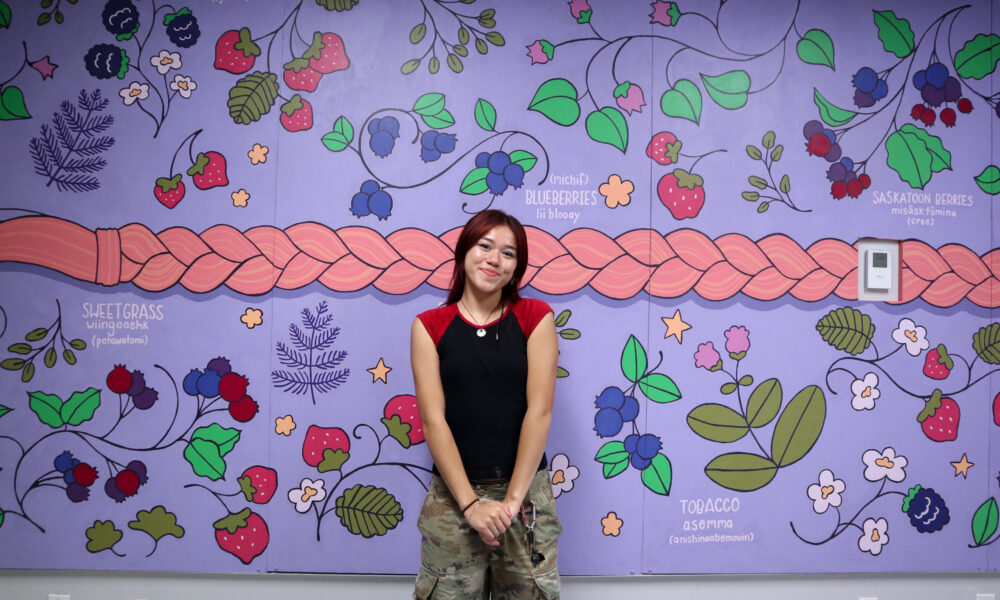
A braid of sweetgrass winds across a purple backdrop in the University Centre’s flex space across from Gerts Student Bar. The mural, entitled “Interwoven,” represents more than vibrant artistic expression—it’s a deliberate effort to establish Indigenous presence in one of McGill’s most frequented student spaces. Zoe Gesaset-Gloqowej Lee, the Chinese-Mi’kmaq artist behind the installation, collaborated with Student’s Society of McGill University (SSMU) Indigenous Affairs Commissioner Delanie Havevrock to bring the project to fruition.

The design is inspired by Lee’s featured article in The Tribune, “A Minor Is Not Enough,” which calls on McGill to expand its undersupported Indigenous studies minor into a durable and meaningful program. The featured art installation centers on strands of sweetgrass—a plant used both ceremonially and medicinally across many Indigenous communities—braided together. 

“We wanted to include a design element that connects all of the visual motifs both in practice and in principle,” Lee explained in an interview with The Tribune. “The sweetgrass ties the whole mural together, being language, community, traditional practices, people, land, and the distribution of those things.” 

Alongside the sweetgrass, the art installation is filled with culturally significant plants like Saskatoon berries, blackberries, and cedar. These elements are labeled in different Indigenous languages, including “Shá:yehse” for blackberries in Kanien’kéha and “Gasgusi” for cedar in Mi’gmaq. Lee deliberately chose elements that reflect the interconnectedness of Indigenous practices while respecting the distinct traditions of different communities.

“We wanted to highlight the diversity across Canada, while also not watering it down into something that was just like a greeting card,” Lee explained, describing the thoughtful approach taken to honour distinct Indigenous traditions throughout the art installation.

The creation process spanned from Oct. 2024 to May 2025, involving extensive community dialogue at First People’s House and collaboration with MU, a Montreal-based mural company, which she worked alongside with for two and a half weeks to bring her vision to life. 

Lee emphasized the collaborative nature of the project. “There’s just been so much input from everywhere. It’s really a community-based initiative.”

Lee noted the contrast between individual support from community members like Indigenous Affairs Commissioner Havevrock and institutional barriers from McGill’s administration.

“There really wasn’t very much support in terms of the administration and the institution,” Lee observed. “It really comes down to the individuals who want to make this happen.”

For Lee, visual representation matters deeply, especially at a university that lacks a visual arts program. “I think visual design really changes a space,” she said. “This is a way to highlight not only the arts, but also Indigenous art and Indigenous creation.”

The mural serves an educational purpose beyond aesthetics. Lee hopes viewers will reflect on “the relationship between land, art, community, and language” while learning about Indigenous linguistic diversity. The piece explores the interconnectedness of different Indigenous communities through shared practices while celebrating distinct cultural expressions.

“It’s a call for reflection and for learning, because there’s all these different languages and all these different words that most people have probably never seen before,” Lee explained.

With the “Interwoven” art expo and concert planned for Sept. 23, Lee sees art as a powerful tool for reconciliation and education, with the potential to bridge gaps between communities. “It is accessible in a way that words and language aren’t […] art is so fundamental to so many different cultures, it’s not just something that one person has authority over.”

This accessibility makes art uniquely suited for fostering understanding in ways that transcend linguistic barriers. 

“Art says so many things that words sometimes can’t,” Lee said. “I want people to see my mural, be inspired to combine their passions, and say something and be visible.”

The mural represents one step toward meaningful Indigenous presence at McGill, though Lee emphasizes that while visibility and acknowledgment alone are important, they are not sufficient. The success of “Interwoven” stands proudly as a call for sustained institutional commitment at McGill to make such collaborations with Indigenous students and communities the norm, rather than the exception.


Artist Zoe Gesaset-Gloqowej Lee is a Design Editor at The Tribune. She was not involved in the editing or publication of this article.

Science & Technology

Dice: The statistician’s Roman Empire

It’s a rainy Wednesday night in 50 BC, and you’re playing Yahtzee against Julius Caesar. You have four 4s, one 6, and one roll left. You have a decision to make: Do you risk it and try to get a Yahtzee, or settle for a fairly impressive four-of-a-kind? It turns out this question—of calculating the odds of whether or not a die will do you a favour—is not only an incredibly ancient question, but the basis of probability calculus

In a recent paper published in International Statistical Review, McGill professor Christian Genest explores the historical role of dice in the development of probability calculus. By exploring the shifting role of dice throughout history, Genest and his co-author David Bellhouse bring preexisting theories together, creating a comprehensive perspective on the evolution of probability calculus in the Western world. 

Dice have long been regarded as central to the development of probability calculus; they allow for randomness to be physicalized in a simple, predictable, and empirical way. However, while there is evidence of ancient Mesopotamians using dice in their games, the first probabilistic calculations only date back to the 13th century. 

“The comparatively late emergence of this mathematical concept is somewhat surprising, given that humans have been confronted to randomness since time immemorial,” Genest explained in a written statement to The Tribune

Genest and Bellhouse attribute this late development to a number of conditions present in the Roman empire, one such factor being the lack of unbiased dice. 

Astragali or tali, made of the ankle bones of goats or sheep, were common substitutes for dice. They had four playable sides and worked as modern dice do, but lacked any regularity that would allow for statistical data to be consistent from one talus to another.

“To my surprise, however, this fact did not appear to be so well documented in the literature, so with my son Richard (who was 9 at the time), I endeavored to toss several modern tali (which we got from a butcher) hundreds of times each in the summer of 2024,” Genest wrote. “We had a lot of fun doing this together.”

The variation in the data they collected led Genest and Bellhouse to conclude that any probabilistic calculations would have been difficult to make and impossible to generalize. However, Genest suspects the Romans never even got that far. 

“People [had a] tendency in ancient times to hold a deterministic view of the world that led them to interpret the result of random events, such as the throw of dice, as a manifestation of some deity’s will,” Genest explained. 

Combined with their deterministic perspective, Genest explained that the use of Roman numerals would have hindered the Romans’ ability to complete any significant calculations; you can’t do any serious math with Roman numerals.

It follows that the Western discovery of probability calculus followed the implementation of Arabic numerals in Western society. In fact, the earliest found source of combinatorial calculations—a Latin poem “De Vetula,” published in the 13th century—is believed to be, in part, a way of introducing readers to Arabic numerals.

Together, the implementation of Arabic numerals, the creation of more “regular” dice, and the fallaway of determinist perspectives allowed for probability calculus and combinatorial mathematics to develop in the West.

“While ‘De Vetula’ seems to be the oldest Western source to date, it is entirely possible that traces of probability calculations could be found in older literature from Chinese, Indian, or Arabic culture. We need to look into it!” Genest wrote. 

This goes to show that while we can hedge our bets on the odds of rolling that last 4 we need, if the Romans’ had Yahtzee, they wouldn’t have even known they had bets to hedge; their dice were biased, and this bias, instead of being attributed to physical structure, was attributed to the will of the gods.

So, yes, if you played Yahtzee against Julius Caesar using modern dice, it would be reasonable to believe—statistically speaking—that you would win, regardless of whether or not you try for that five-of-a-kind.

Out on the Town, Student Life

New to Montreal? Here’s what to do in your first few weeks

Moving to a new place is scary—especially when it’s for school. All of a sudden, we’re thrust into an alien environment, surrounded by swaths of strangers and, at least for many anglophone McGillians, a new language. We’re expected to adapt to all of this while simultaneously managing the new pressure of university-level courses. This can make Montreal appear intimidating. 

Yet, this adjustment also presents an opportunity to make the city your home. Don’t know where to start? Don’t fret, The Tribune has taken the liberty of compiling everything you need to combat homesickness and help you fall in love with Montreal. 

Reach new heights

You may have already noticed Parc du Mont-Royal looming behind campus, an austere giant that lifts the skies and shoulders the buildings. Its dense woods and fertile hiking trails make it the perfect place to clear your head, get that heartbeat up, or contemplate those deep post-midterm existential crises. It’s also one of the best places to acquaint yourself with Montreal. Whether you opt to brave the seemingly never-ending staircase up to Kondiaronk Belvedere or spring for a leisurely stroll to Lac aux Castors, an afternoon on the mountain will be sure to acquaint you with your new home. Take in the city skyline, marvel at the electric cross, or enjoy a coffee from the famed Chalet du Mont Royal in alpine bliss. No matter what, you will come away with a greater understanding of Montreal’s geography and history—and discover the perfect spot to bring new friends.

Take your stand in the city-wide debate

Fairmount or St-Viateur? That is the question. The bagel-war is the only skirmish you’ll want to enlist in—and with top-notch options, it’s hard to pick a side. Travel to the front lines by taking an excursion to the Mile End, a laid-back, cool, and semi-hipster neighbourhood with a thriving food scene stemming from its rich Jewish history. While at St-Viateur, you’ll find yourself in a utopia of cream cheese and breakfast sandwich options; at Fairmount, you’ll only be able to buy bagels by the individual, half dozen, or dozen. The ultimate test: Go to both stores (about a block away from each other), find a spot to sit down outside, and do a blind taste-test. Take a residence acquaintance, a classmate, or, for a real argument, a seasoned Montrealer, and see how heated the quarrel becomes. 

Go off the beaten trail

Even if you’re new to McGill, you probably already know Old Port. Its prestige in terms of Montreal neighbourhoods is rightly deserved. Bursting with history, kitschy souvenir shops, first-class restaurants, and cobblestone streets which magically transport you to a European town square, it’s obviously worth a visit. However, much of Montreal’s rich cultural conversation lies outside the tourist zones, in neighbourhoods most non-Montrealer students might not see if they don’t go looking for it. Walk along the Lachine Canal and you’ll find yourself at the nexus of Saint-Henri, Griffintown, and La Petite-Bourgogne, each with charming, unique architecture, idiosyncratic restaurants and cafes, and its own contributions to Montreal history and accomplishment. 

Can’t decide between Italian, Haitian, Vietnamese, or North African food? In neighbourhoods like Saint Leonard, you can see cultural diffusion in action where ethnic enclaves constantly mesh with one another, producing gastronomic miracles and proud locals. Where else could you get Haitian Tassot with a side of arancini and a Vietnamese coffee, all within one block? Getting outside of the McGill bubble will give you a better sense of the city, the people who live here, and the robust culture they’ve built. Bonus: Taking the metro will make you all the more adept at navigating the city on your own (and you can get a student discount if you order your OPUS card through Minerva).

Become a regular

At a cafe, a bar, a library, or even a club (dance or student, you pick). Show up somewhere regularly. Meet the people there. You’ll soon find that people begin to recognize your face and know your name, and that you’ll know theirs more and more. What’s important is to set up roots. It doesn’t matter if you don’t know anyone else going into it; you’ll meet people. Establish yourself, and you’ll begin to feel all the more at home. 

Montreal, News

Quebec’s proposed public prayer ban could decrease inclusivity at McGill

The Coalition Avenir Québec announced in late August that it plans to propose a law this fall banning public prayer. Introduced by Quebec’s Secularism Minister, Jean-Francois Roberge, the measure is intended to reinforce the province’s existing secularism laws, including Bill 21, which the government implemented in 2019. The newly proposed regulation would expand on such policies by prohibiting religious practice in public spaces. 

At McGill, where the student population represents a wide variety of religious and cultural backgrounds, community members have raised concerns over the law’s potential effects on practicing religious students. 

In a written statement to The Tribune, Hamza AlFarrash, president of the Muslim Students’Association of McGill University (MSA), expressed concerns over the proposed law’s impact on Muslims at McGill. Although McGill’s campus is not technically a public space, AlFarrash explained that the bill’s broader message would threaten students’ ability to practice their faith in a safe and welcoming environment, especially for those who belong to minority faith communities.

“[The law] risks creating a climate where Muslim students feel singled out, stigmatized, and pressured to hide their prayers—even in semi-public spaces like libraries, cafeterias, or student lounges,” AlFarrash wrote. “Such laws do not just regulate space; they shape perception. By suggesting that prayer is something inappropriate or unacceptable in public, the ban opens the door to confusion, harassment, and discrimination.”

Quebec has pursued a strict agenda of secularism (laïcité) since the Quiet Revolution of the 1960s, when the province initiated efforts to distance public institutions such as schools and hospitals from the Catholic Church. In 2019, the government passed Bill 21, banning public servants, including teachers, judges, and police officers, from wearing religious symbols at work. 

AlFarrash explained that this new bill would severely affect MSA members, who rely on public spaces to carry out their mandatory daily prayers. 

“This proposed law would disproportionately impact Muslim students because of the central role that daily prayer plays in our faith,” AlFarrash wrote. “Unlike many other religious groups whose rituals may be weekly or occasional, Muslim students pray five times a day, often during class hours, which requires accessible and reliable prayer spaces on campus.”

AlFarrash noted that McGill already lacks adequate prayer spaces for its population of over 4,000 Muslim students. There is one designated space in the University Centre, which has a 30-person capacity, while another small space under a stairwell accommodates two. Beyond these, most “designated” areas are multipurpose quiet rooms rather than proper prayer spaces, according to AlFarrash.

For other McGill students, the proposed ban points to broader issues regarding inclusivity and equity in Quebec. In an interview with The Tribune, Kaya Scrivens, U1 Arts, expressed concern that Bill 21 unfairly targets certain religious communities. 

“When you look at how Bill 21 affects people, […] the people who have public religious symbols that are a core part of their religion are mostly Muslim women,” Scrivens said. 

Scrivens added that the Quebec government’s propagation of secularist policies may dissuade prospective students from choosing to attend McGill.

“When deciding what school to go to, [religious freedoms] can be something to consider […] that would affect where you’re going for school and whether or not you’re choosing to come to Quebec,” Scrivens said. “It could be a very big decision that would, for me, make me not want to come.” 

The McGill Media Relations Office (MRO) stated they are aware of the proposed law in a written statement to The Tribune.

“McGill has taken note of the tabling of the report by the Comité d’étude sur le respect des principes de la Loi sur la laïcité de l’État et sur les influences religieuses and is reviewing its contents,” the MRO wrote.

It remains unclear what, if any, response the university will adopt should the law pass in the fall.

The Canadian Charter of Rights and Freedoms guarantees freedom of religion and equality for everyone in Canada. Based on the Charter, a ban on public prayer could face constitutional challenges from civil liberties groups, religious organizations, or directly affected individuals. However, Quebec has historically invoked the Charter’s notwithstanding clause—which allows provincial governments to override certain Charter rights for renewable five-year periods—to protect its secularist laws. Quebec could therefore shield the new public prayer ban from legal challenges if its government decides to reinvoke the clause.

McGill student groups like the MSA are currently calling for the university to stand behind the tenets of equity and civil rights.

“We expect McGill’s leadership to ensure that religious freedom is actively protected as a core element of inclusion and student well-being,” AlFarrash wrote. “This isn’t just about Muslims; it’s also about protecting religious freedom and dignity for everyone on campus.” 

AlFarrash also emphasized how necessary it is for McGill’s community to speak out against Quebec’s proposed public prayer ban.

“We’re calling on all students and staff, regardless of background, to stand with us in defending the principle that everyone should feel safe to live their identity openly,” AlFarrash wrote. “This is not just a ‘Muslim issue.’ If public prayer can be restricted today, then tomorrow it could be another form of peaceful expression.”

Out on the Town, Student Life

More to explore: Montreal hidden gems based on your current favourites

As a student, it’s far too easy to fall into repetitive patterns. Routines can be comforting and convenient, especially when your schedule is packed. But if your days in Montreal are starting to feel like a sequence from Groundhog Day, it might be time to switch things up. Whether you’re looking for a new cafe, bar, or restaurant, The Tribune has rounded up your current favourites—and the alternatives we recommend to shake things up. 

If you love Mae Sri, try Pumpui

Tucked away on Rue Milton, Mae Sri is a McGill student favourite for lunch and dinner. Serving up hearty, flavourful Thai cuisine at student-friendly prices, this spot is beloved for its no-fuss charm. If you’re a fan of Mae Sri, you’ll want to check out Pumpui in Little Italy. Its vintage Thai diner aesthetic and streamlined menu deliver a casual but delicious dining experience reminiscent of Mae Sri’s appeal. Pumpui’s rotating curries are warming, complex, and sure to spice up your Montreal restaurant rotation.

If you love Bar Biftek, try Fitzroy

Bar Biftek is a St. Laurent staple, an iconic spot for late night rounds of pool and pitchers. But with few billiard tables and a steady crowd, getting your hands on a cue is like winning the lottery. Enter Fitzroy: a spacious loft hangout equipped with no less than 15 pool tables. Ideal for larger groups or anyone craving a bit more elbow room, Fitzroy promises a night of less waiting and more playing. 

If you love Bar Darling, try Bar Henrietta

McGill students can always count on Bar Darling to deliver an evening of creative cocktails and delicious plates. If you’re looking to add a similar spot to your late-night rotation, Bar Henrietta is sure to impress. Like Bar Darling, this Mile End classic strikes the balance between chic and laid back, featuring a terrace that’s perfect for relaxing with friends and indulging in people-watching. With menu offerings from popcorn to scallops, this versatile spot is ideal for date nights, catch-ups, and everything in between.

If you love Cafe Saint-Barth, try Olive + Gourmando

Cafe Saint-Barth enthusiasts appreciate the comfort of a classic brunch and the reliability of a good cup of coffee. Luckily, Montreal has a wealth of spots that not only match this criteria but encourage you to wander away from the campus bubble. One such gem is Olive + Gourmando. Serving Montrealers since 1998, this Old Port bakery-cafe-restaurant hybrid has grown a cult following. Although you’ll often find a line out the door, the buttery pastries and satisfying sandwiches are well worth the wait. 

If you love Bar Suzanne, try Else’s

Bar Suzanne is a cozy favorite known for its lush greenery, welcoming vibe, and late-night dumpling menu that keeps customers coming back. If you’re a fan of Suzanne’s intimate, dimly-lit atmosphere and satisfying small plates, Else’s offers a kindred experience. Just a short walk away from Bar Suzanne, Else’s is a similarly warm and eclectic hideaway—perfect for seeking refuge as Montreal winter approaches. With a menu that ranges from tacos to butter chicken, it pairs comforting food with a relaxed bar setting, creating the perfect spot to unwind from the stresses of student life.

If you love Nouilles Zhongua, try Nouilles de Lan Zhou

Deservedly popular, Nouilles Zhongua resides across from the Roddick Gates, making it a convenient spot for students craving fresh noodles and warm broth during the week. But if your weekend plans can take you a little farther, Montreal’s Chinatown offers a deeper dive into the city’s world of handmade noodles. Nouilles de Lan Zhou often tops the list of best Chinese noodle spots in the city. With its fast service, substantial portions, and bustling atmosphere, Nouilles de Lan Zhou provides the ultimate motivation to make your way out of the McGill bubble.

Album Reviews, Arts & Entertainment

Point-Counterpoint: Sabrina Carpenter and the thin line between submission and control

On Aug. 29, Sabrina Carpenter released her album Man’s Best Friend. But the real conversation began months earlier—on June 11—when she unveiled the provocative cover art on Instagram. It features Carpenter on all fours, in a black mini-dress and high heels, as an anonymous man grips her by the hair. A second promotional image shows a dog with the album’s name on its collar, an idiom for unquestionable loyalty to one’s owner.

Critics slammed the cover as “deeply irresponsible,” “regressive,” and “insanely misogynistic,” with some saying it “set women back like 100 years.” However, such outrage misses the point. Carpenter is not glamorizing subservience but rather confronting it.

Listeners should understand the album as a self-aware journey. In “Tears,” Carpenter confesses that she gets turned on by the bare minimum: A man who does the dishes, communicates well, and listens. She is not celebrating low standards, but mocking how women are conditioned to reward basic decency. Her irony is clear—she knows it’s absurd, and still, she finds sexual pleasure in it. Digging deeper in “My Man on Willpower,” she watches a former partner prioritize his personal growth so much that he loses devotion to her. Despite her numerous attempts at seduction, he drifts. The song exposes her desperation for male attention, likening her own loyalty to that of a dog. However, the closing track, “Goodbye,” is different. Channeling ABBA’s “Voulez-Vous” and “Take a Chance on Me,” she ends on an empowered note. Her ex wants her back, but she refuses, reminding him that it was he who said goodbye. She finally chooses herself.

Both the album and its cover cynically reflect the idea that accepting the bare minimum is akin to being man’s best friend.She ridicules her own submission to the male gaze through cheeky lines while reclaiming agency. The message isn’t inspirational, but it’s honest: Even when her standards disappoint, she maintains control over her sexuality. 

Girl’s worst nightmare: Where was the puppy love?
Jamie Xie, Staff Writer

In Short n’ Sweet, Carpenter reinvents herself, pivoting from vulnerable Emails I Can’t Send confessional pop to popstar parody. In Man’s Best Friend, she promises one whole hour of all things sex in 4/4 metre as her winking Mae West persona. It comes across as if Carpenter is a little too comfortable in her endeavours to subvert expectations and create a post-ironic, sexually-liberated, feminist image—perhaps at the expense of subtlety and substantive commentary. While her irony represents a refreshing take on the pop genre, her work lacks the intentionality needed to challenge existing patriarchal power structures. Carpenter’s album does very little to engage thoughtfully with criticism of commodified sexuality, falling victim to a lack of creative direction.

The album’s only lead single, “Manchild,”  delivers a performance that comes across not only as formulaic but also derivative of her previous works. Echoing “Busy Woman” musical motifs but falling upon himbo cliches established in “Sharpest Tool.”“House Tour,” and “Sugar Talking,” display the album’s core through retro 80s Nu-disco synths—a safer genre direction than she seemed to be promising with the country elements used in “Slim Pickins” and “Manchild.”

Her strongest songs—“Go Go Juice,” “We Almost Broke Up Last Night,” and “My Man on Willpower”—barely tease this idea of developing Carpenter’s persona by making light of herself. What if Carpenter didn’t have all the answers? Could it be possible that she might not have as much control over her relationships as she would lead us to believe? On “Go Go Juice,” Carpenter is at her apex with her lyricism, creating a vignette of a messy but sympathetic woman running on boozy brunch and pure hope, all in a tight three-minute timeframe. 

Worse than being regressive, Man’s Best Friend suffers from the true crime of a distinct lack of imagination in the audience’s taste—symptoms of a desire to shock and please. Underlying the album are notes of insecurity that Carpenter is aware that the public’s adoration is difficult to hold. The current pop fixation on her may possibly be as short as it was once sweet.

Read the latest issue

Read the latest issue