Latest News

Science & Technology

Les Olympes de la Parole introduced to North America

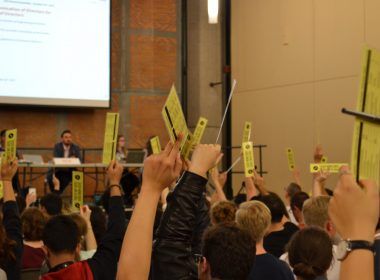
On Nov. 15, the University Women’s Club of Montreal (UWCM) launched the first ever North American rendition of “Les Olympes de la Parole,” an academic competition that aims to engage young women in both local and global issues of gender inequality.

Les Olympes de la Parole was first launched in 2001 by the Association Française des Femmes Diplômées des Universités first launched Les Olympes de la Parole in 2001, an event that is now organized in multiple countries around the world. The competition was named after Olympe de Gouges, a French playwright and activist who was executed for treason in 1793 because of her work.

At the official launch of the competition, Saôde Savary, president of the UWCM, spoke to the importance of implementing "Les Olympes de la Parole" in Montreal.

“The UWCM believes it is now time for Canadian girls to join the global conversation to empower their voices, to support policies that foster a gender equal society and start paving the way for all the girls in North America,” Savary said. “Addressing gender inequality is a complex issue that requires multiple perspectives in order to create sound solutions.”

Several teams of students from Villa Maria College, The Study, and Sacred Heart School of Montreal will be spearheading their own projects centered around a common theme: How improved access to information technologies can empower young Indigenous women in Canada. Speaker Deidre Kahwinehtha Diome, Chair of the Kanawake Combined School Committee, emphasized how much she valued the acknowledgement offered by the UWCM toward her community.

“So often, there is a feeling of alienation that […] Indigenous people are alone in their struggle,” Kahwinehtha Diome said, “[But] when [the UWCM] decided [they] were going to launch this new initiative, Les Olympes de la Parole, [… they] chose [the] topic to be about us, people like me who are working in the trenches every day. And what that felt like to me, was caring, was compassion, was recognition for me and the struggle of all of our people.”

The UWCM invited representatives from all three secondary schools to speak at the launch of the competition. Maria Di Scala, a social studies teacher at Villa Maria, emphasized that today’s students are responsible for creating innovative solutions to issues of gender equity and access to technology.

“Olympe de Gouges herself is a prime example of what Villa Maria has always striven to do, to provide our students with the tools to critically reflect upon social injustices, particularly gender [inequality], and to use their passion and unique position as simultaneously oppressed and privileged in crafting creative and effective solutions,” Di Scala said. “De Gouges […] proved that the ultimate recipe to female empowerment is the combination of education, voice and perseverance.”

Students at The Study have witnessed firsthand how improving access to modern technologies can improve the learning experiences of young women and men. The Study is partnered with a sister school in Nicaragua, where seniors participate in a community service trip and raise funds to provide the school with laptops and printers. Two students from The Study, Mia Strack Van Schyndel and Delila Farias, spoke about the barriers significant to learning experiences.

“We realized that the best way to understand the challenges that Indigenous girls are facing is to speak directly to these women,” Van Schyndel said. “We [met] with Mayor [Madeleine] Redfern, the first female mayor of Iqaluit [….] She brought to our attention that first and foremost, the largest hurdle in regards to new technology is the lack of access to a reliable, affordable Internet connection. As it stands, the only Internet connection [in Iqaluit] is available through satellite, which is slow, unreliable, and expensive [….] This leaves many remote communities in the country not only physically isolated, but socially as well.”

Farias echoed Van Schyndel’s sentiment. She highlighted how the UWCM’s initiative could benefit Indigenous students living on reservations.

“The bridge that this project will build between us and the indigenous women in certain regions of Canada could potentially open numerous doors and offer them opportunities that would not otherwise have been offered,” Farias said.


The UWCM will host a gala on April 6, 2018, where the three winning teams of Les Olympes de la Parole will be announced. The projects led by these teams will be put in motion by the UWCM, with the help of the schools involved.


academic
Arts & Entertainment, Books

Nonfiction November—The Tribune’s favourite reads

Short of listening to a podcast, or reading a long article start-to-finish, reading nonfiction literature remains the best way of feeling like an intelligent, contemporary being. As finals season begins to rear its ugly head, and long days turn into longer nights spent in McLennan, pleasure reading can feel like a distant memory; a luxury reserved for parents, graduates, and retirees. In memoriam of this long forgotten hobby, and because we are chained to the law of alliteration, The McGill Tribune asked writers and editors to compile their favourite nonfiction tomes for our final November issue.

 Born a Crime: Stories From a South African Childhood – Trevor Noah

Avleen K Mokha 

Born a Crime by Trevor Noah, host of The Daily Show, is a bittersweet but important read. Born to a white father and a black mother under the South African apartheid regime, Noah was a criminal at birth. The autobiography is not chronological—yet each chapter, based around one key event in Noah’s life, flows seamlessly. Noah’s voice is incredible; he brings profound insight into seemingly mundane anecdotes. His mischievous charisma and mature outlook on politics and society complement each other in this page-turning read.

Paris to the Moon – Adam Gopnik

Katia Innes

Adam Gopnik left his long-time job at The New Yorker in 1995 to move to Paris, bringing his wife Martha, and their infant son Luke along. Paris to the Moon collects his five years in the City of Light, and frames them as a moment of transition: Between comfort and adventure, security and risk—all teetering on the edge of the new millennium. This collection of essays paints an honest and beautiful depiction of a city from the unique perspective of an outsider.

Our Band Could Be Your Life: Scenes from the American Indie Underground, 1981-1991 – Michael Azzerad

Dylan Adamson

Michael Azzerad’s tour through the dwindling days of American indie rock concludes with the release of Nirvana’s Nevermind (1991). Over the course of 13 narratives detailing the histories of 13 indie bands—from Beat Happening to Black Flag—Azzerad positions Nevermind not as the beginning of grunge, but as the tombstone of truly independent rock music. With vivid, descriptive intimacy, Azzerod dusts off decades-old anecdotes about basement recording studios, filthy tour vans, and backstage brawls. A perfect read for any baby boomer dad who thinks rock died when Led Zeppelin broke up, Our Band Could Be Your Life showcases a thriving DIY post-punk scene existing outside capitalist structures of music distribution.

Guns, Germs, and Steel: The Fates of Human Societies – Jared Diamond

Nicholas Jasinski 

In his 1998 Pulitzer Prize-winning history of human development, Guns, Germs, and Steel: The Fates of Human Societies, UCLA geography professor Jared Diamond takes readers on a tour of the past 13,000 years of our species on Earth. Diamond uncovers and convincingly explains the underlying causes and influences that led societies on certain continents to develop at different rates than those on others. His inquiry ranges from geographical and environmental factors to the effects of religion, disease, and weapons of war on an evolving society. Diamond’s writing is thoroughly-researched and detail-rich, and he successfully presents a plethora of information without making his work feel like a textbook.

Columbine – Dave Cullen

Christina Stackpole

As one of the first reporters on the scene of the 1999 Columbine High School shooting, Dave Cullen presents the most detailed study of the shooting to date. Combining interviews with students, families, and locals and detailed research into case files and evidence, Cullen focuses little on the hour of the shooting itself, and more on the lead-up and aftermath. Exploring the backgrounds of the shooters and victims, the months of grief and controversy after the event, and the critical roles of local law enforcement and the media, Cullen eschews a reductive portrait of the killers, and examines multiple perspectives on the shooting and its repercussion.

Meet Me in the Bathroom: Rebirth and Rock and Roll in New York City 2001-2011 – Lizzy Goodman

Sophie Brzozowski 

The turn of the millennium should have been a bleak time for rock ‘n roll in New York City, with then Mayor Rudy Giuliani cracking down on sex and drugs. Instead, during this era, the city became a backdrop for a revolution that would change the music industry forever. Over the course of a decade, author Lizzy Goodman compiled over 2,000 interviews detailing the Strokes-era New York music scene in all of its debauchery. Bartenders, fans, industry tycoons, and, of course, rockstars recount in depraved detail their favorite shows, parties, and music from this hay-day, proving once and for all that rock ‘n roll did change the world.

The Secret History of Wonder Woman – Jill Lepore

James Collier

William Marston was a Harvard psychologist who invented the lie detector in the 1920s.  He also created Wonder Woman, the first female superhero.  The bizarre and fascinating life story of Wonder Woman’s creator takes centre stage in The Secret History of Wonder Woman—a dense 400-page epic that covers enormous ground in its telling of the struggle for women's rights over the course of the 20th century. Lepore’s extensive research pays off, and her sleuthing connects a treasure trove of rough drafts and private documents to reveal one of the most intricate and intriguing backstories behind a comic book character.

Read The Tribune’s review of Angela Robinson’s 2017 film adaptation

Sick in the Head: Conversations about Life and Comedy – Judd Apatow

Maxime Scraire

In Sick in the Head, Judd Apatow, the talent behind modern-day classics like The 40-Year-Old Virgin and Knocked Up, interviewed his favourite funny people about their upbringings and creative processes. Martin Short, Chris Rock, Seth Rogen, Spike Jonze, Stephen Colbert, Sarah Silverman, and Jim Carrey are only a few of the countless comedy icons who appear in the book. Raw, funny, and enlightening, Sick in the Head is an essential read for comedy nerds.

Arts & Entertainment, Film and TV

Cielo: Alison McAlpine’s conversation with the sky

Among the 142 films featured at the latest Montréal International Documentary Festival (Nov. 9 – 19), one of the most memorable was Cielo, the first feature film by Canadian director Alison McAlpine. Set in the Chilean Atacama Desert, Cielo is an exploration of the night sky’s hold over the people who live in the driest desert in the world.

Cielo is not a typical documentary. Slow-moving and poetic, it floats between gorgeous footage of the stars, conversations with subjects, and McAlpine’s own philosophical musings presented in voiceover narration. More of a meditation than a narrative, Cielo invites viewers to ask their own questions, without ever forcing a response.

The McGill Tribune sat down with McAlpine, who currently lives in Montreal, to discuss how the project was first conceived. McAlpine had been working on a different film project in Chile when, one night, she was caught in a power outage. The experience affected her in a way that was both emotional and intellectual.

“I was there, by chance, in this little village in the desert, and there was a blackout […] and there was no moon, of course no street lights, and I looked up, and I had never seen a sky so extraordinarily beautiful,” McAlpine said. “I was full of questions, and also astounded by the beauty.”

She quickly abandoned her old project.

“I went with this emotional urgency to explore my questions,” McAlpine said. “For me, filmmaking is an inquiry of questions, [questions] hopefully that are important and provocative and evocative and turn your head around.”  

These scientific and metaphysical questions, posed in voiceover to the sky itself, propel the film.

“It felt like [the film] needed a voiceover, but I didn’t want a traditional ‘voice-of-God’ documentary,” McAlpine said. “It did merit various drafts, and some of them were quite clever, but they never felt authentic to me. So finally I stumbled upon [the idea of] a conversation with the sky.”

This loose structure—a conversation with the sky—allowed her to imbue her intellectual and philosophical investigation with human feeling and poetry.

“I wanted to risk being emotional, and simple,” McAlpine said.

Rather than hire a professional voice actor to perform the voiceover, she recorded it herself, often improvising in the recording studio.

“The most vulnerable part is when it’s your [own] voice,” McAlpine said. “I like the expression, ‘the voice is the muscle of the soul.’ And I think it’s very hard for most of us to listen to our own voices.”

Cielo features a wide cast of subjects, whom McAlpine affectionately refers to as her “characters:” Planet hunters working in observatories, a man who takes photographs of UFOs, folk story-tellers, and a miner who writes poetry about the stars. To find these characters, she had to follow her gut.

“It’s really a process of intuition, and chance,” McAlpine said.

Using the observatories as her “constellation,” she journeyed through the desert, hitchhiking to a community of chozas—shack-like houses—where she found a married couple, who later feature in the film arguing about the nature of gravity. The husband told her to go to a mine called Inca de Oro, where she found a miner who reads his poetry in the film.

“I took a bus there, and there I found the miner poet,” McAlpine said. “[…] It was a process of one person leading you to the next, just by chance.”          

McAlpine returned to Chile four times. She only began the process of filming with a Chilean crew once she had stayed with her characters and established relationships with them.

“I had their trust, I really got to know these people,” McAlpine said. “I wanted an intimacy.”

Cielo indeed contains an intimacy, and one that is shared between many parties: The filmmaker, the characters, the viewer, and the sky. Covering one of the largest subjects imaginable, the night sky, she has created a touching film on a remarkably human scale.

“A story can be something very small,” McAlpine said. “A moment that feels to me authentic […] where we rediscover the world.”

Album Reviews, Arts & Entertainment

Reputation is an intimate examination of life and love

In her newest album, Reputation, Taylor Swift bids goodbye to the days of “riding shotgun with her hair undone.” Swift’s sixth studio album, is a self-aware examination of life away from the spotlight. For most of the year before Reputation’s release, Swift spent her time off of social media and had dropped out of the mainstream gossip news cycle.

The result of this self-inflicted media isolation is an album that’s darker and more introspective than anything the country-pop star has ever produced. Unfortunately, the debut single off the album, “Look What You Made Me Do,” which seemed to be an anthem of self-pity, is a weak representation of the emotional vulnerability that Reputation explores.

Reputation builds on the synthetic-pop sounds that ///1989// debuted but, thematically, the album is an ode to the darker and more intimate side of love. In “Dress,” Taylor sings, “I only bought this dress so you could take it off.” The singer swears for the first time in “I Did Something Bad:” “If a man talks shit, then I owe him nothing.” These songs are filled with allusions to the mundane, every-day, messy reality that is loving someone. Rather than singing of grandiose love affairs and excruciating heartbreak,

Taylor is choosing to follow the small moments, both good and bad, that make up real-life love stories. “New Year’s Day” perfectly embodies this reflection and examines life after the clock strikes midnight. The reality, of course, is that relationships are more about “cleaning up bottles” than extravagant parties.

Maybe the most telling line of the album, however, comes from “Call It What You Want” as Taylor sings “Nobody’s heard from me in months / I’m doing better than I ever was”. As a singer nearing her 30s, Taylor is allowing herself to grow up and prove that her identity—and reputation—are more than what we see in the tabloids.

Arts & Entertainment, Music

Flying Lotus soars into third dimension with new live show

Flying Lotus burst through Montreal on Nov. 9 in living and breathing color. Stephen Ellison, the DJ and MC colloquially known as FlyLo, has developed a cult following over the last ten years by refining his organic and complexly-layered sound. Critics heavily praised his fifth studio album, You’re Dead following its release in 2014. FlyLo is an experimental, electronic artist who crafts beats that in many ways defy boundary and categorization, and his performance at MTelus delivered on that reputation and then some.

As I was handed my 3D glasses on the way into the venue that night, I was unsure of what to expect. Two separate lackluster DJs opened the show, and played a mix of bass boosted dance rhythms and some experimental deep house accompanied by a live drummer. It was clear that the three-dimensional aspect of the show would be executed through a large projection screen at the back of the stage, although it wasn’t used for either opener.

When Flying Lotus came on to perform, the dynamic shifted entirely. The large podium at center stage, which had been shrouded in darkness for the openers, became lit with fluorescent pink lights. FlyLo calmly took his position behind it and took us on a journey. He looked mystic in his shawl adorned with what appeared to be religious figures. The glasses until now had made no difference to the screen, displaying only a red emblem. Now it transformed into a sea of three dimensional red waves. FlyLo opened his set with a beat which featured some ethereal synth at first, before building into an exotic, trance-like, rhythm. The show from then on was sublime.

One thing that sets FlyLo apart from other DJs is the interactive nature of his performances. Throughout the concert, he came out from behind his podium and engaged with the crowd—touching their hands and dancing in unison with fans.

Lotus’s musical catalogue is far more diverse than most producers. His sound is at one moment soft and lulling, and the next bombastic and symphonic. The music he creates has a rare power to envelope and infest your mind with feeling and rhythm, and the 3D graphics spectacularly enhanced this effect. When his beats were less organized, free form, and supple, the backgrounds were liquid and flowing, taking the form of jellyfish, water, and other viscous forms. When his sound was focused, driving, and hyper organized, he was accompanied by geometric shapes, kaleidoscopic patterns, and other rigid forms. During “Descent Into Madness,” a beautifully rendered Imperial Star Destroyer floated behind him, spraying pillars of multi-colour dust into the screen below and seemingly into the crowd.

Ellison was constantly surrounded and enveloped by the graphics, making it hard to distinguish him from the virtual reality behind him. Nothing is more characteristic of FlyLo than to make the separation between himself, and his performance, indistinguishable. He rarely stopped to break in between songs, which gave his set a very continuous and malleable feel, and allowed him to showcase his extraordinary mixing ability, flawlessly transitioning between sonically distinct beats. Flying Lotus has an uncanny talent for creating a specific atmosphere or transfer a feeling through the auditory medium, without lyrics. His live performance brings this skill to an even higher level. FlyLo ended his show quickly, thanking the crowd and poignantly surmising that, “This has only ever been about sharing in creativity and art, creating a safe space for all, and spreading the love.” As he left the stage, I believed every word; Flying Lotus in 3D is something truly special to behold.

Creative, In Competition With, Sports

In Competition With: McGill Quidditch

When two sports editors try their hand at actual sports who reigns supreme? On the second episode of In Competition With Selwynne and Stephen face-off in the most magical of McGill sports, Quidditch. 

Featuring: Selwynne Hawkins and Stephen Gill
Directed by April Barrett
Edited by Patrick Beacham and April Barrett
Crew: Emma Avery

Laughing Matters, Opinion

What the great coffee debate boils down to: Instant is best

With coffee shops lining every street corner in Montreal, residents are bound to become regulars at a spot of choice. They find a cafe to lose themselves in an essay on a Sunday afternoon and acquire a signature drink. However, the greatest coffee experience of all is a simple cup of instant coffee.

As we approach the holidays, there are a number of volatile topics of conversation that are best avoided. The only thing worse than Aunt Jean drunkenly detailing her voting history over Christmas dinner is the man who yells at you on the train because someone said “Happy Holidays,” instead of “Merry Christmas.” However, I’ve learned that in my family, the most outrageous reactions often come around dessert, when I break out my instant coffee and giant mug, sparking a polarizing discussion. It seems that once a person establishes a go-to cup of coffee, they’re stuck for life—and will never fail to defend their cup.

Coffee habits are entrenched lifestyle practices. People vary, but, for many, how one drinks coffee quickly engrains itself into one’s personality. My overworked aunt looks me dead in the eye, hands shaking as she grips a full thermos, and professes her love for French vanillas with four shots of espresso. Someone else will sip iced coffee even as they shiver in a winter jacket with the threat of a Montreal snowfall approaching, and swear they’d never drink anything else. Then there’s the person walking out of Starbucks, holding either a Frappuccino or some convoluted holiday drink that, in either scenario, they paid way too much for.


Despite its flaws, nothing compares to the literally and figuratively simple joys instant coffee affords.

Instant coffee is my half sweet, non-fat, extra-whip peppermint mocha. I do recognize that instant coffee is objectively bad—not since the 10th grade have I been naïve enough to believe otherwise. No matter the brand or how refined your palate is, you’ll taste the bitter, almost sour qualities of instant coffee, especially in the aftertaste. Yet, this is not the point.

Despite its flaws, nothing compares to the literally and figuratively simple joys instant coffee affords. Aside from not having to change out of your pajamas to drink it—which already gives it a serious advantage over coffee shop concoctions—it is also the cheapest cup of joe you’ll ever get. Pro tip: Buy at least six jars any time it is on sale and hoard them. They almost never go bad—or well, get any worse.

The advantages of instant coffee go above and beyond practicality. Consider, for a moment, waking up on a Saturday morning, just after midterms have ended and prior to the start of finals, knowing that for one short day, there is nothing pressing to do. Smell the overly pungent coffee granules that permeate the air, as an unmeasured—and definitely far too much—amount falls into a mug. Let the water boil while Netflix plays in the background, and you meander from one tangle of blankets in bed to another makeshift blanket cocoon at your desk. For good measure, I like to lay out some math homework that I know full well will not get done.

With cold hands, grasp that hot cup and take a sip—the first one is always too hot, so burn your mouth and wait another five minutes. There exists a 20 minute window when instant coffee is cool enough to drink, but not cold enough that it becomes literally undrinkable. Finish the cup at your leisure—but again, I stress, do not let it get cold—and then take your portable wrap of warmth, and boil the kettle again.

It is time to put an end to the pretentious coffee debate. Of course, no respectable coffee lover will ever tell you that Maxwell House Instant Dark Roast is better than the rich, full-bodied cup of joe they sipped on while traveling abroad in Barthelona. However, this self-proclaimed coffee expert will tell you that there is no better feeling in the world than bundling up, relaxing, and drinking up the slightly-too-strong scent of a hot cup of instant coffee.


Caitlyn Atkinson is a U0 Management student, and is deeply involved in the Chandler and Monica vs Ross and Rachel debate.


Student Life

TEDxMcGill event gave voice to students and activists alike

On Nov. 11, TEDxMcGill held its fifth annual conference at Montreal’s McCord Museum. Over 100 passionate attendees from the McGill and Montreal communities filed into the museum to watch the series of talks, all of which were centred around the theme ‘giving voice.’ The lineup featured 10 speakers and musical performers in fields ranging from artificial intelligence to LGBTQ+ activism, all speaking on how their work has inspired positive change locally or globally.

From teaching music in indigenous communities to including inter-disciplinary space exploration, the diverse lineup of speakers demonstrated how essential hearing a multitude of voices is in everyday life.

The event’s musical performers interpreted ‘giving voice’ through their voices. Moe Clark and Ahau Marino—musicians, composers, and educators—performed two pieces at the event and used a multitude of musical techniques, such as a looping pedal that layered sound effects over live vocals, to convey music’s ability to empower. After years of exploring various genres of cultural sounds together and teaching music to Indigenous high school students, Clark and Marino have developed a strong partnership.

“Giving voice comes from, for us, using our bodies as the sight for connection, for creation, and for communication,” Clark said in an interview with The McGill Tribune. “And a lot of that comes from the creative capacity to build kinship. Some of that kinship comes from other performers, and artists. And some of that kinship comes from other forces.”

The diversity of fields represented at the conference reminded attendees that there are no limitations to how one can ‘give voice.’ One speaker, Olivia Nuamah, a community builder and activist, spoke about her experience serving as the executive director of Pride Toronto, one of the largest cultural events in North America. Nuamah’s work deals extensively with representing minority groups within the pride community.

“It’s too easy to look at that LGBTQ+ and think that the group is a whole bunch of the same people, when it’s not,” Nuamah told the Tribune. “It’s quite nuanced.”

She also encouraged students to get involved in LGBTQ+ activism, explaining that the first steps to doing so are to learn more about the community and to support local pride events.

“Lots of people are involved in Pride Toronto and Pride Montreal,” Nuamah said.  “We’re looking for as many allies as possible to support what we’re trying to say.”

Another speaker, Paul Albert-Lebrun, U3 engineering, encouraged students to join the space conversation in his talk about the McGill Space Systems Group (MSSG). Albert-Lebrun co-founded the group with McGill alumni Angus McLean and Harris Innes-Miller, graduates in Engineering and Arts, respectively, in the class of 2015. Albert-Lebrun’s decision to create the MSSG stemmed from his interest in interdisciplinary space research. He encouraged students of all faculties to get involved in galactic dialogue—not just those in the field of science.

“I challenge everyone in the audience to think of how their discipline can get involved in space,” Albert-Lebrun told the Tribune. “Getting to space technologically shouldn’t be the only question. The question should be how we get there as a global society.”

Regardless of their area of expertise or major of study, attendees left the event feeling invigorated by the call to make an impact and give voice to others.

Creative

Word on the Y: What does balance mean to you?

As midterms approach, the concept of ‘balance’ may begin to seem increasingly elusive. Navigating university life is no easy task, but remembering to keep the big picture in mind is one of the biggest lessons students learn during their time at McGill. The McGill Tribune asked passers-by at the Y-intersection about how they define a balanced life.

Read more here.

Interviews by Amrit Grewal & Avleen Mokha.
Video by Noah Sutton.

Hockey, Sports

Mo-Money Mo-Awareness: How NHL hockey is helping change the face of men’s health

A simple idea, hatched between friends over a few drinks at an Australian beer garden in 2003, has since grown into a leading charitable organization that has shaken up the way people approach men’s health. The Movember Foundation has helped to fund research and raise awareness for men’s health issues, such as prostate cancer, testicular cancer, and mental health. The NHL has had a profound impact on this movement by leveraging its high profile and bringing Movember to the forefront of sports culture.

During November every year, men are encouraged to join the movement by signing up at movember.com and growing moustaches to “Change the face of men’s health” in order to raise money for the foundation. Those contributions originally funded prostate cancer research exclusively, but the Movember foundation has since expanded to combat testicular cancer and men’s mental health issues. The increased focus on mental health aims to combat the added stigma that men face in discussing mental illness. It’s unfortunately rare for men to take action on their health issues—both mental and physical—so the Movember Foundation also works to proactively instill healthy habits in their lives.

The NHL has provided Movember with one of its largest platforms to promote the cause. In 2007, now-retired Anaheim Ducks forward George Parros brought the movement to the NHL. While still a Ducks player, Movember Foundation cofounder Adam Garone approached him about getting involved when the campaign reached North America. Since then, the movement has picked up steam. Today, it is commonplace for players to grow fresh moustaches during the month. Brendan Gallagher of the Montreal Canadiens has become a proponent for the campaign since he lost his grandfather to prostate cancer. Whole teams have taken the movement in stride too, with the New Jersey Devils and the Columbus Blue Jackets each raising more than $10,000 this year.

Hockey players are considered some of the toughest athletes in all of sports, and their perceived super-human status makes them strong role models for other Movember participants. Movember’s strength lies in its accessibility and power to unite—these issues affect all men, and fans, coaches, referees, managers, and trainers alike have grown moustaches in support of the cause.

Growing a moustache in November can prompt conversations about men’s health. It engages men in talking about the health issues that they face and has made them more knowledgeable and comfortable talking about how they feel. NHL players help promote these healthy habits by increasing the visibility of the movement, thereby funding the research that could inspire lasting solutions to men’s health problems.

As the month of November comes to an end, the focus on health issues should not. Making this commitment to raise money for prostate cancer, testicular cancer, and men’s mental health programs should continue throughout the year. The NHL does a fantastic job in promoting this issue, but all men should take these five actions: Stay connected with friends, reach out to others who need help, be open with someone, know when to get tested for prostate cancer, see a doctor if something doesn’t feel right, and add more physical activity to their day. These tenets can be found on the Movember website, alongside many other helpful links.

To date, Movember has raised nearly $900 million for various men’s health causes, and its momentum doesn’t appear to be slowing. So, to all those who choose to support men’s health issues through growing or donating: Happy Movember!

Read the latest issue

Read the latest issue