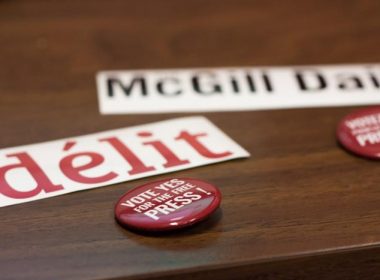
The McGill Tribune’s latest editorial, “If SSMU Council won’t stand up for campus press, students must,” claims that it is the The McGill Daily’s pro-Boycott, Divestment, and Sanctions (BDS) stance against Israel that in part fueled the events at the Nov. 2 Students’ Society of McGill University (SSMU) Legislative Council. However, to frame the opposition to mandating student funding of the Daily Publication Society–the parent organization of both The McGill Daily and Le Délit newspapers–as being primarily about the Daily’s endorsement of BDS misses the point entirely.
It is not about the Daily’s endorsement of BDS per se—everyone should recognize that it is a newspaper’s prerogative to take certain editorial lines. However, a paper claiming the mantle of “free press” should not be permitted to routinely exclude certain voices from publication, thereby invalidating and obscuring them—especially one that asks for funding from all students, but refuses to grant access to free speech to all these students in turn.
Indeed, with regards to Israel, opposition to the Daily stems from the fact that it engages in a wholesale boycott of a considerable segment of campus voices. Specifically, the newspaper “maintains an editorial line of not publishing pieces which promote a Zionist worldview.” This stands in direct contradiction to the Tribune’s call in its latest editorial for “SSMU and students to recognize that it is valuable to have a diversity of voices on campus.”
Given the Tribune’s stated commitment to a “diversity of voices,” it should recognize how students with Zionist viewpoints would bristle at funding a publication like the Daily that preaches diversity and yet systematically excludes their voice from its pages. “Zionist viewpoints” are by no means homogenous, and while reflecting an ethno-religious connection to the physical land, are often highly critical of Israeli state policy and the injustice of the occupation. The Daily pushes the Israeli-Palestinian conflict to the forefront of campus discussion, but by excluding this diversity of voices, neglects to engage in the debate responsibly and acknowledge all its inherent nuance. It should also recognize the hypocrisy inherent in asking for funding from the entirety of the student body in order to ostensibly serve as its platform, while routinely excluding a viewpoint shared in varying manifestations by a portion of the McGill community.
Furthermore, it is extremely reductive and obfuscatory to refer to a “Zionist worldview”–as the Daily does–as if there is a sole cohesive Zionist agenda. Zionism is a movement with a long history, with different interpretations and ideological bents. A singular “Zionist worldview” cannot be objectively pinned down in any meaningful sense. Putting all diverse Zionist voices in a single oppressive box, and discounting the nuance and difference laden within the term is not good journalism by the Daily. Neither is the systematic exclusion of a group, based on a minimized understanding of a diverse ideological movement, from a conversation it is intimately impacted by.
The extent of the mental gymnastics that must go along with claiming that the SSMU Legislative Council events went against the existence of a fair and balanced press on campus, when one of the publications in question is systematically precluding any sort of actual fair and balanced coverage at all, is palpable. The Daily can go ahead and endorse BDS as a newspaper, but do so without being so insecure about their position that upholding it necessitates such expansive gatekeeping in the form of silencing and outright delegitimization of any dissenting or explanatory voice among their pages.
On Oct. 28, the McGill Chapter of HanVoice, an organization that promotes awareness and acceptance of North Korean refugees, held its biggest event of the year, titled ‘What Would You Ask A North Korean?’. The panel featured North Korean defector Ellie Cha, whose family escaped the regime in 2012. Cha has been residing in South Korea and is currently studying at Korea University in Seoul. She is also participating in HanVoice’s Pioneer Project, which aims to empower the North Korean refugee community through leadership experience at the Canadian Parliament.
McGill Political Science Assistant Professor Juan Wang opened the talk by describing the state of nuclear weapon diplomacy across the globe. Historically, North Korea and China have been allied against the United States. Yet, with the U.S. displaying opening aggressive behaviour, Chinese society becoming increasingly capitalist, and North Korea seeking to be militarily self-sufficient through nuclear weapons, Wang emphasized that Kim Jong Un is in a precarious position.
“China needs to desperately get out of the dilemma it is facing,” Wang said. “If it backs down from the sanctions against North Korea, […] then China would lose face as the supposedly important player in the peninsula. [ However,] if it strengthens its sanctions, it may provoke a reckless neighbour to escalate the [nuclear] situation.”
Cha then took the stage to discuss how her aunt disappeared and her father, the vice-president of North Korea’s leading mining companies, lost favour in the government. This did not bode well for Cha’s family, and her father hired Vietnamese smugglers to get them out. Cha has since become a human rights advocate for the North Koreans. During the talk, she shared her insights on how to support those currently living under the regime.
“[People can help by communicating with] North Korea […] because now we have very limited accessibility about our world, that’s the reason why the North Korean government still keeps their [power],” Cha said. “The second thing is you can support their basic needs. In Canada there is [First Steps, a charity,] to [send food….] The last thing is you can support the North Korean refugees, and actually you are doing it here by listening to my stories.”
According to Cha, the North Korean government’s propaganda does not accurately portray what it is like to be a citizen. While the regime imposes its will through human rights violations, the people have become disenchanted with its ideology and simply try to survive however they can.
“In terms of the ideological world, nobody has dreams of success,” Cha said. “But in reality, we have dreams. Someone [might] want to make lots of money, while others just hope to have a very common life. But the most important thing is we are still living in the same world, like you, except for the ideological concepts.”
The indignities of Cha’s journey as a refugee were not easy and she felt that it severely drained her family.
“Yes, the world feels bigger, but there is no space for a refugee,” Cha said. “Me and my family are still searching for a place to call home [….] I live in the South, but my home is in the North. I hope to end up in a free North Korea.”
Danny Yeo, former president of Queen’s University’s chapter of HanVoice, also spoke at the panel, providing context for understanding the plight of North Korean refugees.
“Sometimes North Korean refugees may feel disconnected because of their accent, which is different from that of South Koreans,” Yeo said. “[And] if rocketman does something stupid, then a North Korean kid is bullied and blamed.”
On Nov. 6, Meara Kirwin, U2 Arts, and Gregoire Beaune, U3 Arts, filed a petition with the Students’ Society of McGill University (SSMU) Judicial Board (J-Board) against the Board of Directors’ (BoD) decision to add a question to the Fall 2017 Referendum. The question asks whether students would like to raise the quorum of General Assemblies (GA) to 350 students. The petition states that the question did not undergo the processes required in order to be added to Referendum by SSMU’s Internal Regulations of Elections and Referenda and by its Constitution. The Referendum polling period runs from Nov. 8 until Nov. 10 at 5 p.m..
Referendum questions are added through either a motion passed at a GA, a motion by SSMU Legislative Council, or through the submission of a petition with at least 100 student signatures to the SSMU Chief Electoral Officer (CEO) at least 14 days prior to the Referendum period. A petition to raise the quorum of GAs with 468 student signatures was created by Engineering Senator Tre Mansdoerfer and former Engineering senator Alexander Dow, both U3 Engineering. However, it was not submitted to the CEO before the Oct. 25 deadline for Referendum questions. A motion to raise GA quorum was not presented during the Fall 2017 GA on Oct. 23 or at a Council meeting this semester.
A statement released by the petitioners explained that raising the quorum would make GAs obsolete.
“The constitutional amendment put to referendum […] would have a significant effect on the General Assembly’s ability to consistently meet quorum and conduct business,” the petitioners wrote. “Instead, because proper procedure and deadlines were not followed, most students have been left unaware that this question is coming to referendum in the first place.”
In an unprecedented move, the BoD added the Referendum question through its own motion, the Motion to Bring General Assembly SSMU Constitutional Changes to Referendum, which was passed at the BoD’s Oct. 29 meeting. At the board’s Nov. 5 meeting, SSMU President Muna Tojiboeva explained why the BoD chose this course of action.
“We consulted legal just to see what our obligations were as a corporation under the [Companies Act] in Québec law, and what they said is [that] our [Internal Regulations] are not necessarily representative of what our real legal obligations are,” Tojiboeva said. “In reality, under article 91 of the [Companies Act], it’s only the Board that can approve questions that would go to change the constitution. It’s only the Board and the members that can make a new mandate or put a question to a vote for the membership.”
As a company registered in the province of Québec, SSMU is regulated by the Québec Companies Act, which takes precedence over the SSMU Constitution and Internal Regulations. Article 91 of the Québec Companies Act says that the directors of a company may repeal and make amendments to the by-laws of a company as long as those changes are confirmed at a general meeting of the members called for that express purpose.
“Basically, what our legal counsel said is that [Referendum questions] cannot come unilaterally from the membership as it was done before,” Tojiboeva said.
In an email to The McGill Tribune, Kirwin, one of the petitioners, explained what led her to challenge the BoD’s decision to add the Referendum question.
“We are concerned about the power currently held by the Board of Directors—an unelected body whose power has been increased through constitutional amendments in the past few years,” Kirwin wrote. “This referendum question was brought by the BoD unconstitutionally, and as SSMU members, we must insist that constitutional modes of decision-making are upheld, and that power is not taken from the General Assembly and consolidated at the top of the ladder.”
The McGill Tribune endorses Maria Tippler for PGSS Secretary-General. Tippler expresses an inclusive and forward-thinking vision for her role and the executive as a whole. Her team spirit will bode well when working with fellow executives on important initiatives such as mental health support.
Tippler has extensive experience that makes her well-equipped for this position. She has served as the PGSS Student Support Commissioner since June, where she has shown her devout commitment to the wellbeing and mental health of all members of the society. Moreover, Tippler demonstrates clear, functional leadership skills that will serve her well as Secretary-General. She possesses a strong knowledge of the institution and the people currently in it, and is well prepared to take on a larger role within the PGSS. This previous experience is particularly vital to her picking up the position halfway through the Fall semester.
Maria’s goals are ambitious but realistic, and demonstrate a strong understanding of the timeline for change within her position. She has a clear plan for improving student access to mental health resources; in particular, she hopes to reach out to off-campus students through the program EmpowerMe, which is a platform for students to access mental health support online. She is an approachable leader who evidently cares for PGSS members, and will make a positive impact on both her constituents and other executives.
The film lesbian ARTivism: current realities is a frank documentary that showcases the experiences of a variety of lesbian artists from around the world. On Oct. 24, at Maison de la culture du Plateau Mont-Royal, the film premiered to an audience including director kimura byol-nathalie lemoine, producer Johanne Coulombe, and many of the artists who appeared in the film.
In the summer of 2016, the University of Ottawa hosted a conference bringing together lesbian artists from a range of professions, age groups, and nationalities. The symposium specifically focused lectures and seminars on the role of lesbian “artivists”—activists who use various art forms as their medium to advocate for change—within the contexts of globalization and intersectionality.
The documentary touched on themes ranging from questions of self-representation and archiving, to the nature of art as a means to advocate for lesbian issues. In each section, snippets from some of the conference’s speakers are shown in a talking-head style. Coulombe, one of the head organizers of the conference and a producer of ARTivism, decided to record the event and tasked kimura-lemoine with editing the compiled footage.
Coulombe pursued the project as a means to bring visibility to gay artists.
“We [lesbian activists] work hard but are not seen or heard,” ze said.
ARTivism was made to get a message out. Through an artistic lens, Coulombe and kimura-lemoine tell viewers a story of lesbian empowerment and self determination.
Despite its empowering message, ARTivism falls prey to the faults of many other independent movies lacking in big studio budgets. Transitions are repeatedly cut-and-dry, and the film lacks a unifying narrative from start to finish. This speaks to a broader lack of funding that queer and activist filmmakers face. After seeing it in its entirety, one can appreciate the documentary for its content and overarching message about the diversity within lesbian movements, regardless of its cut-and-dry format.
ARTivism sheds light on the opinions of a diverse cast of lesbian activists and the work that they do. From a young woman describing her queer experiences integrated with her Indigenous identity, to the older symposium participants detailing their time coming out in the 1960’s and 70’s, kimura-lemoine does an excellent job compiling the wide array of topics into accessible, bite-sized formats. Zer organization of the documentary proves how individuals formulate incredibly different views about what it means to be a lesbian and what they should do in terms of activism.
“For me, my part [in making this film], was to [make sure that] everyone, every age, would be represented across all types of disciplines,” said kimura-lemoine.
ARTivism serves as an overview of this wider population. kimura-lemoine and Coulombe’s work is as a rousing addition to the greater narrative of marginalized peoples around the world.
I Choose Montreal (ICM), a campaign created through partnership between the Quebec government, employers, and universities, aims to encourage international students to continue living in the city after graduation by easing the process of finding permanent work in Montreal. At McGill, the project works with the International Student Service and Career Planning Service to promote its newsletter and off-campus events, and to collaborate plans for on-campus activities about networking, internships, and other career opportunities.
Director Mathieu Lefort spearheaded ICM as a three-year program within the Montreal International (MI) non-profit organization, which is supported by the Canadian, Quebec, and Montreal governments as well as private funders. MI’s primary goal is to attract foreign wealth to the city. ICM functions under this mandate by growing the international workforce—particularly in burgeoning tech sectors—and in so doing, promote the international culture of Montreal and grow its economy. During his time in the economic development department of MI, Lefort contributed to a study about the importance of attracting and retaining international students.
According to Lefort, finding jobs and dealing with immigration are the two biggest challenges for students who settle in Montreal post-graduation. He hopes that connecting students with both will alleviate stress and increase retention rates.
ICM works to connect students with prospective employers. The organization visited McGill’s downtown campus 10 times since October 2016, and Lefort reports that their activities have filled classrooms with interested students. Director of Career Planning Service (CaPS) Darlene Hnatchuk works in conjunction with ICM.
“We want our students to benefit from as many networking opportunities as possible,” Hnatchuk said. “As a hub for career education, we have a role in bringing collaborations to life to support our students’ career and professional development. [ICM’s] programming complements what is offered at McGill.”
In 2015, almost 3,000 international post-secondary students were awarded Quebec Selection Certificates, allowing them to work in the province after completing their studies. This number increased in 2016, but Lefort envisions more growth in 2017.
“There is room for improvement [in post-graduation retention rates],” Lefort said. “We want to build on the momentum of the past year.”
ICM also partners with the provincial government to provide accurate, valuable information about the immigration process. Among other measures, ICM holds regular information sessions with the Quebec government to walk foreign students through the system.
Despite the obvious roadblocks to settling here, Montreal’s culture and prospering high-tech sectors can be extremely attractive for soon-to-be graduates. McGill computer science graduate student Sanjay Thakur is certain he will settle in the city after he completes his degree this year. He plans to work in artificial intelligence, an area that both the Canadian government and tech industry hope to expand in Montreal. Besides the promise of a fulfilling career, Thakur also enjoys Montreal for its community, culture, and environment.
“[Montreal] is affordable, public transport is so nice, people are amazing, there are so many parks […] the list goes on and on,” Thakur said. “I have nothing to hide when it comes to my love for this place.”
However, other international students have had issues with the climate and distance.
“The winters are too cold and too long, and even though the beautiful summer makes up for it, I do not want to live in a city where I know I will be too cold five months of the year,” Marine de Lamarzelle, U3 Arts, said. “Plus, I feel very close to my family and I do not like the idea of living far away from them.”
ICM has met with over 3,600 students in the past year and plans to continue on their trajectory for the remaining two years of the project. Additionally, given their success so far and the large foreign student presence in the city, Montreal International and the Quebec government may extend the I Choose Montreal program at the end of the three-year mandate.
A previous version of this article incorrectly stated that Montreal International is managed by the Quebec government and that I Choose Montreal (ICM) holds information sessions with both the Quebec and Montreal governments. In fact, Montreal International is supported by the Canadian, Quebec, and Montreal governments as well as private funders and ICM only holds information sessions with the Quebec government. The Tribune regrets these errors.
Anyone who has ever been a first year in university can remember how overwhelming it can be at times: Navigating campus, taking on large course loads, making new friends, and perhaps even living away from home.
Eighteen-year-old freshmen who live with a chronic illness, like type 1 diabetes, face the struggles that come with taking on the full weight of illness management on top of these adult responsibilities—as the Quebec health system pushes them out of pediatric care into adult care.
“What ends up happening is that during this transition period, [patients] have all these other competing interests where type 1 diabetes may not be as much of a priority,” Meranda Nakhla, a pediatric endocrinologist at the McGill University Health Clinic (MUHC) and an assistant professor in McGill’s Pediatrics Department, said. “As a result, we know that attention to self-management, which is really critical for type 1 diabetes, tends to deteriorate during this time.”
Type 1 diabetes is a disease in which the beta cells of the pancreas are attacked by the immune system, resulting in little or no insulin being produced. Insulin is the hormone necessary for converting the glucose—or sugar—you eat into energy your body requires for survival, and the lack thereof poses serious health problems. Since the disease typically begins in children and young adults and has no known cure, many patients will face a lifetime of daily insulin injections and careful diet management to stay healthy.
On top of the demanding lifestyle of a typical university student, students living with a chronic condition must constantly manage and monitor their health.
The competing priorities of a growing adolescent with type 1 diabetes are important to consider when developing a system of care for these patients. However, a recent study conducted by the MUHC sheds light on the gaps in transitional care between pediatric and adult health services in Quebec. The research found that health care providers lacked understanding of this vulnerable period. Additionally, the substantial differences in the type of care received by pediatric patients compared to adult patients only compounds these stresses.
“Stereotypically, in pediatric care, we do a lot of handholding, walking [the patient] through the steps and don’t prepare them well enough for adult care,” Nakhla said. “As they enter into adult care when they turn 18, […] there’s an expectation that they’re fully autonomous and should be able to take care of all aspects of their life [….] So if you don’t show up to your appointments, then you don’t show up and no one will chase you, like we do in pediatric care. Nobody’s going to make sure that you’re getting your prescriptions.”
Of course, not only type 1 diabetics face such challenges.
“It’s an important issue for anyone [with a] childhood onset chronic disease where there needs to be some sort of transition care provided in pediatric care,” Nekhla said.
While research thus far has focused on highlighting this policy issue, attention is now targeting specific measures which could improve the experiences of patients under standardized transitional care policies in Quebec.
“Actual interventions, whether you’re doing [an] adult clinic [or] peer support group, […] need to go through more of a rigorous evaluation to see how that can affect outcomes when emerging adults get transferred to adult care,” Nekhla said. “That’s the next step in what we can do to improve the process.”
If there’s one thing Montreal is known for, it’s the town's bustling party scene. So when travel agency Expedia recently rated cities across Canada for their local beer, it came as no surprise that Montreal topped the list. The McGill Tribune took a look into this rating by exploring three of the best local breweries—two recommended from Expedia’s list—outside of the McGill bubble.
This quaint Jean-Talon spot exudes sophistication. With millennial-pink tiling, gold-handled taps, and brown and white accents throughout the space, Harricana’s defining trait is its aesthetic. As large front windows welcome rays of light onto short round tables, Harricana feels more like a tea room in Cuba than a Little Italy brewery. Its selection of beers—showcased in large metal cylinders through clear glass windows behind the bar—is extensive, and can be ordered in three glass sizes. For those interested in tasting a wide selection of their brews, made on location, we recommend purchasing multiple 5 oz. drinks. The four of us tasted a succession of beers varying in strength and colour. The Blonde Funky, a derivative of a typical blonde beer, satisfies with sour corners and wild hues. Le Rosé Cidre proved to be another strong choice. An amalgamation of wine and beer’s best traits, it’s both tart and foamy, with the distinct sweetness of any rosé. But be warned: The size of these drinks makes them easy to knock back in a few gulps if you’re not careful.
A self-described “friendly bistro” nestled in the heart of Little Italy, Vices & Versa is a welcoming shelter from biting autumnal winds. This brewpub prides itself on its selection of 35 tap beers made in microbreweries across Quebec, which patrons can enjoy in both a 5 oz. tasting format as well as in traditional pint and pitcher sizes. Vices & Versa also serves other alcoholic beverages among an extensive list of snack food options. The beer choices are inscribed on a chalkboard which, while quaint, is difficult to read and makes choosing a drink a bit more difficult. We opted for the Gaélique Cream Ale, the Ginger Beer au Curcuma, the Motel Coconut, and the 26 Brown Ale. Our beers were unpretentious—good, but certainly nothing out of the ordinary—with the notable exception of the ginger beer, which was a zesty surprise for the four of us.
Pro tip: Follow up your beer tasting with a piping hot pupusa—a Salvadoran stuffed tortilla—from Sabor Latino Andes farther up Boulevard Saint-Laurent.
Lines start forming outside Dieu du Ciel! well before happy hour, and upon entering, it’s easy to see why. This trendy neighbourhood institution has been serving beer to Mile End residents since 1998. On the outside, it looks like your run-of-the-mill gastropub with its modest design, crowded tables, and dim mood lighting. However, there’s a lot more to Dieu du Ciel! than meets the eye. Its in-house brews experiment with audacious flavour combinations that incorporate less traditional tastes, such as peach, caramel, and hibiscus. For the beer skeptic, we recommend any of the bar’s fruit-infused beers. Été Indien, a sour mango beer, and Solstice d’Été aux Prunes, a sour prune beer, both pack a punch; the strong citrus notes counter the bitterness of traditional brews. Route des Épice, a rye beer with peppercorn, is another adventurous pick, but not nearly as rewarding. The pepper taste is overpowering, making this beer good for a sip, but not for a whole glass. Nonetheless, Dieu du Ciel!’s unorthodox offerings and eclectic selection make it well worth the trip up Boulevard Saint-Laurent.
In September 2017, Montreal Public Health declared the increasing presence of fentanyl in recreational drugs a public health emergency. Since the beginning of 2017, 10 drug overdoses linked to fentanyl—two of which were fatal—have occurred in Montreal. To counter the fentanyl crisis, McGill Student Health Services (SHS) held Naloxone administration training between Oct. 24 and 27 for all floor fellows at first-year student residences.
A cheap-yet-powerful opioid, fentanyl can be laced into most drugs, and, if ingested, can lead to a lethal overdose. Naloxone is a reversal agent that effectively slows the ingestion of fentanyl for 30 to 60 minutes, allowing time to administer other emergency treatments. Dr. Hashana Perera, director of SHS, has been working with McGill Clinic nurses since September to provide access to naloxone on campus.
“Around mid-September, the Quebec government introduced a new plan that opened administration of naloxone to third parties who are not health practitioners,” Perera said. “We quickly worked to come up with a plan to provide naloxone to the various McGill parties. Besides the floor fellows, we also provide training for the Residence Life Managers, McGill Security, and [the McGill Student Emergency Response Team] MSERT.”
Currently, naloxone can be administered as both an intramuscular injection and an intranasal spray, the latter of which McGill provides. The floor fellow training sessions, led by McGill Clinic nurses, lasted 45 minutes, and consisted of a basic introduction to fentanyl, naloxone, and the emergency procedures for the management of fentanyl poisoning. New Residence floor fellow Aden Feustel, U3 Science, is now equipped with the knowledge to save students in emergencies following the training.
“I think the biggest thing is recognizing an opioid overdose,” Feustel said. “We were told it’s usually the shallow, slow breathing that’ll give it away.”
Residences will now possess two naloxone kits, each containing one single-use naloxone intranasal spray. In an interview, New Residence floor fellow Corinne Bulger, U2 Arts, highlighted the safety of naloxone intranasal sprays.
“Once the first dose of naloxone is given, a second dose could be administered if emergency services do not arrive in time,” Bulger said. “A good thing about naloxone is that it does not cause any harm to the body, so there is no risk related to using it, even if you use up both kits.”
There have been no reported incidents of drug overdose related to fentanyl at any McGill residence. Although floor fellows say the likelihood of such incidents is unknown, they agree that Naloxone training is necessary for prevention in the future.
“There is never enough training,” Bulger said. ‘Even if there is only one case, or no case at all, the possibility of any outliers makes the trainings totally worth it.”
SHS is also working on information campaigns on fentanyl education for students, which will be carried out across campus by Healthy McGill in the upcoming weeks.