Latest News

McGill, News

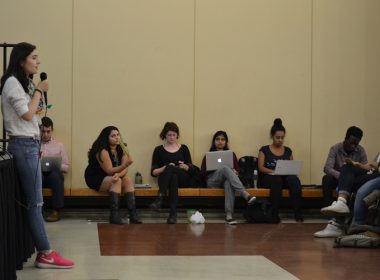
AUS Legislative Council votes to suspend MESS executive council president

On Oct. 11, the Arts Undergraduate Society (AUS) Legislative Council held its third meeting of the Fall semester, during which councillors spent most of the session debating removing two departmental executives for missing mandatory consent training. Council also approved a new speaker, Husayn Jamal, and passed motions to approve the AUS Financial Management Committee (FMC) members-at-large, hold a fall referendum period, and amend the AUS equity policy.

MESS Executive Council co-president temporarily suspended

The most contentious topic of the evening was the motion to suspend Anthropology Students’ Association (ASA) President Sandrine Philie and McGill Environmental Students’ Society (MESS) Executive Council Co-President Peter Garber. Both Philie and Garber were absent from AUS consent training sessions, which occurred on Sept. 25, 28, and 29. The departmental executives failed to submit a valid reason for missing the mandatory trainings by Oct. 1 to AUS President Erik Partridge. As a consequence, Partridge and Vice-President (VP) Internal Rebecca Scarra put forth a motion to remove them from Council.

Despite Philie and Garber’s willingness to attend alternative training externally, Partridge explained that other courses are not equivalent to those that AUS department executives undergo.

“[Our] training is very much tailored to the AUS departmental executives,” Partridge said. “I know that [departmental executives who are] floor fellows were excused given the comprehensiveness of their consent training. Otherwise, there were some requests for excusal based on [AUS] departmental executives attending other consent trainings. For the most part, after reviewing those materials, [they were] deemed not sufficient to cover the training provided to the AUS departmental executives."

Philie cited former ASA co-president Pascale Gerdun‘s resignation to explain why she mistakenly submitted her reason for absence to Scarra instead of Partridge. Due to Gerdun’s absence, Philie claims that she was preoccupied with hiring new ASA executives.

“During the week of the mandatory consent training, I was reviewing all of the applications I received and trying to find the fairest way to give everyone a position they would be happy about,” Philie said. “A week [after the deadline], I learned that I did not email the right person [….] I never intended to skip this training and I do think it should be mandatory.”

Councillors questioned whether Garber considered consent education a priority. While Garber did not provide a valid reason for missing training on time, he acknowledged the significance of the mandatory sessions.

“First of all, I just wanted to recognize the importance of consent,” Garber said. “I didn’t attend [AUS consent training.] It was a slip of my mind but I would love to.”

Ultimately, with 29 votes in favour and 12 abstentions, Council carried a new motion to suspend Garber until he attends AUS makeup consent training sessions. Philie’s reason for absence was deemed valid and as a result, she will remain in her position, provided that she also attend a makeup training session.

Motion to approve FMC members carries

Council unanimously passed a motion to approve Max Knifton, Mia Trana, Daniella Mutuc, and Shannon Timmins as members-at-large for the FMC, the AUS body responsible for reviewing departmental budgets and funding requests from campus groups.

Timmins will serve as co-chair of the FMC alongside AUS VP Finance Noah Lew.

“[Timmins] is one of our AUS assistants,” Lew said. “She’s excellent.”

Motion to amend the Equity Policy

Council voted to amend the AUS Equity Policy so that all Council members can receive training on equity and inclusivity from any resource pre-approved by the Equity Commissioners. Previously, AUS executives and Senators were not allowed to receive training from external groups such as the Social Equity and Diversity Office (SEDE). Partridge explained that the amendment would provide more flexibility for executives and Senators to receive thorough training in the future.

AUS Council will next meet on Oct. 25.

Arts & Entertainment, Music

Trib Mix – October Trip Hop Bops

As the weather gets colder, that summer ‘17 playlist you made just doesn’t feel the same anymore. With midterms, presentations, and essays bombarding students, it’s essential to have a playlist to help you keep focused. Look no further, ‘cause we got you covered. Feast your ears on these trip-hop beats, layered with jazz samples, off-beat drums, and vinyl hiss. Originating in the United Kingdom in the early ‘90s, trip hop emerged as a heavily experimental genre, combining jazz, hip hop, and electronic sounds. In recent years, beatmakers have used samples from foreign films and even anime references to establish a sense of nostalgia. Whether you’re studying, relaxing, playing video games, or falling asleep, these beats are perfect for concentrating without compromising catchiness.


Arts & Entertainment, Film and TV

Bleak, Bizarre, and Riveting—Bojack Horseman returns to Netflix for Season 4

The saddest satire of celebrity culture currently available on streaming platforms, Bojack Horseman returned to Netflix with its newest season last month. Known for its unique take on celebrity culture and unromanticized portrayal of mental illness, the animated show follows alcoholic horse-man Bojack Horseman (Will Arnett), the aged star of a ‘90s sitcom, and his life in anthropomorphic Los Angeles.

Bojack Horseman continues to employ cartoonist Lisa Hanawalt’s  designs in its signature style: Visual jokes and animal puns add another clever layer to the show. The show has a reputation for unusual settings—consider the awards show episode in season three that took place completely under water—but in this season, the settings became even more abstract. The visuals compellingly depict flashbacks to the ‘20s, as well as inner monologues and hallucinations when the script demanded them, making for complex visual storytelling.

In characteristically witty and absurdist form, the show takes a darker turn in season four. While the first three seasons had their brutally emotional moments, each episode maintained a fair balance between humour and bleakness. By contrast, each episode in season four is significantly more harrowing. This imbalance gives the viewer less time to process dramatic scenes, which made the show difficult to watch at times.

Season four very topically addresses the political scandals of this year. As Mr. Peanutbutter (Paul F. Tompkins) runs for the position of governor of California–a role he is decidedly under-qualified for–the nepotistic and performative aspects of modern politics become evident. His views on divisive subjects such as fracking are entirely dependent on circumstance. In ‘Hollywoo,’ admitting to your dislike of avocado can make you lose voter support. The show develops an allegory for Trump’s rise to power, echoing  the pettiness of many recent political scandals. Bojack Horseman shows how garnering support in politics unfortunately has less to do with merit and more to do with knowing the right people.

This most recent installment of the melancholic, alcoholic horse’s saga raises the stakes in terms of character development. Individuals once sequestered to mere secondary status are  devoted full episodes, emotionally investing viewers in unexpected storylines. The episode “Hooray! Todd Episode!” follows Todd (Aaron Paul)—Bojack’s human best friend and primary enabler—as he questions his sexuality and interacts with other main characters. This focused perspective helps the story progress through multiple character plots at once, but also brings novel insight into the characters’ inner worlds.

Plotlines in creator Raphael Bob-Waksberg’s universe do not parallel each other. Convoluted, clashing arcs forego the convenience of simple storytelling. For instance, as the season draws to a close, Bojack’s manager and cat Princess Carolyn is determined to accomplish a personal goal which requires Bojack’s involvement. But our perpetually self-defeating hero harshly dismisses her pleas, bringing Princess Carolyn’s story to a frustrating anticlimax. Upon once again switching perspectives, however, we learn that Bojack had just made a harrowing discovery about his family. Bojack’s subsequent horror causes us to re-evaluate our original judgement of his knee-jerk response to Princess Carolyn, entering the particular episode’s climax into a heartbreaking, morally perplexing territory. As jarring as it is when arcs clash, Bojack Horseman shows that every individual story is more complicated than you'd think. Although not exactly an uplifting, moralistic lesson, the show posits—in its signature hungover haze—that there is always a life more miserable than yours right around the corner.

Although the heavier subject material was a little hard to stomach, the multiple perspectives, along with the amusing and relevant commentary on politics and show business, ensure that Bojack Horseman will maintains its entirely unique status among 21st century comedies.


https://www.youtube.com/watch?v=Bf12qwPWDVI


Arts & Entertainment, Pop Rhetoric

Pop Dialectic: Is Mother! An inscrutable masterpiece? or regurgitated sexist hobgob?

mother! (2017) is a slamming punch to the face—a descent from taut, domestic psychodrama to full-throttle hermeneutic madness. In director Darren Aronofsky’s words, it is “a fever dream,” dabbling in feminism, filmmaking, and biblical allegory. While all of this could make for a truly impactful film, mother! instead flounders in a sea of sensory overload and delirium, perhaps in an attempt to mask the film’s shallowness.

It must be noted, however, that despite its other shortcomings mother! is a remarkably well-made film. From mise-en-scene to cinematography to sound, Aronofsky’s craftsmanship is in peak form throughout. Unfortunately, mother!’s cinematic merits are tainted by its masquerade as a feminist narrative.

mother! is sympathetic to its titular character’s gendered struggle. Told from her perspective—the camera rarely strays from an unnerving closeup of Lawrence’s face—Aronofsky seeks to understand his character’s servile domesticity and blind devotion to her negligent husband. Unfortunately, as the narrative progresses, it subjects mother to the cruelest forms of torment and suffering, in the most uncomfortable and quasi-pornographic detail.

There is nothing wrong with portraying extreme human suffering on film if it serves a meaningful point. mother!, however, has no truly meaningful point. Beyond surface-level commentary on obsessive artists and marital breakdown, it is mostly a biblical allegory, yet the theological “insight” that Aronofsky offers is nothing that a cursory read of the book of Genesis would not provide. Aronofsky has not improved much from the hollow polemics of his previous film, Noah (2014). He uses his films as an arena to rant about his conflicted religious identity, but none of this remotely justifies the viciousness of his artistic approach. All mother! is doing is regurgitating the same images of violence against women that have saturated cinema for a century, alluding to self-reflexivity with its artistic filter, but only scratching at the surface.

Letters to the Editor, Opinion

Letter to the Editor: Clarifying McGill’s Policy Against Sexual Violence

I write to respond to two pieces that ran in The McGill Tribune on Oct. 17: "Editorial: On sexual violence reform, it's McGill's turn" and Caitlin Kindig's news piece, "Our Turn action plan gives McGill's Sexual Violence Policy a C- grade." Both articles contain misunderstandings or incomplete information about McGill's Policy against Sexual Violence. I would like to provide some clarifying information.

It is important for Tribune readers to know that the Policy was unanimously passed by Senate and the Board in Fall 2016 after months of intensive, focused, dedicated collaboration and consultation with multiple campus stakeholder groups, especially students. Upon adoption, it was understood that the Policy can and will evolve to ensure it responds fully and fairly to the needs of the University community. Two committees—both of which have broad student representation—are working to ensure the effective implementation of the Policy and a deeper understanding of campus sexual violence, and responses to it, at McGill. These committees, led by Associate Professors Lucy Lach and Shaheen Shariff, are actively seeking student input; indeed, students will receive a survey from Shariff’s committee this week. Lach and Shariff's committees will submit final reports this spring that will include recommendations to further McGill’s efforts at sexual-violence prevention and response.

It is also essential for our community to know about McGill's new Office for Sexual Violence Response, Support and Education (O-SVRSE), and to be aware of the outstanding work it does. The O-SVSRE was established as a result of the Policy. Its full-time staff is dedicated to the crucial work of supporting and coordinating resources for survivors. It seeks to ensure that survivors will not be required to disclose an incident of sexual violence more than one time, and to support any survivor who wishes to report an incident of sexual violence. Additionally, the O-SVRSE is charged with developing campus-wide education and awareness-raising strategies with a view to sexual-violence prevention.

Finally, I stress two key points that seem to be misunderstood and misrepresented. First, the Policy was established with deep student involvement and an institutional commitment to engage with students and other campus stakeholders as we continuously review the Policy and its application, so that it reflects the needs and realities of our campus. Second, the Policy is broad and inclusive in its scope and extends to all forms of sexual violence, on campus or not, and to all members of the McGill community, including faculty and staff.


Angela Campbell is the Associate Vice-Provost (Equity and Academic Policies) at McGill University, and a professor in the McGill Faculty of Law. 

Commentary, Opinion

Bye bye BuzzFeed: The folly of individualism and the personal essay

Last spring, Jia Tolentino wrote an article in The New Yorker declaring the end of what has arguably been the biggest literary trend of the 21st century: The personal essay. This trend has been bolstered by a subgenre of often pointless confessionals. These have inundated publications over the last decade for three major reasons: They’re simple to write, they’re accessible, and, most importantly, they’re easily attached to seductive headlines. Most people have probably noticed the Buzzfeed articles that flood Facebook news feeds with titles like “My Year Without Makeup,” “Ten Times I Knew I Loved You,” or “Watching And Reading About White People Having Sex is My Escape.”

Do we really need to read articles like this? Probably not, but–the merits of these pieces aside–the reason these sorts of essays have been published with such frequency is simply that people click on them. This desperation for and dependence on web-traffic has nurtured an online subgenre of largely tasteless, pointless, and awkwardly-personal exposition pieces. Unfortunately, this dangerous turn to the superficial egocentric has undermined the value and reputation of more powerful personal essays. Championed by George Orwell, Christopher Hitchens, Bell Hooks, and so many others, valuable and pointed personal essays still exist today, and must remain, as they provide an essential outlet for nuanced perspective in expository writing.

The supposed death of the personal essay has caused a polarizing discussion about the genre’s purpose and relevance in the world today. McGill English Assistant Professor Merve Emre is among those who’ve voiced distaste for the genre’s recent vapidity, writing critically in The Boston Review, “for so many personal essayists, all paths lead back to the ‘I.’” Emre laments the fact that too often, the personal essay, as exemplified by prominent essayist Durga Chew-Bose, “is totally apolitical, bereft of any common political or ethical position.”

This is the gathering consensus leading to the dwindling publication of this type of essay. In a world of burgeoning social and political turmoil, there’s simply no place for pointless individualism, nor is such promotion of narcissism innocuous. That said, examples of the value of personal essays are published every day: Take Jaime Lowe’s recent article in The New York Times examining the dysfunctionality of the psychopharmacology industry through the lens of her own experience. Essays like Lowe’s encourage an emotional engagement and understanding with social issues that’s difficult to elicit with detached expository writing.

The personal essay is a powerful and effective outlet to harness unique perspectives, but the notion often causes people to cringe. In 1936, Orwell wrote an essay titled “In Defence of the Novel,” later republished in 1968 in a collection of what could be called personal essays. Orwell was responding to the novel’s declining standing in literary academia. According to Orwell, this decline was due to an oversaturation of novels—usually bad ones—with reviews such as, ‘“If you can read this book and not shriek with delight, your soul is dead.’” Amid hundreds of works of mediocrity, it’s easier to turn away from the genre altogether; however, Orwell concludes that readers must persist in seeing the inherent value that narrators can provide through storytelling.

The trajectory of the personal essay has resulted in a similar phenomenon: Headlines such as “The Most Moving Personal Essays You Needed to Read in 2016,” push people to dismiss the genre altogether. But, the personal essay remains a way to communicate nuanced and relevant phenomena through individual experiences and provides an irreplaceable platform for issues that could otherwise be more easily brushed aside. The genre’s fundamental value lies in its unique position to elicit valuable emotional engagement in argumentative writing. Declining desire for shallow personal essays is positive, but the genre as a whole, like the novel, cannot die because good writing will always have a place when it has a point.

Commentary, Opinion

Thought for food: A closer look at McGill Food and Dining Services

As Virginia Woolf said, “One cannot think well, love well, sleep well, if one has not dined well.”

Despite the numerous awards bestowed upon McGill Food and Dining Services (MFDS) over the past years, McGill’s dining halls are just not stepping up to the plate. The slew of praise and recognition for MFDS hides the small but crucial systematic issues with our dining halls: Their extreme price, considerable inconsistency, and lack of choice and transparency.

The mandatory meal plan for first year students in non-apartment style residences costs a whopping $4,575. Compared to the food one could buy outside of McGill, that’s roughly 640 days’ worth of healthy, sustainable groceries, based on a $50 per week budget. But, if you’re not quite ready to become a full adult and live off-campus as a first year student—especially if you are one of the 13,000 students living in Montreal for the first time—you are subject to this extremely expensive and, in my experience, not very delectable meal plan.

Once students get the mandatory meal plan, their lives do not become as carefree as the MFDS website touts—the hours of the five dining halls differ drastically, and are mismatched with the times many students prefer to eat. During the week, dining halls are open on average from 8 a.m. to 9 p.m., but lack hot meals between 2 p.m. and 5 p.m., when hungry, tired students typically return from classes in search of sustenance. During the weekends, dining halls operate from around 10:30 a.m. to 8 p.m., although many students rise well before 10 and undoubtedly go to bed (and search for dinner) long past the early hour of 8.

Although most students have fridges and limited cooking facilities in residence accessible at all hours, these are not large or equipped enough to provide full, balanced meals for every student, as one small kitchenette is generally shared by dozens of students.

MFDS poses added problems for students with dietary restrictions. Gluten free options are present but limited—breakfast choices are generally limited to eggs and potatoes, while classics such as pancakes or french toast are always made with regular, gluten-filled flours. The dinner menu contains the same sides of roasted vegetables and plain rice. The dairy-free choices are just as slim—only soy milk for coffee and cereal, and no replacements for other dairy goods such as yogurt and ice cream. Of course, it is difficult for MFDS to suit everyone, but dietary accommodations would drastically improve the wellbeing of many students.

Further, the lack of transparency makes the system difficult to navigate. Even a month into classes, many first-year students I have met are still unsure of how the dining halls work. Some lucky students are individually advised by kind dining hall staff members of certain “hacks” to the system, including the “five-cent bag” rule, which applies to certain brand-name, taxable items sold in the dining halls. As MFDS does not explain, in order for these items to be purchased through students’ meal plans as opposed to their One-Card accounts, students must ask for an imaginary “five-cent bag” to be charged to their account. Pricing is also unclear, as students often realize the cost of their meal only by the cashier (too late). Another example is the fancy “Ozzy” machines for taking food “to go,” which remain a large mystery to most new students.

MFDS promotes eco-friendliness and student responsibility, and is admittedly similar to neighbouring universities, including Concordia, in pricing, rules, and even sustainability. However, this is no excuse for lack of action in other areas. There are some concrete changes MFDS should make in order to improve effective and enjoyable dining for students. First, adjustments could be made to the pricing of food, such as charging by weight as opposed to fixed portions, thus eliminating the waste of money and food. Along this line of individualized accommodation, McGill must increase the availability of special dietary products. Gluten-free baked goods, non-dairy milks, and vegan-friendly meals, would greatly benefit the hundreds of students with such restrictions in their diets. Additionally, all McGill dining halls should serve hot food throughout the day, without gaps during the day.

Furthermore, some issues could be solved with a “dining hall orientation” for new students upon their arrival at McGill, so that students are not left to sort out the multi-layered system on their own, amid the pressures already involved in transitioning into one’s first year of university.

With some simple structural changes, MFDS will keep its students happier and better fed.

McGill, News, SSMU

SSMU Vice-President Finance suspended from the SSMU Board of Directors

Students’ Society of McGill University (SSMU) Vice-President (VP) Finance Arisha Khan has been temporarily suspended from her position on the SSMU Board of Directors until Oct. 30. The motion to suspend her was approved by the Board, with six votes in favor and four abstentions, during a closed session at their Oct. 16 meeting. The Board determined Khan breached confidentiality in forwarding a confidential e-mail correspondence between SSMU executives regarding the appointment of VP Student Life Jemark Earle to the Board to Dorothy Apedaile, a student not a member of the SSMU executive.

The Board approved a motion mandating SSMU General Manager Ryan Hughes to investigate alleged leaks to student media during their Sept. 24 meeting. At the Oct. 16 meeting, Hughes presented the findings of his investigation to the Board. SSMU President Muna Tojiboeva, VP Internal Maya Koparkar, and VP Student Life Jemark Earle were asked to leave the SSMU boardroom for the length of the closed session, and Khan, who was attending the Blueprints for Success conference in Los Angeles on behalf of SSMU, was absent from the meeting entirely. Tojiboeva, Koparkar, Earle, and Isabella Anderson, a member-at-large, abstained from the vote to suspend Khan, and all other members of the Board voted to approve it. According to Tojiboeva, members of the Board were notified of the presentation prior to the meeting.

[The presentation] was scheduled in advance, and all Board members were notified that the General Manager would present two weeks in advance,” Tojiboeva wrote in an email to The McGill Tribune. “Further, as stipulated in the Constitution, members of the Board may participate by electronic means, […] meaning if Director Khan wished she could have participated even though she was out of the country.”

In an interview with the Tribune, Khan questioned whether the Board was made aware of the presentation prior to the meeting.

“This topic wasn’t in the agenda,” Khan said. “Obviously I would have made myself available to defend myself [….] I’m very confused [about] Ryan [saying he would be] presenting the results of the investigation in two weeks, because that’s not true.”

Khan said that the decision to suspend her was unfounded and that it sets a dangerous precedent for the Board’s definition of breaches of confidentiality.

“They made the decision without proper evidence, and without even giving me a chance to speak for myself,” Khan said. “If [the Board] is going to target [my email as] a breach of confidentiality then [they] need to seriously have a conversation about what exactly constitutes a breach of confidentiality.”

Neither the SSMU Constitution nor the Quebec Companies Act make any mentions of breaches of confidentiality, but all SSMU executives sign a non-disclosure agreement (NDA) with SSMU upon their employment. Article 10.10 of the Constitution gives the Board the power to suspend any Officer from their position for any reason it deems sufficient through a majority vote.

As of Oct. 17, Khan claimed that the Board had not officially notified her of her suspension. However, Tobjiboeva denied this.

The General Manager of SSMU informed the Vice-President Finance of her suspension,” Tojiboeva wrote. “The Board meeting ended yesterday at 9PM and the General Manager informed the Vice-President Finance [on Oct. 17].”

In an email to the Tribune, SSMU VP External Connor Spencer, who is not a member of the Board, expressed her disappointment with the lack of transparency in the board's decision to suspend Khan.

I am appalled that the Board and our General Manager decided to present the information when accommodations had not been made to make sure VP Khan was there to represent herself,” Spencer wrote. “We are a union. We are literally here in order to ensure our members have representation and are not on their own to advocate for themselves. I am extremely disappointed not just as an executive, but also as a member, that this is the route the Board has taken this year with regards to the transparency of their decisions.”

News

Board of Governors convene for the first meeting of the year

The Board of Governors (BoG) held its first meeting of the 2017-2018 term on Oct. 5, which highlighted the appointment of McGill alumna Julie Payette to the office of Governor General of Canada, McGill’s response to the legalization of cannabis, recent progress made by the Task Force on Indigenous Studies and Indigenous Education, and the university’s plans to enact its Policy Against Sexual Violence.

McGill alumni successes

The meeting opened with the recognition of the appointment of McGill alumna Julie Payette, (BEng ‘86) to the position of Governor General, on Oct. 2. She is Canada’s 29th Governor General, succeeding David Johnston. As Governor General, Payette has the final say on any legislation by giving Royal Assent.

“Her speech is so relevant, her focus is focused on education, and she really connected to the indigenous people,” Governor Ram Panda said.

Additionally, McGill alumna Jennifer Sidey was recruited by the Canadian Space Agency. She is the fifth McGill graduate to join the CSA.

“[Payette told me] ‘I think that, for McGill graduates, the sky is not the limit,’” Fortier said.

Discussion on the legalization of recreational cannabis

Members of the BoG also discussed the legalization of recreational cannabis—scheduled to occur in Quebec on July 1, 2018—and how this will affect student life. According to McGill Principal Suzanne Fortier, McGill is working with all other Quebec universities through the Bureau de Cooperation Universitaire to implement a provincially-standardized safe regime on campus to regulate the recreational use of cannabis.

“We will treat cannabis the same way that we treat alcohol on campus,” Fortier said. “Nothing [is permitted] during the day, inside or out. The [Vice-President] (VP) Research initiated the idea of [investing] in core research on the impact of cannabis [on students].”

Steps to improve Indigenous relations

Later, Provost and VP (Academic) Christopher Manfredi and VP Camilla Cook gave updates on the progress of the Task Force on Indigenous Studies and Indigenous Education, an ongoing initiative that aims to expand awareness of Indigenous history and repair relations with Indigenous communities at McGill. In the BoG report, Manfredi identified 52 ‘Calls to Action’ to be undertaken to achieve the Task Force’s goals. These 52 steps are divided into five categories: Student recruitment and retention, physical representation and symbolic recognition, academic programs and curriculum, research and the academic complement, and building capacity and human resources.

“We have role to play in a couple of different areas,” Manfredi said. “Extensive teacher training programs are in effect […] as well as research programs, to deal with food and water security and infections that [Indigenous] communities are facing [….] The indigenous community should not be ignored, and they are, singularly, the fastest growing young demographic in Canada.”

Governor Tina Hobday asked Manfredi to clarify aspects of the report.

“This seems extremely ambitious to me as it is, a lot involved, a lot of complexity [….] My question is, do you think you’re going to get to the last recommendations, how long is it going to take?” Hobday said.

Manfredi explained that implementation of the goals is a long-term strategy that he expects will take several years to complete.

“Some of these things are going to be worked on between now and 2022,” Manfredi said. “[It is] a roadway to how we can forward our crucial job in the connection of the indigenous community [….] However, some can be immediate, such as indigenous representation on campus in the form of indigenous art.”

Discussion on the Policy Against Sexual Violence

The BoG discussed the university's Policy Against Sexual Violence. Fortier emphasized the $23 million investment from the Quebec provincial government to counter sexual violence in post-secondary institutions across the province.

This investment followed a new policy accepted by the Quebec government at the end of 2016. McGill passed its own Policy against Sexual Violence in November 2016, which placed emphasis on the support and wellbeing of survivors. Fortier affirmed the policy’s mandate to separate the support process from the investigation process.

“First thing is to support the person, don’t wait for the investigation to be completed,” Fortier said. “Don’t even wait for it to start. We are going to move the [support] services to make it a private environment separate from the investigation, and put it as a priority to give support and whatever help the survivor needs.”

News

WIIS holds first public event on women in peacekeeping

The McGill chapter of Women in International Security (WIIS) held its first public event, “Women in Peacekeeping,” on Oct. 11, which called for increasing the participation of women in the United Nations’ (UN) peacekeeping forces. The talk was hosted by WIIS executive director,  Cassandra Steer, who has worked with McGill both within the Faculty of Law and as the executive director of Institute of Air and Space Law. WIIS operates globally as a non-profit organization committed to supporting and advancing the interests of women in the field of international security.

The main objective of peacekeeping is to ensure the safety of civilians in countries involved in conflict by sending in soldiers from non-partisan countries. Steer began her talk by describing the violence that women often face in conflict-stricken countries. She cited Dr. Tia Palermo’s 2011 study which states that more than 400,000 local women were raped at the hands of both combatants and members of the occupying United Nations Peacekeeping Force in the Democratic Republic of the Congo in 2007.

Commenting on the statistics, Steer highlighted the impact of sexual violence in countries with armed conflicts.

“Armed conflict impacts women and men, but women and girls are targeted because of their gender in a very particular way,” Steer said. “When you attack a woman’s sexuality […] you take away her power, her identity, her ability to interact with society.”

Steer went on to explain that the stigma associated with sexual violence often discourages women and girls from reporting or disclosing their assault to authorities.

“Women and girls who have been attacked sexually don’t feel that they can report that atrocity because often they will be ostracized,” Steer said, “[The sentiment is that] they are no longer clean, they are dirty, it was their fault.”

Evidence from the National Center for Biotechnology Information suggests that women feel safer disclosing incidents of sexual violence to other women than they do men. Steer noted that there have been no documented incidents of women peacekeepers sexually assaulting locals. She believes that having women in leadership roles is a start to solving mass sexual violence, but called for a solution more nuanced than simply fulfilling gender quotas.

“There’s a risk that the perception is [that] if we deploy women, it’ll solve all our gendered problems,” Steer said. “Women are sometimes alone. They can be isolated, they can deal with sexism and violence, they can deal with sexual aggression from leaders within the peacekeeping force, […] and they may be expected to deal with every gendered issue.”  

Lynne Gouliquer, an assistant professor in Sociology at Laurentian University, researches female employment in male-dominated fields. In an email to The McGill Tribune, Gouliquer emphasized the importance of diverse approaches to peacekeeping.

“The more diverse an organisation, the better able it will be [able to meet] its goals, objectives, and mission in a proper and ethical manner,” Gouliquer wrote. “[The Canadian military] does not represent the diversity present in Canada. The issues of gender and sexual minority discrimination and harassment that […] plague our military [are indications] that our military has issues to fix, in addition to attracting more women and increasing diversity.”

Students at the event noted the harsh reality of gendered violence perpetrated by peacekeeping forces. For Melissa Montana, co-founder of the McGill Chapter of WIIS, this event helped promote awareness of gender disparities in this realm and more widely across the globe.

“It is important for students to educate themselves more on the issue, so that they can better understand how these power dynamics work in society, and learn to rectify them through their day-to-day lives,” Montana wrote in an email to the Tribune. “Whether that be trying to host more diverse panel discussions on campus, or even thinking more broadly about how policies […] affect men and women in different ways.”

Read the latest issue

Read the latest issue