

Latest News

Baseball, Sports

Alleged steroid players exiting hall of fame purgatory

Four years after the 1994 MLB lockout hinted at baseball’s impending financial death, Mark McGwire and Sammy Sosa resuscitated the game with an electrifying race past Roger Maris’ single season homerun record. The 1998 season marked a rebirth for baseball, but a revival underscored by rampant, unsupervised, and unpunished steroid use.

While Sosa and McGwire, along with pitcher Roger Clemens and the ‘Home Run King’ Barry Bonds, sit at the peaks of baseball’s all-time statistical tables, the smear of their steroid scandals has detained them in Hall of Fame voter purgatory over the course of their eligibility. Yet, steroid users’ transgressions are not singular and their guilt is not unilateral. The Hall of Fame is moving towards inducting steroid users due to a deepened understanding of baseball’s inbuilt contradictions.

Each year, members of the Baseball Writers’ Association of America (BBWAA) vote on a list of eligible retired players for inclusion in the Hall of Fame. This year, after four stagnant years, Bonds and Clemens have seen a significant rise in votes. Though neither is close to approaching the required two-thirds of the vote necessary for enshrinement, the shift in voter mindset suggests that the public punishment for alleged steroid users inches towards a conclusion.

Characterized in the popular imagination as drug-addled monsters, Bonds and Clemens were nonetheless transcendent talents who arguably already had Hall of Fame-calibre careers prior to their alleged steroid use. While no conclusive evidence has been found that Bonds ever used steroids, his implication in the 2006 BALCO scandal and subsequent perjury and obstruction of justice trials have forever tarnished his name. Similarly, Clemens resolutely denied his steroid use to Congress in 2008, leading to six charges of perjury of which he was later acquitted. However, the popular discourse against their induction argues that their alleged cheating–though fostered by and financially beneficial to the league–irreparably disgraced baseball’s public esteem.

The coming absolution of these legends could be that BBWAA requires a 10-year membership for voter eligibility. This means that a younger crop of writers who covered the peak steroid years at the turn of the century are finally receiving ballots. Yet a more compelling reason could be that the recent induction of former commissioner Bud Selig has opened the door for steroid era legends to also enter the Hall of Fame.

Selig—considered by some to be the greatest commissioner ever due to the league’s unprecedented economic success under his leadership—entered the Hall of Fame last month despite acting as a blind-eye overseer during the steroids era, all but abetting steroid use when it fuelled league prosperity. Selig insistently deferred blame solely onto the players by feigning ignorance. His more recent ‘hard on drugs’ stance only arrived a decade after the 1998 home run race with his contracted drug report from former U.S. senator George Mitchell in late 2007. Even then, Selig only did so after negotiating a lucrative contract extension in 2008 that paid him more than any player. Selig’s inclusion should be no less controversial and has perhaps less merit than the rest of the steroid era greats.

Simply put, if steroids can prevent players from getting in, the structural powers who ignored doping for financial success should face a similar punishment instead of enshrinement with open arms. Yet, Selig’s induction and changing perceptions of retired legends might signal the end of steroid users’ status in baseball history limbo. As the discussion on steroids becomes more nuanced, perhaps voters will continue to dispel the Hall of Fame’s illusions of morality and self-importance.

Campus Spotlight, Private, Student Life

Long-distance tutoring connects McGill students to Syrian refugees with the Syrian Kids Foundation

Over the Internet, McGill students are preparing Syrian refugees in Turkey to take English language proficiency exams. The tutoring is facilitated by the Syrian Kids Foundation (SKF), an organization founded in 2012 to support Syrian refugees in Turkey. Through its flagship project, the Al Salam School, the SKF provides over 1,800 Syrian refugee children living in Turkey with an education. 

The SKF was created in response to the Syrian refugee crisis—the mass displacement of Syrians following the outbreak of civil war in 2011. Faisal Alazem, co-founder and executive director of the SKF, felt moved to create the program after visiting Turkey in person and witnessing the suffering of Syrian refugee children. 

“During a visit to Turkey with friends, we realized that there were so many kids that were of school age that were in the streets trying to make a living, sometimes working, sometimes trying to beg for money, for bread,” Alazem said. “And you realize that there is something very aggressive happening to Syrian children.” 

While working with the children, the foundation identified other areas for their intervention. They extended their services to include free transportation to school and psychological counselling.

“It's really by interacting with the kids that we realized the need to expand social programs,” Alazem said. “[We needed] to have a psychologist speak with them because some of the things that they have seen, no human beings should ever be exposed to this, and particularly kids. Seeing a brother lose an arm, lose a leg, seeing your father deceased and returned home in a box with signs of torture, this is the everyday routine.”

At the Al Salam School, the students learn math, physics, chemistry, biology, and Turkish. The foundation also enlists the help of volunteers from McGill and other Montreal universities, including Concordia University, to teach Syrian students English via Skype.  The goal is to help refugees prepare for the Test of English as a Foreign Language (TOEFL) and the International English Language Testing Service (IELTS). These examinations are necessary to attend university in Canada, should the students wish to do so.

SyrianKidsFoundation_stuliving_online2

Ati Shohoudi Mojdehi, a fourth-year PhD student in Educational Psychology, describes her work preparing Syrian refugee students for English language exams as a fulfilling experience. 

“I have been teaching IELTS over eight years because it is sort of my passion,” Shohoudi Mojdehi said. “So this foundation has two things that are my passion: One [is] helping people, the other [is teaching the] IELTS.” 

Likewise, McGill tutor Brandon Payliss, a Masters student in  chemistry, has had a positive experience volunteering for the SKF. More than any other benefit of tutoring, Payliss is inspired by his students’ resilience. 

“It is amazing to see the progress they make despite the challenges they face,” Payliss said. “One of my students reached out to me and told me personally the things that he had experienced and some of the challenges he has faced, like losing family. It makes you quite speechless.”

Recently, the tutoring program has begun to see the fruit of their labours. In December 2016, two graduates of the Al Salam School began studying at Concordia University on a scholarship founded by the SKF. The organizers at the SKF are gratified by the perseverance and commitment to education that the students have demonstrated. 

“I think they realize that education is their passport,” Alazem said. “More and more they realize that if [they] graduate with good grades and [are] able to [attend] a good university, that is going to be [their] passport. Those are going to be [their]  credentials in the world. This is [their] hope. This is what can give [them the] closest to a normal life as possible.” 

Arts & Entertainment, Film and TV

“Jackie” delivers a haunting biopic of an enigmatic icon

Pablo Larrain’s Jackie is first and foremost concerned with history. This is not to say that the film’s objective is a mere chronological depiction of historical events. Rather, contrary to more conventional biopics, Jackie is concerned with the conscious role of individuals in creating history—which in the case of Jacqueline Kennedy Onassis, is a highly personal and ambitious enterprise.

Following Onassis after the assassination of her husband, President John F. Kennedy, Jackie offers an uncompromisingly intimate glimpse into an American tragedy and an icon left alone in the national spotlight. At times hard to follow, Larrain’s film weaves together a tapestry of memories from Jackie’s shattered psyche. It leaps chronologically from the former First Lady’s famous “Camelot” interview with Life Magazine in 1963 to her pacing feverishly through the White House in her bloodstained pink Chanel suit, to watching tearfully as Vice-President Lyndon B. Johnson is sworn in aboard Air Force One after departing Texas. Although the flashbacks often feel haphazard, the eclectic chronology is guided by phenomenal direction and performances—chiefly that of Natalie Portman in the titular role. 

Portman’s Jackie Kennedy straddles a fine line between calculating and frantic throughout. With the First Lady’s Atlantic prep school purr mastered, she lives up to all the Oscar buzz her performance has earned. While her character does feel conspicuously practiced, as the film progresses we come to understand the careful attention to detail the First Lady invested in her public image: Jackie Kennedy’s character is inherently performative. As Portman navigates through Jackie’s grief, shock, fear, and pride, we watch her nervously struggle to keep her trademark poise intact. The narrative experience can be dizzying, but the film’s bold structuring is reflective of Jackie’s volatile grief, attempting to preserve the legacy of her White House’s “Camelot” myth, while coming to grips with the reality of her new situation.

Fittingly teeming with contradictions, Jackie’s story is framed by the aforementioned interview after the assassination of her husband. The conversation is tense, as journalist Theodore H. White (Billy Crudup) struggles to muster the necessary composure to move past the former First Lady’s guarded exterior. Her responses are sporadically candid and occasionally graphic as she describes her husband’s wounds. Watching Portman’s Jackie grapple with the way her story is told illustrates the film’s major themes of preserving one’s legacy and public image. However, the interview framing device often muddles her story’s progression, unnecessarily confusing the narrative. The late addition of a second, ambiguously dated post-assassination conversation with a priest (John Hurt) only adds to the chronological chaos. 

The film’s frantic approach to its subject matter is tied together by Mica Levi’s (Under the Skin) mournful score, one of the year’s best. The discordant strings complement the film’s disorienting effect. It renders scenes—such as the one in which Jackie removes her iconic Chanel suit—all the more haunting. 

Jackie possesses a near nightmarish quality that lingers upon exiting the theatre. Like no biopic before it, and likely none to come after it—barring Larrain’s imminent Neruda, that will explore the life of exiled Chilean poet Pablo Neruda—the film probes the dark underbelly of what it means to be a public icon. Larrain’s vision is singular; however, while the film strives for new ground, it often eschews clarity in the process.  

Still, the ensuing chaos is beautifully ambivalent, befitting the enigmatic icon at its centre.

Arts & Entertainment, Music

Sun Astronauts, Emmett McCleary perform at Le Cagibi

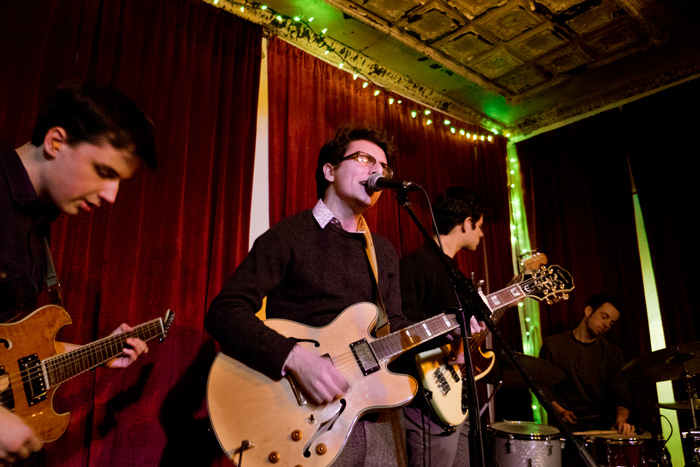
Far beyond the McGill bubble and deep in the Mile End on Boul. St-Laurent, musicians and fans escaped the bitter January cold this past Saturday at Le Cagibi. Tucked away in the back room, three musical acts—two of which are McGill students—joined together for a night of indie folk, classic rock, and pop. 

Playing after Vermont-based band J Bengoy, Sun Astronauts and Emmett McCleary represented McGill’s music community and showcased their diverse repertoires. 

Her first performance in almost a year, solo act Sun Astronauts—U4 sociology and archaeology student Janice Ngiam—graced the audience with her delicate voice. Sun Astronauts breathlessly sings of relatable everyday experiences. “Glue of My Sticker” reflects on crushes you see from a distance—that content moment where “it’s just too easy to dream you up,”—before their flaws are observed. One untitled and haunting track accompanies lyrics written by the singer’s brother, Adrian Ngiam, whispering of frustrations one experiences when feeling excluded. 

The transcendent vocals of Sun Astronauts’ indie folk songs are ideal for a relaxing Sunday afternoon. Using loop pedals to construct layers of dreamy vocals lends a whimsical quality to her music. After her single “A Little Little” found success on Hong Kong radio charts in 2011, Sun Astronauts toured throughout China and the U.S. before coming to Montreal to attend McGill.   

Boston native and U2 Arts student Emmett McCleary has been playing the drums since the age of four and releasing music since he was twelve. Previously producing tracks under the alias Easter.—a childhood nickname bestowed by his grandfather—the transition to Emmett McCleary was less of an artistic shift and more of an effort for search optimization. The adoption of his real name, however, shows a growth in confidence. The musician was previously insecure about some of his lyrics, but he’s now proud to put his name behind his produced tracks. 

McCleary was raised listening to classic rock, R&B, and Motown. Inspired by artists such as The Beatles, his most recent single, “Dream Lover,” is reminiscent of their cheerful and timeless pop classics.

“I’m firmly a pop guy,” explains McCleary. “I like a verse, a good chorus.”

[soundcloud url=”https://api.soundcloud.com/tracks/300387590″ params=”color=ff5500&auto_play=false&hide_related=false&show_comments=true&show_user=true&show_reposts=false” width=”100%” height=”166″ iframe=”true” /]

Observing the community of McGill musicians, McCleary hopes to see more events where McGill musicians can get together and have more internal support. 

“There are a lot of people at McGill that play music and write and I’m always surprised to find a friend,” he said. “So I think there’s a good amount of people producing music, it’s just missing a stronger sense of community and hopefully that will grow in the coming years.”

Suggesting more student concerts at Gerts or simply having McGill-funded student performances could be a means for artists to gravitate towards campus events. McCleary clarified that most of the shows he plays don’t feature student artists, but he’s optimistic about the ability of McGill’s musicians to band together.

Keep an eye out for McCleary’s forthcoming album, set to  be released in May. In the meantime, he’ll be touring the States throughout February. Sun Astronauts’ first performance after a brief absence suggests an upcoming release of new music soon. 


Listen to Sun Astronauts at soundcloud.com/sunastronauts; J Bengoy at soundcloud.com/jbengoy; and Emmett McCleary at soundcloud.com/emmettmccleary 

A previous version of this article incorrectly named the artist otherwise known as Sun Astronauts, whose name is Janice Ngiam. The Tribune regrets this error. 

Campus Spotlight, Private, Student Life

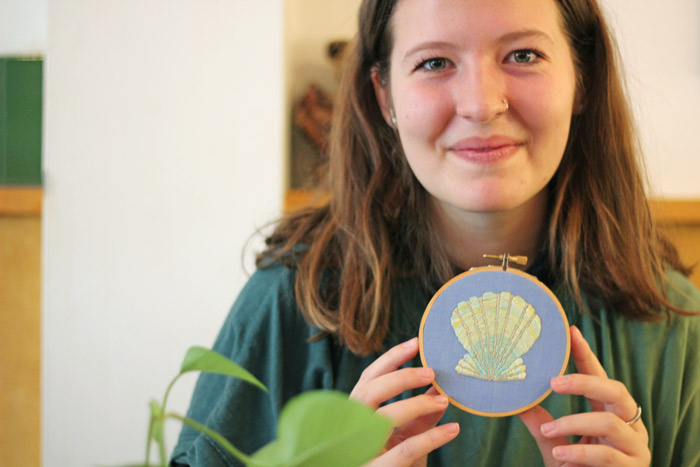
Instagram embroidery: Emily Sanders on needlepoint and the online art community with @thread_counted

Since its inception in 2010, Instagram has grown to serve a vast range of purposes for different online communities; many lovers of fashion, dogs, and memes have all found their home there. For Emily Sanders, U3 Arts student better known by her 1,200+ followers as @thread_counted, the app has allowed her to develop an online following among fans of hand embroidery and lovers of pretty things. 

Sanders started doing hand embroidery in February 2016, after discovering the community of embroidery-focused Instagram accounts, and feeling intrigued to try the practice herself. After purchasing her first embroidery kit, with time and practice, she began to see a positive impact on her mental health. 

“I started doing embroidery because I felt like I wasn’t really having a creative outlet with school,” Sanders said. “It’s something that I just do when I watch TV. It relaxes me [….] One time I was having a really bad day at school, and then I just went home, and embroidered, and it was like the stress was all gone.” 

Sanders’ skill with a needle is entirely self-taught, as noted in the description of her Instagram account. She was able to learn with the help of the Internet, taking to online tutorials and other embroidery Instagram accounts to learn basic stitches. After developing her craft for several months, Sanders began selling her work online in June 2016. While she receives the majority of her commissions via Instagram direct messages, Sanders is also developing her Etsy account, threadcounted. In December 2016, her work was placed on sale at Art Pop, a local art boutique located on Mount Royal Avenue. 

[metaslider id=49746]

Many of Sanders’ designs depict natural elements, including leaves, trees, and animals, and are clearly influenced by her love for the outdoors; she has a particular affinity for whales. She attributes this to her time spent working as a camp counsellor in the Adirondack Mountains, where she was not only exposed to nature, but to a variety of arts and crafts. 

“My camp did a lot of arts and crafts stuff,” Sanders said. “So even though I never really did any embroidery there, we did a ton of knitting. It was very creative and very hands-on in general, which is what I like.”

When designing a new piece, Sanders will often draw out her vision repeatedly until she feels comfortable stitching it. However, like many artists, she often perceives her final product to fall short of her original vision. 

“It’s not perfect, [hand embroidery is] one of those arts where it’s never really gonna come out for me the way I draw it,” Sanders said. “Often [my final product] will change from what [my initial design] was.” 

Feeling insecure about one’s work is a common part of the creative process, and Sanders’ involvement in the embroidery social media community often worsens this feeling. Constantly seeing the work of others makes it difficult not to feel self-conscious, and Sanders is no stranger to this feeling. 

“It was a bit daunting, obviously. I started and I wanted to be as good as the people that I see [on social media],” Sanders said. 

In addition to feeling pressure to perform up to par with other Instagrammers, Sanders often struggles to maintain her creative vision without being influenced by the feedback of her following. On a platform where every double tap is validation of one of her designs, it can be easy to be swayed by mass opinion. As she’s grown as an embroidery artist, Sanders has learned to pay more attention to her own desires and needs in her designs, more so than the comment section of her Instagram account.

“Since I’m doing it so much on social media, it’s hard to get not caught-up in how many likes you get or how many people are following you,” Sanders said. “So now I just try to say, ‘What do I like?’ and ‘What do I think would be cool?’”

Though being a part of the Instagram art community is a rose that has its thorns, Sanders still views this aspect of her work in a largely positive light.

“I really love the Instagram community of [embroidery] too because so often, that social media thing can be really negative,” Sanders said. “So when you do something that’s a craft, or a sort of textile art, [it can feel] so much more positive [….] I recommend following [embroidery accounts] because your Instagram [feed is] just so much prettier!”

Chill Thrills, Out on the Town, Student Life

Hidden hot chocolate at La Distributrice

Rich chocolate, anchored in bitter notes, is blended with robust, fruity coffee. On the tongue, La Distributrice’s decadent mocha is equivalent to a warm hug: An eco-friendly, locally-sourced hug. 

Walking along the busy street of Mount Royal Avenue, one could easily miss the small window shop home to this delicious winter staple. Its stark white awning peeping out from beneath stairs is the only thing signifying its existence to passers-by. 

Comparable in size to the collector’s booth of a subway, La Distributrice is a compact café. With no seating, the café operates as a counter, offering the ultimate coffee ‘to-go’ ideal for the busy patron. 

First starting as a barista under the shop’s previous owners, Max Vezina, the current owner, developed an affection for the miniature café style during his time working there. This ultimately led him to  purchase the café. He now aims to serve high-quality drinks as part of the third wave of coffee, in which coffee is viewed as an artisanal foodstuff, rather than just a commodity. 

“The vision, as I understood it, was to kind of revolutionize the ‘coffee to-go,’” Vezina said. “To make the most out of the small space and provide a good third-wave coffee from direct trade and eco-roasted. Basically to have a third-wave café with no seating places, and [to] be able to offer the passers-by the best coffee possible for a really good price.”

While it may be the smallest café in Montreal, La Distributrice is also known among locals for having some of the best hot chocolate in the city. Vezina attributes its high quality to the fine ingredients that go into it.

(Christopher Li / The McGill Tribune)

“[Our hot chocolate] is made with an extra bitter chocolate, so it is kind of the same idea as the coffee we have here, locally sourced,” Vezina said. “[…] It’s cocoa [is] so very present in the mouth, and not that sweet.”

The procedure for creating the rich taste involves melting the raw chocolate in steamed milk. The drink’s decadence comes from a mix of both quality and quantity; 37 grams of raw chocolate in each cup. 

The heft of the chocolate also blends well with the coffee the café uses, which has cocoa and fruity notes. When mixed, these ingredients make their mocha latte, another top-selling drink at La Distributrice, the crowd pleaser that it is. 

The miniature space was not always home to Montreal’s smallest café. The spot has a long history of different stores occupying it, including a pizza shop, a shoe shiner, and a taco stand. However, none have been quite as successful in staying open for as long as La Distributrice. 

“This is probably the only commercial location that is this small in Montreal,” Vezina said. “I think it was first used 15 years ago, by a guy who made all the procedures to have it be a commercial space because he wanted to have a newspaper stand [….] Pretty much each [new store after that] just succeeded one another every year, they never really last for long-except for this place, which has been here for five years.” 

Contrary to its external appearance, the café’s internal operations feel far from confining. Complete with warm wood panelling and expert organization, the small space maintains a welcoming atmosphere for staff and customers. 

“It looks really small from the outside, but I find the inside is very cozy,” Vezina said. “[….] It must be the one question I hear the most, ‘You must be claustrophobic working here.’ I’m always like, ‘No, I feel great.’” 

Vezina’s love for the compact concept is evident in his potential plans to expand. 

“It wasn’t in the plans of the previous owners [to expand to new locations], but I find [the window shop concept] so easily exportable,” Vezina said. “[If I were to open a second café], I don’t even know if it would be in Montreal, maybe have some in Quebec, or elsewhere. I would love to open a coffee shop in New Zealand. But it is such a good concept, and it works in the smallest of spaces.” 

While La Distributrice lacks seating, there is no absence of conversation or friendly customer relations. The shop has many loyal visitors, and the staff welcomes each customer, both new and returning, with kindness.
 

Out on the Town, Student Life

In the ‘Loop’: Lighting up the Place des Festivals

From Dec. 8 to Jan. 27, anyone walking through Quartier des Spectacles in downtown Montreal will be able to experience and interact with 13 large luminescent wheels scattered around the Place des Festivals. These are the product of Montreal’s annual Luminothérapie competition, launched Dec. 10, 2015. The winners of the competition, announced in October 2016, were awarded a $300,000 production budget to publicly display their interactive installation over the winter months.

This year’s winning design, known as Loop, is more than just an art exhibit. Jonathan Villeneuve and Olivier Girouard, the artists behind the installation, describe the wheels as manually-activated ‘machines.’

Each wheel depicts a different fairy tale through a series of images on the inside of a vertical cylinder, akin to a life-sized zoetrope. Visitors are able to sit inside the cylinder and rotate the images by pushing a metal bar back and forth, creating a short stop-motion animation. A musical score accompanies the rotating pictures, as well as a spinning, colour-changing light on the outside of the wheel.

The project itself took almost a year to become reality. The initial proposal was presented in January 2016. Once Villeneuve and Girouard were chosen as finalists, they had three weeks in March to put together a plan with a budget and deadline. It took them until the end of September to have a working prototype with all the components, and by the time all the parts had been ordered for the final product in late October, they only had five weeks left to build the thirteen wheels.

“We didn’t sleep a lot […] I think we spent four to five months working seven days a week,” Villeneuve said. “I think I can count on one hand the days where our planning for the day went exactly according to plan.”

The competition required visual, auditory, and interactive components. To meet these requirements, the two artists based the final machine around three main technical inspirations.

It began with the zoetrope, which is a device that can best be described as the equivalent of an animated GIF before film had been invented. It works by spinning a series of images on the inside of a cylinder, creating the illusion of movement. The artists were also inspired by the design of a music box, a metal barrel with strategically placed pins, that when rotated plays a musical score on a loop. Finally, Villeneuve and Girouard drew from the railway handcar, a manually-powered car activated by one or two people pulling levers, as their third source of inspiration. 

These three objects all require manual activation for them to work. The whole project revolved around these three ideas and what they had in common.

“It’s pretty satisfying how we managed to [combine] these three elements that were really far apart into one single device,” Villeneuve said. “It’s the idea of [transforming] these three past technologies […] into really futuristic devices. It often makes people think of a time machine, so there’s really these elements of the future and the past meeting in one device.”

Because operating the machines was can feel complicated for new users, Villeneuve and Girouard initially worried that it would be difficult for the public to understand how to use the installment.

“We really wanted to come up with something that was totally new and invented, but still refer to people’s intuition and make it really obvious […] how to use it,” Villeneuve commented.

In previous years, some art installments in the Place des Festivals were much more intuitive to use, such as the seesaws of Impulse, presented for the Luminothérapie 2015-2016 competition, or the swings of 21 Swings, which has returned each spring since 2011. However, the public reaction this year was extremely positive.

“[The exhibit] worked really well. There was no need to explain to people how to use it, they just understood and found their own ways,” Villeneuve said.

The name of the exhibit itself—Loop—reflects the workings of the simple mechanisms behind each individual machine that Villeneuve and Girouard have combined into one. Although, this title wasn’t the artists’ first idea; they initially chose the title ‘Chimera,’ but after deliberation, ultimately decided against it. 

“We both liked Chimera […] this weird machine with different parts, but then to explain it, it’s already complex. For a public art installation people need to understand right away. It needs to be fast and easy,” Girouard added.

Both artists agreed that in the end it’s the public that decides on the name of the installation, regardless of its official title. Last year’s exhibit for Luminothérapie was titled Impulse, but most people referred to it by its appearance, as the ‘seesaws.’

Despite their anxiety over its title and user-friendliness, the final version of Loop was deemed a success for the artists.

“Even if you take so many different paths to get to the goal, it’s fun when you reach [it] and you realize, ‘That’s exactly the idea I had at first.’ Nothing really changed,” Girouard said.


For more information on Loop visit the Quartier Des Spectacles website.

News, SSMU

SSMU Council passes motion to oppose Bill 62

On Jan. 12 the Students’ Society of McGill University (SSMU) Legislative Council voted to pass the Motion Regarding SSMU Opposition to Quebec Bill 62 and the Motion Regarding Interim Provision for Board of Directors Reporting. Furthermore, faculty committees and SSMU executives gave reports outlining key updates and plans for new projects.


Motion Regarding SSMU Opposition to Quebec Bill 62

Council voted to pass the Motion Regarding SSMU Opposition to Quebec Bill 62, which calls for SSMU to publicly denounce the introduction and passage of the law. Bill 62, introduced in June 2015 by Minister of Justice Stéphanie Vallée, would ban face-covering religious symbols–such as niqabs–for public servants while they’re at work. The motion was moved by Vice-President (VP) External David Aird and President Ben Ger.

“Bill 62 is essentially a watered-down version of what we’ve seen previously under the Parti Québécois government with the Quebec Charter of Value, which called for [the removal] of all religious symbols from government officials,” Aird said. “We see it as a human rights issue [….] The Bill is essentially creating a problem that doesn’t exist.”

Councillors present at the meeting expressed support for the motion. Environment Representative Tuviere Okome provided her input on the necessity of the motion.

“Quebec has always had a strange view on the religion of Islam and this is what this Bill is, it’s perpetuating […] Islamphobia in Canada,” Okome said.

The motion passed with 95 per cent in favour and 5 per cent abstaining.


Motion Regarding Interim Provision for Board of Directors Reporting

Council also voted to pass the Motion Regarding Interim Provision for Board of Directors Reporting, which will introduce a new mandate for the interim SSMU Board of Directors (BoD) reports. The BoD will be required to provide regular and immediate updates to the Legislative Council by submitting a detailed report for each legislative meeting about the matters it has dealt with since the last report.

The Ad-Hoc Democratic Governance Review Committee, which was created in November 2016 to review the BoD and the General Assembly, will still provide a complete report on the BoD by the end of the academic year. Arts Representative Igor Sadikov summarized why the Interim Provision was necessary, despite the role of the Ad-Hoc Democratic Governance Review Committee.

“This is something we thought would be beneficial immediately, [rather than] having to wait for the committee to complete the rest of the report,” Sadikov said. “This interim division would [allow] for [the BoD] to submit a report to council for each council meeting.”

The motion was passed with 95 per cent in favour and 5 per cent abstaining.


Executive Reports

VP Operations Sacha Magder gave updates about the SSMU building, including recent successes with Gerts Bar.

“For the first time ever, we have Carnival, Science Games, and E-Week hosting events at Gerts, which is something I’ve been working on since last summer,” Magder said. “I’m so happy to see these events held at our student bar again.”

VP University Affairs Erin Sobat reported on progress that is being made with the McGill Policy against Sexual Violence, which was approved was approved by the McGill Senate in November 2016.

“[We’ve created] an advisory committee to oversee the implementation of everything in the Policy, [such as] setting up the new office, changing the referral procedures, and looking at educational and training initiatives that are mandated,” Sobat said. “But there is also something we asked for back in May [2016,…] called a Panel for Campus Study, that will specifically look at other policies and procedures that are outside of the scope of the new Policy, particularly disciplinary procedures […] and regulation of conflict of interest, which addresses things like student-professor relationships.”

Science & Technology

Building a virtual brain with network neuroscience

"We've become quite good at collecting data to take the brain apart into individual pieces [….] The difficulty we have is how to pull it back together," said Dr. Anthony Randal McIntosh, University of Toronto Psychology Professor and Director of the Baycrest Centre’s Rotman Research Institute.

On Jan. 10, Dr. McIntosh spoke at the Montreal Neurological Institute (MNI) at a seminar entitled “Bridging clinical and cognitive neuroscience with large-scale computational modelling.”

Dr. McIntosh has been a vital figure in the rapidly expanding field of network neuroscience, which explores how different brain regions interact with each other over time.

With advancements in active brain imaging technology, it’s possible to see where spots of the brain light up’ during given tasks; however, static images often neglect the ways in which different brain regions are highly interconnected and incredibly dynamic, even at rest.

Along with a group of software developers and other neuroscientists, Dr. McIntosh led the creation of TheVirtualBrain (TVB), a free, open-source modelling platform that allows anyone to create a simulation of a brain. TVB uses real-life neuroimaging data from methods like functional magnetic resonance imaging (fMRI), which maps activity over time by tracking blood flow in the brain.

"[The brain] is a very complex system," Dr. McIntosh said. "Complex systems tend to operate as a network, so in order to understand them, we actually have to really capture the network dynamics."

Network neuroscience relies on a branch of mathematics called graph theory, where brain regions of interest can be viewed as ‘nodes.’ The connections between pairs of nodes—or the flow of information between brain regions—can be represented by ‘edges.’ It's an intricate, ever-changing game of connect-the-dots that has been applied to several other fields. For instance, graph theory has been used to analyze relationships in social networks.

Like many other biological sciences, neuroscience turns to computers to find new ways of looking at empirical data—that is, real-life observations—through a network perspective.

"I use the modelling approach to constrain possibilities, to test hypotheses […,] and to take it back, then, to empirical approaches to validate that," Dr. McIntosh said. “It’s a nice reciprocal loop.”

These models are sets of equations and values that tell the simulated brain, with its nodes and edges, how to behave. From there, the simulated brain can be manipulated and visually represented in different ways. Without TVB, scientists would need to perform deep brain stimulation (DBS) or transcranial magnetic stimulation (TMS) for controlled activation of certain areas of the brain.

"You can look at what happens to the network dynamics when you start poking [the virtual brain], like you would for DBS […] or TMS," Dr. McIntosh said. "Are there certain areas that are more effective in transmitting the stimulation?"

Each person's brain connectivity—also known as their connectome—is unique. Brain simulations can be helpful in clinical settings, where virtual brains can be created for each individual patient. For example, by programming and analyzing the unique virtual connectome of a patient who suffers from seizures, scientists can study where in the brain the seizure starts and how activity propagates to other brain regions.

The same can be inferred from stroke patients. Relationships can be found between a patient's behavioural performance during rehabilitation and patterns of certain connections. These models can be used to propose possible interventions before testing them out on real patients.

Dr. McIntosh concluded the seminar with a nod to MNI's recent effort to make research data as available and collaborative as possible. Though network neuroscience is still a relatively young field, there is more to come in its cognitive and clinical applications.

"This is work in the spirit of the open science initiative that McGill has embraced,” Dr. McIntosh said. “The success of things like the modelling platform, the success of neuroinformatics, [and] the success of being able to use this to understand clinical conditions really requires community input."

Science & Technology

In search of a sustainable, nutritious diet

What is the perfect human diet in terms of nutrition and environmental impact? According to McGill’s School of Dietetics and Human Nutrition Professor Dr. Timothy Johns, finding the right balance is the key.

Johns, an ethnobotanist and nutritionist, said that humans are omnivores by nature.

“We’re adaptable, but it’s not just ‘anything goes,’” Johns said. “In terms of nutrition and health, eating less meat and animal-sourced food and more unprocessed plants would be positive.”

The contemporary diet includes a lot of meat, which can have negative health effects, such as increasing the risk of cardiovascular disease and diabetes. However, key elements of our diet, like Vitamin B12, calcium, and certain protein components, are much easier to acquire with more meat in the diet.

Katherine Gray-Donald, retired associate professor in McGill’s School of Dietetics and Human Nutrition, believes that special diets, such as vegan, vegetarian, and Paleo diets, can be adequate, and can possibly improve health as people pay more attention to what they eat, if the diet is properly designed.

“It is important to follow scientific information and not fall into groups that abound with fake science,” Gray-Donald cautioned.

Different diets work for different people, though it’s clear that we didn’t evolve with our processed modern diet in mind. Johns also highlighted that some have cultural, moral, or religious reasons for not eating certain foods, making the issue more complicated. Though there isn’t always a direct relationship, diet choice can also influence causes of climate change.

“Twenty to thirty per cent of the total greenhouse gases [emitted] are related to the production, processing, and transportation of food,” Johns said.

Animal-sourced foods produce more greenhouse gases. To lower emissions from transporting food, local production is typically favourable to global production. Though most types of produce are now available year round, shipping blueberries from Chilé to Canada is //not// an environmentally-friendly option.

The balance between sustainability and diet is also evident in fish consumption. Johns noted that fish provide a lot of health benefits, even though some fisheries are unsustainable.

“Nothing is black and white. Fish farming can take the pressure off wild fish populations, but even so, there are problems with GMOs and pollution,” Johns said. “You have to look at it case-by-case.”

According to Gray-Donald, another environmental problem is food waste. It is estimated that 30 per cent of food grown is never consumed. She suggested that fresh produce should not always take priority over alternatives.

“Frozen fruits and vegetables can provide local foods all year long, and avoid flying in delicate fruits from distant lands in off seasons,” Gray-Donald said. “Dried fruits and even canned fruits are fine.”

The question of which diet best preserves biodiversity is also a tough one.

“In terms of habitat destruction, veganism is probably less destructive,” Johns said. “However, vegans eating these plants and destroying populations is bad for biodiversity and agrobiodiversity. But you need to do this for animal food, too.”

Though it’s not the norm, vegan and vegetarian ‘elitists’ who consume expensive and unsustainable superfoods actually pose a potential threat to biodiversity. Johns puts the blame on industrial-style agriculture as well as demographic pressures as the largest threats to both plants and animals.

Gray-Donald urged people to follow information from reputable sources and avoid forming like-minded groups.

“Many people think they are nutrition experts and seem to pick and choose to believe what they want and not believe the mainstream scientific community,” Gray-Donald said.

Overall, change must begin at an individual level. Changes at the system-level will happen when more people start asking more questions about their eating.

“There must be a change of mindset, attitude, and preferences,” Johns said.

Read the latest issue

Read the latest issue