Latest News

Private, Student Life

TedxMontreal 2016 defines, inspires, and changes perspectives

TEDxMontreal, which had Perspectives as its theme in 2016, aims to stimulate curiosity by showcasing a diversity of viewpoints from the Montreal community. It is among the TEDx program of self-organized events, designed to bring a TED-like experience to local cities. This year, the conference was held on Nov. 12 at Espace DCMTL, located in Parc-Extension. This neighbourhood is away from the spotlight of downtown, and was chosen to represent the uncovering of underground ideas and culture in Montreal. 

Created in 2008, TEDx is a global event in which communities worldwide self-organize day-long TED conferences, all with a common mission to foster innovation and spread ideas. The format is simple and effective: Experts in many different spheres–from artists to entrepreneurs–give 10- to 20-minute speeches that engender thoughtful conversation among the speakers and attendees.

Katy Yam, coordinator for the conference, shares TEDxMontreal’s goal to enlighten and strengthen the Montreal community by shedding light upon all of the innovation and creativity happening within the city. 

 “We’re all about discovering and showcasing, and finding those hidden pearls of what’s happening in Montreal,” Yam said. “We want people to change [their] perspectives.”  

Half of the 12 total speakers conducted their talks in French, while the other half spoke in English. All of the presentations were focused on either ideas originating from Montreal or inspiring feats and works by Montrealers. 

One of these innovators was Doctor Yoshua Bengio. Bengio is the head of the Montreal Institute for Learning Algorithms and a professor in Computer Science at the University of Montreal. Bengio is best known for his contributions to biologically-inspired machine learning and artificial intelligence (AI). During his speech, Bengio spoke about the steady integration of AI into everyday life. 

“This new revolution, this second machine age, is going to expand our cognitive abilities, our mental power,” Bengio said. “Computers are not just going to replace manual labour, but also mental labour.” 

On top of a research grant of $213 million given to various Montreal universities to push the boundaries of the AI industry and data science innovation, Montreal has become home to the largest concentration of academic researchers of deep learning in the world. This project is just one among a multitude of remarkable projects occurring in Montreal of which many people may not be aware. 

While more than half of the speakers were scientists, there were also presenters from the arts and social sciences. Speaker Alexis Charpentier, is a music archaeologist; he is among the small community of individuals who dedicate their lives and careers to discovering and refurbishing lost vinyl records. By searching the world for unique records—what he calls his “holy grail”—he gives forgotten music a second chance to thrive. 

 “Beautiful art deserves to be cherished, shared, and rediscovered,” Charpentier  said. “Embrace curators, we are alternative voices to the mainstream music channels.”

In addition to speeches about scientific advancements and creative passions, there were speakers who told stories about their personal experiences. Susan Wener was a crowd favourite, earning a standing ovation at the end of her talk. Wener is not only the author of a national bestseller, Resilience, she is also a therapist with a teaching degree from McGill, as well asa two-time survivor of cancer. Wener told her tale of recovery, and discussed the power of using stories to change perspectives. Wener hoped that people would take away the central messages of strength and finding hope in difficult times.

“It’s not about the things that happen to you […] it’s what you do with what happens to you […] that determines your quality of life,” Wener  said. “The word ‘impossible’ simply means that it hasn’t been done yet.”

The attendees of TEDxMontreal came from a broad variety of backgrounds, professions, nationalities, ages, and talents, showcasing Montreal’s diversity. This speaks to the event’s role as a platform to bring people together expose them to a multitude of unique Montreal-born ideas, all while encouraging creativity and innovation. 

“It’s great for the community, for people to connect, […] and for innovation,” Matthieu Favre, a guest of TEDxMontreal, said.

Yam believed that TEDxMontreal accomplished its goal of showcasing the success and talent from around the Montreal community, along with reinforcing the general importance of diversity. 

“We have so much to be proud of in this city,” Yam said. “I want more success, more Montrealers and Quebecers on the worldwide stage, and TED is a great platform for that."

Arts & Entertainment, Film and TV

“Moonlight” lights up festival screens

Moonlight, the long-awaited second feature from American director Barry Jenkins, is an adaptation of a play-cum-memoir by Tarell Alvin McCraney. The film has already been playing at the TIFF Bell Lightbox theatre in Toronto, but on November 18, the auditorium was full. Perhaps it’s to be expected—after all, it was 6 o’clock on a Friday—but the crowd likely amassed due to the special nature of this particular screening: Following the film, Jenkins was slated to answer questions from the audience via Skype. Already a hit with critics from its time spent on the festival circuit— the film first premiered at the Telluride Film Festival in early September and then made its way to the Toronto International Film Festival shortly afterwards—it was clear from the throngs of people gathered at the theatre, Moonlight has gained early traction with moviegoers as well; as the opening scene flickers to life, it becomes easy to see why.

The story is divided into three chapters, each providing a glimpse into the life of a young black man named Chiron who is growing up in a crime-ridden neighbourhood of Miami. Chiron is played at different ages by three actors (Alex Hibbert, Ashton Sanders, and Trevante Rhodes). He is bullied at school and often left to his own devices by his drug-addicted mother, played with gut-wrenching honesty by Naomie Harris of Skyfall and Spectre. He finds himself drawn to a benevolent drug dealer played by Mahershala Ali, of Marvel’s Luke Cage. Chiron grapples with his sexuality during tender exchanges of affection with his best and only friend Kevin, also played by three separate actors. Ultimately, he is torn between embodying everyone’s expectations of him and becoming the person he desperately yearns to be. 

The film is gorgeously shot and masterfully scored, taking care not to rush with its depictions of Chiron’s warring selves. From boyhood to adolescence and adulthood, Chiron is dramatically transformed in innumerable, irreparable ways, and yet remarkably, a sense of hope–always simmering beneath the surface–is never lost. Fittingly, the movie ends on an ambiguous note, leaving it up to the viewer to decide if Chiron is fated to become a casualty of his environment.

For Jenkins, although the film was challenging to make, it was more “manifest destiny” than anything else. 

“I grew up in the neighbourhood that you see depicted in this film […], it seemed like this massive place growing up […], it was our whole world, you know, in a certain way,” Jenkins fondly explained. “Despite the limitations, there was so much possibility of experience and expression there.” 

When an audience member inquired about the public reactions to Moonlight, especially in the wake of the recent U.S. presidential election, Jenkins became resolute. 

“I’m not so much worried about the backlash,” he said after a slight pause. “I got a message today. I was tagged alongside Lee Daniels…about my attempt at the ‘faggotization’ of America. I’m used to it at this point and the only thing I think of is […], I don’t walk down the street holding my partner’s hand, I can’t imagine the horror and the aggression people who identify as LGBTQ just living their lives, how much they endure every day. So I can shoulder whatever backlash I get.”

In an America full of citizens made recently more aware of the state of their identities, Moonlight will resonate deeply with audiences. 

Commentary, Opinion

The social hangover of McGill’s drinking culture

I  was at a café the other week, trying to decide between one croissant or two croissants, when I found myself confronted with an all-too-frequent crisis—I was faced with a familiar face, but no name to put to it. Luckily, she seemed to be in the same dilemma. We locked eyes, and without any immediately accessible fire exits or open windows, I smiled and waved tentatively. In the requisite two minutes of small talk that followed, we concluded that yeah, we'd totally met at so-and-so's party last month. At that point, I had to bite the bullet and say those five special words that have been salvaging burnt bridges since the dawn of time: "Sorry, what's your name again?"

Unsurprisingly, at so-and-so's party last month, we had both been drunk.

It's a surreal experience to soberly encounter the people that you ‘met’ while you were drunk. You may very well know their aunt’s middle name, or have an in-depth understanding about their recent break up, and yet still waver as to whether you should say “Hi” when you see them on campus. The dissonance between drunk and sober worlds is awkward at best and alienating at worst.

At McGill, this scenario is commonplace because much of social life revolves around drinking: This includes three faculty-run bars, Gerts, Open Air Pub, faculty Froshes, and a competitive drinking event for every possible charitable cause. Beyond its well-documented health and safety risks, McGill's binge drinking culture has a more subtle—but significant—social effect on the ways students interact with each other, both during and after parties. In the long run, conflating the idea of being close to people with just being drunk with people hinders the establishment of meaningful relationships.

When alcohol is as central to social events as it is at McGill, being drunk can start to feel like a necessity to form meaningful connections—which aren’t so meaningful once everyone has sobered up.

There’s a reason that drinking and social life are so easily intertwined: In the face of a packed house party where you only know four people, a red solo cup can feel like a lifeline. For many of us, alcohol is that extra nudge needed to get out of our comfort zones and strike up a conversation with someone new.

The problem is when conversation doesn’t carry over—as it often doesn’t—to the next time you see that person while sober. Your drunk self was wearing a suit of armour when they jumped in on that chat with a friend-of-a-friend. Faced with the same situation, sober you feels sheepish and exposed. It’s hard to follow up on beer-fueled interactions when it feels like someone else—someone bolder, funnier, and probably better-looking—was the one making them. When you have a 45 minute discussion with a new acquaintance about the finer points of beer pong strategy but avoid eye contact the next time you see them, it’s as though you didn't really meet that person at all.

In the short term, this isn’t such a big deal. Feeling awkward around people now and again is a prerequisite of any undergraduate degree. But, over time, when alcohol is as central to social events as it is at McGill, being drunk can start to feel like a necessity to form meaningful connections—which aren’t so meaningful once everyone has sobered up. Rather than bringing people together, the net effect can be distancing and alienating. This has even more troubling implications if students are looking to build life-long relationships at university. In the post-secondary context, individual self-esteem and capacity for intimacy are often still crystallizing.

There’s no simple solution. So long as college students—and people beyond university, for that matter—use alcohol as a social lubricant, a social hangover is an inevitable result. But, seeing the correlation between the two is helpful: If you’re feeling disconnected from that person you were drunken best friends with three nights ago, you can then recognize that you’re not alone. Breaking the silence on that painfully awkward elevator ride or perfecting the passing-smile-and-wave on campus can feel like a Herculean task. It’s useful to remember that the other person probably feels the same way. If you make that leap of faith between drunk and sober interaction, maybe you two can talk about it.

And if you can’t remember their name, it’s okay to just ask.


Jackie Houston is a U2 Political Science and Psychology student and columnist for The McGill Tribune. She dreams of a world where she can pet any stranger’s dog with no questions asked.


McGill, News

Motion to support Notice of Seizure permanently struck from GA Agenda

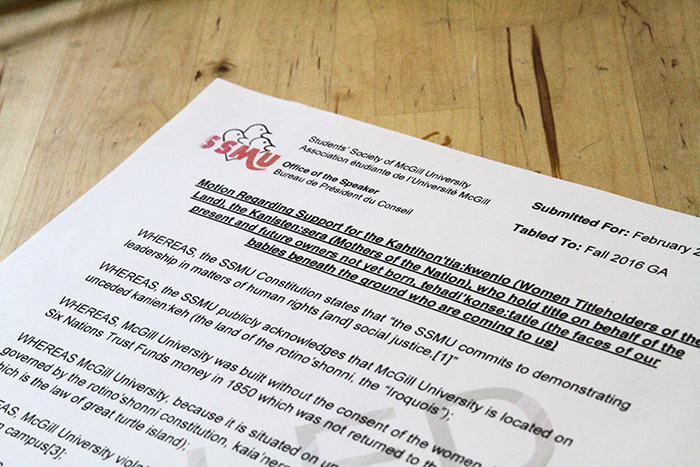
At the Students’ Society of McGill University (SSMU) 2016 Winter General Assembly (GA) on Feb. 22, a motion moved by petition was brought forward titled, “Support for the Kahtihon’tia:kwenio (Women Titleholders of the Land).” The motion called for SSMU to stand in support of the Notice of Seizure delivered by a member of the Kahnawake Mohawk community.

The Notice of Seizure asked for McGill University to immediately cease military research on campus and to pay debts owed to the Mohawk Nation. The motion in support of the seizure was first postponed from the Winter 2016 to the Fall 2016 GA, where it was then struck from the agenda by the Executive Committee–made up of the seven SSMU executives–according to SSMU Vice-President (VP) University Affairs Erin Sobat.

“Typically, the motion would have automatically appeared again on the agenda, but in light of the circumstances, the Executive Committee proposed that it be struck when the [Fall 2016] agenda was adopted,” Sobat said. “Christian [Quequish], [SSMU] Indigenous Affairs Commissioner, spoke to the reasoning behind this and members in attendance had the opportunity to ask questions or make comments. For example, if they wanted to argue that it should remain.”

Quequish consulted with members of the Kahnawake community before recommending the motion be removed from the agenda.

“In anticipation of this issue, I did consult with several community members of Kahnawake and was able to determine that the indigenous activist [who delivered the notice] is and continues to act in isolation of the governance systems within Kahnawake,” Quequish said. “After further consultation with indigenous stakeholders in the McGill community, I made the recommendation to the SSMU executives that we act on this. The SSMU executives put forward the suggestion that we strike the motion from the agenda and release a statement explaining why.”

Quequish was critical of the lack of consultation with indigenous students and the indigenous nation when preparing the motion.

“It was found that the movers in question did not consult with indigenous students on campus, or anyone from Kahnawake, before putting the motion forward,” Quequish said. “This is especially problematic considering the tone and scope of the indigenous activists’ claim.”

A statement released by SSMU to members over email says the ‘Women Titleholders’ cited in the motion do not represent Kahnawake in any official capacity.

“The motion presented at the Winter General Assembly is misrepresentative of local indigenous perspectives and stems from selective consultation with activists operating in isolation from traditional governance systems,”  read the statement. “In particular, the ‘Women Titleholders’ are not official representatives of Kahnawake, nor do they have the support of the Kahnawake Longhouses or many indigenous students on-campus.”

Quequish was further concerned over events that followed the presentation of the motion at the 2016 Winter GA.

“A further reason for the tabling of the motion is that an indigenous student in attendance protested the motion,” Quequish said. “It was found that following the tabling of the motion, the indigenous student was harassed by the indigenous activist, but only because the movers had given [the indigenous activist] the student’s contact information.”

The 2016 Fall GA was held on Nov. 7 and the motion was not on the agenda.

“Notably, the GA also did not meet quorum, so if it had not been struck the motion would have been deferred to the Legislative Council,” Sobat said. “At this stage, however, the motion has been removed and is not up for future discussion.”

According to Quequish, in the aftermath of this motion, SSMU is looking to implement and better institutionalize consultative processes with indigenous students and communities for motions that will affect them.

“SSMU adopted a policy […] on Indigenous Solidarity last semester [that was put forward by the previous Indigenous Affairs Commissioner],” Quequish said. “We will be using that framework to address gaps in consultation between indigenous individuals, groups, and communities and the larger SSMU community. Also, per the statement, we will be distributing more resources and contacts to students and student groups where appropriate.”

According to SSMU President Ben Ger, the Executive Committee is now looking to update the Solidarity Policy to avoid similar situations.

“The Committee will be looking into ways to amend the Indigenous Solidarity Policy to add in some of those protocols. However, they have not yet been finalized,” Ger said. “The process of developing consultative protocols would primarily be handled by the Indigenous Affairs Commissioner and the Indigenous Affairs Committee, with support from [the VP External David Aird, the VP University Affairs Erin Sobat], and myself.”

Martlets, Men's Varsity, Sports

McGill Sailing rules the waves in Canada and the United States

While most students are just trying to stay afloat academically, members of the McGill Sailing team must balance school with practices, competitions across the East Coast, and fundraising initiatives to finance their season.

“The McGill sailors on the team are the most dedicated group of athletes I’ve ever met,” McGill Sailing Vice-President Renee Torrie said.

The sailing schedule is intense, with practices held four afternoons a week and competitions every weekend. The team’s first-place finish in three regattas this season has sustained their spirits as well as their rankings.

“In Canada, we are first right now,” Torrie said. “We just won the National Championship. And in the U.S., […] we’re ranked 16th, which is right in the middle for New England.”

Their efforts paid off in the Canadian National Championship, taking home the first-place finish. McGill sailing’s high ranking in New England is especially admirable considering the high level of competition from American schools. American teams have varsity designation and are fully-funded by their schools. McGill’s sailing team only has club status, meaning that while it is supported by the university, it relies on team fees and fundraising to finance its season.

“We recently have been purchasing new boats and that was a big logistical thing,” Torrie said. “The people at [McGill Athletics] have been really helpful [logistically] in helping us import the boats, buy the boats, [and] all of that.”

The purchase of 12 second hand from St. George’s School in Rhode Island has made all the difference for the sailing team. Formerly, the team had to borrow boats from the Royal St-Lawrence Yacht Club in Dorval, where the team practices. The club has been very gracious in accommodating the team, but their boats were uneven, meaning that some were capable of faster times than others, which made inter-team competitions during practice difficult. Though perhaps not the epitome of luxury, the new boats represent an improvement over the old fleet as they are even, which has lent to the sailing team’s remarkable success this season.

“These boats have significantly improved our practices,” President Amanda Ivey explained. “Having an even fleet is extremely useful because it allows you to better compare your boat speed […] while eliminating variables significant to the specific boat.”

The fleet of boats are expensive, costing over $40,000 to purchase and transport to Montreal. Without subsidies from McGill, the sailing team is forced to embark on fundraising campaigns themselves to acquire the new equipment they need to remain competitive. The team has fundraised successfully through “Seeds of Change” campaigns and by mobilizing members of the wider McGill and Montreal community. Seeds of Change is a not-for-profit crowdfunding network where McGill alumni, friends, and family are able to make donations to help organizations reach their goals.

“We had no idea what our community could do for us until we launched our campaign,” Fundraising Coordinator Isaiah Riesman-Tremonte said. “I had the distinct feeling that we had started something really special.”

Indeed, the sailing team surpassed their initial fundraising goal with donations from friends and family culminating in $40,000 raised over two years. This process has brought the team and the Montreal community closer together.

“It’s a family,” Torrie said. “It’s the most supportive, loving group of people ever. I think being a club team makes us more cohesive, gives us something to strive towards. We always want to be improving together, trying to prove ourselves, […] it’s really more than just a sailing team.”

The McGill Sailing team  has overcome a lack of funding from McGill by connecting with a wider community. Perhaps that is why they train so hard—they have a sense of responsibility beyond their own team.

“We have an [extremely] committed community that cares about us,” Riesman-Tremonte said. “We have them to thank for our success this year.”

Arts & Entertainment, Music, Theatre

Opera McGill’s “Alcina”: A dubious experiment in orientalism

From the cultural stereotypes in Madame Butterfly to the racism in Otello, the intersection of race and culture with opera has a dark and problematic history. Given this legacy, the East Asian setting and the specific Chinese cultural influences of Opera McGill’s production of Alcina is confusing, especially given the European libretto. 

The production of Alcina, was, without a doubt, impressive and meticulous. The vocalists were mesmerizing, the orchestra colourful, and the dedication and preparation were evident throughout. The director, professor Patrick Hensen, reflected that Alcina is a lengthy and demanding opera.   

“The difficulties are the length of these Handel operas—for both the students and today’s modern audience, and the vocal demands of a few roles.” The difficulties were evidently overcome in this seamless and engaging performance. The design elements of production, however, are where the East Asian influences are clear.

Hensen’s unusual setting of the opera was inspired by the Italian poem, “Orlando Furioso” by Ariosto, which inspired a 16th century Opera by Brochi, which later influenced Handel’s Alcina

“In the Ariosto, there is a subplot concerning the saracen Ruggiero and his Christian girlfriend Bradamante. He is flown away by Hippogriff to Alcina’s island “east of India” where he’s enchanted by the sorceress Alcina,” Hensen explained. It was this location that provided the inspiration for the setting. 

“So, it is from within this context that Vincent [Lefèvre, the set designer] and I sought to find a contextual setting in which to both experiment with marrying the flow and movement of Tai Chi with Handel’s music, as well as find what “east of India” might mean,” Hensen elaborated.

Many visual aspects of the production were influenced by Chinese culture. The set included a large Chinese coin representing a compass, designed by a professional Chinese acupuncturist, as well as sky lanterns in the shapes of  planets and stars. The cast performed in traditional Chinese dress and makeup, and props, such as swords and parasols. The movement in the Opera was inspired by Tai Chi, and the cast trained in the ancient art for the production. Quick and short stepped motions by female characters, especially Alcina, appeared to evoke the ancient tradition of foot binding. 

The setting and art direction of the production, however, has been the subject of controversy. Many students, including some involved in the production, feel uncomfortable about the risk of perpetuating orientalism in art—where depictions of Asia are stereotyped in a way that risk fetishizing a particular culture. When asked about the issue of cultural appropriation surrounding the opera, Hensen acknowledges that appropriation is an issue, but explains that he does not see it as relevant to the production. He sees the spread of culture as a vital component of opera. 

“All opera, like all art, lives through a series of cultural exchanges that produce new art,” Hensen said.  “For instance, Opera McGill’s production here in Montreal in 2016 is a remount of the original production in 2007 by a German composer’s Italian opera written for a 1735 English audience at Covent Garden that was based on a 16th century epic poem by the Italian Ariosto. This is just one example of how cultural exchange over centuries helped to create just one opera performance here at McGill, and how complicated art is when looking at source material and/or influences.” 

In the specific context of Alcina, Hensen views the production as an amalgamation of several cultural influences. 

 “If we look right at these sources, Alcina’s characters are not Chinese, they are—if I was pressed to describe—a combination of backgrounds,” Hensen said. “Saracen [Ruggiero], Christian Europeans [Bradamante, Oberto], Sorceresses who live on a magical and mystical island somewhere east of India [Alcina and her sister Morgana], a wizard probably from Libya [Melisso], and Alcina’s general Oronte [probably a hired mercenary].”

Rebecca Jacobson, a violinist in the orchestra of Alcina, has opposing views on the setting of the opera. 

 “I guess I’m just trying to understand why,” she explains. “Handel did not write the opera for that setting, and there are so many other options for the production, and people were upset, so I just don’t understand.” 

Jacobson also describes issues of difficult relationships within the cast and production members. 

“There’s a difficult power dynamic, and it’s hard to explain. But no one wants to risk going to someone in authority. There’s really no way to talk about it,” Jacobson said.

When asked about resisting  the opera’s artistic liberties, Jacobson emphasizes the integrity of the music.

“Many of my friends who weren’t involved in the production asked me why I wasn’t protesting,” Jacobson said. “But there are so many artists, especially the singers, who have been rehearsing for months, that it wasn’t fair to let the music suffer. They deserve for their music to be recognized.” 

Regardless of the questionable setting, Jacobson is correct: The success of the music in Alcina was readily apparent. Race and culture in the production, however, was presented in an ethically dubious way, surrounded by conflicting discourses.

Student Life

The Pomodoro Technique: A time management method to get you through finals

Every student has their own study methods. There are those who still haven’t opened their books, and probably won’t until the day of their final exam. There are the lucky few that inexplicably seem to understand the material with almost no effort or revision. Then there are the students that fall in between these two extremes; those that spend multiple hours in the library, typing up notes, playing catch-up with the readings, going over lecture recordings, and trying not to fall behind before finals season hits. This requires a strong sense of time management, and the Pomodoro Technique is a method that has proven to be successful in increasing efficiency, and effectively allocating time.

The concept is simple: Set a timer for 25 minutes—also known as one Pomodoro—and focus fully on a single task until the time is up. Take a five minute break as a reward, and repeat. After two hours—or four rounds of Pomodoro—take a longer break of 20 to 30 minutes.

This method breaks up study sessions into manageable chunks of time, reduces distractions, and increases productivity.

Makoto Rheault-Kihara, U3 Management, first discovered the technique one year ago. 

“I was reading this book [that] talked about different productivity methods to get the most out of your time, and Pomodoro was [the] number one recommendation,” Rheault-Kihara said. “The more I looked into it, the more I realised that all these other people that I follow—whether it’s entrepreneurs or artists or designers—also use the Pomodoro method.”

The technique was developed in the 1980s by Francesco Cirillo when he was a university student himself. The Pomodoro Technique is still popular today among university students because it is easy to use, adaptable to each individual, and can be followed as strictly or minimally as necessary.

“Usually, I’ll do 25 [minutes working], five [minutes break] and then 20-10 to make it a little easier,” Rheault-Kihara said. “25-5 for three hours gets really tiring, but if you do 20 minutes work then 10 minutes break [at the end of] every hour it’s [not too bad].”

In the long run, this study method helps one discover how much time they need to complete different tasks. It is an effective tool in creating a set schedule that increases motivation to finish tasks within a given time—whether it is in one Pomodoro, or five. It also significantly reduces distractions. 

“You’re super focused for the twenty-five minutes, then in the five minute break you’re totally guilt free,” Rheault-Kihara explains. “Usually when I’m studying and I pick up my phone […] I feel guilty about it, but those [breaks of] five or ten minutes are great.”

Kim Halle, U4 Arts, has been using the study technique ever since attending a workshop on how to get the most out it. ever since. Like Rheault-Kihara, Halle usually creates his own timing system based on his workload and his current state of mind. 

“You need to time [your sessions] according to what you’re actually doing and how you’re feeling,” Halle said. “The 25-5 that’s recommended works for most people, but if you’re feeling particularly energetic, 45-15 is totally fine too. If I feel like I’m completely inattentive, I’ll do very short study periods and build up. If I feel like I’m really [focused], I’ll do longer study periods and then tone it down as the night goes on.”

According to Cirillo, it is also beneficial to one’s overall productivity to define the personal objectives you want to get from each Pomodoro session. For Halle, this part of the process allows him to reflect on his capabilities.

“[One of the things] that was explained to me is to always, for every period of time, have an objective at the beginning and review it at the end,” Halle stated.  “You have to figure out how much you can actually do, is it a realistic goal, that kind of thing [….] It really helps.”

The Pomodoro Technique has proven to be especially useful for students who struggle with time management or focusing for long periods of time. At the McGill Office for Students with Disabilities (OSD), this method is highly recommended—especially for those with attention deficit disorders, such as Halle.

“I got diagnosed with Combined Type ADHD [a year ago], which meant that distractibility [was more prominent for me than in] the average student,” Halle said. “I was all over the place with my studies, I could never sit still, it took me forever to get in the zone when I was studying, and then get out of it when I was done.”

The method can also be advantageous outside of academics. On his official website, Cirillo elaborates on how it can be used in all sorts of professions, and both individually and in teams. The work-life balance that so many students seek can also be improved, as it enables the appreciation of time off after a productive work session.

The Pomodoro Technique is an incredibly simple, yet effective, way of increasing efficiency and boosting productivity. Its effects on time management can encompass a large portion of daily life, and though it may seem intimidating to begin with, Rheault-Kihara provides reassurance.

“The first cycle is the hardest […], but I definitely know that if I spend three hours on Pomodoro, I get a lot more work done than three hours of just regular work.”


Visit the official website for the timer at cirillocompany.de/pages/pomodoro-technique/ or get started with an online Pomodoro timer at www.tomato-timer.com

Album Reviews, Arts & Entertainment, Music

Album Review: We Got It From Here…Thank You 4 Your Service – A Tribe Called Quest


A Tribe Called Quest (ATCQ) mean a lot of things to a lot of people. The group was formed in 1985 with original members Q-Tip, Phife Dawg, and Ali Shaheed Muhammad. Their status as a uniquely positive, innovative force in the “Golden Age” of rap is beyond reproach, which is why the death of Phife Dawg this year shocked many hip hop enthusiasts profoundly. On March 22, at only 45 years old, Malik Izaak Taylor was pronounced dead due to complications caused by diabetes, seemingly closing the door on an already unlikely reunion. It seemed improbable that an ATCQ reunion would survive the loss of one of the most influential MCs of  the era, but the verses he recorded for the project before his passing show that, lyrically, Phife never lost his touch. Announced only a week before its Nov. 11 release, We Got It From Here . . . Thank You 4 Your Service arrived as a total surprise, and shows that ATCQ still has much to offer.

In large part tribute to the recently deceased Five Foot Assassin (aka Phife Diggy, the Di-Dawg, Donald Juice, The Five Footer, etc.), this long awaited reunion LP is capable of reducing listeners to tears and stirring  rebellion. In a divisive time in American history, the Tribe’s voice of unity, peace, and love for one another carries as much weight as ever with some more explicitly political bars than in their early work. 

In the dumpster fire of a year that has been 2016, We Got It From Here . . . emerges as both a comforting hand on the shoulder, and a voice urging protest. The interplay between bittersweet nostalgia and political outrage is readily evident in album opener, “The Space Program.” The song describes white people escaping an ecologically destroyed Earth for Mars and leaving PoC communities behind. As the cautious jazz rap keys kick in underneath Phife and Q-Tip’s acappella introduction, it’s tough not to feel emotional; however, the pair’s sure-handed and complementary flows quickly steer the song in a consciously political direction. Jarobi White, an intermittent contributor to ATCQ, outlines: “They planning for our future / none of our people involved.” 

The Tribe’s innovative use of sampling is featured prominently on the album. “We The People . . .”, an instant banger, utilizes a Metallica drum sample in its righteous fury against the rise of white supremacy in America. “Solid Wall of Sound,” featuring Busta Rhymes, expertly appropriates a classic rock staple in vintage Tribe fashion, looping Elton John’s vocals and the song’s signature swaggering drums. Despite its success in recapturing the jubilant crate-digging mentality of the early 90s, to call the group’s final statement “nostalgic” would be reductive. ATCQ’s style and contributions to the rap industry are timeless. 

The introduction of Jarobi White—credited as Jarobi—to the microphone is one of many new pieces in play on the Tribe’s swan song. Jarobi’s verses serve as a breath of air from Tip’s sometimes smothering singular vision. Alongside a plethora of contributors, he ensures the album’s essential collective spirit. Of course, there aren’t many artists who would decline an opportunity to collaborate on a final ATCQ album, but We Got It From Here…’s credits—including Jack White, Kanye West, Andre 3000, Kendrick Lamar, and more—instantly inspire excitement. 

Looking beyond the star-studded cast, the album never loses sight of its purpose as the final Tribe record. The ghost of Phife Dawg looms large over the album’s sprawling sixteen tracks. One can appreciate the cautious hand of Q-Tip in preserving the spirit of Phife’s rhymes throughout the lengthy mixing process preceding its release eight months after his death. The differences that once drove the pair apart are brushed aside. When Phife’s idiosyncratic Patois/Queens accent interplays with Tip’s perpetually cool, nasally delivery, it feels like 1991 again. 

With so much expectation heaped on this unlikely comeback, there was ample opportunity for the album to disappoint. However, Phife, Tip, Jarobi, Shaheed, and the album’s myriad contributors ensure that it stands up with the rest of the Tribe’s seminal catalogue. Jubilant, tear-jerking, and inspiring, We Got It From Here . . . Thank You 4 Your Service is an expansive and complete experience. Though Phife gestures towards passing the torch to the next generation of rappers on standout “Dis Generation,” this is not an album people will be forgetting any time soon.

Science & Technology

The science of hangovers

With 77 per cent of drinkers reporting that they suffer from hangovers, wasting a weekend morning that was meant to be spent studying because of a splitting headache and nausea is no uncommon occurrence. While there is still no magical cure, scientists are coming closer to understanding the science behind the phenomenon that afflicts many of the McGill population.

“What happens when you drink alcohol is that it gets metabolized by the liver and converted to acetaldehyde,” Dr. Ariel Fenster, professor in McGill’s Department of Chemistry, explained.

Acetaldehyde is a carcinogenic compound that is toxic to the body. While acetaldehyde can be broken down into acetic acid during excessive drinking—which is then further broken down into carbon dioxide and water—the enzyme that converts acetaldehyde to acetic acid is in short supply.

“If the concentration of this enzyme […] is not very high, then there will be a [buildup] of acetaldehyde in the body, which [can be] really nasty,” Fenster said.

Acetaldehyde toxicity is the primary cause of headaches and nausea the morning after heavy drinking.

In the bloodstream, alcohol is also a diuretic which inhibits the pituitary gland from producing vasopressin. Without this hormone, the kidneys send water directly to the bladder rather than reabsorbing it into the body. The result is the frequent urination that many experience when they drink a lot, as well as the subsequent dehydration.

The dry, leathery tongue many people wake up with after excessive drinking is the body’s way of indicating that it’s extremely dehydrated. The diuretic effect of alcohol is also responsible for the expulsion of ionic salts, which, in combination with alcohol’s ability to break down and remove important energy stores in the liver, manifests itself in weakness, fatigue, and a general lack of coordination during a hangover.

“But it’s not just the alcohol [that causes hangovers],” Fenster said. “One of the major causes of hangovers is a class of chemicals known as congeners. Congeners are a chemical generated at the same time as [ethanol] in the fermentation process [.…] The higher the concentration of congeners, the worse a hangover you will have. The greater the age and the darker the colour [of the alcohol], the higher the concentration of congeners, and therefore, the worse the hangover.”

Drinking cognac or a dark rum, for example, would likely produce a worse hangover than drinking the same amount of white wine or vodka.

To avoid the productivity-killing effects of a hangover, there are numerous drinking guidelines that tend to be drilled into first-years as they enter McGill and university life. Eating a heavy meal before going out, drinking plenty of water throughout the night, and not drinking anything at least 90 minutes before going to bed are all key. Additionally, as Fenster explained, there is some validity to the old saying, ‘beer before liquor never been sicker.’ The carbon dioxide in beer or other carbonated beverages causes alcohol to be more readily absorbed.

“If the beverage you drink is carbonated, it is more quickly absorbed,” Fenster said. “You’re going to get sick faster with champagne than with the same intake of white wine, for instance.”

The best way to avoid a hangover, though, is the most obvious one.

“The key is really to drink in moderation, to space your drinking,” Fenster said. “General common sense is the best way to express it.”

Science & Technology

How polling works and why it went wrong in 2016

Many avid media observers were shocked by Donald Trump’s victory in the 2016 United States presidential election. For weeks, media outlets had reported on polls predicting a swift Trump defeat. On election day, FiveThirtyEight, a data journalism website, conservatively projected that there was 71 per cent chance of Hillary Clinton winning. Even more confidently, Reuters, an international news agency, predicted a whopping 90 per cent chance of a Clinton victory.

Despite their convictions, the predictions were wrong. To understand how the polls could be so inaccurate, it’s important to understand how polls are conducted.

“[Polling is] probability sampling, that means that the polling company […] will choose a random sample that is supposed to be statistically representative of the population as a whole,” McGill Assistant Professor of Sociology, who specializes in political processes, Barry Eidlin explained. “[The sample size] can be as small as 1,000 [people], but they’re usually around the 3,000 range. Then, with that randomly generated sample, [… the polling company] will ask a series of standardized questions on a survey. Then, they use those to make estimations about the opinions of the populations as a whole.”

While many media sites like Reuters conducted their own polls, FiveThirtyEight aggregated results from multiple state and national polls from across the United States. FiveThirtyEight’s polling analysis was then put through its election simulator to test for a variety of outcomes.

Polling companies have different methodologies to generate randomized samples. The Pew Research Center conducts their poll by selecting a randomized group of landline and cellphone numbers in the 50 states and the District of Columbia. On the other hand, a NBC News/SurveyMonkey poll relies on a sample of the 3 million people who use the SurveyMonkey online polling system. These two methods of polling have different challenges and can yield different results.

“These days, the problem is [that …] lots of people don’t have landlines anymore,” Eidlin said. “There’s a bit of crisis in polling strictly at a logistical level in that response rates have collapsed so much, right at the moment when we have a lot of very sophisticated statistical techniques to make sure that our samples are good and the estimations [the polling companies] are using are good.”

While logistical and technological difficulties could have been sources of error, another possibility for why the polls incorrectly predicted the election was what is known as the “Shy Trumper” hypothesis.

“There’s nothing conclusive, but clearly all the polls severely underestimated the level of Trump support,” Eidlin said. “One of the ways in which that could’ve happened is by a lot of people who actually voted for Trump saying they were undecided [….] There’s always a problem in any kind of survey you are doing with what is called ‘appropriateness bias,’ […] in that if you hold opinions that you know are not socially acceptable, you’re not that likely to tell a stranger on the phone your unpopular opinions.”

The final hypothesis as to why the polls got it so wrong was simply that there were many last minute swing voters that the pollsters never recorded. Whichever hypothesis is correct, one fact remains: The pollsters and their aggregates’ predictions were wrong across the board.

“Pollsters are well aware that the profession faces serious challenges that this election has only served to highlight,” Pew Research Center wrote in a post-election article. “At its best, polling provides an equal voice to everyone and helps to give expression to the public’s needs and wants in ways that elections may be too blunt to do. That is why restoring polling’s credibility is so important, and why we are committed to helping in the effort to do so.”

Read the latest issue

Read the latest issue