

Latest News

Arts & Entertainment, Theatre

Montreal Improv’s “Dreamtime” brings your wildest dreams to the stage

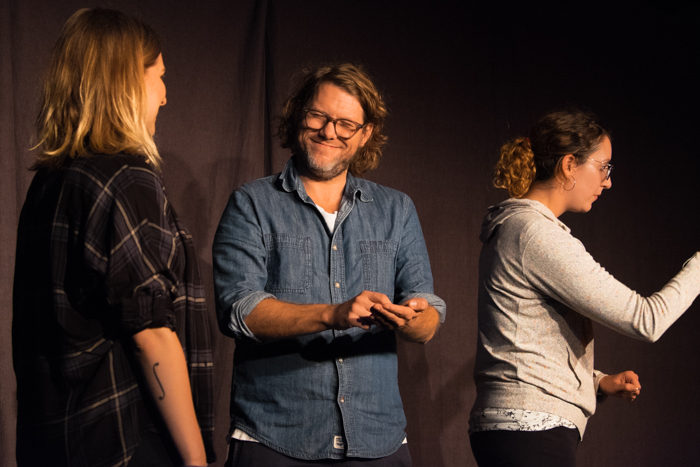
There is something dreamlike about improvisational theatre. Dreams and improv both instill a feeling of surreal unpredictability, an atmosphere of colourful chaos, and a sense of blurry boundlessness. They keep you on your toes and pull you into a distinctly unique experience while breaking down the walls between reality and imagination. Dreamtime, which was organized and performed by students of Montreal Improv, masterfully took advantage of these similarities to create a performance based on people’s dreams. 

The venue, Montreal Improv, is a relatively small theatre on St-Laurent. The theatre room can only be described as clandestine, with its neat rows of folding chairs and nearly non-existent lighting. This dim, minimalist setting exudes a feeling of privacy and intimacy, which implores audiences to forget about the outside world and fully engage with the performance. 

The show’s opener, Frank Mythic—a duo comprised of Andrew Assaf and Dimitri Kyres— performed an improv set based on the word “metro.” Starting with the premise of a man looking for his lost brother in a subway station with the help of a police officer, the story quickly unfolded into an epically amusing mock mystery. The act was not flawless; they broke character and let out a few chuckles in the dramatic sequences, yet, their blunders were largely drowned out by the laughter erupting from the audience. 

Frank Mythic was followed by Genghis, a group composed of Kate Bradley, Paige Cooper, Al Lafrance, Paul Piro, and Stefan Spec. The group opted to perform a series of shorter skits based on a random assortment of props. While their performances were somewhat difficult to follow, their style of humour—bold and wacky—often hit the right note with the audience.

Afterwards, showrunners Isobel Cully and Helena Vassiliou took to the stage to introduce Dreamtime and its team, made up of themselves, Jason Grimmer, James McGee, Jaymie Métivier, and Mariana Vial. As with each of their performances, Dreamtime requested that audience members contribute interesting ideas from dreams they’ve had to serve as a springboard for the improvised act. Before the performance, one audience member shared her dream about a visit from a faceless ex-boyfriend.

To the tune of the 1958 classic  “Mr Sandman,” Dreamtime came onstage, with their act proving to be an unpredictable hilarity. Instead of recreating the described dream scene-for-scene, the performers presented a collection of different stories based on different features of it and the feelings it aroused. The main plot was about the faceless man, portrayed by Cully. However, there were many other skits, with one particularly memorable story based on McGee’s portrayal of a man with a strange fascination with his girlfriend’s feet, based off of the mention of feet in the dream. The most unique aspect of the show was that the different subplots would play out almost coincidentally, with two different stories at times performed at once. 

After the show, Cully elaborated on the team’s use of disorganized transitions. 

“Instead of trying to make the ideas [focused on] dreams, making the format and the transitions more like dreams was the intention.” Cully said. “It’s kind of like how [different parts of] dreams just melt into one another.”

Every performer played multiple roles, each with distinct personalities and backgrounds, yet there was a unique sense of personal style that they were able to inject into their characters. McGee stood out the most in this aspect—every one of his characters would make the audience break out in awkward laughter, but for different reasons. 

“[What I like the most about improv] is that you can be someone else while being 100 per cent yourself,” said Cully. “In improv, you can use your own experiences to do something completely different from what you would do in real life.” 

Despite the wide range of scenarios and forms of humour showcased by the performers, everything ultimately came together to create an experience which successfully captured the feeling of a dream. Although the show intentionally demanded incohesiveness and chaos, it was clear that the team was working as a singular body—they were never thrown off by each other’s eccentricities. Vassiliou explained that this teamwork is why she enjoys improv. 

“Improv is an art form where you can’t ever get too comfortable.” she said. “It’s a practice in teamwork and communication.” 

The Dreamtime team is looking forward to hosting more shows at Montreal Improv. Vassiliou encourages McGill students to attend future performances. 

“Keep your ears to the ground for more improv shows,” she said. “And remember your dreams so you can come share them!”

Arts & Entertainment, Music

Future funk and retro rhythm

Toronto producer Harrison—real name Harrison Robinson—is bringing a fresh sound to clubs across Canada. 

Harrison’s music exudes optimism while addressing some of the subtle difficulties of the experience of youth, from relationships to clubbing. His SoundCloud bio says, “Maybe it’s not so bad.” One of his singles, “It’s Okay, I Promise,” features a monologue from Clairmont the Second about a failed relationship that finishes with “I will find another, knowing you can’t handle it.” These adages are secondary, though, to a unique and compelling album that showcases an eclectic mix of funk, pop, and R&B.  

 Checkpoint Titanium is the 21-year-old artist’s first full-length album, after several years spent developing his sound with various beatmakers and collaborators on SoundCloud. With this project, Harrison said that he wanted to move forward to making more fully-developed, original songs.

 “When I started SoundCloud it was really just beatmaking, sample loops, and shit, not anything much more serious than that,” he said. “I wanted to make full pieces.” 

 Two songs, “So Far from Home” and “Vertigo” make a notable departure from beats to full-fledged pop songs.

 “[‘Vertigo’ is] more like a pop song,” Harrison said. “allie [a Toronto singer and producer] wrote the lyrics, and I spent a lot of time on the instrumental, having it open for an artist to sing on. So, it’s fun making a song knowing someone’s gonna sing on it.” 

In 10 succinct tracks, Harrison showcases his diversity as a producer and songwriter with uptempo and synth-heavy dance numbers—“Checkpoint Titanium” and “Right Hook”—to funk-based ballads—“It’s Okay, I Promise” and “So Far from Home”.

 “So, the point is, you can stay here in fear, forever, as yourself, […] Or we can go everywhere, by love, together,” Harrison orates on “You and I.” “I’m going there anyways […]” This assertion alludes to underlying sonic themes of spontaneity, experimentation, and exuberance.

 Harrison emphasizes the importance of having a good time with his music. A good show, he said, happens when everyone is enjoying themselves. 

“I like the open-mindedness of Montreal, and when people go out to dance, they go out to dance,”  he said. “It’s a bunch of students, and people just want to go have fun.”

 It’s hard not to dance when listening to Harrison—heavy funk and R&B influences combined with uptempo synth beats make for an infectious and exciting sound. Creative sonic and tempo variation sets these tracks apart from the monotony of other techno/house SoundCloud artists.

 While his music alone is enough to ensure a good time, Harrison’s stage presence truly emphasizes his sense of fun. Opening for Cashmere Cat to a small but growing crowd on the Saturday before Halloween, his charismatic stage banter and lively performance amplifies the spirit of his set.  

 Harrison’s good vibes extend beyond his music. His cover art is bubbly with pink and blue hues, often with playful illustrations or lettering. His website has an addictive Super Mario-style video game featuring a skateboarding avatar of Harrison, dodging bullets and collecting coins while chasing his escaped dog, Aika. 

Checkpoint Titanium poises Harrison as a producing talent to watch out for. His songs strip away all dancing inhibitions and conceits with the perfect sound for a night out. 


Listen to Checkpoint Titanium at soundcloud.com/harrison_music

[URIS id=48404]

Private, Student Life

TEDxMontreal Women conference calls women to action

On Saturday, Oct 29. hundreds of people gathered in Salle Mercure for the annual TEDxMontreal Women conference—one of many TEDx Women conferences across the world. Over the course of the day, 16 speakers gave powerful talks related to the theme, “It’s about time.” 

The conference theme for the independently-run TEDx event was derived from the wider TEDWomen conference topic this year. Though broad, the assertive subject gave speakers room to touch on issues of health, human rights, technology, and social justice, all while calling women to action. For Emily Hamilton-Leavitt, director of Food Logistics for TEDxMontreal Women, the theme challenges women to take ownership of their accomplishments.

“It’s about time we showcase what we’re good at and not minimize our accomplishments […] women have a tendency to not necessarily own what they do,” Hamilton-Leavitt said. “They’re not necessarily going out there and showing it to the world, and we wanted people to really see how women can do these incredible things.”

Speakers at the event spoke on topics ranging from female sexual pleasure to the importance of finding moments of stillness in otherwise busy and chaotic days. The range of talks helped ensure that every attendee could find a subject they were interested in. However, one speaker, Juss Kaur, spread a powerful message on religious tolerance that she hoped all attendees could engage with. 

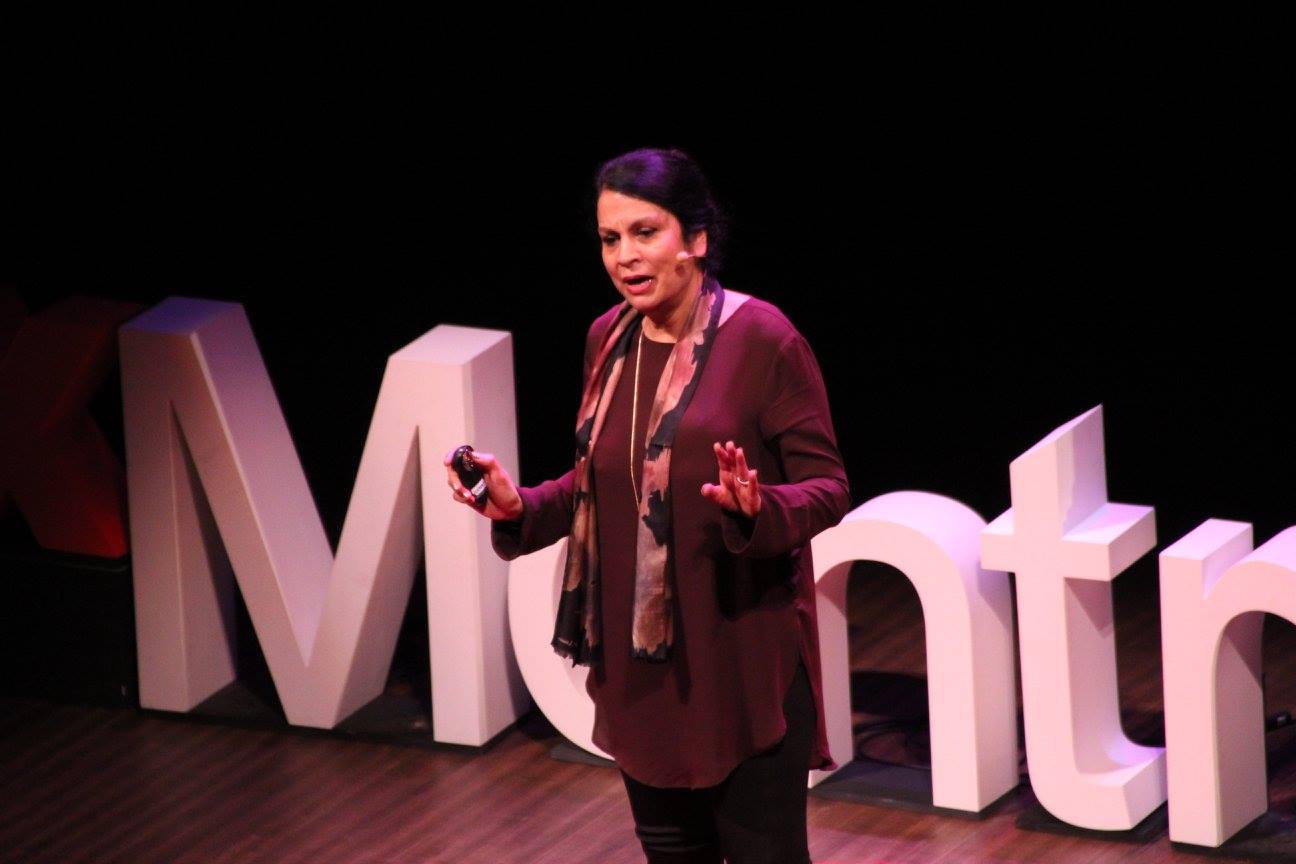
As a Sikh liaison in the McGill Office of Religious and Spiritual Life (MORSL), religious acceptance is an important topic for Kaur. In her talk, she addressed religion-based hate crimes and western phobia of those wearing head coverings. 

Juss Kaur speaks on religious tolerance. (Wendy Low / TEDx Montreal Women)

Juss Kaur speaks on religious tolerance. (Wendy Low / TEDx Montreal Women)


“There is this turbanphobia that’s going along, and, as a Sikh woman, I’m very concerned about that,” Kaur said. “Since 9/11 basically, some people generalize and they say that all turban wearing individuals are terrorists, and so I wanted to bring across this message that this is not so […] we have to understand that everyone is not the same. You can’t take a brush and paint everything the same.” 

Kaur shared her vision of oneness, calling on audience members to search for common ground with those with whom they have superficial differences. 

“My message is that it is our responsibility to learn to counter all our fears,” Kaur said. “Fears come from hatred and not being able to understand other people, to understand that below all these surface differences we are all the same.”

In addition to the diversity of topics at the conference, there was a similar range of variety in speaker ages and backgrounds. The youngest speaker at the conference, for example, was Emma Hason, 16-year-old high school student and poet. Instead of a talk, Hason performed a slam poem about the pressures placed on teenage girls to excel academically and socially. The topic of Hason’s talk was rooted in her personal experiences as a young woman.

emma hason
Emma Hason performs a poem on social pressures placed on teenage girls. (Wendy Low / TEDx Montreal Women)


“I always sort of felt that there was this pressure on girls my age and I’d see that a lot at school,” Hason said. “I was really noticing that a lot of people felt like they had to act a certain way just because that’s what society told them to do.”

Hason’s ultimate goal with her poem was to mobilize other young women in her community to support one another, rather than perpetuate unrealistically high standards placed on teenage girls with attitudes of individualism.

“A lot of times, girls have a habit of turning on each other and thinking that it’s each for her own,” Hason said. “If we stick together, we can maybe make it through everything, and we don’t have to always give in to what other people say we need to be like, we don’t have to be afraid to be ourselves because there’s always going to be other girls who are going to stick up for us and have our backs.” 

Whether a talk’s purpose is to build community among viewers, to call people to action, or to raise awareness on an issue or invention, the TED platform serves an important role in disemminating ideas. Because many audience members at TED conferences attend with the expectation to learn, each idea shared has a resounding impact upon the listeners. This was certainly true at TEDxMontreal Women. 

“I think [TED is] a very important venue for sharing knowledge,” Kaur said. “The people who were there were very open-minded and ready to receive the message. I think that’s amazing, and of course from here, these are the type of people who can bring change, […attendees are] open-minded, with attitudes that say, ‘Yes, there is possibility of looking at something with a different attitude.”

Arts & Entertainment, Books

Book Review: “3 or 4 Years an Indian”

The introductory blurb on the back of 3 or 4 Years an Indian describes author Cindy Styles as being “a new author born by obligation.” Of all Styles’ titles—musician, healer, McGill alumna—the only one that she has ever been denied was the one she is owed: Membership to the Qalipu Mi’kmaq nation, a small band of landless indigenous Canadians that, thanks to the 2014 parlimentary bill C-25, has very strict membership requirements. 

Styles’ story begins in 2011, when Harper’s government formally acknowledged the indigenous Newfoundland nation and promised its members all the health and economic benefits they were entitled to. As the news began to circulate, members from near and far came forward, and before long more than 100,000 individuals had claimed legitimate ties to the nation—almost four times the original estimate of enrolment.  It was then that the government began to amend its original plan. Membership contracts were revised and rules were changed. Despite their status as a “landless tribe,” those members who were living outside of Newfoundland were faced with the strenuous and demeaning task of proving their authenticity to the government by providing everything from affidavits to family photos. Styles, who is of Mi’kmaq heritage and entitled to membership in the indigenous nation, was inspired to write her story when her identity was challenged. 

3 or 4 Years an Indian is a quick read. Of its 130 pages, almost half the book is comprised of photos, letters, and lists, tucked away in addendums, to which Styles often refers. Interrupting her own narrative, she asks readers to flip back and forth, creating a “maze-like trickery to mirror the task presented [to me] by the Canadian government.” 

“I’m a Music major, right?” Styles joked in an interview. “The book has ABA formatting, with a variety of imagined codetta’s in the form of addendums. Creative non-fiction.” This format successfully reflected the confusion and miscommunication that characterized the process of Qalipu Mi’kmaq membership.

Hers is not a linear story. Styles insists that it began generations ago, with the family and traditions that she was born into, and the colonialism that threatened them. The first of the addendums contains the letter she and many others received from Aboriginal Affairs and Northern Development Canada, detailing the steps they must take in order to complete the process of “Self and Group Identification.” What follows is the letter she wrote in response to the Enrolment Committee, in which she recounts childhood anecdotes, family histories and personal accomplishments to prove her genuine ties to her own people. 

Near the middle, the book abruptly segues into a brief interlude about addiction and substance abuse. The chapters preach the dangers of alcohol, marijuana, cigarettes, and Kraft Dinner, along with a slew of street drugs that Styles hopes readers haven’t tried.  Her  favorable view of sobriety, although eloquent and earnest, is one we’ve heard before, not to mention that it appears without much explanation as to how it relates to the rest of the story. 

Although this transition is blunt, Styles’ additional message here is effective. Speaking candidly about substance abuse and Indigenous- Canadian relations moves the reader away from the media’s portrayal of addiction and hopelessness within Indigenous reservations.

“It’s not that it’s inaccurate or misrepresented, it’s more about overall optics,” Styles explained. “We both know I could follow a few of Canada’s finest sons and daughters around any campus, frat, or sorority house on any given weekend,  and come up with some pretty unattractive footage. I see substance abuse in many cultures. So, since I am of the healthiest body and mind, I thought I’d offer advice to the other cultures. How dare I? I did.”

The entire story is delivered with this kind of wit and shrewdness. 3 or 4 Years an Indian is an meaningful narrative that entertains while it educates. Told in a unique format with a confident voice, the book sheds light on the injustices still present in Canada. At once charming and blunt, funny and solemn, 3 or 4 Years an Indian is an atypical work of non-fiction that puts personal experience at the forefront of a historic phenomenon. 

Student Life

Dogs of McGill

Many McGill students feel as though they have little time to care for themselves, much less for a pet. However, the McGill student body is not without its share of dog owners, as many students can be seen walking their dogs on campus on a regular basis. Armed with a socially-acceptable reason for an adult to pet stranger’s dogs, The McGill Tribune set out to get to know student dog owners and the loving, unique relationship they have with their dogs.

(Grace Hebert / The McGill Tribune)
  

Sugar

Breed: Corgi

Age: 1 ½ years

It’s a balmy Thursday afternoon at the weekly Farmer’s market, which is in full swing. A couple walks briskly by with their dog trotting in front, despite her short legs. After a quick, well-appreciated scratch, owner Dana Li, U3 Joint Honours Economics and Finance, uses a knee as leverage for face kisses as others come to pet and take pictures of her dog, Sugar.


McGill Tribune (MT): How did you get Sugar?

Dana Li: “I have a friend of a friend who has a farm. They had two dogs and would give puppies away.”

MT: Where do you like to take her on walks?

DL: “Mostly on Mont-Royal, but I also take her on [walks] around campus.”

MT: Can you tell me anything special about Sugar?

DL: “She’s very well-behaved. She can shake hands and sit [on command]. She’s well house-trained.”


fluffyfluffs_gracehebert(dog1)_o1

Harper

  • Breed: Morkie

  • Age: 8 months

A large throng of students pass through  the Milton Gates on their way to class in the early afternoon. Amidst them, a small dog pulls ahead of the pack, followed quickly by her owner, Taylor Kris, U2 English and Marketing. The small, fluffy dog expertly weaves out from under the many feet in search of more smells and a faster pace.


MT: Is this your first dog?

Taylor Kriz: “My parents have two, but this is my first dog I’ve personally owned.”

MT: Where do you like to walk Harper?

TK: “I walk her everywhere! Usually on the mountain since you don’t need a leash.”

MT: What makes her special?

TK: “She’s a furball and pretty smart. She’s already potty-trained and can sit [on command].”


MT: What is your favorite thing about Harper?

TK: “She is such a snuggle bunny. She likes to sleep beside me every night.”


fluffyfluffs_gracehebert(dog4)_o4

River

Breed: German Shepherd/Border Collie/American Pitbull mix

Age: 2 ½ years

On the grassy steps near the Milton Gates, River lounges beside her owner, Kyle Gardner, U3 Marketing Management, as he does homework. River stretches out on the grass, trying to get as much sun exposure as possible. With the approach of others, she perks up with a bright spark of intelligence in her eye.


MT: How did you get her?

Kyle Gardner: Actually, she’s my twin brother’s dog. He got her off of Kijiji because someone was trying to get rid of a litter. I’m taking care of her now because he can’t have River in the apartment. I’ve been taking care of her on and off since she was a pup.”

MT: Where do you like to walk River?

KG: “I walk her on campus, but I usually take her to the dog park on Docteur Penfield and Pins.”

MT: What is special about River?

KG: “She is the smartest dog I’ve ever had. She can do so many tricks. I’ve almost gotten her to get a beer from the fridge. We got the foamies for each can but she won’t pick them up. She can defend [a goal], like in soccer. She especially likes hide and seek and hiding the ball.”

MT: Do you have any concerns about the pitbull ban in Montreal?

KG: “I was thinking of registering her as a German Shepherd and Border Collie. I won’t get her tested though, just for plausible deniability.”

MT: Does she have any quirks?

KG: “She gets upset when no one is petting her. She also has a terrible nose. She can’t sniff out anything. And she doesn’t under the concept of pointing. She just stares at your finger.”


fluffyfluffs_gracehebert(dog3)_o3

Vladimir

  • Breed: Black Labrador/Rottweiler mix

  • Age: 5 years

In front of the McConnell Engineering building, Vladimir’s huge, black frame pulls towards the Y-intersection with little heed of his owner, Mashal Khan,U1 Software Engineering, who attempts to keep with his break-neck pace. Upon being stopped, Vladimir jumps up for a hug, and goes straight for the face for kisses.


MT: When did you get Vladimir?

Mashal Khan: “I just got him this weekend at the local SPCA. He was abandoned and left on the street. Then he was adopted for 3 weeks and returned. So many people get dogs and then say they are too busy to take care of one and then get rid of them, especially McGill students.”

MT: Where do you like to walk him?

MK: “I walk him on campus. He likes Lower Field since he has space to run.”

MT: What is something special about Vladimir?

MK: “He never barks. He has the best temperament. He’s always friendly and he likes everyone. He especially likes to hug. When he’s tired, he likes to curl up next to me. He also loves belly rubs.”


fluffyfluffs_gracehebert(dog2)_o2


Kaiser:

Breed: Miniature Pinscher

Age: 3 months

At the bus stop on Milton and Parc, Berk Tokmak, U1 Political Science, sits with his dog Kaiser; Kaiser is small enough to fit in his owner’s hands. Kaiser is shivering in the cold, despite his coat—though this doesn’t stop him from trying to eat bottle caps and drag his leash in front of pedestrians. Kaiser is full of youthful energy, and is very affectionate.


MT: Is Kaiser your first dog?

Berk Tokmak: “He is my first dog.”

MT:  Where do you like to walk him?

BT: “Depends. I walk him everywhere.”

MT: What do you like most about Kaiser?

BT: “He’s very energetic. He is instinctively programmed to hunt down vermin.”

(L-A Benoit / The McGill Tribune)
McGill, News

Chabad at McGill event faces protest

On Nov. 8, Chabad at McGill, the local branch of Chabad International, hosted an event on Lower Field that soon attracted protesters, including members and supporters of the Boycott, Divestment, and Sanctions (BDS) campaign. Chabad International is a not-for-profit educational outreach organization that aims to create a “home-away-from-home”. The BDS Action Network at McGill lobbies to divest from and prevent any future university investments in companies that profit from the occupation of Palestine, as well as for Students’ Society of McGill University (SSMU) to take a firm stance condemning Israeli actions. As part of the event, which was called Artists 4 Israel, Chabad McGill erected a section of wall on which participants could paint murals.

According to Eva Chorna, a U1 Science student and member of Chabad’s student board, the event was intended to promote positive messages.

"Basically, what we tried doing with this event [was] we brought a group of artists [who] came to spray paint a mural on which we were promoting a really peaceful and inclusive message for coexistence," Chorna said.

According to Chorna, the event was designed to bring together people of different backgrounds and political views through a common medium–art. The event was not related to Israeli-Palestinian relations.

"It’s just related to the idea that […] Israel comes to campus with its arms wide open, with the desire to have a conversation about peace, with the desire to engage with students in a meaningful dialogue, in a meaningful conversation," Chorna said.

Protesters felt that the wall on which the murals were painted inappropriately resembled the West Bank Barrier Wall, an obstruction built by Israeli forces in 2002 to separate Palestine and Israel. According to Laura Khoury, U3 Engineering and a BDS supporter who was present at the protest, the event made many students uncomfortable because of its likeness to the West Bank Barrier.

"It is […] frustrating that they used a form of appropriation [such] as the Wall, which for a lot of people is […] triggering because many Palestinians need to go through multiple checkpoints on this wall to even go to school," Khoury said.

Julie Skarha, U3 Arts and Science, a protester who is an organizing member of McGill BDS Action Network, indicated that she found the symbolism of the wall a matter of concern.
"The graffiti canvas normalized the occupation by appropriating forms [of] Palestinian resistance in the West Bank against the Apartheid Wall, [which] restricts the mobility, access to medical resources, and water supplies of Palestinians in the West Bank," Skarha said.

According to Chorna, once the protesters stood in front of the murals, she and other participants invited them to partake in spray-painting the mural and were firmly rejected by the pro-Palestinian.

"These guys decided that instead of contributing […] and maybe even tagging their own message […] to not interact with us, refused to speak to us, [stood] in front of our mural, [and blocked] the view of other students from this amazing, artistic work, and [created] tensions," said Chorna.

According to Khoury, the event sent an uncomfortable message to Palestinian students on campus.

"Forgetting the political sphere in which we [live] and in which the continuous colonization of Palestine actually exists and promoting Israel as a country [and] culture of peace beyond the political spectrum is not in any way fair […],” said Khoury. “It does not portray the actual situation on the ground and for us Palestinians that [walk] by on this campus, we feel very uncomfortable to see the appropriation of Palestinian resistance."

A previous version of this article incorrectly stated that the BDS Action Network at McGill lobbies to prevent university investments in Israeli companies that profit from the occupation of Palestine. In fact, the BDS Action Network at McGill does not exclusively focus on Israeli companies. Further, the Action Network lobbies for the university to divest from current investments as well as to prevent additional investments that contribute to the occupation of Palestine. The Tribune regrets this error. 

Laughing Matters, Opinion

The official guide to becoming a McGill gym bro

I  am compelled to thank all of the McGill gym bros who have approached me over the past four years for teaching me how to work out. Your generosity consists of stopping me mid-set to critique my form, asking me which of my boyfriends taught me how to lift weights, suggesting that I use the bar meant for girls, and telling me that another exercise would be more effective. Apparently, being a female in the gym permanently renders me clueless as to lifting weights, despite having done so for years.

I have noticed that although there is a standard way to conduct oneself in the gym as a male, there is a glaring lack of standardized procedure for newcomer gym bros. For example, a first-year attending the gym for the first time might actually respect others’ space while working out, and wait to use equipment. As a lowly female that dares to enter—and use—the weight section, I maintain that the McGill gym community must avoid such a bro-pocalypse. Worry not, potential and novice gym-goers. I present to any aspiring bros a polished guide to working out in gym bro fashion and flexing masculinity!

As any alpha male should, McGill’s gym bros must set an example to all beta gym-goers. Incoming gym gals will not know how to work out if no one tells them how to. Endeavour to grunt as loudly as you can—yell, if necessary—during any and all compound movements, especially the ultra-masculine bench press. If you happen to be spotting your fellow bro, support him by counting his reps as loudly as possible, and shout any motivational quotes that come to mind. Always be mindful that if you do not make your presence known to every single person in the fitness centre, the gym pedestrians will continue with their routine of useless exercises. Without seeing a shining example of real, unfettered strength, the McGill population will surely shrivel into—heaven forbid—negative gains.


As any alpha male should, McGill’s gym bros must set an example to all beta gym-goers.

The next step in solidifying bro status is to occupy as much space as possible in the weights section. Place your water bottle—presumably filled with quadruple-strength explosive pre-workout mix—and towel on separate box steps. Otherwise, why are you at the gym? Let others know you need as much space as possible to properly activate your muscles. If someone dares to ask for such a crucial piece of equipment as your water bottle platform, make sure you do at least two more impeccable sets of deadlifts before acknowledging their presence. If they have not already cowered away, move your precious bottle of pre-workout to the floor, accompanied with a loud sigh to signify your displeasure of acquiescing to their unreasonable demands.

Above all, make sure to observe any lowly gym-goers closely while they work out. When you witness improper form, ineffectual exercises, or the gains-destroyer—also known as cardio—provide your unsolicited, but much needed, advice. Never mind their goals or their physique, you are the authority on all physical activity. Disrupt such a display of embarrassment and lead them to the right path, even if that path is to the exit turnstile. If you see a female in your lifting territory, simultaneously correct her form and tell her to lift heavier weights if she wants booty gains. Then, do numerous pull-ups in front of her between sets to reassert your strength and wisdom. Bonus points to if you manage to interrupt her mid-set!

Upon consistent and rigorous devotion to the aforementioned principles, you will eventually flourish into the McGill gym bro you always dreamed of becoming. Go forth and bestow this gift of knowledge on everyone else. And by that, I mean tell them their form sucks.


Jennifer Lockerby is a U3 Political Science and IDS major from a thriving metropolis known as Niagara Falls. She enjoys street photography, SoundCloud rappers, makeup, intersectional feminist discourse, and attempting to lift weights.


Science & Technology

The impact of climate change on Arctic biodiversity

“Most spiders are small. I don’t know if that’s a comfort to you or not,” Dean of Students and Department of Natural Resources Associate Professor Christopher Buddle said to the audience on Nov. 10 at Cutting Edge Lectures in Science, hosted by the Redpath Museum.

As an arachnologist studying the biodiversity of spiders and insects in Arctic systems, Buddle is no stranger to the hostile environments of the North. Much of his research addresses the critical situation concerning climate change that has been becoming an increasingly significant factor in Arctic habitats.

“We know that the Arctic is changing,” Buddle said. “It’s very alarming, because the rate of which things like climate change happen in the North is very, very rapid.”

The far northern environments, which Buddle refers to as “the fragile Arctic,” most severely feel the effects of changing climates. Through his fieldwork in the arctic, Buddle hopes to understand the consequences of climate change on the northern ecosystems and to benchmark the state of its biodiversity.

During one of his northern expeditions, Buddle and his research team collected approximately 30,000 spiders, consisting of 14 families and 306 different species. The Arctic is home to a wide array of spider diversity and taxonomy. The Arctic species exhibit an impressive degree of plasticity and adaptability in order to thrive in challenging conditions.

In 2012, Buddle and his graduate students found that more than half of the female wolf spider population were parasitized by wasps in the Yukon—an unusually high rate. The parasitic relationship begins when the wasp latches on to the spinneret of a female spider and lays its eggs in the egg sac of the host. The wasp eggs hatch and subsequently devour the spider.

A particularly memorable arachnid encounter occurred when Buddle and two research associates accidentally stumbled upon a new species of pseudoscorpion under rocks in the Yukon. Coincidentally, pseudoscorpions—a close relative of scorpions and spiders—were also discovered by complete chance in the 1980s.

“That’s not how we think of science working, by accident, but I think it works by accident more often than not,” Buddle said.

Upon further investigation into these mysterious species, researchers found that pseudoscorpions can survive without breathing for 17 days in deoxygenated water—a discovery that was later reported on by the BBC.

Buddle discussed the importance of species identification in order to track and understand the real and profound effects that occur as a result of climate change.

“We need to tell the stories of species. They have a story to tell, we just don’t know the stories,” Buddle said.

Natural history, as described by Buddle, is usually presented as dead relics in dusty museums. Instead, it ought to be considered as a foundational piece of how humans perceive nature and how field observations are a valuable component of the scientific method. Unfortunately, the number of courses and textbooks on natural history have been decreasing over time. Nonetheless, many passionate professors at McGill are working to integrate natural history back into classes.

“Always be open to working [with] people. They know a hell lot more than you do,” Buddle said. “Collaboration is key, and I think almost most importantly, [is] curiosity, wonder, and passion […] let’s make sure that keeps happening.”

McGill, Montreal, News, Private

Construction affects professors and businesses

Ongoing construction on McTavish and Sherbrooke Streets has been causing trouble for students and professors alike.

McGill staff and students have come up with strategies to cope with the obstructions, such as Anthropology Sessional Lecturer Karen McAllister, who created a map when students had difficulty locating her office.

“Getting to lectures was an issue sometimes, especially when they first started the construction,” McAllister said. “You just recognize that, okay, it’s going to take a bit longer, and that’s fine.”

Local businesses have not been as adaptable to restrictions of movement. Restaurants in particular have been adversely affected by the construction and claim to have generally been uninformed about the process. Pizza Navona Manager Kamalpreet Singh felt that the construction significantly reduced sales, although he pointed out that losses were somewhat offset by the construction workers themselves going for lunch.

“I think, because of the construction, not many people like to pass on this side, they either like to go through Maisonneuve or Sainte-Catherine,” Singh said. “There are a lot of other factors that dropped our sales [.…] But I can say it has affected us, and it has affected our [sales] by 30 per cent along with a number of other factors.”

Singh also expressed displeasure with the dust that the construction stirs up.

“In summer, we were unable to open our doors. We don’t have any air conditioner, but as soon as we opened these doors, dust would come flying in and sit on the tables and pizzas,” Singh said.

Pannizza Manager Erik Boulet was frustrated with the lack of communication from the City of Montreal. His recent investment into an outside patio was made obsolete with very little prior notice.

“The city allowed me to put a patio right in front and a year and a half later they chopped the sidewalk off,” Boulet said. “A couple months before they started doing the construction they came up and said, ‘yep, this is what we’re doing; you have to take down your patio.’”

Boulet expressed frustration over the loss of sales since the construction started.

“We’ve had a decrease in sales of 10 to 11 per cent,” Boulet said. “It’s probably going to get a little bit worse when they start doing the sidewalks too and I don’t even know if I will be able to have access to my commerce.”

The Students’ Society of McGill University (SSMU), however, has unexpectedly benefited from the tearing up of McTavish Street. SSMU VP Finance Niall Carolan empathized with students, but was pleased that his earlier prediction that construction would limit foot traffic and, as a result,  food sales in SSMU turned out to be incorrect.

“While I empathize that it is an added hassle, having students re-routed through our building on the first and second floors has helped spread awareness and boost sales for our student-run operations,” Carolan said. “We are thankful [construction] has not posed any major or long-term inconveniences to our general activities.”

Furthermore, Carolan expects that the finished project will bring more potential customers to SSMU.

“I am very excited for the completion of the construction project, being the last point at the top of the walkway before the mountain should provide a great opportunity,” Carolan said. “As long as we are able to adapt our operations to be able to capitalize on the increased foot traffic, I am confident this project will benefit SSMU operations.”

Science & Technology

Where to look for life on Mars: Finding clues from sulphate isotopes deep within the crust

Thanks to a study published in the October issue of Nature Communications, ecosystems are now known to be capable of surviving in the ancient rocks of the Earth’s crust.

Two members of McGill’s Department of Earth and Planetary Sciences—Boswell Wing and Thi Hao Bui—assisted colleagues from the University of Alberta and the University of Toronto to publish this groundbreaking discovery.

The researchers extracted water from a non-active portion of a mine outside of Timmins, Ontario. The high concentration of sulphur and the variety of sulphate isotopes within the extracted water were deemed worthy of investigation. Isotopes are versions of the same element, but with a different number of neutrons within their nuclei and different radioactive charges.

Measuring the sulphate isotopes proved a tricky and involved process. Bui, a postdoctoral research graduate in the Department of Earth and Planetary Sciences at McGill, outlined the process.

“For every litre of water extracted from the mine, about one milligram of isotope exists,” Bui said. “In the wet lab, research assistants work to locate this one milligram of isotope within the litre of water, which takes a lot of time and energy.”

A machine built by members of McGill’s research staff detects differences between these isotopes because the variation in the number of nuclei affects their weight.

These measurements led the team to its unexpected conclusion: Microbial organisms must be acquiring their energy from the repeated recycling of ancient sulphur.

“We didn’t actually identify any microorganisms in those subsurface waters,” Wing, former Associate Professor of the Department of Earth and Planetary Sciences at McGill, explained. “But what we identified was evidence of their activity.”

By measuring sulphate isotopes dissolved in water, scientists concluded that microbial organisms could thrive in fracture waters found between the cracks of ancient rocks. Microorganisms can take in organic carbon—like sugars—from their atmosphere and can then use sulphate to oxidize it. The combination of suphate and organic carbons allows microorganisms to maintain metabolic activity over two kilometres below the surface of the Earth.

“When [the organisms] do that, they have a very slight preference for the sulphate that contains sulphur 32, relative to the heavier isotopes of sulphur, like sulphur 33 and sulphur 34,” Wing said.

Lead author Long Li, assistant professor at the University of Alberta’s Department of Earth and Atmospheric Sciences, explained that these isotopes provide a renewable energy source for the microorganisms.

“Sulphate […] is actually produced in place by reaction between the water and rock,” Li explained to the McGill Newsroom. “What this means is that the reaction will occur naturally and can persist for as long as the water and rock are in contact, potentially billions of years.”

Not only do the sulphate isotopes highlight how diverse the habitable portions of Earth are, but also that there is a possibility that similar life forms exist on Mars.

While this prediction may also be true for other planets, similarities between early Earth and early Mars make our neighbouring planet a particularly convincing candidate for once having sustained life. Evidence of historical shorelines and indicative chemicals affirms that there were once large bodies of water on Mars. Furthermore, Mars is largely made of the same type of rocks as Earth.

Wing explains that the surface of Mars is dry, cold, and has little protection from UV radiation. However, living deep in the crust of Mars, off only hydrogen and sulphate in a fluid-filled pocket, could allow for growth and a habitable environment.

The novel discovery could help guide further Martian explorations. To look for life on Mars, look within its crust.


Read the latest issue

Read the latest issue