Latest News

McGill, News

Bioengineering Department seeks to form undergraduate society

Following the Quebec Ministère de l’Éducation et de l’Enseignement’s approval of McGill University’s bioengineering undergraduate program in June 2016, students of the department are now campaigning for their own society.  

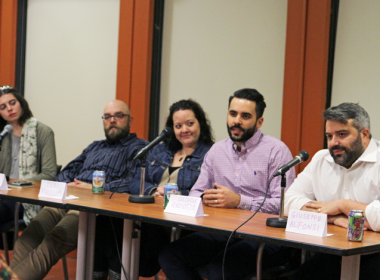
First year bioengineering students Niloufar Serajmehdizadeh and Itai Wine have been elected as representatives to shadow Chemical Engineering Students’ Society (CHESS) and McGill Association of Mechanical Engineers (MAME) respectively, in order learn about the operations of a student group.

By forming an undergraduate society, bioengineering students look to gain access to  their own student lounge, establish formal  connections with companies in their field, schedule workshops and outings that would help advance students’ careers, and maintain a relationship with department heads.

Engineering Undergraduate Society (EUS) Council President Jean-Louis Shi, U4 Mechanical Engineering, stressed that student representatives should learn how EUS operates before diving into their own projects. Shi intends for a bioengineering society to be established in two years.

“Most of our departments have 400 students on average,” Shi said. “With only 30 students in the department, we tried to make sure that [the bioengineering department] have the right resources, the right tools to create events, and have their own services and initiatives. Within these two years, we’ll build up the leadership of a future bioengineering department […] we want to give them an  understanding [of] how to work with the EUS. Unfortunately, a lot of things in our society are not written down. It’s a lot of passed down knowledge of how to organize events.”

Serajmehdizadeh voiced her dissatisfaction with the lack of functions dedicated to bioengineering students.

“We are invited to [other engineering departments’] events but a lot of their events don’t apply to us,” Serajmehdizadeh said. “[CHESS] gets tours for a chemical factory, but it’s not really relevant to [bioengineering] students. This is one of our main arguments for why we want our own student society with our own events. Right now, we’re shadowing these two student societies [CHESS and MAME] because we don’t have [our own society].”

As part of their student fees, bioengineering students contribute to a student society fund. However, due to the small number of students enrolled in the program, this capital amounts to approximately $200. In an email to The Tribune, MAME President Dimitri Calomiris reiterated the impossibility of forming a bioengineering society this year.

“It takes a large amount of planning, knowledge, and funding,” Calomiris wrote.  “It is incredibly unfeasible for a brand new department to set up an operational society this year. As such, mechanical took a representative to show the bioengineering students how things are run on our side such that they can follow in our footsteps.”

Serajmehdizadeh insists that there are no strained relations between the bioengineering department, CHESS, and MAME. Even so, she  voiced frustration with the EUS.

“Our main tension is with EUS [….] Before reaching out to CHESS, we were reaching out to EUS itself to start a student society, but they weren’t agreeing with it,” Serajmehdizadeh said. ‘They were like you have to wait. You’re not a lot of people. But then Kerry Lawless [President of CHESS] sent me the constitution of the EUS and there is no rule saying that you need to be [a certain] amount of people to start a student society.”

The EUS Council gave voting privileges to a single bioengineering representative present at meeting on Oct 12. Serajmehdizadeh and Wine will therefore take turns voting on EUS Council motions.

“I felt that they still needed a voice,” Shi said. “I decided to pass a motion to give the bioengineering class one vote at council. So, now they at least have representation on council.”

Despite submitting a petition to the EUS, the motion to create a bioengineering student society has been postponed to the following EUS Council meeting on the grounds that the Council speaker was not notified 72 hours prior. However, in an email to The Tribune, Serajmehdizadeh attributed this delay to a misunderstanding between both parties.

“The motion got postponed due to miscommunication on both sides,” Serajmehdizadeh said. “EUS is actually cooperating with us now and [Shi] agreed to have a meeting with all the BUSS (Bioengineering Undergraduate Student Society) execs and discuss the possibility of a student society.”

Shi confirmed that he would meet with both bioengineering representatives on Oct. 24.

“We’re going to meet them and have a chat with the whole society that they created,” Shi said. “We’ll ask them to meet us more regularly if they want to go forward with this. Right now, I’m not sure if they’re aware of the technicalities of how to run events with the EUS. If they don’t want to do the chaperoning [with CHESS and MAME], we have to make sure they have the right learning path because that’s the most crucial aspect of creating a society.”

News, SSMU

SSMU Council considers motion to provide free menstrual products on campus

On Oct. 13, the Students’ Society of McGill University (SSMU) legislative council discussed motions supporting the Association of McGill University Supports Employees (AMUSE) collective bargaining and distribution of free menstrual hygiene products. The meeting also covered the creation of a fee for the Musician’s Collective and increasing the student fee for Midnight Kitchen.

Free Menstrual Hygiene Products Fee

SSMU President Ben Ger presented a motion that would support the creation of a fund for freely supplying and distributing menstrual products on campus to undergraduate students. According to Ger, the purpose of the motion is to focus on advocacy for the provision of free products and will be funded by a provisional fee of $0.90 per student per semester if approved by the student body.

The higher pricing of products labeled ‘feminine’ and the perception of menstrual products as luxury goods are examples of the gendering of products. In comparison, items that are used by both genders—such as toilet paper—are supplied for free.

“A large part of this motion is about advocacy,” Ger said. “There will be education awareness, like lobbying around the gendering of products and the pricing discrimination surrounding the gendering of hygiene products.”

Elaine Patterson, VP Student Life, explained the logistics behind the distribution of menstrual products.

“[We] have done research on providing different types of menstrual products, mostly tampons and pads,” Patterson said. “We have research on different suppliers [….] The idea is that with [the $0.90] fee, there will be 20 pads and tampons for each student per cycle.”

According to Patterson, if not all tampons and pads get used, the leftover money will go towards alternative menstrual care products in the following school year.

AMUSE Collective Bargaining

AMUSE, a labour union that represents casual or temporary employees at McGill, is currently in the process of bargaining for a new collective agreement for its workers that regulates the terms and conditions of employees in the workplace. According to Claire Michela, president of AMUSE, independent research found that the average living wage in Montreal is $15.38 per hour: however, many AMUSE employees are paid $10.85.

“We compared our situation with McGill University Non-Academic Certified Association (MUNACA) employees who work similar jobs for more hours,” Michela said. “They get lots of benefits that we don’t. This [mandate] is basically regarding our demands which are basically to raise our wages, to make our jobs more stable, [and] to increase accessibility for students.”

Richard (Tre) Mansdoerfer, an engineering representative, voiced concern that small campus businesses may be forced to cut staff if the minimum wage is raised.

“It’s awesome to increase [the] minimum wage, […] but for something […that only has] four employees who are paid $12 an hour, […] an increase to $15 can mean that they can only hire three people,” Mansdoerfer said. “So, instead of increasing the amount of money available to every person, you increase the wage, but you have one person take a hit.”

When asked if raising wages will come at the cost of reducing the amount of available jobs, Michela said that this would not be the case.

“Casuals are doing more of the work than ever,” Michela said. “Casuals are and still would be way cheaper labour than MUNACA labour. It makes sense to keep hiring casual employees. I don’t think [cutting jobs] is very likely to happen.”

Creation of a Musician’s Collective Fee

Since its designation as a service in 2012, the Musician’s Collective has been subsidized by the SSMU general operating budget. The Musician’s Collective provides a public ‘jam space’ that can be booked by any McGill student, free of charge. To financially support the Musician’s Collective, an opt-outable $0.10 fee per student per semester was proposed.

The fee will be used to cover maintenance costs of the jam space. Patterson explained that SSMU’s general operating budget can no longer support the Musician’s Collective.

“All the expenses incurred by the Musician’s Collective [were] subsidized by the SSMU’s operational budget,” Patterson said. “Typically that ended up being $2,000 of SSMU’s operating budget. SSMU’s operating budget is [no longer] able to subsidize things like [the Musician’s Collective] because [subsidizing] is a non sustainable way of funding a service.”


A previous version of this article included a fragment of a quote from engineering representative Richard (Tre) Mansdoerfer that referred to Frostbite employees as members of AMUSE. In fact, only employees of McGill operations are covered under the AMUSE collective agreement, which does not include employees of student association operations like Frostbite. Additionally, the menstrual products fee was previously misstated.

McGill, News

Potential national marijuana legislation to be voted on in Spring 2017

Following a history of prohibition and criminalization since 1923, the legalization of marijuana  will soon be brought to a vote in Canada. The Liberal government will be announcing their new legislation in the spring of 2017, in line with their current platform.

A nine-member task force of experts was formed to advise the Canadian government on how to best move forward with its plan to legalize marijuana. The Task Force on Cannabis Legalization and Regulation has engaged with the public, government officials, indigenous peoples, youth, and health experts across Canada. Dr. Mark Ware, a cannabinoid researcher and a professor of Family Medicine at McGill, is the vice-chair of the task force. According to Ware, the discussion is not whether Canada should legalize marijuana, but how to best legalize it.

“We haven’t made any recommendations,” Dr. Ware said. “We are still deliberating on the input that we’ve received.”

Dr. Caleb Abaka Bouhairie, a McGill Medicine alumni and a Montreal physician, believes that marijuana may hold promise for patients suffering from a variety of diseases.  

“From a medicinal perspective, there is a growing body of literature that describes both their harmful and their potentially beneficial effects [in treatments for] epilepsy, certain chronic pain disorders, anorexia, cachexia, glaucoma, and refractory nausea,” Dr. Bouhairie wrote in an email to The Tribune.

Kapil Sareen-Khanna, U3 Medicine, says that the medical community has yet to see a trend of long-term damage from marijuana use.  

“[Decades after the onset of widespread cigarette use, we’ve seen] women’s lung cancer and heart disease rates still just hitting the plateau and trying to curve downwards [whereas] men’s have started to curve down earlier,” Sareen-Khanna said. “But with weed, we haven’t seen any huge associations [in trends].”

According to Sareen-Khanna, the arguments against the legalization of marijuana are similar to those that can be made against other legal drugs, such as alcohol and tobacco: Increased potential for substance abuse, adverse side-effects, and the risk of addiction. However, marijuana has medicinal properties and has significantly less acute, chronic, and [physiological] effects in comparison to alcohol and tobacco.

“The active compounds [in marijuana] are called cannabinoids,” Sareen-Khanna said. “Cannabinoids act on cannabinoid receptors and we have them in our gut and […] in our brain. In the gut […], but also in the immune system of the gut, and in the brain it’s in areas that control nausea, vomiting, pain, etcetera. [They’ve] already started to study and treat chronic pain [….] Officially, it’s not really approved for anything, medical marijuana.”

Dr. Mary-Ann Fitzcharles, a rheumatologist and pain researcher at the Research Institute of the McGill University Health Centre, and a professor of medicine at McGill, commented on the uncertainties that surround marijuana.

“This is a lot of basic scientific knowledge about the cannabinoid system,” Dr. Fitzcharles said. “However, it is a leap of faith to jump from [our understanding of] that system to the use of marijuana in the patient population.”

Dr. Fitzcharles explained that despite the growing body of scientific literature, there is still not enough clinical evidence that supports the claim used by proponents of legalization that marijuana-based medicines are effective and useful for large populations of people.

“The medical world has not yet done its due diligence to provide the evidence for the safety of using marijuana in many conditions, particularly in the rheumatic diseases,” Dr. Fitzcharles said. “We have no knowledge of what marijuana combined with other drugs would do, let alone what marijuana does on its own.”

According to Dr. Fitzcharles, the prohibition of marijuana has presented a challenge to necessary scientific research. She believes that without such clinical evidence, researchers cannot expect to be adequately educated about the effects of marijuana.

“It’s been extremely difficult,” Dr.  Fitzcharles said. “There is no question that with all the legalities and illegalities of marijuana, the clinical researchers have had great difficulties with moving ahead with research. As physicians who base our management on evidence, we have to advocate for the good and proper research”

Andrew DiNunzio, U4 Science, feels that marijuana is already widely accessible for recreational users in Montreal.

“Every Sunday, if you go to Tam-Tams [in Mount Royal Park], you can smell the weed, and the cops are right there,” DiNunzio said. “People smoke there all the time. I don’t think things will be much different under the new law.”

McGill Director of Internal Communications, Doug Sweet, stated that it is too early to speculate on how the legalization of marijuana will affect the university campus. In connection with the movement towards a smoke-free campus, Sweet said that all forms of smoking will be covered by the university’s smoking policy.

“We presume that whatever smoking policy will be in effect at McGill at the time will apply,” Sweet said.

According to Dr. Fitzcharles, with Spring 2017 fast approaching, the public needs to be mindful that with the advent of the new marijuana legislation comes a wave of new concerns.


“The public generally believes that marijuana is safe and is not addictive […] most importantly, that you are safe to drive,” Dr. Fitzcharles said. “We must acknowledge that marijuana is not a panacea. It’s not an agent without any negative consequences.”


A previous version of this article incorrectly stated that Sareen-Khanna said that marijuana has only medicinal properties while alcohol and tobacco do not. In fact, he specified that alcohol and tobacco have greater acute, chronic, and physiological effects than marijuana. In addition, a previous version of this article incorrectly quoted Sareen-Khanna as saying cannaboids work in the amygdala, the part of the brain that processes fear and anxiety. In fact, Sareen-Khanna said cannaboids work in the cannaboid receptors in the gut and the brain.

News, The Tribune Explains

The Tribune Explains: McGill Senate

What is the McGill Senate?

The McGill Senate was established in 1935 as an elected body intended to serve as a link between the McGill community and the Board of Governors (BoG). The BoG is partially comprised of elected Students’ Society of McGill University (SSMU) and Post-Graduate Students’ Society (PGSS) executives, with remaining members appointed by the administration. Officially, Senate is the highest governing academic body at McGill and debates and advises on policy related to academia, such as revisions to research misconduct policies and examination policies. The Senate is made up of 13 undergraduate representatives on behalf of SSMU, eight graduate representative on behalf of PGSS, and 90 faculty members and staff, including deans and professors elected from within each faculty. Elected faculty members serve for three years, whereas student representatives serve for one. The Principal and the Secretary-General chair Senate meetings and have the responsibilities of moderating debate and giving the deciding vote in the event of a tie.

What does the McGill Senate Do?

Being an academic body, the Senate focuses on curriculum decisions as well as academic research, and is influenced by the general desires of the student community.

By contrast, the BoG is recognized as McGill’s highest legal body. SSMU Vice-President University Affairs Erin Sobat expressed displeasure that such an arrangement delegates the Senate to the role of an advisory body, with the majority of decision-making happening within the Board and, thus, without much student influence.

“A lot of things that come to Senate are already decided on at the committee level or the administrative level,” Sobat said. “Oftentimes, when something is brought up that’s more operational in nature, usually they’re administrative decisions that they don’t want to discuss more publically, they’ll say that it’s a matter for the Board and we can’t talk about it [at Senate].”

Regular Meetings, Joint Board-Senate Meeting, and Confidential Sessions

There are three arrangements of Senate meetings: Senate’s regular committee meetings, the annual Joint Board-Senate meeting, and confidential sessions.

The Senate is composed of several committees, most of which meet once a month. It has regular standing committees that do not change over time and can create ad hoc committees to address emerging issues. It also has standing regulation committees that are convened when specific regulations are enacted–such as the Committee on Student Grievances–which meets only when a student files a complaint against a university employee.

The Joint Board-Senate meeting has members of the BoG and Senate meet once a year to discuss an important theme. While no binding decisions are made at these meetings, they are important for fostering discussion and cooperation between these two governing bodies. At the end of each meeting, members are asked to suggest next year’s theme. The theme for 2016-2017 is “McGill's Sustainability Plans and Initiatives” and past years’ themes have included “Designing a Smart Campus for the 21st Century” and “Mental Health at McGill University.”

“Board members and Senators are asked to fill out a questionnaire after each Joint Board-Senate meeting; one of the questions is for suggestions of topics for future meetings,” Secretary General Edyta Rogowska said. “No decisions are made [at the meeting], it is simply an opportunity for the Board and the Senate to discuss matters they consider relevant to the university’s mission.”

Senate can also meet confidentially on topics related to private affairs of individuals.


“In practice, [confidential sessions are] generally [for] the Report of the Honorary Degrees and Convocations Committee which contains recommendations on honorary degree recipients and recipients for other awards,” Rogowska said.

Basketball, Sports

Point Counterpoint: Will the Raptors win a championship before the Maple Leafs?

It’s a great time to be a Toronto sports fan. The Maple Leafs look rejuvenated while the Blue Jays are making another deep run in the playoffs. However, the Toronto Raptors are the team some people tend to forget. The Raptors have not only developed one of the best home atmospheres in the NBA, but are the Toronto team closest to winning a league title.

Last May marked the end of one of the greatest Toronto sports playoff runs in modern history. After two series victories and two wins in the Eastern Conference Finals, the Raptors were finally eliminated by the eventual champion Cleveland Cavaliers. At the same time, the Maple Leafs were golfing, having just finished dead last in the NHL. Even with the addition of first-overall pick Austin Matthews, the Leafs will not be a contender for many years.

Quality management is key to winning titles and the Raptors’ executives have been making shrewd decisions in recent years. The Leafs, however, have struggled with coaching and management up until very recently. In the 2013-2014 season, the Raptors’ hiring of General Manager Masai Ujiri changed the team’s mindset. Toronto made the postseason for the first time since ex-star Raptor Chris Bosh was playing for the team. It felt like a stepping stone for the franchise. Led by Head Coach Dwayne Casey, point guard Kyle Lowry, and guard Demar Derozan, the Raptors have a core that can sustain success. Ujiri now has a strong balance of veterans and young players. The young-guns like Corey Joseph, Norman Powell, and Delon Wright now have the opportunity to grow with the team. Ujiri’s asset management has been superb as he repeatedly shipped out older players for draft picks and cap space. He then turned the extra money into key additions like DeMarre Carroll and Jared Sullinger.

Science & Technology

Combatting dystopian visions of the future with Seeds of Good Anthropocene project

The Earth has reached a new epoch, one in which the climate is largely impacted by human activities. The anthropocene, as scientists call this period, is often viewed as hopeless, a geological age which will bring environmental destruction; or, in an even more dystopian view, an era that will lead to the end of life as we know it.

“The Anthropocene […] is the name for a new geological epoch in which humanity has become a force reshaping the geological, biological, and atmospheric dynamics of Earth,” the Seeds of Good Anthropocene website explains.

As an evolving and unique time period, much is unknown about the anthropocene. In collaboration with Stockholm University in Sweden and Stellenbosch University in South Africa, McGill is leading a project called Seeds of Good Anthropocene.

“We aim to counterbalance current dystopic visions of the future,” the project’s websites states.

Shocking images of environmental peril in the news—as well as some courses at McGill—aren’t helping improve the situation but are rather creating a sense of hopelessness: The Great Barrier Reef is dying, rivers are running dry, and species are going extinct.

Associate Professor in the Department of Natural Resource Sciences and the School of Environment at McGill, Dr. Elena Bennett, brings together “bright spots” of environmental action from around the world to study how humanity can build a healthy anthropocene.

“We see our seeds of good change and our blind spots as pockets of a better future that’s already in existence today,” Bennett said in a video for the World Economic Forum.

As the lead author, Bennett published “Bright spots: seeds of a good anthropocene” in the October 2016 issue of The Ecological Society of America’s Frontiers in Ecology and the Environment.

“The paper proposed [how] social and environmental projects can reverse a pattern in which human prosperity has come with harms to ecosystems and excluded communities,” Andrew Revkin wrote in The New York Times opinion blog Dot Earth.

The paper on Good anthropocenes provides an introduction to the project and how these bright spots may be used to develop more useful scenarios for the future.

“I want to find ideas that challenge my view of what the world would be like, or have a better vision […of] ‘good’ than I have,” Bennett said. “We try to push for [bright spots] that are transformational, rather than just ‘good news’ stories.”

Bennett and her team are investigating these social and environmental projects. Most were started by citizens with no special qualifications, only the desire to help the environment.

Bennett recounted the tale of a woman in England who noticed that a large portion of the sidewalk in her neighbourhood was unused and could be used to grow vegetables. Replacing cement with vegetable patches became more meaningful, as the community began to came together to cook meals. Health in Harmony, another ‘bright spot’ reviewed in the paper, is a project based in Indonesia that offers free or low-cost health care in exchange for a commitment to protect the native forests. In these cases, both the planet’s climate and communities are becoming stronger and healthier.

The Seeds of a Good Anthropocene project has two inspirational messages. First, there is hope—set aside the dystopian image of a dead and chaotic planet Earth and think about how we can build a better environment for future generations. Second, reporting on ‘bright spots’ may inspire someone to make a similar impact in their neighbourhood.  

Analysis of bright spots will help develop a better image for the future of our planet, and help to create a Good Anthropocene. Although Earth has been damaged by humankind, it can still be saved.

“We can’t build a world that we can’t even imagine,” Bennett said.

Emerging Trends, Private, Student Life

Stick n’ poke tattoo culture spreads across Montreal

The centuries-old stick n’ poke tattooing technique has skyrocketed in popularity in North America since the 1960s. These DIY tattoos are made by dipping a needle in tattoo ink and repeatedly puncturing the skin. Specifically in Montreal, stick n’ poke tattoos have become increasingly common in recent years as a less expensive alternative to tattoos executed with guns.  

Stick n’ poke tattoos cater to a different clientele than traditional tattoos, not only in their affordability, but also in their unique aesthetic. Though they can differ greatly in style, stick n’ poke tattoos are often characterized by their unique intricate designs. This minimalistic aesthetic of stick n’ pokes cannot be achieved as successfully with gun tattoos.

“Stick n’ poke offers a different visual effect, as it can be more pointillist,” Toronto-based stick n’ poke artist Fion Liu, know in the community as sadstab, said. “Also, with stick n’ poke, you can control how deep the needle can go, unlike tattoos done with guns.”

Much like with traditional tattoos, the designs that clients choose vary a lot depending on the style of the artist. For example, some of Liu’s pieces employ the same image layering technique in three different colours, but each tattoo has a subject that is unique to the client.  


“For the most part, people tend to get artist’s [pre-drawn designs on] flash sheets a lot and embrace the unique aesthetic of each artist,” Liu said. “Generally stick n’ poke artists […] stick with small to medium sized tattoos.”

In addition to the aesthetic differences between gun tattoos and stick n’ pokes,  the latter cut expenses for both the artist and the client. There is no standard fee, and stick n’ poke artists don’t have to give a portion of their earnings to the shop or parlour at which they’re employed, as traditional tattoo artists do. This is one of the driving forces behind the recent boom in popularity of stick n’ poke among students in Montreal.

“Stick n’ pokes are cheaper than normal tattoos,” Chloe Rowen, U3 Arts, said. “It’s convenient too. I got mine in my apartment while I was drinking and hanging out with friends. I was listening to music and had people distracting me, it was great.”

The flexibility and convenience of stick n’ poke tattoos is another key factor in their growth. If the proper tools are available, stick n’ poke tattooing can be performed anywhere, at anytime, by anyone. Liu, for example, has given tattoos backstage at concerts and in the smoking rooms at concert venues. It is also common among students to give and receive stick n’ pokes in a friend’s apartment or at a house party. 

“While some sessions are planned and even paid for, it’s also common that people see my stick n’ pokes at a party, and ask for one on the spot,” Mayson Miller-Thompson, U3 Arts student and local artist, said.

For many, the idea of getting a tattoo in an unregulated space brings up issues of safety and sanitation. Miller-Thompson and Liu both stress safety as important to keep in mind, even though, according to Liu, stick n’ pokes heal more quickly and easily than traditional tattoos.


“I’ve given around 100 stick n’ pokes, and no one has ever gotten an infection,” Miller-Thompson said. “One of the most important things to remember is to use gloves. Also, I notice that people are more comfortable when I unwrap a sterile needle in front of them.”

There is no doubt that social media has helped facilitate the surge of stick n’ pokes. Platforms like Instagram help stick n’ poke artists to develop their  brand and share the specific aesthetic of their tattoos with a wider audience. Liu also attributes much of the rise of stick n’ poke tattoos across Canada to Bunz, a trade-based online community for exchanging goods and services. The site provides a platform for people to connect with stick n’ poke artists in their city, and allows them to trade items, goods, and services for tattoos instead of paying for them. 

“The scene on Bunz has been spreading the word of stick n’ poke quite broadly,” Liu said. “The cheap cost and fast-paced design process are also perks that attract more people to stick n’ poke.”

Stick n’ poke tattoos provide a strong complement to the model of accessibility—financial, and otherwise—that Bunz maintains. Therein lies the undercurrent of its spread across student communities in Montreal; stick n’ poke tattoos are a source of body art that meets the limits of student wallets, and allows the comfort and flexibility to self-decorate in an environment of one’s choice.

Private, Student Life

A planner with an agenda: School Schmool incorporates local art and activism

As the mayhem of the semester engulfs students, many find it difficult to keep track of their busy schedule. A planner can help with that. School Schmool, a multi-purpose agenda published yearly by the Quebec Public Interest Research Group (QPIRG) at McGill and Concordia, aims to do exactly that and more.

Presented as “your radical guide to your often unradical school,” School Schmool aims to bring together the activist student communities from McGill, Concordia, and Montreal at large. Aside from an agenda section, the 2016-2017 issue of School Schmool features poetry and visual artwork submitted by local artists and writers. The book also features articles addressing social justice issues, such as gender and racial equality, and a list of groups and resources available to Montreal students. These include health and counselling services, and student activist groups like the Union for Gender Empowerment.

The agenda is just one of QPIRG McGill’s many social-justice oriented projects and endeavours. The student-run non-profit organization is the Quebec branch of Public Interest Research Groups, which began to emerge in the early 1970s in university campuses across the U.S. and Canada. As explained in the planner, QPIRG “conducts research, education, and action on environmental and social justice issues at McGill University and in the Montreal community.”

School Schmool already has an extensive history as a QPIRG project, as it dates back to 1994. At the time, it was an independent bi-annual publication, which included group profiles, articles, and resources for Montreal students, especially those interested in the social and environmental justice issues central to QPIRG’s mandate. When the project was revived in 2006, it followed those same principles while adding a second focus: The agenda. School Schmool now aims to be the ultimate tool to track both students’ busy academic and activist schedules.

For QPIRG McGill’s Outreach Coordinator and recent McGill graduate Raphaële Frison, School Schmool has retained its original purpose, while expanding upon it.

“[School Schmool] was revived as more of an agenda, but still has that original idea of being a resource guide,” Frison said. “We have articles, mixtapes, music suggestions, recipes, astrology. All sorts of things.”

As a collaborative project between the McGill and Concordia branches of QPIRG, School Schmool is representative of the united and diverse activist community that surrounds the organizations. The variety of material featured in the agenda illustrates QPIRG’s efforts to educate and engage students in justice issues that affect the community. For example, an article on intersectional feminism is followed by a “beginner’s guide to herbalism.” The planner also offers tips for the everyday life of a student. The “Super Broke-Ass Guide to Montreal: Students” offers advice in a tone that ranges from straightforward to hilariously enlightening, listing tips such as, “live with lots of roommates,” or “scam yuppies, [because…] yuppies will pay a shit ton of money for things you might already be doing,” or even, “sabotage your local bank/government office/university administration building,” just for fun.

As an agenda, School Schmool has to compete with the many other options supplied by McGill and Concordia, as well as all those found in mainstream stationery stores. The planner’s editorial board pinpoints this competition as one of the reasons for the creation of the alternative planner.

School Schmool was created because people felt that agendas provided by McGill were way too capitalist,” Annie Chen, a co-coordinator of this year’s issue and recent McGill graduate, said. “They had too many ads which were featured, dependent on having the financial resources to buy ads.”

By being financially independent, School Schmool editors aim to banish what they perceive as an endless capitalist system perpetuated by the alternatives provided by other student organizations and departments.

“I contributed a couple bucks for the agenda because it really matters to me that it’s ad free,” Aidan Gilchrist-Blackwood, U3 Arts student and owner of a School Schmool agenda, said. “To me, the financial model shows that collectively-financed and collectively-supported projects can work, which I think is an especially important message in the context of austerity.”

School Schmool’s success supersedes a simple opposition to the capitalist system; it aims to act as a comprehensive activist tool for the university student. Chen estimates that the latest edition of the agenda is one of QPIRG’s most successful yet.

“The agenda goes beyond what’s been done with previous publications,” Chen said. “The activist purpose of the project has only gotten stronger over time. One of the mandates of School Schmool is to provide students with things they would never learn otherwise, and I think we’ve achieved that.”

Students who have purchased the agenda also find that School Schmool is not only a useful organizing tool, but also a successfully informative project.

“I really love the texts,” Gilchrist-Blackwood said. “I feel like I’ve learned a lot through them about the organizing context of McGill and Montreal.”

By combining a helpful planner section with engaging artwork and instructive resources about social justice issues of concern for students, School Schmool transcends the purpose of a simple agenda and becomes an essential tool in the arsenal of all politically-dedicated students.


School Schmool 2016-2017 is still available at various locations across McGill—including the QPIRG Office, Midnight Kitchen, and Organic Campus—and across Concordia, while in stock.

McGill, News

SSMU hosts second Student annual Academic Summit

On Oct. 15, the Students’ Society of McGill University (SSMU) held its second annual Student Academic Summit to educate students on how to effect change on campus through university governance systems. The summit consisted of discussions focused on university advocacy and addressing upcoming initiatives, including faculty-based mental health programming, McGill’s Draft Policy Against Sexual Violence, the Library Improvement Fund, as well as the Office for Students with Disabilities’ (OSD) new Universal Design for Learning (UDL) toolkit. 

According Erin Sobat, SSMU Vice-President (VP) University Affairs and organizer of the event, this year’s summit was targeted not only at student representatives but also anyone interested in effecting meaningful change at McGill. 

“Certainly we want not just to reach students who are already involved, but we also want to make sure that [students] have concrete ways to act,” Sobat said. “The goal of this whole day is SSMU playing this coordinating role where we can provide resources, referrals, and contacts for students to take on [these initiatives] because we just don’t have the capacity to do it all, and we’re also not best suited to advocate for something in a particular department, unlike the students who are most engaged in that department or even just students taking classes.”

Sobat admits that McGill’s governance may appear ambiguous to many students. As such, he intended for the summit to clarify policy development in governance structures.

“Understandably, students don’t have a full picture of how the university is structured in terms of governance and decision-making,” said Sobat. “Even for elected [representatives] or elected Senators, it often takes them a few months of their role to actually understand where they fit and everything, and what can they do [….]  I hope [the summit] makes [it…] more clear, because it can be intimidating”

A portion of the summit was dedicated to the UDL toolkit, an educational framework meant to accommodate different learning styles. In the presentation, Associate Director of the OSD Tanja Beck emphasized how professors can use the UDL toolkit to provide a more inclusive learning experience and to improve evaluation methods for students without disabilities. 

“Professors have a concern that it will lower academic standards, which is really something that we’re not going for at all,” Beck said. “It’s so important for faculty to know what they really want to assess. They need to ask themselves, ‘Am I really assessing if [students] can write by hand or can they also type the essay? Is it really necessary for students to sit down and do a test in 3 hours or can they do it over two days as a take-home exam?’ Once they’ve clearly identified those [priorities], it’s a lot easier to decide when they can be flexible and when they can’t. And that’s really the starting point of UDL.”

According to Elizabeth Reed, U2 Arts student and VP Academic for the Anthropology Students’ Association (ASA), felt that the summit solidified her understanding of students’ rights and introduced her to resources she can recommend to those struggling with their studies.  

“It’s been really helpful to hear more about what I can do for the people I’m supposed to represent,” Reed said. 

Moreover, for Reed, the summit shed light on how to advance projects as a student representative. She felt the summit was helpful in showing her where she can go for help when trying to enact change in her department.

“It’s hard to find that information somewhere else, so these kind of summits are useful because I found out stuff today […] that could really help my projects and the projects of my colleagues [on the ASA],” Reed said. 
 

Behind the Bench, Soccer, Sports

In praise of Jurgen Klopp’s Liverpool

The charismatic Jurgen Klopp arrived at Liverpool FC as a highly pedigreed manager last year. He previously led Borussia Dortmund–a mid-table Bundesliga club before his arrival in 2008–to two Bundesliga titles and a European Champions League final appearance in 2013. Liverpool fans anticipated Klopp’s arrival with sky-high expectations. For the first time in a while a top-four English Premier League (EPL) finish, or even a title seemed within grasp.

Liverpool fans tasted success under former manager Brendan Rodgers when his Luis Suarez-led team finished runners-up in the 2013-14 EPL season. However, the Northern Irishman’s inflexible tactics and insistence on possession football led to his downfall. Klopp’s arrival demanded he address the lack of goals from midfield, a leaky defence, and a team short on confidence. 

In his first game in charge, a 0-0 draw with Tottenham Hotspur, Klopp’s now famous ‘gegenpressing’ (counter-pressing) playing style was evident, albeit as a work-in-progress. Gegenpress is organized, aggressive pressing high up the pitch in order to regain possession of the ball as quickly as possible, and then counterattack by moving the ball quickly between players. This requires a high level of structure—one person begins the pressing and the rest of the team follows in order to cover passing lanes and reduce holes in the defence. 

In that match against Tottenham, Klopp started off with a 4-2-3-1 formation with Emre Can and Lucas in the holding roles; Philippe Coutinho, Adam Lallana, and James Milner in the mid-field; and Divock Origi at the top. Liverpool’s game was relentless in its pace and full of excitement. Klopp’s tactics have since developed as he’s experimented with different players and formations.

Fans and the rest of the Premier League now realize how effective Liverpool’s gegenpressing is. The system came into its own against Manchester City in November 2015. Liverpool began with a 4-3-3 formation with Coutinho, Lallana, and Roberto Firmino forming the front three. Firmino–who Rodgers played out of position on the wing or as an attacking midfielder–started in his natural centre-forward position. The strategy proved to be a masterstroke by Klopp. Firmino and Coutinho’s constant pressure and slick skills on the ball proved too much for the usually-solid City defence and the Reds won the game 4-1. This established Firmino not only as a starting forward, but a vital part of the team.

Fastforward to this season and Liverpool have the players required to make Klopp’s system work. Klopp’s insistence on double training sessions in preseason ensured that his players knew his philosophy inside out. The German addressed the Reds’ long-standing defensive frailties by bringing in 6’4” centre-back Joel Matip from Schalke. Klopp also brought in Senegalese international Sadio Mane from Southampton for £30 million to add to Liverpool’s attacking ranks. The forward’s blistering pace, dribbling skills, and shooting ability added much needed directness to Liverpool’s attack.

Tactically, Klopp switched from a 4-2-3-1 to a fluid 4-3-3 with Jordan Henderson, Lallana, and Georginio Wijnaldum in the middle of the park; and Firmino, Coutinho, and Mane in the front three. In this formation, two of the midfielders forward while one sits deep. The midfield pairing of Lallana and Wijnaldum is better equipped to join the attack without having to go wide, as they are joined by the wide attackers when Liverpool has possession of the ball. The introduction of James Milner, a natural winger/midfielder, to left back has also improved Liverpool’s defence.

Klopp finally has a team of players he wants, playing the style he wants. Liverpool seem back at their best, and are genuine title-contenders this season. After the doom and gloom of the mid-2000’s, Jurgen Klopp is ushering in a new era—one that could bring silverware to the club. 

Read the latest issue

Read the latest issue