Latest News

Arts & Entertainment, Film and TV

Pop Rhetoric: The small screen reaches a wider audience

Television has long been regarded as film’s more annoying, less accomplished younger sibling. Sound bytes like 'made for T.V. movie' and 'multi-camera sitcom' continue to haunt audiences’ psyches, evoking nightmares of outrageous laugh tracks and over-dramatic soap opera acting.  For decades, critics considered film the real art form—a medium that actually allowed its stories and characters nuance and development. However, this past awards season has proven otherwise. When the Academy Awards tried to congratulate itself on a year of great films, audiences were livid. The movies that made Hollywood so proud did not represent the diversity of the American public, and the awards ceremony was infamously dubbed, “Oscars So White.” In comparison, this year marked the most inclusive Emmys in its 68-year existence. Or, as host Jimmy Kimmel so cuttingly quipped, “The Emmys are so diverse this year, the Oscars are now telling people we’re one of their closest friends.” Television has improved because it is finally reflecting diverse stories and perspectives. Meanwhile, mainstream filmmakers continue to cling to their claim that only white heteronormative narratives make money. 

This year’s Emmys broke countless records. It was the first year that each leading acting category nominated a person of colour. Kate McKinnon, Saturday Night Live’s first openly gay cast member, won for “Best Supporting Actress in a Comedy.” Aziz Ansari was the first Indian-American to be nominated for a leading actor award. However, Kimmel recognized that there is still room for improvement: “Here in Hollywood, the only thing we value more than diversity is congratulating ourselves on how much we value diversity.”

Transparent star Jeffrey Tambor’s acceptance speech highlighted Hollywood’s tendency to cast cisgender people in trangender roles. He said he would “not be unhappy" to be "the last cisgender man to play a female transgender on TV.” Master of None writer Alan Yang used his airtime to call attention to the lack of Asian-American representation within mainstream media. The evening’s underlying tone of advocacy was proof that not only has television made tremendous progress, but that it is working hard to continue to do so. 

Diversity on screen is indebted to new formats of television. Film is confined to vague financial measurements like “foreign box office” and “international markets.” Movies lack diverse representation largely because studios think they will make more money by keeping their films broad and generic. When director Rupert Sanders cast Scarlett Johansson instead of a Japanese actor in his remake of Ghost in a Shell, Forbes magazine defended him by explaining, “Scarlett Johansson is a big movie star and for a film that will cost what Ghost in the Shell will probably cost, you arguably need a ‘put butts in the theater seats’ movie star to justify said investment.”  Mainstream award shows like the Oscars are evidence that not only does this mentality restrict the representation in box office hits, but it also limits the variety of films Hollywood will recognize. New independent content developers, whether it be Netflix, Amazon, or FX, understand that putting faith into individual creators to tell their own stories makes for better television. The shows the Emmys celebrated this year are all proof of the success in new types of distribution: John Oliver’s Last Week Tonight is produced by HBO and viewed primarily on Youtube; Amazon streams Jill Soloway’s Transparent online; and Aziz Ansari’s Master of None is a Netflix original. 

Television has dramatically improved largely because network television is an outdated format—when artists have autonomy from studios, they create more unique and powerful work. The Oscars continue to pander to media moguls who insist that movies can only make money with bankable white stars. Meanwhile, T.V. producers have discovered that audiences respond to seeing themselves on-screen. Diversity, whether it is diversity of actors, stories, or distribution, makes for quality television. 


Private, Science & Technology

Acetaminophen, the leading cause of liver damage: Health Canada adds new warning labels

Acetaminophen is one of the most popular pain relief—analgesic—drugs. It can be found in a variety of medications—it is most commonly sold as Tylenol—and can be readily purchased over-the-counter at any corner pharmacy or drugstore.

It is also the number one leading cause of liver damage in Canada.

On Sept. 15, over a year after Health Canada published its safety guidance in 2015, the federal government released their review of the drug, highlighting the unusually high overdose rates of acetaminophen linked with the likelihood of liver injury. There are approximately 4,000 hospitalizations associated with acetaminophen in Canada every year. With more than 250 cases of serious liver damage, over half of which can be accredited to accidental overdoses. Six per cent of the total hospitalization cases resulted in acute liver failure.

“It’s the most common cause of liver injury. Period,” Dr. Michael Reider, a pediatric clinical pharmacologist at Western University, told CBC News.

Acetaminophen is used in a wide range of both prescription and non-prescription products. It is found in more than 400 medications authorized for sale in Canada, most commonly used to treat symptoms such as coughs, colds, headaches, and fevers.

In fact, according to Dr. Reider, many may not even know about the presence of acetaminophen in their medication unless they carefully examine the label. Some widely recognized brands that contain acetaminophen include Tylenol, Neocitran, Percocet, Nyquil, Vicks, and Vicodin.

Dr. Eric Yoshida, a liver specialist at the Vancouver General Hospital, regularly encounters patients who suffer from severe liver failure due to accidental overdoses. The most typical case, he told CBC News, is an individual losing track of how many medications with acetaminophen they took and accidentally taking too many.

Other common mistakes include taking the next dosage too soon, taking more than the recommended amount, or using two medications containing acetaminophen at the same time.

“Those are the kind of inadvertent uses that can lead to drug-induced liver disease [and] acute liver injury,” Yoshida warns.

Health Canada seeks to address this issue by working towards making it easier to recognize drugs that have acetaminophen as an ingredient. Drug producers will add the warning ‘Contains Acetaminophen’ in bold, red text on the top right-hand corner of the labels of all applicable medications. The labelling will immediately apply to all new products, and all products already on the market will be updated within the next 18 months. A calibrated dosing device will also be included with all children’s liquid products, so parents know exactly the amount of acetaminophen their child is consuming.

Despite this, many medical experts are disappointed with Health Canada’s lack of action in implementing further preventative methods. Aside from adding warning labels, federal drug regulators have failed to lower the recommended maximum daily dosage, or take extra-strength acetaminophen medications off the counter—both measures which health professionals believe are imperative in reducing accidental overdose rates.

“Overall, when it comes to drug safety, Health Canada has a culture of slow incremental change,” Dr. Joel Lexchin, a drug safety researcher and professor emeritus at York University, told The Toronto Star.

However, these warnings are no reason to panic and avoid acetaminophen-containing medications altogether. Most Canadians have no trouble using these drugs safely. Improper usage and overdoses can easily be prevented with just a little extra caution to read the warning label that comes with any medication.

Football, Sports

McGill stalls, split regular season with Sherbrooke

McGill Redmen football’s (2-2) offence stalled in a 20-11 defeat to the Sherbrooke Vert et Or (2-2), on a blustery Sept. 24 day at McGill’s Molson Stadium. It was a disappointing loss for the Redmen, who led the Vert et Or for the first three quarters of the game. Sherbrooke, however, capitalized on McGill’s inability to find the endzone after the first quarter, stringing together some impressive fourth-quarter drives to put the game out of reach for the home team.

“We just didn’t execute the way we should have on the offensive side of the ball,” Head Coach Ronald Hilaire said. “We kept them in the game by not scoring and ultimately it came to bite us in the butt in the end.”

Initially, McGill seemed dangerous and moved the chains well on offence. Freshman quarterback Fred Paquette-Perrault threw a beautiful 43-yard pass on McGill’s second possession. He seemed primed to give the Sherbrooke defensive backfield hell for the rest of the game. The Redmen’s sole touchdown came on a five-yard rush by senior receiver Louis Brouillette, a play after fourth-year wide out Jonathan Mack took a brilliant catch on the one-yard line.

Afterwards, however, McGill struggled to mobilize its offence. Paquette-Perrault was benched early in the fourth quarter after many stalled drives. The Sherbrooke defensive line had an excellent game and held the Redmen to 60 rushing yards on 20 carries. In the meantime, the Vert et Or recorded a pair of safeties and trailed 11-4 going into the final quarter. McGill’s defence was equally dominant throughout the first three quarters. This led to an offensive standstill, although Sherbrooke slowly crept towards McGill’s score.

“I don’t know [what went wrong today], because we had a good week of practice,” third year running back Nicholas Khandar said. “We did not execute the offence. Sherbrooke had a good game.”

In the fourth quarter, Sherbrooke’s offence unshackled. Riddled with drops and overthrows through the first three quarters, their wideouts started to make plays. With nine minutes left in the final quarter, Sherbrooke wide receiver Frederick Caron pulled a slick double move to record a 43-yard touchdown. It was plain sailing for the Vert et Or from then on as they scored 16 points in the final quarter.

“They had momentum and they used it to their advantage,” Hilaire said. “They got a big play on a double move and it created something for them.”

McGill lost a chance to solidify their position in the CIS playoff race. However, They still have four games to play and posses the talent to comfortably make the postseason. The Redmen take the field next on Sunday Oct. 2, against Laval


Quotable

“I am still proud of the effort we gave. We still have to fix up some things, but it is week four. We still have a lot of football to play, so we will see what happens.”—Coach Ronald Hilaire keeping the game in perspective.


Stats Corner:

McGill held Sherbrooke to 1.6 yards per carry in comparison to McGill’s 3 yards per carry.


Moment of the Game

Jonathan Mack went over the middle, absorbed a blow from a Sherbrooke defensive back, juggled the ball, and ultimately held onto it five yards from the goal line. This 10 yard catch set up McGill’s sole touchdown of the game.


Opinion

What we can learn from Homa: Concordia professor’s release from Iranian prison underscores importance of her work

The international community cheered today when Iran finally released acclaimed academic and former Concordia University professor, Dr. Homa Hoodfar. The Iranian-Canadian anthropologist was detained in Evin Prison in Tehran for over one hundred days without access to her family or lawyer. The details of Hoodfar’s charges were ambiguous, though reports in Iranian news outlets accused her of “dabbling in feminism and security matters.”

In the face of Iran’s grave human rights violations, students, professors, and scholars worldwide cried out for justice, giving rise to the #FreeHoma movement. Just last week, Concordia University students rallied in downtown Montreal to demand their revered professor’s safe and timely release. On Sept. 26, their prayers were finally answered. Now that Homa is free, we must remind people of the significance and impact of her academic contributions. Homa’s lessons of cultural and religious acceptance are lessons that the world desperately needs to hear—especially given the increasing prevalence of cultural prejudice and intolerance in Western societies.

Hoodfar’s work is about making others understand cultural differences, not fear them.

It takes nothing more than a glimpse at Hoodfar’s work to see that she never belonged in an Iranian prison. Her research is apolitical in nature; her mission is to educate, rather than to criticize or provoke. Muslim scholar Tariq Ramadan described Homa’s detention as un-Islamic, emphasizing that her “research on Muslim women’s struggles—both in the Middle East and in the West—is balanced and characterized by respect for those about whom she writes.” Homa poses no threat to Iran. She isn’t simply a respected anthropologist, she’s an advocate for the rights of Muslim women, wanting to shatter stereotypes. Hoodfar’s work is about making others understand cultural differences, not fear them.

For example, Hoodfar fervently condemns the Western notion that the Muslim veil is a symbol of oppression. In one of her early articles, The Veil in Our Minds and on Our Heads, she stresses that veiling is an individual choice that has nothing to do with ignorance or power. Western stereotypes of the veil, which stem from colonial legacies and racist practices, deny Muslim women their agency. Cue the controversial Canadian niqab debate of 2015 over the Federal Court of Appeal ruling that prohibited the ban of the niqab at citizenship ceremonies. Zunera Ishaq, the Muslim woman at the centre of the debate, told The Toronto Star, “It’s precisely because I won’t listen to how other people want me to live my life that I wear a niqab.” This debate was central in the federal election last year, underscoring the prominence of the social stereotype that Hoodfar works tirelessly to deconstruct.

Many of today’s problems are based on prejudice, misinformation, and intolerance: today's world is one where an American presidential candidate can propose a “Muslim ban” as a tactic to gain votes. We also exist in a world where Islamist terrorist groups carry out mass killings of innocent people. This is the same world where a respected academic endured three months in prison simply because she was brave enough to challenge social constructions of race, culture, religion, and identity. Homa Hoodfar reminds us that Islam is not unidimensional—it is consistently evolving. She spreads messages of understanding and equality that combat anti-Muslim stigma. Her research bridges the gap between two cultures that are often portrayed as standing in opposition.

The #FreeHoma movement extended beyond the plight of one individual. It was a fight for academic freedom, cultural and religious acceptance, and female empowerment. Homa may be free, but her sacrifice makes it increasingly clear that this fight is not over.


Men's Varsity, Sports

Lacrosse: Bromley and Bolton both net hat tricks to lead McGill Redmen past the Queen’s Golden Gaels

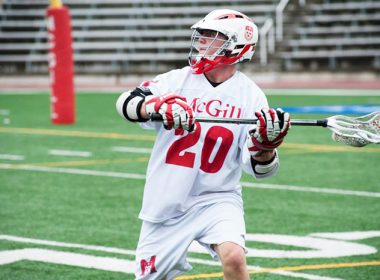
On Saturday Sept 24, at the newly refurbished Forbes Field, McGill Redmen Lacrosse (4-1) faced off against the Queen’s Gaels (1-4). McGill scored first and maintained its dominance for the rest of the game, finishing with a 15-8 score line. 

Thanks to a strong first half of the season, the Redmen find themsleves ranked second in the CUFLA East Division.

“We’re at one loss right now,” Midfielder Bohe Hosking said. “But we’re still confident.”

McGill’s only loss of the season was against Trent University, who are currently undefeated in CUFLA play. McGill led for most of the game, but Trent had a strong fourth quarter and scored the game winner in the last minute of play.

“We had a tough one against Trent,” fourth-year attacker Spencer Bromley said. “You never like to lose, but it was a good game and I think we’re off on the right foot.”

Bromley, who leads the team with 21 points, scored four times and assisted once against Queen’s on Saturday afternoon. Attacker Goose Bolton also notched five points, scoring three times along with a pair of assists, while midfielder Emile Sassone-Lawless was credited with five assists.

Though the point leaders from Saturday’s game are all seasoned veterans, many of the rookies also made valuable contributions. The wide score line afforded Head Coach Tim Murdoch the flexibility to give minutes to players who haven’t had much field time so far this season.

“Some of our freshmen stepped in and played key roles,” Murdoch noted. “[It’s] very inspirational for our [starting lineup], who are playing ahead of these guys, to see them step in […] and perform.”

Saturday’s game was their home opener, and a dedicated group of fans watched from the hill behind Forbes Field. As the Redmen look to repeat after a national championship last year, they’re hoping to garner even more support from the McGill community.

“We just like seeing the bleachers packed,” Hosking said. “Hopefully that can happen with a few [more] home wins.”

The Redmen have seven more regular season games, four of which are at home. Next weekend, they’ll travel to Ottawa to play against the Ottawa Gee-Gees and the Carleton Ravens. They’ll then return to host the Bishop’s Gaiters on Oct. 6 at Molson Stadium.


Quotable: “Everyone wants to beat us, so everyone is good competition.”—Spencer Bromley.


Stats corner: It only took Goose Bolton 62 seconds to score McGill’s first goal of the game.


Moment of the game: Rookie defender Alessio Marcogliese scored the first goal of his McGill career by carrying the ball from the half and whipping it past Queen’s goalie.


Behind the Bench, Hockey, Sports

The World Cup of Hockey: Semi-Final Preview

The World Cup of Hockey has provided fans with excellent entertainment value through the preliminary round, despite its reputation as an NHL cash grab. Round-robin play began with eight teams competing: Pool A featured Canada, USA, Czech Republic, and Team Europe; Pool B was comprised of Russia, Finland, Sweden, and Team North America. There were some disappointments along the way. The US went 0-3 and failed to qualify for the semi-finals. Finland also went winless, falling back to earth after an energetic Finnish team won the World Junior Championships earlier this year. Now, the top two teams from each pool advance and we breakdown the matchups ahead of elimination action this weekend.


Canada (Pool A winner) vs. Russia (Pool B runner-up)


Russia’s lack of defensive depth will be their undoing against Canada; the Canadian offence is too well-balanced and aggressive for the sub-par Russian blueline corps. Team Russia, led by Washington Capitals sniper Alexander Ovechkin, claims an offensive depth that can rival Canada’s; however, outside of defenders Dmitry Orlov and Nikita Zaitsev, the Russians lack a true game-breaker from the blueline.

Canada remains the greatest hockey power and is stacked at every position, with Sidney Crosby, Jonathan Toews, and Matt Duchene leading the charge offensively. Despite Russian goaltender Sergei Bobrovsky’s incredible play throughout this tournament, it doesn’t seem likely that he will be able to steal a game from the powerful Canadians. Canada outscored their opponents 14-3 through the preliminary round, while the Russians salvaged a positive 8-5 differential courtesy of their 3-0 win over a weak Finnish team in their final game.

After beating the Americans 4-2 in a dominating round-robin game performance, Canadian Head Coach Mike Babcock said, “We weren’t as good as we’re capable of being tonight."

If accurate, that’s a scary reality for Canada’s opponents.


Prediction: Canada over Russia, 5-2.


Sweden (Pool B winner) vs. Team Europe (Pool A runner-up)


Sweden's defensive play and mobility from the blueline should give them a slight edge over Team Europe in this matchup. The Swedes’ first game of the World Cup was a 2-1 victory over Russia that should not have been so close, as their transition game and defensive play kept them in control of the puck. They boast the second best defensive corps in the tournament after Canada. Their defensemen have shown a propensity for jumping up in the play and creating offence, as big 6’7’’ defenceman Victor Hedman did when he came in off the point to score the game winner against Russia earlier in the tournament.

Team Europe has been the underdog story of the tournament. A veteran team many pundits picked to finish last, they beat the USA 3-0 in their opener, before beating the Czechs in overtime to lock up the number-two spot in Pool A. Even though Europe has emerged as a contender with an experienced squad, they lack the mobile, elite, puck-moving blueline that they would need to defeat the Swedes.

Although Sweden lost 6-2 to Europe in pre-tournament play, Henrik Lundqvist had one of his worst career games in his country’s colours. Expect him to perform much better in a game of this magnitude and the Swedes to come out looking for blood.


Prediction: Sweden over Team Europe, 4-3 in OT.

Baseball, Men's Varsity, Sports

Redmen Baseball walks off against rival Concordia

Fan Night at Gary Carter Field drew a crowd of students, who brought their enthusiasm as Redmen baseball (9-1) overcame a rough start to defeat the rival Concordia Stingers (3-4) 4-3 on Wednesday.

Starting pitcher Henry Dennis, second-year Arts, had a difficult second inning, hitting Concordia’s Daniel Paklarian and walking Alex Hall and Matthew Litwin to load the bases. He subsequently surrendered his only hit of the game—a left field double that scored three—to catcher Dario Vincelli.

Dennis showed excellent composure and contained the Stinger’s batting his next three innings. After facing eight batters in the second, Dennis faced only 11 more over the rest of his innings.

“I give a lot of credit to Chris [Stanford], my catcher, and the team staying focused and making plays behind me,” Dennis said. “That gave me the confidence to use my best stuff. The team really kept my head together.”

Acknowledging Dennis’s rough start, Head Coach Jason Starr said that the Redmen managed to limit the effects of the disastrous second inning.

“He gave us five innings and gave up three runs, which is usually enough for us, and it was tonight,” Starr said. “Henry [Dennis is] a guy who will battle for us, and he did that tonight.”

The Redmen got on the board in the bottom of the second inning when catcher Christopher Stanford led off with a triple and scored on first baseman Gabriel Hamilton’s RBI groundout to second. Hamilton drove in two more runs to tie the game in the bottom of the fourth, scoring Stanford and second baseman Sam Savoie on a left-field double.

Dennis left the game at the end of the fifth inning for reliever Jack Pantalena. A lead-off single and a dropped third strike allowed runners to progress to second and third bases with one out in the top of the sixth. Second-year Economics major Pantalena kept his cool, however, and struck out the remaining two batters to preserve the tie. In the seventh, he gave up a single before striking out the next three Concordia batters.

“I started my last game, so relieving was different,” Pantalena said. “But I talked to my catcher and I was able to hit my spots. We talked about who was coming up, I knew what I was going to throw and was able to execute.”

In the bottom of the seventh, with the game tied at three apiece, Emerson Dohm, pinch-hitting for designated hitter Camden Lawhead, led off with a single to centre. He was quickly lifted from the game for pinch-runner Zachary Aaron. Aaron advanced to second on a single, and to third when shortstop Louis-Xavier Labrosse grounded out to shortstop. Then, on a wild pitch, Aaron came home to win the ballgame—an exciting walk-off win in front of a loud, enthusiastic crowd.

McGill next plays away at the University of Montreal on Sept. 23.


Stat corner:

Reliever Jack Pantalena recorded six strikeouts in two innings pitched.

Quotable:

“It was a good team win, everybody contributed. We just have to take things one game, one inning at a time, and it happened to work out today.” – Starting pitcher Henry Dennis

Moment of the game:

With the game tied and one out in the bottom of the seventh inning, pinch-runner Zach Aaron came home from third on a wild pitch to score the winning run.

Arts & Entertainment

Into the Deep: Honduran scuba divers brush with ‘mermaids’ in Liwa Mairin photography exhibit

The Liwa Mairin photography exhibit, taking place at the Maison du Développement Durable, showcases an unfamiliar terrain, the depths of the sea. The exhibit is being presented by documentary photographer Valérian Mazataud in collaboration with Handicap International, which is a non-profit organization that uses donations to support more than 2 million people across 59 countries. Mazataud holds a degree in marine environment and specifically studies ancient instruments of scuba diving; the images he captures display his fascination for those who experience life underwater.


The subjects of Mazataud’s work are the Moskitia people—a group who lives in the Honduran part of the Amazon jungle and who, for over 40 years, have based their economy on the practice of deep-sea dive fishing. Mazataud shows his subject’s way of life through his photographs. By entering their homes and following the daily routines of these people, the viewer is able to understand how all aspects of their lives tie back to the theme of fishing. The various demographics of citizens within the villages have their separate duties, and yet they all work towards a common goal. Their lives are centred on the water, the backbone of their community and provider of all necessities.


The diving method is extremely dangerous due to outdated equipment, causing severe cases of decompression illness. As a result of spinal cord injuries, the remote region in Honduras has an estimated 3,000 paraplegics and over 600 people have died due to their injuries. One of Mazataud’s photographs shows a young man being helped into his wheelchair by an elderly woman. Having lost his ability to walk, the man must rely on family members to help him complete daily tasks. Another section of the exhibit displays a former diver being treated by a physiotherapist, tied to a bench and visibly uncomfortable.

Mazataud focuses on the expressions of his subjects. The viewer’s eyes are immediately drawn to the furrowed brow of a handicapped man feeling the sun on his cheeks, or the sly smirk of a woman gutting fish. A connection to these people is created, despite being a world away. Even in the heart of downtown Montreal, the Liwa Mairin Exhibit transports its viewer to the rural villages photographed.

Photographs of the divers side by side with fish draws the comparison of the diver’s movements through the water. The citizens of the region believe that they are victims of ‘Liwa,’ a type of natural spirit that dwells in rivers, oceans, and lagoons. Specifically, Liwa Mairin translates to “water woman being”—a creature similar to a mermaid. The folklore explains that they punish men who dive for lobsters on the seabed by giving them diseases and poor health. Silhouetted by the sunlight above, the divers’ bodies streamline through the water, drawing the connection with underwater people such as the Liwa Mairin. The vibrant colours mimic those of what one may find under the ocean: Murky greens and clear blues. The consistent theme of water as the pillar in these societies, despite its dangers to the people, is drawn through the entirety of the collection.


Through his photographs and partnership with Handicap International, Mazataud visualizes the Moskitia economy and the subsequent injuries it produces. An informational guide for the exhibit explains that Mazataud wishes to shed light on the issue faced by these silenced citizens, in hopes that his photographs can speak on their behalf to make change for the better.

On display from September 8 to September 29, “Liwa Mairin” can be viewed at 50 rue Sainte Catherine at the Maison du Developpement Durable.


Football, Sports

The NFL’s quarterback concussion conundrum

The first two weeks of the NFL season have been confusing for NFL players. The opening game of the season saw the league return to the 1970s when big hits and headshots were commonplace. Specifically, in week one, Carolina Panthers’ quarterback Cam Newton, one of the biggest quarterbacks in the league, took two nasty helmet-to-helmet shots from Broncos’ defenders Brandon Marshall and Darian Stewart but stayed in the game, seemingly in contravention of the league’s concussion protocol. However, this past week, in the Buffalo Bills-NY Jets game, Bills’ quarterback Tyrod Taylor—a much smaller quarterback—was temporarily removed from the game to be evaluated for a concussion in the third quarter after taking a particularly violent hit.

Inconsistent application of the concussion protocol, which requires any player who appears concussed to be removed from the game and assessed, has led fans to criticize the NFL. Former NFL official Mike Pereira said, “what disappointed me the most [about the hits on Cam Newton] was how they basically went against protocol with 36 seconds to go. The shot Newton took from Stewart on the offsetting fouls, protocol has Newton out of the game, and it starts with the referees.”

The reasons the officiating crew did not pull Newton from the game are unclear. Generally, quarterbacks are more protected than other players because they are often defenseless and considered the most important players in the game.

Many believe the referees treated Cam Newton unfairly because he is physically bigger than the average quarterback. Panthers’ Tight End Greg Olsen was particularly critical of the officiating.

“Treat him like a quarterback,” said Olsen. “I know he's the biggest guy on the field, but he's still a [quarterback]."

Regardless of his size, Newton should have been examined after both of those head shots. That’s not just a failure of the referees who didn’t call the penalties, but also the NFL trainers who are supposed to be watching for headshots.

The way referee Ed Hochuli handled Buffalo Bills quarterback Tyrod Taylor after he took a huge hit on a third quarter play against the New York Jets was textbook. It was clear that Taylor did not want to come out of the game, but Hochuli insisted that Taylor be checked. Two plays later, Taylor was back in the game. When concussion protocol works, it’s that simple.

When it come to player safety, the NFL treats all quarterbacks differently. Certain top-tier quarterbacks like Tom Brady and Drew Brees seem to get more favourable calls because of their status in the NFL. Late hits against these top guys are regularly called and their games are strictly officiated in an effort to protect them from harm. Larger quarterbacks like Cam Newton and Ben Roethlisberger tend not to be protected by NFL officials. Meanwhile, smaller quarterbacks, such as Tyrod Taylor and Dak Prescott, are ruled more strictly despite playing a similar type of game. These quarterbacks’ play styles involves a lot of play-action rollouts and running outside of the pocket. When these smaller players leave the pocket, they are still treated as quarterbacks—as opposed to Newton, who is often seen as a runner—benefiting from protections that other players do not receive. The NFL needs to start calling all quarterbacks equally. If the league is as serious about safety as it claims to be, it’s beyond time to prove it.

Opinion

McGill’s active shooter video a grim yet necessary precaution

Few scenarios are more terrifying than that of an active shooter on campus. Sadly, events like these are not just an intangible fear, but a reality in modern society. For this reason, McGill took it upon itself to educate students on how to survive an active shooter scenario with a controversial new video. The university is now encouraging faculty to show students the 12 minute video, which consists of a dramatic reenactment of a campus shooting and a briefing on the necessary steps to survive.

Some students, and members of society at large, were taken aback by the graphic content of the video and complained that it was excessive. However, despite its relatively graphic and intense nature, the video is an effective precaution due to its informative review of the steps to surviving an active shooter scenario and its ability to capture the audience’s attention.

Since 2013, there have been 195 school shootings in the United States. A statistic like this is as shocking as it is horrifying, and drives home the necessity of preparation. While Canada may not be as plagued by gun violence as the United States, it exists here as well, and cannot be taken lightly. Many remember the Dawson College Shooting in Montreal 10 years ago and the Polytechnique Massacre in 1989. The most recent tragedy was the school shooting just this year in La Loche, Saskatchewan.

What is perhaps most controversial is the decision to release the video around the 10th anniversary of the Dawson College Shooting—an action viewed by some as insensitive to victims of the tragedy. However, as Canadians remember and memorialize the shooting, it is important to look for methods to minimize harm should such a tragedy happen again. The 10th anniversary of the Dawson College Shooting provides a window to open up dialogues on the issue of gun violence. While no amount of training or videos can prevent a shooter on campus, the measures taken by McGill can help to ensure that in case of such a scenario, students are prepared, informed, and capable of protecting their lives. The country can heal from the Dawson shooting, but it should also learn from it.


Despite what may be said about the video, a less graphic or more mundane version would not have been able to communicate its message as effectively.

The video released by McGill is intense, but for this reason it succeeds in capturing students’ attention and keeping it throughout. Despite what may be said about the video, a less graphic or more mundane version would not have been able to communicate its message as effectively. Those used to routine fire drills and airplane safety demonstrations tend to zone out during emergency preparation warnings, and because of this they can lose their effectiveness. While McGill could have easily created a simple presentation or a purely informative video that reviewed the steps to survive an active shooter, it is unlikely that any would listen. While intense, the video is not overly graphic: It refrains from showing deaths on-screen, and does not use any blood or gore. In doing so, the video is able to drive home the danger of the topic, and emphasize the importance of being prepared while refraining from being over the top.

Beyond simply grabbing students’ attention, the video does exactly what it was meant to—prepare students for how to survive a shooting. Throughout the video, students are presented with the steps to follow in a clear and precise manner. The steps are repeated numerous times and summarized at the end. It makes sure that everyone watching can remember what to do in the unlikely event of a shooting here at McGill. The best way to survive any dangerous situation is to prepare and know exactly the steps to follow, and this video helps students do just that. Surely the video will stay in students’ minds, and if necessary, can be a critical component in their saving lives.

The video serves both as a way to help students stay safe in the event of a shooting, and as a method to remember Dawson College—as well as all other school shootings. Speaking about these tragedies, and about the issue of gun violence in general, is not easy. It’s unsettling, uncomfortable, and at times even frightening, but as such an important issue speaking openly and candidly about it is absolutely vital. Due to the unfortunate reality of school shootings, McGill’s active shooter video was an important step in preparing for the worst.


Read the latest issue

Read the latest issue