


Latest News

Opinion

Information overload is an overblown fear

For the past few years, the term ‘information overload’ has saturated numerous media outlets, from reputable scholarly journals to more mainstream magazines offering solutions to an apparent epidemic sweeping the modern world. The argument contends that the accessibility of information online, from go-to search sites such as Google and Wikipedia, to social media outlets, are overwhelming our cognitive functions. Simple decisions are portrayed as burdens and procrastination is to blame for a generation lazier than ever before. These sorts of claims, however, are something that hard-working young students would undoubtedly take issue with. Fears of information overload are clearly overblown, particularly in the case of highly-educated students. Worries about too much information should not overshadow the agency of individuals in navigating online realms.

The other side of procrastination implicated in information overload is termed decision fatigue. Not only has technology increased the amount of information out there, it has increased the speed at which we handle it. Higher levels of productivity require more decisions every day for each individual. Professor Daniel Levitin suggests that we are in fact limited to the number of decisions we can make a day under sound mental judgment.


Too much information may be a potential source of additional stress, but it is is not the cause for reduced productivity.

In the day-to-day lives of students, it’s plain to see that there are more choices and decisions to make, ranging from food products to career paths. Levitin contends in his work The Organized Mind: Thinking Straight in the Age of Information Overload that the raw amount of data humanity has produced in the last 10 years is greater than the sum total we had created previously.

Greater availability of information—made obvious by the negative connotations of the word overload—actually has the potential to impair cognitive functions. There is undeniably more information for each one of us to parse through in our everyday lives, and as a result, procrastination has become a more prominent issue in modern society. The focus on procrastination has created an endless discussion and supply of articles that all claim to provide the step-by-step solution to conquering information overload. Yet despite this discourse, people are still productive. Too much information may be a potential source of additional stress, but it is is not the cause for reduced productivity.

Information overload may be what unconsciously leads students toward a ‘short’ Netflix break or a full-on downward spiral of procrastination; but most students emerge from said breaks to continue on with their responsibilities. Students are so aware of the danger posed by Facebook feeds filled with entertaining videos that they will temporarily turn their wireless connection off to get a paper written or even employ a friend to take away their cell phone until a particular task is completed. Students have adapted to the availability of distractions. The issue therefore resides not in the access to information, but how individuals manage their own responses to that information.

Procrastination and decision fatigue can clearly be problematic results of the pace at which we receive information today. That being said, students and professionals make use of coping techniques that fall in stride with Levitin’s suggestions featured in Forbes. People take breaks, write to-do lists, prioritize, and do their best to focus on one task at a time. As students paying for an education, productivity is still of a high enough importance to encourage adaptation to the challenges that accompany the ease of accessibility to a multitude of distractions.


Student Life

Taking advantage of Montreal’s summer season

Gone are the days when the image of summer school was a punishment to keep free-spirited kids away from their dreams of sweet summertime. In university, the reasons for choosing to enroll in summer classes can range from lightening the course load during the traditional school year, keeping up with a scheduled graduation date after setbacks, or even an attempt to fast-track one’s degree. Whatever the motivation may be, summer school at McGill is not to be dreaded, but cherished. 

The classes that McGill offers in the summer are almost all one month long, so class hours are significantly longer than they would be during a normal semester. Classes can actually become more enjoyable and engaging when you are able to allot them more time and attention.

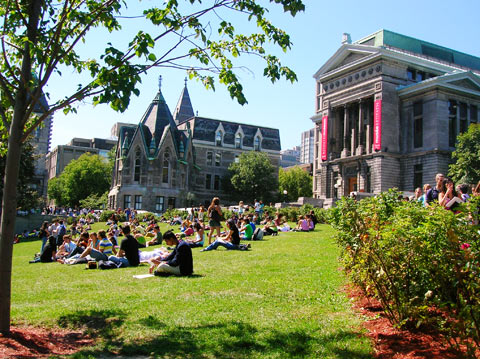
The greater amount of daylight also makes waking up and getting to classes much less of a burden. These sunny days are also great for exploring new study spots that simply are not accessible during most of the year, most notably the Lower Field lawn. 

Summer in Montreal is not just for school. Although most students spend a large portion of the year in Montreal trying to avoid being outside for extended periods of time, the summer scene in Montreal offers some outdoor activities that will shed a whole new light on the city. A greater inclination to explore the city by foot or bike in the warmer weather provide numerous opportunities to find very cool areas that may otherwise have gone unexplored during your time at McGill. 

While the snow can be pretty, the view from Mont Royal is undeniably more beautiful with some foliage on the trees. Aside from Parc Mont-Royal, Montreal boasts some other beautiful parks slightly further outside the McGill bubble that are definitely worth the visit. Parc La Fontaine is still relatively close to campus, and is often the location of outdoor yoga classes in the summer. For a more extended day activity, rent a bike on the Canal Lachine and travel west to arrive at Parc René Lévesque, which juts out into the Saint-Lawrence River at the end of the canal—a far point of the city that few students get the chance to visit.  Although the Atwater and Jean-Talon markets are open year-round, they have a more lively vibe in the summer that makes market shopping a more enjoyable activity. 

Another noticeable difference in the summer is the chance to enjoy the patio experience of some of Montreal’s best restaurants or bars, because happy hour—or lunch hour—truly is much better on a patio. In terms of nightlife and entertainment, summer also tends to be the time of year that a lot of big concert tours travel through Montreal. This year’s big names include Tori Kelly, Justin Bieber, Janet Jackson, and Ellie Goulding—and these are just some of the shows that can be attended. Last minute tickets can be purchased on the website Vivid Seats. While there is no guarantee that tickets can be snagged, on the off chance they are purchased, the website can be a great, affordable option. 

While they can go unnoticed, a small feature that adds to the summer experience is the proliferation of beautiful gardens downtown. Last summer, a short stroll west on Rue Sherbrooke from McGill exposed passersby to rows upon rows of beautiful tulips. 

While most students often try to get away from McGill following their last Winter final, the summer months in Montreal are patiently waiting to display all they have to offer. From the very little changes that summer brings to the city’s energy, to the chance to enjoy a class on a deeper level and the opportunity to gain a more holistic view of Montreal, working in at least one summer month into your time studying at McGill is something every student should consider.

Editorial, Opinion

Editorial: Advancement of McGill’s mission statement in conflict with corporatization of the university

It is difficult for students to comment on the McGill’s behemoth bureaucratic nature. Various administrative levels seem oceans apart from the day-to-day educational pursuits of the student body. As a line gets drawn between administrators on one side, and academics and students on the other, all members of the McGill community must ask themselves: “Who is a university for?” The answer to this question must be one that balances the practical needs of a public university facing austerity measures with the priorities of maintaining McGill’s place as an accessible research institution. But such a balance is not the reality of McGill’s situation.

The corporatization of the university is a nebulous concept, and is directly related to answering the question of “Who a university is for.” Ever since the 2008 financial crisis, universities across North America have had to clamber to find new sources of funding. The effects have been a particularly bitter pill to swallow in Quebec. Universities, in response to defunding, face higher competition to attract the best students and achieve top rankings, as well as greater competition for a more limited number of research grants. Students and faculty members have less influence on priorities because of the reduction in funding from non-corporate grants. Corporatization also refers to the influence of private sector actors who become more influential vis-à-vis traditional university stakeholders, as private financial backing becomes more essential to university research and operations.

Some of this distance may be accounted for by McGill’s frugality, which, to be fair, is not its fault; but a lot of it must also be boiled down to who McGill considers to be important stakeholders.

Oftentimes McGill’s priorities feel disingenuous and distant from the student experience. Some of this distance may be accounted for by McGill’s frugality, which, to be fair, is not its fault; but a lot of it must also be boiled down to who McGill considers to be important stakeholders. For example, the administration’s response to the Divest McGill campaign this past week shows that it prioritizes the viewpoint of certain alumni and potential donors over current students, faculty members, and the alumni who returned their diplomas in protest.

Professors are also increasingly disillusioned by the corporate university structure. Many feel the pressure of having to find funding for their research. Various studies in 2013 found that Quebec universities are underfunded compared their peers across Canada. Quebec’s share of federal research funding fell from 30.5 per cent in 2003-2004 to 25.4 per cent in 2008-2009; in 2014, Quebec university funding declined by 4.6 per cent while other universities in Canada saw increases. Acquiring funding is more competitive, earning a tenured position at McGill is more difficult, and class sizes are growing. McGill may provide support for research, but it must do so selectively. McGill therefore leans towards financial pragmatism; in so doing, it makes a value judgment as to which experiences are valuable and which are not.

Part of the answer to the question “Who is a university for?” is in the mission statement of McGill: “The mission of McGill University is the advancement of learning and the creation and dissemination of knowledge, by offering the best possible education, by carrying out research and scholarly activities judged to be excellent by the highest international standards, and by providing service to society.” As such, the corporatization of the university should be viewed as alarming; while McGill must make money somehow, internalizing the rationale and structure of a private corporation cannot mean losing sight of who a university is for—namely, society and its curious minds.

Lucius
Arts & Entertainment, Music

Lucius becomes one with the music

On March 28, Lucius, a five-piece band led by singers Holly Laessig and Jess Wolfe, performed at Theatre Fairmount as part of its tour to commemorate the release of its second album, Good Grief. While its first album, Wildewoman, has been praised for its soulful ’60s vibe, its new album moves in a different direction, taking on an ’80s pop sound. To Peter Lalish, guitarist for Lucius, this distinction in sound comes from the fact that unlike the band’s first album, Good Grief was written from scratch as a collaboration between the band’s members. Lucius’ lead singers, female powerhouses Holly Laessig and Jess Wolfe, met at Berklee College of Music and began working together in 2003. It was only until they moved to New York four years ago that they met Lalish and the other two members Dan Molad (drums, vocals) and Andi Burri (drums, guitar, and vocals), coming together to form Lucius as it is known today.

“Wildewoman was [made] starting from a lot of different moments in time,” Lalish explained. “[Good Grief is] one story that [combines] all of our crazy different personalities and musical tastes all in one […. Writing this album was] the first time that we all realized how much we each love Nine Inch Nails, and we each love old school hip hop, and we each love Harry Nilsson, and [even] classical music.”

Coming to a final consensus can be challenging while taking so many opinions into account, however. As Lalish noted, taking all five voices into consideration presented a challenge that also pushed their musical sound in a different direction from their first album.

“Each of us in the band are all songwriters,” Lalish explained. “You put five songwriters in a room and you have five different perspectives on the same thing, and so that can be a challenge by itself […] it’s sort of like everyone’s opinions, and it turns into this big stew pot. And you have to sort of see where the voice is, and all of that. So I think that those drastic changes [in our sound] are really just from having more opinions in the room.”

The band was not shy to showcase its hard work on this album during the show, with lively performances of many of the new songs. Starting off the show with “Madness,” a passionate transcription of a dream, Laessig and Wolfe assumed position across from each other in symmetry center stage, singing passionately in unison. A few songs later, they quickly picked up the audience’s energy with “Almost Makes Me Wish for Rain,” utilizing the full stage space by walking in different directions and assuming various positions on the stage, standing close and interacting with a lively first few rows. Later, for “Born Again Teen,” the pair moved their mics to stage right, facing each other in symmetry while head-banging to the bouncy 80’s-sounding pop song.

The band's engaging stage presence throughout the show included far more than its versatility in stage location, however. Two-thirds of the way through the show, Laessig and Wolfe left the stage completely, leaving the other three members to play what sounded like an improvised drum interlude for several minutes. The move left audience members a bit disoriented, but nonetheless entertained. The girls returned several minutes later in completely new outfits to coolly continue the show as though nothing had happened.

When prompted about the costume change after the show, Lalish explained that costume changes serve more than the purpose of keeping the audience on their toes.

“One, it’s like a little bit of a breather for [Laessig and Wolfe],” Lalish explained. “Instead of screaming the whole show, they get a minute to go back there and catch their breath. And then it’s also a moment for the guys to act like idiots and just make noise on stage, which is always fun.”

Costumery is a large part of Lucius’ identity as a band. Laessig and Wolfe always dress and style their hair in unison, thus placing emphasis on their sound: Two voices as one, or put-together harmony.

“They’re always doing this two-headed beast sort of music,” Lalish said. “It’s not always in harmony, a lot of it’s in unison, and that is kind of a rare thing [….] I think it was less of a reaction of ‘Let’s get some attention doing this,’ and more of like ‘Let’s really make an attempt at becoming sort of one thing that this is a reflection of that sound, that one kind of projected voice. [Laessig and Wolfe] have two really really different personalities. I think this allows them to find a common ground in their songwriting, […] I think to them it is important that they can step into these shoes and be able to perform on stage as this thing that’s maybe a little bit outside of themselves, but it has even more power, I think, that way.”

The band’s power was ever present during Monday’s performance, captivating the audience song after song. After leaving the stage a second time, they quickly summoned several minutes of applause from the audience, and returned for an encore by popular demand, bringing with them the members of their opening act, Pure Bathing Culture. The two bands silenced a once-rowdy audience with a collaboration on Elvis Presley’s “I Can’t Help Falling in Love With You” that was eerily beautiful and passionate. Several songs later, Lucius ended the show with a song off itsfirst album, “Genevieve,” bouncing around the stage, playing drums, and head banging, and summoning the same level of energy from the dancing crowd. If there was anything to take away from the concert, it’s Lucius’ power to keep an audience engaged with theatrics, energy, and powerful voices.

Off the Board, Opinion

Off the board: Still trapped in the ‘comfort women’ issue

Last November, I wrote a feature about the “Comfort Women”—the euphemistic term for women captured during the Second World War by the Japanese Imperial Army as sex slaves. A month later, Japan and South Korea reached a settlement to their longstanding dispute over the comfort women. The settlement includes an apology from Japanese Prime Minister Shinzo Abe and an $8.3 million aid fund from Tokyo for former comfort women.

While this event was praised by international observers, including the US government, many are still not satisfied. Advocates and former comfort women have presented issues with the deal in its current form. For instance, Japan’s apologies and compensation only extend to the comfort women from South Korea, despite remaining survivors and families in other countries across East Asia that suffered under Japan’s terror. Furthermore, the 46 remaining women survivors in South Korea were not consulted on the deal’s terms.

Yet one aspect that has not been in the limelight is Japan’s unchanging attempt to nationalize and whitewash historical educational agendas, which is a barrier to reconciliation among all those affected by the Second World War in Asia.

In December 2015, around the same time that Tokyo and Seoul reached the agreement, a joint statement was released in Perspectives on History published by the American Historical Association. Fifty Japanese scholars—of whom 48 were affiliated with a Japanese institution—demanded corrections to information on comfort women in a high school history textbook Traditions and Encounters: A Global Perspective on the Past, published by McGraw-Hill Education.

Yet one aspect that has not been in the limelight is Japan’s unchanging attempt to nationalize and whitewash historical educational agendas, which is a barrier to reconciliation among all those affected by the Second World War in Asia.

In late 2014, Japan’s Foreign Ministry told its New York consulate general to ask McGraw-Hill to change the depiction of comfort women in the same textbook. McGraw-Hill continues to stand by the textbook and its historical content.

Distinguishing between governmental intervention and academic peer review, Alexis Dudden, a professor of history at the University of Connecticut, said, “It’s not natural that a government intervenes in academic publication [….] Imagine if Ambassador Caroline Kennedy sent three people from the American embassy in Tokyo to various publishers of school textbooks to examine how Japanese textbooks portray the attack on Pearl Harbor.”

These developments are alarming in the face of the Tokyo-Seoul deal. Recently, Japan’s Ministry of Education, Culture, Sports, Science and Technology came out with a list of approved high school textbooks for the 2017 academic year. This list was produced under Prime Minister Abe’s instruction to the education ministry to only approve textbooks promoting nationalism and positions supported by its right-wing government—which entailed screening information about comfort women.

Such parallel movements—one of political reconciliation and the other of historical contestation—are a reminder that the comfort women issue is far from over. Japanese scholars attacking McGraw-Hill for information on comfort women is only one symptom of the whitewashing of Japan’s history. Its own national curriculum, revised for the upcoming academic year, confirms the unchanging nature of its historical revision.

Keeping history alive within education is integral, not only to hold wrongdoers accountable, but to ensure that history doesn’t repeat itself. Japan’s war history accounts for a large portion of geopolitical tensions today, and as new generations emerge, the importance of historical accuracy regarding the war is essential.

According to Mariko Oi, in a BBC article, “Japanese people often fail to understand why neighbouring countries harbour a grudge over events that happened in the 1930s and 40s. The reason, in many cases, is that they barely learned any 20th century history. I myself only got a full picture when I left Japan and went to school in Australia.”

There are long ways to go in all post-war treaties—but the first step is always acknowledgement of actions. While political diplomacy has inched forward in the deal between Tokyo and Seoul, true reconciliation between Japan and the nations of comfort women will not occur—nor last—until Japan acknowledges its actions within classrooms and stops meddling in the historical education of other countries.


Natalie Wong is a U2 student in political science and communications. She has a bottomless appetite for food, journalism, caffeine, live music, and naps.


Science & Technology

Delving into the data: The science of predicting elections

The 2012 United States presidential election was the culmination of an 18-month-long campaign that saw voters bombarded with debates, ads, endorsements, and relentless media coverage. There were also dozens of factors for voters to consider when deciding which candidate to cast their ballot for, from stances on policy to questions of character and everything in between.

Given all of this, it would be extremely difficult to predict who any particular segment of the voting public will choose. Yet Nate Silver, a baseball statistician turned political analyst, achieved unprecedented success by correctly predicting how all 50 states would vote.

Silver had access to the same polls as other analysts, yet the remarkable accuracy of his predictions suggests he (and his mathematical model) saw patterns in the data that nobody else did.

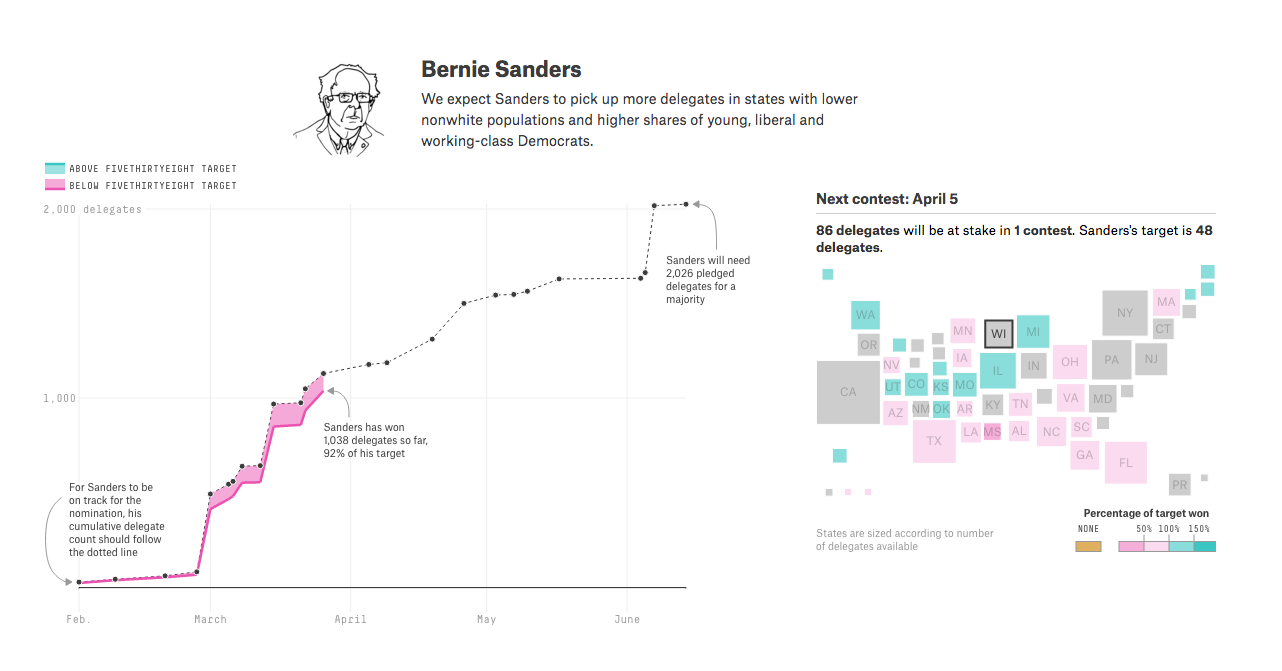
Silver’swebsite, FiveThirtyEight, named for the number of votes in the Electoral College, has been forecasting the results of Republican and Democratic presidential primaries, ever since primaries began in February. His predictions are based on three main factors: State polls, national polls, and endorsements.

Silver’s simplest model, described as “polls-only,” does more than simply average the results of the most recent state polls: Larger polls count for more than smaller ones, and each polling company is assigned a reliability rating based on the accuracy of their past polls, which determines how much weight that company’s polls are given.

His “polls-plus” model also takes into account how candidates are faring in national polls, as well as the number of endorsements that they have received from sitting members of the House of Representatives, from senators, and from state governors. 

(FiveThirtyEight.com)
)

Of course, even the most sophisticated models aren’t right in every case, but when models and polls alike miss by spectacular margins, it’s clear that some factors were not accounted for. One such case is in Michigan, where Bernie Sanders won the Democratic primary over Hillary Clinton despite being given a less than one per cent chance at victory by Silver’s models

Major news networks remained confused even after votes began to pour in, with the Associated Press waiting until 11:30 PM to call Michigan for Sanders. One large election returns provider, Decision Desk HQ, even called Michigan for Clinton earlier in the evening, despite the fact that she was trailing by more than five per cent.

The election night hesitations were largely due to the fact that Wayne County, which contains Detroit and a relatively large percentage of non-white voters, a demographic that has favoured Clinton, was among the last to finish reporting its votes. Clinton ended up winning Wayne County by over 20 percentage points, and the statewide non-white vote by 29 points, but this was not enough to overcome the lead that Sanders had built in rural areas with a higher percentage of white voters.

The day after the primary, Carl Bialik of FiveThirtyEight, discussed in an article just what had gone wrong with the polls. The main factor was that polls had mistakenly estimated the demographic of the electorate. Voters under 30 made up a much larger percentage than expected and Sanders won over 80 percent of their votes. Another consideration was the surprisingly large number of voters who self-identified as independents. There were twice as many as expected, and Sanders won their vote by 43 percentage points.

The message, after all of the dust had cleared was that elections, much like weather, are complicated and chaotic systems. These systems are incredibly difficult to predict, and mistakes come with the territory, but the more that statistics are used to analyze them, the greater our understanding of them grows.

It's meandyou
Art, Arts & Entertainment

Instagram, politics, and the fashion of feminism

Contemporary artists have long been at the forefront of social and aesthetic change. Art, fashion, music, film, dance, and intersections across all genres have become even more of a melting pot of influence through the ease of connection over social media. The new wave of socio-cultural activism that spans art, fashion, and music is greatly indebted to Instagram and Tumblr for its popularity and poignancy. 

Social activism is imbued within the fashion of our generation: Androgynous and unisex styles, oversized clothing, and gender blending outfits. Clothing is a way of demonstrating changes in society’s understanding of gender identity, objectification, gaze, and body autonomy. A few small designers have taken to Instagram almost exclusively to promote, network, and sell their designs. This is a business model that reflects what today’s youth seem to care about more and more: socially conscious and relevant products. 

Me and You is one brand that has seen success following this model. Headed by Maayan Toledo and Julia Baylis, Me and You is known for their simple white and pink underwear with “feminist” written proudly on the back. Other popular products are “feminist” and “bad bitch” nameplate necklaces and sweatshirts with “Don’t Touch” emblazoned across the front. The brand maintains a soft, feminine aesthetic (lots of baby pink and cursive script) while commenting on the way marketing and consumption is intertwined with the patriarchal male gaze. 

A large part of this commentary comes from the brand’s many collaborations and association with other feminist and activist figures. The brand communicates intersectionality through their work with models such as Barbara Ferreira and Diana Veras. Both models have a large social media presence and use this platform to discuss the lack of representation of people from all walks of life, across the spectrum of body type, sexuality, and race. 

Maayan Toledo and Julia Baylis are just two out of hundreds of artists, mostly based in New York City, whose work deals with these issues. Petra Collins and Grace Micelli (aka artbabygirl on Instagram) are widely known for their feminist-focused art and clothing production (in the case of the latter). Amandla Stenberg, Hari Nef, Jazz Jennings, Jaden Smith, and Sanam Sindhi are just a few other figures whose work is essentially involved in changing the cultural landscape through social media. 

It’s not news to say that Instagram has become an indispensible tool for the liberal and politically-conscious movements sweeping across North America and the world. Feminism, Black Lives Matter, the Bernie Sanders campaign, and Queer and Trans People of Color’s rights have expanded in scope and visibility thanks to Instagram. These movements have become an accessory, a component in the millennial aesthetic. Political correctness and a socially conscious attitude are just as trendy as mom jeans and Adidas Superstar shoes. Self-expression in fashion has simply expanded to include an implicit declaration of personal politics, and that’s not a bad thing at all. In fact, it’s a welcome new change.


@kaochengkai in the "Vacation Twill Jacket" from my @printalloverme collaboration 🌹

A photo posted by Grace Miceli (@artbabygirl) on


Grace Micelli (@artbabygirl)’s illustrations and clothing appropriates a juvenile style and pop culture iconography as a celebration of the everyday millennial: Someone unaligned with gender norms and unsatisfied with the drabness of today’s styles. Micelli’s kitschy and feminine aesthetic spices ubiquitous American Apparel-style basics, creating a norm core look that is anything but normal. 


A photo posted by @its_meandyou on


Artist Arvida Bystrom (@arvidabystrom) models the “feminist” underwear by Me and You. Self- love and radical feminism are common themes amongst Me and You’s collaborators, models, and photographers. iPhones, selfie sticks, and Macbooks covered with stickers are typical props in many photos, illustrating how this particular feminist aesthetic has manifested itself in the age of personal communication technologies. 


A photo posted by Olivier Zahm (@ozpurple) on


@myfriendpaige and @juliettelabelle (via @ozpurple) pose with shirts from Bernie Barbie, an unofficial Bernie Sanders merchandiser. Bernie Barbie donates 40 per cent of their proceeds to Planned Parenthood. The stylized shirts characterize the Bernie ‘brand’ as pro-feminist and pro-sexuality while co-opting the trendiness of Bernie Sanders and democratic socialism.

Science & Technology

Move aside elephants—birds are the smartest non-primates

Footage from a revolutionary behavioural experiment showed non-primates making and using tools just like humans. In the video, a crow is trying to get food out of a narrow vessel, but its beak is too short for it to reach through the container. Nearby, the researchers placed a straight wire, which the crow bent against a nearby surface into a hook. Then, holding the hook in its beak, it fished the food from the bottle.

Corvids—the family of birds that includes crows, ravens, rooks, jackdaws, and jays—are pretty smart overall. Although not to the level of parrots and cockatoos, ravens can also mimic human speech. They also have a highly developed system of communication and are believed to be among the most intelligent non-primate animals in existence.

McGill Professor Andrew Reisner recalls meeting a graduate student studying corvid intelligence at Oxford University when these results were first published in 2015. 

“I had read early in the year that some crows had been observed making tools, and I mentioned this to him,” Reisner explained. “He said that he knew about that, as it had been he who had first observed it happening. Evidently the graduate students took turns watching the ‘bird box,’ […]  and the tool making first occurred there on his shift.”

One of the biggest milestones in intelligence not strictly related to ‘smarts’ is self-awareness and self-recognition. If an individual creature is sentient enough to comprehend itself as an entity and understand the implications, scientists can consider it sentient on a higher level than creatures that, however clever, have no sense of self.

One popular method to test this is called the ‘Mirror Test,’ which attempts to analyze animals’ behaviour when faced with their own reflection, to determine whether they interpret the image as another animal or if the image is understood as a representation of the original.

A number of animals have been observed interacting with their reflection in such a way that scientists believe they have a true sense of self—among them a few different birds, including the magpie (Pica pica). This means different things for different animals: In the case of the magpies, birds were shown to be able to identify the location of a dot placed on them when they were able to see themselves in a mirror, but not by touch or when the dot was of the same color as their feathers.

We assumed that you can’t be good at everything. It seems that in this case, the urban birds [do] have it all.

This test is not perfect—among its criticisms is that it tests only a limited and specific set of conditions. For example, dogs rely primarily on smell and hearing, with much less sensory input coming from vision, so they may process the data differently.

The use of tools is another important marker for intelligence. Very few animals can commandeer resources from their environment, using specially shaped rocks or sticks as extensions of the body in order to complete an otherwise impossible task. It is considered one of the major steps in human evolution, but has now been observed in a number of other species—mainly primates—but also elephants, dolphins, and some octopuses.

A variety of birds have been recorded using tools, including woodpeckers and Egyptian vultures; however, only one family of animals has also been known to do something no other animal, other than a human has ever been known to do: Manufacture their own tools. In the study related at the beginning of this article, New Caledonian crows (Corvus moneduloides) were shown to be able to adapt elements of their environment into tools they could then use—for example, bending a length of wire into a long hook of just the right shape to free a morsel of food from a closed container.

McGill University has its own place in the history of animal intelligence, as well. Dr. T Wesley Mills, a turn-of-the-century McGill physiologist, wrote a book on the subject: The Nature and Development of Animal Intelligence (1898). A century later, our university is still a hotspot for new developments.

McGill’s Bellairs Research Institute in Barbados just published a study detailing a dramatic difference in intelligence between rural and urban birds, indicating that city birds, who spend most of their lives around humans and human activity, pick up some street smarts from their environment. Some of which include boosted immunity and problem-solving skills, which usually do not correlate. 

“We assumed that you can’t be good at everything,” Jean-Nicolas Audet, one of the authors of the study in the journal Behavioral Ecology said. “It seems that in this case, the urban birds [do] have it all.”

Further study is always being carried out at the McGill biology department’s Lefebvre laboratory. Professor Louis Lefebvre has also studied bird intelligence extensively, and has determined the Japanese carrion crow (Corvus corone) to be the smartest he’s studied. Since 1994, Lefebvre and his students have studied over 500 distinct species of birds, with a special eye toward remarkable learning innovations in feeding patterns. This includes how tits, a type of bird, have been observed learning how to open milk bottles. He’s also studied how crows in cities with traffic lights have learned to interpret the light colour as a signal of precisely where and when to drop nuts on the crosswalk so that they will be cracked by automobiles and also when it is safe to retrieve them afterward.

2,500 years ago, the Greek storyteller Aesop observed the fascinatingly intelligent feeding patterns of birds, especially crows. Today, these birds continue to show that they’re a lot smarter than we tend to give them credit for. 

Science & Technology

The epidemic of the HIV/AIDS stigma

“It’s a hard three letters to absorb. It’s a turning point in one’s life,” was how Charlie Sheen described his diagnosis with HIV in an interview with NewsTalk.

After revealing his illness in December of last year, Sheen faced multiple lawsuits from ex-sexual partners claiming he didn’t inform them of his infection. In both the United States and Canada, it’s a criminal offence to be HIV-positive and have sex with someone without informing them of their diagnosis.

For much of the HIV-positive population, infection remains an unspoken secret. Diagnosis with HIV was nearly a death sentence during its peak outbreaks in the 1980s. Today, the disease can be well-treated and controlled. Through what’s known as cocktail antiviral drug therapy, patients are administered a variety of drugs that greatly lower viral load—the number of virus particles in the body—and reduce infectivity. HIV infects and kills important immune cells called T cells, often leading to acquired immune deficiency syndrome (AIDS) and thus allowing opportunistic infections to thrive; however, many HIV-positive patients are now able to live normal lives, with their status never progressing to AIDS. 

Still, the stigma associated with HIV/AIDS persists. In North America, infection continues to be associated with death, despite the landmarks made in antiviral therapy. HIV infection also remains attached to taboo topics, like homosexual sex and intravenous drug use, and is often therefore associated with irresponsibility or moral fault. Although HIV has been shown to spread primarily through heterosexual sex, infection also continues to be associated with homosexual behaviour. 

Unfortunately, this stigma is not just a sociological phenomenon; it has huge impacts on the epidemiology of the virus. Dr. Mark Wainberg, director of the McGill University AIDS Centre explained that one of the primary hurdles in ending the HIV epidemic is getting people to come forward for testing.

Identify 90 per cent of people who are positive, treat 90 per cent of those, and bring 90 per cent of those who are treated to non-detectability of viral load (making them non-infectious). The attainment of the initial 90 per cent goal will be by far the most difficult.

“Studies have shown that a majority of at-risk individuals in some countries [like the UK] don’t know they are infected because they have never been tested,” Wainberg said. “This is probably due to the perceived stigma attached to an HIV diagnosis.”

As of 2014, the Public Health Agency of Canada stated that one in five HIV-positive Canadians were unaware that they had HIV. This represents approximately 16,000 Canadians who could be effectively treated, and countless others who could avoid infection. 

Lowering viral load through therapy can prevent HIV transmission; however, doctors cannot begin treatment unless they know who is infected.

“The WHO [World Health Organization] has established 90-90-90 guidelines to be accomplished by 2020,” Wainberg explained. “Identify 90 per cent of people who are positive, treat 90 per cent of those, and bring 90 per cent of those who are treated to non-detectability of viral load (making them non-infectious). The attainment of the initial 90 per cent goal will be by far the most difficult.” 

To meet this goal, Wainberg proposes paying people to be tested, as a means of incentivizing them. An additional way to promote diagnosis rates may be to combat the stigma associated with the disease. Either way, it is clear that proper awareness of the modern HIV/AIDS epidemic is vital, as this stigma may be one of the most dangerous epidemics of our time.

McGill Gym
Martlets, Men's Varsity, Sports

Explaining the Athletics Fee

All McGill students, whether they are varsity athletes or not, pay the McGill Athletics and Recreation Fee. Full time undergraduate students pay $130.83 a term, and part-time students pay $79.13. Undergraduate students also contribute to the Athletics and Recreation Facilities Improvement Fee. The Athletics and Recreation fee is one of the largest student fees, and it caused controversy among members of the Post-Graduate Students’ Society (PGSS) in 2013 when Athletics asked for a fee increase. Little public information exists on exactly how the fee operates, and how it benefits McGill Athletics and the wider McGill student population

McGill Athletics and Recreation fee

McGill Athletics and Recreation has an overall operating budget dedicated to the running of various programs, maintaining and running their various facilities and programs, and paying staff salaries. According to Philip Quintal, interim executive director of McGill Athletics and Recreation, the McGill Athletics and Recreation Fee contributes 64 per cent of the revenue stream that goes directly into the operating budget, which is then used to carry out Athletics’ general operations.

“The athletics fee, as our other revenues do, [contributes] to the day to day, overall running of our Athletics and Recreation operations,” Quintal explained. “It helps us with our programming, with our facilities, our maintenance issues [….] Right now, our net gains from […] our athletics fee is roughly just a little over $7 million.”

McGill Athletics also provides a number of jobs for students. The Athletics fee contributes to the payroll for university students to work.

“We have always tried to […] provide work opportunities for our McGill university students,” Quintal explained. “[That] goes hand in hand with running [Athletics’] programs and opening our building to our students.”

Other sources of revenue for the operating budget

McGill Athletics has revenue streams outside of the Athletics fee. Athletics works throughout the year to ensure that they are getting enough revenue to fund their facilities and operations.

“If you were just to take our payroll, our full time staff, our full time payroll, and you took the money to run all of our buildings […] only those two factors combined are right around $9 million,” Quintal explained. “We have to have a very good plan put forward to try and generate revenues to keep the place running […]  there are many other things that contribute towards that budget [for example] buying equipment, the travel of some of our teams.”

Part of this additional revenue comes from renting out facilities, selling gym memberships and providing services and programs to the general public and students alike. Members of the public pay $76 a month for access to the sports complex and fitness centre while undergraduate McGill students pay $32 a semester for access to the fitness centre.

“We sell memberships, students pay fees to participate in intramural programs,” Quintal said. “If you take a fitness and recreation course, there is a fee to participate in that course […] we sell a small fitness centre membership that we collect from our students.”

McGill also makes money from varsity sports on game day by selling tickets and refreshments. On these days, you can also see some of Athletics’ corporate sponsors, such as Dominos Pizza, or Peel Pub.

“We got out and we try as much as possible to market some of our programs so that we have corporate sponsorships on the outside,” Quintal said.

According to Doug Sweet, director of internal communications at McGill, Athletics also receives money from the Quebec government but no funds from the operating budget are earmarked for Athletics

“McGill receives $2.5 million per year from the government of Quebec for services to students,” Sweet wrote in an email to the Tribune. “[Seventy-five] per cent of that goes to Student Services; 25 per cent goes to Athletics. McGill’s central operating budget does not contribute to Athletics.”

“[We] also have a transfer from the university that helps to cover the fact that we […] [house] the [Department] of Kinesiology and Physical Education […] [as well as] housing exams,” Quintal said. “That fee over the years has been reduced, but there is still a fee towards that.”

Why would Student fees increase?

In 2014 the McGill Athletics and Recreation fee increased to account for various rising costs.

“Energy costs always go up,” Quintal explained. “Salaries, whether they are mandated by collective agreements, whether it is university salary policy, [increase]. The maintenance of our facilities, because some of our facilities are older, […]require more and more financial input.”

For the Athletics fee to increase, a referendum question must be brought to the Students’ Society of McGill University (SSMU) Legislative Council.

“Our Internal Regulations […] say that if the University wants to increase an ancillary fee, I […] am obligated to bring a motion for a referendum question to Legislative Council,” wrote Zachariah Houston, SSMU vice-president (VP) Finance, in an email to the Tribune. “The Legislative Council would then decide whether or not to send the question to referendum [….] I will note that in recent years, Council has always decided to put questions on increases to ancillary fees forward to referendum and allow the SSMU membership at large to decide.”

The Athletics & Recreation Facilities Improvement fee

This fee, renewed in 2014, is separate from the primary Athletics and Recreation Fee and does not contribute to Athletics’ operating budget. Instead it is earmarked is for the improvement of athletics facilities for McGill Students. According to Quintal, students contribute $432,000 a year to this fee, a figure matched by the University.

“[Some] examples of the athletic improvement fee over the last little while [are] changing the turf on Molson Stadium,” Quintal said. “We are […] putting in a new surface [on Forbes Field]. We are also doing a face lift on our tennis courts [….] [Recently], the expansion of our Fitness Centre and the addition of the mezzanine level with […] additional equipment […] came from [the improvement] fee.”

According to Houston, SSMU is not involved in the decisions regarding the use of the improvement fee.

“In terms of involvement, the SSMU is not actively involved in decisions regarding the use of the fee–since the fee is a McGill fee, the revenue does not go through the SSMU,” Houston said.

Communication with students

McGill Athletics and Recreation aims to consult students to improve its services.

“We are always trying to communicate with the students,” Quintal explained. “In some of our advisory board meetings […] it came forward to us that students needed more space to meet to study […] we redesigned [the mezzanine of Tomlinson Hall] with some new tables where groups of students can meet.”

Athletics also sends out an annual survey to varsity athletes asking about satisfaction with the various Athletics services.

According to Houston, Athletics has not reached out to SSMU this year for consultation.

“During my term, McGill Athletics has not reached out to SSMU for student opinions regarding the use of the Athletics and Recreation Facilities Improvement Fee, nor the Athletics Fee,” Houston wrote. “Of course, I cannot speak to whether or not they have done consultation with SSMU in the past. Also, we do receive a monthly report with some very minimal information regarding how the Athletics and Recreation Facilities Improvement Fee is being used.”

Looking forward

Although its implementation has not been very well publicized, the student fee is an integral part of Athletics and Recreation. As budget cuts continue to hit Quebec universities, these fees may become topics of discussion once more. It is important that students understand both how their fees are being used and the avenues through which McGill Athletics and Recreation engages student needs and wants.

Read the latest issue

Read the latest issue