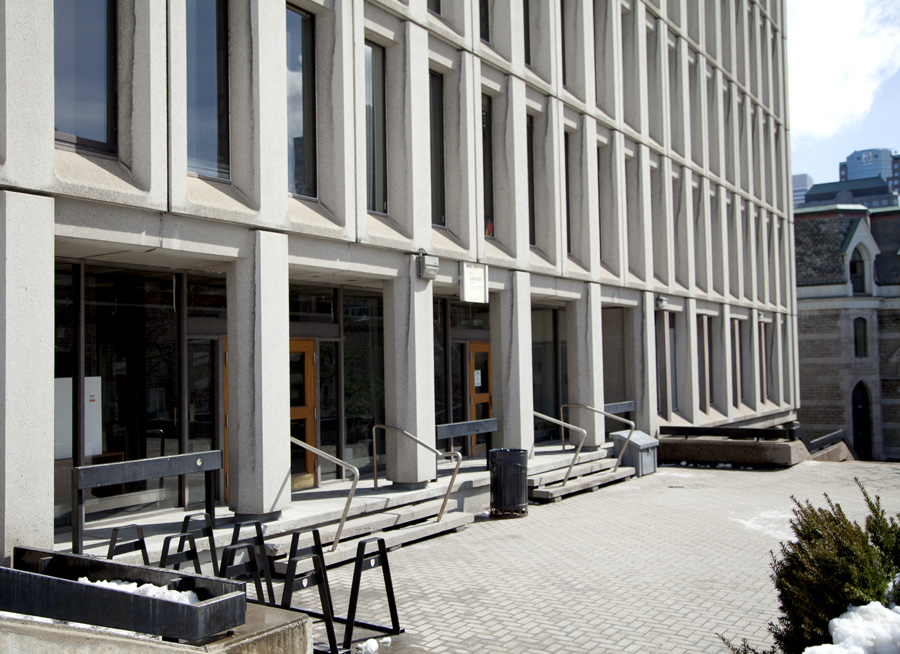
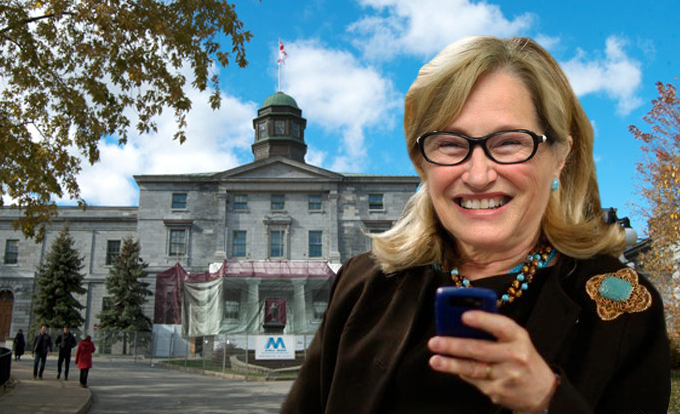
After a disappointing meeting with members of Divest McGill, McGill University Principal Josie-Anne Fournier announced plans to address a growing student complaint: The hike from Leacock Building to the McIntyre Medical Building.
“We will be purchasing 20 fleets of Cadillac Escalades to transport students to and from Leacock and McIntyre for free," Fournier said. “These vehicles will help students get to class on time, as well as reduce the hundreds of students the Health Centre receives each year due to slipping injuries."
Fournier is also intersted in making this experience as positive as possible for students added,
“We will also mandate that the engines be kept running at all times, so we can ensure that a student coming from the McLennan Library holding a cup of Premium Molson Coffee would be kept warm as soon as they board the Cadillac," Fournier said.
Lindsey Graham, a U2 Economics and Political Science double major, applauded the principal taking the initiative to address serious campus issues.
“Although I have never read the emails sent from Principal Fournier's office, I will definitely keep an eye out for the next one," Emma Dubois, U3 Management, added, “Drill, Baby, Drill! Harper 2020!”
Although McGill will absorb all costs for the coming Fall semester, SSMU will take charge of the vehicles and drivers from 2017 onwards.
“We expect all the students to chip in towards this service, which is why we will likely be calling for a $5.50 base fee increase in 2017," incoming SSMU president Jen Fer. “This time, it will pass."
With a voter turnout rate of 17.5 per cent, the lowest since 2005, McGill students voted on a myriad of issues in the Students’ Society of McGill University (SSMU) Winter 2016 Referendum. Among them were the hotly debated amendments 13.2 and 13.3, which would have created a General Assembly (GA) Steering Committee with the power to block motions from debate at a GA. Students rejected the motion with a slim majority of 52.6 per cent. This was the right decision. As discussed on the Tribune’s McGill Matters podcast, the proposed steering committee would have undermined SSMU as a representative body while doing little to actually alter the divisive nature that contentious motions create on campus; however, the amendments were motivated by a real concern among students that SSMU is too political. The steering committee was not the answer, but the question of how SSMU can work to address these concerns remains.
[audiotrack title=”McGill Matters, EP. 1: When SSMU is confronted with external and divisive issues” songwriter=”Zachary Carson, Albert Park, and David Watson” date=”March 18, 2016″ width=”700″ height=”200″ src=”https://24f2041bb5b609d25f1a97039f71682cc9154421.googledrive.com/host/0B9rQxTeDv2duM0FmSjBSYkZFS1k/mcgillmatters1.mp3″ autoplay=”on”]
Amendments 13.2 and 13.3 were proposed after this year’s iteration of an ever present and hotly debated motion—for SSMU to support the Boycott, Divestment, and Sanction (BDS) movement against the Israel for its occupation of Palestinian territory. BDS motions have become synonymous with intense debate on campus, which some—especially those who campaign against them—have described as too divisive. As such, It is easy to assume that the idea of a steering committee arose specifically to block future BDS motions from the GA; however, to assume this is to ignore a much more pervasive concern among students that goes beyond one single issue; that SSMU is being too political. In the 2014-2015 SSMU Student Experience Survey, almost a quarter of student respondents felt uncomfortable on campus because of their political beliefs and less than 20 per cent of students felt that SSMU represented their political beliefs.
The proposed steering committee would not have addressed these concerns. It would have undermined SSMU as a representative body as an unelected committee would have veto power on GA motions. It would have also increased divisive debate on campus. Blocking a potential GA motion on the grounds of “divisiveness” would have meant SSMU was effectively against the motion (the “No” campaign against BDS continually cited divisiveness as a reason to vote against). But to think that rejecting the amendments means the end of these concerns on campus is just as naïve as to think the steering committee would have addressed them. It was rejected with a slim majority, which still means that a significant number of students felt uncomfortable enough with the nature of debate on campus to vote in favour the amendments. SSMU needs to continue to work to develop a better way to address the concerns of those who believe that SSMU is being too political without completely sidelining those who want to use the body as a platform for political stances.
Neither side of this debate is wrong. At the core of each perspective is a desire for students to feel comfortable on campus and believe that their interests are represented by their student government. It may seem impossible to demand that SSMU somehow reconcile the desires of groups who want contradictory things, but this is a challenge that all governments operating at any level face. No one expects the answer to be perfect, but one failed attempt should not deter future attempts to work towards a solution.
Popular perceptions of Greek life will forever be caught under the shadow of the 1978 comedy Animal House, in which a youthful John Belushi and his gang of misfit fraternity brothers engage in debauchery and hilarity as they struggle to keep their organization legitimate at the fictional Faber College. These judgements assume that Greek life—and fraternity life in particular—is little more than an opportunity for an exclusive group of privileged and obnoxious young men to throw parties, get drunk, and hit on girls. Stereotypes claim that fraternity brothers are misogynistic and hyper-masculine while sorority sisters are little more than shallow and image-obsessed Valley girls. In my experience, being a member of a fraternity has taught me important values as well as how to build meaningful friendships.
Many non-affiliated students at McGill do not understand this. I’ve gotten countless blank stares when introducing myself as a proud member of a fraternity accompanied by comments like “Oh. You’re a frat boy,” or “Well you must be great at drinking then!” While parties are certainly an element of Greek life, they are very far from the actual purpose that Greek organizations serve for their members and the university community. As opposed to requiring conformity and single-mindedness, fraternities and sororities give their members the opportunity to show their true selves and join a close-knit, student-run and student-led community where they can express their values without judgement or fear of reprisal.
Popular stereotypes and deplorable actions by few individuals should not shape the perceptions of entire organizations.
The Greek system at McGill includes four sororities and eight fraternities governed by the Inter-Greek Letter Council, the school’s second-largest student group. Each chapter is affiliated with a national Canadian or North American organization that unites chapters at universities across the continent. Estimates vary, but approximately 500 students, less than two per cent of the undergraduate student body, are members of fraternities or sororities with chapters at McGill, many of which accept members from Concordia as well. Fraternities are many of the oldest student organizations at McGill, with some existing since the first decade of the 20th century. The fact that Greeks form such a minority at McGill undoubtedly contributes to the lack of accurate knowledge of the community.
In contrast to images of inebriated boys packed into a frat house, Greek organizations give students the chance to form meaningful and lasting relationships with individuals who they might not have otherwise met. Members come from different corners of the world, different faculties, and different upbringings. Joining a fraternity or sorority and completing the pledging or recruitment process gave me a feeling of being a part of something larger than any individual. Pledging processes are assumed to involve hazing simply because of their secrecy; if you don’t know what’s happening, and aren’t allowed to know, it must be something illegal. This is a misunderstanding of what pledging means and the purpose it serves. Through pledging, fraternities and sororities build their recruits into men and women deserving of being lifelong members through traditions that date back to the organizations’ foundings. While these customs are highly secretive and vary significantly from group to group, the universal experience of having to accomplish difficult tasks together as a pledge class and facing challenges together as a unit creates a bond that is inimitable. It also differs from experiences such as playing on a sports team, in that there is no parent or coach or any form of older authority figure involved. By nature of its secrecy, the rewards and sense of fulfillment are largely personal.
Joining a fraternity was the best decision I made since coming to McGill. Brotherhood is not just for the three or four years of university—it’s for life. I will one day graduate from McGill University and leave Montreal, moving away from many of the people I know here. But I know that I will always have a home to return to. Even if I have never met any of the active brothers of the future, I’ll be able to knock on the door of my fraternity and be greeted by a new brother. Relationships made through greek life are longer lasting than any other non-blood relationship.
University years are a formative time in a person’s life, during which fraternities and sororities serve as character-building institutions that require commitment and dedication, encourage creativity, and develop leadership and organization skills. Because the majority of events and gatherings are private, partying forms the most visible part of Greek life for those not involved—but it is really a minor element of the experience and more a celebration of brotherhood or sisterhood than the goal of it. Greeks spend the majority of their time just like every other McGill student: In class, doing homework, or participating in extracurriculars. On top of this, they attend ritual activities, manage a house and organization of up to 80 people, and give back to their community through individual and combined fundraising or volunteering activities. Popular stereotypes and deplorable actions by few individuals should not shape the perceptions of entire organizations.
Sports Editor Nick Jasinski is in his second year in the Desautels Faculty of Management. He is a proud brother of the Alpha Beta Gamma chapter of Phi Kappa Pi fraternity.
The end of the sold-out 2016 Arts Undergraduate Society (AUS) and the Science Undergraduate Society (SUS) annual Grad Ball descended into chaos at coat check. Guests were unable to retrieve their belongings and around 2:30 a.m. the police were called to intervene. The event took place on the evening of Saturday, March 19, at Le Windsor Hotel in Montreal’s Golden Square Mile and included dinner, dancing, and an open bar.
Hailey Krychman, U3 Arts, commended the general coordination and execution of the ball.
“The overall event was really fun,” she said. “I think overall people were very classy, despite being super drunk, and I didn’t really feel like anything was going wrong. The music was great and so was the venue. It was very well organized by the AUS and SUS. Of course because there were open bars, there were sometimes long lines but nothing unmanageable or excessively rowdy.”
However, issues arose as the evening concluded. According to U3 Computer Science and Biology student Cassandra Rogers, with hundreds of guests, and only a few staff members manning the coat check, the night became disorganized as guests attempted to collect their belongings to leave.
“There was no security to speak of managing the crowd or creating a line, and there were only three or four people working behind the coat check desk,” Rogers recalled. “At the counter, I was shoved and pushed down by other students trying to reach over me to attract the attention of the coat check staff. Some people were trying to climb over other people [….] More than a few men in the crowd were making inappropriate comments about being in such close proximity to so many women [….] The crowd was overflowing up the stairs and into the main hall by the time I was able to escape.”
According to Cleona Tsang, U3 Psychology, coat check staff eventually stopped using the ticket system all together, leading to students’ belongings being left out in the open.
“There were also just a bunch of coats and bags thrown out past the coat check room and my coat and my friend’s coat and my bag were just on the floor up for grabs,” she said. “Anyone could have taken that stuff. Plus, they gave up with the tickets [halfway through] and just yelled out, ‘Whose is this jacket?’ and whoever said, ‘Mine’ got to take it home. No organization whatsoever. I was lucky I found my stuff, but I was there for an hour and a half.”
Douglass Luo, U4 Economics, also described a volatile situation at coat check.
“Everyone just crowded around the coat check, yelling at each other and trying to shove their way to the front,” he said. “It felt like a riot was about to break out. I’m lucky I was near the front of the line, because I hear a lot of people didn’t get their coats.”
Rogers took note of several students who were inebriated but were unable to receive aid from the McGill Student Emergency Response Team (M-SERT).
“Some people were very drunk and ill, and it seemed like medics or M-SERT staff weren’t really able to fight their way through the crowd to get to them,” Rogers added.
Officers from the Service de Police de la Ville de Montréal (SPVM) ultimately responded to the scene and reportedly used harsh tactics to get through the crowd.
“People were screaming and shouting and cursing and someone yelled [that] she was going to punch someone if they didn’t stop stepping on her toes,” Tsang said. “The police arrived and someone—I think it was a policeman—just shoved a bunch of us back by brute force. It was very aggressive and rowdy and a lot of people tried to take control of the situation but the crowd was so unforgiving.”
In a post on the Grad Ball Facebook event page, the AUS and SUS formally apologized and explained what had happened.
“Employees of Le Windsor felt unable to handle the crowd around coat check and decided to call the police,” the Grad Ball Committee wrote.
At the time of publication, the SPVM had no report of the night’s events, according to Marie-Élaine Ladouceur, SPVM media relations.
“I checked the events of that evening,” Ladouceur said. “I didn’t find any report.”
In response to statements concerning police brutality towards guests, the Grad Ball Committee announced on its Facebook event that it would look into pursuing a formal complaint with the SPVM.
“[We] are considering filing a complaint with the SPVM regarding the events which took place on the evening of March 19 at Le Windsor on behalf of guests who felt harassed or mistreated by law enforcement officials,” AUS President Jacob Greenspon said. “As stated on our Facebook post on March 21, we encourage anyone who wanted to provide a statement to email us.”
Greenspon stated that no testimonies have yet been received to follow through with a formal complaint.
“Given that neither the Grad Ball Committee nor any Faculty Executives have received any reports from guests as of yet, it is unlikely that we will file a complaint with the SPVM, but we remain open to the possibility if students come forward,” Greenspon said. “The [AUS] and [SUS] will be following up with Le Windsor to relay complaints we’ve received from our guests and to help find any lost belongings.”
The Christian Old Testament tells beautiful stories. It is poetic, rich in morals, and well-written. The beginning of the world, as described by Genesis 1, creates a haze whereby from nothing, God creates something.
“In the beginning, God created the heavens and the earth,” the Bible reads. “On the first day, God said, ‘Let there be light,’ and there was light. God saw that the light was good, and he separated the light from the darkness. God called the light, ‘day’ and the darkness, he called ‘night.’”
According to the BBC, Earth was formed by accretion (the coming together of matter due to gravitational force to form larger bodies) from a solar nebula creating an incredibly hot mass, covered in toxic volcanic gases. Though the Bible does not acknowledge the empirical creation of the world, and the /BBC/ does not acknowledge the Biblical explanation, the two are not mutually exclusive.
Before being pummeled by meteor impacts and cooling down enough to form a crust, the Earth did look like the formless, empty, and dark Earth described in the Bible. According to some scientists, however, the Bible’s later claims that God made everything from birds, the moon, and trees—creationism—are false. But the Bible is not a scientific paper, written to stake claims about the world and our surroundings. Rather, it is a book—a very old book—compiled of historical texts and sources from different authors and civilizations.
“The Bible speaks a language that’s over 2,000 years old [and] when some people try reading it as if it scientific fact, you start to distort what is actually meant,” my brother, Alex Nevitt, a seminarian at the Gregorian University in Rome, explained. “You need to speak theology to understand what’s written in the Bible.”
I, like many others, do not speak theology. I am a scientist and an atheist. Though my mother is agnostic, my father is an extremely devout and practicing Catholic and my brother is studying to become a priest. Admittedly, dinner is weird.
“I don’t believe in creationism, I don’t think it’s a truth,” my brother continued. “That is something that’s happened in modern times where the Bible has been read as if it is speaking in scientific language [….] However, the Bible doesn’t speak that way.”
When I was younger, I had a hard time reconciling the Bible with my education because all stories and explanations were always inexplicably tied to God, and my public school never mentioned Him. But my devout father always tried to keep Him in my heart.
“I was brought up in the faith since I was a baby,” my father, Bill Nevitt, explained. “I went to Catholic grammar school, Catholic high school […] and finished and graduated from a Catholic college.”
“A man dying of cancer searches for life meaning.” When condensed into this single phrase, the plot of Ikiru seems trite and simple. Yet renowned director Akira Kurosawa is an original storyteller who uses this familiar narrative to create an existential masterpiece.
The opening shot of the film is an X-ray of a stomach belonging to Public Affairs Section Chief Kanji Watanabe (Takashi Shimura). The stomach is filled with tumors that will eventually kill him. The narrator of the film introduces the viewer to Watanabe hunched over at his desk.
“It would only be tiresome to meet him right now,” the narrator explained. “After all, he’s simply passing time without actually living his life. In other words, he’s not really alive.” Watanabe’s job consists of stamping paperwork and appearing busy.
Having worked monotonously in the public affairs department for 25 years, not skipping a single day on the job, Watanabe is appropriately nicknamed “The Mummy.”
Upon learning of his death sentence, Watanabe initially plunges into a state of despair. He takes to drinking and meets a young man at a bar who learns of his situation and guides him through a night of hedonistic enjoyment. At a crowded dance hall, Watanabe requests a song entitled “Life is Brief.” The happy dancers pause in their footsteps to listen pensively to Watanabe’s soft voice as he sings the lyrics. This plaintive, heart-breaking song perfectly encapsulates the elegiac tone of Ikiru.
As Watanabe’s imminent death approaches, he rids himself of his sorrow and transforms into a Christ-like figure who, resurrected from his deathlike daily routine, aims to better his community. Through this religious interpretation, women play an important role as Watanabe’s disciples. In the beginning of the film, a group of poor women visit the public affairs department with a proposal to make a sewage pit into a children’s playground. They are constantly deferred until Watanabe cuts through the red tape and takes action. At Watanabe’s funeral, these women weep and bow to his shrine like worshippers.
One woman in the film is the youthful and energetic Toyo Odagiri (Miki Odagiri), whom Watanabe enjoys spending time with. While previously working at Watanabe’s office, Toyo quits her job to produce toy bunnies. “I feel like I am playing with every baby in Japan,” she tells him of her work. At his shrine, she leaves a fuzzy bunny that hops around playfully.
Kurosawa uses movement strategically in Ikiru. Filming the stagnant office workers sitting hunched at their desks and men talking criss-crossed signify a morbidity of spirit. Perhaps the reason for Watanabe’s laconicism is that talking is a way of not moving. For example, the bureaucrats stall and defer proposals yet achieve no action. Unlike the others, Watanabe is a character of movement. In the most picturesque scene of the film, Watanabe rocks in a child’s swing, not talking but once again singing “Life is Brief.”
Sound, such as background noise or pregnant silence, is also used strategically by Kurosawa to elicit emotional responses from the viewer. After dining with Toyo, Watanabe descends the staircase of the restaurant as a group of girls sing “Happy Birthday” to their friend. As the camera focuses on Watanabe’s smiling and awakened face, it seems as if the girls are celebrating his rebirth.
Ikiru, though made in 1952, was not released in the United States until 1960 as it was labeled “too Japanese.” Ironically, Ikiru’s subject matter could not be more universal, as the film forces the viewer to acknowledge the brevity of human existence and the importance of breaking free from idleness.
On March 23, Principal Suzanne Fortier sent an email to the McGill student body announcing that the Board of Governors (BoG) had decided not to divest from McGill’s holdings in fossil fuel companies. Divest McGill first submitted a call to divest from fossil fuels to the Committee to Advise on Matters of Social Responsibility (CAMSR) in Feb 2015. CAMSR took over a year to make their decision, finally delivering their report to the BoG on March 17.
The final CAMSR report on divestment thanked Divest McGill for bringing the issue of climate change to attention at McGill, but stated that CAMSR and Divest McGill hold different views on the role that extractive industries play.
“The Committee is persuaded that the beneficial impact of fossil fuel companies offsets or outweighs injurious impact at this time,” CAMSR’s report stated.
The report outlined that they had not found the actions of fossil fuel companies to cause social injury, despite the case presented by Divest McGill.
“Continuing to explore or refusing to keep unburnable reserves underground does not directly have grave injurious impact on individuals or the natural environment,” the report stated. “Climate change is an injurious impact primarily due to the burning of fossil fuels by end-users rather than activities of fossil fuel companies.”
Jed Lenetsky, U1 Environment and member of Divest McGill, said that the BoG did not properly examine the harm being done by fossil fuel companies.
“The fact that they didn’t even consider extreme extraction as social injury was a serious affront to people who are being directly affected by irresponsible extraction methods every day,” Lenetsky said. “They also claimed that climate change shouldn’t be considered social injury because it hasn’t yet reached grave levels. Hundreds of thousands of people dying every year, and more being displaced across the world because of climate change, seems pretty dire to us.”
Mike Andrew, president of the Co-op Mining Engineering Undergraduate Society (CMEUS) explained that the society supports McGill’s decision to not divest.
“Many students in the program obtain internships and post graduation positions at fossil fuel companies,” he said. “CMEUS [… is] committed to ensuring the stability of Canada’s energy future in a safe and sustainable manner. Collectively, we understand the importance of transitioning to a carbon neutral economy in the face of climate change. That being said, fossil fuel companies are among the largest investors in the green energy technology that is needed for this transition.”
CAMSR explained how divestment would not be an impactful movement against climate change.
“Divestment, whether to exert financial influence or for symbolic purposes, would not be an effective means of addressing climate change,” the report reads. “It is an ultimate action that is disconnected from the intended outcome of reducing the injurious impact represented by climate change. It also is a distraction to efficacious forms of action, and somewhat overreaching relative to reasonable next steps given the current economic and political reality. The Committee sees no advantage or benefit for McGill to engage in action that would have negligible impact on climate change.”
Students’ Society of McGill University (SSMU) Vice-President (VP) External Affairs Emily Boytinck stated that the BoG and CAMSR did not allow McGill students to be a part of the decision process.
“All CAMSR meetings were held in closed sessions, and the final report was released to the board only 26 hours before it was voted on,” Boytinck said. “Furthermore, the BoG never once heard from Divest McGill directly, despite the fact that Divest McGill attended every board meeting as observers this year.”
Although he did not respond to a request for comment, Chair of the BoG, Stuart “Kip” Cobbett was closely involved in the deliberation process.
“Earlier in the year, a few members of Divest McGill met with Kip Cobbett and Michael Di Grappa, [vice-principal Administration and Finance], to discuss the idea of releasing a draft report before it was voted on at the [BoG],” Boytinck said. “This way, there could be feedback provided on the report and community voices would be able to be heard. This is not uncommon practice, as Dalhousie released a draft report initially as well. Kip Cobbett, however, responded by noting that this was not a conversation.”
Kareem Ibrahim, SSMU president and member of theBoG, stated that an increase in transparency would benefit any future decisions regarding divestment.
“Although the University followed its procedures appropriately, we would certainly appreciate a more open process next time, as exists in many other comparable universities,” Ibrahim said. “This would require some changes to our governance procedures, but in the spirit of transparent and two-way dialogue, I don’t think this would be an issue.”
The choice not to divest left many students frustrated with the university and the lack of consideration for student voices.
“The decision by members of the Board to maintain McGill’s investments in fossil fuels is disappointing and embarrassing to say the least,” Lenetsky said. “Not only does their decision signal their inability to lead on issues of great importance to all of humankind, it also demonstrates how disconnected they are from the McGill community. They were the first body at McGill to reject divestment, and did so after refusing to conduct community consultation or provide a draft report for community comment. They didn’t even have the courtesy to inform us of the vote.”
Although there are not yet any formal plans to present the case for divestment again, Doug Sweet, director of the McGill’s Media Relations Office, indicated that the BoG could revisit divestment in the future.
“CAMSR has finished its work on this file,” Sweet wrote in an email to the Tribune. “If and when another request is made, it will re-engage.”
Lenetsky noted that this is not the last time that Divest McGill will petition the University.
“This is not the end of our campaign by any means,” he said. “If anything, the Board’s ridiculous report is galvanizing further support and action for divestment. We simply care too much to let our university continue to be on the wrong side of history.”
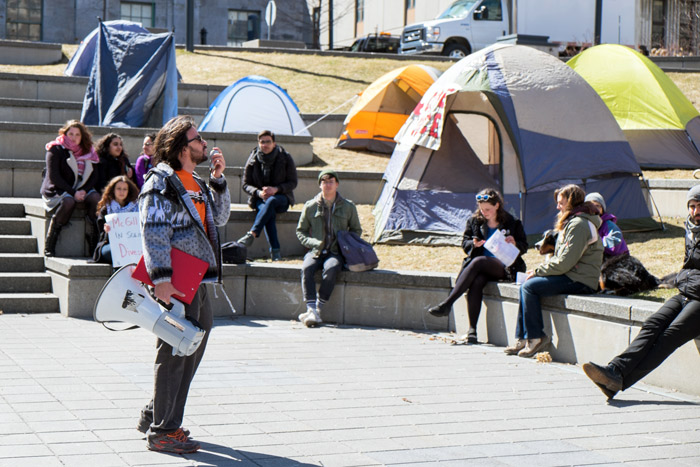
On Tuesday March 29, Divest McGill began a sit-in in front of the James Administration Building. According to the event’s Facebook page, sit-in participants are prepared to stay until all demands are met.
In an era where social media sites are dominated by the likes of Farmville, bars and pubs increasingly entice patrons with the prospect of some drunken Dance Dance Revolution, and even the elderly have been swept by the rush of Candy Crush, video games have successfully expanded beyond their niche origins and have permeated society on an intergenerational level. One such area of video game proliferation, however unlikely it may seem, has been the classroom.
Contrary to the lingering notion that video games kill brain cells, an idea that plagued many a Cold War-era household, educators at both the primary and higher levels have started to tap into the unique potential of games for stimulating curiosity and imparting experience in ways that traditional schooling simply cannot. Montreal in particular—through the research conducted by Darren Wershler, associate professor of English and Concordia University Research Chair in Media & Contemporary Literature, and the graduate courses taught by Dr. Christian Ehret, assistant professor at McGill’s Faculty of Education—stands as a pioneer in uncovering these largely untapped rewards games can offer for the classroom and beyond. But what exactly can games offer the classroom, and why do they even need them in the first place?
“I’ve always tried to see if I can use the game as a kind of allegory,” Wershler said. “Can we use the game to teach students how ideology works, or explore concepts such as free will and forced choice? Instead of saying we’re going to take this theory and apply it to game, it’s like turning the telescope around and going the other way. You use the game to tell you something about a larger intellectual question. This kind of approach allows students to end up thinking about things that are of interest to them from other categories.”
As the panic surrounding mid-term/finals season proves, grades and the fear of failure surrounding them constitute one of the defining elements of acquiring an education. Yet that fear is often so palpable that students increasingly run the risk of becoming averse towards the subject material and come to view education through a lens of woe rather than wonder, ultimately hindering their growth. As Lee Sheldon, associate professor and co-director at the Games and Simulation Arts and Sciences program at Rensselaer Polytechnic Institute, articulates in his book The Multiplayer Classroom, the modern classroom directly contributes to this fear of academia through its foundation upon letter grades which are assigned “as penalties for failure,” where students start at 100 and then whittle their score down through mistakes. The tried and tested mechanics used to incentivize player engagement in video games offer an invaluable tool for teachers in combating this fear of failure.
By having students start at an F and then ‘rise up’ in level to achieve an A through ‘Experience Points’ distributed across assignments ‘ranked’ in difficulty, offering unlockable ‘achievements’ in recognition of exceptional accomplishments, and organizing ‘guild’ systems wherein students receive bonus points for helping each other, Sheldon’s case study ultimately showed how the use of such RPG mechanics led students to achieve a higher interest in learning and better grades. Games allow students to move up instead of fall down academically, and, while the grade numbers are practically the same, such a psychological difference is crucial for stimulating the joy and wonder learning is supposed to be all about.
Another common problem many students face, particularly at the earlier stages of education, lies within the concept of transference, where students often feel that the things they learn in the classroom bear little relevance to life outside the classroom.Video games, as amalgamations of so many different fields, stand as one of the perfect teaching mediums with which to show the interconnectedness of class concepts.
“Game studies are always interdisciplinary because games are such weird, fractionating objects,” Wershler said. “You need some insights coming from film studies, digital media, communication theory, literary studies about narrative, philosophy, programming […] you really can’t approach games from a sole disciplinary perspective as you just miss stuff.”
In one of his most successful class projects, Wershler had students studying Plato’s Republic attempt to recreate a utopia within the sandbox engine of Minecraft. Utilizing the game in such a manner ultimately led students, according to Wershler, to both connect with the material in a deeper, more personal way, and have a wider grasp on how these concepts transcend the assignment.
‘Class divisions’ between Minecraft-savvy students and those less so, ecological debates concerning the actual building of the project, and issues of responsibility all were entailed in the fact that the project was so massive it detrimentally “slowed the entire class server to a crawl” for other students.
“Their utopia forced them to think about a whole set of questions that they weren’t aware of when they started, but by the time they were finished were able to think about in the ways philosophers have always approached utopia and dystopia,” Wershler said. “That’s sort of what I mean by games as allegory. When game studies in the classroom work at their best, the game becomes an occasion for thinking about something larger.”
For Ehret the commmunity surrounding the game is more important than the content.
“Video games, regardless of the content, create opportunities to learn differently than other platoforms: Open world games, for example, teach players how to grapple with new languages, symbiotitc codes, like icons, and ways of talking to each other that are different from the communitication of everyday life, but also transfer to other areas of your life,” Ehret said. “So when we talk about literacy now, we talk about multiple literacy, so you might know standard english, or standard french, but can you switch between all of those various discourses, and do so adjunctively? Video games are one of those types of languages, or discourse communities, and kids learning and talking in those areas have a lot of transerfable skills to academic writing.”
Perhaps one of the most powerful areas in which games can uniquely impact students in the modern classroom is in their sense of agency. Student agency refers to the sense, or lack thereof, of how much control students feel they have over their studies and how much they perceive their academic choices, whether choosing classes or picking a university, to be meaningful choices they can actually make. It has become a common trope that kids within the public school system increasingly feel that college is out of their grasp, or that they’re ensnared in whatever pre-determined plan was set out by their parents, and thus can’t meaningfully change their lives or the community around them. When agency dwindles, so too does student motivation. School, once again, begins to foster the very sentiments that turn students away from it. Video games, a medium all about action and ‘doing,’ stand as one of the best ways to empower students and make them believe their choices matter.
Ehret has conducted extensive research on the social impact of video games, and his experiences powerfully demonstrate the potential games have to impart the notion that kids can impact their communities.
“A Minecraft club at the Nashville Public Library was created for the specific purpose [of] redesign[ing] and reimagin[ing] areas of the city that were currently dilapidated or home to underprivileged communities, and to think about how to design them for ‘spatial justice,’ with more mobility between communities, green spaces, and community gardens in mind, and to think about all those things that would create more fruitful communities,” Ehret said. “The kids involved became like urban planners in Minecraft and reimagined those spaces and actually rebuilt them according to their imaginings together and presented it to local city planners. Those sandbox games like Minecraft provide at least two big potentials, one for us to harness kids’ expertise in games, but also to reimagine, with and alongside kids, not as experts ourselves, potential projects for social justice.”
While implementing video games and their mechanics in schools is certainly not devoid of challenges, the positive changes they bring to the classroom to make them a necessary force in the 21st century school system. If the curiosity that is supposed to at the foundation of education is to be rekindled, there needs to be a move away from a system of based on moving down, and focus on levelling up.