

Latest News

Duo Nouveau MUPPS
Art, Arts & Entertainment

The McGill University Photography Students’ Society’s Retrospective in retrospect

The McGill University Photography Students’ Society (MUPSS) celebrated their first annual exhibit last Wednesday entitled Retrospective. Featuring the work of McGill students in both film and digital prints, Retrospective was well-attended and met with high praise from both the McGill community and the general public.

The exhibit itself was low-key—the majority of photos did not exceed 8” by 10” dimensions. Held at Shape Gallery on Boulevard Saint-Laurent, visitors removed their coats and shoes after escaping the snowy street outside. The small size of the prints, paired with chipped floors and tattered walls, created a cozy and welcoming atmosphere. Soft melodies from the Montreal band Duo Nouveau played in the background, and the entire collection was held in a single room.

Focusing on the simplicities of life, the subjects of the photos were mostly everyday objects, ordinary people, and nature. Retrospective was the perfect name for the exhibit, and it set the mood for the entire collection. Perhaps the best representation of this would be Roald Teffries’ twin pieces, “Mirror” and “Miroir,” depicting two convex mirrors from different perspectives. At first glance, they appear to be plain and could easily be passed over without further inspection; however, Retrospective is about pausing to reflect on the little things in life and considering how we perceive things—even two plain mirrors.

Joseph Dahdah’s “Untitled” focuses on an elderly man on the metro, squatting and looking at his phone. In the foreground is the fuzzy outline of another person, hands clasped around a duffel bag. Dahdah’s second print, also “Untitled,” is in black and white, of a man in sneakers and dark jeans reading a newspaper while crouching on a box. To the side are stacks of more newspapers, presumably from where the subject acquired the one in his hands. Dahdah’s work encapsulates the idea of finding wonder in everyday moments, and in the scenes we pass by every day and would appreciate, if only we had stopped to look in the first place.

Retrospective, at times, felt like a jump to the past. “Armored” by Scott Cope depicts a march of uniformed police, but a shutter malfunction caused the top half of the photo to be blurred black. The dystopian scene is suddenly transformed by the blur, mimicking the haze of tear gas that protesters may face. Jules Tomi’s “Noam Chomsky was traumatized by the Soviet Union” shows a man looking on into the crowd while holding up part of a large sign on a stick. The picture feels dated, leaving the viewer questioning when the photo was taken. “Armored” and “Chomsky” work well together, capturing a protest from two opposing perspectives.  Another piece, “A Father’s Work” by Sally Han, simply portrays hands pouring sauce into a jug, but the achromatic colouring gives the impression that the photo was taken decades ago. Perhaps the “retro” portion of Retrospective is ambiguity in time.

The modesty and humility of the collection convey a sense of honesty that connects with the viewer through relatable depictions of the simplest of acts: Pouring something into a jar, or looking at one’s cellphone on the metro. The way Retrospective was structured conveys a sense of familiarity even with the pictures of “grander” subjects, like protestors or mountain climbers. This was aided by the soft lines and colouring that together achieve an intimate effect. Retrospective tells viewers to stop, reflect and focus on the small details of life that give unexpected joy. Retrospective was enjoyable, but not incredibly memorable. The humble gallery and small prints could have used larger, attention-grabbing ones as an anchor, for larger impact. But for MUPSS’ first exhibit ever, it was a job well done.

McGill University Arts Building
Joke

McGill to divest from the colour red

In the latest divisive Students’ Society of McGill University (SSMU) motion debated at yesterday’s Mid-Term-Crisis General Assembly (GA), 87 per cent of students decided to part ways with the iconic McGill red. SSMU is now mandated to lobby the McGill Board of Governors to divest from and boycott all things red, which will necessitate a comprehensive rebranding strategy to remove all traces of the colour from McGill buildings, websites, and logos. 

“This call for BDR (Boycott and Divest from Red) states that such campaigns are to remain in place until McGill meets its obligation to create a stress-free, environment for students, and to recognize the colour wheel’s inalienable right to self-determination,” the motion read. 

SSMU will effective immediately be removing all traces of the colour from its property, with minor renovations and repainting at Gerts Bar to force the cancellation of Sangria Wednesday this week.

“It’s a small price to pay for the huge step forward we’re making with this decision,” explained SSMU President Karl Abraham to disheartened students.

Gerts’ red sangria will likely not survive the cut. 

The “Yes” group consistently expressed concern regarding the stressful nature of the colour: It reminds students too closely of the red X’s written on their fifth grade long division tests, and the red F’s on midterms handed back during McGill’s neverending midterm period. It brings to mind only the judgemental negativity of the red squiggly lines in Microsoft Word, which incidentally still fail to grasp the correct spelling of “colour.” The colour has now become inseparable from the red notification bubble that pops up on myCourses, which continues to shatter dreams of attending Harvard Law and working alongside Harvey Specter. 

The “Yes” group advocates renaming the “McGill Redmen” the “McGill Men,” to help the process along. It argues that “Redmen” was “a stupid name anyways.” The martlet on McGill’s logos will also have to go, with various suggestions for its replacement including Rainbow Fish, a tropical parrot, or alternatively, just a blank white space. Consequently, the “McGill Martlets” will no longer be a suitable name choice, with rumours circulating that the Martlets will soon be unveiled as the “McGill Floodgirls,” to remind student athletes of the fearlessness and bravery demonstrated by McGill’s most courageous student.

In a surprising turn of events, McGill Principal Jo-Anne Fournier expressed her relief at the passage of the motion, and praised students for the courage and solidarity they have shown throughout this hard time. 

“This really speaks to the kind of innovative problem-solving unique to McGill students,” Fournier explained in a congratulatory email to the McGill community. “Things have been really tough lately, with austerity cuts and all, but I’m so excited to be involved in this ground-breaking journey towards a stress-free school.” 

It is estimated that boycotting red will reduce campus mental health services expenses by at least 50 per cent.

In an exclusive interview with the Tribune, a weary Fournier also admitted that she didn’t even like McGill red that much. 

“Quite frankly, it will be nice to be able to shake things up a bit,” Fournier said. “I’m more of a lavender person anyways.” 

The Colour-Blind Students’ Network expressed its support for the movement, stating that McGill’s overuse of red in its branding is oppressive and discriminatory towards the full colour spectrum. Red comes in many shades, and promoting fire-engine-red as the only socially accepted norm is unacceptable. 

“Just because society has institutionalized red as a primary colour, doesn’t mean McGill can overlook the struggles of under-appreciated colours, like mauve.” Vice-President (VP) Paintbrushes, Mandy Warhol, explained.

The McGill Teetotalers Club also officially endorsed the movement, as red is too closely associated with the ubiquitous red solo cup. 

“Frankly, the red solo cup promotes wastefulness,” Jane Simpleton, U0, complained. “Beer pong is a waste of plastic, a waste of time, and a waste of an education.” 

The club’s office has since reportedly been the victim of several acts of vandalism and harassment, including drunk streakers; graffiti reading, “red solo cup, I fill you up;” and receiving excessive free promotional gear from Molson Canadian.

The “No” group remains disappointed with the decision, reiterating that divestment will only serve to “marginalize Canadians on campus, and make them feel ashamed of their nationality and their maple leaves.” Many of its supporters reportedly swore to move to Laval after yesterday’s decision.

*This article is a work of satire and a part of our joke issue*

News, SSMU

SSMU Council releases statement in favour of divestment

At its March 24 meeting, Students’ Society of McGill University (SSMU) Council discussed the McGill Board of Governors’ (BoG) recent decision not to divest from the fossil fuel industry, and passed two motions: For SSMU to officially stand in solidarity with Black Lives Matter Toronto and an official policy on indigenous solidarity. 


Response to BoG’s decision not to divest

SSMU Council released a statement in favour of divestment, countering the decision of McGill’s BoG not to divest from  the university’s holdings in fossil fuel industries.  The BoG based its decision upon the report written by the Committee to Advise on Matters of Social Responsibility (CAMSR), releasing their decision in a special meeting on March 23. The report stated that CAMSR does not believe significant social injury had occurred by investment in fossil fuels, which Vice-President (VP) External Emily Boytinck singled out as a particular flaw. 

“I think that this is shameful,” said Boytinck. “How dare they say the impact is not grave? They should speak with the 150,000 people who die every year due to climate change.  They should speak with the indigenous communities who are the first people affected by this issue.” 

Boytinck also addressed concerns over security at the BoG meeting directed at students attending as representatives from Divest McGill.

“Divest McGill has been present at every single board meeting this year,” Boytinck said. “It was the first time we were escorted up in James administration by security. It was a huge slap in the face for a committee who has repeatedly called us a partner. I was disappointed and shocked by the way the [BoG] treated students at that meeting.” 

Boytinck highlighted the lack of transparency in the decision-making process, as none of the CAMSR meetings on the matter were open to the public, and no information is available on the experts with whom CAMSR consulted.

“SSMU will continue to work with Divest McGill to find a way for this question to be brought back to the Board of Governors in an open and consultative manner,” Boytinck said.


Solidarity with Black Lives Matter Toronto

Council passed a motion brought forward by the Black Students’ Network (BSN) for SSMU to officially support the Black Lives Matter Toronto organization, following their recently-released statement of solidarity calling on community organizations, labour representatives, individuals and the broader global community to protest against police brutality. The statement demands the release of the names of the officers who shot and killed Andre Loku, a 45-year-old father of five last July.  Protestors are also for charges to be laid against the officers since they have been cleared of any liability. 

VP Internal Omar El-Sharaway brought forward the concern that the motion might be viewed as divisive, quoting the results of a student experience survey which revealed that students would prefer SSMU to be “less political and more fun.”

Boytinck cited the importance of SSMU taking a stance on this issue, given its connection to McGill students. 

“This directly affects students at McGill,” Boytinck said.  “What we consider to be a student issue and not to be a student issue, is in and of itself a political choice.”

VP University Affairs Chloe Rourke added her agreement to Boytinck’s response. 

“I take issue with some of the claims that SSMU should be less political,” Rourke said. “It’s important to quantify and qualify what you mean by that.  Student unions have historically played a role in human rights movements across the world. Remaining neutral is also very much a political choice.” 


Policy on Indigenous Solidarity 

Council approved a motion to adopt a policy on Indigenous Solidarity, drafted by Indigenous Affairs Coordinator, Leslie Anne St. Amour, following consultation with various indigenous student groups, staff, and faculty members. 

“The policy covers many areas, particularly focusing on how SSMU can better support McGill’s Indigenous students, as well as lobbying the university to hire more indigenous staff and faculty, and increase indigenous course content,”  St. Amour explained.

St. Amour addressed the lack of physical spaces on campus for indigenous student groups as one area SSMU can work to improve upon through this policy. 

“There is only one space on campus which allows for [the cleansing ceremony of] smudging, First Peoples House, and it is not a great space  for holding large events,” St. Amour said.

The policy also obliges the office of the VP External to reach out to indigenous communities at the beginning of the academic year, and continuously throughout the year as relevant issues arise. 

Joke

Student crashes Minerva by accidently completing course evaluation

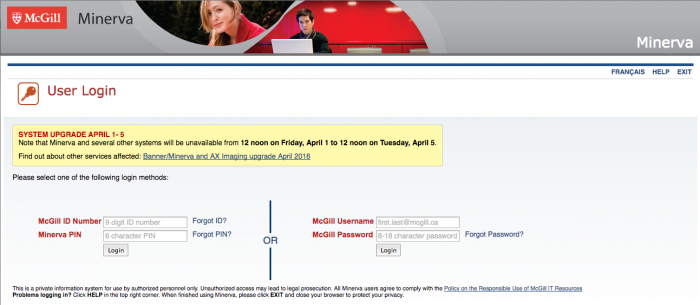
Like every other student, I thought Minerva was supposedly going to be unavailable from Friday April 1 to Tuesday April 5 because of a technical upgrade; however, I was still a bit skeptical about this official reason. Yesterday confirmed my thoughts.

I had received a call in the early afternoon from a blocked number. Since I thought it was my friend prank-calling me, I decided to answer. But from the moment I heard this voice, I knew this was no prank call. I had never heard someone who  seemed as frightened as this.. The caller, who claimed to be a current McGill student and shall be called Mr. X for reasons pertaining to anonymity, asked me with a shaky voice if I could print the truth on Minerva’s system crash. Since he was not willing to speak on the phone as he thought our phones might be tapped, I asked him where we could meet. He told me to meet him at his flat in the ghetto. I checked the weather, not knowing whether the last day of March was going to be snowy, rainy, sunny, hot or cold. Unfortunately, the weather had me put my coat and my winter boots.

After steering clear of vomit puddles and shattered beer bottles, I finally arrived to his door and rang. I waited a long time, and finally heard some footsteps. He opened the door wide enough for me too see one eye and asked me if someone had followed me. I told him that I had taken precaution.

Hesitating for a couple seconds, Mr. X invited me inside. He immediately blurted everything out.

 “I accidentally completed a course evaluation,” he said. “I got drunk last night and I remember that I was texting my ex to try to get her back. I blacked out after and I woke up with my phone showing Minerva’s message to thank me for completing my course evaluation!”

He explained to me that completing this one evaluation probably overflowed Minerva’s system, which was not prepared to get so much information.

Understanding the gravity of the situation, I asked Mr. X if he could remember additional information. He took some time to think, and he got a panic attack. 

“I think I even left some additional written comments,” he said.

 At this moment, I knew his time at McGill was over. If people were to identify him, he would become the butt of everyone’s jokes.

I called up McGill’s witness protection program (McWitSec) and asked them if they were willing to cooperate with Mr. X’s transfer to Concordia under a new identity. McWitSec told me they could only help under one condition: Mr. X had to complete his four other evaluations, this time on paper, so that McGill’s administration could finally work with student reviews.

Mr. X did not want to relive this traumatic experience. I tried to convince him but ultimately failed. He slowly breathed in and out, and told me he was going to leave for the Bahamas to finally be at peace with himself. I wished him good luck, and left the apartment. I walked up a bit and heard my name.

“Wait,”he said. “I’m going to take the deal.”

Mr. X completed his course evaluations and arranged his transfer to Concordia. He moved out from the ghetto and now turns off his router every time he goes out to drink.

Minerva is now on maintenance until April 5, and from a trustworthy source, the administration is upgrading the system to allow up to 10 course evaluations.

*This article is a work of satire and a part of our joke issue*

Hockey, Martlets, Men's Varsity, Sports

Blast from the Past: Hockey at McGill

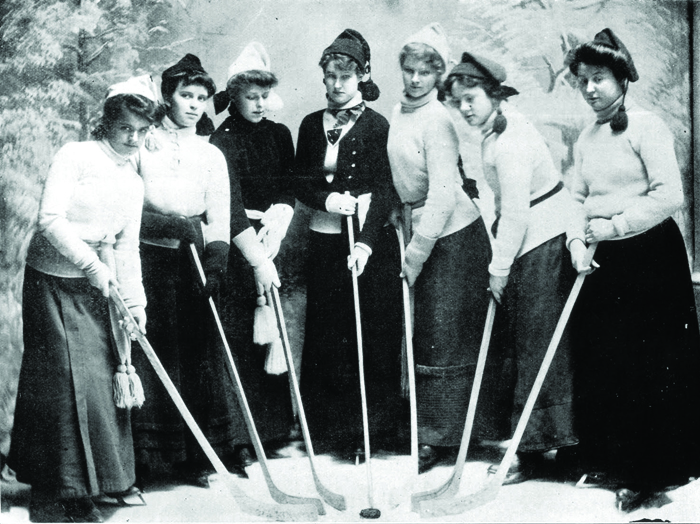
Hockey, like most modern sports, evolved over time as players combined various sports, including field hockey, lacrosse, and games from the British Isles such as shinty and shinny, and adapted them for the long Canadian winter. McGill students played a pivotal role in creating the game we know and love today, according to McGill Athletics Sports Information Officer Earl Zukerman.

“The game evolved, it wasn’t invented overnight, so […] when you’re making a statement about the beginning of a game or the origins of the game, we all have to be talking about the same thing,” Zukerman  explained. “I like to call it organized hockey. Once you have organized hockey, you have rules that are specific to that sport and differentiate it from another sport. Also, organized hockey implies that you have a referee to enforce the rules and that [… all players] agree on the same rules.”

In 1875, the first game of organized hockey was played at the Victoria Skating Rink in Montreal, a structure which has since become the parking garage in front of the current Bell Centre.

“The first indoor game that we know of that involved rules and referees and a type of puck was the 1875 game played in Montreal […]” Zukerman said. “Not all the players were McGill students, but a number of them were. There was one fellow in particular, [James Creighton], who came to Montreal from Dalhousie, and he is considered by most historians to be the father of hockey.”

Moving hockey inside sparked major changes in gameplay, and the dimensions of Victoria Rink would even become the basis for today’s standard rink measurements.

“When the game was moved indoors, now you had to place a limit on how many players could play,” Zukerman said. “Once you moved the game indoors, there had to be a time limit to the games because when you go to any rink, you can’t just take over the ice for the entire day [….] By having the game in that [particular] rink it basically set the size. Any rinks built after that were basically approximately the same size [….] So that first game in 1875 that involved a couple of mcGill students changed hockey forever.”

Creighton, who would eventually earn his law degree from McGill in the 1880s, was deeply involved in the early shaping of the sport. In 1873, according to a letter written a few decades later, he sat down with other McGill students to draft the original rules of hockey. These original rules, which were essentially field hockey rules with the word ‘ice’ added, according to Zukerman, would not be published and available for the public until 1877, the same week that the new McGill Hockey Club played their first game.

“Their first game was on January 31st, 1877 […] so that week the rules also happened to be published in the [Montreal Gazette],” Zukerman said. “We believe that the writer of the rules, because there’s no name on the Gazette article […] was James Creighton because he was writing for the Gazette at the time and he was the one involved with the organization of the rules in 1873.”

The McGill Hockey Club of 1877 became an official school club, and would eventually be the McGill varsity hockey team that students know today. Though there is heavy debate about hockey’s true origins, it is safe to consider McGill greatly influential in its history.

“In my research, I’m comfortable saying that McGill students were involved in drafting the first organized rules to the game […] and McGill students were involved in the first organized hockey team […] in 1877 and probably published the first rules in 1877 as well,” Zuckerman said.

The legacy of that first indoor game in Victoria Rink can be seen every time the Redmen take the ice. Currently, they are in their 139th season, and have not stopped making history. A dozen members of the team have been inducted into the Hockey Hall of Fame and 15 players are inscribed on the Stanley Cup.

CKUT
Arts & Entertainment, Music

Video didn’t necessarily kill the radio star: how CKUT is revitalizing the airwaves

The Casbah Coffee Club, like countless other dive bars  in Liverpool, has staked its claim in music history. The supposed “launchpad of the Beatles” now features a commemorative plaque, signed memorabilia, and a £15 entry fee. Yet, the Casbah Club’s most impressive piece of history is also its most modest. Positioned under a series of commemorative photographs and t-shirts is a beat-up brown console whose function is difficult to discern at first. However, upon closer examination, its purpose becomes clear: This is the radio where the Beatles first heard their music broadcast. In a room full of historical treasures, the radio stands head-and-shoulders above the rest. You can almost imagine the fab four huddled around it thinking to themselves, “Hey, this ‘music’ thing might work out all right for us.” 

Radio used to be the major way that people accessed and discovered music. As virtually the only way for up-and-coming artists to get their music heard, it became a crucial entry point into the industry. Radio was essential to the rise of Rock ‘N’ Roll in the 1950s, with DJs such as Alan Freed and Wolfman Jack gaining celebrity status themselves. In those days, anyone who was anyone was on the radio and everybody was listening. 

[metaslider id=44730]

By the 1980s however, new and exciting ways of listening to music were beginning to weaken radio’s stranglehold. The introduction of in-car tape decks and CD players provided alternatives to drive-time radio shows. Later, the Internet and the rise of the blogosphere gave listeners exciting new ways to discover music. Today, streaming services such as Spotify and Pandora have provided perhaps the most robust challenge yet. Now, instead of combing the airwaves, more and more listeners are relying on these services to discover new music, some of which feature built-in algorithms that suggest songs based on previous listening habits.

The million dollar question then, is ‘What should radio be in 2016?’ No longer the only source for new and exciting music and facing steep competition, radio stations are finding ways to adjust.

“The biggest change for radio is that twenty years ago, radio stations were just that,” Mark Bergman, program director and Afternoon Drive announcer for Montreal’s Virgin Radio 96 said. “Today a station like Virgin is no longer just a radio station, we are an entertainment brand.” 

It’s an outlook that’s common in radio today. In order to compete, stations are looking beyond the music and toward a more holistic entertainment package, complete with an active social media presence. 

“I think we’re changing by the second,” Bergman said. “Music radio will become more and more about the great personalities in the mix with the music. That’s the only way we’re going to compete with digital.” 

Virgin is one of the most popular radio stations in Montreal, with over two million listeners each week; however, it is not just the big boys who are finding new ways to make radio relevant. McGill’s own CKUT is going beyond the music as well, albeit in a different way. For one, CKUT has always prominently featured news coverage in addition to music, focusing on stories that may have been overlooked by more mainstream outlets. 

Aishwarya Singh is a student who has worked extensively in CKUT’s news department, contributing to the station’s two major news programs: Off the Hour and All Things McGill

“We speak to the people who are working for change within a specific context,” said Singh. “If we’re going to a demonstration, we wouldn’t speak to the police but to the protesters or event organizers.”

This approach is reflected in everything CKUT puts on the air, from its news and culture, to even its music. 

“We try to get a perspective that’s less covered by mainstream radio,” Rudy Quinn, who has hosted multiple programs on the station said. “Personally, I tend to focus on smaller labels and bands out of Montreal.”

They’re not the only ones who benefit. University radio stations such as CKUT also provide a valuable creative outlet for students on campus. 

“In the classroom, we are passive receptors of knowledge,” Singh said. “Of course you can engage with that knowledge critically, but […] I feel like [working in radio] gives you a type of knowledge you wouldn’t get in the classroom. 

This knowledge is then passed to listeners through the station’s multifaceted programming. 

“If you’re the radio you have access to many different groups involved in Montreal,” said Quinn. “We have programming 24 hours a day, seven days a week. I can’t paint CKUT with one broad brush. There’s just so much going on.” 

While streaming services offer tailor-made playlists based on past listening habits, radio can push listeners outside of their comfort zones.

“On Facebook and other social networks you only get a small glimpse what your friends are posting […but radio] broadens your horizons,” Quinn said. “I play stuff that I like, but also stuff that my audience might not like or not know yet. I hope that they’ll enjoy it and that it’ll get them talking.” 

Perhaps more than anything, radio provides the opportunity to establish a connection between the listener and the larger community. 

“I think it’s about giving McGill a voice into the broader community, but also giving the community a voice into McGill,” Quinn said. 

In a telecommunications industry that has become increasingly automated, radio has remained a distinctly human industry. The radio is a conversation of sorts between DJ and audience and an invitation into a larger world. 

Bergman puts it succinctly: “All the streaming services offer is music, nowhere else can you listen to a station and feel, and know, and breathe Montreal,” he explained.

McGill, News, SSMU

Panel addresses what it means to be an indigenous ally

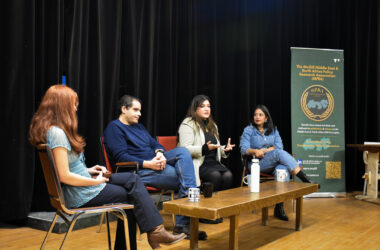
On March 22, members of the McGill community attended a panel on indigenous allyship as part of the Students’ Society of McGill University’s (SSMU) Indigeneity and Allyship 2016 event series.  

The panel, co-hosted by SSMU Indigenous Affairs and the Education Undergraduate Society (EdUS), aimed to define what it means to be an ally and how students can become involved in the issues affecting indigenous communities. It answered questions on how to best support members of Indigenous communities and how to collaborate successfully with them. Three speakers shared their views on the topic: Paige Isaac, a member of the Listuguj Mi’gmaq First Nations and the coordinator of the First People’s House at McGill; Tayla Lalonde, president of the Aboriginal Peoples Commission for the Liberal Party of Canada-Quebec and board member for Indigenous Access McGill; and Patrick Brennan, executive director of McGill’s Institute for the Study of International Development. 

The panel opened with the question, “What is the most important part of being an ally?” Isaac began by stating that being an ally is a process rather than a label.

 “It’s something that you’re constantly striving to be or do,” Isaac said. “Your actions are speaking more than words, you’re standing with whoever you’re being an ally with, not speaking for them [….] It’s learning, educating yourself on different issues, hearing from diverse perspectives, listening to the news, [and] talking to resource people at universities [and] businesses.” 

 Lalonde stressed the importance of mutual collaboration, through the acts of both listening and understanding rather than always asking questions.

 “A lot of times, people think that they are being an ally when they are constantly asking the marginalized person to tell them their story,” Lalonde said. “[This] approach is a little misguided because it’s exhausting to be that person who always has to answer those questions over and over again [….] By asking those questions you are also triggering deep-seated issues for people because a lot of people [… have] been marginalized.”

For Brennan, being an ally is about supporting people, not forcing your own viewpoint on marginalized groups.

“You can be there to support, or what I like to say ‘lead from the side,’ but you need to be careful not to confuse the destiny of a marginalized people with a solution that you have come up with,” Brennan said. 

Lalonde went on to explain the benefits that can arise from an ally’s privileged social position—particularly among university students.

 “If you have access to student government or decision-makers because of your place of privilege […using] that to push issues for [the] indigenous community, [is] a really effective way of being an ally,” said Lalonde.

Lalonde also shared her personal experience as an indigenous student at McGill and how she felt the lack of indigenous content from the moment she arrived.

 “When I think back to when I started [at] McGill in 2008, what I always remember is how invisible I felt,” Lalonde said. “I was sometimes one of the only indigenous people in my classes [….] I didn’t see myself reflected in the course content anywhere [….] There wasn’t any dedicated time in discussing the indigenous viewpoint.”

Lalonde specifically described an instance when she felt erased as a member of her Cree society.

“I remember sitting in an anthropology class and I remember learning about Indigenous people from this white male professor,” she said. “No insult to white male professors, but it was strange to hear this person talking about our people, Cree, from his anthropological perspective, which kind of made it feel like we didn’t still exist.”

 Going forward, Isaac emphasized the necessity of having more indigenous faculty members and offering more indigenous-focused classes. 

“[Provide] more opportunities for people to engage in Indigenous pedagogies,” Isaac said. “I’m hoping if your voices are loud enough to say ‘we want this,’ [the school] would listen.”

This article has been corrected. The panel is a part of SSMU's Indigeneity and Allyship 2016 event and not as part of SSMU  and EdUS' Indigenous Awareness week, as previously reported. The Tribune regrets this error. 

Science & Technology

Islamic art inspires metamaterial

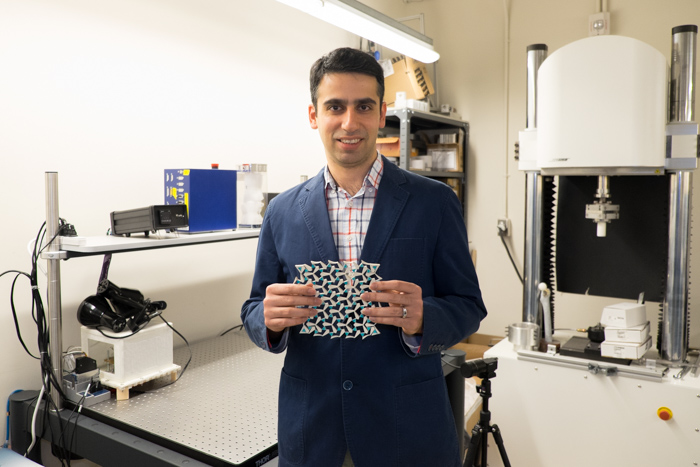
On March 21, McGill University’s Facebook page shared a video that demonstrated a unique type of material called an auxetic, expanding while being stretched. The metamaterial, designed Dr. Ahmad Rafsanjani, a member of the Pasini lab in McGill University’s Faculty of Engineering, is unique because when it is stretched, it becomes wider and longer. Conventional materials such as metals or plastics, on the other hand, contract in the direction lateral to the force exerted upon them. That is, they get longer in the direction they are pulled in, and shorter in the opposite direction—longer and thinner.

Due to this unique property—defined in mathematics as exhibiting a negative Poisson’s ratio—engineers categorize auxetics as a class of metamaterials that possess mechanical properties above and beyond that of conventional objects.

Bistable auxetics are desirable in any industry that requires smaller packaging. They may have applications in medical stents, which are used to treat narrow or weak arteries. Traditionally, a metal or plastic tube inserted into a blood vessel is used keep open previously blocked passages. Having a flexible material will enable smaller arteries to be treated with greater precision. Additional applications include satellite panels, where smaller packaging is essential in delivering the payload into space.

Scientists and mechanical engineers have studied auxetics extensively. As a result, the conventional square auxetic, a ‘base’ model for this class of metamaterials, has been very well described. In order to stay in an expanded form, conventional auxetics require a constant and continuous force to be exerted upon it, and this unfortunately makes the material difficult to commercialize.

DesignDaily: Material that can grow when stretched is inspired…

Inspired by Islamic art; a group of researchers at Canada’s McGill university have engineered a new kind of stretchable material that can grow when stretched.A ‘metamaterial’ that when pulled in one direction, expands also in a lateral direction. In other words, when stretched, the material becomes wider, rather than just longer and thinner.Video via: New Scientist Credits: A Rafsanjani/McGill University

Posted by DesignDaily on Monday, March 21, 2016

On the other hand, the auxetics designed by the McGill team is bistable. Bistable auxetics require no such additional force to stay in an expanded conformation, and consequently possess myriad of applications ranging from aerospace to biomedicine.

“Before [my design], the only bistable auxetic that has been described were complex origami patterns,” Rafsanjani said. “They were hard to make. Graduate students sometimes spent days just folding the patterns.”

Researchers first discovered the bistability of origami structures in a paper published in Advanced Materials in March 2015. And the design developed by Rafsanjani can be created using a laser cutter in less than an hour.


“The beauty of purely mechanical systems is that they are scale-free,” Rafsanjani explained. “Essentially, a model developed in a lab can be changed into any size for any practical application.”

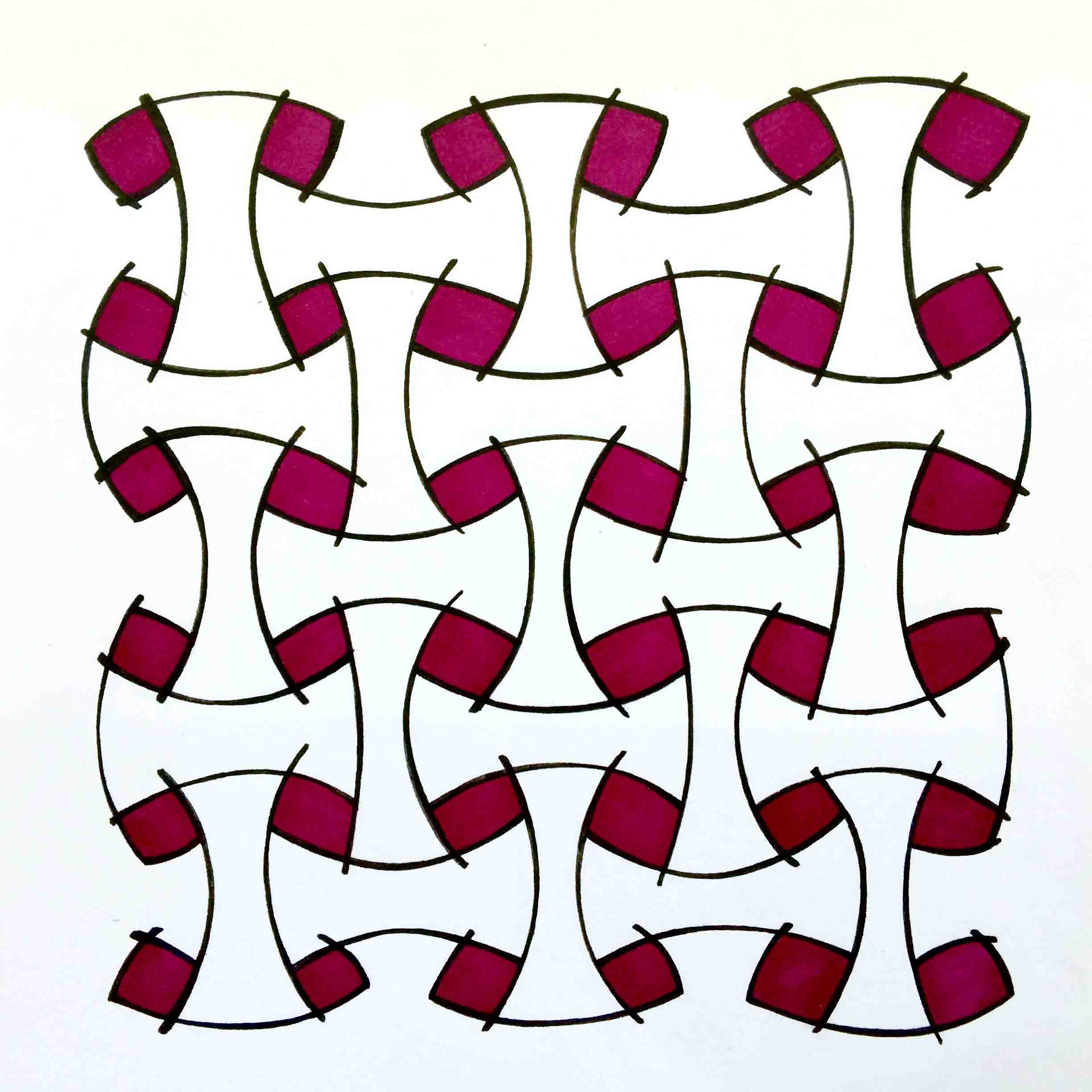
Born and raised in Iran, Rafsanjani attributed his geometric designs to Islamic art, specifically the patterns found on panels of a 1,000-year-old Iranian tomb; however, Rafsanjani cites all forms of art as sources of scientific inspiration.

Similar patterns inspired Rafsanjani in his bistable auxetic design. (Elli Slavitch / McGill Tribune)
Similar patterns inspired Rafsanjani in his bistable auxetic design. (The McGill Tribune)

“Throughout my life I attempt to find elements that inspire me” he explained. “Artists are not bound by [the same] practical and physical constraints as scientists.”

It appears that art, as an element of inspiration, is a recurring motif in Rafsanjani’s works. In a paper about metamaterials published in 2015, Rafsanjani cited artist Ron Resch in his introduction.

However, Rafsanjani’s description of his materials as being inspired from Islamic art has been met with criticism. Some have argued that Islamic art is not an all-encompassing term and that science and art should not be mixed.

“I could very well have said ‘Persian Art,’ or ‘Iranian Art,’” Rafsanjani said. “Of course this would have been a lot less controversial. But the geometric patterns that I used are part of an artistic theme synonymous with Islam. To use another name would simply be not true.”

Regardless of where he draws his inspiration from, Rafsanjani plans to continue his scientific work.

“I am dedicating my life to the pursuit of scientific achievement,” he said.

Joke

Varsity LARP team wins regional championship

Spirits were high this past weekend at Parc Mont-Royal, where the McGill Redmasters claimed victory at the Provincial Varsity Live Action Roleplay Championship (the PLARP). In a riveting final battle against reigning LARP champions the Concordia Orcs, Redmaster co-captain Dave Stipinski and his high elven broadsword, Deathslayer, dealt the winning blow to the last of the Orc forces.

“We’re really just thrilled to be here,” said an exhilarated Stipinski at the trophy ceremony, which was unfortunately cut short by scheduled park maintenance.  “It’s an honour to compete against the Orcs, and league heavyweights like Frollo Boulderspine and Khan the Nightbringer.”

It’s been a long journey for Stipinsk—or the “Roddick Assassin,” as he is known around the league—and his teammates. Although familiar to many students as an endearing if odd staple of Tam Tams, competitive LARPing has received far less public attention. The Redmasters were only given varsity status this Fall, after co-captain Erica Cowell placed a curse of eternal damnation upon McGill Athletics and Recreation. 

“Throw demonic runes into the mix, and suddenly the admin’s not so keen to play hardball,” Cowell, level 12 druid and potions major, joked.

Per the stipulations of the curse, funds were reallocated from the McGill Quidditch team, and the Redmasters made their debut into the varsity community. 

The team faced an uphill road to the championship, however. Scheduling field time at Molson Stadium between Redmen and Martlets practices proved difficult – training sessions are held primarily in Stipinski’s basement. The team also struggled to gain adequate storage space for its equipment in the McGill Sports Complex. 

“Standard issue lockers just aren’t built for full-body 12th century armor and chainmail,” Cowell explained. “And a decent longsword? Forget it.”

 Logistical difficulties were only the beginning. Disaster struck halfway through the regular season, when star player Harry Presley was suspended after pummeling a 10-year-old recreational LARPer with his fire mace. The victim, now recovered, reportedly “thought they were just playing a game” when he unknowingly wandered into a cutthroat team practice at Parc Mont-Royal. Presley allegedly mistook the minor for a particularly well-costumed dwarf, but was nonetheless suspended from the league for unsportsmanlike conduct. 

The players have also struggled with marginalization in the McGill sports community. 

“It’s not always obvious, you know, but it’s the little things,” Stipinski said somberly while sharpening his broadsword. “We didn’t get a table at the Varsity Gala, our gameshave pretty low turnout, professors still won’t accept battles as reason for assignment extensions. People don’t take us seriously as athletes. But I think our win today is really going to change the conversation.”

When reached for comment, McGill varsity football quarterback Charlie Laval wasn’t familiar with LARP as a sport, but did know Stipinski personally as “that dude that was always playing Settlers of Catan in residence”. Laval didn’t address Stipinski’s recommendation of traditional goblin battle strategy to improve the Redmen Football team’s performance. 

Up next, the underdog team hopes to continue their winning streak at the National LARP Championships in Kingston, Ontario this May. With increased funding, they’re also looking to get matching letterman chainmail.  

*This article is a work of satire and a part of our joke issue*

McGill Gym
Hockey, Martlets, Men's Varsity, Podcasts, Sports, The Sport Authority

The Sport Authority EP. 5: Life as a club athlete at McGill

[audiotrack title=”The Sport Authority Ep. 5: Life as a club athlete at McGill” songwriter=”Mayaz Alam and Nicole Spadotto” date=”March 26, 2016″ width=”700″ height=”200″ src=”https://24f2041bb5b609d25f1a97039f71682cc9154421.googledrive.com/host/0B9rQxTeDv2duM0FmSjBSYkZFS1k/mcgill%20athletics.mp3″ autoplay=”on”]

There are many athletes at McGill. Some are varsity athletes that represent the university, others are recreational athletes who play a sport to stay in shape or to keep their mind off of school In the middle are club athletes who play on teams such as Ultimate Frisbee, Equestrian, and Women's Lacrosse. In the fifth epidsode of the Sport Authority, Editor-in-Chief Mayaz Alam talks to staff writer Nicole Spadotto about her experiences as a varsity athlete with the Martlet hockey team and as a club athlete with the Women's Lacrosse team.

Read the latest issue

Read the latest issue