

Latest News

a, Opinion

Basic income tightens the belts of the most vulnerable

The premier of Quebec, Philippe Couillard, has announced he was “serious” about implementing an unconditional basic income for all Quebec residents. This universal basic income, inspired by countries such as Finland, would replace all of the government’s current aid in revenue, such as welfare and tax credits. The Quebec Minister of Employment and Social Solidarity, François Blais, a proponent of this measure, said that it would be possible to initiate this reform in a span of 20 to 25 years. Universal basic income is a measure that all governments should consider as a potential solution to extreme poverty. But in this scary era of austerity, this aspiration to universal basic income is paradoxical.

It would take at least 20 years to implement basic income, but the government has, in less than two years, carried out severe budget cuts in several social programs. One such austerity measure is Bill 70, which can reduce welfare cheques if applicants refuse to enlist in programs to find a job or get more training. While it is easy to say that universal basic income is a ‘serious’ option, it seems like Couillard wants to make citizens forget about the harsh reality he has inflicted upon Quebecers. Thinking seriously about universal income does not help the many Quebecers who, at this very moment, have a considerably diminished quality of life due to the politics of austerity. Although basic income might reduce basic inequalities in day-to-day life such as housing, transport, and food, it cannot replace social programs.

During these 20 years before the implementation of a basic income scheme—while the province continues its austerity measures—standards of living will continue to diminish. First-time welfare applicants, who could have psychological problems, will have more difficulty getting enough money to survive due to Bill 70. Drug addicts will be left to themselves because financial assistance for rehabilitation has decreased from $750 to $200 a month, one of the biggest detox centres in Quebec, the Mélaric Centre, has closed, and 43 of the center’s patients have no other choice but to return to prison, even if it costs more for the government to jail them than assist them. Fields that are traditionally dominated by women, such as in teaching and nursing, will suffer a freeze in salaries. In that line of thought, Françoise David, spokesperson of Quebec Solidaire, said that “the government of Quebec has inflicted upon hundreds of thousands of female workers longer working hours and decreased salaries.”

Basic income has its flaws as a policy [….] It only helps the most basic needs, such as food and housing.

Basic income has its flaws as a policy. It is not the solution to all social problems. It only helps the most basic needs, such as food and housing. While this is an important achievement as currently one in six Canadian children face hunger every year, improving basic needs fulfillment does not solve other variables of socioeconomic inequality. Even with basic income, budget cuts in kindergartens due to austerity will affect kids in their lives later on. Basic income will not provide kids and teenagers who need the assistance of specialists, such as speech therapists and psychologists, to succeed. For example, a basic income scheme wouldn’t address the needs of autistic children, who only receive four hours of covered behavioural intervention instead of the necessary twenty. Small and medium-sized enterprises would become less financially stable as tax credits are cut as well. Workers who suffer a work-related accident or disease would still have less available compensation due to budget cuts in the Commission de la santé et de la sécurité du travail (CSST). The universal basic income is not the solution if there are no social programs in health and education.

Yet the real victims of these times of austerity—doctors and corporations—would be safe under a basic income scheme. Health and Social Services’ Minister Gaétan Barrette has offered a raise of “42 per cent for specialists and 34 per cent for general practitioners.” Bombardier received a bailout of “$1.3 billion no questions asked” to save the C-Series division that employs around 2,000 employees. These employees would be better off with a government-paid sabbatical year while finding another job, instead of supporting an unsustainable line of airplanes. After receiving the bailout, Bombardier has just announced the layoff of 2,400 employees in Quebec. In the end, the bailout did not even secure the jobs of Quebecer employees.

Even if universal basic income is a serious proposition, it cannot replace all social services that have been damaged by tremendous budget cuts. This ‘seriousness’ seems like a poisoned chalice; it looks good but it cannot solve everything, especially in health and education. The government’s obsession with a zero-deficit budget, which is the cause of so many cuts in social programs, looks to be more ideological than an actual economic necessity for Quebec. According to economist Pierre Fortin, austerity measures “could considerably damage economic growth, social stability and public administration’s effectiveness.” All in all, austerity measures are irresponsible in the economic and social sense. The government of Quebec needs to put a stop to austerity before seeking to resolve social inequalities through basic income. The timeline for its implementation is too long, and its results too ambiguous.


Amin Guidara is a first year Political Science and Software Engineering student. He enjoys watching soccer and Quentin Tarantino movies.


a, Hockey, Know Your Athlete, Sports

Know Your Athlete: Melodie Daoust

Melodie Daoust is very busy. Jan. 8, half a day removed from captaining the Canadian Women’s Development team to a gold in Germany, the Senior physical education major stepped onto the ice in Martlet uniform to face Concordia.

“It is a lot of organization when you play for two teams, especially when you play for a team and you go to a school like McGill,” Doust said. “You try to balance your schoolwork with your hockey. It is possible for whoever wants to do it and put [their] heart into it.”

Daoust’s passion for hockey has driven her distinguished career. Her defining moment was making Team Canada Women’s that won gold in women’s hockey at the Sochi Olympics; she also represented Canada at the Under 18 (U18) level.  Daoust has dominated as a Martlet—winning titles in both the CIS and RSEQ league, as well as CIS Rookie-of-the-Year and MVP awards. In her childhood, she played multiple sports until deciding to follow in her family’s footsteps and play hockey.

“Basically, I was five years old and my brother and my father were playing hockey,” Daoust recounted. “I was doing figure skating at the time and I wanted to just be like them. So I [asked] my parents to put me into hockey.”

Daoust was heavily recruited, but turned down multiple scholarships by American universities to play at McGill instead, which she described as a “perfect fit.” However, Daoust did take a sabbatical from the Martlet team in the 2013-14 season to successfully pursue her dream of representing Canada at the Olympics.

“It was either you are going to stay in school and play hockey, or go live your dreams for the first time and experience it,” Daoust said. “It was not a tough choice.”

She has always relished the opportunity to put on the red-and-white uniform.

“The first time I received a call from the U18 program, that was a dream come true at that point,” Daoust said. “Just wearing the Team Canada jersey […] was just the best experience of my life[….] I don’t regret anything. It was a lot of work to get there, but once you are at that level, it is just an amazing experience overall.”

Daoust and the CIS no.3 ranked Martlets now have their focus on the CIS Nationals. They lost the RSEQ finals in a 4-3 Game 2 thriller against the Montreal Carabins, but still have the national title to play for. Daoust was struck by the strength of play in the RSEQ.

“The RSEQ is probably the best league in Canada to play in,” Daoust explained. “All the teams in the conference are getting better. It’s awesome—the goaltenders in our league seem to have made a huge difference this year, because there are not a lot of goals in comparison to other years. You can see that women’s game has really grown over the years.” 

Daoust still has a year left of eligibility in her McGill career. As for her studies, which she described as “number one,” Daoust particularly prized the fieldwork aspect of her physical education degree.

“It made me know what I am going to do when I have graduated,” Daoust elaborated. “And I really enjoy teaching and sharing my experience with the kids.”

As for her future in hockey, Daoust wants to play professionally in the CWHL. She is definitely one to watch out for in the future.


McGill Tribune (MT): What is your favourite show?


Melodie Daoust (MD): The Bachelor.


MT: Which street do you prefer, Rue Sainte-Catherine’s or Rue Saint-Laurent?


MD: Rue Sainte-Catherine’s.


MT: Who is your favourite superhero?


MD: Spiderman, because he’s flying around.


MT: What is your favourite meal to cook?


MD: Tartar.

a, Recipes, Student Life

Recipe: No-bake energy bites

In an ideal world, students would have the time to prepare three healthy, hearty meals per day, with neat tupperwares of leftovers stored in the fridge, prepped for the week. In reality, students often end up eating out, snacking, and skipping meals due to their busy schedules. These energy bites are a healthy solution when you find yourself on campus in need of a quick snack to hold you over for that three hour class or an afternoon packed with meetings. They are easy to pack into a Ziploc and also work well for breakfast. Most importantly, they only require a few ingredients (most of which you probably already have), and they can be prepared in under 10 minutes. 


INGREDIENTS

1 cup of oats

½ cup of semi-sweet chocolate chips

½ cup of chopped walnuts

½ cup of peanut butter

1/3 cup of honey

1 teaspoon of vanilla extract


DIRECTIONS

1.Combine all the ingredients in a bowl.

2. Form into balls using your hands.

3. Arrange balls on a baking sheet and freeze until set, about 1 hour. 

a, Arts & Entertainment, Theatre

Bring Your Own Juice (BYOJ) is serious about silliness

2016 marks the fourth year of the original sketch comedy troupe Bring Your Own Juice (BYOJ)’s of bringing unabashed silliness to a relatively stodgy campus atmosphere. The group, consisting of 10 student members, delivered a preview of their upcoming show at Players’ Theatre that was an absurd, surreal, and entertaining representation of its constituent members’ talents.

From the moment the show opened with a number about the growing sexual tension between two news anchors covering an annual “Grandparent’s Day Parade,” it became clear that BYOJ is serious about not taking itself seriously. At McGill, the majority of theatrical productions are highly thought out affairs, aiming to be streamlined and professional, putting months of planning and preparation into an adaptation of a known play. 

The beauty of sketch comedy is that it is a completely different species of theatre.  It doesn’t aim to transport you to some foreign realm with high production value or engross you in its calculated plot. Being funny is its first order of business—everything else works at the service of this main goal. This isn’t to say that there is less thought or work involved in a BYOJ production compared to something out of McGill’s drama department. As member Abbey Hipkin emphasizes, “the group both writes and develops its entire show in about a month, with rehearsals every day.” With only a small time frame to come up with an entire production, BYOJ’s sketches have a certain charming, imperfect quality about them that many long for in an academic environment that seeks perfection.

McGill is actually pretty late to join the sketch bandwagon, according to members Courtney Kassel and D.J. Mausner. 

“I’m from the US,” Kassel said. “Most universities have a sketch comedy group that’s pretty well known.”  

Sketch comedy is actually a big deal outside McGill, and it is very understandable why—it offers a judgment-free, creative environment where negativity is left at the door and weirdness is embraced. And this is certainly clear from an audience member’s standpoint when watching the sketches in action. Plot points range from cleverly satirical to completely surreal, and the actors’ complete lack of inhibition makes for a comfortable and loose atmosphere. Every segment is completely unlike anything one has watched before; and this constant feeling of having no idea what to expect is part of what makes watching BYOJ such a great experience. The group succeeds in not only being hilarious, but also innovative, relevant and clever.

Mausner emphasized that being members of the student demographic is a huge part of its success.  

“We’re very connected and we know what’s funny or interesting to write about first,” Mausner said, mentioning the group’s active involvement in student life and in Montreal’s comedy scene. 

The sketches themselves didn’t follow a discernable formula or theme, but nonetheless connected with the audience over very important cultural references, like #freethenipple for one. But perhaps one of the most endearing things about BYOJ is a very tight-knit group.  

“After spending every day together, you become really close,” Hipkin said. 

This is clearly conveyed in the performance, where the actors appear to be playing rather than working together. They make a very cohesive unit and their energy is infectious. The sketches are approachable and make you feel like you’re in on every joke.

If the press preview was any indication, the show that will mark the full culmination of BYOJ’s efforts in the past month promises to be a good time. Laughter really is the best medicine, and likely a perfect cap off to the dreary midterm season. Go with one or five friends that know how to take a joke, and you won’t be disappointed.

Bring Your Own Juice will be performing March 10 to 12 in Players’ Theatre at 8 p.m.. Tickets are $6.

a, McGill, Montreal, News

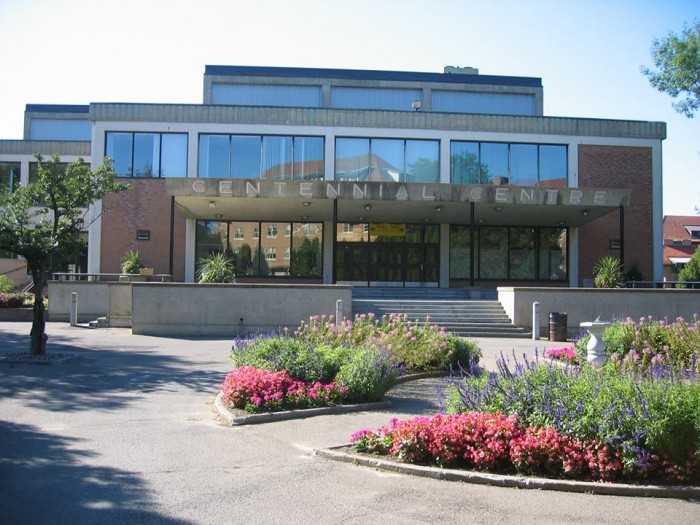
Rent for Centennial Centre at Macdonald increases under new MoA with McGill

On Feb. 4, the Macdonald Campus Students’ Society (MCSS) signed a Memorandum of Agreement (MoA) with the McGill administration, reducing the area of space in the Centennial Centre– the central student hub on campus– and increasing the student fee paid into the space. The renewed MoA will remain valid until 2020.

According to the renewed MoA, the area of space in Centennial Centre, granted to the MCSS for revenue generating activities, will be reduced from 3784 to 3043 square feet. Additionally, from 2016-2020, the MCSS will now have to pay $15.00/sq ft for the space, compared to the previous $13.00/sq ft with the rent being subjected to a $0.50 increase every year.

Originally, the McGill administration proposed a hike to $16.00/sq ft with a one-dollar increase every following year. Negotiations began early in 2015, however,  a consensus was not reached until last month. According to MCSS Vice-President (VP) Finance Nihal Mandanna C.P., MCSS could not accept the initial proposed increase.

“The negotiations dragged on so long [because] we were not going to agree with the one-dollar increase [per year],” Mandanna said. “We can’t justify that increase towards students [.…] The jump from $13 to $15 is a roughly 15 per cent increase. We didn’t feel [such a raise] on top of the one-dollar increase every single year […] is reasonable.”

Mandanna recalled that the administration’s justification for the proposed increase was that the rent for student spaces on Macdonald campus should be comparable to that of the Downtown campus. However, Mandanna raised the point that the populations of the two campuses differ greatly in size.

“[The Macdonald Campus] has a total undergraduate population of around 1,400 students, versus almost 30,000 in Downtown [campus],” Mandanna said.

The two parties eventually settled on a $0.50 annual increase.

“We managed to negotiate it down to only [a] 50 cents increase every year,” Mandanna recalled. “The good side to that is in five year’s time, we will be paying $17.50/sq ft, compared to the [originally proposed] $20.00/sq ft”

According to Mandanna, despite the rent hike, MCSS is not planning to increase its student fees for the time being.

“We are in pretty good financial standing,” he said. “So we don’t see the necessity to increase our student fees yet.”

He also pledged not to make The Ceilidh, the campus bar at Centennial Centre, a major source of profit for MCSS to cover its rent and expenses.

“I personally don’t necessarily agree with making money off alcohol, especially off your students,” he explained. “If we’re going to provide a bar, we want to provide a service—a space to hang out, a space to have a drink with friends or profs [….] At Mac, The Ceilidh is one of our only student spaces. As such, it is an essential part of Mac culture.”

According to President of MCGSS Nicolas Chatel-Launay, services provided by MCSS, such as The Ceilidh, form an integral part of graduate student life and welfare on Macdonald campus.

“The bar running well is a good thing for us [graduate students] as well,” Chatel-Launay said. “A lot of the bar staff are graduate students, and it is a tradition that the bar manager being a graduate student, usually a PhD. Also, it’s the social place here [.…] The bar is also open to staff and the department. When we have departmental seminars or parties, it’s in there, so everyone benefits.”

According to Post-Graduate Students’ Society (PGSS) Financial Officer Behrang Sharif, PGSS agreed to pay an annual fee to MCSS for members of its subsidiary organization on Macdonald Campus, the Macdonald Campus Graduate Students’ Society (MCGSS), to be able to use MCSS services.

 “We have recently negotiated and signed a [Memorandum of Agreement] with MCSS to pay $11 per MCGSS student to help fund services and clubs at Macdonald campus,” Sharif said. “This will be increased according to inflation every year.”

a, Letters to the Editor, Opinion

Letter to the editor: Tuition deregulation is a gamble at best, destructive at worst

The Tribune’s editorial, “Deregulation at McGill should not necessitate an increase in international student tuition,” is inaccurate and unrealistic in depicting what tuition deregulation would entail for students.

First, it fails to clearly differentiate between equalization and deregulation policies; it is possible to eliminate the equalization model in Quebec without deregulating tuition fees. It also does not recognize the historical context of this system, which has been central in establishing francophone post-secondary education across the province. If Quebec international tuition fees primarily benefit McGill, mobilization against future increases might also be isolated to our campus.

In an earlier Tribune article, the Students’ Society of McGill University (SSMU) Vice-President (VP) University Affairs, Chloe Rourke,  is clearly quoted as stating, “Every time tuition has been deregulated we have seen an immediate increase in tuition for international students.” While the university emphasizes the benefits of ending equalization, they are reticent to acknowledge the substantial increases made to fees in all deregulated programs, or the inevitable decrease in financial accessibility that follows. According to the Scholarships and Student Aid Office, despite increases to our financial aid program, in the  2013-2014 school yearthis covered only 25 per cent of tuition fees for international students in deregulated programs, compared to 54 per cent in regulated programs.

There is a particular risk of McGill using “market rates” to match international tuition to other Canadian or even American institutions. This follows the trend of deregulation here and at other schools, such as the University of British Columbia. If current trends continue, within a decade McGill programs deregulated in 2008 will have nearly tripled in cost. This is a reactionary process that shifts the burden of government cuts to students, rather than a real contribution towards improving the quality of education.

Thus, while it may be tempting to suggest that “McGill stands to benefit from deregulation,” it is unlikely that this scenario includes the diverse cohort of less privileged international students alluded to in the editorial. While the piece claims that international students have been more open to tuition increases, it is likely that those least opposed to hikes are also those who can already afford them.

We must be particularly wary of such assertions in our current climate, where the future plans of the administration are opaque at best. As student representatives, we are extremely concerned with both the quality and accessibility of our educational experience for a diverse student body. Significant budget cuts have severely threatened both of these values, and we are calling on the University to oppose provincial austerity measures instead of further offloading their impact on to students. Tuition increases, much like austerity, are not an economic necessity but a political choice.

Alex Kpeglo-Hennessy (U3 Honours Political Science) and Erin Sobat (U3 History) are the Arts undergraduate senators this year. They can be reached at [email protected] and [email protected]. This letter is co-signed by other members of the SSMU Senate Caucus: Benjamin Brunot (Law), Parvesh Chainani (Education), and David Benrimoh (medicine)

a, Arts & Entertainment, Music

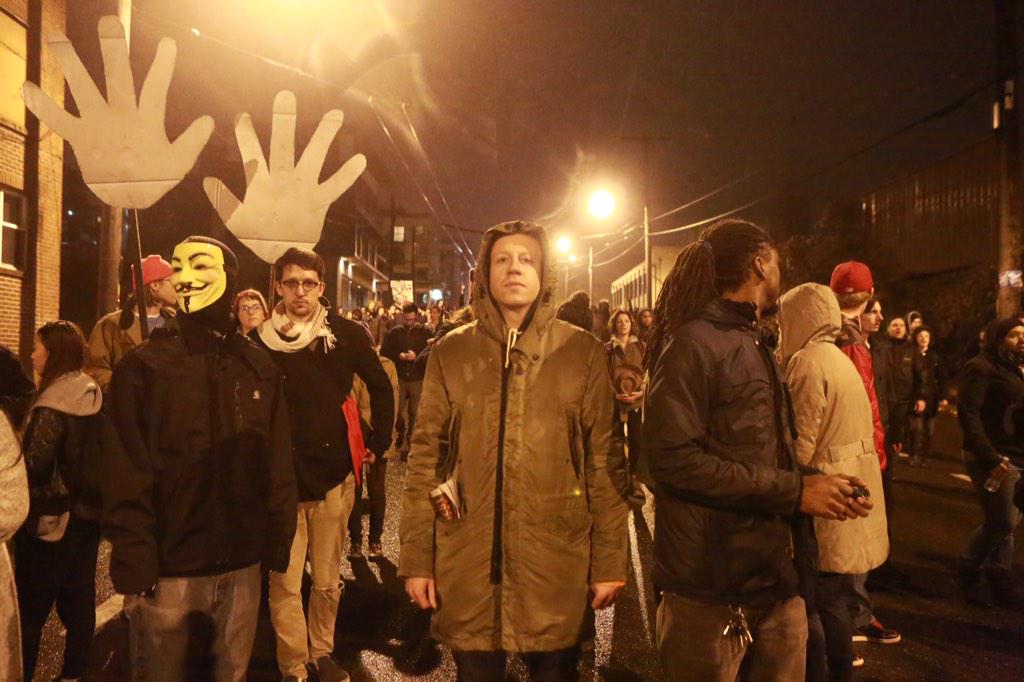
Pop Dialectic: Macklemore and the question of white privilege

Macklemore’s latest hit, “White Privilege II” gives the outspoken rapper a chance to delve into the serious issues of white privilege and appropriation in Hip Hop, but do his lyrics drive home a powerful point, or are they just an ironic display of the very privilege he’s lambasting against?

“White Privilege II” helps Macklemore properly address the real issues 

– Jasmine Lee

“White Privilege II” by Macklemore, featuring poet and singer Jamila Woods, is a song that has been a long time coming. On his solo album, /he Language of My World (2005), Macklemore debuted “White Privilege,” a song where he considers his role as a white performer in a traditionally black musical culture. He compares the appropriation of Hip Hop to other genres such as rock; calling out Elvis Presley for taking on the title “King of Rock”  based on a musical style that originates from black artists. He also questions his place in the genre as a rapper, which “started off in a block that [he’s] never been to / to counteract a struggle that [he’s] never been through.” From listening to this song, one can tell that Macklemore left the issue open-ended, as he himself doesn’t quite know the answer to the problem of white privilege.

Macklemore has also less prominently addressed white privilege in his Grammy-winning album The Heist (2012). In the last verse of the song “A Wake,” Macklemore questions what he can do (or if he can do anything at all) as a white man who sees new cases of police brutality against black people every week. His subconscious tells him, “Don’t get involved if the cause isn’t mine / so we just party like it’s 1999 / celebrate the ignorance while these kids keep dying.” A common theme of these songs is that Macklemore knows better than to choose ignorance; there has to be a way to accept the responsibility of white privilege while respecting black voices, who need to be heard the most.

The amount of time, thought, and effort that has gone into the production of ”White Privilege II” is evident when you listen to the song all the way through. On the song’s website, a brief description says, “This song is the outcome of an ongoing dialogue with musicians, activists, and teachers within our community in Seattle and beyond. Their work and engagement was essential to the creative process.” This short paragraph is followed with profiles of the many people involved in the making of the tack, plus a corporate statement regarding  Macklemore & Ryan Lewis LLC’s involvement in supporting black-led organizations. As for the song itself, Macklemore confronts the same issues that he does in “A Wake,” questioning where he stands and how he should speak (if at all) in the black activist movement. Like in the original “White Privilege,” he calls out white artists, now including Iggy Azalea and Miley Cyrus, for appropriating black culture but contributing nothing to the anti-oppression movement. He also bluntly states that his success is built on the very foundation of white supremacy, the same system that simultaneously supports police brutality and praises the appropriation of black culture. He also criticizes the people who praise his rap as “true poetry” and say that his rap is “the only hip-hop that I let my kids listen to,” as many of these people are the same people who condone systematic violence against black people saying, “If a cop pulls you over, it’s your fault if you run.”

There are numerous layers to Macklemore’s piece, and perhaps the most important message is that Macklemore is no hero or saviour. He is simply relaying the same message that has been said by numerous black activists for so many years, and so many of these activists have gone unheard. It is a nine minute polemic that was not made to be a mainstream radio hit, but for his fans to listen to and learn from. Whether or not you are a fan of Macklemore, take some time to not only listen to “White Privilege II,” but to also consider how to respectfully contribute to anti-oppression movements in America.

Macklemore flexing his white, celebrity privilege does nothing to address the real issues

– Christopher Lutes

Macklemore is at it again. The grammy-winning self-appointed poet laureate of /how we live now/ has released an 8:43 minute long opus about how he relates to the Black Lives Matter movement. In typical Macklemore fashion, it manages to be simultaneously condescending and ignorant, spending four lengthy verses rapping in a questionable cadence (he’s a white guy from Seattle, not Method Man) about his take on race relations in America; as if anybody while watching the protests across the US thought to themselves, “Hmmm, I wonder what the guy who wrote ‘Thrift Shop’ has to say about all of this.”

The track examines different facets of the movement, starting with his first person perspective at a Black Lives Matter rally. He expresses his trepidations about being there, torn between the idea that he would feel out of place at a predominately black protest versus not wanting to feel like a bystander. Beneath the bombastic, gaudy layers of production, courtesy of Ryan Lewis, and the embarrassingly lazy slant rhymes delivered by Macklemore, there’s a germ of a good idea here. Feeling unsure of whether or not to speak up on black issues as a white man is a legitimate line of questioning, but the matter is pretty much settled by his subsequent writing, recording, mastering, and releasing the song. Also, it somehow never comes up that the problem might not just be that he’s white—he’s also a celebrity. Like Sean Penn going to post-HurricaneKatrina New Orleans or John Travolta personally airlifting groceries to Haiti, Macklemore’s intentions may be good, but he must have known that his celebrity status would invariably take some of the focus away from the evening’s protest, especially when he takes the time to pose for photos.

The second verse shifts to the perspective of a hip-hop fan who chastises Macklemore for being a hypocrite by appearing to care about civil rights while basing his career on an appropriation of black culture. It’s interesting that the sole criticism Macklemore perceives hip-hop fans have of him is that he’s white, and not the fact that he’s a mediocre songwriter. The fact that he doesn’t include any nuanced self-criticism in this verse—instead, he opts to make the exact point Eminem did 14 years ago in “Without Me”—is understandable given his seeming yearn to be treated as a serious artist who raps about ‘the issues.’ But it’s frustrating that he fails to address any real gripes beyond the surface level. For instance, he never brings up that feeling the need to weigh in on every issue is also acting as part of the white power structure that he wants to rail against.

Wading deeper into the semiotic minefield, his third verse switches perspectives yet again to that of an unhip soccer mom archetype who happens to be a fan of Macklemore and a casual racist. The verse perfectly crystallizes the insidious middle-distance empathy that exists in his music, purporting to be open-minded and honest in one moment, then delivering a lazy stereotype in the next. There’s a lot of potential in talking about the complex unconscious racism that exists in some white hip-hop fans, but Macklemore instead goes after the easiest target imaginable.

The final verse comes full circle, going back to Macklemore who seems to be trying really hard to tie a nice ribbon on a complicated issue with lines that amount to “Boy, the world sure seems to have a lot of opinions, eh?” The verse is a culmination of everything wrong with the song, serving up a mountain of recycled platitudes and interpolated civil rights chants. It is delivered with Macklemore’s trademark faux-profound affectation, as if he were taking dictation from god. He’s so clearly looking for an ‘attaboy’ from the black community by continuing to lob softball criticisms at himself and repenting for being a white rapper.

Ultimately, the only thing admirable about “White Privilege II” are Macklemore’s intentions, and even those are dubious. His yearning to be taken seriously trumps any political message he’s trying to get across, and the result is a gigantic mess that almost anyone could take offense with. There are many important conversations around the modern civil rights movement that other rappers have already been having with much more first-hand knowledge and nuance. In this context, Macklemore comes off as just another white voice in a sea of white voices, making reductive, redundant arguments because he feels like he has to.

a, Basketball, Podcasts, Sports, The Sport Authority

The Sport Authority EP. 4: Recapping the NBA trade deadline

[audiotrack title=”The Sport Authority Ep. 4: Recapping the NBA trade deadline” songwriter=”Zikomo Smith and Arman Bery” date=”February 27, 2016″ width=”700″ height=”200″ src=”https://24f2041bb5b609d25f1a97039f71682cc9154421.googledrive.com/host/0B9rQxTeDv2duM0FmSjBSYkZFS1k/NBA%20trade%20deadline%20podcast%20%28final%29.mp3″ autoplay=”on”]

The NBA trade deadline last week saw little activity; teams were more conservative given next year’s salary cap increase, and most moves aimed to consolidate picks for future drafts, or to take on players that complemented teams systems.

Who were the winners and losers of the trade deadline? Was Tobias Harris a good pickup for the Detroit Pistons? Why have the Memphis Grizzlies accrued so many second round draft picks? Also on the lineup is the mystifing decision behind why Sting was chosen to play at NBA All Star Weekend. Contributor Arman Bery and Sports Editor Ziko Smith discuss these issues and more in episode four of The Sport Authority Podcast.

a, News, SSMU

SSMU Council adds referendum question on political GA motions

Amendment regarding GA motions

The Students’ Society of McGill University (SSMU) Council approved a motion for the upcoming Winter referendum on a process to prevent motions deemed as ‘divisive’ or ‘external’ to SSMU’s mandate from being discussed at the General Assembly (GA). Under the proposed amendment, the GA Steering Committeean unelected body composed of the SSMU president, vice-president (VP) (University Affairs), speaker of Council, four councillors and a thirdeExecutive member to be chosen by a vote of Councilwould decide if the content of a potential GA motion should be debated and voted on by students, unless those present at the GA vote to overturn the decision with a two-thirds majority.

Science Representative Sean Taylor felt that adding this system would be a step towards easing tensions that emerged in light of the GA on Monday, February 21 which saw the approval of a motion in support of Boycott, Divestment, and Sanctions against Israel.

“We’ve been told by the results of a survey that we put out last year […] that SSMU is being too political,” Taylor said. “I hear from my constituents that there’s just a lot of people tired of divisive things like this coming forward because they don’t think that, as a student society, we’re there to provide support for them.”

SSMU VP External Emily Boytinck raised the concern that a screening process could limit the democratic nature of the GA.

“It is absolutely unacceptable that as a representative body—or even a potential non-representative body such as the steering committee—has the choice to determine what is divisive and what isn’t,” Boytinck said. “This is extremely problematic, not only for the culture of what we consider to be divisive, but also for who gets to have their voice heard on campus.”

Mental Health Fee

Council has approved for referendum a motion to create a new restricted fee to cover certain mental health services. Citing the need for urgent action in combatting mental illness on campus and the success of previously-established student efforts in this domain, the motion proposes a $0.40 opt-outable fee for all SSMU members, and would be used for general projects and hiring mental health staff.

While Clubs and Services Representative Francois-Paul Truc agreed with the necessity of these services, he expressed concern that it was a rehash of the recently-proposed SSMU fee increase that failed in special referendum.

“I’m very disturbed that this is a direct overlap with the referendum motion that failed previously, especially considering that this mental [health] fee will go towards paying staff, and one of the primary concerns that was echoed during the referendum was that people did not want more money going to staff,” Truc said.

Engineering Representative Malcolm McClintock spoke in support of the motion, citing the individuality of the fee as an asset.

“Seeing as the students didn’t directly oppose every individual motion that was packaged together into the referendum […] putting something forward that is smaller such as this is more beneficial in that students can actually pick and choose what they do and do not want rather than saying no to the large number that they saw during the referendum,” McClintock said.

This runs concurrent to the passing of a question for referendum to raise the opt-outable SSMU Health Plan fee by $25 to cover the addition of psychology services to the plan.

Leap Manifesto

Council voted to add SSMU to the list of signatories to the Leap Manifesto, a broad set of demands decided on by a cohort of “indigenous rights, social and food justice, environmental, faith-based, and labour movements,” according to the motion.

Boytinck, a co-mover of the motion, compared this motion to the recently passed SSMU Climate Change Policy.

“[I]t’s a little toned-down because it’s made by a lot of groups,” she said.  “[Demands] are related to climate justice, indigenous rights, the just transition for workers against austerity cuts that severely damage the environment.”

Boytinck noted that the motion was largely symbolic, stating that signing the manifesto would be in solidarity with other McGill groups that have signed it, including Divest McGill and the McGill Office for Religious and Spiritual Life.

McClintock expressed concerns with the neutrality of the motion.

Unfortunately, [the Engineering Undergraduate Society is] inclined to abstain with regards to the fact that this is more of a  political statement that doesn’t represent the beliefs of the [enginering students],” McClintock said.

The motion passed with 16 in favour, one opposing, and six abstaining.

This article was corrected on March 2, the Tribune regrets any errors.

Read the latest issue

Read the latest issue