


Latest News

a, Basketball, Martlets, Sports

Basketball: Injury-riddled Martlets squeak by Stingers in overtime

Despite trouncing the Concordia Stingers (2-8) 64-49 last Thursday, the McGill Martlets (7-1) barely beat their rivals Saturday, winning 72-70 in a nail-biting overtime performance.

McGill—sporting pink uniforms in honour of Pink Weekend, where the team aims to raise money for breast cancer research—fell six points behind Concordia in the first quarter. A quick race to regain their lead before the end of the first half followed, with the scoreboard showing 26-25 for McGill at the buzzer. The rest of the game consisted of back-and-forth action between the two teams, leading to an edgy and high-fouling second half as tensions heightened; the Martlets seemed uncharacteristically uneasy as the match progressed.

“We’ve got to be more disciplined and understand what we’re looking for,” Head Coach Ryan Thorne said on the team’s shaky performance. “I think sometimes when there are pressure situations it becomes frantic, and they just run around, and are uncertain, and will give [the ball] to anybody.”

Before this weekend, the Martlets have had to get by without two of their top players: Senior point guard Dianna Ros, who is out with an ankle injury, and senior forward Marian Sylla, who only just got back onto the court after a week absence due to a leg injury.

“[Ros has] been out for a couple weeks,” said Thorne. “[Sylla] hasn’t played for a couple games either; she didn’t play last Saturday and she didn’t play Thursday. We’re just reintegrating her into the whole thing […] limiting her minutes, just making sure she gets back okay.”

Sylla spent only 18 minutes on the court, but made efficient use of her playing time, putting up 10 points. Meanwhile, junior centre and former NCAA player Alex Kiss-Rusk took control of the game, scoring 28 points for the Martlets, a game-high.

“Right now Alex is dominating, but the last two games where you see the real domination she’s playing against smaller post players,” Thorne explained. “Starting next weekend she gets in against some post players who are more her size, so we’ll be able to gauge that better once we see it.”

[URIS id=42633]

Despite recent injuries, the Martlets have maintained strong control over the top of the RSEQ, only losing once this season to UQÀM (6-2). While Sylla and Ros’ injuries have undoubtedly hurt the team’s stats the past few games, their maintained dominance over the RSEQ is good news for the team’s future.

“The good thing is we’re winning games without [Sylla and Ros], so that’s positive,” Thorne said. “I think [freshman guard] Gladys Hakizimana played a really good game today, she did a really good job offensively[….] I was happy with the overall team play.”

Quotable

“It was a great opportunity. That’s just a great cause, so for us to do something like that we wanted to make it a little special [….] The girls just loved it. It was an honour to do something like that.” — Head Coach Ryan Thorne on filming an ad in preparation for Pink Weekend.

Stat Corner

The Martlets out-rebounded the Stingers 45-16.

Play of the Game

With time winding down at the end of the fourth quarter and the scores tied, Stingers senior forward Marilyse Roy-Viau drove to the basket for a chance to win the game. Fortunately for the Martlets, her layup did not fall.

a, Arts & Entertainment, Theatre

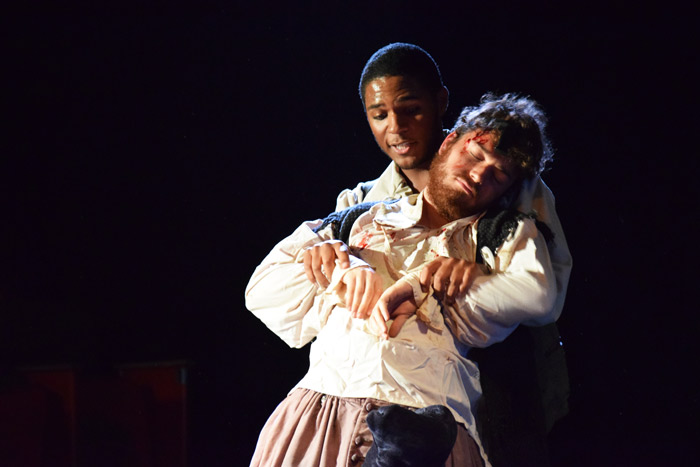
Conspiracy! is about more than just theories

History is a black box where nobody in the present can ever really know what happened in the past. Lies become truth through force of attrition, and truths are lost forever to the erosion of records. This unsteady ground is the foundation of Chocolate Moose Theatre Company’s production of Conspiracy!, a play that spins its themes of ambiguity into the realm of paranoid absurdity.

Written by Co-Director Martin Law, the play follows two siblings: The uptight, perpetually-worried Richard (Dakota Wellman), and the headstrong Jane (Alexandra Petrachuk), who has just been released from prison on a treason sentence. They end up in front of Queen Elizabeth I, who tasks them with faking the murder of famous playwright Christopher Marlowe for reasons that are never made entirely clear. What follows is a deceptively shaggy series of humourous incidents that seem designed more to pit clashing personalities against each other in comedic ways than to advance the plot. But in a fashion typical of Elizabethan theatre, multiple plotlines converge in the final act. Soon it becomes apparent that the play has been carefully laying the groundwork for several layers of revelation to occur.

[URIS id=42570]

The play seems to come to a poignant resolution about the power of creating a false historical narrative. It then completely eschews any sense of resolution, settling on a defiantly anachronistic ending that is as terrifying as it is hilarious. Just as the characters have been fooled by each other in various ways throughout the play, the biggest trick turns out to have been played on the audience.

Despite the fact that the script could have easily been 20 minutes shorter, it maintains a consistent level of energy throughout, rapidly tossing off Shakespearean wordplay and making pithy observations about the era in a way that leans on the fourth wall without pushing it over. What’s perhaps most impressive is how well it draws Christopher Marlowe (Kenny Streule)—a historical figure who has been accused of being everything from a spy to a warlock to the real author of Shakespeare’s plays—as a collection of the myths that surround him rather than settle on one simple interpretation. The result is a character who literalizes the themes of the play in a way that both creates a complex character and brings an extra level of focus to the production.

The acting is top-to-bottom fantastic with the caveat that some performances relish a little too much in their broad loudness. Every single put-on British or Scottish accent is delivered believably, with some actors playing multiple dialects, which is an anomaly in today’s Montreal theatre scene. The Bull siblings have believable chemistry and manage to keep the cast grounded amidst the boorish anarchy of Marlowe. Particular standouts in the supporting cast include Katherine Turnbull as a delightfully unhinged Scottish militant, and Harry Burton as a servile attendant to the Queen. In an inspired casting choice, almost all actors play double roles which invites a number of fun parallels that can be drawn, and contributes to the play’s general atmosphere of paranoia.

Law and Hannah Kirby (who also directed Players’ Theatre’s excellent Round Dance last year) are able to convey a lot despite their limited space and minimal set dressings. The set is very simple—a table, some chairs, and some black wooden boxes make up almost the entirety of the props. But they’re mixed into an endless number of imaginative permutations—for instance, some boxes and a lighting filter are enough to make a convincing moonlight burial scene. Scenes of bloodshed are usually preceded by the stage gradually becoming cast in red light, contributing to the play’s tone of heightened reality.

The lack of a direct tether to an objective historical truth could alienate some more traditional viewers, but the play makes the point that such a thing never existed in the first place. When Napoleon said that “history is a lie agreed upon,” this is probably not what he meant, but also, it kind of is.

a, Arts & Entertainment, Film and TV

Growing up is hard to do: Welcome to F.L.

From unrequited love to acne to peer pressure, adolescence isn’t always particularly easy-going. Geneviève Dulude-De Celles’ new documentary, Welcome to F.L., follows a group of Québécois high schoolers tasked with photographing each other to decorate the dull, grey exterior of their school. The film alternates between talking head interviews and fly-on-the-wall footage of the teenagers in their day-to-day lives, as they deal with realities of bullying, popularity, and social class imbalance. The film therefore alternates between being insightful and relatable to oftentimes tedious and redundant.

The students in Welcome to F.L. discuss what many consider to be the generic tropes of feeling invisible, wanting to fit in, and searching for identity and purpose in life. One student points out the parallels between movies and real life, since cliques in her school really do exist—there are the smokers, the jocks, the rich kids, and the not-so rich kids. The takeaway from this film is that despite the conflicting social groups, they all want to belong. This might seem like a contrived and generic conclusion to reach, but childish ramblings can reveal a truth that goes deeper than the speaker’s intentions.

“Many filmmakers portray teenagers as immoral and ignorant, with pursuits that are pretty base,” coming-of-age filmmaker John Hughes said in a 1985 interview with the Chicago Tribune. “They seem to think that teenagers aren’t very bright. But I haven't found that to be the case. I listen to kids. I respect them. Some of them are as bright as any of the adults I've met.”

Although the documentary includes many scenes that speak more directly to the human condition, the best parts were the quietest ones, where nothing is said at all. In one instance there was a boy climbing a building to find the perfect view of the sunset, in another scene he strums his guitar. Listening to such a silence means grasping the complexity that is adolescence, when one’s hopes and dreams are so much greater than one’s confidence. These quiet moments can often be the most teachable. Welcome to F.L. understands these complexities we’ve all faced at some point, as the students reveal their visions of the world with surprising introspection, humour, and candor.

The documentary also cleverly illustrates the hidden beauty that can be found within life’s everyday banalities, from laughing with a group of friends to walking home from school while smoking a cigarette. But it also treads a very fine line between beauty and tedium. A large chunk of the documentary seems to act as mere filler rather than offering an insightful commentary on the journey of growing up. The audience doesn’t really need to watch minute after minute of someone applying makeup for their prom or running around doing Parkour stunts. These filler sequences come across as substitutes for the film’s lack of more meaty and profound material.

Ultimately, however, Welcome to F.L. redeems its shortcomings with a refreshingly candid portrayal of today’s youth, as the students face relatable trials and tribulations before entering the next stage of their lives. While teen angst may seem overdone and cliché, the audience can’t help but feel a nostalgic connection to the students and the universal dilemmas they share. After all, growing up is not always easy to do.

a, Football, Sports

NFL Conference Championship Predictions

AFC: New England Patriots at Denver Broncos

Last weekend, the No. 1 seeded Denver Broncos managed to slide past a crippled Pittsburgh Steelers team missing its two best players. Rather than the dominating victory normally seen under future hall-of-fame quarterback Peyton Manning’s tenure, the game raised more questions than answers. The normally stout Denver defence allowed over 300 yards against a Ben Roethlisberger whose arm is held together with tape at this point. The Bronco’s offence looks even worse with a 39-year-old Manning whose play makes noted draft bust Blaine Gabbert look like a MVP. On the other side of the field, this is the best the Patriots offense has been in weeks. Number one receiver Julian Edelman is back and tight end Rob Gronkowski is getting healthier every week. Their running game is still an issue, but Head Coach Bill Belichick and quarterback Tom Brady have no qualms passing the ball on upwards of 50 plays per game, as shown by their victory over the Buffalo Bills in which Brady threw 59 times.

Defensively, the Patriots have the personnel to go toe to toe with the Broncos offence. Corners Malcolm Butler and Logan Ryan are both having solid seasons, the defensive line did not regress after losing Vince Wilfork and the linebacker corps is deep in talent. While they may not get the same recognition as Arizona or Seattle, the Patriots present a solid defence week in and week out. Unless Manning borrows Michael Jordan’s secret stuff from Space Jam, the Broncos offence has no chance of putting up more than 13 points. That’s just not enough against New England.

Prediction: Patriots 28 – Broncos 13

NFC: Arizona Cardinals at Carolina Panthers

The NFC Conference Championship game should be one of the most exciting football games in years. It features two high flying offenses and turnover hawking defenses. The Panther’s offence relies on quarterback Cam Newton’s ability to take over as both a runner and a passer. To win this match, Newton needs to have his best game yet. The Arizona Cardinals' defence is extremely disciplined—penalized the second least in the NFL—a result of Head Coach Bruce Arians’ meticulous game planning. Newton shouldn't be able to run or break the pocket as much against Arizona as with other teams. The Cardinals know their assignments and will rarely over-pursue during read options and roll outs, taking away a major part of the Panthers offence. Last week against the Green Bay Packers, Arizona managed to keep quarterback Aaron Rodgers in the pocket for most of the game and the team will probably adopt a similar strategy here. This puts more pressure on the receivers who need to beat the Cardinals defensive backs and get separation, something they are pretty terrible at doing considering their No. 1 receiver is a kick returner. The Cardinals play very aggressively which usually leaves every receiver single covered. The only Panthers player that may be able to get open on a consistent basis is tight end Greg Olsen, who will need to do his best Gronk impression and take over the game.

Defensively, the Panthers may meet their match against the Cardinals. This is a team built on deep passing with an elite quarterback in Carson Palmer who can make every single throw on the field. The Panthers have no one besides Josh Norman who can keep up with any of Arizona’s first five wide receivers. If Norman covers Larry Fitzgerald, that leaves Michael Floyd, John Brown, and JJ Nelson against an overmatched opposition. Expect Arizona to play a lot of five wide formations and use running back David Johnson as a pass catcher more often than as a runner. The overwhelming firepower of the Arizona offence might be too much for Carolina to handle, and will propel them to a victory. 

Prediction: Cardinals 35 – Panthers 31

Justin Trudeau
a, Opinion

An endeavour for a representative and legitimate Parliament

Canada’s electoral system is in need of a reboot. It discourages people from voting by the simple fact that a majority government may be formed without a majority of the popular vote. Andrew Coyne, columnist for The National Post, summed the system up, saying that it sustains “false and exaggerated majorities, discriminates among voters, rewards regionally divisive parties,” and wastes votes. Fortunately, Prime Minister Justin Trudeau has promised that the 2015 federal election is the last under the first-past-the-post system.

Trudeau should set aside partisanship and strategy, even if it means having less power, to prove that he is committed to Canadians’ interests and to the improvement of democracy.

Although Trudeau’s promise of electoral reform is a good measure, it is not etched in stone. Politicians’ promises often fall through once in office for one reason or another, such as a realization regarding the logistics of a policy—as is the case with the Canadian government’s response to the refugee crisis—or conflicts and delays due to political partisanship.  The fact that Trudeau won a majority government because of the flawed electoral system undoubtedly reduces his incentive to change the system. For two consecutive elections, Canadian parties have won majority governments with approximately 39 per cent of the popular vote. Since the Liberals have a majority government, one could say that more than 10 million Canadians’ votes were wasted on other parties. A system that includes greater proportional representation is needed.

If the Liberals do follow through with electoral reform, their plan to not hold a referendum on a new voting system is a good choice. Ensuring that the entire field of eligible voters is properly educated on a matter of this gravity and complexity would be a tall order. During the Ontario electoral reform referendum in 2007, 47 per cent of those polled said they knew nothing at all about the proposal, and only 12 per cent said they knew a lot. Although reform is often argued along partisan lines, reform itself should not be an ideological or partisan issue; it is simply reform for Canadians to be represented more effectively. Furthermore, Canadians who voted for the Liberals endorsed the campaign promise of all-party consultation as an alternative to holding a referendum. Any reform that is undertaken will thus be done in concert with the other parties. This plan to consult Canadians was confirmed by the Liberal House leader Dominic LeBlanc, who said that it has “always been [their] plan” and that there is no reason to think that’s been changed.

At this point, the Liberals could either sustain the current system by becoming complacent to change, implement an electoral system that could boost their dominance in Parliament, such as ranked ballots, or they could follow through with the all-party consultation. Without strong actions from the federal government to undertake electoral reform, the opposition parties, the media, and civil society must take the lead to push for reforms and monitor them closely. Rather than criticizing the Liberal party for not promising a referendum, there must be pressure to ensure that electoral reform is taken seriously by all those involved in the consultation. Voters must express their preferences to their Members of Parliament, and the debate must be vigorous beyond Parliament Hill. Media must emphasize the issue; Andrew Coyne’s column is one example of how this can be done, but other journalists and personalities must follow suit.

Electoral reform is ultimately a question of how equality will be defined in Canadian democracy. Thus, the particular machinations of the people in government, and the various power plays that may go into the reformed policy must be framed in terms of the overall goal. While the government must be held up to scrutiny, commentators, and citizens must bear in mind the ultimate objective—a system that is more representative, where all may participate fairly and equally.

a, Arts & Entertainment, Theatre

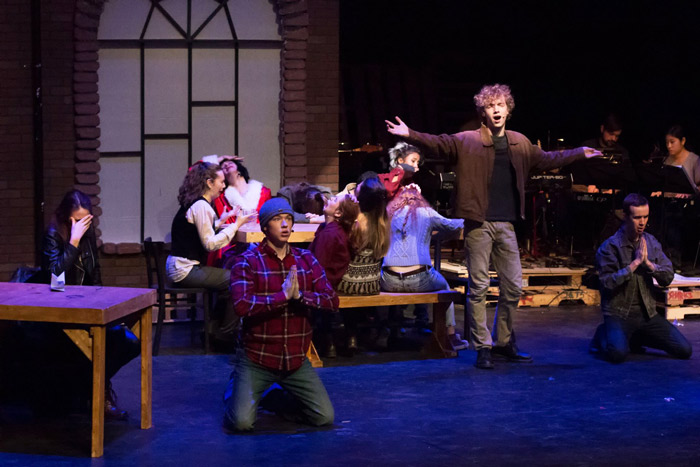
La vie Boheme: AUTS’ RENT sheds light and darkness on New York’s starving artists

Sentimental is a term that is often used in a derogatory way in criticism. Strong emotions are juxtaposed with a more savvy and self-aware, or clear-headed and objective approach to human issues. ‘Sentimental’ is a label frequently applied to musicals, and this year’s Arts Undergraduate Theatre Society (AUTS) production, RENT is no exception.  The musical is firmly rooted in the lifestyle of the bohemian New York City artists of the time, and thus tackles the effects of the AIDS epidemic, gentrification, and drug abuse. Despite these dark themes, the work is undeniably earnest: The ideal of the bohemian is romanticized, and the themes presented are to live life in the moment and not abandon your passions.

In a world where Alphabet City has been gentrified beyond recognition, the success of a show like RENT is thus grounded in the ability of the cast and director to make these themes seem real and relevant rather than trite and nostalgic. Daniel Austin-Boyd, the director of the show, did an excellent job by taking the source material in a more abstract direction. RENT is traditionally performed as a rock opera, with very few dance numbers. For RENT,  Austin-Boyd chose instead to enlist the help of experienced choreographer Debbie Friedmann. He uses a variety of dance numbers until the end of the first act, accentuating the fantastic and optimistic elements of the source material. This stands in contrast to the more tragic second act, where dance takes a back seat. Beyond the musical numbers, the show is full of stylistic flair, using silhouette and tableau in ways that punctuate the show’s themes within the show.

Friedmann’s choreography is worth special mention. The show features a diverse array of dance styles, including waacking, contemporary, tango, burlesque, and street dance.

“Every movement is thought out both conceptually and in movement,” Friedmann explained. “When you put that much thought into the choreography, [the audience] gets the idea behind it.”

It takes a moment to adjust to the elaborate dance performances, which come close to overcrowding the stage at times, but it pays off in moments like “Contact,” a raw and sexual number that concludes with the entire ensemble forming a writhing mass in the middle of the stage. Waacking and other dances that originated in black queer subcultures are used in “Today 4 U” to great effect, bringing the fantastic camp of drag shows to light.

The protagonist, Angel (Jordan Pollock), is central to the work: Their death represents the cost borne by the queer community in New York during the AIDS epidemic. Pollack holds this role down well, performing in and out of drag, showcasing both his excellent voice and an appreciation for music. Collins, Angel’s partner who is portrayed by Zachary Sykes, has a fantastic bass voice which serves as a strong anchor throughout the show. The chemistry between the two actors is not particularly steamy, but they both do an excellent job portraying their roles. A chemistry which works very well is between Mark (Olivier Bishop-Mercier) and Roger (Jack Ball), who are friends outside of the production and have a natural ease and familiarity with each other on stage. Roger’s romance with Mimi (Theodora Metechiuk) exhibits clear sexuality. Her portrayal oozes sex appeal, though there could have been more done to emphasize the weakness and fear that Mimi feels.

An especially enjoyable performance comes through in Sophie Doyle’s Maureen, a character whose reputation is built up for a long time before she takes the stage. Doyle perfectly captures the complications in the figure of the bourgeoisie bohemian: She is so passionate in what she does that she lacks self-awareness. Her performance of “Over the Moon” is over-the-top and hilarious, serving as a hint at some of the hypocrisy in bohemian communities as she takes centre stage to speak for experiences she doesn’t really understand. Overall, the casting fits the characters, and the additional members of the ensemble bring comedy as well as terrific voices to the production.

It’s impossible to talk about RENT without mentioning the music, which is superb throughout. As in previous productions at Moyse Hall, there are some issues with the wireless microphones, but the issues are relatively unobtrusive. The voices were nicely balanced, and the live band is talented. The powerful, delicate harmonies create shiver-worthy musical moments. In the end, this music seems to be the answer to the question of sentimentality, the feelings that it produces, combined with the stylistic touches, and performances makes the performance feel true.

Austin-Boyd and the cast and crew do a good job of bringing out meaning and nuance in their production of RENT. By nodding at some of the fantastical elements of the bohemian lifestyle, they make the harsh realities of it seem current. That said, this is still a very fun and enjoyable show to watch, with lots of laughs. The range of the performance makes it definitively a worthwhile production to see.

RENT will be performed in Moyse Hall from Thursday Jan. 28 to Saturday Jan. 30 at 6:45 p.m. Visit www.autsmcgill.com for ticket information.

a, Arts & Entertainment

Album Review: Each Other – Aidan Knight

Despite being home to a collection of bands such as Frog Eyes, Armchair Cynics, and Hot Hot Heat, Victoria B.C. is not particularly known for its music scene. The biggest act to arise from the eccentric city is Nelly Furtado, but she’s hardly made a dent in the music scene since 2002. Using a collection of odd instruments from his father’s second-hand shop, Aidan Knight has managed to break through the seal of Vancouver Island and emerge into the business on his own terms.

Knight’s music is like being dropped into a dream, exploring sounds you’ve never experienced yet feeling soothed by the familiarity of his voice. Knight embraces and transforms the unique culture and sound of his home into a whimsical journey on his third studio album, Each Other/ The raw, organic feel to his music transfers the ideals and characteristics of Vancouver Island to his listeners—think towering dark green forests, a lingering smell of rain, and rocky ocean beaches.

The shaky, yet soothing vocals on opening track “Each Other” lead the album through a drearily optimistic collection of eight songs. With many dips and turns throughout, his voice often seems to melt into the music on songs like “You Are Not Here” and “What Light (Never Goes Dim).” He should, however, be cautious of repetition—the beginning and endings of songs begin to melt together as the album progresses. Knight looks to Wilco’s Jeff Tweedy and Canadian legend Daniel Lanois for influence, but still captures his own original sound. All three musicians share a love for indie-rock guitar-playing, and it’s clear that Knight harnesses the same talent and maturity in his music. His lyrics are inspired by his life and observations and is never afraid to push creative boundaries.

Knight perfectly blends his resonant voice with textured layers of haunting sound, understated and subtle at times but leaving a lasting impression. A particularly spectral song, “Funeral Singers,” includes female accompanying vocals similar to that of Of Monsters and Men. Knight’s eerie and breezy melodies are perfect for a mellow Sunday morning, and in perfect B.C. fashion, with an endless drizzle of rain in the background. Commencing his UK Tour for Each Otherthis February, this may be the first time you’re hearing Aidan Knight’s name, but it won’t be the last.

Standout lyric

“Nothing’s important, at least not tonight”

Standout song

All Clear

Sounds like

Edward Sharpe and the Magnetic Zeros, Angus and Julia Stone, City and Colour, Wilco

a, Sports

10 Things: Ski Flying

  1. The 2015 FIS Ski Flying World Championships will be held from the 15th to the 17th of January, 2016 in Tauplitz/Bad Mitterndorf, Austria for the fifth time. The defending world champion is Severin Freund.
  2. The sport of ski flying is derived from ski jumping, but much greater distances can be achieved in the former. Athletes individually descend down a built takeoff ramp at high speeds and then jump from the end of it with as much power as they can physically generate and proceed to glide—’fly’—as far as they can down the steeply sloped hill and hope for a stable landing. Athletes are judged using a point system based on distance and style by five judges.
  3. One of the worst injuries in the sport’s history happened in 1999 when Slovenian Valery Kobelev crashed and landed head-first onto the hill at 65 mph, sliding unconscious down the slope. Kobelev was in a medically-induced coma for several months and was only able to return to the sport seven years later in 2006.
  4. The career of former Swiss ski jumper Walter Steiner was documented in the 1974 film, The Great Ecstasy of Woodcarver Steiner by filmmaker Werner Herzog. Streiner competed in the 1972 Winter Olympics in Sapporo, Japan and won a ski jumping silver medal in the individual large hill.
  5. For team competitions, a national team is made up of four athletes that are selected by the team’s head coach. Countries are allowed to field up to eight teams, as long as they are able to field a full team of four. Similar to individual competitions, there are two rounds, but with each round divided into four rotations in which each athlete of every team jumps once.
  6. Team competitions are a staple at ski flying events, which are contested as part of the Ski Flying World Cup, but the points earned count towards a separate Nations Cup for teams. An athlete’s individual World Cup rankings are therefore unaffected by team competitions
  7. . In Canada, the sport of ski jumping— the sister sport to ski flying and one of the original winter Olympic sports—is in desperate need of monetary support to keep the national team alive. The Canadian organization needs public support and donations to be able to field a team at the South Korean Winter Olympic Games in 2018. Ski jumping receives zero financial aid from Own the Podium (Canada’s Olympic legacy funding mechanism) or any other public sources.
  8. Peter Prevc of Slovenia ‘flew’ an unbelievable 244 metres to clinch the individual ski flying world championship title with a ski hill record in a shortened competition on Jan. 16, 2016.
  9. This January, Austrian ski flyer Lukas Mueller underwent surgery on his lower spine a few hours after a severe crash during test ski flying on the world championship hill. An equipment problem caused Mueller to fall while landing a 120-metre jump in heavy snowfall.
  10. The origins of ski flying can be traced to 1936 in Planica, Slovenia when 18-year-old Austrian Josef "Sepp" Bradl became the first man in history to land a ski jump of over 100 metres. His world record jump of 101.5 m (333 ft) took place at a new hill designed and completed in 1934 by engineers Stanko Bloudek,Ivan Rožman, and Joso Gorec and named "Bloudek’s giant.” Upon witnessing Bradl’s jumps in the triple digits, Bloudek enthusiastically stated: "That was no longer ski jumping. That was ski flying!"
a, Out on the Town, Student Life

LeCHOP event combines cooking competition with affordable prices

Kicking off its fourth year in Montreal, LeCHOP features five different restaurants in a six-week challenge lasting from Jan. 4 to Feb. 11. The executive chefs from L’Atelier d’Argentine Vieux-Port, L'Atelier d'Argentine Downtown, Decca77, Newtown, and Wienstein & Gavino’s each compete in a weekly challenge where they must create a dish using a specific ingredient, with limited time. Voting is also open to the public online, where they can select their favourite challenge dish from each week, and potentially win a free dinner for two at one of the participating restaurants. Each dish is then served as part of a special $25, three-course fixed-price menu in each of the restaurants.

The event seeks to attract customers to the participating restaurants during the winter months when businesses typically see a drop in clientele due to the frigid temperatures and consumer overspending during the holiday season. A dinner from the LeCHOP menu at L’Atelier d’Argentine Vieux-Port indeed beats away the winter blues and satisfies taste buds—all without breaking the bank.

Looming tall on a relatively quiet street in the Old Port, L’Atelier d’Argentine Vieux-Port doesn’t look particularly welcoming from the outside. Once inside, however, the atmosphere becomes inviting and cozy, owing in part to a large, modern fireplace and dim lighting. The restaurant’s vibe provides shivering Montrealers with a warm respite from the cold, and a glimpse of what a casual yet convivial meal out in Buenos Aires might resemble—a welcome escape, especially during this time of year.

“[LeCHOP] is a nice way to introduce people to our restaurant and to Argentinian cuisine as a whole […] at an affordable cost to go out to the restaurant in January,” said Jean-Bernard Forgues, Director of Operations of L’Atelier d’Argentine, .

L’Atelier d’Argentine Vieux-Port's LeCHOP menu features a selection of dishes, which seek to represent the Argentinian tastes and traditions while also incorporating seasonal ingredients.

“We wanted to give people an idea not only of what’s seasonal right now, but also of the way Argentinians treat seasonal ingredients in a traditional way,” explained Natalia Machado, Group Executive Chef of L’Atelier d’Argentine.

A creamy seafood chowder, served as an entrée, is hearty and warm—perfect for a cold January night. The addition of chorizo powder and tomato mojo adds pleasant spice to the classic southern Argentinian dish. Empanadas, a staple in many Latin American countries, are also served as an entrée, deliciously combining fontina cheese and caramelized onions to give a new spin on the common Argentinian version.

[LeCHOP] is a nice way to introduce people to our restaurant and to Argentinian cuisine as a whole […] at an affordable cost to go out to the restaurant in January.

The special ingredient from the second week’s LeCHOP challenge was scallops. Machado prepared Callos del chubut—pan-seared scallops coated with polenta and served with porcini mushroom cream and potato confit. This dish won the challenge in the second week, and proved to be delicious as a main course on the LeCHOP menu. While the scallops will no longer be available, as they will be replaced by the new week’s challenge dish, customers also can’t go wrong ordering the beef short ribs, which will be available on the menu throughout the LeCHOP event. These are served with smashed potatoes, paprika, rosemary, and garnished with the classic Argentinian chimichurri sauce.

For patrons seeking the quintessential Argentinean experience, L’Atelier d’Argentine allows those ordering from the LeCHOP menu to choose from a variety of different cuts of beef to add to their order, ensuring that carnivorous customers get their fix.

Although adding meat comes at an extra cost, it is worth the splurge.

“We try to stay true to the Argentinian way of grilling [.…]” explained Machado. “In Argentina, we grill [short ribs] and smoke them, and we cook them for long periods of time on the grill, so they have a very different texture,” explained Machado.

This week’s challenge ingredient was maple syrup, which Machado used as a glaze for trout—a fish commonly eaten in Patagonia, where Machado spent her summers as a child. “It’s embracing a very local and traditional ingredient from Canada […] and it’s very common in Argentina to do sweet-and-sour dishes, so the use of maple syrup instead of sugar or honey is something that I think is great,” said Machado.

The trout with maple syrup glaze will be served from Jan. 18 to 24. It is surely worth the visit to L’Atelier d’Argentine Vieux-Port to taste this fusion of traditions, and to experience uniquely Argentine dining right in Montreal.

(Machado's LeCHOP menu is also available at L'Atelier d'Argentine Downtown, located at 1458 Rue Crescent).

a, McGill, News, SSMU

SSMU presents a new student lounge

Renovations of the Student Lounge on the first floor of the Students’ Society of McGill University (SSMU) Building are underway, with a proposed completion by mid-semester.  

The last time the student lounge had been renovated was in the summer of 2010. According to Vice-President (VP) Clubs and Services Kimber Bialik, students can expect new couches and bean bag chairs, as well as more tables for those who like to use it as a study space. 

“The student lounge will remain fundamentally a lounge space, so students can certainly expect more in the way of couches,” Bialik said. “Designs that have been reviewed have included more table and work space.”

From November to December 2015, the status of the student lounge was unclear. Joni Williams, U2 Economics, noted that she had wanted to use the lounge, but discovered the room had been locked, then unlocked.

“I really enjoyed [spending] time in the lounge after a long class,” Williams said. “And I was a bit confused when in November and December I tried to go in, but it was closed, and then [later] reopened again.”

In November 2015, the lounge briefly closed due to a potential bed bug infestation, but was reopened when no evidence was found to back up that claim. 

“In late November, a student came to the SSMU Office and said that they believed there were bed bugs in the student lounge,” Bialik said. “SSMU immediately closed [the room] and brought in a pest control company to inspect the space for bed bugs, and after professional inspection, there were no traces of bed bugs found.” 

The SSMU lounge closed permanently for the semester after another student brought a bed bug claim to Bialik’s attention. 

“Although we already had a confirmation that there were no bedbugs following the [previous] inspection, the lounge was closed again for the duration of the exam period, simply due to the sheer number of students who were concerned that there could potentially be pests in the lounge,” Bialik said. 

 The renovations were inspired by students’ proposals to the SSMU Building Committee, which historically develops a project list and sets the priorities for SSMU without student consultation. 

“The Building Committee has a budget of roughly $40,000 annually that is restricted for space improvements within the SSMU Building,” Bialik said.

This year, she placed a hold on half of the total funds set aside for space improvements and solicited student proposals on where those funds should go— ultimately towards new furniture and carpet for the lounge. 

The new furniture includes couches, tables, and chairs, and is estimated to cost about $20,000, which is covered by the hold Bialik placed on the Building Committee’s budget for space improvements. The carpet was replaced over the winter break at a cost of $10,000.

“The [replacement of the carpeting] is being funded by SSMU’s Capital Expenditure Reserve Fund (CERF),” Bialik said.  “[This] is a restricted fund that SSMU uses for building maintenance and renovation projects to the building.” 

This week, the Building Committee will be reviewing the proposals for furniture design. After the designs and proposed expenses are approved the plans will be presented for ratification at SSMU Legislative Council.

Read the latest issue

Read the latest issue