Latest News

Joshua Hyslop
a, Arts & Entertainment

Album Review: In Deepest Blue – Joshua Hyslop

In Deepest Blue is the new album by West Coast singer-songwriter Joshua Hyslop. It follows his 2012 debut, Where the Mountain Meets the Valley, and does not stray from his well-established mellow indie folk sound. The cover art for the album is an appropriate depiction of the music within: A steel-blue watercolor painting of the shore with dark clouds on the top and few rocks at the bottom. Like the music, it is very pretty and very soothing, but also empty. In Deepest Blue presents itself as a raging swell, but in reality is more of a puddle.

The album opens with gentle plucked acoustic guitars and mandolin melody in “The Flood,” before Hyslop’s breathy vocals enter with lyrics about love and loss. Track two, “Falling,” follows the same formula, but with the addition of a haunting pedal steel guitar. Hyslop is a very technically talented singer, with light, breathy vocals reminiscent of Belle and Sebastian or Nick Drake. His vocals add gentleness and warmth to the songs, but they are also one of the albums largest flaws. Hyslop sings about complex topics, but he does not have the vocal compassion and charisma to sound convincing. This results in songs that sound shallow and clichéd instead of nuanced and heartfelt. His lyrics also rarely dive deeper into the subjects he’s singing about, and as a result, when he claims that “I’ve loved, I’ve lost,” it is hard to believe him.

Though In Deepest Blue is far from perfect, it does have many good moments: Chiefly the production, which is easily the highlight of the album. Hyslop takes advantage of a huge variety of instruments, including the banjo and organ, and blends them together to create a soothing folk sound. Also, tracks such as “Living and Dying” and “Instrumental” feature gorgeous intricately fingerpicked guitar parts that are sure to appeal to musicians and folk fans.

In Deepest Blue exhibits Hyslop’s strengths and potential as an artist, but it ultimately falls short of its target. Hyslop’s songs are pleasantly folky and easy to listen to, but they lack the passion and emotional depth that a singer-songwriter needs in order to be memorable and sing with conviction. The juxtaposition of the flat vocals with impersonal lyrics just makes Hyslop not much more than a guy at the open mic who takes himself far too seriously.

Standout Track:

“Gone”

Sounds Like:

The Tallest Man on Earth, Bon Iver, Nick Drake

Would be better if:

Hyslop put more emotion into his vocals

a, McGill, News

McGill student sued for destruction of masters thesis

On Wednesday Nov. 4, McGill alumnus Elias Gedamu M.ENG‘11 was brought to court by NeuroRx Research Inc., a research organization that images the central nervous system, where he completed research for his Masters of Engineering thesis. McGill Professor Dr. Douglas Arnold, president of NeuroRX, supervised Gedamu’s research and was the representative for NeuroRx present during trial proceedings. In a statement of claim, served on April 9, 2013, NeuroRx called for the destruction of Gedamu’s already published works, including his thesis.s

“NeuroRx […] asks this Honourable Court to issue a permanent injunction, enjoining [Gedamu] to destroy all papers, writing and publications (past, present, or future) in which he has used, uses, or will be using, directly or indirectly, any confidential data and information obtained during his employment at NeuroRx Research Inc. and/or in the context of his work and research as a student at McGill University,” the statement read.

Following a lengthy discussion outside of the courtroom, both parties came to a settlement, the details of which have not been released.


Lack of protective policies


Currently, McGill has no clear policies in place to address a student whose thesis is called upon for destruction, even though the univeristy customarily retains ownership and copyrights of theses published by its students. According to Gedamu’s lawyer, Julius Grey, this is an area that needs to be addressed at the university level.

“It is clear that some new policy must be adopted by Canadian universities to regulate in the interest of both teachers and the use of material that student uses for his or her Masters,” Grey said.

Masters of Physiology student, Ali Gariépy expressed concerns over the ability of students to legally defend themselves against professors or large companies if they were to find themselves in a similar situation.

“Masters students don’t really have the means [to defend themselves], whereas a professor has the university behind them I guess, which would make it a little difficult,” she said.


Data confidentiality


NeuroRx describes the use of confidential information and data in Gedamu’s thesis as a driving force behind their motivation for its destruction.

“That data and information are strictly confidential and belong to NeuroRx’s clients, partners, and sponsors,” the statement reads. “[It is] not meant to be revealed, published, distributed, disclosed or used without prior approval from NeuroRx and its clients, partners and sponsors.”

According to Arnold, while client consent may have been given for information to be used for clinical research purposes, no consent was given for its publication.

“The use of confidential data in research is a very sensitive topic, but an extremely important one,” Arnold said. “There are several reasons why the use and publication of confidential data require approval. One example is that the informed consent provided by patients may not have included the use of their protected personal health information for anything other than the original purpose that they consented to. Another is that that the owners of confidential data have a legitimate interest in what is done with their data, and may place contractual restrictions on redistribution of their data to third parties.”

While conducting research with NeuroRX, Gedamu received a Natural Science and Engineering Research Council of Canada (NSERC) scholarship. An agreement signed between Gedamu and NSERC stipulates the use of research results for publication as a requirement of the scholarship.

“It is the intention of the parties that the students [or] post-docs publish the results of the research activities for the purpose of the students’ [or] post-docs’ thesis, research paper, patents or, more generally, scientific literature,” the agreement reads.

Additionally, Gedamu’s statement of defence claims that NeuroRx was made aware of his intention to publish his findings prior to their publication.

“[NeuroRx]’s representative (Dr. Douglas Arnold) and [Gedamu’s] supervisors (Dr. Douglas Arnold himself and Dr. Louis Collins) were clearly aware of [Gedamu]’s intent to publish his findings and agreed with the idea, the whole appears from e-mail exchanges,” the statement read.

Gedamu has previously published three research papers from 2008, 2009, and 2010 respectively, all of which list Arnold and Collins as authors.


Employee status


A secondary area of contention in the lawsuit is the status of students as employees of the companies where their thesis research is completed. NeuroRx claims Gedamu as a former employee; Gedamu’s defence, however, states this was not the case.

“He was not an employee of [the] Plaintiff, but a graduate student sponsored by [NeuroRx] to pursue research activities pursuant to two successive NSERC Agreements between [Gedamu], [NeuroRx] and McGill,” the defence reads.

The defence additionally claimed that any contracts entered into between Gedamu and NeuroRx after the NSERC agreements had been signed, including agreements concerning confidentiality and disclosure of client information, were void as they went against the NSERC agreement.

“The non-university partner will not ask the student [or] post-doc to sign any agreement or contract without obtaining the university’s consent to such agreement,” the NSERC agreement reads. “Failing this, any other consent will be void, irrespective of the date of signature.”

a, News, SSMU

CKUT fee increase fails in SSMU referendum

The results of the 2015 Students’ Society of McGill University (SSMU) referendum were announced on Nov. 15. All referendum questions passed, with the exception of the CKUT fee increase.


The Safety Network fee


The first referendum question, which proposed the creation of a SSMU Safety Network Fee passed by 75.3 per cent. The non-opt-outable fee, which will charge students $3.97 per semester, will be used to collectively fund the services of the SSMU Safety Network: The McGill Students’ Emergency Response Team (M-SERT), DriveSafe, WalkSafe, and the Sexual Assault Centre of McGill Students’ Society (SACOMSS).

The Safety Network fee will replace the old fee structure, where M-SERT was funded by a non-opt-outable student fee of $0.50 per semester, and SACOMSS was funded by a non-opt-outable student fee of  $0.75 per undergraduate per semester. WalkSafe and DriveSafe were funded by a $0.05 and $0.25 per student per semester fee respectively, allocated to them by SSMU from the SSMU base membership fee. SSMU Vice-President (VP) Finance Zacheriah Houston spoke to the success of the referendum question.

“We’re thrilled that the safety network fee passed,” Houston said. “The passing of this fee means that [MSERT] will have guaranteed funding for the next five years, and is also more transparent to students because they know what they’re paying directly into. SACOMSS getting a fee increase is incredible because they’ll be able to pay their staff, which is something that they need to do.”

The Safety Network fee will be charged to students from Winter 2016 to Winter 2021, inclusively.


CKUT fee


In the referendum question regarding the CKUT Radio student fee, 54.7 per cent of students voted “No” to the referendum question that proposed increasing the CKUT fee for all undergraduate students regardless of faculty by $1.50.

According to the CKUT’s annual budget for 2015-2016, the radio station is currently running a deficit of $40,251. Chair of the CKUT Board of Directors Cecilia MacArthur spoke to the ramifications of the results.

“The loss has dire effects on our ability to function as a radio station,” MacArthur said. “Still, we will not be closing. As a station, we will continue discussions about new sources of fundings, including restructuring how we sell ads and fundraising in other ways.”


Plebiscite questions


The vote on the first plebiscite question, proposing that SSMU increase its focus on developing projects that alleviate the cost of commodities, like housing and food, for students, saw 79.0 per cent of students in support.

“Do you support the SSMU focusing more of its energy on developing projects to increase the financial accessibility of commodities, such as student housing and food cooperatives, for students?” the plebiscite question read.

SSMU President Kareem Ibrahim expressed his excitement about the opportunities that the results of  this plebiscite has presented.

“I’m definitely excited to see that students would want to see SSMU having a more active role in not only student-run co-ops but also in just making things more accessible to them financially,” Ibrahim said. “There is this student housing that we’re interested in exploring, also making the Nest and the [Student Run Cafe] a bit more student-run, it’s something I think would be of interest to students, and something we could invest more time in.”

In regards to the second plebiscite question, 56.9 per cent of students voted “Yes” to part one, which proposed the creation of a new yearbook fee to fund Old McGill, McGill’s yearbook. For part two of the plebiscite question, 76.6 per cent of students voted “Yes” for which stated that this fee would be non-opt-outable.

a, Student Life

Med students revolutionize the search for samosas

A stranger to McGill University would be surprised to witness a disproportionately high number of students walking around with samosas in their hands. Samosas have become a staple fundraiser food for student clubs and a key part of the average McGill student’s daily diet. Feeling particularly devoted to the samosa but frustrated by not being able to locate them on campus, Tyler Safran, now a second-year student in the Faculty of Medicine, created the Samosa Search Facebook group in January 2015. What started as an inside joke has since accumulated a campus-wide following. 

Long before creation of any Samosa-related social media, there was no way for McGill students to seek out a nearby samosa sale without wandering from building to building. Locating a samosa was left entirely to luck and class location. Safran created the Samosa Search group as a way to track and advertise samosa sales in the McIntyre Medical Building, where, as a medicine student, he took all of his classes. Initially, the group only included the members of Safran’s program, until one day in March of 2015, it began to grow inexplicably. The group currently has 1531 members, with students confirming samosa sales every day. Safran has even expanded his team to include “Vice-President of Quality,” Kapil Sareen-Khanna, a second year student in the Faculty of Medicine.

The group is far from the only one facilitating samosa sales on campus. "Samosa Sales,” another Facebook group, was created before Samosa Search: the two are now considered in competition. Samosa Sales is a group that serves a similar purpose, providing a venue for clubs to advertise their samosa fundraisers and for students to post inquiries for nearby sales. However, Safran felt that this group was not nearly as effective at advertising and locating sales, thus motivating the creation of Samosa Search. 

“Samosa Sales was a dead group,” Safran said. “Once in a while someone would post when they were desperate [….] It was kind of ridiculous, because no one ever knew where the samosas were.” 

Other loyal members of Samosa Search echoed Safran’s sentiments of distaste toward the Samosa Sales page. 

“My initial thoughts were that it was rather unnecessary to have two groups, but that has definitely changed,” Sierra Skoropada, U4 Psychology student, said. “You don’t have to scroll down looking for people who posted about sales in different locations. On Samosa Search, the ‘confirmations’ of the day are all laid out in a single post to make filling your belly quick and easy.”

'We were just finishing our sale, [and had] maybe 30 samosas left, and I posted in the group that we were almost out, and people came running out of McIntyre 522 to buy samosas from us. It was crazy […]'


The loyalty and passion that all Samosa Search members have for samosas also helps garner more attention for clubs aiming to promote their sales.

“[Safran’s] group has a lot of hype, so it’s really easy to ride the popularity wave with it,” Frank Battaglia, U2 Physiology student and charity director of the Physiology Undergraduate League of Students (PULS), said. “The other group just lacks the flair that [Safran] brings.”

Safran has also hypothesized that the popularity of the Facebook group, and the excitement it has built around samosa sales has increased their quantity and frequency of occurrence around campus.

“I actually think there are more samosa sales on campus now,” Safran said. “I think that once we started a group where we see samosa sales all the time, there are days where [there are] five or six sales, and that was never the case [prior to Samosa Search].”

In addition to increasing the prevalence of samosa sales on campus, there is also evidence toward the ability of Samosa Search to increasing the speed with which clubs sell out. Most student club executives interviewed agreed that their sellout times were increased after posting in the Samosa Search page. 

“I’ve seen first-hand that [Safran’s] group is actually making a difference in sales,” Battaglia said. “I remember we were just finishing our sale, [and had] maybe 30 samosas left, and I posted in that group that we were almost out, and people came running out of McIntyre 522 to buy samosas from us. It was crazy—[there was an] instant response.” 

In addition to the user-friendly layout of Samosa Search, with Safran’s daily listings of locations of samosa sales across campus, the group has become a community for everyone in it. Though it is a closed group, Safran believes this actually makes it more inclusive, and builds a community of students who are dedicated to their mutual love of samosas.

"You just really immerse yourself in something," Safran said. "It’s the fact that we’re so active in our posting and the fact that we’ve put […] a community together [that makes Samosa Search unique].

The love that McGill students share for Samosas is undeniably unconventional; their formidable presence on campus can be difficult to understand for non-McGill students. But to Samosa Search leaders, the reasoning behind McGill’s obsession for samosas is simple.

“It’s a filling food, it’s very cheap, and it’s delicious,” Sareen-Khanna said. “[You can] buy a meal for six, seven dollars plus tax at the caf […] or you can get, for two dollars, three samosas. I just think people will pick that over [other food options].”

While making this food more accessible to its members, another key element of the Samosa Search group is the humour that Safran and Sareen-Khanna bring to it. With each of Safran’s daily confirmations comes new phrases, such as “mose”—a nickname for Samosa coined by Safran, as well as puns and longer jokes and stories. 

“I just follow to laugh at [Safran’s] nonsense and to watch the masses at McGill slowly join the bandwagon,” said Matthew Dankner, first-year student in the Faculty of Medicine and a member of the Facebook group.  

Other members of the group expressed similar feelings, putting higher value on the comedic value of the group than on the convenience of Samosa postings.

“Sometimes I go on it just because it’s funny,” Jeannie Richardson, U2 Psychology and Latin American Studies, said. “[My favourite part of the page is] definitely the humour. I love how there’s lingo, like [the word] “mose,” and how seriously people take it.”

The speed with which Safran posts his daily confirmations makes it a sustainable responsibility that he cannot see himself parting with any time in the near future, even with the changing schedule and intensities of the medical program. 

“Starting in January, we’re probably never going to be back on campus, so I’ll be confirming samosas from the hospital,” Safran said. “A year from now, we might not be on campus every day, but [nothing would make me happier than] after a long day at the hospital, [looking] at my phone, and [seeing] people […] still writing, ‘Man, great samosa.’”

a, Features

Food, Facts, & Fiction

Waiting patiently on the centre of a table sits a large bowl of homemade gravy, the warm smell of turkey-stuffing wafts through the room, and hot steam rises from the garlic mashed potatoes; it’s Thanksgiving. It is a perfect time to give thanks for what everyone truly loves—food. Dinner is not for one but for four: A vegetarian, a self-prescribed gluten-free, a paleo diet follower, and a vegan. Looks like turkey stuffing is off the menu; the only thing that can be eaten by all are the Brussels sprouts—no salt, no butter, baked not fried.

This phenomenon is quite common, especially in university settings like McGill. Food is an obsession, infecting all forms of media: Popular fitness magazines, diet blogs, and food Instagrams inform people of all things related to diet and nutrition. No longer are parents the only ones shoving nutritional guidelines down their children’s throats—university students are more concerned with what they consume than any generation before. Who can blame them? They grew up in a world where over 60 per cent of adults are classified as overweight or obese.  From juice to chocolate cleanses, it seems every type of food can make or break a diet. 

Everyone seems to have varying answers what diet to adopt. For example, Dr. Loren Cordain, a global leading expert on paleolithic diets and founder of the paleolithic movement, believes that the culprits of our obesity epidemics and health problems are whole grains, dairy, and processed foods. Over the past two years, the ‘paleo diet’ has become part of the most Googled nutritional regime, with celebrities everywhere endorsing it. From Matthew McConaughey to Miley Cyrus, superstars and students alike have all got a taste of this new diet fad. The paleo diet makes claims of significantly decreasing cardiovascular risk factors, aiding weightloss, and promoting a whole host of other health benefits by advocating for the eating habits of early hunter-gatherers. Food processes developed later in evolutionary history such as grain and dairy products, salts, sugars, and processed foods. Concurrently, Cordain promotes foods such as grass-fed meat, eggs, fruits, and vegetables. Under such restrictive regimes, it’s hard to believe this caveman craze could be the answer to society’s nutritional woes.

The co-founder of the McGill chapter of Spoon University—a digital food publication for university students—Liza Levitis, U2 Cognitive Science student, decided to try out the paleo diet after reading about it online prior to entering university, by following recipes and advice from various internet sources. 

“Though I adhered to a pretty strict paleo diet for the entirety of a summer, I found that it was more difficult to maintain in university,” Levitis said. “Everyone reacts to the [diet] differently, and I decided to re-introduce grains little by little to see how I’d react.” 

As a science student, Levitis is critical 

a, Science & Technology

Give the flu shot a shot


Vaccinations are very much in the public consciousness right now as a small, but vocal, section of people make this medical issue into a political one. They claim regular vaccinations lead to adverse health effects such as autism and rare muscular disorders. Although the flu shot is now in their sights, these ‘anti-vaxxers’ have historically focused on the measles, mumps, and rubella (MMR) vaccine, as well as other early childhood vaccinations.

The paper that the anti-vaxxers’ claims are almost entirely based on has been conclusively proven fraudulent. To this day, however, the fear of vaccines has remained, explains Associate Professor in the McGill Faculty of Medicine and Medical Director of the MUHC Vaccine Study Centre Caroline Quach.

“It was fraudulent research that led to wrong conclusions,” said Quach. “The problem is that some people kept on saying ‘yes, my children had the vaccine and then developed symptoms of autism.’ And because these people mainly were stars, they had a lot of media attention.”

The science behind the influenza shot is fascinating and underreported. Every year, scientists at the World Health Organization (WHO) race against the clock to predict the strains will likely be circulating in time to prepare that season’s vaccine. It is an inexact method mostly based on observing the strains in circulation in the southern hemisphere, where winter is offset by six months—about how long each batch of vaccine takes to prepare, cultivating the virus in an egg-based cell layer. Even still, the predictions are often wrong, as the epidemiology is chaotic, and mutations rapid and unpredictable.

“I think the main problem with the flu vaccine is that it doesn’t work that well,” stated Quach. “Some years the vaccine effectiveness is going to be zero and other years it’s going to be 50 per cent. Like last year, it did not work. There’s no doubt about it. The efficacy–the effectiveness–was zero.”

Today, there is a widespread problem with people not getting their yearly flu shots. But the biggest issues making people forgo the vaccine aren’t ignorance or fear. The vast majority of those who should get the shot, but don’t, do so for reasons of accessibility or apathy.

“20 per cent of parents of previous years have said that if [the MUHC’s vaccination program] hadn’t been there they wouldn’t have gotten the flu shot for their kid,” explained Quach. “Accessibility is really playing a huge role [….] If it’s an extra hassle, they’re not going to do it.”

Most surprisingly of all, though, is the rampant apathy going on among those with the most access of anyone—healthcare workers. And when first-line workers don’t get vaccinated, they’re not only endangering themselves, but also their patients.

“As healthcare professionals, it is our responsibility to get vaccinated,” stated Quach. “We know that people come into work anyway even when they’re sick, not because they want to contaminate their patients but because they feel the pressure that they would put on their colleagues if they would not come in. We’re already so stretched, if I have to stay home every time I have a sniffle, this hospital would not work.”

This mentality can be dangerous for patients with weaker immune systems, such as children and the elderly, who, if infected, are likelier to develop more severe symptoms like pneumonia.

Healthcare workers at MUHC and elsewhere can get the flu shot at work, and others in Montreal who want the shot but can’t spare the time should look into Occupational Health & Safety mobile clinics. McGill Students are eligible for the vaccination through the Student Health Service at the Brown Building on McTavish Street.

a, Off the Board, Opinion

Michael Angelakos’ coming out and sensationalism in media

During a recent podcast interview, Michael Angelakos—lead singer of Passion Pit—discussed his sexuality, stating that “I like girls, I like boys, everyone’s fantastic; but you know what? I’m gay. Finally.” The interview revolved around a number of other highly personal topics: His anxiety, bipolar disorder, history of suicide attempts, and his emotional breakdowns—all of which he has been very upfront about over the course of his career. Given his transparency with his mental health issues, Angelakos’ decision to finally and officially ‘come out’ speaks to something larger and more overarching: The sensationalized and socially constructed practice of ‘coming out’ itself.

After the interview was published, publications such as Complex, CBS, and Entertainment Weekly were quick to jump on this one particular snippet of the conversation, glorifying his sexuality as the sole topic that was discussed. Despite developments in social consciousness of identity issues, such as, but not limited to, sexuality, ‘being gay’ is still a headline-maker. Thus, both ‘coming out’ and one’s sexuality—if it’s not straight—is based on divergence from a socially determined norm. Put simply, he did not have to come out as straight; where heterosexuality is assumed, homosexuality is announced. Nevertheless, the ‘less-is-more’ approach he took with discussing his sexuality is a hopeful indication of future progress. “Being as honest and transparent as you can be is actually really really empowering. Because finally you are, you know, it shows that you have guts,” he said in his contribution to the Bring Change 2 Mind campaign.

Put simply, he did not have to come out as straight; where heterosexuality is assumed, homosexuality is announced.

The concept of ‘coming out’ is rooted in categories, labels, and division. In contrast, heterosexuality is linked to the social status quo: It’s easy and ordinary. Moreover, it is also often unintentionally perpetuated and presumed through heteronormative assumption. His sexual confusion was easier to ignore than face: “When you are teetering on the edge of heterosexuality and homosexuality or whatever, and you don’t know what’s going on, it’s so much more comfortable to just keep going back to what you know,” he said in the interview.

There have recently been many methods of coming out; for instance, actress Ellen Page made a public announcement on stage to a large audience, and Olympic diver Tom Daley published a YouTube video to announce that his partner is the same sex—both of which are important in their own way in making a statement. By casually bringing up his sexual desire for men as part of the larger conversation about his relationship with his ex-wife, the media, and his bipolar disorder, it is much more aligned with the more modern notion that sexuality doesn’t define, and thus shouldn’t be defining.

The media’s reaction to his disorder was also sensationalized: Pitchfork wrote an extended article entitled “Inside the Brilliant and Troubled Mind of Passion Pit”—which, while shedding light on his struggles, also inherently enforced and sensationalised his fight with his bipolar disorder. In his experience, recovery was contingent on a diagnosis. Despite improvements in destigmatizing previously taboo topics, such as mental health, acceptance of the implications of these topics on the individual remains in short supply. When the band cancelled its shows in 2012 in order for Angelakos to receive treatment, they received huge backlash from fans and critics. The negative response from his fans when he went ‘public’ about his bipolar disorder was a factor in why he remained silent about his sexuality for longer.

While the understanding of sexuality has transformed over time from stigma to the intersection of sexuality with other aspects of identity, such as race, gender, and class issues, this transformation remains incomplete. There is an inherent irony to the process of coming out: even though the topic was broached subtly in this case, it was quickly sensationalized by the media.

There is the argument that coming out is necessary to raise awareness and shed light on the normality of ‘being gay.’ But there is also the flipside: That coming out is an inherently socially-constructed convention. Angelakos’ experience, while not representative, is a reminder of the media’s participation in the perpetuation of heteronormative social constructs.


Jack Neal is an Arts & Entertainment editor at the McGill Tribune.


a, Know Your Athlete, Sports

Know Your Athlete: Nicolas Khandar

Nicolas Khandar, an explosive sophomore running back for the Redmen football team, is a surprising and adaptable man. A Frenchman born and raised, Khandar embraced football after moving away from the Parisian suburbs of his childhood to study in Canada. He later represented the French National Football Team in the IFAF World Championships. Khandar’s passion for football is at the heart of his journey.

“In France, American football is not a big [thing],” Khandar explained. “But [at 13,] my best friend told me—‘Oh you know American football, maybe we have to try it.’ And one day we went to the team near to our houses. It was good.”

Khandar is part of the sport’s growing popularity in France—the Federation Francaise de Football Americain boasts 208 teams and 21,085 players today in comparison with only nine teams back in 1983.

“I like a lot of aspects [of] the sport,” Khandar said. “I like the contact; I like the speed, the American culture.”

Khandar took to football quickly and joined the age group ranks of the French National Team in 2010. He was part of the fourth-place French National Team in last summer’s World Championships in Madrid. The squad blew away the competition—Khandar had two touchdowns in a 53-3 quarterfinal drubbing of Australia—before running into the powerhouse U.S.A. team. in the semifinals. Khandar had the opportunity to play under Head Coach Patrick Esume, who had previous experience as a coaching consultant with various NFL teams, including the Oakland Raiders.

“I have played with the French National Team for, maybe five years,” Khandar said, “I am a little bit nationalistic. [This summer] was a very good experience because I know a lot of the guys in the team. It was a new coaching staff, but it was a good experience.”

Khandar’s French connection got him recruited to the Cégep de Thetford, where he excelled on the football field. He recorded 1,374 yards on 9.5 yards per carry, and scored 12 touchdowns in his sole year at Thetford.

“The [coach] in Thetford, he is a French guy,” Khandar explained. “So he always watches French players, and one day he contacted me and asked me if I wanted to try in Canada, and I went.”

And, even though powerhouse programs like Laval recruited Khandar, his best friend encouraged him to come to McGill—just as he swayed his decision to play football in the first place.

“[I came] because my best friend came to McGill too, and during my visit to McGill, I really appreciated the coach, he was so cool,” Khandar said. “I [also] really liked the academic aspect.”

Khandar had a promising, but injury-riddled, sophomore campaign for McGill. He had a mid-season concussion and was on crutches after McGill’s homecoming matchup with Concordia. Khandar’s game, however, is studded with an array of jukes and excellent acceleration. His best game of the season came against Acadia where he went off for 155 yards and a touchdown on only eight carries.

For now, Khandar will continue studying for his Certificate of English Proficiency, though he hopes to transfer into the school of Dietetics and Human Nutrition. The question remains if he will he stay in Montreal after graduating. For someone used to being flexible and moving across cities, he is unsurprisingly ambivalent.

“If I find work in Montreal after school, maybe I will stay,” Khandar says.


McGill Tribune (MT): Who is your favourite superhero?

Nicolas Khandar (NK): Batman. He doesn’t have a superpower, but I think he can beat every villain because he is so smart and has all the gadgets.


MT: Do you prefer French or American rap?

NK: French.


MT: Which street do you prefer, Saint-Catherine or Saint-Laurent?

NK: Saint-Catherine. I like the shops, I often go shopping.


MT: What’s your favourite NFL team?

NK: Pittsburgh Steelers.


MT: Who will win the Super Bowl?

NK: Denver Broncos or Pittsburgh Steelers.

a, Science & Technology

Making it through final exams: ‘Stressing-out’ can make or break you

A sense of urgency begins to loom on campus as finals approach. Libraries get more crowded, lines at Tim Hortons get longer, and all-nighters become more frequent. With all the pressure to do well, finals tends to generate a great deal of stress among students. But what exactly is stress? 

According to the National Institute of Mental Health, the mere mention of the word stress can cause stress. The Mayo Clinic defines it as “a psychological and physical reaction to the ever-increasing demands of life.” These demands could be small, like finding a new route to class, or drastic, like moving to a new city, getting a new job, or attending a new school. 

As a general principle, the human body likes to maintain a relatively stable internal environment, known as homeostasis. External changes can lead to a physiological response that disturb the body’s homeostasis. This is felt as stress. 

In the past, stress caused by external stimuli served to protect humans from potential threats like predators. Nowadays, despite the emergence of different stimuli and demands from life, the body’s physiological response, or stress mechanism, has remained the same. Also known as the “flight or fight response,” this stress mechanism is controlled by the sympathetic nervous system. 

Whenever the brain senses a threat (stressor) the sympathetic nervous system is activated. A few complex reactions later, the hormone epinephrine is released by the adrenal glands. Epinephrine results in higher pulse rate, increased blood pressure, and rapid breathing. The person experiencing these becomes more alert and all the senses become sharp. As epinephrine’s effects begin to subside, the secondary component of the stress response is activated. Known as the HPA axis, it uses a series of hormonal signals to keep the sympathetic nervous system repressed.

Normally, this benefits the individual by mounting an appropriate response to the stressor. Once the threat is terminated, the body returns to normal through the workings of the parasympathetic nervous system. Problems begin to emerge, however, when a person is constantly bombarded by stressors for a long period of time resulting in chronic stress.

“Persistent epinephrine surges can damage blood vessels and arteries, increasing blood pressure and raising risk of heart attacks and strokes,” a report by Harvard Health Publications reads.

Students during finals are very susceptible to periods of chronic stress. They often put in huge amounts of work and time into their studies. Small doses of stress can be beneficial because increased alertness and sharper senses can make students work at higher levels. Constant stress, however, can be quite harmful. 

The Mayo Clinic reports on its website that overactivation of the stress pathway leads to headaches, muscle tension, fatigue, sleep problems, anxiety, lack of motivation, and depression reports.

These symptoms, if experienced during finals, or any other time of the year, are detrimental to the student. Unfortunately, stress is an integral part of a college student’s life. But it is the way a student responds to the stress that is important. 

A 2008 Associated Press and mtvU survey of college students found that 80 per cent of college students say they frequently or sometimes experience stress. To cope with this stress, a student can rely on family, friends, and the services provided by their respective university. McGill, for example, provides special therapy sessions with kittens and dogs to relieve some stress. Qualified counsellors are also available to provide support.

The world is filled with constant stressors. Stress-management, therefore, is a serious subject that individuals should work on to ensure a healthy future.

a, Editorial, Opinion

Editorial: Unmoderated online culture has become unsustainable in SSMU elections

Candidates for any elected position may anticipate mudslinging, as it is part and parcel of any campaigning process; however, harassment to the point of dropping out is unacceptable, especially at the student level. This harassment does not necessarily take place between campaign teams—it plays out in online forums where anyone, regardless of whether they are members of the Students’ Society of McGill University (SSMU) or not, may engage in criticism and personal attacks. 

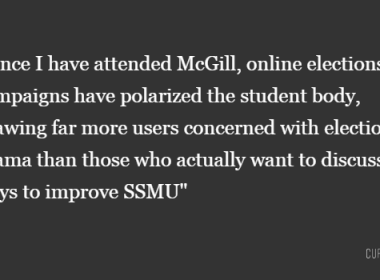
SSMU elections have reached a breaking point. It is no longer sustainable for candidates to take part in or be subject to such an intensely negative online culture. While increasing student interest in the short term, online turmoil only serves to further alienate the student body in the long run. Currently, Elections SSMU, which has some control over the candidates insofar as the bylaws mandate, is not equipped to handle the challenges of such a culture; thus, the incentives for both candidates and the electorate who participates in these tactics must be adjusted in order to discourage a negative electoral culture.

The judicial board and Elections SSMU are institutions that ought to protect or sanction candidates when necessary. But the proliferation of a negative online community full of false accounts, personal attacks, and baseless accusations exposes the weaknesses of these channels. Anyone, whether or not they are members of SSMU, may post allegations, complaints, and criticisms related to the candidates. This takes the decision to punish a candidate beyond official channels—when the vote can be influenced by untrue claims, the fairness of an election is reduced. 

For an electorate that vocally laments the lack of representation in SSMU, the engagement in negative commentary perpetuates that cycle itself.

To ensure that accusations are formally investigated, candidates must direct any allegation to Elections SSMU. Anonymity protects those who incite negative commentary from repercussions; candidates become open targets for online harassment. SSMU may not feel the immediate consequences of online polemics, but the impact will quickly manifest itself. The pool of candidates has already been small in recent elections—three out of six executive positions were uncontested in the Winter 2015 election, and there were initially no candidates at all for the VP External position. For an electorate that vocally laments the lack of representation in SSMU, the engagement in negative commentary perpetuates that cycle itself.

Part of the issue is the platform on which campaigns take place. Although Facebook is an inherently personal platform, the shift cannot be blamed on the internet by itself—personal attacks can occur through any medium. Criticism is necessary to encourage a healthy debate and analysis of the viability of candidates, but the balance between reasonable and unreasonable scrutiny has tipped towards the latter. Regardless of whether an allegation is true or not, or what Elections SSMU or the judicial board decides, it is allowed to fester online to limited consequence­—only candidates themselves can be held accountable to byalws. Freedom of expression thus comes into conflict with the fairness of an election.

Although the problem resides in the attitudes of a select few who perpetuate online negativity, Elections SSMU may provide the impetus for change. Currently, it acts when issues are brought forward, and even then its enforcement of these guidelines is inconsistent. Instead, it should set strict, unambiguous rules to which all candidates must adhere during any campaign. Such rules may entail a strict penalty to those who engage negative commentators, making the de-escalation of conflict a priority. It may also establish a positive incentive system whereby campaigns that have a positive online setting—defined by active discussion and criticism without crossing the line to harassment—are rewarded. This will not eliminate the problem, but it may help to mitigate the consequences.

Personality is inevitably a factor at play in SSMU elections, as candidates are individuals rather than partisan. But some members of the McGill community have lost a sense for what is legitimate criticism and inquiry and inexcusable personal attacks—the latter can cause lasting negative impacts on the individuals targeted. While the stakes of student government are certainly high—given that the position is paid and entails extensive responsibilities—a line must be entrenched to protect future candidates and the sustainability of student elections themselves. Candidates must be able to present themselves as peers; they cannot be dehumanized.

Read the latest issue

Read the latest issue