Latest News

a, Campus Spotlight, Student Life

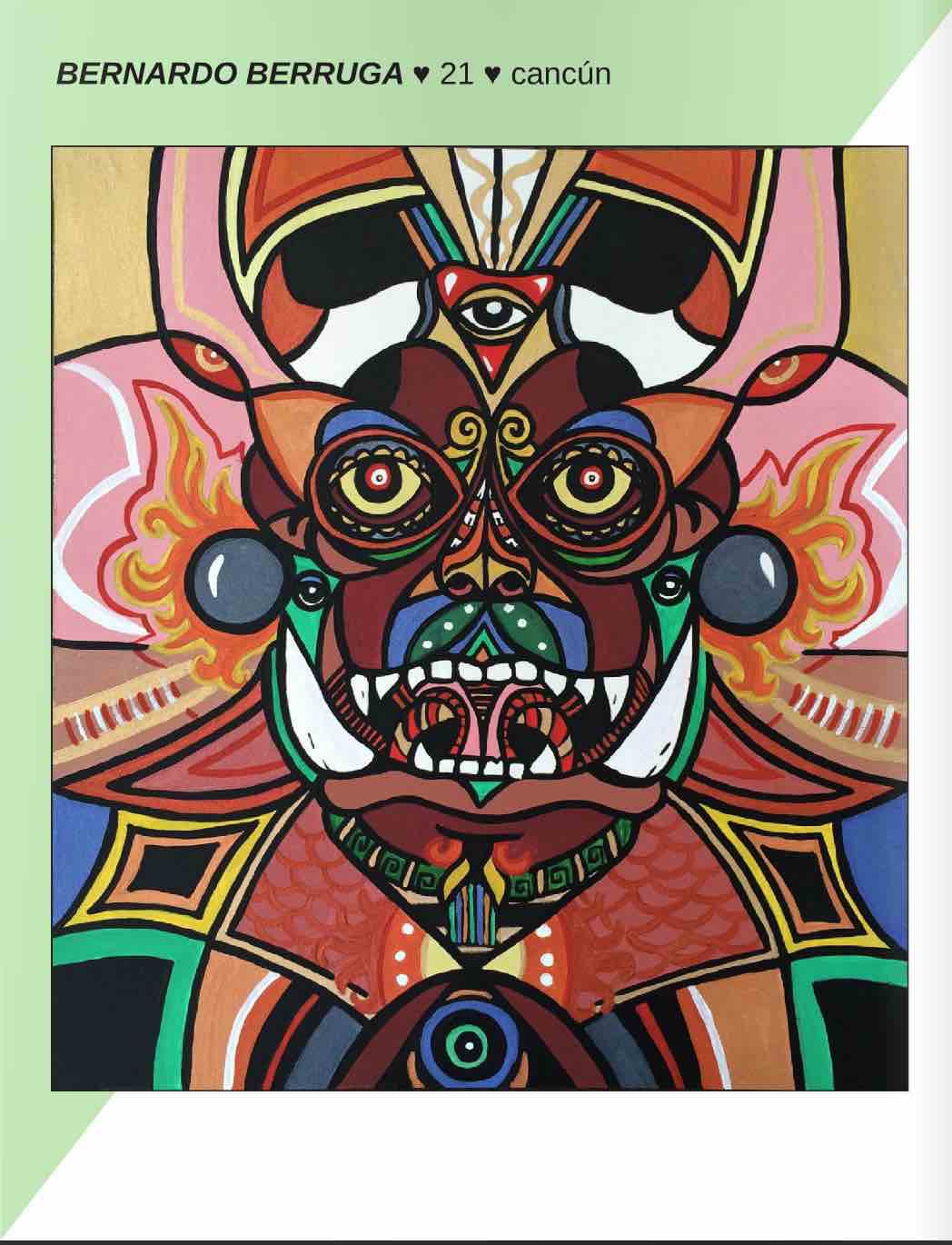
Campus spotlight: Formerly Known As Magazine

Montreal, commonly referred to as the cultural capital of Canada, has a thriving art scene. However, the community can feel inaccessible to anyone without an art background. In the fall of 2013, Natalie Della Valle, Julian Trompeter, and Emma Gaudio, a group of McGill students, came together to address their mutual feeling that discussion of art in Montreal was often too serious to be enjoyable for the wider public. What came about as a result was the creation of their own art magazine, Formerly Known As (FKA), which seeks to free the conversation around art, and invite more people into the art world. 

“There are a lot of art magazines that approach very serious work, but they approach it very formally,” Della Valle, U3 Anthropology, explained.  “We’re trying to have […] enjoyable conversations about serious work, and not take ourselves too seriously while doing it.”

Trompeter, Della Valle, and Gaudio, who were friends before they were co-founders, discussed the idea in passing for a long time before finally taking action.  

“People didn’t believe we were actually going to do this,” Gaudio, U3 History, recalled. “We spent so long trying to figure out a name, and then we had to change that name, and it became this thing that went on for so long that when we finally had an issue people were like ‘Wait, this is actually a legitimate publication.’” 

With regards to magazine content, the founders stated they want to keep their limits as broad as possible.

“One of the great things about FKA is that it’s very diverse,” Della Valle said. “We feature writing, industrial design, fashion design, film photography, painting, sculpture, performance art, stills from pieces. It’s really anything.” 

“As long as it can be printed and communicated clearly what it is, it could end up in the magazine,” Trompeter, U3 Cultural Studies, said. “The more [diversity] the better […]”

FKA also aims to make their magazine accessible to artists and readers beyond the McGill bubble. When FKA first came together, the founders took an alternate route from most student-led groups, and decided against confining their readership and contributor network to McGill students. 

“Half the artists we feature aren’t students anymore,” Della Valle added. “We have a lot of [contributors] who graduated a few years ago, who are already starting to make names for themselves.”

Since its first issue in 2014, FKA has grown immensely, and the founders are currently in the process of working on their fourth issue. 

“The publication has gotten bigger, [and] not only in terms of the number of artists we feature,” Gaudio said. “We have a lot more people involved. Before it was just the [initial] four of us, then the three of us [that are founders now]. Now there are 14 [members], so we have people who help us […] it’s really awesome that people want to get involved because they see that we’re doing something different.”

The three founders each have unique past experiences with art that led them to starting the magazine together. Trompeter, whose parents are both artists, grew up exposed to art.

“I always wanted to do something artistic,” Trompeter said. “I used to really want to be a graphic designer—that’s where I got my skillset for Adobe CreativeSuite, since I had been doing it from a very young age. I’m very lucky to have been taught that [….] When I heard Natalie and Levi and Emma were getting involved in an art magazine, I knew it was a situation where my skills could be put to the task.” 

Della Valle was also raised in an environment where she was immersed in art. 

“I grew up in this weird small town in New Hampshire that was really strangely connected to the art world,” Della Valle said. “The oldest art colony in the [United States] is right down the road from my house [….The artist colony] started sending all of these really famous artists and journalists to give lectures at my public high school.”

Gaudio, on the other hand, didn’t always have an interest in art, which was what drew her to the magazine in the first place. 

“In first year, when we talked about it, I was always like ‘Art’s stupid, I hate art,’” Gaudio said. “When I [said] art, I really [meant] this stiff, stuffy, male-dominated, prestigious thing. And that’s why I wanted to be involved with [FKA]—to make art accessible for people like myself who wouldn’t normally say they are into art [….] It cultivated an interest in art that I didn’t know that I had.” 

The founders’ different backgrounds give each one a unique perspective on the magazine as a whole, and on the pieces they publish. Since each team member approaches every submission from a slightly different angle, disagreements occur; however, these moments are key in addressing strengths and weaknesses that the others may not have seen otherwise, and solidifying what the magazine should represent and stand for.

“We have a very similar vision, but it’s not exactly the same,” Della Valle said. “Which is good, because then we end up debating some pieces and why they should or shouldn’t be in the magazine.” 

[URIS id=37872]

The magazine typically reviews contributions at the end of a three-month submission period. During this time, the entire 14-person FKA team joins forces to reach out to artists and request art work. After reviewing the pieces and making final content decisions, the team begins laying out the magazine using Adobe InDesign software. All three founders agree that this is the most stressful step. 

“No matter how prepared you are, the deadlines are crazy, even the ones that you set for yourself,” Trompeter said. “It takes a long time […] because it’s not one page of something visual, in this case it’s 72 of them in a row, and you want to maximize how striking and engaging each page will be for the reader.” 

The trio also aims to do justice to the artists’ work when laying out the pieces.

“The design for each spread is very responsive to the piece of art and the person’s work that we’re featuring,” Della Valle said. “It’s a balance between structuring the page just for that person’s work, versus the magazine as a whole.”

Once layout is done, the magazine is sold in print, and uploaded online for free. This is done to ensure that a wider audience is able to enjoy and engage with FKA. Then, the team gets started on planning a launch party to celebrate the release of the magazine, and bring together local artists with the magazine’s readers. 

FKA’s parties are a key source of funding for the magazine; however, in keeping with their goal of inclusivity, the team tries to make their parties welcoming to all, regardless of financial constraint. 

“The money we use for the parties goes toward printing for the most part,” Gaudio explained. “We do a ‘pay what you can at the door’ type of thing, so we can [release the magazine in] print.” 

Though FKA’s three founders are all in their final years of university, they have no concern about keeping the magazine alive beyond McGill, even if their respective futures separate them geographically. 

“Wherever we are, FKA is,” Trompeter said. “We can all be in three different places, and ultimately FKA is in those three places, not anywhere else.”

What’s more, the team is optimistic that their plans for their upcoming issue will take the magazine to new levels, hopefully ensuring their success as a magazine beyond graduation. Their last issue was shipped to Japan, the United Kingdom, and all over the United States, and they hope to keep expanding in the coming months with the release of issue four.

“We’re growing up a lot right now,” Della Valle said. “A lot of things are hopefully on the horizon. This is going to be an exciting year for FKA [….] Keep your eyes open.” 

a, McGill, Montreal, News

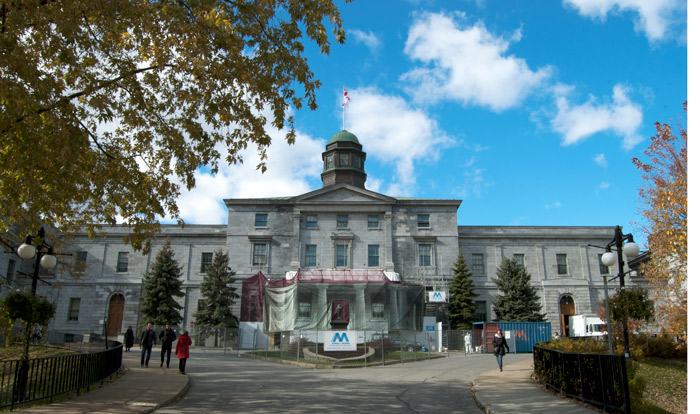
Arts Building renovations delayed by two months

Students walking past the Arts Building will continue to see the familiar face of construction, as the portico stabilization project has been delayed by two months. 

When the project began in late June, the McGill Reporter wrote that it would cost around $500,000. According to Michael Mannella, project manager for the stabilization, however, the total project budget is $1.047 million.

“The project is still well under budget,” Mannella said. “In every construction project we undertake at the university, we always build in a 10 per cent construction contingency to deal with unknown site conditions. As it looks now, the construction contingency will be more than enough to deal with the [unforeseen circumstances] needed throughout the duration of the project.” 

According to Mannella, the construction was meant to be completed this month, but has faced multiple setbacks. These include delays in masonry stone procurement and the need to find a stone supplier after the original supplier backed out of the project.

“Optimistically, we wanted to finish the project in October 2015,” he said. “With a building structure of [around] 100 years of age you are almost certain to come across site conditions and unknowns that need to be dealt with during the construction phase [….] With that said, we are now scheduled to be completed in early December, 2015.”

This project is one component of McGill’s efforts to tackle its massive infrastructure and maintenance deficit. Hudson Meadwell, interim dean for the Faculty of Arts, who has been at McGill for 25 years, attributed the lack of maintenance in the past to budgetary constraints.

“If the budget envelope [had been] bigger, we could accommodate more attention to deferred maintenance,” he said.

To address this issue, the university has committed to investing $400 million into deferred maintenance.

Structural problems were first identified in 2011 during a project to update the windows and facade of the Arts Building. 

“The structural engineer installed a monitor on the cracks [then] in order to check for movement in the future,” Mannella said. “There was a small movement noticed on the monitors by the structural engineer in July 2014, which forced McGill Facilities to […] address the portico’s structural issues.”

Following further observations, consultants noticed that the portico entrance was beginning to pull away from the main building. 

“This basically became a health and safety issue that needed to be dealt with as soon as possible,” Mannella said. “Also, the existing masonry elements were in advanced state of deterioration and needed to be either replaced or stabilized [….] Worst case scenario, if we would have ignored this problem […] the portico entrance would have simply detached completely from the main building structure.”

The Arts Building, one of the most iconic symbols of McGill, is  defined as a ‘historically protected’ building, a status which affects restoration and renovation procedures. 

“These are standards that are city-imposed or provincially-imposed with regards to particular buildings that are designated as heritage buildings,” explained Meadwell. “Because we as a campus have such a special connection to the city and to the mountain, there are lots of ways in which how we build is affected by distinctive kinds of restrictions.”

Mannella noted that this designation made the project more difficult and costly to complete. 

“Our intention in this project was always to restore and stabilize the existing masonry elements rather than to replace them,” Mannella said. “It would have been easier and probably cheaper to just replace every masonry stone, but we definitely would not get the same quality of stone or colour match that it is needed [….] It is more expensive to maintain the authenticity, but you cannot put a dollar amount on the value we are adding to preserve the existing masonry elements.”

According to Associate Dean of Arts (Academic Administration and Oversight) Gillian Lane-Mercier, the increased emphasis on addressing deferred maintenance is due to evolving standards.

“Norms have changed over time,” she said. “What was fine in the 1960s is no longer fine with regards to ventilation and fire protections, and I think this has all added up on the part of the university that this deferred maintenance can’t be deferred [any longer].”

a, Men's Varsity, Sports

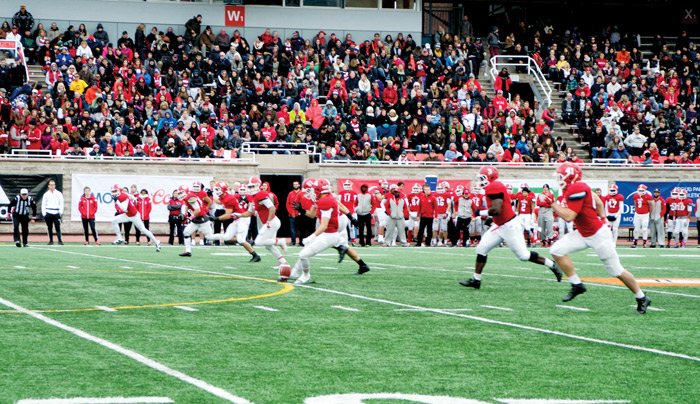
Football: McGill heartbroken in last minute Homecoming loss against Concordia

McGill Redmen
41

Concordia Stingers

43

I

t was almost so perfect. Instead, McGill (3-4-0) endured a gut-wrenching 43-41 loss against Concordia (4-3-0) on the final play of the Homecoming Game last Saturday at Molson Stadium.

Redmen quarterback Nicolas English drove down the field on the McGill’s final offensive possession, responding to a seemingly unwarranted late game penalty by hitting senior receiver Yannick Langelier-Vanasse for a 14-yard touchdown. That gave McGill a 41-40 lead with one minute and 20 seconds left on the clock.

English has owned the starting job since the fourth week and had a career day against Concordia, throwing for four touchdowns and 393 yards.

“[English] grew every week [this season],” Head Coach Ronald Hilaire explained. “He is poised in the pocket, and he led us to the lead with a minute left in the game.”

Unfortunately it was not enough, as the Stingers’ explosive offence marched down the field to set up the game-winning field goal as time expired. Concordia quarterback Trenton Miller and running back Jean Guy-Rimpel combined for 522 yards and had great success in the intermediate passing game. McGill missed injured linebacker Karl Forgues, who had been the RSEQ in tackles prior to the game.

“[Forgues] is a great player for us […] but we rely on more than just one player,” Hilaire said. “Of course ,his talent cannot be reproduced, but we have a lot of players who fight hard and play the right way.”

Nonetheless, McGill fought hard and made some outstanding plays on both sides of the ball—the best of which was when veteran wideout Louis Brouillette hit junior receiver Jonathan Mack for a 52-yard touchdown on a trick play in the second quarter.

Indeed, the McGill receivers had an excellent all-around performance. They blocked effectively, springing Langelier-Vanasse for several big gains in the second half. Langelier-Vanasse had two touchdowns, and 154 yards on seven receptions; Brouillette reeled in nine catches and two touchdowns; and Mack, sophomore receiver Remi Bertelin and freshman receiver Kevin Etienne all made huge plays to keep the Redmen in the game.

“They played well; they are a great group,” Hilaire said. “We have a veteran group and they did what we expected of them.”

McGill needed to outscore Concordia by 13 points to make the RSEQ playoffs coming into the game. That victory became increasingly less likely as the clock wore down, and McGill was just looking for a win that would affirm the huge improvements they made this year. It was heartbreaking to see them fall short at the final hurdle. The Redmen, however, have more than proved their worth this season, and can go into their final game against the no.1 ranked RSEQ team Laval next week with their heads held high.

Sound bites

“[I told the team] I love them, we are a family [and] we are going to fight together. We’ll learn from this experience and we will never let it happen again.” -Hilaire on an emotional loss.

Play of the Game

Seven minutes into the second quarter, English passed backwards to Brouillette on what looked to be a bubble screen.  The Concordia defence fell for the trick play leaving Mack open and sprinting up the sideline. Brouillette dropped back and hit Mack in stride for a stunning 52 yard touchdown.

Stat of the game

The two teams combined for 1108 yards of offence.

a, Features

Superman’s evolution in the fog of war

Superheroes may be a fixture in all things Halloween, but their importance extends beyond their costumes and comic strip panels. In the face of constant turmoil in the world, superheroes enter the scene to encourage an attitude of hope amidst plaguing issues.

Superheroes created throughout history generally embody values of the culture that produced them. The character fights against everything that threatens such values. The archetype superhero comes in the form of Superman, in terms of both appearance and the pursuit of “good,” or, the dominant moral values of the current society.

The era between the late ’30s and late ’40s became known as the Golden Age of comic books, and Superman was the embodiment of the period. At this time, comic books became an accepted form of art, and superheroes began to play a central role in American culture—one marked by hope.

“Superman stands for everything good the human race can become,” said Edvard Nicolas, comic book aficionado. “[He has a] good moral, [a] deep sense of justice, [and] use of power only to help those in need and never kill another human being.”

Superman's creation set the tone for all superheroes to come, and his story is one that is still relevant today. His character provided the base for the superhero formula of a hidden identity, and the powers and vibrant costumes that went along with it. Captain America, who followed shortly after, had a similar structure. He also has a secret human alter ego as Steve Rogers, gained powers through a serum invented by the military, and wore a colourful uniform— even in the same colours as Superman.

According to long time editor of spider-man books at Marvel Comics, Danny Fingeroth’s Superman on the Couch: What Superheroes Really Tell Us about Ourselves and Our Society, at the basis of a superhero is a protagonistic leading character. There are three levels of heroes: Real life heroes, fictional heroes, and superheroes.  A hero, such as a firefighter or a doctor, is essentially the ordinary realizing the extraordinary, like individuals who fight the odds, and sometimes, even beat them. The next step is a fictional hero, a character who is still human, like Sherlock Holmes or Indiana Jones. Finally, moving from labels of fictional hero to superhero, is the possession of supernatural powers, or at least the use of gadgets to reach superhuman ability.

Superheroes were made to give children ideals with which to battle a cruel adult world, which was on the verge of social, political, and military upheaval. They were tough and would rise above the law in the pursuit of good. The superheroes were determined figures with a simplistic ideology: To protect the world from evil. The reader didn't have to do anything other than sit back, suspend reality, and be entertained by their exciting adventures.

The superhero comic books of the Golden Age age were largely inspired by fantasy, such as Superman’s origin from another planet or Aquaman’s ability to breathe under water.

Jerry Siegel, co-creator of Superman, wrote that the basis for Superman was the notion of mythology.

"[Superman is a] character like Samson, Hercules, and all the strong men I have ever heard [told about] rolled into one,” he said. “Only more so.”

Although Superman’s strength and powers were paramount, he couldn't be so unearthly that readers wouldn't find him relatable.

Illustration of Superman

Sarah Nafisa Shahid, U3 Arts and a member of the (unofficial) comic book club at McGill, noted that it can be hard to see Superman as relatable as as other superheroes, like the X-Men.

“Most of the characters were heavily flawed,” she said. “That [was] relatable to me as an ordinary person.”

Superman’s humanity was crucial, and although having a real world identity as Clark Kent helped, it wasn’t enough to just have a journalist alter-ego. Clark Kent had human feelings and the ability to empathize, with sincere sorrow for his parents’ natural deaths and his inability to prevent them. Sympathy played a key role in the depiction of his humanity.

PHOTO: Superman Secret Origin, him with his parents. Credit: Wikipedia.

“Superman is not relatable, he is a dream,” said Nicholas. “He’s super strong, but he is reluctant to use his force. He can rule over the world, but instead, helps every person he can. Clark Kent is relatable. He’s from a small town, he loves his job, his wife and his parents. Everyone can be Clark Kent, [and] everyone wishes to be Superman.”

While Superman may be invincible on Earth, he does have a critical weakness: Kryptonite. Thus, creators managed to find a balance in making Superman invincible to earthly dangers, while providing kryptonite as his mythical downfall. In this way, Superman becomes more mortal, and therefore, is not so alien to readers.

Given that superheroes embody societal values, society reinvents such ideals over time. There's been a Superman for every decade since the character was born, maintaining similar powers and ideals while fighting different evils. While Superman fought primarily against fictional villains throughout the evolution of his character, he has fought against real villains too. For example, The Adventures of Superman radio show in mid ’40s featured Superman fighting the Ku Klux Klan when legal action was lacking. The ’50s Cold War era version brought his villains into a more science fiction-related realm, representing the growing concerns over improper scientific development and nuclear power.

A uniting factor among most major superhero comics is that they were written by Jewish individuals towards the start of World War II. With peaking antisemitism during the interwar period both in the U.S. and abroad, most Jews could not get university degrees, and often were not allowed to work in advertising agencies. Since careers in publishing weren’t an option, aspiring Jewish writers and artists found jobs in comics.

Superman, Batman, Spiderman, the X-Men, Green Lantern, and The Avengers were all written in this context between the 1930s and 1960s. In the 1970s, while Jewish individuals took up three per cent of the general population, they were also 80 per cent of the best-paid writers and illustrators of comic books in the United States.

By the end of the 1930s, the world desperately needed a superhero. Hitler and Stalin had gained full force and the American economy was in a poor state. Superheroes were created as a form of escape from the increase in conflict in the world and as a release from its accompanying stress.

“It is often suggested that Superman was originally created as a fantasy of social justice as a means of alleviating economic worries about effects of the Great Depression in the U.S.A.,” writes Cultural Studies Professor Sean Carney.

Coming from immigrant families who had small tailoring shops, Siegel and Shuster were undeniably affected by deteriorating economic conditions.

Perfectly timed with this era’s desperation was the release of /Action Comics no. 1,/ the first Superman comic book, created by Jerry Siegel and Joe Shuster in 1938, three years before the U.S.A. officially entered the war. The target of this comic was to set free the imaginations of U.S. citizens, providing a distraction from the war that seemed ever-approaching, through Superman. Such a character was reminiscent of cultural values of the time; morals were embodied through Superman’s actions and convictions, and served to remind citizens of their purpose in patriotism.

“[Superman] was handsome, intelligent, invincible, patriotic, almost flawless with an astounding morale,” said Shahid. “I always felt that his character portrayed a sense of superiority that America as a country was opting for [….] It was instrumental to the American propaganda that promoted consumerism and individualism and most importantly, the American patriotism.”

Siegel was strongly influenced by the anti-Semitism he experienced. He wrote about a hero who could battle the bullies, a protagonist who could surely beat the antagonists. In addition to Superman’s behaviour once an adult, the story of his arrival to Earth was one all too familiar at the time. As a refugee escaping to the United States from a world about to explode, Superman mirrored the lives of his creators, the Shusters and Siegels, and many other Jewish families fleed Europe before the Holocaust. Superman’s parents sent him to Earth in the hope that he would find a new beginning, which is essentially what Jewish families were doing at the time to try and save their children.

PHOTO 1: Action Comics #1, credit: Daily Mail

While Superman seemed to hold an endless stream of powers, there were limits that had to be imposed on him, particularly as American engagement in the war grew. During the war, the mythical world of Superman had to cross-cut issues of reality, which was not simple. Superman’s ability to easily win any war that didn’t involve kryptonite became an issue of morale when the United States officially joined the war in December of 1941. While adults were arguing about strategy and tactics and were worrying about their sons being drafted, adolescents had a simpler question: Where was Superman?

Readers were accustomed to Superman being able to fight off any fictional evil that came his way. When America was still neutral, Superman could effortlessly fight villains like Karl Wolff, the Dukalian leader, who bore significant resemblance to the Nazis. Once the United States joined the war however, it became their responsibility to fight the real Nazis. As cultural contexts translated into comics, this responsibility to fight Nazi’s theoretically became Superman’s as well. Other heroes, like Captain America, were fighting in the war, so many wondered why Superman, the archetypal American hero, was sitting out.

Explicitly incorporating Superman in the context of the war was complicated, because expectations were greater with Superman. Superman, in the context before the States entered the war, was fighting fictional villains to create a general ‘good vs. evil’ storyline where ‘good’ prevailed. As the war started for the States, the tragic reality of the war and the comic story line were brought together in a manner that hit too close to home. There was the risk that Superman, the once encouraging figure for soldiers, would become a disheartening one. Based on Superman's track record, he should be able to fix everything right away, and creators could not give people those kinds of expectations, yet they couldn't disappoint millions by having Superman fail to do his part.

Writers had to craft a solution that would give Superman an out, and that's exactly what they did. A February 1942 instalment of the “Superman” newspaper strip showed that Clark Kent tried to enlist in the army, but during his physical test, he accidentally read the eye chart in the next room with his X-ray vision. The examiner conceded that Kent was physically superb, but thought he was completely blind. Thus, the army did not want him, absolving him of his duty to fight.

PHOTO: Fighting Nazi tanks. Credit: Good Comics. PHOTO: Superman holding up Hitler and Japanese Emperor. Credit: Superman Homepage.

While writers could not explicitly place Superman in the context of World War II, they found a way to implicitly use Superman as a vehicle for hope amidst the war. In the summer of 1942 the intro to Superman on the radio was changed. The intro now described him as fighting a "Never-ending battle for truth, justice, and the American way!"

Superman had always fought for patriotic values, but it was only with the nation at war, and Americans thinking more than ever about why their country was worth fighting and dying for, that the idea of an “American way” of believing and acting took hold in the mind of the public, and in the myth of Superman.

PHOTO: Truth, Justice and the American Way. Credit: Comic Vine

Superman and the incessant hope he provides may be the foundation for humans looking to superheroes to fight for them, but he also gifts us with the possibility of something to have faith in that isn’t controversial. In a society where all too often, cynicism is equated with realism, and positivity with ignorance, having faith in a figure with irrevocable insistence on fighting the bad in service of the good seems as vital as ever. As long as there's evil in the world, superheroes will continue to fight it.

Despite an evolution across time and space for more than 70 years, Superman still manages to encapsulate popular morales today.

“Superman is an interesting metaphor of our society,” said Julie Savaria, recent MBA graduate of McGill and comic book devotee. “He is struggling to reconcile who he is and who he can become [….] We live in a society where we are expected to be productive and just plain perfect at all times; but, like Superman and Clark Kent, we are vulnerable. It is this vulnerability that makes us human.”


 

a, Science & Technology

Where is artificial intelligence headed?

In Stanley Kubrick’s classic 1968 film 2001: A Space Odyssey, the protagonist, astronaut Dr. David Bowman, has a standoff with his spacecraft’s artificial intelligence (AI) system, HAL. After discussing plans with a fellow astronaut onboard to deactivate HAL, Bowman attempts to re-enter the spacecraft from an external rescue mission. However, he is prevented from doing so by HAL, who calmly tells him that it will not allow him back inside because if he were to turn off the system, it would jeopardize their mission. 

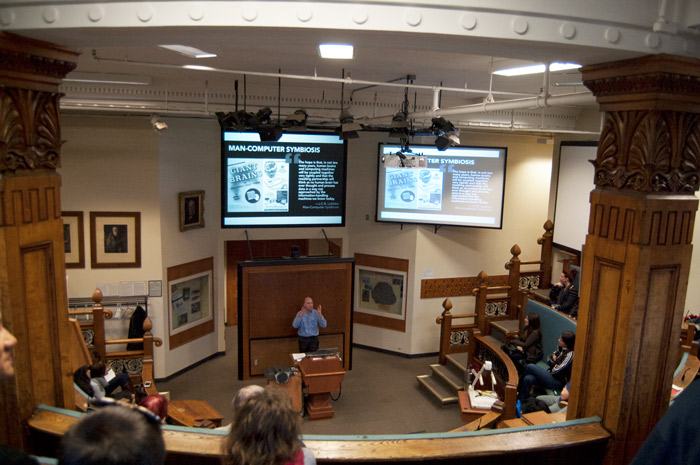
This act of defiance by a computer makes it only fitting that a screening of this particular movie would follow a presentation on AI given by Dr. Jeremy Cooperstock, an associate professor in the Department of Electrical and Computer Engineering. Cooperstock’s  presentation, titled “Is humanity smart enough for AI?” took place last Friday in Redpath Museum as part of the “Freaky Friday” lecture series. He addressed contemporary concerns about the nature of AI—concerns that are, according to him, not exactly irrational.

 “The bottom line, I think, is that we need to be afraid,” Cooperstock said. “We need to consider the consequences [of AI].” 

Cooperstock quoted Eliezer Yudkowsky, co-founder of the Machine Intelligence Research Institute (MIRI), to underscore his point: “By far, the greatest danger of AI is that people conclude too early that they understand it.”

Indeed, one would think that those in charge of designing and developing the technology in question would have to, at the very least, understand how it operates. Incredibly, this is not always the case. Cooperstock recalled a story told by Dr. Geoffrey Hinton, a professor in the Department of Computer Science at the University of Toronto, involving the U.S. army, which had hired a group of researchers to pioneer a detection system capable of identifying camouflaged enemy tanks. 

The researchers set out to take hundreds of photographs of camouflaged tanks, hidden in the trees at the forest line, as well as photographs of the forest line in its natural state. This data was used to develop a ‘neural network’ for the recognition system; however, the researchers had failed to account for the weather on the days when the photographs were done; the photographs of the camouflaged tanks were taken on sunny days whereas the photographs of the forest line were taken on overcast days. This seemingly insignificant variation led to the system being a better gauge of the weather than of the presence of camouflaged enemy tanks.

Though this error proved to be relatively benign, other more disastrous  cases of AI gone wrong have been documented. In 1985, China Airlines Flight 006 almost crashed because the autopilot system had blocked the pilots from regaining control of the aircraft—until well after the plane had gone into a steep dive. 

Worse still, claimed Cooperstock, is the idea of automated military weapons, which have been ‘perfected’ to the point of not requiring physical human operation. In the past, computer hackers have been able to bring down military drones because the software is accessible and easy to replicate, and has no human checkpoint. 

Ultimately, Cooperstock noted that society’s greatest defence against what some might jokingly refer to as the robot uprising is spreading the word about the drawbacks of AI. 

“We need to ask very careful questions and have this discussion as a society about the potential implications of these tools that we’re building,” Cooperstock explained. “Most importantly, “ […] We have to be cautious and aware of the potential for things running amok.”

a, Football, Sports

Behind the Bench: Why the NFL won’t let you have your pink and wear it too

Every October, the NFL engages in a variety of activities to promote breast cancer awareness—also known as Pink October. While at face value, the league’s efforts may appear altruistic, further inquiry casts a shadow of doubt upon its intentions. 

It’s no secret that the NFL has undergone significant media scrutiny in recent years. The news that 87 deceased NFL players have tested positive for concussion-induced chronic traumatic encephalopathy (CTE) is a terrible backdrop to Ray Rice and Greg Hardy’s domestic violence incidents, as well as Adrian Peterson’s recent child abuse scandal. In contrast to these horrific events, Breast Cancer Awareness Month offers a more family-friendly cause that everyone can get behind and support. It’s a chance for the NFL to gain praise for their philanthropic and altruistic efforts to support people who struggle against cancer every day. 

Over the past few years, commentators have questioned the distribution of proceeds raised during Pink October. From last year’s total, a mere 12.5 per cent of profit went towards breast cancer research. The remaining profits were split between the NFL and merchandise wholesalers—many of which are also owned by the NFL. 

While the NFL’s profit distribution leaves a stale taste in the mouths of many fans, it seems as if the league can at least be given credit for raising awareness for the cause. One of the ways it does this is through supporting the Susan G. Komen Foundation, which encourages many people to get tested for breast cancer and lends a vital hand in ending the stigma around the disease through positivity and support to cancer patients and survivors. This may prove to be particularly important for people in lower socioeconomic strata who, lacking resources and support, may not have considered getting tested before. 

This season, however, the NFL has made a series of insensitive decisions that suggests the motives behind Pink October are not entirely selfless. Players who have attempted to put in their own work to fight cancer have been discouraged, and in some cases, even fined by the NFL. The NFL’s behaviour, when put under scrutiny, seems to be more focused on gaining positive recognition for the league than offering support to those afflicted with cancer. 

For example, Steelers defensive end Cam Heyward was recently fined $5,787 for wearing customized eye black honouring his late father Craig “Ironhead” Heyward, who passed away from a brain tumour. Heyward’s eye black prints “iron” on one strip and “head” on the other. He plans to sell the eye black to benefit cancer research at the Children’s Hospital of Pittsburgh and the Southeastern Brain Tumor Foundation. 

Additionally, the NFL denied Pittsburgh Steelers running back DeAngelo Williams’ request to wear pink accessories all season long in an attempt to pay tribute to his mother and aunts who died of breast cancer because it conflicted with the league’s uniform policy. When the NFL refused this request, Williams opted to cover mammogram costs for 53 women.

With regards to Williams’ previous team, the Carolina Panthers, the NFL’s position against Williams is particularly poignant. In previous years, the league had Williams’ now deceased mother, Sandra Hill, appear in pregame ceremonies to advocate for breast cancer awareness. As a breast cancer patient, Hill’s contribution to Pink October was vital as it added a necessary element of legitimacy to the NFL’s campaign. 

The NFL’s refusal to support cancer victims outside of Pink October demonstrates an exploitative side to the month. It appears as if the league is cashing in on its players’ negative experiences with cancer in order to position the NFL in a positive light. It communicates to the public that the NFL’s business in breast cancer awareness is not to offer positivity to cancer fighters or to help the healing process of its survivors, but rather a tactic to manage its image as tightly as possible. 

Fans are now left with the question: Are the NFL’s breast cancer awareness policies morally permissible? It may seem callous to criticize the league for its work, but it’s hard not to question the NFL’s motives. Breast cancer doesn’t stop after the month of October, and Williams’ and Heyward's efforts shouldn’t have to either.

Art Cuba
a, Art, Arts & Entertainment

The colours of Cuba

Cuba has received a lot of international attention recently due to the improvement in its relationship with the United States. Though prospects seem better now, the Cuban population has had to endure much hardship after Fidel Castro’s 1959 revolution. The economic sanctions imposed by the Organization of American States (OAS) in 1962,  coupled with the communist regime’s own economic impotence, resulted in poor living conditions during the ’70s that still haunt the country today.

Cuban artists in particular—alongside homosexuals, counter-revolutionary political activists, and other state-branded deviants—suffered immensely at the hands of the regime, facing brutal imprisonment and oftentimes compulsory military service within the ‘Military Units to Aid Production.’ Art Cuba, the latest group exhibition at Galerie Aura, stands as the first exhibition of Cuban art in Canada since the recent rapprochement, and brings the unique historic-cultural struggles inherent to the country to the forefront.

The gallery provides a glimpse into some of the complex dualities that pervade the Cuban psyche: The ocean is at once a symbol of limitless freedom and a body of entrapment. The communist regime promises progress yet delivers backwardness. The very distinctively Cuban identity fused with Afro-Cuban culture are all concepts explored by various artists hailing from Cuba’s artistic elite.

Immediately upon entering the gallery, the colourful chaos of Carlos Quintana’s “Intriga en el solar” sets the tone of the exhibition. Described as an artist whose work stems from “phantasmagoric hallucination” and seem to reflect a stream of consciousness art style, Quintana’s work explores a vision of the supernatural rooted in Afro-Cuban culture. He accomplishes this through an intricate blending of bright red floral patterns into human figures, the zoomorphism exhibited on said human figures, and finally their colour contrasted with a jet black spiritual figure in the foreground. Manuel Mendive’s untitled acrylic on canvas taps into this same Afro-Cuban culture, focusing on the Yoruba religion in particular. In an attempt to map the Yoruba concept that there is one universal soul from which all life stems from, Mendive depicts various human figures literally fused with animal and plant life and engaged in a process of perpetual rebirth.

In contrast to these often bright, supernatural depictions, Alexis Leyva Machado, known as Kcho, portrays the grim reality facing illegal Cuban emigration. His simple, yet powerful, image of an oar, symbolizing the perilous journey awaiting illegal immigrants, that gradually melds into a human femur is quite a succinct snapshot of the grave decision made by thousands of Cubans. 

Liudmila Velasco and Nelson Ramirez’s collaborative work “El Viaje” further sheds light on the ocean’s place in the Cuban psyche. By depicting a woman cramped within a suitcase in the fetal position upon the high seas, Velasco and Ramirez situate the ocean as both a place of birth, offering new lives to successful escapees, and of extreme confinement, as potential emigrants remain totally eclipsed by water on all sides.

The piece that stood out most was Alfredo Sarabia’s “Entramado,” which in Spanish means both ‘a confining framework,’ but also a ‘schematic’ or means for structuring and operating something. “Entramado” depicts a common scene in Cuba: That of an open ended, sprawling mass of power cables connected to publicly accessible transformers. As a result of the harsh economic conditions that define Cuban reality, society is one that is constantly drawn to improvisation in order to meet basic standards of living. Consequently, such an impromptu arrangement of wires and transformers is one that is simultaneously limiting and empowering by necessity. The union between the Cuban and USSR flags in the background, surrounded by wires, furthers this sense of imposed limitation. The piece itself, riddled with functioning power outlets, invites viewers to participate in this improvisatory nature, as each outlet is actually functional and thus mirrors the transformers depicted.

Ultimately, Galerie Aura’s Art Cuba exhibition powerfully sheds light on the Cuban story, and projects high hopes for the future of Cuban art in the wake of rapprochement. 

Art Cuba is located at Galerie Aura (2050 Rue Crescent) and is running from from Oct. 14 to Dec. 15. Admission is free.

a, Fact or Fiction, Science & Technology

Are monsters real?

Science has a reputation for refutation. But this is not always the case, and some researchers have found that monsters and ghosts might actually exist; however, maybe not in the way that people expect. 

Zombies

The concept of zombies originates from Haitian folklore, in which Vodou priests called bokors were reportedly able to turn normal people into the undead using a magical powder introduced to the bloodstream. In 1982, Wade Davis, Harvard anthropologist and ethnobotanist, travelled to a number of Haitian villages in search of genuine bokor priests. In The Serpent and the Rainbow, a book Davis wrote about his experiences in Haiti, Davis described his encounter with  Clairvius Narcisse, a Haitian man who was widely believed to have been dead for 18 years before being ‘cured.’ While undead, Narcisse reportedly had no personal identity and existed in a permanent trance-like state. 

Davis’s controversial explanation for these symptoms was based in chemistry and pharmacology. According to Davis, priests would imbue individuals with tetrodotoxin—a powerful neurotoxin found in pufferfish—as well as various deliriant drugs. However, these effects remain unproven, and are not entirely consistent with other instances of tetrodotoxin poisoning. 

Many scientists, including Pace University neurologist Terence Hines and Tavistock Institute psychologist R. D. Laing, dismiss these claims. Instead, they push a social or behavioral model similar to the nocebo (reverse placebo) effect. This effect is seen in several culture-specific ‘folk illnesses’ such as First Nations wendigo psychosis—a type of canabilism—or Aboriginal Australian bone-pointing—an omen of death—where the staunch belief in a ritual or ailment psychosomatically produces  symptoms. The study of these purported medical conditions remains on the fringe of anthropology, and even the idea that they exist as medical as opposed to social issues is controversial.

Vampires

Vampires have experienced a massive resurgence in popularity over the last few decades, and with this, an influx of rationalizations for a scientific cause behind vampirism.The most common modern suggestions are diseases such as rabies and porphyria, which are both highly communicable. Their symptoms include aggression, sleep pattern disruption, sensitivity to light and the taste of garlic, as well as psychosis.

Today’s modern pop culture conception of vampirism is very far removed from the original lore, which, for example, gave the creatures a ‘purplish’ skin tone, due to blood consumption,  and an obsession with counting, today called arithmomania.

Ghosts

Ghosts have historically been harder to pin down. It seems intuitively unlikely that any sort of disease could turn a living human being into an incorporeal and semitransparent spectre. What’s more, the underlying folklore is vague and found in some shape or form in every world culture, as opposed to the more regional and specific legends of vampires or zombies. However, scientists have been using infrasound, especially subsonic frequencies of around 19 hertz—just below the range of human hearing—to offer a more rational explanation to ghost stories. 

A 2003 study conducted by National Physical Laboratory acoustical scientist Richard Lord and University of Hertfordshire psychologist Richard Wiseman showed that infrasound caused feelings of dissociation, unease, and paranoia. At certain ranges of frequencies, which have since been conclusively detected in several houses reported to be haunted, infrasound can establish sympathetic vibrations in the vitreous humour of the eye, leading to ghost-like hallucinations and fleeting, darting motion indistinctly seen in peripheral vision, as shown in a NASA study.

The theorized evolutionary purpose of the visceral human reaction to certain frequencies of infrasound is that it is produced by volcanoes, earthquakes, growling tigers, and other natural sources of danger that understandably became hardwired into humans’ innate fear reactions. In the modern world, however, it’s more likely to encounter infrasound as the result of a noisy fan or faulty plumbing than a hungry tiger—and these can often lead to reports of hauntings in houses that really just need a good renovation.

a, Editorial, Opinion

Student innovation key to Montreal’s future

McGill is often portrayed as an institution that operates alongside Montreal rather than within it. While its quota system requires approximately 50 per cent of the student body to be made up of students from Quebec, most of the international and out-of-province student body decide to leave upon graduation. Given recent economic reports that detail the numbers of lost jobs and shrunken industries in Montreal, the decision to leave is not unreasonable; however, allowing a large number of students to slip through its fingers upon graduation is not in the best interest of the city.

Creativity has the opportunity to thrive at McGill. Universities in Montreal have numerous opportunities for student entrepreneurship and innovation. Initiatives such as the Quartier de l’Innovation (QI), the Dobson Cup, and Seeds of Change are opportunities for students across faculties to experiment and expand their professional horizons. But these incubators for creativity and innovation on campus have not yet been translated into opportunities in the Montreal community on a large scale.

Resources such as the Career Planning Service (CaPS) are essential to assisting students in professional development. Yet, even through services such as their mentorship program, there more of an individual focus than a community one. Those who are intensely interested in a certain field will seek out the appropriate assistance, and so there is a certain amount of required individual agency; but even with interest, there is an information mismatch. The potential for a student community of innovation is there, but it has yet to be tapped into. Opportunities abound, but awareness of those opportunities is limited by the fragmented dissemination of information. Streamlining student access to information pertaining to opportunities for entrepreneurship would solidify a culture of innovation within campus.


Incubators for creativity and innovation on campus have not yet been translated into opportunities in the Montreal community on a large scale.

There are the obvious barriers to students remaining in Montreal post-graduation—corruption, the language barrier for many students, and a lack of business infrastructure since the 1970s are just a few. But a significant portion of the McGill community is from Quebec or Montreal, and will stay after graduation. The expansion of opportunities for innovation and entrepreneruship in Montreal post graduation will compel more students to remain in the city while improving the opportunities available to locals.

Innovation and entrepreneurship are not easy anywhere, but succeeding in Montreal is particularly difficult. Montreal pales next to economic hubs such as Toronto, New York City, and London in terms of innovation. While it is strong in film and technology—especially as the city’s concerted effort to attract digital companies beginning in the 1990s—Montreal is still considered the worst large city in Canada to develop a business. Progress in these barriers is a long-term commitment, but perhaps the impetus need not come from above. A cohesive effort to develop programs within McGill would empower students to contribute to innovation in Montreal.

Nevertheless, McGill students have not been absent from the scene of entrepreneurship. Dispatch Coffee, the caffeine dispensary operating in the McConnell Engineering building was started by McGill alumni, as well as Heart City Apparel, a charitable organization that promotes the work of small artists in Montreal. Were McGill students given further tools to enter the Montreal private sector, it could pave the way to lowering the existing barriers and transplanting these initiatives into Montreal as long-term businesses. Improvements in corruption, infrastructure, and interest in Montreal as a hub for innovation do not need to be the first step; instead, bottom-up development from the grassroots level could assist Montreal in prioritizing such improvements. A McGill education can be applied to our immediate environment—arguably, most who start a project while at university would prefer to not relocate. It is a matter of adjusting the taboo held by international and out-of-province students, as well as providing the tools to all students. As McGill works on cultivating student interest in preparing for the realworld and exploring various avenues, it ought to focus on how students can contribute to innovation within the Montreal community.


The Rolling Stones
a, Arts & Entertainment, Film and TV

Cocksucker Blues travels from Super 8 to the Silver Screen

It’s rare for a band like The Rolling Stones to be embarrassed or even scandalized by anything, but the footage in Robert Frank’s documentary Cocksucker Blues was evidently too much for the band to reveal to their public. Despite the liberal atmosphere of the early ‘70s, which saw the explosion of classic rock—and the hedonism that came with it—Cocksucker Blues was deemed inappropriate for public audiences. The issue was taken to court, and it was finally decided in 1977 that the film could not legally be shown until 1979, and then only four times per year, and only with director Robert Frank present at each showing. 

Cocksucker Blues was exhibited in Montreal’s Festival du Nouveau Cinéma on October 16, the first official screening of the film since the Museum of Modern Art screened it at The Rolling Stones: 50 Years of Film exhibition in 2012. Montreal was one of the places Frank first illegally showed the film.

It’s safe to assume that the majority of those attending the screening arrived with a basic background on the Rolling Stones as a seminal cultural phenomenon and a wild caricature of the rock ‘n’ roll lifestyle. Whether most of the audience was there to bask in the heyday of classic rock hedonism, or scoff at the very same thing, it required real grit to sit through the raw, often-humourless footage of their 1972 Exile on Main St tour.   

The film was shot in a cinéma vérité style, which contributed to its disjointed nature. Cinéma vérité is a rather broad genre of documentary film, conducted in this case by providing several cameras for band members, groupies, and sound engineers alike to record what they saw on tour. The result—compiled in the editing  room by Frank to lend some semblance of story—is a shaky, often random, and even cringe-inducing record of The Rolling Stones’ lifestyle. The film failed to reveal the glamour of life on the road with the Stones and the excitement of cultural revolution that comes with many rock documentaries (see The Last Waltz or Monterey Pop). Instead, the film’s unflinching lens casts a pall over the orgies, injections, lines, and parties. While some interviewees are gregarious and giddy from drug use, their words have little more consequence than the stoned musings of the average person. 

There are moments of joy that break through the dizzying close-ups of naked girls and heroin users. The longer concert scenes showcase the band at their best: In a haze of glitter, velvet, smoke machines, and screaming riffs to go along with Keith Richards’ mad guitar solos. Other innocent scenes remind the audience of the Stones’ humanity, such as when Mick Jagger goes through a painstaking process to order a bowl of strawberries and blueberries to his room in a middle-of-nowhere hotel. 

Ultimately, Cocksucker Blues succeeds in that it is not a glamourization of debauchery but an honest look at it. The film exhibits an unedited view of the Stones in all their hedonist glory, and that includes many moments of vulnerability and some of dazzling invincibility. 

Read the latest issue

Read the latest issue