


Latest News

a, McGill, News, SSMU

McGill Senate demands increased transparency in budgetary allocations

  • Questions regarding student services funding

    At the April 22 McGill Senate meeting, Students’ Society of McGill University (SSMU) President Courtney Ayukawa, Vice-President University Affairs Claire Stewart-Kanigan, Arts & Science Senator Chloe Rourke and Arts Senator Jacob Greenspon voiced concerns over the allocation of provincial government grants specified for student services in light of an $11 million budget cut imposed on McGill by the Liberals.

    “Whereas, the Deputy Provost (Student Life and Learning) stated that in the event that the most recent budget cut by the Quebec government was above the $5-6 million projected by McGill, government grants designated as for ‘services for students’ that previously were distributed exclusively to Student Services may begin to be distributed to other student-serving units to protect the “core mission” of the University,” the question read. “Will government grants designated as for ‘services for students’ be disbursed to units beyond Student Services in 2015-16 given the most recent cut?”

    In response, Deputy Provost (Student Life and Learning) Ollivier Dyens described the current financial state of McGill Student Services.

    “We estimate that Student Services will close [fiscal year 2015] with a $100,000 surplus,” he explained. “Student Services is utilizing $1.5 million of the approximately $6 million surplus to fund [fiscal year 2016] operations. This use of the surplus is meant to cover all of the normal additional costs to operations as well as the government imposed cuts.”

    Dyens continued to explain that the proposed redistribution of government grants to more general areas of student services was created to allow generalised services to continue existing despite provincial budget cuts.

    “The government grant we receive is meant to fund services to students, […which] include units such as the Dean of Students, Service Point, Advising, the Libraries,” he explained. “If we face unsustainable [provincial budget ] cuts over the next few years, we may be forced to reallocate a portion of the government grant to ensure the viability of services to students. We would be able to do so only because Student Services has an accumulated surplus of more than $6 million. This is not a long-term solution and is only meant as a potential emergency measure to ensure that all services will be maintained.”


  • McGill University Budget

    Provost Anthony Masi explained that the University had to respond to last-minute budget cuts from the Quebec government. Despite these cuts McGill managed a $4.3 million surplus for the 2014-2015 fiscal year. According to Masi, the University’s two fiscal priorities for the upcoming 2015-2016 will result in a project deficit for the year.

    “We plan to honor all of the salary commitments that have been made, which will cost $22 million more next year,” Masi said, adding that McGill would also have to tackle maintenance needs. “In order to address those needs, The Board of Governors has approved a [proposal] to issue debt up to $400 million, to be repaid over a 40 year period.”

    Masi continued to explain that future operating budgets will also be responsible for repaying capital as well as interest.

    “In light of these burdens, the University has, for the first time in a decade, an annual deficit lower than that of the prior year,” explained Masi. “Unfortunately, due to these new budgetary impositions, the projection for the 2015-2016 fiscal year is a $4.7 million deficit.”


montreal biodome
a, From the BrainSTEM, Science & Technology

From the BrainSTEM: Montreal Museums Day

As a student, being able to immerse myself in Montreal’s rich network of museums—without having to pay anything—is an exciting proposition. On May 24, when the Board of Montreal Museum Directors hosted the 29th edition of La Journée Des Musées, Montréalais: Montreal Museums Day, I had to participate.

The Biodôme, one of the participating museums, where living creatures are affected by these masses of people shouting and shuffling through its enclosures, should rethink its participation in Museum Day. The Biodôme’s main selling point is its lack of large fencing separating people and animals. Unfortunately, this absence of barriers creates a shared ecosystem consisting of dozens of screaming children and shuffling adults, not the proper ecosystem for any wild animal.

According to Liberation BC—an animal rights group based in Vancouver—wild animals in stressful situations will often start “chewing, licking, and self-mutilation, as well as rocking, swaying, pacing in regimented circles, head-tossing and neck-stretching, and air-biting.” On such a crowded day, the animals were stressed and retreated into the hidden spaces of their enclosures resulting in a cycle of frustrated children and adults pounding on glass enclosures, screaming, crying, and even shaking trees, all in the hope of seeing interesting and exciting animals. Throughout these fits, no staff, trainers, or security were available to put an end to the deplorable behaviour of their guests—and this was upsetting, to say the least.

The ethics of keeping wild animals in captivity has already been fiercely debated. Museum Day highlighted that while better than a standard cage, the Biodôme’s enclosures were far from ideal for the animals.

''No matter how good the cage is, you can't recreate the wild—it can't be even a pale shadow of the natural environment, with the same species of prey and predators,'' said Eric Pianka, a zoologist at the University of Texas, to the New York Times. ''An animal in a zoo is totally out of context, like a word without the rest of its sentence.''

While wildlife conservationists encourage the shift from cages to more natural habitats, the Biodome is too small to host the animals it contains. Originally a 1,620 m2 velodrome used for cycling events during the 1976 Olympic Games, it was refurbished and made into a zoo afterwards. One of its larger inhabitants, the Canadian Lynx, will roam up to five kilometers a day and have territories upward of 50 km2 in the wild. If the Biodome were to give just one of its 4,500 animals a proper habitat the Lynx would need free reign of the entire centre. The Biodôme’s four other exhibits offered more of the same. The animals were either absent or looked under-stimulated, overweight, and sad—be it Atlantic Puffins from the Labrador Coast or River Otters from the Laurentian Maple Forest. The flux of visitors for Museum Day played a part in my forgettable experience of the Biodôme; however, these high prices, run-down conditions, blasé staff, and droves of strollers and people seem to be common occurrences for the animals throughout the year.

The Montreal Science Centre, my next stop, was host to a startlingly small amount of science. One of its permanent exhibits, Les moulins de l’imagination, is actually nothing but a collection of ‘Do-Nothing Machines,’ similar to Rube Goldberg machines—that is, an over-engineered machine that serves little purpose, designed by an artist named Florence Veilleux.

Their other permanent exhibits include Cargo; a history on the process by which boats dock into Montreal, idTV; an interactive exhibit allowing children to produce a TV show; Clic!; something I can only describe as a glorified playpen, filled with building blocks and toys; and Science 26; an “A is for Animation, B is for Brain-style” interactive exhibit. The exhibits were colourful and eye-catching, and the Centre beautiful, spacious, and elegant. But both the permanent and temporary exhibits offered very little actual scientific information. The main temporary exhibit, Fabrik, allowed children to build cars, bridges, and other engineered creations. On one hand, this definitely encouraged creativity, imagination, and teamwork for the children. On the other hand, their exhibits and this type of environment could easily be recreated at a playground with a box of Legos.

While designing exhibits that could successfully enlighten and educate in a broader sense can be difficult, it’s not impossible. Captivating tools like Tesla coils—that create beautiful electrical bursts by using resonant circuits—could teach important lessons about physics. Fun chemistry projects—like the iodine clock—that uses simple and safe ingredients to create bright and fun chemical reactions, are exciting and informative.

For art history museums, an event like Montreal Museum Day is the perfect opportunity to get to know their exhibits, without having to pay the price. For other types of museums, like the Biodome, where the livelihood of their exhibits—namely, animals—require quiet and calm to thrive, an event like Montreal Museum Day is destructive: It puts unnecessary strain on not only the guests and staff but also the exhibits. The price these animals pay—so that guests don't have to—is ultimately too high for a place like the Biodome to participate in Montreal Museum Day.

florence + the machine how big how blue how beautiful-min
a, Arts & Entertainment

Album Review: Florence + the Machine – How Big, How Blue, How Beautiful


Much of the lead-up to How Big, How Blue, How Beautiful, the highly anticipated studio album from British indie-rock band Florence + the Machine, has included an overemphasis of the album’s stripped-back sound. No stranger to bombast, the band’s previous two albums were high on drama, jam-packed with existential lyricism, and filled to the brim with grandiose instrumentals.

In a recent press release, frontwoman Florence Welch stated that “the new album became about trying to learn how to live [in reality] rather than trying to escape it.” She seemingly follows up that statement during “Caught,” in which she states, “it’s one of the hardest things I’ve ever had to do.” Unfortunately, this conflict in the album’s creation is painfully present throughout the entire album as the songs tread a treacherous line between underwhelming and overwrought.

That the record has taken on a much more self-aware and introspective approach in the thematic and musical arrangements is momentarily clear within the opening song, “Ship To Wreck” in which Welch asks, “Oh my love remind me, what was it that I said?” over a much more soft-rock oriented sound in comparison to the band’s orchestral past efforts. However, the subsequent track, “What Kind Of Man,” begins with breathy vocals before awkwardly switching to an aggressive section that leans heavily on guitar and drums. The track continues on into an overwrought and grandiose climax—something the band claimed to have left behind—with Welch howling over seemingly dozens of brass instruments.


What follows is nine underwhelming songs that blend into a rather melancholy but musically chaotic whirlwind of vague ballads, disinteresting 70s drivetime rock, and undercooked production. Even Welch’s vocals, which are noticeably restrained, are still too much when set against the subdued and dreary backdrop of the songs in this collection. Additionally, many of the ‘new’ themes of water, religion, and self-worth were all explored in the band’s 2011 record, Ceremonials, where the over-the-top production was much more fitting with the explosion of emotion conveyed. On How Big…, the same answer-seeking lyrics and soaring vocals aren’t supported: instead, Welch is left searching, high above the reality that she tried to encapsulate and ground herself in with this record.

In leaving behind the overly dramatic arrangements that once made the band so notable, Florence and the Machine have left themselves with a pastiche sound that makes even the aforementioned track, “What Kind Of Man,” a breath of fresh and drama-filled air. One song, “Third Eye,” does break from the melancholy formula. The result is that Welch lets go completely and accepts that she’s at her best when going full-scale with her music. Her dramatic layered vocals are supported by galloping drums and a fantastic combination of claps, guitars, and piano riffs. But even this song sums up the album’s confused existence perfectly: “I am the same / I am the same / but I’m trying to change,” she shrieks. This juxtaposing agenda is as long-winded and vague as the album’s title: It’s very big, very blue, but not very beautiful or cohesive.


Standout Tracks: Third Eye, What Kind Of Man, & Ship To Wreck

a, Basketball, Sports

2015 NBA Finals Preview

Golden State Warriors

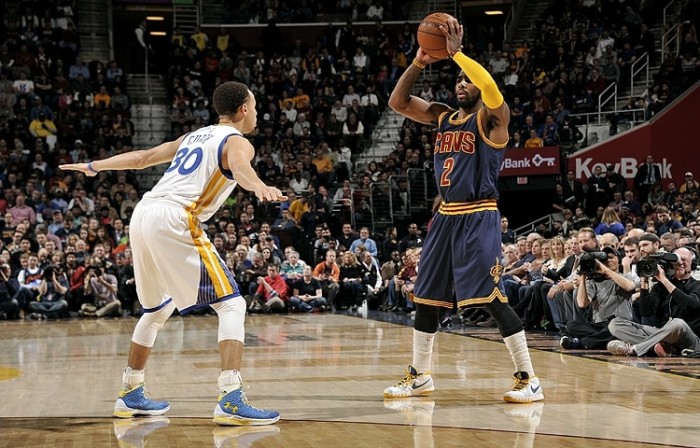
As respected as Lebron James is and as impressive as all of his accomplishments have been, there’s little doubt that the Golden State Warriors will conquer the Cleveland Cavaliers in the NBA Finals and capture their first Championship since the days of Rick Barry back in 1975. The reason being—the Warriors have a superior team.

Prior to the start of a playoff series, if you knew that LeBron James, who by all means is the best basketball player on the planet, would go on to average 28 points, close to 8 rebounds, 4 assists, and 2 steals with incredible efficiency (specifically, 57 per cent shooting from the floor, 51 per cent from three point range, and 79 per cent from the free throw line) in that same series, you'd probably be inclined to think that he'd be a lock to lead his team to victory. A year ago when matched up with the San Antonio Spurs in the Finals LeBron did exactly that, but despite such a remarkable performance he still fell short of a championship goal and was defeated by a record margin of points in just five games.

That isn't to say that Cleveland is limited in terms of talent—it’s just that Golden State offers so much more with its depth. This season, the Warriors ranked among the top 10 teams across the NBA in terms of bench production, averaging 36.4 bench points per game. The Cavaliers, on the other hand, ranked dead last, averaging a little over 24. Additionally, James and his squad are challenged with the task of overcoming a juggernaut on both ends of the floor. Out of all 30 teams this year, Golden State ranked first in defensive efficiency, allowing only 98.2 points per 100 possessions, and ranked second in offensive efficiency, scoring 109.7 points per 100 possessions. Cleveland wasn't that far behind in terms of offensive efficiency, but the real discrepancy lies on the defensive side, where the Cavs ranked 20th in the regular season. The Warriors also had the highest league totals in effective field goal percentage and true shooting percentage. Furthermore, no team owned an assist ratio close to that of Golden State, who ended their possessions with an assist nearly 20 per cent of the time this season. Simply put, no team in the NBA has moved the ball or executed as well as the Warriors have since October.

Though the Cavs have made significant strides on defence since acquiring the likes of guard Iman Shumpert and big man Timofey Mozgov, there's a strong chance that they'll be exploited by a team whose execution is unmatched, and whose shooters get off shots in the blink of an eye. When it's all said and done, Stephen Curry, with the help of a well rounded supporting cast, will remind everyone why he's not only the league’s MVP, but also quite possibly the most lethal offensive marksman to ever play the sport. A wise bettor should always lean towards the safest pick, and as far as this year goes, no team is safer to side with than the Warriors.

– Dan Gilbert

Cleveland Cavaliers

Boastinga 67-15, record, the NBA’s most efficient offense and defence and the league MVP, it is fair to say that the Golden State Warriors deserve to win. Basketball instinct, however, says that the Cleveland Cavaliers will come out on top. Stars win championships and Cleveland have the biggest star on the planet.

LeBron James is the X-factor in these NBA finals. If he plays well, the Cavs will win hands down. If not, then congrats to the Warriors. Unfortunately for Golden State, he is playing some of the best basketball in recent memory. Offensively, the only person that can stop him is himself. On the defensive end, he can guard all five positions with incredible ease; especially since Golden State doesn’t have a threatening big man who can score inside. He is possibly the only player in the world than could rally this crippled Cleveland team, devoid of a fully healthy Kyrie Irving, Kevin Love, and Anderson Varejao, to the NBA Finals. The argument of the Eastern Conference being weaker can be made, but nonetheless LeBron averaged a near triple-double in a Conference Finals sweep against a strong of a Hawks side that went 22-8 against Western Conference teams in the regular season. Furthermore, the team is clicking on all cylinders. Everyone is making big shots and great defensive plays, and their brand of basketball looks quite beautiful, at least in the last series versus Atlanta. Matthew Dellavedova is looking like a veteran in his first playoff experience is running the pick and roll effectively and hustling on every play. Then you have Tristan Thompson, the rebounding machine of the playoffs. Nobody can match his intensity and effort in his position on the Warriors’ roster. Fans can’t forget Timofey Mozgov, the defensive stopper who goes after each lay-up and swats it like he’s playing volleyball. He is also a very underrated passer, as he regularly finds the open man on the wing when he is being doubled in the post. And then the old Knicks twins in Iman Shumpert and J.R Smith who have become all of a sudden an offensive spark-plug duo in these playoffs, knocking down multiple wide-open shot created by Dellavedova or LeBron. When Cleveland was down, these two started gaming and making shots like the rim was 10 feet wide. The matchups for these two teams favour Cleveland. Of course, the point guard position battle goes to Stephen Curry. But at the shooting guard position, with Klay Thompson shaking off a possible concussion and who has sneakily had a poor and inconsistent playoffs so far. Smith may have the advantage—his plus-minus totals in these playoffs are a bit higher with +104 over the +96 for Klay. At small forward LeBron James clearly wins over Harrison Barnes, but Draymond Green gets the edge over Tristan Thompson because of his versatility. Thompson may be a factor on both ends because his hustle is hard to duplicate. Finally, Mozgov over Bogut is an easy decision at the center position. The Cavs are a completely different team right now than the shaky club that started out this season. They’re on a mission, and that is the scariest thing for an opponent, especially when the team is headed by arguably the best player in the world right now in LeBron James.

– Abdul Atta

a, Hockey, Sports

NHL Stanley Cup 2015 Preview

Chicago Blackhawks

Jonathan Toews is the ideal player to pick if someone were starting an NHL franchise from scratch. Sidney Crosby is a hard hit away from a career-ending concussion. John Tavares is a special talent but he has hasn’t proven himself quite yet. Steven Stamkos would be a fine choice, but Toews is the closest thing you can get to David Ortiz in hockey. While Mike Trout is definitely the better overall player, what you want Big Papi at the plate with two outs in the bottom of the 9th inning in Game 7 of the World Series.

With his back against the wall, Toews has proven time and time again that he can be counted upon to step up and deliver. He has captained the Hawks to two Stanley Cups since 2010, and owns an absurd 11-4 record in elimination games since being drafted in 2006. In the Western Conference Finals, Toews became the first player in NHL history to have multi-goal performances in Games 5 and 7 on the road in the same series. This isn’t his first rodeo, and it isn’t the first go-around for most of the players on this seasoned Chicago squad.

The Lightning offensive core of Stamkos, Tyler Johnson, and Ondrej Palat may have the speed advantage, but they lack the experience that Chicago’s forwards have. The emergence of Brandon Saad and Teuvo Teravainen has given the Blackhawks an infusion of youth and speed that has blended with Toews and Patrick Kane to form a dynamic offence that doesn’t lose in overtime. Saad, in particular, has been a revelation during these playoffs. After breaking out as a solid second line option in 2013, he has taken his game to the next level in the post-season, racking up eight points on six goals and two assists.

On defence, Chicago has been blasted by analysts for its top-heavy lineup of Duncan Keith, Brent Seabrook, Johnny Oduya, and Niklas Hjalmarsson, but those four by themselves could square off against just about any blue line in the league. If the minutes were heavy against Anaheim (Keith, in particular, has averaged a ridiculous 31:36 minutes through 17 games thus far), they’ll only rise against Tampa, and that shouldn’t worry anyone in Chicago. Joel Quenneville has serviceable options off the bench in Kimmo Timonen, David Rundblad and Kyle Cumiskey, but this is Quenneville’s 16th playoff appearance and he knows best of all that you don’t leave your best players on the bench in the Finals.

Tampa Bay’s Ben Bishop is an outstanding goalie, but there’s no way he’s going to be able to succeed in slowing Chicago’s offence when Pekka Rinne, Devan Dubnyk, and Frederik Andersen all failed. Rinne and Dubnyk are both Vezina Trophy finalists who posted superior regular season save percentages to Bishop, and the Hawks steamrolled past both netminders with ease. Meanwhile, the Lightning took two more games to make it through a much weaker Eastern Conference to the Stanley Cup Final.

If the NHL were set in the world of Game of Thrones, the Hawks are a battle-tested group of grizzled Wildlings accustomed surviving in the brutal climate North (West) of the Wall. The Bolts are King Tommen, sitting pretty on the Eastern Conference throne despite not having ever unsheathed the Valyrian sword gathering dust under their race-car bed.

– Elie Waitzer

Pick: Blackhawks in six

Tampa Bay Lightning

Since the NHL instituted its myriad of rule changes to try and increase offence and scoring the league has turned into a game dominated by speedy forwards. That’s a good thing for the Tampa Bay Lightning, whose top two lines have scorched the blue lines of the teams they beat in the Eastern Conference.

Any good hockey team is built up the middle and the Lightning have an outstanding goalie in Ben Bishop, a top-five defenceman in Victor Hedman, and a superstar centre in Steven Stamkos. Also, unlike other top-heavy teams like the Pittsburgh Penguins, the Lightning have shown remarkable balance from players who aren’t its superstars – for much of the post-season their second line “Triplets” of Ondrej Palat, Nikita Kucherov, and Tyler Johnson have been playing like a first line. Additionally Johnson, their second line centre, has been the breakout star of this year’s playoffs. While the Lightning have been devoid of scoring past their top six forwards – they combine for 82 per cent of the team’s goals this post-season – their bottom six forwards and gritty blueline have done admirable work. Overall Tampa Bay has only allowed opponents to have 28 shot attempts per game, nine less than Chicago, and has let in 2.45 goals against average (GAA), compared to Chicago’s 2.94 GAA. Hedman’s partner Anton Stralman isn’t as talented as the second-best blueliner on the opposition but he plays efficiently and rarely makes any mistakes, a benefit when playing against a team like the Blackhawks.

Yes, the Lightning are young (their average age of 26.38 is good for fourth youngest in the league) and comparatively inexperienced compared to Jonathan Toews and co; however, they have been tested during these playoffs and have performed extremely well in elimination games. Additionally the Blackhawks’ veteran blue line should be extremely fatigued following a grueling seven game series against the Anaheim Ducks, especially star defenceman Duncan Keith. Youth should be viewed as a positive, not a deterrent.

Ultimately, this series will come down to goaltending. Ben Bishop has been bothered by periods of inconsistency but he does lead the playoffs in shutouts and has posted two Game 7 shutouts this season. On the other side, Corey Crawford has also been his typical inconsistent self, he was even pulled in favour of Scott Darling in the first round of the playoffs, but has the experience of winning a title in 2013.

Tampa Bay and Chicago are extremely even across the board. Tampa Bay is the up-and-coming dynasty with a hotshot coach in Jon Cooper and its young stars. Chicago is the establishment and may have the best coach in the game in Joel Quenneville. The Blackhawks may be the favourites but the Lightning have played into the role of plucky, and extremely talented, underdog. Look for Ben Bishop to steal a few games for the Lightning as they clinch the series in seven games on home ice.

– Mayaz Alam

Pick: Lightning in seven

World

US and North Korea to hold nuclear talks in Beijing

This is some dummy copy. You’re not really supposed to read this dummy copy, it is just a place holder for people who need some type to visualize what the actual copy might look like if it were real content.

If you want to read, I might suggest a good book, perhaps Hemingway or Melville. That’s why they call it, the dummy copy. This, of course, is not the real copy for this entry. Rest assured, the words will expand the concept. With clarity. Conviction. And a little wit.

In today’s competitive market environment, the body copy of your entry must lead the reader through a series of disarmingly simple thoughts.

All your supporting arguments must be communicated with simplicity and charm. And in such a way that the reader will read on. (After all, that’s a reader’s job: to read, isn’t it?) And by the time your readers have reached this point in the finished copy, you will have convinced them that you not only respect their intelligence, but you also understand their needs as consumers.

As a result of which, your entry will repay your efforts. Take your sales; simply put, they will rise. Likewise your credibility. There’s every chance your competitors will wish they’d placed this entry, not you. While your customers will have probably forgotten that your competitors even exist. Which brings us, by a somewhat circuitous route, to another small point, but one which we feel should be raised.

Long copy or short – You decide

As a marketer, you probably don’t even believe in body copy. Let alone long body copy. (Unless you have a long body yourself.) Well, truth is, who‘s to blame you? Fact is, too much long body copy is dotted with such indulgent little phrases like truth is, fact is, and who’s to blame you. Trust us: we guarantee, with a hand over our heart, that no such indulgent rubbish will appear in your entry. That’s why God gave us big blue pencils. So we can expunge every example of witted waffle.

For you, the skies will be blue, the birds will sing, and your copy will be crafted by a dedicated little man whose wife will be sitting at home, knitting, wondering why your entry demands more of her husband‘s time than it should.

But you will know why, won‘t you? You will have given her husband a chance to immortalize himself in print, writing some of the most persuasive prose on behalf of a truly enlightened purveyor of widgets. And so, while your dedicated reader, enslaved to each mellifluous paragraph, clutches his newspaper with increasing interest and intention to purchase, you can count all your increased profits and take pots of money to your bank. Sadly, this is not the real copy for this entry. But it could well be. All you have to do is look at the account executive sitting across your desk (the fellow with the lugubrious face and the calf-like eyes), and say ”Yes! Yes! Yes!“ And anything you want, body copy, dinners, women, will be yours. Couldn’t be fairer than that, could we?

Politics

Putin election victory: What next for Russia?

This is some dummy copy. You’re not really supposed to read this dummy copy, it is just a place holder for people who need some type to visualize what the actual copy might look like if it were real content.

If you want to read, I might suggest a good book, perhaps Hemingway or Melville. That’s why they call it, the dummy copy. This, of course, is not the real copy for this entry. Rest assured, the words will expand the concept. With clarity. Conviction. And a little wit.

In today’s competitive market environment, the body copy of your entry must lead the reader through a series of disarmingly simple thoughts.

All your supporting arguments must be communicated with simplicity and charm. And in such a way that the reader will read on. (After all, that’s a reader’s job: to read, isn’t it?) And by the time your readers have reached this point in the finished copy, you will have convinced them that you not only respect their intelligence, but you also understand their needs as consumers.

As a result of which, your entry will repay your efforts. Take your sales; simply put, they will rise. Likewise your credibility. There’s every chance your competitors will wish they’d placed this entry, not you. While your customers will have probably forgotten that your competitors even exist. Which brings us, by a somewhat circuitous route, to another small point, but one which we feel should be raised. (more…)

New England Patriots Deflategate
a, Behind the Bench, Football, Sports

Behind the Bench: Deflategate – More than just hot air

The NFL clearly loves scandals. American Football’s pantheon appears to thrive off the infamy of its improprieties and missteps. It is stunning that a corporation with financial access to the best lawyers, publicists, and advisors in the world can have a punishment policy that seems to equate domestic abuse and deflating game balls.

Amidst the bluster it cannot be forgotten that the act of deflating the game balls is a serious issue and worthy of punishment. In terms of the wider context, it pales in comparison with the accounts of domestic abuse committed by Ray Rice and Greg Hardy. Nonetheless, tampering with equipment encourages the breaking of other rules and damages the integrity of the sport. Most damningly in the case of the Patriots the incident left the least powerful members of their franchise, the equipment managers Jim McNally and John Jastremski at the whims of the higher-ups.

On the field, the NFL must ensure that all rules and equipment are respected; the league is becoming increasingly regulated, whether on the field with player safety and concussions or off the field with player fines and suspensions. Additionally it must encourage a culture of compliance to the rule book now more than ever. If teams are allowed to disregard certain rules on the field, nothing will push them to adhere to other rules protecting player health (mandatory concussion testing after big hits), or suspending players for criminal activity. To trivialize one rule in the pursuit of winning or gamesmanship is to trivialize other necessary rules in service of the same end. In such a morally fraught chapter of the league’s 49 year history, it cannot afford to encourage an ‘anything goes’ mentality as the norm.

On the field, the NFL must ensure that all rules and equipment are respected; the league is becoming increasingly regulated, whether on the field with player safety and concussions or off the field with player fines and suspensions.

This issue also highlights problems with the NFL’s game-day officiating. An argument already exists that the NFL should employ referees full-time. Now there is an argument that the NFL should provide the game day footballs. Why was New England, or any franchise for that matter, in a situation that so obviously lent itself to a conflict of interest? The high-pressure (or in this case, low pressure) nature of professional sports encourages teams to find the smallest of competitive edges. That attitude can easily spill over into rule breaking. The NFL has to take more control of the equipment. All of the confusion and farce surrounding McNally’s nickname “the deflator” could have been avoided. If the NFL had an organised system of measuring the inflation of game balls, it would be very clear whether the balls were tampered with or not. The Wells Report could have been compiled on firmer ground. You don’t want fans to lose faith in the on-field action because a perception of rule-breaking has developed, don’t give teams the opportunity to cheat. In this case the integrity of the on field action is very much at stake.

The most serious, and underreported, aspect of Deflategate is that the Patriots’ equipment managers were suspended for a year without pay. Yes it is true that there is no firm evidence that Tom Brady knew about the deflation. It is, however, also highly unlikely that McNally was cavalierly deflating balls of his own accord. There is a precedent of quarterbacks asking for underinflated game balls: Tampa Bay quarterback Brad Johnson paid $7,500 for just that in 2001. As ex-commissioner Paul Tagliabue explained in response to Bountygate five years ago, “Players accept that they work for coaches” and will often do what coaches ask of them, even if they don’t necessarily agree with the decision. This power no doubt extends over equipment managers. Deflategate left the least powerful the most vulnerable. And that is the most damaging and serious consequence of the Deflategate episode.

Don Draper Mad Men
a, Arts & Entertainment, Film and TV

Pop Rhetoric: Don Draper’s last stand

**SPOILERS**

A man sits alone at a hotel restaurant smoking a cigarette. He's classically handsome in a way that went out of style with black and white cinema. It's 1959, and Don Draper (Jon Hamm) is the most talented advertiser in a city full of talented advertisers. Years later, the same man races across the Utah salt flats in a stock car. His face is now wind-battered and saturated with alcohol, his bangs swept messily across his forehead. Years of malaise have made him sweaty and desperate. This is not the face of a happy man. It probably never was.

Through eight years, seven seasons, and 92 episodes, Mad Men’s existential question has always been the same: “Will Don ever break his cycle of self-destruction and make peace with his past?” In its final hour, the answer becomes an undefinitive “maybe.” The time in between the pilot and the finale has seen Don's gradual downfall, and consequently the decline of a generation of people like him—those who are stuck in the nostalgia and sentimentality of the past. The 1960s marked a cultural shift away from the wholesome ideals of the ’50s into a decade of more radical actions and ideologies, but the only permanent changes that Don has experienced are those of circumstance rather than mentality—he goes from being an unhappily married man to an unhappily single man and back again.

Really, the only major character who doesn't get a definitively happy ending is Don, who spends the entirety of the finale separated from the rest of the cast and is unable to reach closure with anyone.

And what, exactly, does happiness mean beyond the abstract sense? The endings given to the rest of Mad Men's sprawling cast attempt to answer this. Peggy (Elisabeth Moss) and Joan (Christina Hendricks), for instance, who realize that there's more to life than solely work or family;instead, they both find happiness in the balance between the two. Roger (John Slaterry) and Pete (Vincent Kartheiser) are able to learn from their past indiscretions, and can then maturely decide that their lives are better when they’re not constantly chasing after something new in their personally and professionally. Betty (January Jones) has, after being diagnosed with terminal lung cancer, finally gathered the inner strength to live life on her own terms, bravely continuing her personal development and ensuring her children have a stable future.

Really, the only major character who doesn't get a definitively happy ending is Don, who spends the entirety of the finale separated from the rest of the cast and is unable to reach closure with anyone. While it may seem strange for a series' final episode to have no in-person interaction between its protagonist and any other supporting characters, it certainly isn’t surprising. There's an idea common to both East Asian philosophy and Alcoholics Anonymous that one cannot make peace with themselves nor others without great personal sacrifice. Even as Don sits with a blissful smile across his face and his back to the Pacific Ocean, resting in some remote California meditation seminar after having lost everything that tethered him to the real world, he has not ascended to a higher plane of happiness nor self-acceptance. It is not the smile of a man who has made peace with his demons or his past. Instead, it’s the smile of a man who has finally discovered how to monetize happiness.

As he sits cross-legged repeating the simple mantra of Transcendental Meditation, the scene cuts to the famous Coca-Cola commercial, "I'd Like to Buy the World a Coke," where a pan-cultural group of people stand in field and sing together about world unity. It's one of the most successful, recognizable ad campaigns of all time, and Mad Men creator Matthew Weiner audaciously attributes its creation to a fictional character. Its overlapping harmonies close out the episode, daring the viewer to believe in a world that can come together under the umbrella of a sugary beverage. The amount of irony that undercuts the scene depends on how optimistic you are about the future, and more specifically, Don's future. Don has found tranquility, he has found happiness, and he has put a price on both and sold them to the world. Are peace and profitability mutually exclusive? For the sake of Don's soul, hopefully not.

The_Desired_Effect_Brandon Flowers
a, Arts & Entertainment

Album Review: Brandon Flowers – The Desired Effect


By now, channelling sounds from another era and successfully executing them using modern day influences and themes is both often-used and difficult to get right. However, in Brandon Flowers’ new album, The Desired Effect, The Killers frontman does just that, defying a simple rehash of the past by creating a collection of immaculate-sounding ’80s-inspired songs.

Featuring a host of big-name producers and musicians such as Danielle Haim (HAIM) and Ariel Rechtshaid (Vampire Weekend), this collaborative effort draws from a time when bubblegum pop dominated the music scene. Incorporating synthesizers, echoing drums, and reverbed vocals, Flowers creates an effortless and surprisingly uplifting listen—a welcome departure from the dark and often mood-dampening sound of his previous effort, Flamingo (2010).

The lead single, “Can’t Deny My Love” borrows strongly from the Duran-Duran era, while “Lonely Town” is wonderfully reminiscent of ’80s dance-rock. “Still Want You” is a calypso-infused song that sees Flowers proclaiming his undying love amidst a world of “Climate change and debt [and] nuclear distress.” This reflective perspective runs throughout the entire album. “Never Get You Right” addresses the pressures of a normalized society, while album closer, “The Way It’s Always Been,” incorporates Flowers’ own Mormon beliefs and worrying about an unforeseen future: “You sink or you swim / and we’re just hoping that / He’s really got the power to save us from these sins.”

These darker moments are juxtaposed with more hopeful tracks such as the standout song, “Diggin’ Up the Heart,” which evokes images of a rather giddy cross-desert road trip with a Cadillac kicking up dust as it speeds down a lonely road. In a way, that image sums up the album perfectly—with the past in view and an unknown future, the only thing left to do is live for the enjoyment of living itself. And aside from a few moments of uninspired lyrics (see “Dreams Come True”) and a relatively slow second-half, The Desired Effect is a successful explosion of ’80s-sounds that bolster its happy-go-lucky mindset.

Standout Tracks: “Diggin’ Up the Heart” “Never Get you Right”

Read the latest issue

Read the latest issue