Latest News

a, Montreal, News

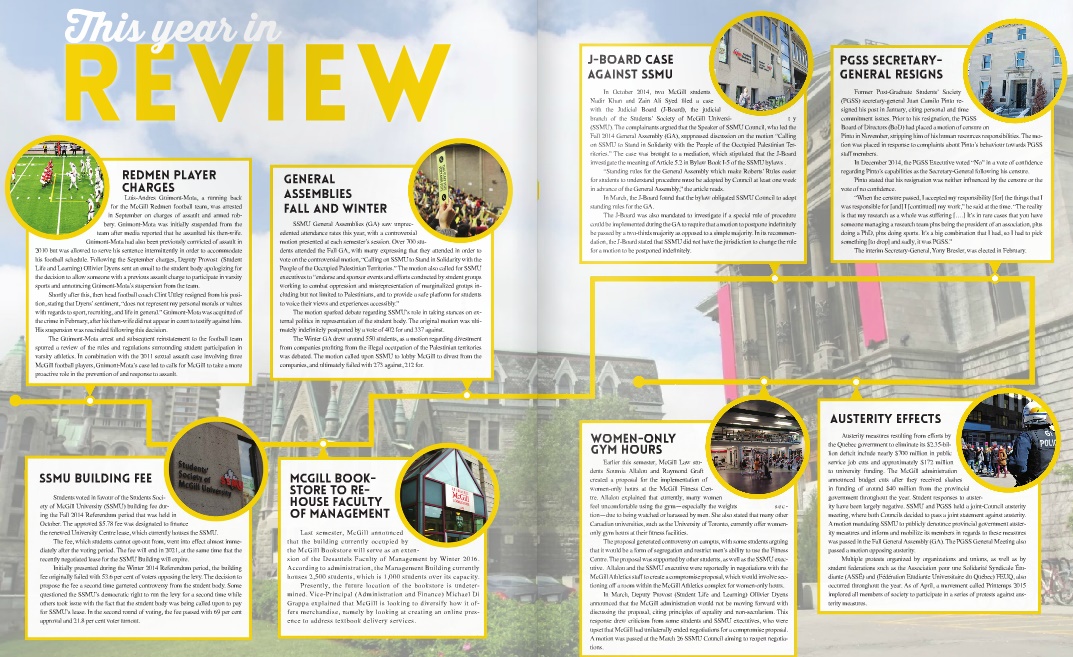
Anti-austerity march draws estimated 75,000 protesters

Tens of thousands of participants marched in a protest against provincial austerity measures on April 2. The protest was organized by student federation Association pour une Solidarité Syndicale Étudiante (ASSÉ). According to the organizers, around 75,000 people participated in the march, which convened at Square Victoria at 1 p.m. and continued for more than two hours through the streets, ending at Place Émile-Gamelin. The march was deemed illegal from its onset by the police because organizers failed to provide an itinerary of the route beforehand, but it nontheless remained peaceful. 

McGill students and union members were present at the march, including members of the Association of McGill University Support Employees (AMUSE) and  the McGill Law Students’ Society (MLSS). The MLSS had voted on April 1 to hold a one day strike on April 2— the vote passed by 61 per cent. Jacob Schweda, a Law student, explained that students in his faculty were concerned about the impact of austerity on the public sector. 

“I think people are particularly concerned about the effect austerity cuts will have on groups that we will serve in the future as lawyers. For example, freezes to legal aid ability, cuts to social assistance, [and] cuts to women’s groups, which really undermines equality,” Schweda said. “So there’s a danger of creating different classes of people and excluding people from society—and as future lawyers, we have an obligation to speak out against that.”

Andrea Palmer, a student in the McGill School of Social Work, said that although the social work student association had not officially gone on strike, students within the school were aware of and affected by the austerity movement. 

“As social work students, I think […] we are more aware than most people because we are directly affected working in the social, community, [and] health sectors,” she said. “For example, a lot of us work with marginalized groups and communities and we know that women and those who are more vulnerable in our society, like the lower socialeconomic status, are disproportionately affected by these cuts. We’re working every day and seeing these cuts affect the individuals we’re working with.”

 In addition to the large student presence, many families and social groups attended the march. Post-secondary students from CÉGEPs, such as Vanier College, and university institutions also decided to strike on April 2.

President of the Confédération des Associations D’étudiants et Étudiantes de L’université Laval (CADEUL) Thierry Bouchard-Vincent explained that around 20,000 students from Université Laval were on strike for April 2. 

“Most of our associations have a position on the [cuts to public services], but of course, what we [have] seen [for] months [are] the cuts in universities,” Bouchard-Vincent said. “Many have heard negotiations of how these cuts will affect the teachings and the number of classes and the offering of different courses.” 

He also stated that the society’s member associations had voted to take a unified stance. 

“All our associations took a position on a qualified majority on a caucus against the cuts in the public systems,” Bouchard-Vincent said. “We stay informed on the other activities of the other associations; we try to inform [students] of the effects of the cuts, especially on other universities, and inform and help other associations who want to take further actions.”

a, Features

Campus stories: Tracking a year’s worth of experiences

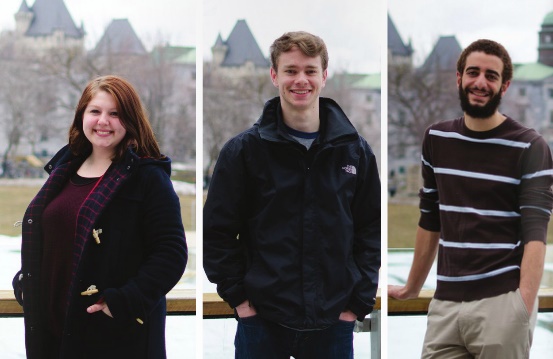
In August, The Tribune met with nine different students, who would then go through a year’s worth of experiences in Montreal and McGill. Each was asked to describe something important to him or her. Eight months later, we revisited their stories. 

a, Editorial, Opinion

Editorial: SSMU membership within federation necessary to advance students’ interests

The Students’ Society of McGill University (SSMU) is currently taking part in discussions to create a new student federation following turmoil within the largest provincial student federation, the Fédération Etudiante Universitaire du Québec (FEUQ). SSMU is currently not a member of FEUQ, but the recent disaffiliation from the federation by one of the most powerful member organizations, the Fédération des Associations Etudiantes du campus de l’Université de Montréal (FAÉCUM), has prompted SSMU—as well as 15 other students’ societies—to consider membership within a new federation. During this period of deliberation, SSMU should seek to join a federation that will be able to best advance undergraduates’ interests and use its bargaining power to successfully lobby the government to enact policies that better represent students’ needs.

A large student federation has the capability to advocate for student rights at a provincial level. While it has lost momentum recently with allegations of corruption and backdoor politics culminating in the disaffiliation of FAÉCUM, FEUQ and its recent issues have put a spotlight on SSMU’s need to belong to a federation. The increased attention towards the benefits of belonging to a federation—as well as the potential governance issues that can arise within such organizations—has brought up the question of what student associations should seek from a federation.

The interests of McGill students do differ from those of other student associations within a federation­. As an Anglophone institution with a large proportion of international students, McGill’s needs are unique within the province. For example, health insurance for international students, and upholding McGill’s interests as an English university, should be taken into account when guiding SSMU’s decision to join a federation. SSMU should thus seek out other student associations with structural similarities in order to best advance its interests—for instance, the undergraduate unions at Bishop’s University and Concordia University. Moreover, SSMU and the Post-Graduate Students’ Society of McGill University (PGSS), which is currently a member of FEUQ, could bolster each others’ strength and bargaining power by joining the same federation by virtue of their shared similarities from being at the same university. SSMU and PGSS rarely join forces to tackle issues that they both face—the first ever joint summit between the university’s two student associations was held this year was their first ever. Increased collaboration is necessary moving forward and the incoming executives for both should continue to engage in discussions.

During this period of deliberation, SSMU should seek to join a federation that will be able to best advance undergraduates’ interests and use its bargaining power to successfully lobby the government to enact policies that better represent students’ needs.

SSMU Vice-President External Amina Moustaqim-Barrette stated her intentions to consult students about joining a student federation at the beginning of her term. SSMU has since implemented the student experience survey, which consulted students on the issue, but there has been little else in terms of engagement or communication with students about joining a federation. Moreover, the survey should have been carried out earlier during the year so that SSMU would have the results now as they’re attempting to decide on a student federation. While Moustaqim-Barrette has attended several FEUQ congresses, the information regarding student federations has not been effectively communicated to students, something that the incoming VP External Emily Boytinck must rectify. Boytnick, should use the results of the consultation efforts to inform her actions next year and achieve membership within a student federation.

While consultation is necessary to determine student attitudes towards contentious issues handled by federations—such as opposing austerity—other less controversial matters that federations tackle have been ignored due to SSMU’s absence within a federation. Issues such as the need for bursary programs, health insurance, unpaid internships, and funding for the Office for Students with Disabilities (OSD), all of which the majority of student support, and which don’t require drawn-out consultation processes or negotiations, have fallen by the wayside. Therefore, SSMU executives should seek to join a stable and powerful student federation that will represent its interests at the provincial level as soon as possible. Where SSMU alone may lack the clout to advance the interests of its constituents, federations have the resources and the leverage to represent students and pressure the government to enact change on their behalf, which is why expedited consultation and more productive discussions should be prioritized in the coming year.

a, Science & Technology

This summer’s hottest apps

It’s important to remember that summer extends beyond the inevitable approach of tank tops, jorts, and Ray-Bans. Here are the Tribune’s picks of apps to augment the summer experience, whether it’s a soul-searching trip to South East Asia, one last road trip with friends after graduation, or the familiar comfort of that hometown sunshine.

Summer abroad

CityMaps2Go

Offline access is by far the most important thing to consider when picking apps to be used abroad. Depending on the country, data plans may not be available, and WiFi can be spotty at best. CityMaps2Go offers detailed and comprehensive maps for cities and regions around the world, from downtown Chicago to rural Romania. Download maps before leaving home and access them later. Most smartphones have built-in GPS capabilities that don’t require data. Use the GPS system and the app’s pins to make navigating new cities a breeze.

PackPoint

PackPoint is an app that curates packing lists based on the destination and type of activity. Triposo is a wiki-style app that offers detailed readings on different areas; use Triposo to brush up on the history of a city, a region’s customs, or the different types of food in a country. XE Currency offers conversions between different types of currency, and updates to real-time values whenever WiFi or data is available. 

Skype

Skype is invaluable in making phone calls whenever WiFi is available. Different residence preferences beget different apps; use Hostelworld to sort local hostels by price and rating, and use AirBnB to find cheap residences for a more local experience.

Home sweet home

GrillTime

Some of the most enjoyable summers are spent at home with a beer in hand and friendly company. Oftentimes these opportunities lend themselves perfectly to a BBQ and grill session, which is where GrillTime comes in. By selecting the meat, thickness, and preferred level of doneness, this app recommends a grilling time and temperature, with flip reminders to boot. 

BandsInTown Concerts

The app BandsInTown Concerts displays dates for upcoming shows and allows the user to curate the bands displayed based on the music on his/her phone and a set radius.  With summer’s propensity for high heat and fewer clothes, it’s important to keep in shape for the exhausting summer festivals and inevitable beach photo. 

RunKeeper

Use RunKeeper to maximize outdoor cardio sessions; the app features a route and distance tracker, pulls music from a specified playlist on the phone, and tracks the user’s progress towards his/her goal.


a, News, SSMU

Emily Boytinck elected SSMU VP External by 13 per cent margin

Emily Boytinck, U3 Science, was elected the Vice-President (VP) External of the Student’s Society of McGill University (SSMU) last Friday with 56.3 per cent of the vote. The opposing candidate, Joanna Schacter, U3 Arts, earned 43.7 per cent of the vote. 2185 students in total voted in the election, with 369 abstentions.  

Following the announcement of the results, Boytinck expressed her excitement and gratitude. 

“I just feel very relieved, and happy for all the support that I received during the campaign,” she said. “I’m really looking forward to connecting with the Montreal community more and really getting involved and connecting with other student associations across Montreal and in Quebec. I think that’ll be a really exciting part of the portfolio this [upcoming] year.”

The by-election for SSMU’s VP External position was held because no candidates were nominated during the initial SSMU elections campaign period. A nomination period for the by-election followed, and ended on March 20, with Boytinck and Schacter being announced as the two candidates.  

2185 students voted in the VP-External by-election compared to the 5465 students who voted in the SSMU elections. Boytinck underscored the issues of student engagement in elections at McGill.

“It’s a little disappointing that the turnout was lower for [the by-election],” she said. “I think that has not only to do with the fact that there is a lot of misinformation about what the VP External actually does, but also just apathy about politics in Quebec.”

Schacter expressed gratitude towards the students who had voted in the by-election.

“I’m grateful to each and every voter, not just to those who voted in my favour, but to everyone who did vote, even the abstentions,” she said. “I wish [Boytinck] the best of luck.”

Schacter also echoed Boytinck’s concerns of student engagement with SSMU elections. 

“We are a university filled with opinionated people,” she said. “There is no way that students have nothing to say, or that any existing apathy is innate. If participation is low numbers-wise, which it is, that is a symptom of a larger problem—one in which I believe that SSMU has a hand [in]. What SSMU does is by no means easy, but there needs to be a greater effort at outreach and accessible information, and, in particular, at representing a greater variety of students more equitably.”

Going forward, Schacter hopes that all issues and suggestions brought forward by both candidates during the campaign process will taken under consideration for the coming year. 

“We both brought a lot of great ideas to the table, and I hope that this election has [allowed Boytinck] to look at multiple perspectives and student issues that she will take into consideration going forward,” Schacter said. 

a, Art, Arts & Entertainment

Wall Art and Tan Lines

Summer in Montreal is the best time to catch up on our cultural quotas for the year: Time stretches out, schoolwork melts away, cash (hopefully) starts flowing in from summer jobs, and there seems to be a music festival for every weekend of July and August. Outdoor concerts and film screenings are given but no one wants to be trapped in a museum, so it’s easy to forget about the visual arts scene during the summer. However, Montreal has a plethora of opportunities to enjoy the visual arts while still soaking in as much Vitamin D as possible.

  • FIMA

    The FIMA (Festival International Montreal en Arts) is an outdoor art festival that shuts down a kilometre of Saint-Catherine Street for five whole days in the beginning of July. Considered the “greatest open-air art gallery in eastern Canada,” the festival features 120 established and emerging artists from various backgrounds. What makes it so unique is that the format allows for the general public to interact with the artists firsthand as they stroll from station to station—a process that is not included in standard gallery format. It also features short-film screenings, craft work demos, live painting, and multimedia performances. The entire exhibit is free to the public; all it takes is a quick stroll down Rue Saint Catherine.

  • Musée de Lachine

    One of Montreal’s most intriguing art destinations is the Musée de Lachine, featuring its famous Open Air Museum, a contemporary sculpture garden which spreads along the waterfront. In an open and natural space, the exhibit is subject to changes in the environment—daylight, weather, and season—allowing the visual experience to change hour-to-hour and day-to-day. The exhibit is bicycle accessible, so cyclists need not dismount!

  • The swings at Place des Arts

    It would be impossible to talk about outdoor art without talking about Montreal’s famous swings. Most people have seen them, as part of the Quartier des Spectacles at Place Des Arts, but not everyone knows the story behind them. Created by artists Mouna Andraos and Melissa Mongiat in conjunction with design group Daily Tous Les Jours, the swings are meant to create a collaborative music experience. The sounds and lighting adjust to body weight and movement, creating an individualized experience for all participants—but then harmonize with the other swings—to compose one universalized sound. The concept of the exhibit is meant to represent how community can be found even at the core of a fast-paced urban centre. And as you watch Montrealers and tourists of all ages and backgrounds stop to “play” on the swings, it is clear that it is a truly unifying experience.

  • Botanical Gardens

    Although not quite an art museum, the botanical gardens serves as a summertime feast for the eyes. The colourful display of flora, thematic gardens, and exotic greenhouses are interspersed with sculptures and season. There are virtual exhibits on topics such as “Open Windows on Japanese Gardens” and “Trees Inside and Out.” The botanical gardens are certainly an oasis of beauty and education within a metropolitan setting.

Outdoor art is scattered throughout the city and is cataloged in Bureau d’Art Public, an organization that manages municipal public art, including upwards of 300 works placed in parks, street corners, squares, and municipal buildings. The website lists the entire collection, complete with pictures and artist bios. Whether you are in Montreal all summer or just visiting for a week during Osheaga, don’t forget about the wonderful things that the visual arts scene has to offer.

a, Student Life, The Viewpoint

The Viewpoint: Back to the future

Priyanka Bijlani is a U3 student majoring in International Development. She will be pursuing a Master’s degree at the London School of Economics in the Fall.

It was just three years ago that the McGill Tribune asked me to reflect on my experience of entering McGill at the age of 16. Retrospectively, it’s hard to believe how quickly my undergraduate life has evolved—I will soon walk across a dais to receive my bachelor’s degree at the age of 19. From my first article written by my freshman self to this article, it is amazing to run through the trajectory of how my experiences at McGill on- and off-campus have paved the road for my future academic and career pursuits.  

Many changes have taken place during my time at McGill—the opening of Premiere Moisson, the closure of Sinfully Asian, and most recently, Rue Université being renamed Rue Robert Bourassa. On a more personal juncture, like most students, I have changed my major, minors, and career choices; however, my mindset on age remains unchanged. Age is just a number—the experiences are what take precedence in an individual’s development.

Although I was initially irresolute if McGill was the right choice for me, I can now wholeheartedly affirm that it has changed me for the better and moulded me into the graduate I longed to be. While I have managed to retain some knowledge that I once absorbed during my lectures in the massive Leacock 132 room, what has left an imprint on me as an undergraduate and as an individual were the extensive networks, opportunities I was exposed to, and the way of life in Montreal.

Throughout my time at McGill, I have noticed that a prominent topic of discourse amongst students is the limited resources making it difficult for focused guidance in career placements. However, I would disagree. While job hunting can be a competitive and cumbersome process, the trait on the trajectory to attaining anything is persistence and perseverance, and that is the prime element that has kept me positively driven. McGill’s educational environment is conducive to one’s success in that it offers students a magnitude of choices and options. Using these resources, it is up to students to go the extra mile to seek the opportunities, be it for our personal growth or career development.  

During my second year for instance, I was particularly interested in technology start-ups. In the process of trying to launch my own start-up—which didn’t take off—I ended up connecting with a McGill alumnus via LinkedIn and in turn joined his venture capital firm, The Founder Project. Here, I gained valuable insights by integrating myself into the professional and cultural spheres of life in Montreal.  Such experiences enabled me to build a league of my own through the common connections and liaisons I had established over time.

Amongst the numerous ways to get involved on campus, McGill offers programs that are unparalleled to other institutions. One in particular that contributed to my personal growth and career choice was the McGill Not-for-Profit Consulting (MNFPC) program. The MNFPC program allows students to gain consulting experience in the not-for-profit sector, which encapsulates my interests. This program not only facilitated the increase of my knowledge in this field, but also showed me how to apply myself professionally while also giving back to the community of Montreal that has given me so much.

Looking back at what I encountered—the apprehensions of being a 16-year-old froshie, being 13-hour flight away from home, and building a life in a new environment—I can now say without reservation that it was all worth it. The decisions that I have made along the way—both good and bad—have helped to mould me into a more independent individual as I step out into the world as a graduate, albeit still a teenager. With persistence, drive, and an open mind, you can make your experience here whatever you wish for it to be. From your peers to your professors and global network of alumni, McGill provides you with a solid foundation. Your success is contingent on how you choose to build from it.  

a, Arts & Entertainment, Music

Album Review: Clay & Alex – At Home

At Home marks local Montreal duo Clay & Alex’s debut release and, as the title suggests, is an eight-song album recorded entirely in their apartment. 

The opener, “Hot Shame,” leads the album off on a relatively calm, yet hopeful note, with something that sounds like a mixture of Bon Iver and Simon and Garfunkel, with a George Harrison-style guitar lead thrown in later on. However, the excitement is diluted by next two songs, “A Million Places” and “Kids,” which drag a bit. The vocal harmonies and dynamics are beautiful, but the slow finger picking and dreary tones make it feel like a sleepy dream, instead of propelling the album forward. 

Fourth track “All I Want” picks the album back up and introduces some of the album’s catchiest melodies. The clapping during the verse carries the arrangement and encourages you tap along. Following that there’s “Make it to Summer” and “Mom,” which, for the most part, maintain the characteristic dream like feel from before, but add a handful of new things; the former building on a bouncy waltz beat and the latter, a neat upbeat electric guitar melody. 

Album closer “Fight” starts off with an infectious gospel soul style vocal arrangement that set the stage for a big finale. However, when expected to hit its peak, Clay & Alex slow the song down until it ends abruptly, leaving much to be desired. 

As a whole, the snappier sections are more enjoyable because they contained more memorable moments while the slower sections seemed to lack punctuation.  

The entire album is pleasant to listen to and features some fantastic songwriting. It isn’t the most groundbreaking release, but that’s not what it’s meant to be. At Home could benefit from more variety, but demonstrates solid potential for whatever comes next from Clay & Alex.

a, Baseball, Sports

Baseball returns to the ‘Big O’ for annual exhibition series

Nobody cares about attendance during Spring Training—or at least, nobody is supposed to. Each year MLB teams take a trip to either Florida or Arizona to prepare for the upcoming season. Pitchers and catchers report to camp around mid-February, with position players joining them a couple weeks later. The pre-season starts up around the beginning of March, and while there are winners and losers, and competitions for roster spots, it all tends to feel as though very little is at stake. Nobody worries about how many people are in the stands for these games—ticket revenue does not make or break a team’s Spring Training. That’s what is so unique about the Toronto Blue Jays’ annual pre-season exhibition series in Montreal: Attendance is crucial and it feels as though the season is on the line.

It’s been over 10 years since the Montreal Expos moved to Washington, and until recently, there wasn’t much reason to believe a team would ever be coming back. The four Blue Jays exhibition games—the two this year and the two last March—however, have given Montrealers a reason to believe again. Over 96,000 fans attended the two games against the Cincinnati Reds at Olympic Stadium over the weekend, surpassing last year’s tally.

The games themselves were not all that exciting. The Blue Jays and Reds split the series, with the visiting Reds winning 2-0 Friday night and the ‘hometown’ Jays topping Cincinnati 9-1 Saturday. What these games represent, however, should excite baseball fans in Montreal. Despite a decrepit stadium, an extended holiday weekend, and the fact that these games do not truly ‘count,’ fans still showed up in droves, a signal to league officials that Montreal is serious about baseball.

“These are impressive numbers,” John McHale, senior vice president of MLB, told reporters over the weekend. “We thought that because of the Easter holiday and the novelty perhaps wearing off this year, there might have been fewer people for this year’s games. We wouldn’t even have thought that was bad.”

The possibility of baseball returning to Montreal has gained weight over the past few years thanks to the success of these games. Commissioner Rob Manfred recently stated that Montreal passed the first test in this process, but that a clear plan for a new stadium is necessary before a team moves to Montreal.

Though the weekend mostly centred on baseball potentially returning to Montreal one day, these games also offered a return of sorts to Montreal native and Blue Jays starting catcher Russell Martin. Martin signed a five-year contract with the Blue Jays as a free agent in the off-season and will be a key cog in Toronto’s lineup this season. While a trip to Montreal may not have been the main reason for his decision to sign with the Jays, it was certainly a welcome bonus.

Martin went hitless in both games, but still received a standing ovation from the Olympic Stadium crowd each time he walked up to the plate for an at-bat. His father, a saxophonist from Montreal, played the national anthem Friday night before getting to watch his son get the hero’s treatment from the raucous crowd.

With the MLB’s regular season now underway, the results of these two games are no longer of any consequence. Two games aren’t enough to indicate whether a city can support a team, but to make light of this weekend’s success would be a mistake. Spring Training games aren’t meant to have high stakes, but Montreal proved that doesn’t always have to be true.

Read the latest issue

Read the latest issue