Latest News

a, Science & Technology

Programming until sunrise

In a test of will power, determination, and innovation, McHacks presented an incredible challenge to its participants—twenty-four hours’ worth of non-stop creative coding fueled by energy-drinks. Traditionally, ‘hackathons’ are 24 to 36 hours long and invite coders to develop an application, website, or program. Those with the best, most creative, and useful program are judged by a panel and the top 10  teams are awarded prizes. However, the success of hackathons largely relies on sponsorship provided by industrial companies.

“Hackathons are only made possible by industry sponsors,” explained Deepanjan Roy, a U3 computer science and math major, and one of the 18 co-organizers for McHacks this year. “These sponsors come into the hackathon and stay up for the whole event and interact with the hackers, and there’s a lot of opportunity to talk to people in industry.”

These interactions help students better understand the technology they’re using and to better understand how the industries are operating. The representatives who come to the hackathons from these companies are generally engineers and possess a strong understanding of what the students are trying to accomplish. This year, some of McHacks’ major sponsors are Nuance, Vungle, Namecheap and Shopify. 

Hack McGill, which is responsible for organizing McHacks each year, was created by computer science students at the beginning of last year.

“There wasn’t really anything encouraging people to explore their own ideas, work on their own projects, meet people who wanted to do the same thing, and share common goals,” explained Xavier Denis, a U3 computer science student and one of the original founders of Hack McGill. “[After creating Hack McGill], we had over a hundred people, and since then, we’ve been trending upwards. We have around 1,000 members [today.]”

McHacks is not a McGill exclusive event, and welcomes students from other universities as well. 

“McHacks currently has 622 people attending this weekend,” Denis explained. “We have between 100 to 200 McGill students [as well as] people from Waterloo, from Philadelphia, from Maryland.” 

Part of the appeal of attending McHacks is that students often emerge after a grueling night of programming with job offers from the industry. According to Denis, around 10 per cent of the participants find jobs.

Furthermore, there is a wide range of projects that participants approach. Teams build funny, useful, and technical applications.

This year’s winners—hailing from Ontario—were Adrian Pawliszko, Karan Thukral, Julian Nadeau, and Vinny Crupi. The team developed an app called ‘Tendr’—a play on the word ‘Tinder’—that matches the user with restaurants in the area. The software is a native iOS app developed in Objective-C, a programming language. Other notable creations included ‘Banana for Scale,’ which converts any unit to ‘banana-size,’ a speed-reading app called ‘Parrot,’ and ‘Shades of Grey,’ an app that lets you know how many shades of grey are in a photo. ‘Mad Curves’ was given the HackBoard’s Choice award, designated for the organizers’ choice of best app. It was developed by Miles Cranmer, U0 Science, that uses Oculus Rift DK2—a virtual reality headset—to navigate a 3D graph of any equation. 

While McHacks may have ended, these students will continue to code and program for years to come. And the experiences they gain from events like these are invaluable.

 “[In computer science], the stuff you learn in school is not often very practical and applicable, so we have hackathons that teach you to build something instead of just learning the theory behind it,” Roy said.

a, Basketball, Behind the Bench, Sports

Behind the bench: Nothing but Nets

As long as I have been watching the NBA, I have been a New Jersey/Brooklyn Nets fan. Yes, those Nets. The team that has had a cumulative .447 winning percentage since the 2003-2004 season, the year I started following them. However, this is also the franchise that was purchased by a charismatic Russian oligarch in 2010, plays in a state-of-the-art arena in one of the most exciting cities in North America, and has been to the playoffs in six of the last 12 seasons  Supporting the Nets is very much a roller coaster of an experience.

Fandom is a complicated concept. At its core, it involves people spending incredible amounts of time and money supporting another group of people who play games in a particular uniform. A fan’s highs and lows can be reflected in how their team is faring, a phenomenon psychologists call ‘basking in reflective glory.’ Ever I became a Nets fan, there hasn’t been much glory to bask in. The Nets—both their New Jersey and Brooklyn iterations—should be a lesson in mismanagement for other franchises. Consider the facts: The Nets have cycled through eight coaches in the past 12 seasons, only two of their first round draft picks in the same time period still play with the team, and their basketball operations are running a $144 million dollar deficit—$131 million more than any other team in the league last season. 

The franchise hasn’t been a perennial cellar dweller by any means; rather, the Nets have been oscillating between functional and dysfunctional for more than a decade, and most often end up being mediocre. The Nets aren’t just mediocre though, they’re the worst kind of mediocre.They reel you in under the false promise of future success before collapsing under a heap of overvalued assets and perplexing losses—Toronto Maple Leafs fans should know this feeling very well.

This year’s wild trade deadline—nine per cent of the league’s players were moved—was more of the same. Early reports suggested that Brooklyn was a frontrunner to land Oklahoma City guard Reggie Jackson, a dynamic yet disgruntled player who had the potential to be a future cornerstone. In typical Nets fashion, they lost out on Jackson to the Detroit Pistons. They did, however, pick up Thaddeus Young, an above-average, albeit undersized power forward while only giving up a limited and aged Kevin Garnett. Two steps backwards, one-and-a-half steps forward.

The thing that bothers me most about the Nets is that they have no on-court identity, they are undeniably boring to watch, and they have no identifiable long-term plan. At least with the Philadelphia 76ers, who started off this season with 17 straight losses, fans know that there is a ‘process’ that the organization is trying to follow. 


It’s time to start over in Brooklyn. The endless .500 seasons need to end if the Nets ever want to achieve success with the way that the NBA is currently configured. The treadmill of mediocrity is the NBA’s wasteland, and the Nets have been residents for 12 tumultuous years now, pretty much the entirety of the time I have been an avid fan. What will make me happy as a fan now is not another playoff appearance and early exit, but rather a fresh start and a complete overhaul. Maybe then, the Nets will be more than nothing.

a, Science & Technology

The brightest and boldest futures

Students from the Faculty of Science often find themselves struggling to pick a path after graduation. Sometimes, when it feels like an M.D. or Ph.D. is the only option, a science major can feel trapped. In a series of presentations, McGill’s Biochemistry Undergraduate Society (BUGS) showcased the possibilities and the flexibility that a biochemistry degree can provide at its 2015 Alumni Career Symposium on Saturday, Feb. 21. Speakers included high school teachers, industry representatives, MD-PhD students, and urban gardeners.

“We want to show students that there are many other opportunities out there,” explained Alexandr Magder, U2 Science and representative from BUGS.

While the paths taken by these individuals were all unique, they all had one thing in common—they chose their path because they were interested in it.

“People are like ‘be a doctor or be a scientist,’ and I [said] no, I wanted to do both,” explained Adam Fontebasso, a graduate of the Honours Biochemistry program, who is in the clinical phase of medical school within McGill’s MD-PhD program.

An MD-PhD program gave Fontebasso an opportunity to fulfill his desire to work both in the lab and with patients. 

However, not everyone’s a ‘lab rat,’ explained Dr. Donna Rindress, who co-founded BioMedCom Consultants—where healthcare technology is adopted using evidence and rationale. Rindress, after completing a Ph.D. in biochemistry from McGill, delved into the industry world. 

“To work with industry, the most important thing to realize is that it’s not academic research, it’s pragmatic research—[you] have to give someone something that is useful,” she explained. 

Paul Farkas, now a Human Resources (HR) representative for industrial engineering giants in Calgary, echoed this need for pragmatism.

“Virtually every organization in the world will say, ‘In this company, we pay for performance,’” Farkas said. “I was interviewing for an [HR position in a] large nuclear energy company, and I asked the president, ‘How do you determine your compensation?’ He said it’s easy, ‘I pay for performance.’”

To prove this, Farkas, on his first day on the job, then using a series of performance analysis programs, found zero correlation between pay increase and performance—the company’s president wasn’t paying his employees for the quality of their work. Their salaraies, Farkas found, were solely correlated to their starting salary. According to Farkas, his ability to approach a problem like a scientist and to look at a problem empirically is due in part to his training at McGill. 

Powerful problem-solving skills are what helped Lauren Rathmell bring fresh fruits and vegetables to urban areas. Rathmell is the Greenhouse Director and a founding member of Lufa Farms, a for-profit urban farm located in Montreal. 

“There’s a huge greenhouse industry in Canada, but we’re doing things differently—strategizing and coming up with our own methods to do things,” Rathmell explained. 

While creating one’s own start-up is not necessarily the easiest task in the world, it is extremely rewarding, explained Rathmell—with this company, she is living and breathing her work.

While the idea of following a so-called ‘unconventional path’ can seem overwhelming, breaking the standard is something McGill bioinformatics professor Michael Hallet encourages everyone to do.

“Learn how to program, take some Bioinformatics, move to San Francisco, and walk into Google with some good ideas,” Hallet said. 

While that path may not be the one for everyone, the message remains the same.

“There are opportunities to work in other areas such as management consulting, teaching, or [even] becoming a patent agent,” explained event organizer Larischa DeWet, VP Internal for BUGS.

For a person who is bored by the idea of research or medical work, many options remain open—it’s just a matter of looking for them. 

a, Men's Varsity, Sports

Labrecque, Redmen cruise into OUA East Finals

McGill Redmen
2

Queen's Gaels
0

The McGill Redmen (21-5-0) showed why they came into the OUA East semifinals as clear favourites on Friday night, sweeping the best-of-three series against the Queen’s Golden Gaels (13-12-1) with ease. Following a come-from-behind 3-1 win in game two in Kingston, the Redmen will get a few days to rest before taking on UQTR in the OUA East Finals.

McGill went into game one of the series riding the momentum of back-to-back wins against Concordia and got on the scoreboard first with a redirected goal off the stick of star centre Cedric McNicoll midway through the second period.

Momentum in the game quickly shifted, however, as McGill began to get into serious penalty trouble. Queen’s tied it up on a power play goal just seven minutes after McNicoll’s goal, and succeeded in getting under the Redmen players’ skin over the last two periods. The Gaels, however, greatly underestimated the task of scoring shorthanded goals against McGill this season.

The Redmen, who had one of the top penalty-killing units in the CIS this year, managed to fend off five straight power play opportunities before striking back with a power play goal of their own with just minutes left in the third period. After getting the puck from star defenceman Samuel Labrecque, junior winger Jonathan Brunelle fired a shot at Queen’s goalie Kevin Bailie. The puck was tipped into the net by junior winger Patrick Delisle-Houde for the go-ahead goal.

The Redmen have now allowed just two goals over 20 power play opportunities in the playoffs thus far, but as any Redmen player will tell you, much of the credit goes to the man in net, sophomore Jacob Gervais-Chouinard. Head Coach Kelly Nobes has tapped Gervais-Chouinard as the team’s starting goalie in the playoffs, and he has not disappointed, posting a 4-1 record to go along with a .932 save percentage through five games.

Though Queen’s scored first in game two, the Gaels looked desperate in the face of elimination and the Redmen dispatched their opponents with a strong third period. Following what may go down as one of the greatest offensive regular seasons by a defenseman in OUA history, Samuel Labrecque began adding to his post-season legend, scoring twice in a 17-second span to put McGill up for good. It also happened to be his birthday.

After Labrecque’s one-timer off a pass from Brunelle knotted the score at 1-1, the referees called a penalty on a Queen’s assistant coach following a comment directed at the officiating team. Back on the power play, McNicoll wasted no time getting the puck back into the Gaels’ zone, quickly feeding Labrecque for another one-timer that caught Bailie off-guard. Junior winger Max Le Sieur added an empty netter with 50 seconds remaining to seal the victory for the Redmen.

Moving forward, the Redmen will need to continue to be lock down their end of the ice and make the most of their opportunities on offence—the deeper it gets into the post-season, the more consistency will matter.

a, Arts & Entertainment

Album Review: Imagine Dragons – Smoke and Mirrors

“I’m sorry for everything I’ve done,” confesses Imagine Dragons frontman Dan Reynolds on the opening song of the band’s second album, Smoke and Mirrors—something he should absolutely feel the need to apologize for. Whilst their debut, Night Visions (2012) was, albeit a bit of a mess, it was an exciting mess with huge, soaring choruses and energy to match during live performances. Smoke & Mirrors isn’t necessarily a step forward; it’s more of the same, but less. 

With “Shots,” the album begins with an upbeat, galloping drumbeat supported sound and showcases Reynolds’ surprisingly strong vocals. It’s an airy, falsetto-abound sound; however, that same airiness lacks a proper grounding and sincerity in the lyricism to support the emotional statements.

 This plagues the entire album. On “It Comes Back To Me,” Reynolds claims that it’s “all the things that worry are all the things you don’t believe,” without actually digging any deeper than proclaiming this. He then repeats “It comes back to you” numerous times as if to reiterate the point. It ends up being monotonous, uninspiring, and it would be nice if in fact the band didn’t ‘come back’ with more surface-level rubbish in the next song, “Smoke & Mirrors.” 

 Yet it doesn’t get any better; “I’m So Sorry” is a blatant rip-off of The Black Keys; “I Bet My Life” is a generic, overarching, swooping indie-anthem—a well-trodden path. “Gold,” despite its ‘Black Skinhead’-esque intro, is one of the most annoying and disjointed songs you’ll ever hear.

 Reynolds’ vocals are pretty good, and songs such as “Polaroid” excel with its stripped-back production and nursery-rhyme style. But even this fails to properly convey any sort of sincerity, and when coupled with lackluster production, Smoke and Mirrors is a lot of smoke without any fire.     


a, McGill, Montreal, News

Scholars examine racial discourse and practices in Canada, United States

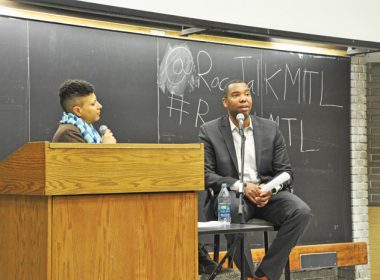
A panel discussion on the history and development of anti-black racial practices in Canada and the United States was held on Feb. 16 as part of the David A. Freedman Speaker Series. Titled “Discourses of Race: The United States, Canada, and Transnational Anti-Blackness,” the event was organized by the McGill Black Students’ Network, the McGill Debating Union, the Women of Colour Collective at McGill Law School, Media @ McGill, and the McGill Department of History.

Panellists included Dr. Darryl Leroux, sociology professor at St. Mary’s University; Frank Mackey, an author on black history in Canada and Quebec; and Dr. Charmaine Nelson, art history professor at McGill University.

Rachel Zellers, a PhD candidate at McGill who on critical race theory, moderated the discussion. She opened the conversation by reflecting on the interchanges of racial segregation practices between the U.S. and Canada. 

Zellers remarked that although Jim Crow practices are typically understood as uniquely American, they were also present in Canada.

“Jim Crow did not respect nation-state boundaries,” Zellers said. “Canadians turned to American Southerners for clear clues on how to handle blacks migrating into Canada, adapting Jim Crow to fit into Canada’s political archetype.”

She argued that the transnationalism of Jim Crow laws can be understood through historic moments in the U.S. and their influence in Canada. She highlighted the Fugitive Slave Acts, which were a pair of federal laws that allowed for the capture and return of runaway slaves.

“In 1850, for example, the implementation of the Fugitive Slave Acts in the U.S. took place,” she said. “At the same time in Canada, 1850 saw the enactments of legalized racial segregation in Upper Canada’s schooling system.” 

Zellers explained that between 1896 and 1911, the Canadian Department of Immigration created its own Jim Crow policies to deter black migration to the West. By 1911, the Laurier government instituted the first federal law in Canada based on racial exclusion that banned black immigration into Canada. 

“The Canadian Department of Immigration halted the migration of black farming families from the U.S. by sending its agents into Oklahoma and Kansas to pay bribes directly to prominent black American community leaders,” she said. “Black physicians were paid to tour and testify that a biological lack of fitness prevented black bodies to survive the frigid conditions in [the] Canadian West.”

Nelson, who explores race through art history in her teaching, then reflected on her own experiences at McGill, stating that students are often surprised by her desire to talk about race in a Canadian context.

“I have yet to encounter the Canadian student who enters knowing that slavery happened in Canada,” she said. “This is not a conversation that should be happening for the first time in a university setting.”

In the latter part of the panel discussion, Zellers focused the discussion on slavery in Quebec. The panellists agreed that Quebec’s relationship to racism and slavery was and remains particularly unique. 

“In Quebec, French people emphasize their marginalization rather than their privilege,” Nelson said. “They only ever speak of themselves as victims within the context of Canadian society, rather than oppressors [….] However, we need to talk about the need to maintain anti-ethnic practices.”

Zellers said that Quebec’s history has long been misrepresented, explaining that slave practices in Quebec were influenced by the U.S. and England.

“In New France, 17th century [French] colonists justified their indigenous slavery by closely observing French Atlantic slave practices [of black slaves],” she said. “They aimed to make their indigenous slaves ‘like negroes.’”

Near the end of the conference, the conversation became heated when Mackey suggested that slavery in Quebec took on a different form than it had in the U.S. Leroux quickly refuted Mackey’s claim.

“The only reason plantations were not present in Quebec is because it was unprofitable due to the Canadian climate,” Leroux said.

Zellers wrapped up the discussion by responding to Mackey’s remarks. 

“Those discrepancies or differences between how brutal or how less brutal slavery was in the context of Canada are not important to me at the end of the day,” Zellers said. “At the end of the day, when the talking point is really about one humanity, that’s all that matters. The differences in brutality serve a purpose in my mind that serves white people much more than black people.” 

a, McGill, Montreal, News

McGill experts discuss Supreme Court decision on physician-assisted death

The Supreme Court’s ruling on Feb. 6 against the criminal ban of physician-assisted death has sparked questions amongst McGill experts regarding Canada’s future legislation on the issue.  

According to the Supreme Court judgment, the Criminal Code that currently bans individuals from assisting others in suicide is in contradiction with the Constitution. The Court ruled that access to physician-assisted death should be granted to clearly consenting, competent adults who wish to remove intolerable suffering under terminal illness, disease, or disability by undergoing physician-assisted death.

Quebec had previously passed Bill 52 in June 2014, which ensured Quebecers access to medical aid in dying as well as palliative care­—healthcare for terminally-ill patients.

According to Pierre Deschamps, barrister and member of McGill Research Group of Health and Law, the Supreme Court’s framing of persons eligible for physician-assisted death is broader than Quebec’s Bill 52.

“The Supreme Court did not say that this would occur at the end of one’s life,” Deschamps said. “The Quebec legislation says that in order for one to  [avail] himself of the medical aid to die, [the person] must be at the end of his life—kind of a terminal position.”

The ruling of the Supreme Court would also allow for physician-assisted suicide, in addition to the physician-assisted death that Bill 52 addresses. 

“Physician-assisted death [is] where the physician will administer [the patient’s] dose of medication [inducing death],” Deschamps said. “Physician-assisted suicide [is] where the physician will provide the patient […] with the medication, and it’s going to be up to the patient to use or not use [it].”

Deschamps suggested that the Supreme Court’s judgement may result in changes to Bill 52.

“The Quebec legislation will need to adapt itself or [a] change of rule in order to comply with the Supreme Court’s decision based on the charter,” he said.

The Supreme Court refused to issue a constitutional exemption which would be special constitutional permission to the appellant to commit an act which is against a certain law. Instead, the court issued a declaration that the Criminal Code’s current invalidation of physician-assisted death is deferred for 12 months, leaving it to the federal government to make a legislative response. 

“[Issuing] such an exemption would create uncertainty, undermine the rule of law, and usurp Parliament’s role,” the court report reads. “Complex regulatory regimes are better created by Parliament than by the courts [….] We would suspend the declaration of invalidity for 12 months.”

Federal government and provinces will need to address the ruling through legislation within the 12-month period to replace the criminal ban invalidated by the court. In light of Quebec’s experience with Bill 52, however, Deschamps said that he believes 12 months might not be enough for thorough consultation and discourse. 

“Before the Quebec legislation was adopted, there were five years where there were consultations with [Quebecers], with the College of Physicians, with numerous groups,”  Deschamps said. “The Quebec government [then said] they would allow 18 months in order to prepare for the implementation of what is in the law. The Supreme Court gave the provinces and federal government a year to cover both aspects of physician-assisted suicide and physician-assisted death, and we all know that takes more than one year.” 

According to Robert Leckey, associate professor at McGill’s Faculty of Law, if the federal government will not draft a new law on physician-assisted death, provincial legislation would be even more necessary. 

“It’s just possible the federal government would say, ‘We’re not able to deal with this, we don’t want to deal with this, our voters don’t want us to deal with this.’” Leckey said. “If they do nothing […] it becomes even more important for provinces to [draft legislation].”

Margaret Somerville, professor at McGill’s Faculty of Law and founding director of McGill Centre of Ethics, Medicine and Law, raised concerns that the qualification for physician-assisted death in Canada, including Quebec, is set too low.

“The Supreme Court didn’t even mention that you have to be terminally ill,” she said. “The Supreme Court talked about [when] you have an incurable disease and you have suffering­—and the suffering is to be judged by you. If you said your suffering was unbearable, that’s what had to be accepted.”

Carolyn Ells, associate professor at McGill’s Faculty of Medicine, is based in the Biomedical Ethics Unit and suggested that such a choice to remove suffering by withdrawing from life should be available.

“[For some health professionals,] they see there are the rare cases where the end of life is truly unbearable,” she said. “They try and try to make it as best as they can, but it’s awful for some patients [.…] Even if you may not want to go [for physician-assisted death], maybe it is the right thing to do sometimes.”

According to Ells, physician-assisted death should not be a replacement to palliative care. She suggests that legalizing physician-assisted death should come with improving palliative care.

“For [physician-assisted death] in Quebec […] we’re not forcing that it is part of palliative care intervention itself, but it’s among many options people might choose [from],” Ells said. “People would still want palliative care [….] That is a very good motivation to improve the options.”

Somerville also advocated for more safeguards on the implementation of physician-assisted death if it is passed, such as requiring the authorization of a judge to proceed, similar to current procedures in detaining mentally ill patients.

“[It needs be ensured] that it is only used in rare cases,” she said. “Surely killing somebody is more serious than keeping a person in the [Allen Memorial Institute] for an extra day […] so it’s not an unusual thing to require.”

Ells also stressed the importance of respecting democracy in the legislation process, and that death should not be a taboo in public discussion.

“I’m in the waiting game too ,” Ells said. “Situations have changed because of the Supreme Court of Canada. In a democratic country where we value each individual person’s view, […] it’s important for people to talk about value and death [….] It can’t be avoided.”

a, Research Briefs, Science & Technology

Research Briefs—Feb. 24, 2015

  • Giving the finger

    The notion that there exists a correlation between the length of a person’s finger and their amicability may seem strange. However, researchers from McGill University are showing exactly that—but only in men. Scientists, by comparing the length of the index second finger (2D) to the fourth finger (4D), have created a reproducible standard for predicting behaviours in people known as the 2D:4D ratio.

    “Men with smaller 2D:4D ratios were more likely to engage in behaviours such as listening attentively, smiling, compromising, expressing reassurance and complimenting the other person,” explained Professor Debbie Moskowitz, lead author of the study.

    A person’s level of amiability can be made into a single mean by evaluating their reactions throughout the day, explained professor emeritus, Dr. Simon Young, a co-author on the study.

    “[Moskowitz] had developed a pretty nice method for looking at human social behaviour in everyday life,” Simon said. “People would check off various interactions that they had engaged in throughout the day.”

    For this study, Moskowitz and her colleagues studied 155 men and women over the course of 20 days and had them complete evaluation forms. From this data, Moskowitz was able to compile two major axes: Dominant or submissive, and agreeable or quarrelsome. The participant’s overall behaviour could then be averaged into one category. The team found that these character traits were directly correlated to the 2D:4D ratio.

    “The ratio of index finger to your ring finger for the 2D:4D ratio is related to testosterone exposure in utero,” explained Simon.

    Digit ratio has been shown to be determined by the amount of testosterone that the fetus was exposed to during development. According to past studies, it is highly likely that these same hormones affect development of the brain, which could account for the differences in behavior. Men with smaller 2D:4D ratios have had higher levels of hormone exposure, and were more likely to act agreeably with women, while the men with larger 2D:4D ratios had lower hormone exposure in utero, and were also more quarrelsome.

    “It gives this neat marker of what happened when an adult’s brain was developing,” Simon said.

    Other studies have shown that correlations exist between the 2D:4D ratio and the number of children a person will have, whether a person would be monogamous or not, and a person’s risk of developing cancer. Interestingly, these effects are absent in women.

    These results come as no surprise to the researchers and add to the ever-growing list of literature that relates digit ratio with behavioural and physical traits.

    “It’s interesting from two points of view,” Young said. “First of all, what is happening in the fetal brain can program the adult in this extremely specific way. And the second thing is human social interaction. This is just one more little piece in the puzzle of the factors influencing it, which we really need to know more about.”

  • New HPV vaccine effective against nine viral strains

    Two vaccines currently exist to protect against HPV. Cervarix is a “bivalent” vaccine, meaning that it contains viral antigens against two strains of HPV. It protects against the two most common cancer-causing strains, HPV-16, and 18, whereas “quadrivalent” Gardasil protects against four strains, HPV-6, 11, 16 and 18. Unfortunately, these aren’t the only strains that can cause cancer, and optimizing viral protection is key.

    In a recent paper in the New England Journal of Medicine a new vaccine—Gardasil 9—offers protection against the original four strains, as well as HPV-31, 33, 45, 52, and 58—making it nine-valent. When conducting clinical trials, this new vaccine showed a 20 per cent increase in protection against genital cancers in women between the ages of 16 and 26.

    While Gardasil 9 is associated with an increase in side effects from using the vaccine compared to its counterparts, the cancers that the vaccine protect against are not comparably dangerous. These side effects are expected due to the fact that the new vaccine has more viral antigens. The side effects include headaches, nausea, dizziness, and fatigue.

    Despite the assumption that only women should be vaccinated for HPV, in reality, it is highly recommended that HPV vaccines be administered to men and women. Men who have sex with other men and have not been vaccinated are also at risk from HPV-related diseases. Vaccinations contribute to protecting everyone, explained Dan Apter, lead author on the study.

a, Arts & Entertainment

Album Review: The Dodos – Individ

San Francisco indie band, The Dodos leaves behind its acoustic-folk sounds of 2008’s The Visitor and 2013’s Carrier for the neurotic industrial rock of its sixth release, Individ. The band’s usual intricate drum patterns and haunting lyrics make the album worth a listen, but the musical creativity of past works is lacking. 

The album has a promising opening, with the ominous guitar feedback and frantic strumming of “Precipitation.” Once the vocals pick up, there is a shift into heavy guitar chords but mundane melodies. Much of the guitar on the rest of the album falls into a pattern of sharp, repetitive strumming, which makes for a rudimentary sound.  One track that manages to stand out musically is “Goodbye’s and Endings,” in which both the percussion and guitar are more detailed and the electronic bridges add some variety.

While the guitar riffs are at times mind-numbingly drab, the haunting lyrics on tracks like “The Tide” show The Dodos’ strength as lyricists. Lines like “We’ll keep playing/ Until there is nothing/ There’ll be no room at the bottom” seem to mesh well with the anxious music. But the vocals of frontman Meric Long have never been The Dodos’ strength, and the indistinguishable groans on Individ are again flat and mediocre.  

It’s clear that The Dodos were trying to take its sound in a new direction, and while the fast and pointed guitar and percussion, feedback noise, and gothic lyrics prevent the album from being a total snooze fest, overall the album is forgettable.


a, Martlets, Men's Varsity, Sports

The week that was for McGill Athletics: February 24th

Athletes of the week

Samuel Labrecque

Birthday boy Labrecque scored two goals in 17 seconds to propel McGill to the OUA East finals on Friday. Labrecque was the key figure in McGill’s 2-0 sweep of Queens; in the series opener, he assisted both of McGill’s goals in their 2-1 victory. Labrecque doesn’t only show up on his birthday—he has been an offensive force this entire season. He leads all OUA players in playoff goals with five in as many matchups. He also scored 13 goals in the regular season, the most of any defenceman in the CIS. He is also only five goals away from the record for most goals in a season by a McGill defenceman and three away from holding the record for the most game winners in a season by a defenceman, all as a freshman. 

Alex Kiss-Rusk

Centre Alex Kiss-Rusk continued her front court dominance this week with strong performances against the Concordia Stingers and the UQÀM Citadins. She recorded 11 boards and 13 points against the Stingers on Saturday, two days after going 100 per cent from the free throw line on her way to a team-high 15 points, six boards, and three blocks against UQÀM. Her play was a big part of the Martlets out-rebounding their opponents by a lopsided 113 to 64. With the 6’4” Psychology major in the low post, McGill should feel confident matching up against any team in the playoffs.

Beyond the box score

Martlet Hockey

McGill (16-4) came back swinging in the third period against the Ottawa Gee Gees on Friday to win 3-1 and crush the Gee Gees’ dream of ending their 43-game losing streak to the Martlets. With the win and a Carabins loss in overtime against Concordia, McGill also secured the RSEQ division title. As a result, McGill will face Ottawa for the second straight year in the best-of-three RSEQ semifinals. Alexandria Serpico scored the game-winning goal three minutes into the third period, and Melodie Daoust continued her fine form as she slotted McGill’s 7th shorthanded goal this season to put the game out of reach with 29 seconds left to play. Brittney Fouracres also contributed a goal to the winning effort. McGill demonstrated its offensive dominance in outshooting the Gee Gees 46-9. The Martlets will undoubtedly be confident going into their matchup against Ottawa. They finished the season on a five-game winning streak, in which they avenged their ignominious 0-5 loss to the Montreal Carabins by defeating them 6-3.

Martlet Basketball 

By defeating Concordia (6-9) 65-53 on Saturday, the Martlets extended their conference record to 14-1 just two days after clinching the RSEQ regular season title for the fifth year in a row. Fourteen regular season games is the most a Martlet squad has won during Coach Thorne’s tenure. 

Forwards Mariam Sylla and Alex Kiss-Rusk continued their dominant play with routine double doubles. Both pulled down 11 rebounds apiece, while Sylla dropped 20 points and Kiss-Rusk tallied 13 points. The team out-rebounded the Stingers 39-21 on the back of these performances. Starting point guard Dianna Ros moved the ball effectively with six assists. McGill also improved its shooting performance from Thursday shooting 44.3 per cent from the field while holding the Stingers to 32.2 per cent. McGill will finish the season against Laval on Thursday, Feb. 27. The team will face either Concordia or Laval in the RSEQ semifinals based on the outcome of the final week of the regular season.


By the numbers

5 – The number of goals the McGill Redmen scored in their OUA East semifinal sweep of Queen’s, and the number of goals that defenceman Samuel Labreque has scored in the playoffs so far.

9 – The number of personal bests recorded by the McGill University swim team at the CIS Championships at the University of Victoria this weekend.

71 – The number of rebounds the Martlet basketball squad pulled down against the UQÀM Citadins. They added 42 more against Concordia on Saturay. 

Read the latest issue

Read the latest issue