Latest News

a, Student Life

Crossword: Holiday edition

Across

1. Eve’s companion

5. Klaus Teuber’s board game

10. Light in colour

11. Make amends

12. Response to a criminal charge

13. Slang for mother and father

14. Nun

16. A collection of objects

17. Narrow opening

19. America’s health agency

22. Phobia

24. Crazy Eights, sort of

25. Dispense liquid

28. Offspring

32. Supportive undergarment

33. Kate Winslet in Titanic

34. 5h30m ahead of UTC

35. Anthropod’s paired appendages

Down

1. Found on mobile devices

2. Artist of “The Persistence of Memory”

3. Malted barley beverages

4. Butcher’s inventory

5. Stephen King novel

6. Dined

7. A lot

8. A forced bet

9. Home of avian creatures

15. Film starring Will Ferrell

18. Type of dance

19. Young animal

20. Genetic instructions

21. Snake or beer

23. Bird or sidekick

26. Bear, in Latin

27. On a scale of one to 10

29. Charged molecule

30. 5h00m behind UTC

31. To perceive

World

This fierce blizzard has made February Boston’s snowiest month ever

This is some dummy copy. You’re not really supposed to read this dummy copy, it is just a place holder for people who need some type to visualize what the actual copy might look like if it were real content.

If you want to read, I might suggest a good book, perhaps Hemingway or Melville. That’s why they call it, the dummy copy. This, of course, is not the real copy for this entry. Rest assured, the words will expand the concept. With clarity. Conviction. And a little wit.

In today’s competitive market environment, the body copy of your entry must lead the reader through a series of disarmingly simple thoughts.

All your supporting arguments must be communicated with simplicity and charm. And in such a way that the reader will read on. (After all, that’s a reader’s job: to read, isn’t it?) And by the time your readers have reached this point in the finished copy, you will have convinced them that you not only respect their intelligence, but you also understand their needs as consumers.

© Image: KIERAN KESNER FOR MASHABLE

a, McGill, News

Black Students’ Network holds vigil in memory of Michael Brown

The Black Students’ Network (BSN) organized a vigil on Lower Field at McGill on Tuesday, Nov. 26, held in memory of Michael Brown, who was shot and killed by police officer Darren Wilson on Aug. 9 in Ferguson, Missouri. On Nov. 24, Robert McCulloch, prosecuting attorney for St. Louis County, Missouri, announced that the grand jury presiding over Wilson’s indictment hearing for Brown’s death had decided not to indict Wilson.

The grand jury’s decision was met with controversy throughout the United States and internationally, leading to protests in Ferguson and around the world. According to Richenda Grazette, BSN internal coordinator, the vigil was organized to bring together McGill students affected by this decision .

“[The vigil] was important to organize for us because we were greatly disappointed by the verdict, and we knew that a lot of other students and members of the community were likely feeling the same emotions as us,” Grazette said. “We were trying to send a message of support and solidarity, both with one another and with other ongoing protests across North America.”

The vigil itself was sombre and moving, according to Blare Coughlin, U3 Arts, who attended the event.

“There was just a very palpable feeling of mourning and apprehension,” Coughlin said. “This is about a black boy who was murdered, the refusal of the American government to acknowledge that black lives matter, and the institutional racism that permeates our lives.”

Grazette echoed these views, stating that the presence of attendees to the vigil was very powerful.

“I can only really speak for myself, but I found the vigil incredibly moving and positive,” she said.

Coughlin also spoke to the role of non-black allies in the discourse surrounding this case.

“Speak out, definitely,” Coughlin said. “But don’t speak over.”

In light of these recent events, last Thursday, the Students’ Society of McGill University (SSMU) Legislative Council passed a motion to work with BSN in standing in solidarity with those affected by police brutality.

Going forward, Grazette highlights the importance of continuing discourse about institutionalized racism.

“The most important thing is to not forget or stop talking about these issues, and especially not forgetting the names of lives lost,” she said.

a, Montreal, News

Thousands march in Montreal and Quebec City against provincial austerity measures

Tens of thousands of protesters participated in a march against the Quebec government’s proposed austerity measures on Saturday, Nov. 29. According to the organizers of the protest, the Collectif Refusons l’Austerité, over 125,000 people participated in both Montreal and Quebec City.

Protesters included representatives from student unions, employees of the public sector, and members of various social service groups. They marched in response to the Quebec government’s plans to cut $4 billion from the provincial government budget. The cuts would affect programs and services such as healthcare, daycare programs, and education.

Brian Leclerc, a member of the Canadian Union of Public Employees (CUPE), said he was unhappy with the government’s decision to slash social programs.

“We’ve made years and years of social progress in Quebec that this government is eliminating slowly but surely, and we’re going to be collectively in a situation of vulnerability if people don’t rise up,” Leclerc said. “Every social program there is, whether it be daycares, parental leave, healthcare, or education—these are all social programs that we’ve fought hard for and paid through the nose for [….] I hope it passes a clear message to this government that people won’t take this lying down.”

Stefanie Bergeron, a McGill graduate student and member of the Post-Graduate Students’ Society (PGSS), said she participated in the protest as a way to give feedback to the government on its actions, which she felt were not representative of the population’s demands.

“As a student, I’m directly affected by austerity measures,” Bergeron said. “I also work with women’s groups, and we’re […] more affected by austerity than men. I would like the government to realize that being elected doesn’t mean you have full power [….] The voice of your people matter.”

Representatives from the Students’ Society of McGill University (SSMU) and PGSS also attended the protest. The student bodies of both unions have previously taken a stance against austerity measures made by the provincial government at their respective general assemblies.

“Many students went to the protest in small groups of their own,” PGSS External Affairs Officer Julien Ouellet said. “In the future, we hope to find a way to create a single ‘McGill contingent’ with SSMU.”

Ouellet said that PGSS would encourage its constituents to better understand how austerity cuts impact them.

“I think it is important to adapt the message so that all the members of our diverse population realize how this might affect them, whether it be cuts in the variety of journals offered by our library system, or the university’s ability to cover the indirect costs of research,” Ouellet said. “We will do our best to make sure that our members understand that austerity is not an abstract economic concept but something that has a very direct impact on the quality of their degree, and the support they get while at McGill.”

Moving forward, Ouellet stated that McGill student unions will take more action to provide a unified stance against austerity measures.

“PGSS and SSMU are planning to hold a joint council meeting to identify the ways in which to fight austerity, as well as the trickle-down consequences it might have for our students within the university,” he said.

a, Arts & Entertainment, Theatre

Pop Rhetoric: Christopher Nolan and the cinema of abstraction

Christopher Nolan used to make movies about people. The director, along with his script-writing brother Jonathan Nolan, have made some of the best genre films of the past decade, including Memento (2000), Insomnia (2002), The Prestige (2006), and two-thirds of the Dark Knight trilogy. His recent movies—particularly his latest film, Interstellar—have confirmed a shift away from this trend. They have become increasingly lifted from their rooting in character and human motivation and more about vague concepts. In the past, he never backed away from touching on weighty ideas—magic, self-delusion, nihilism, rivalry, and scientific discovery—but those ideas used to come from how people related to them. Now, they’re mostly just afterthoughts, jumping-off points for ideas and mouthpieces for expository dialogue as he moves further into abstraction.

The backlash from some of his early fans started popping up around the time of Inception (2010)—the movie that has been the Rosetta Stone for all of his flaws as a writer and a director. You can see him struggle through the first hour of the film, as he has to create dozens of definitions and answers so the audience can get to a point where it’s not completely confused by the plot. The same thing happens in Interstellar, where the plot doesn’t really get going until a third of the way through the nearly three-hour movie. Since you have nothing real to hold onto character-wise except for some clunky and generic backstory, the eventual tearful goodbyes before launching Matthew McConaughey and Anne Hathaway into space doesn’t feel as propulsive and final as it should. If this sort of thing were to happen in one of his films, it would be an outlier, but the reality is that it’s becoming a pattern.

Compare his films from Inception, The Dark Knight Rises and Interstellar to any of his others. Before, he was able to blend concept and character in a way that made sense. He was able to find a path between his dogma and the characters in a way that seemed honest on a level both inside and outside of the world of his films. Memento communicated the dangers of misplaced anger and delusion not by being especially brilliant or groundbreaking on a philosophical level, but by making the main character a vehicle for these ideals while simultaneously keeping motivations and emotions in the foreground. The Prestige did the same thing with rivalry and Pyrrhic victory.

The turning point was The Dark Knight. It’s like he saw the positive reaction to the film and came to the conclusion that what people liked about it was its nihilistic ideology, psychological thought experiments, and everything about ‘living long enough to see yourself become a villain’—but this is only part of the truth. Those parts worked because they were tied to something real—all of the ideological conflict in the film came from the real-life conflict between Batman and the Joker. I don’t inherently care about nihilism, honour, or vigilantism just because they’ve been tacked onto celluloid—I care about them because the characters do, too.

After The Dark Knight, you can see his camera move further and further from the characters themselves as his lenses get wider, his shots encompassing more physical space but losing their grounding in the here and now. They’ve become increasingly maudlin and calculated, where the most lively character in Interstellar is an actual robot. As running times have ballooned from film to film, he paradoxically seems to put less content into each one, his creative talents seemingly more consumed with creating a world of physical spectacle than a world of personal effect. The results are films with all the energy of watching somebody puzzle through a Rubix Cube in real time.

Thus, nearly every character is treated as a silhouette – instead of taking the time to shade in character detail, he shades in plot points, which makes the impact of the movie suffer. An intelligent character, for instance, in his earlier work would have had the time to flesh out just what makes him so brilliant in the first place (see Nikola Tesla in The Prestige). In his recent movies, he’s relied on big-name actors to do the emotional heavy-lifting. The shading is gone and what we get instead is Michael Caine in Interstellar wearing a tweed jacket under a blackboard with a bunch of equations on it. “Take my word for it, he’s smart,” Nolan implies with these shots. “You don’t need to know how or why, or even what makes him interesting, but trust me on this, okay?”

A lot of this comes from what seems to be his desire to be the next Steven Spielberg, but he just doesn’t have the emotional touch necessary to make big-budget genre films work in the way that Spielberg does. Interstellar would have worked so much better if Nolan had cribbed some effect from Spielberg and let the characters take a moment to marvel at the wonders of science, or at least quietly contemplate their place in the universe. Instead, they go into space with gritty resolve, work through their mission out of a sense of obligation rather than passion, all while kowtowing to sci-fi tropes that ran out of cultural currency decades ago.

We see these massive wide angle shots revealing solar systems and black holes, and it’s clear that the audience is supposed to be experiencing the emotional wonder and exhilaration instead of the characters. But the truth is that the magic of the CGI’d cosmos is nothing when compared to the beauty of Tesla in The Prestige illuminating an entire field with light bulbs planted in the ground. The cruelty of a silent and airless universe cannot hold a candle to Carrie-Anne Moss’ malice in Memento when she berates and demoralizes an amnesiac just because she knows he’ll forget about it in a couple of minutes. The difference is that the latter examples are real – we can feel them because we’ve all been there in one form or another. The alternative is just computer imaging; it’s meticulous and pretty and well-composed, but ultimately as wide as an ocean and deep as a puddle. It would benefit Nolan to get back to the emotional core that made his earlier films so great, before he wobbles off into infinity.

a, McGill, News

Carbon monoxide leak at ECOLE sustainable housing project spurs implementation of new safety measures

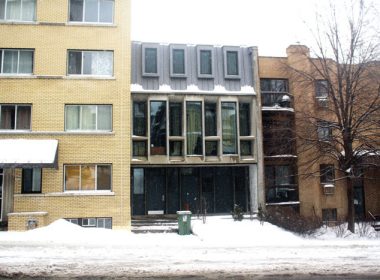
A student was hospitalized following a carbon monoxide leak detected Nov. 23 in the ECOLE sustainable housing project, which was launched earlier this semester. The ECOLE project house, located on 3559 University Street, is leased to ECOLE by McGill Student Housing and Hospitality Services (SHHS).

Kareem Ibrahim, a member of the ECOLE board of directors, explained that residents had experienced symptoms of carbon monoxide exposure prior to the leak’s detection.

“One of the facilitators had the initiative to ask for carbon monoxide detectors in some of the rooms because people were feeling a bit lightheaded,” Ibrahim said. “It turns out there was a leak.”

Managing Director (Residence Life and Customer Relations) Janice Johnson of SHHS explained that after receiving notification of the leak, SHHS facilities followed the appropriate procedures to fix it.

“There was a problem with the furnace [in the ECOLE house] that resulted in a carbon monoxide leak in the house,” Johnson said. “So we had to turn off the furnace and get that fixed [….] It [took] about 36 hours to get it completely fixed.”

Ibrahim and Johnson confirmed that one student was sent to the hospital, but that the student is recovering well.

“[The person] is doing great,” Ibrahim said. “It was a brief scare.”

Johnson said that other student residences have tested negative for carbon monoxide. According to Johnson, SHHS will be taking proactive measures to prevent future scares.

“Even though it’s not required by code, we have now put in local carbon monoxide detectors,” she said. “We are now looking into how we can have the detectors centrally monitored.”

a, Arts & Entertainment, Music

Student concert round-up

The Steel River Band and EMPEROR T and the Suspenders

In case you’ve never heard of Barfly (4062 Saint-Laurent) before, here’s what it is in a nutshell: A hole in the wall tucked between Roy and Duluth that hosts a bluegrass night every Sunday,  and is likely to be blasting hard rock or metal on any other night you walk in. Last Thursday night offered a microcosm of the bar’s unlikely dichotomy, as folk rock duo The Steel River Band opened for three-piece rock outfit and fellow McGill students, EMPEROR T and the Suspenders.

The first group, comprised of guitarist/vocalist/percussionist Alex Carey and mandolinist/percussionist Sam Quigley, kicked off the night with a mixture of traditional folk standards and more contemporary originals and covers. Despite boasting only two musicians, their foot-controlled tambourines gave them a richer sound than what their strings alone would have provided, and they had no trouble energizing the crowd, delivering impassioned renditions of Newfoundland classic “The Night Pat Murphy Died” and Johnny Cash’s legendary “Folsom Prison Blues.”

EMPEROR T and the Suspenders certainly kept the energy alive, playing a long set full of brief, uptempo rock/punk/funk tunes. The cohesion between drummer Robbie Rolin, bassist Joey Cowan, and guitarist/vocalist Alex Heymell—whose raspy, powerful voice is reminiscent of Chris Cornell’s—was definitely strong; but for next time, they should focus on quality over quantity, as Heymell consistently forgot lyrics and skipped verses on the band’s covers (“All Along the Watchtower,” “Johnny B. Goode,” “Where Is My Mind?”). However, they played like they were having the time of their lives on stage—and it rubbed off on the crowd—which in the long run, is much more important than a few lyrical gaffes.

— Max Berger

North Country Towers and Soulstice a Cappella

Since 2000, Soulstice a Cappella has been one of the most prominent a cappella groups on campus. Completely co-ed and featuring an eclectic mix of styles from the 1960s to today’s hits, the troupe’s sound is thoroughly relatable with just enough obscurity to keep you interested. Their latest performance, “After Midnight”, with opener North Country Towers, perfectly encapsulated their dynamic but fun style. My only wish was that I had been more awake when I arrived at Le Cabaret du Mile End (5240 Parc) on Sunday night, as the crowd around me was eagerly singing and bouncing in rhythm with the group. Each song was begging for you to sing along, and it is a true testament to the group’s talent that they managed to keep the energy going throughout the concert.

Not enough time is spent supporting a cappella groups on campus; it can’t be denied that the group has talent, so do yourself a favour and head out to their next performance.

— Morgan Alexander

Busty and the Bass

It’s fitting, that a band whose earliest jam sessions took place in the basement of Solin Hall, played the biggest show of their lives—so far—just a few blocks away from the McGill residence, under the bright lights of the Corona Theatre. Hundreds of students made the pilgrimage down to St. Henri to take in the free concert that Busty and the Bass received for winning the nationwide Rock Your Campus contest. It would have felt just like an indoor OAP—with TD providing the corporate presence that Provigo usually occupies—if not for the fact that no alcohol was being served.

Despite that minor setback for those who were looking to get a little tipsy on a Monday, Busty provided its own type of intoxication, mesmerizing the crowd as the band always does. The band was able to get through most of the songs in its catalogue, from the funky tunes like “Sum DrunkFunk” and “PS I’m Pregnant” to the wildly soulful “Mmmhhmmm”—even unveiling a Disney medley arranged by trombonist Chris Vincent. They eventually ceded the stage to the Arkells—veteran Corona Theatre performers who were excellent as usual—but surprised the crowd by coming out to join the headliners for spirited covers of Jackie Wilson’s “Higher and Higher” and Stevie Wonder’s “Uptight” to close out the night.

— Max Berger

a, News, SSMU

SSMU President, Speaker of Council respond to Fall GA J-Board case, deny charges

On Nov. 16, Courtney Ayukawa, president of the Students’ Society of McGill University (SSMU) and Rachel Simmons, speaker of the legislative council of SSMU, released an official response to a recent Judicial Board (J-Board) petition filed by Zain Ali Syed and Nadir Khan over the practices of the Speaker at the SSMU General Assembly (GA) held on Oct. 22. The response asks the J-Board to dismiss the case. (more…)

a, News, PGSS

PGSS Executive midterm reviews

Brighita Lungu
Ge Sa
Jennifer Murray
Juan Pinto
Nikki Meadows
Julien Ouellet

(pgss.mcgill.ca)

This week, the McGill Tribune conducted midterm reviews of the Post-Graduate Students’ Society (PGSS) executives.
Click on the portraits to learn more.
Members Affairs Officer, Brighita Lungu
Lungu has been working on several projects, including the #ConsentMcGill campaign and mental health initiatives. She acted as a PGSS representative in the Sexual Assault Working Group, acting actively to recruit graduate students to become involved.
Lungu is also currently engaged with a number of mental health initiatives, including organizing a two-day mental health first-aid training for executive officers, commissioners, and graduate students to take part in. She is also working in collaboration with Mental Health Services, Counselling Services, and the Peer Support Network on a video which will include testimonials from students, that seeks to address and decrease the stigma associated with mental health issues. According to Lungu, the project has fallen behind schedule and the video may not be able to be released in February as originally planned.

Internal Affairs Officer, Ge Sa

According to Ge Sa, officer responsible for organizing events for PGSS members, he has had a busy calendar this year, with events such as the Summer Dodgeball League, the Habs ticket sale, and the PGSS Halloween Party. Turnouts at events this semester have been larger than before, according to Sa.
This year, Sa has been trying to organize more family-friendly events to accommodate PGSS members who are also parents.
“We have had, among others, an outdoor movie night […] an apple-picking trip, special ticket deals to the Botanical Garden, La Ronde, and many music or comedy shows,” he said. “We’ll [also] be having a Holiday Movie Marathon Week in December at Thomson House.”
Sa believes that financial support is an area of improvement that his portfolio could benefit from. He is currently working with Pinto to establish an Intramural Sports Grant, with an aim to encourage members to be more physically active. They are also working on a project to improve Thomson House, but both projects will require significant financial support.”

Academic Affairs Officer, Jennifer Murray

According to Murray, there has been an increase in student participation on university committees this year.
Murray worked on the amendments to the regulations and guidelines for graduate student supervision, which were passed in Senate in October. The amendments increased accountability for both the supervisors and the supervisees, and is part of the long term push to improve advising for graduate students.
Also, as part of her portfolio on library improvements, Murray recruited graduate students to sit at feasibility study groups for the library master plan.
Murray, also explained that the transition of over 1,200 graduate students, postdoctoral, and clinical fellows to the new Glen superhospital will pose challenges to PGSS members, and she will be working to support students during the move.

Secretary-General,  Juan Pinto

Pinto’s push for redesigning PGSS’s internal judiciary is one of the main highlights of his work thus far. The Judicial Board—formerly the Board of Appeals—will be restructured so that it will require a law student to deal with procedural issues, and that judges be nominated and approved by councils rather than appointed.
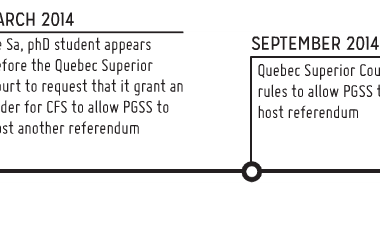
The biggest challenge for Pinto remains pushing a PGSS referendum to separate from the Canadian Federation of Students (CFS). After 5 years of litigation, the Superior Court of Quebec granted a PGSS member the right to ask for a referendum to leave CFS—a step in the right direction for all of PGSS, according to Pinto. However, the main challenge for Pinto and the rest of PGSS remains the referendum itself, and it remains to be seen how the process will unfold.

Financial Affairs Officer, Nikki Meadows

In her first semester on the job, PGSS Financial Affairs Officer Nikki Meadows has successfully amended two major funds under her portfolio. According to Meadows, the process of applying for grants is more streamlined and more transparent, with the selection criteria more clear to applicants. The Post-Graduate Student Life fund was also overhauled. The first major change allows Post-Graduate Student Associations to have more control over the Student-Life fees that are collected from their membership. In addition, the Association of Postdoctoral Fellows will receive 25 per cent of the Student-Life fees from each post-doctorate for the first time. According to Meadows, the lease negotiations for Thomson House with McGill are still ongoing.

External Affairs Officer, Julien Ouellet

As a representative of McGill graduate students to student groups and the Quebec government, Ouellet’s largest project this term has been to continue his predecessors’ work lobbying for revenue neutral health insurance for international students, which he has been successful in doing. Smaller successful projects include his organization of a conference with the president of the Canadian Institutes of Health Research (CIHR), a draft of the new Frais Institutionals Obligators (FIO) policy, and the organization of a GU15 conference—an annual conference between 15 research intensive universities as a way to share and collaborate information.
According to Ouellet, the major challenge he has faced has been austerity measures and the difficulty of implementing a subsidized Société de transport de Montreal (STM) pass for students who are older than 25. As the STM is currently operating under a deficit, Ouellet remains optimistic that he will be able to complete this initiative once the STM has balanced their budget.

a, News, SSMU

Fall 2014 SSMU Executive midterm reviews


Stefan Fong

 
Kathleen Bradley

 
Claire Stewart-Kanigan

 
Courtney Ayukawa

 
J. Daniel Chaim

 
Amina Moustaqim-Barrette

This week, the McGill Tribune conducted midterm reviews of the Students' Society of McGill University (SSMU) executives.
Click on the portraits to learn more.
 

VP Clubs and Services, Stefan Fong
 
 
Coming into the position with a year’s worth of experience, there were high expectations for Stefan Fong, vice-president clubs and services, to build upon his past endeavours.
Fong has been more proactive in pursuing long-term goals. He has completed the research stage of the Club Hub, and hopes to have it implemented by the end of his term. Fong has also started a pilot testing of myInvolvement, which has become available to 25 clubs. In addition, Fong has begun to lay the groundwork for the 10-Year Development Plan for SSMU, as well as the reorganizing of the fourth floor of the SSMU building.
Last year, Fong faced criticism for being unresponsive, particularly in regards to responding to emails, and failing to be proactive when working with clubs. However, Fong appears to have addressed these issues, responding to emails more readily and increasing his cooperation with clubs. Club workshops, for example, saw the participation of over 160 clubs.

VP Finance and Operations, Kathleen Bradley


Despite overseeing the passing of the SSMU Building Fee as the referendum's campaign manager, Bradley has faced many challenges with the SSMU budget. The student-run café (SRC), the Nest accumulated a $76,282 deficit this year, which Bradley attributed to startup costs and a discrepancy between what students want in terms of locally sourced ingredients and affordable food. As the Nest is first and foremost a student-run café, it is important for Bradley to continue consultation about how the Nest can be well-received by students, especially in light of its deficit and recent complaints by students about expensive food on campus. As the original intention for the Nest was for it to break even as an operation, it is concerning to see it struggle financially.
Bradley also presented the 2014-2015 global budget at a recent Council meeting and with student media outlets on campus, which was an effective way of communicating and clarifying aspects of the budget. She also worked with a graphic designer to present the budget in an accessible manner.
Bradley recently raised important concerns about the fee consolidation that McGill proposed, advocating for students in her insistence that the consolidation would not be transparent for students.

VP University Affairs, Claire Stewart-Kanigan


With the first ever Mental Health Week wrapping up last week, Stewart-Kanigan has shown initiative for mental health and other portfolios under the VP University Affairs. Even after Mental Health Week ended, she has proven to continue prioritizing mental health, as she is now working on development of a Mental Health Facebook page and listserv.
Stewart-Kanigan also led SSMU’s collaboration with the #ConsentMcGill campaign, with a panel held by the SSMU Equity Commissioner during that week. Beyond that, she has also continued work on the sexual assault policy, which has undergone continuous review by a working group and has been publicized to the student body through an open forum and website.
As an active advocate for students, Stewart-Kanigan has called for more student representation and engagement at the annual joint board-senate meeting earlier this month, and asking councillors to reach out to their constituents prior to the Town Hall on the library master plan. Furthermore, she conducted consultation for the library improvement fund, which is also a key part of her portfolio.

President, Courtney Ayukawa


Ayukawa has presided over many accomplishments and drawbacks in her first term. Most notably, the Fall 2014 General Assembly (GA) saw participation of over 800 members of SSMU­­—attributed in part to the controversial motion on solidarity with Palestine. We hope that Ayukawa and the executive team can find a way to continue to engage with the student body and encourage attendance in the Winter 2015 GA.
Her enthusiasm for sustainability has translated into many efforts to bolster the green aspect of the president’s portfolio through environment commissioners and long-term studies. This supplements the aspect of her portfolio weakened last year when its mandated coordinator was cut due to budgetary issues.
Ayukawa has fielded a number of unforeseen circumstances this year, including two Judicial Board (J-Board) cases, and a provincial case questioning the validity of the election of her as president, which has since been dropped. With the first J-Board case resolved and the court case dropped, we hope that Ayukawa can continue her job more smoothly in the next term, including overseeing the hiring of a new general manager for SSMU.

VP Internal Affairs, J. Daniel Chaim


This year, Chaim led the planning and development of a frosh that saw a $3,600 deficit in its over $200,000 in operations, compared to last year’s deficit of $21,000, which was a significant improvement in budgeting. With the recent Students’ Society Programming Network (SSPN) event, Chaim also appears to be expanding the events planning section of his portfolio in a positive way.
4Floors, the SSMU Halloween party, also ran a $5,281 deficit due to unforeseen security costs due to construction around McTavish extending into November. As 4Floors ticket prices were increased this year, and because the construction has been ongoing since the summer, this deficit was another example of unsuccessful budget planning, and it is imperative that the SSMU executives work to take a more proactive approach to anticipate and consider all expenses, particularly amidst student criticisms of SSMU’s money management.
Another initiative Chaim has taken is for the consideration of a publications fee for the Old McGill yearbook, which has seen drastically declining sales in past years. The fee would help fund the distribution of the yearbook to all students. Although this may standardize the distribution of a university keepsake, students have been wary of extraneous fees recently, and this may be another addition to the tensions between students and SSMU.
Chaim should also continuously seek the methods for feedback and concerns of the undergraduate student body as it falls under his communication portfolio. When SSMU-student relations are tenuous, the VP Internal should prioritize methods of communication not just through listservs and mass distribution of information, but through two-way conversations and debates. The recent motion approved by the legislative council to establish an Ad-Hoc Student Engagement Committee will hopefully aid Chaim to these ends.

VP External Affairs, Amina Moustaqim-Barrette


Following SSMU’s withdrawal from the Table de Concertation Etudiante du Québec (TaCEQ), Moustaqim-Barrette has attempted to create working relationships with student unions at Concordia, Université Laval, Université de Montréal as well as student federations such as the Fédération Etudiante Universitaire du Québec (FEUQ) and the Association pour une Solidarité Syndicale Etudiante (ASSÉ). However, no official consultation with the student body has taken place and no formal action has been initiated beyond regular meetings with representatives from other student bodies and federations, a troubling concern in the light of a renewed round of budget cuts by the provincial government.
Additionally, it is difficult to hold her accountable for her efforts because no reports have been produced for the student body that detail her work. While we applaud Moustaqim-Barrette for her lobbying initiatives, these efforts have largely not been publicized or communicated properly to the student body.
With regards to community affairs, she has maintained a positive relationship with the Milton-Parc Citizens’ Community and assisted the Social Equity and Diversity Education (SEDE) office during Community Engagement Day.
In the coming semester, we would like to see Moustaqim-Barrette take further measures to consult the student body to learn what students want from their student union in regards to external actions.

Read the latest issue

Read the latest issue