Latest News

a, Features

Ladies sing the blues

With Kim Kardashian’s recent front page butt-spread on Paper Magazine and Nicki Minaj’s “Anaconda” music video fuelling more “How to twerk” YouTube videos than ever before, it seems that we have finally reached an era of women in control of the mainstream media. (more…)

a, Martlets, Sports

Martlets fly past Ravens

McGill Martlets
6

Carleton Ravens
2
 

(more…)

The Arts Lounge of AUS McGill
a, News, SSMU

Inconsistencies with BdA alcohol permits among reasons for resignation of AUS VP Social

VP Social resignation and BdA improprieties

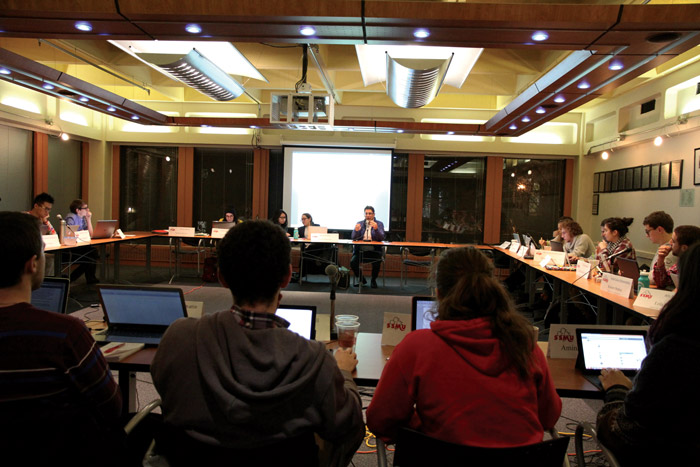
During last Wednesday’s Arts Undergraduate Society (AUS) Council meeting, the AUS discussed the replacement process for Kyle Rouhani, who recently resigned as VP Social. According to a statement by Rouhani on his Facebook page, he decided to resign “for reasons of extreme personal, academic, and emotional duress met during the role.”

According to AUS President Ava Liu, issues involving alcohol permits for Bar des Arts (BdA) also factored into Rouhani’s resignation.

“There were improprieties [with the BdA liquor permit] which were symptoms, the VP Social says, of his inability to fulfill his portfolio due to […] duress,” she said.

She declined to elaborate further “out of respect for the VP Social.”

Liu further stated that BdA’s operation would not be affected by the resignation.

“BdA is run by a team under the VP Social portfolio [….] They’re very competent and they’re working very hard,” Liu said. “The liquor permit has been processed by the VP Internal of the AUS, so she will be taking over that role [….] Permits are secured for the rest of the semester and for next semester too [….] There are no repercussions going forward.”

Rouhani is the third AUS executive to resign this year, following the replacement of the VP Finance, Kateryn Kim by Li Xue and the VP Internal, Leila Alfaro by Roma Nadeem.

Replacement process and portfolio discussion

Liu outlined two options moving forward, a by-election or an appointment. Council members expressed concern that, under the appointment system, only current members of AUS standing committees can be considered. A straw poll revealed, however, that most councillors were also opposed to a by-election as the process would take a long time.

“It’s too late to hold [a by-election] without running into exam period, and if we go into next semester, we won’t have someone in the role until mid-February,” Liu said. “Therefore, I don’t think [a by-election is] feasible.”
After further discussion, the council reached a solution that addressed the councillors’ concerns.

“I will send out a callout to AUS for people who are interested in running for the position to fill out the Event Planning and Implementation Committee (EPIC) application form […] and from there we will hold an appointment next session,” Liu said.

Liu explained that EPIC already consisted of most of the candidates who were to run for the vacant portfolio, and any interested candidates currently not on one of the AUS’ committees could make themselves eligible for appointment by applying for one of the many empty seats on EPIC.

With the replacement process decided, discussion moved onto the portfolio itself. Members of the council and the audience called into question the portfolio’s structure, citing the stress associated with transitioning from frosh into the school year.

“I think that the new VP Social should not have the responsibilities outlined in the portfolio for the rest of the year and should instead focus on restructuring the portfolio,” Christine Koppenaal, U1 Psychology, said. “I think that there’s an inherent problem with the portfolio as demonstrated by the fact that this is not the first VP Social to resign in the last few years. The […] portfolio is just too overwhelming for one person to handle.”

Arts Internship Office (AIO) Fee

Xue met with the Financial Management Committee (FMC) to discuss the structure of the proposed $2.25 per credit fee to reform advising and career services. The FMC recommended that the financing be modelled after similar faculty-specific services such as the Desautels Career Service (DCS) and the Engineering Career Centre (ECC). However, there was disagreement over the fairness of imposing $1.5 million of the endowment fund on Arts students over the next five years.

“There was a split on whether or not the endowment model was the recommendation, because [it seems] like a certain pack of students [will be paying] for future students to access these services,” Xue said.

Xue offered several solutions to this issue, including extending the endowment period over a greater number of years in order to spread out the costs. VP Academic Erin Sobat proposed to set aside time in the next council meeting for a town hall to discuss the fee.

SNAX sandwich freeze

Sobat met with Deputy Provost Ollivier Dyens to discuss the recent order from the university to discontinue sandwich sales at SNAX, a snack and beverage stand run by the AUS. Following years of selling sandwiches, the administration recently ordered SNAX to stop its sales, claiming that they had only discovered the violation of the Memorandum of Agreement (MoA) this year.

According to Sobat, Dyens was against renegotiating SNAX’s MoA with the university, and mentioned that he was concerned that allowing concessions to SNAX would open the door for other student organizations to violate their MoAs.

“I pointed out that this is not a pattern of opening doors; this is a pattern of closing them,” Sobat said, in reference to the closure of the popular student-run Architecture Café by the administration in 2010.

“Moving forward, our goal is to set up a meeting with the Provost and a representative from [McGill Food and Dining Services] to find a solution,” Sobat said.

Xue said she met with SNAX Manager Hasan Nizami, who was optimistic about the establishment’s survival despite being unable to sell sandwiches.

“They are introducing new options,” Xue said. “For example, kosher food […] and Indian [meals] such as butter chicken […] because [they are] finding that a lot of the sandwich customers aren’t coming back.


a, McGill, News

Town hall on libraries: Rethinking McLennan for the 21st century

Students, faculty, and staff were invited to a Town Hall meeting last Tuesday to discuss their priorities for the future of the McLennan Library. (more…)

a, Arts & Entertainment, Music

Pop Rhetoric: Cereal killer—Why Usher’s promotion is wrecking his image

Besides attracting local attention for walking around the Plateau wearing a raccoon hat before kicking off his current tour in Montreal, Usher has made headlines recently for following in the footsteps of generations of toy manufacturers and announcing that his latest single will be exclusively distributed as a cereal box prize. The song, “Clueless,” won’t appear on his upcoming album UR, and, for at least the foreseeable future, the only way to legally own it will be to purchase a specially-marked box of Honey Nut Cheerios from Walmart and then download it using a digital code. Usher is just one of many artists to entertain unconventional promotional techniques in a market where music sales have diminished greatly. He’s certainly not the first to receive corporate sponsorship prior to a release—but by inextricably tying the sale of his single to two non-musical organizations, he’s only damaging his own artistic image and opening the door for companies to negatively impact the music industry.

When I use the phrase “damaging his own artistic image,” I don’t mean to say that Usher is some kind of a sellout for agreeing to promote his music in partnership with Walmart and General Mills. He’ll be heavily compensated for his efforts and even if he has an estimated net worth of $110 million already, Usher has every right to try to increase that number.

The issue with Usher’s decision, however, is that he’s not just using the companies as a platform on which to promote his song—or even giving consumers the option to let a company profit while supporting his work—his song essentially is one of the companies’ products. Fans who want to download “Clueless” are now obligated to make a trip to Walmart and leave with a box of Honey Nut Cheerios. As with any promotion, it’ll be a welcome offer for some and a complete annoyance for others; but unlike a regular promotion, there’s only one distributor for Usher’s song. It’s a disservice to fans to ask them to purchase something they may not want in order for them to own a copy of an artist’s work. Even if “Clueless” were to be Usher’s best song to date, the terms of its release will still stand as something capable of alienating fans—not to mention making it tougher for many to take him seriously as an artist.

Because album sales are no longer the robust revenue source they once were for musicians, the lure of corporate sponsorship is tempting, and corporations stand to gain the most by offering promotions  to artists like Usher that fuse together commodities from a purchase standpoint. It remains to be seen whether or not this type of deal will actually begin to frequently affect the music industry, but it’s already clear that the biggest and wealthiest artists aren’t immune from going for it. Even Jay-Z—Hova himself—agreed to a promotion for 2013’s Magna Carta Holy Grail that allowed Samsung to distribute one million copies of the album three days early to fans who had bought certain products of theirs and paid him $5 million. Of course, the album was made available to other retailers after those three days, but it’s an example of the power that even fleeting exclusivity can bring.

The irony in the Usher discussion is that in spite of the exclusivity that Walmart and General Mills have with the Honey Nut Cheerios promotion, anyone who wants to can realistically find “Clueless” on the internet and listen to a free stream—I certainly did. Still, for those who have nobler ideals when it comes to supporting their favourite artists, there’s no reason they should have to also support a company they haven’t directly chosen to endorse. Or, perhaps if a financially secure artist insists on tying the sales of their music to an unaffiliated third party, they can learn from Taylor Swift, who is donating the proceeds from her recent single “Welcome to New York” to New York City public schools. Maybe Usher’s real motivation in all of this is taking responsibility to ensure that his fans understand the value of a proper breakfast, but in the almost-certain likelihood that that isn’t the case, he should get a clue and find a new way to promote his single.

a, Arts & Entertainment, Music

Deep Cuts: Shoegazey gems—Diamonds on the soles of your shoes

40 Days

Artist: Slowdive

Album: Souvlaki

Released: May 17, 1993

Maybe Brian Eno’s production has something to do with it, but this song is almost too joyful to be classified as shoegaze. Verging on dream pop, the track opens with loud and pulsing synthesizers, while a quick tempo will have you nodding along with lyrics you can’t quite make out. As the chorus builds up, the words are completely drowned out by a wobbling synth melody. The perfect song to make you forget the final you just flunked.

Sometimes

Artist: My Bloody Valentine

Album: Loveless

Released: November 4, 1991

https://youtube.com/watch?v=t0dJqlvOSq4

No shoegaze list could be complete without a track from My Bloody Valentine’s masterpiece, Loveless. You may remember this nostalgic ballad from the soundtrack of Lost in Translation (2003), playing in the background as Scarlett Johansson observes the Tokyo night through a taxicab window. Buried beneath Kevin Shields’ trademark amplified open-string noise, a melodic keyboard hook rises steadily in pitch throughout the song, finally cresting above the static blare like a deep-sea fish coming up for air.

Cherry Coloured Funk

Artist: Cocteau Twins

Album: Heaven or Las Vegas

Released: September 17, 1990

https://youtube.com/watch?v=WybSSagVvoU

The Cocteau Twins played an integral role in the development of the shoegaze genre, and the dreamy guitar on this track has influenced countless artists, from Slowdive to Lush. More recently, The Weeknd sampled it to exquisite effect on “The Knowing,” distilling a haunting one-string melody from the song’s hypnotic fuzz. Vocally, lead singer Elizabeth Frazer switches back and forth between a quiet monotone and a beautiful, lilting whine, eventually merging the two to create a catchy harmony that carries the song.

Vapour Trails

Artist: Ride

Album: Nowhere

Released: October 15, 1990

This song walks the fine line between being sappy and lovely. Mark Gardener’s lyrics, echoey and melancholy under layers of effects, describe a love as fleeting as a vapour trail in the sky—here one day and gone the next. The song starts off with a faint distorted guitar jangle before the drums hit like a ton of bricks, and the volume is cranked up to appropriate shoegaze levels, completely blanketing the vocals. Technically brilliant, the bass drum is the most musical aspect of this track, driving relentlessly until the outro, where it abruptly gives way to fading orchestral strings.

John Arnott calling a game
a, Behind the Bench, Sports

Behind the Bench: The art of commentary

Good sports commentary is hard to come by nowadays. On occasion we hear balanced, interesting analysis, but most of the time it feels like we’re being drowned in a sea of ads, stats, and clichés. (more…)

a, Arts & Entertainment

Play Review: Six Characters in Search of an Author

Most theatrical productions that work well are not trying to reinvent the wheel. As long as the writing is solid, a play will generally be successful if it just sticks to the script with few extra flourishes. This isn’t really an option with Luigi Pirandello’s Six Characters in Search of an Author. Derided as absurdist and nonsensical when it premiered in Italy in 1921, the play requires the vision of a director and crew who are willing to take risks in order to make it a vibrant piece of theatre, rather than a dry exercise in recursion. Though this production is certainly propelled by bold choices, it often falls victim to ideas that aren’t fully fleshed out, and is brought down by flaws in the play itself that can’t be avoided. 

Six Characters takes place on a stage where a group of actors are rehearsing a play. We see petty dramas and rivalries unfold between the actors as the Director (Malachy Cleary) and crew get ready to rehearse—and then the impossible happens. Six fictional characters materialize out of nowhere, interrupt the proceedings, and insist that their story be told. At first the Director waves it off as nonsense,  but then decides to indulge them. Idea becomes character and character becomes audience as they begin to mount a new play. What follows is a series of conversations and monologues about agency, reality, and the nature of illusion.

All of that could come off as a dry exercise in meta-theatre—it’s a testament to the playwright that it never devolves into a completely academic exercise. The characters, while not “real,” have very believable and tragic pasts to explore, and these events culminate in a very satisfying conclusion. However, the pacing can drag, with the play often becoming a series of long-winded monologues that repeat previous plot points and ideas ad nauseum, deflating the dramatic tension. There are also a few bizarre additions to the text in the form of interjections from the supporting cast, but unfortunately, these attempts at humour fall completely flat.

Beyond the titular Six Characters and the Director, none of the actors get much of a chance to distinguish themselves, though they all excel with the material given to them. The more prominent characters are given much more to work with, and therefore have more chances to come up short. Mostly, these performances are good, with the actors attempting and mostly succeeding at breathing life into the text. Too often, though, performances devolve into characters yelling at each other instead of simply acting. The two leads, Father (Nicholas Lepage) and Director, are especially guilty of this—though Father brings a manic physicality to the role that makes these flaws much more forgivable. The clear standout of the cast is Oskar Flemer as the Son, who almost completely avoids the rampant escalation of the rest of the cast, bringing a nuanced anger to the role, characterized by a quietness that is much more frightening than screaming.

The production itself is uneven, equal parts inspired and misguided. The costuming and set design were quite strong for a McGill production—the Six Characters are elevated to an almost otherworldly eeriness through their pristine formalwear contrasted against the ornate masks and blue lipstick that they wear at all times. It’s a decision that could come off as monumentally silly, but it works. The sets are simple—just a door, a desk, and four giant canvas panels (used brilliantly to create shadows of the characters)—yet manage to eke out a deeper level of meaning from the text. The soundtrack, on the other hand, is completely overwrought and poorly coordinated—none of the songs sound cohesive with each other, nor with the play itself. One particularly tone-deaf moment involves playing the intro to Pink Floyd’s “Money” when a character mentions the fact that they received money for something.

Though the play is admirable for its ambition, and contains many elements worth the price of admission, it never reaches the level of quality that it needs to make it a consistently engrossing production.

Six Characters in Search of an Author runs from Wednesday, Nov. 19 to Saturday, Nov. 22 at 8 p.m. at Players’ Theatre (3480 McTavish). Student tickets are $6.

a, McGill, News

Fortier sits down with campus media, discusses bilateral agreement

On Wednesday, Nov. 12, Principal Suzanne Fortier sat down with members of the McGill media to talk about issues concerning the McGill community, including the ongoing talks on Quebec’s bilateral agreement with France regarding tuition and the financial troubles McGill is facing resulting from provincial austerity measures.

Bilateral agreement between France and Quebec

Earlier this year, the provincial government announced that it would be reviewing the terms of the 1978 bilateral agreement to possibly increase the ratespaid by French citizens to that of non-Quebecois Canadian residents. According to the bilateral agreement between Quebec and France, French citizens are allowed to pay the same rates of tuition as Quebec residents. An article in the Montreal Gazette estimated that the current rate of tuition for French citizens is costing Quebec about $50 million per year.

According to Fortier, any increases to tuition for French citizens would be accompanied with an expansion of McGill’s bursary program, which gives need-based financial aid through grants to students. All students—international and Canadian—will be able to apply for the bursaries.

“I personally think that indeed, the agreement has to be revisited,” Fortier said. “We need to make sure that we continue building our bursary program [….] We’re a university where we try to bring together people who are very smart and interested in being a very diverse community, and so the only way we can do that is by having a strong bursary program that will [also] apply to French students.”

Fortier continued to explain that new partnerships between McGill and French institutions that Quebec students could take advantage of were also being explored by McGill.

“There is not enough interest [for] Quebec students to go [to] France and [to] the universities participating in such exchange programs, because the more prestigious universities are not in the framework of this exchange,” Fortier stated. “We can explore those new partnerships—it would be interesting.”

Austerity measures

In September, the provincial government announced that $172 million would be cut from their 2014-2015 budget for the university sector. Consequently, McGill could accumulate a deficit of up to $34 million in a worst-case scenario for the 2014 fiscal year. Fortier spoke to the impact these cuts would have on McGill students as recently funds for services such as the Arts Internship Office (AIO) and 24-hour library access have been partially shifted from McGill to students in the form of embedded fees.

“I am not scared that [we will] become a university for the rich […] because we have implanted politics in order to ensure that this does not happen,” Fortier said in addressing a concern that McGill would be increasingly financially inaccessible as a result of these increased fees. “We do not look at the financial situation of our students when we offer a place at McGill. We have a bursary program, that in my opinion, [is] the best bursary program per student in Canada.”

According to Fortier, the provincial government’s cuts are a harsh but necessary measure.

“I am not, as a citizen, opposed to [the Quebec government’s] goal of reaching a balanced budget,” she said. “I think it’s important for the long term. I believe [that] the more we live outside of what we can afford in the long term, the more we’ll create an unstable situation for this province. I understand that it’s not an easy reality. It’s not something we like to see—cuts after cuts.”

a, McGill, News

What’s Happening at McGill

November – December 2014

Senate meetings
Senate meetings feature discussion and decision-making regarding university academic policies. Members of the university are welcome to sit in and observe the Senate, which is comprised of students, professors, administration, and non-academic staff, and discuss an array of pertinent topics, including policy changes and financial obstacles. (more…)

Read the latest issue

Read the latest issue