

Latest News

a, McGill, News

Harm Reduction 101 workshop discusses models and strategies for building stronger communities

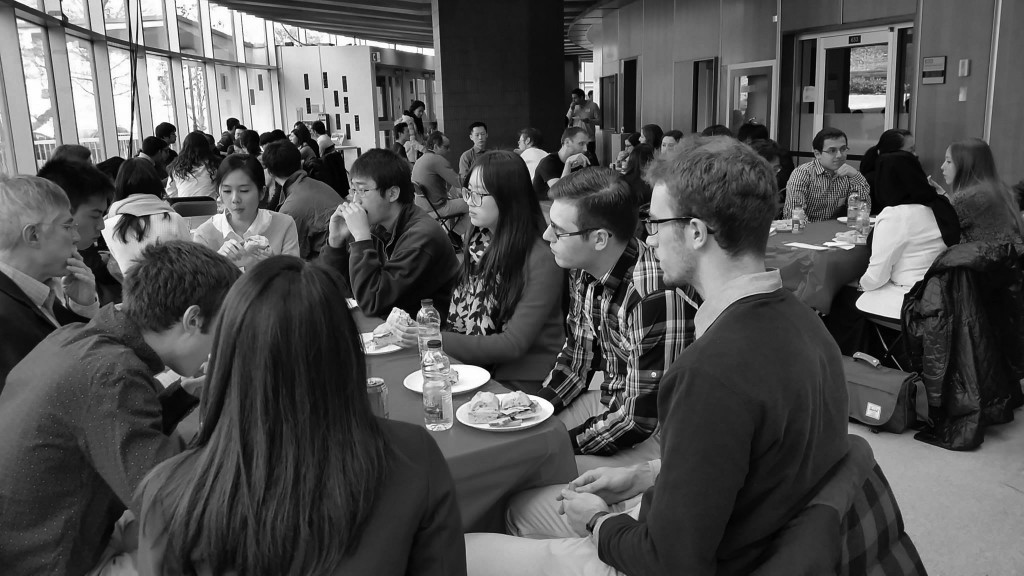
The Indigenous Women and Two-Spirit Harm Reduction Coalition (IW2SHRC) hosted a two-hour workshop on Sunday, Nov. 16 as part of the Mental Health Awareness Week. Titled “Harm Reduction 101”, the interactive workshop discussed essential harm reduction practices, especially regarding drug use and HIV/AIDS among the indigenous community.

Lindsay Nixon, U3 Honours Women’s Studies student at Concordia University and moderator at the workshop, described the history of the harm reduction approach and how it has changed over the years.

“The term originated from HIV/AIDS activism and drug use in the late 1980s in New York,” she said. “But our understanding of the term has expanded beyond drug use and safer sex to include everything from literacy and labour conditions to student life and interpersonal relations.”

Molly Swain, U4 Honours Women’s Studies McGill student and moderator, emphasized the urgent need to raise awareness about harm reduction practices, especially in indigenous communities.

“New cases of HIV/AIDS are increasing the most rapidly in Canada among Indigenous people,” she pointed out. “The lack of prompt response to [this] is, among other reasons, caused by the stereotyping of indigenous peoples as an inherently dysfunctional group.”

Nixon further explained that the crux of the harm reduction ideology is the importance of people’s autonomy and self-determination.

“Harm reduction practices that focus on drug use don’t focus on the prevention of the drug use itself, but on reducing the harm in the lives of the people who continue to use drugs,” Swain said. “Harm reduction practitioners acknowledge that people are the experts of their own lives and are best able to determine what they really need.”

Criticizing prohibition, Swain said that initiatives and policies that are meant to reduce and prevent actual drug use do not work.

“People continue to use drugs despite the risk of penalization,” she said. “Thus, these preventive and reductive policies serve to further stigmatize and marginalize drug users which isolates them and affects their ability to access mainstream health care and social services.”

Swain further discussed the importance of understanding the causes of harm in order to implement effective harm reduction interventions.

“Some factors that make drug users especially vulnerable are racism, colonialism, sexism, criminalization, and capitalism,” she said. “For example, a low-income person of colour who uses drugs may not seek medical treatment because he may be criminalized for it, whereas an upper-middle class caucasian McGill student who may have used a little too much can most likely get treatment at the emergency room without being penalized for it.”

The organization arranges workshops and educational initiatives in addition to providing harm reduction resources, referrals, and materials to indigenous people in Montreal and beyond, according to Swain.

“Harm reduction is a whole plethora of different practices and strategies that people use to cope with all kinds of problems in their lives,” Swain said.

Nixon elaborated on the organization’s mandate.

“We believe in facilitating harm reduction practices for Indigenous peoples in Montreal,” Nixon said. “We run under the premise that colonization is harmful, so decolonization is imperative for the survival and well being of Indigenous communities.”

According to Students’ Society of McGill University (SSMU) VP University Affairs Claire Stewart-Kanigan, Mental Health Awareness Week was a success.

“Attendance was  consistent at our over 20 events, partnerships across campus were strong, and students were very supportive of the week’s theme,” she said. “We set out to focus the week around key elements of our broader plan for approaching mental health on campus—cross-campus partnerships, peer-based support, self-care, intersectionality, and institutional accountability—and I believe the final outcome reflected this.”

a, Student Life, Student of the Week

Student of the Week: Brittany Davis

There are very few full-time students who are also committed to solving large-scale problems such as human trafficking. Currently finishing her last year as an undergraduate majoring in English literature and minoring in French literature, Brittany Davis hopes to continue on with a career in law. Her goal is to become a human rights lawyer, focusing on issues such as human trafficking, while working alongside non-governmental organizations (NGOs).

Human trafficking is a worldwide, multi-billion industry, and Davis is committed to spreading awareness. Davis became passionate about human trafficking because of the influence of friends who were part of an anti-human trafficking track force encouraged her to join ‘Montréal Love146 Taskforce’ (Love146).

“Love146 tries to provide solutions to human trafficking through the empowerment of love, and helping victims of human trafficking,” Davis said. “[Love146] also encourages prevention as well, giving full resources in order to avoid such situations, and especially giving more resources to police. Finally, [our organization works to] understand the causes [of] human trafficking […] and make sure there is a reinforcement of laws and a creation of further laws to prevent human trafficking around the world.”

One of Davis’ main aims is to spread awareness on the reality of human trafficking throughout McGill’s campus, and eliminate myths linked to slavery—debunking the myths through facts, such as the actual number of enslaved people present in Canada.

“You don’t hear of as many human trafficking cases in Canada, but it doesn’t mean they don’t exist and are not a reality,” Davis said.

She recalls a few resonant issues within cases of human trafficking that particularly stuck with her.

“One big issue that we find is that once victims are freed and saved from their situation of slavery, there isn’t enough after-care provided for them,” Davis said. “Dealing with the trauma once the situation has been resolved is excruciatingly difficult, and a lack of help can lead to terrible consequences, such as suicide.”

The complexity of human trafficking makes the issue incredibly difficult to deal with. Some prostitution cases are evidence of the blurred definition human trafficking can have.

“Indeed, some girls will go into prostitution ‘willingly,’ but then will find themselves forced to stay in it by their pimps [due to] drugs and other incentives,” Davis said. “When this happens, the cases are seen as human-trafficking cases.”

Another issue that has recently sparked Davis’ interest is the feminist movement that procured a lot of buzz in the media recently. Davis said that she appreciates the publicity that celebrities like Emma Watson and Sheryl Sandberg have spurred for the feminism movement. Chimamanda Ngozi Adichie’s ‘We Should All Be Feminists’ essay was particularly inspiring to Davis.

Davis’ enthusiasm for this topic encouraged her to start writing for FIERCE Magazine, a feminist and women’s online magazine started by a friend from McMaster University. Davis is the director of interviews, and her next feature for the upcoming issue coming out Dec. 19, will focus on gender binaries. She was able to meet the transgender, Montreal based comedian, Tranna Wintour, as well as Andrew Bailey, known for his monologue on male rape. Finally, she has written a piece on ‘IAmElemental,’ a business that creates solely female action figures, hoping to encourage a positive re-interpretation of the traditional female action figures.

Davis credits her time at McGill to shaping her identity and determination to create change for the betterment of the world.

“McGill has helped me [to have] an open mind thanks to all the classes I’ve taken [and] the conversations I [had]with my peers,” said Davis. “It’s been an awesome environment to grow in and I will take what I learnt here with me in the future.”

a, News

AMUSE and MUNACA undergo political merger to combat erosion of permanent positions

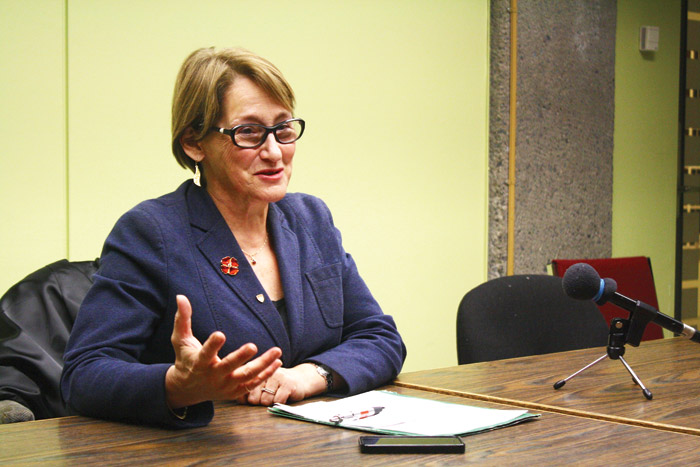
The Association of McGill University Support Employees (AMUSE), a union representing over 1,300 non-academic employees, is currently undergoing the process of a political merger with the McGill University Non-Academic Certified Association (MUNACA).
AMUSE was originally formed as a union in 2010 for employees in casual non-academic positions, such as floor fellows, as opposed to those in permanent ones. MUNACA, accredited in 1994, is the union for the permanent non-academic workers employed by McGill, including clerical, technician, and library assistant positions. Both unions are part of the Public Service Alliance of Canada (PSAC). a parent organization.
President of AMUSE Amber Gross explained that the merger would benefit both AMUSE and MUNACA members by providing a stronger bargaining power against the replacement of permanent positions with casual ones.
“What’s happening at McGill right now [is that] permanent positions are MUNACA positions,” Gross said. “When someone retires or leaves, they aren’t being replaced by someone permanent, [but] by two or three casuals. So permanent jobs at McGill are eroding and turning into casuals, which are lower pay, lower benefits, lower job security. The purpose of this is to protect the level of employment security and benefits at McGill by fighting back against this erosion.”
The political merger will only take place if both unions’ members approve the decision to proceed with it in their respective general assemblies (GA). According to Gross, AMUSE is set to hold its Special GA in January, while MUNACA will have its GA in December.
“We will spend the winter drafting final bylaws [and] final budget,” Gross said. “Then we’ll have a foundation for a GA in the spring, where everyone from both unions will come elect new officers, approve a budget. At that point, we’ll officially be one merged union.”
Members will not see any fee increase resulting from the merger, according to an information sheet jointly provided by AMUSE and MUNACA to their members. The newly merged union structure would have the GA as the highest decision-making body, with a Union Council replacing the current structures of the Board of Representatives for AMUSE and Councils within MUNACA.
Evan Luc, a U3 Arts and Science student, expressed positive opinions about the merger.
“I work as a floor fellow and this is contract work with no opportunity of a permanent position,” Luc said. “However, from my angle, this allows the casual and permanent workers that work similar positions to be able to stand in solidarity with one another and coordinate better working conditions in their posts.”
Luc also praised AMUSE’s efforts on providing information to its members.
“I think AMUSE is really great with outreach,” he said. “Members were offered the chance to attend merger proposal information sessions—one was even at Mac Campus [….] There is also extensive documentation on their website regarding the timeline of events and the benefits of this merger. The amount of information relayed by AMUSE regarding this merger has been impressive and really well stated.”

a, Science & Technology

BUGS hosts Research Awareness Day

On Saturday, Nov. 15, the gap between student and professor narrowed. A variety of biochemical experts gathered on the sixth floor of McIntyre Medical Building to explain their research. Areas of interest were widespread, and included topics such as tumour genetics, eye development, and macromolecular machinery. The students were first invited to listen to brief presentations given by the professors, and then to share lunch with them.

“The goal of RAD [Research Awareness Day] is to expose students to the research that occurs in the biochemistry department and to give them an opportunity to meet professors and discuss [their] research,” explained Larischa DeWet, VP Internal for Biochemistry Undergraduate Society (BUGS).

DeWet helped organize RAD alongside biochemistry professor Jason Young, who explained how undergraduate students could get involved in research. He highlighted that past experience wasn’t necessary; instead, things like commitment, dedication, and interest are what professors will look for.

“I had a student apply to my lab who had never worked in research before,” Young explained. “But he had worked for a pharmacy for something like nine years, and would go every Friday [even] during exams. So when he applied, I called the pharmacy, and they told me he was reliable [and] consistent [.…] He now has a PhD.”

During the presentation, the professors gave advice for students applying for lab positions.

“When e-mailing professors, show interest specifically in what they’re doing,” stated professor Maxime Bouchard, one of the researchers presenting at the event. “We get hundreds of applications from around the world, so make sure you know exactly why you want to work in my lab.”

The different lab positions available to students—showcased by RAD—are extensive. For example, professor Martin Schmeing uses x-ray crystallography to determine the structures of various large macromolecular machines. He chose this route because of the satisfaction from getting instant results.

“You run the experiment, and bam! The results are right in front of you,” Schmeing explained. “Now you have to analyze them, you have to ask questions, you start to interpret what you have.”

The event gave students the opportunity to figure out what type of research they want to pursue. The professor’s presentations demonstrated the huge spectrum available when going into research.

“Students don’t often get to hear about the amazing work that the members of their department are [doing],” explained Alexandr Magder, U2 representative from BUGS. “It’s an amazing experience because it allows students to see the real-world applications of the […] knowledge they [get] from their classes.”

RAD bridged the frequent gap between the student and the professors. It’s a unique event that provides a less intimidating venue for discussion.

“[The] event [helps] demystify what scientific research is all about,” Bouchard explained. “The small group discussions at lunch provide a unique opportunity to understand what scientific research really is.”

Diving into the unknown world of scientific research can be overwhelming. RAD helps connect professors with students to make that much easier.

a, Science & Technology

Tracking back problems with Backtrack

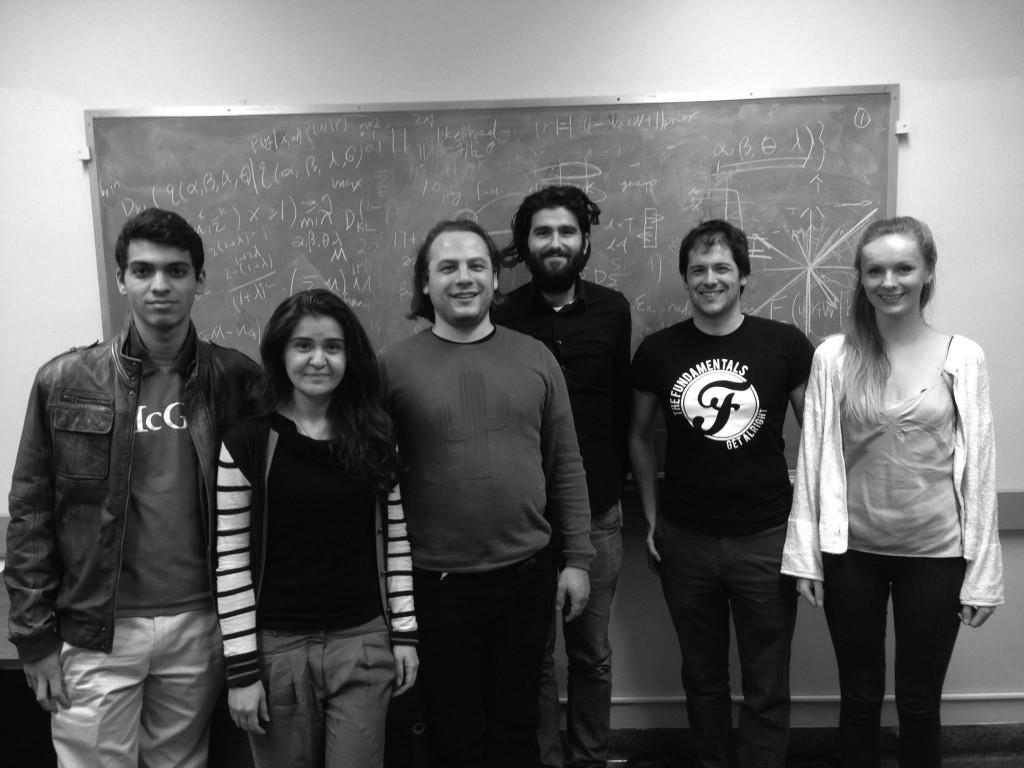
In the worldwide race to find the next must-use mobile app, “there’s an app for that” is one of the most common refrains heard today. Backtrack is the scientific foray into the mobile app world for McGill graduates Alex Danco and Alex Daskalov. The app, which is in its developing stages as it seeks $50,000 through Kickstarter, aims to help users visualize their back movement and track that progress through the app.

The system uses a sensor shaped like a two-pronged stick roughly the size of a hand, which the user can secure onto his or her back using a disposable adhesive patch. Backtrack uses inertial measurement unit (IMU) sensors to detect position and shape; the information is then sent to the user’s phone via Bluetooth. The app then lets the user track movement and range on a 360-degree map, both of which can be tracked on a daily basis.

According to Dr. Ladan Mahabadi, a collaborator on Backtrack, the purpose of the app is to give patients with back problems an accessible way to recover.

“The idea was that when you go to your physiotherapist, it’s very short-term […] and the expectation [is] that you would actually maintain doing the exercises [at home,]” she said. “Back pain is one of those things where recovery and improvement happens over a long period of time […] so patients [can] get discouraged. [Danco and Daskalov] figured out that the best way to remedy this would be to show the patient how much they’re recovering over time [….] We’re focusing on telling you [the exact] variation on your range of movement, the complexity of your movement, and the dexterity of your movement.”

The Kickstarter also offers Hacktrack, an open API device, which is a tool used to build software that can be used by developers who want to track changes in shape by other companies that may want to target other parts of the body.

“We built a shape sensor and we showed it to a lot of people,” Daskalov said. “But when we saw that people were excited about that as a novel sensor, we figured we should offer it to others to see what other applications [it may have.]”

Mahabadi noted that Backtrack is different from other apps in its focus and the features it offers.

“[The aim is] to redefine recovery as a personal achievement of milestones,” Mahabadi said. “I’m not comparing my movement to yours, but I want to know how my movement today compares to days before. Machine learning is this tool that looks at the data collective for a particular individual […] and quantifies your recovery for you over various periods of time.”

According to Backtrack’s Kickstarter, the initial stages of development involved many broken prototypes due to cracked electrical connections, which caused the team to subsequently change the circuits and device design in order to avoid those issues.

However, Backtrack is still undergoing adjustments before it will be ready for shipping and distribution. The team is currently working on the sensor’s size, contouring, and application methods as it seeks universality in the sensor’s wear and use. The goal is to make the sensor as thin and unobtrusive as possible.

Daskalov added that the team is currently working on presenting the product to universities and clinics, rather than individual customers to see direct effects on patients.

“The device is not something we intend to sell directly to consumers,” Daskalov said. “We already started a number of partnerships with various universities, like Concordia [….] We will start working with various physiotherapy clinics to see how we can actually apply this to patients and see their improvement.”

Mahabadi also stated that back pain is a prevalent and cumbersome problem that many people face, which was why the team sought to tackle the issue.

“It’s both the sheer number of people that suffer from back pain, and the false hypothesis that back pain is so big and so unquantifiable, that attacking the problem is almost impossible,” she said. “The burden of improvement is on the patient, and the reason a lot of people don’t improve is because they stop the exercises that would help them.”

According to Mahabadi, the Backtrack team hopes to see the product not only used for back rehabilitation, but also in other medical applications.

“I’m hoping that we can get other collaborators involved,” Mahabadi said. “What would be fantastic would be to get these in neurodegenerative applications [like for] ALS or Parkinson’s. I believe that our techniques can actually detect those critical episodes.”

a, Arts & Entertainment, Music

Album Review: Nick Jonas—Nick Jonas

Nick Jonas’ new self-titled album is a steady step into maturity for the young artist. Still attempting to shake off the ‘boy band’ image he spent years perfecting with his brothers, he has moved into the world of ’80s-era R&B, and interestingly dedicated his PR campaign towards the LGBTQ community.

While Nick Jonas is undeniably more grown-up than any of his other work—and certainly shows a musical talent that had been handily stifled during his time in the Jonas Brothers—Jonas still has a lot of cleaning up to do if he wants to be taken seriously as an artist. The track “Wilderness” is a clichéd look into an on-again, off-again relationship. “Jealous,” meanwhile, has received a lot of praise for being the strongest on the track, yet Jonas’ voices sounds shaky throughout and his acclaimed falsetto fails to reach the heights it does on “Avalanche.”

The real standout on the album, though, is “Numb,” which combines a bass-heavy club beat with a strong hook to provide the emotional backbone of the album while also showing the strongest production value. Angel Haze adds a strong dimension to the track, providing subtle hip-hop backing without losing the overall jazz electronic feel.

Considering Jonas’ long history in the music industry, but rather recent fling as a solo artist, the ultimately poor production value of this album is its true downfall. While Jonas may not have Justin Timberlake-level chops, he’s clearly working towards a mastery in the field of young, white, male R&B pop male singers, as best represented in “Take Over.” If Jonas really wants to gain legitimacy in the music field, he needs to continue defining himself as something other than adorable Camp Rock (2008) heartbreaker, and find a producer who will get that tone across in a sophisticated manner.

Demarco Murray stiff arm
a, Football, Sports

Point counterpoint: Start vs. Sit

The Cowboys’ DeMarco Murray has rushed for over 100 yards in all but one game this season, and is on a pace to eclipse 2,000 yards by the end of the year. However, there are some who believe that Dallas is overworking its star running back, risking his future health and performance in the effort to win. This week, we examine the two sides of this argument—in Murray’s case and in the broader sporting context. Should professional teams sit their star players in order to preserve them for a potential playoff push at the expense of present success?

Click each perspective to read more

Start

Zikomo Smith

The Dallas Cowboys must keep on playing DeMarco Murray. Sports franchises should never sit their star players in meaningful situations, and injury avoidance is not a smart reason to sit a star.
Teams need their best players in games with playoff implications. Murray has been essential for the Cowboys, and he is on track to break franchise records. He is also the best rusher in the league in terms of picking up crucial first downs and in rushing efficiency statistics, as measured by Defence-adjusted Value Over Average (DVOA). The Cowboys have an excellent record at 7-3, but with six games to play, a playoff spot is not guaranteed. Dallas needs Murray to continue to carry the team in order to avoid disappointing a disgruntled fan base that hasn’t tasted the playoffs in four years.
Apart from a top seed in the final game of an NBA season, most teams will have something to play for. It could be home field advantage; it could be for an individual scoring record; it could be to install a specific strategy. Teams have immediate objectives to meet and need their stars in order to meet them.
Some may counter that San Antonio Spurs Head Coach Gregg Popovich’s willingness to bench starters was in order to keep his star players fresh and healthy down the stretch. They will argue that resting the stars earlier in the season helped the Spurs win the NBA Championship. But in the Spurs’ case, Popovich was right in benching his starters because he was trying to implement a specific style of play. Against the Heat in last year’s regular season, Popovich wanted to give his bench confidence and also build chemistry in his alternate lineups through increased playtime. He had a strategic objective that went beyond protecting the health of his starting five.
As long as a team’s strategy is based around a star player, that player is needed in the game. Popovich’s strategy gave him the flexibility to pick multiple players. The Cowboys do not have a strategy that would allow them to sub in another running back for Murray and still be able to see the same levels of success.
Also, resting a player for a game is not going to preserve him in the long run. In the NBA, a star will play around 36 minutes a game. Over an 82-game season, 36 minutes of extra rest will have a minimal effect on protecting from wear and tear. Similarly, in the NFL, injuries are very common and happen throughout the entire season. Resting a player for one game does not remove the high risk of playing such a violent sport.
Teams should also play their stars out of respect for the fans. People worldwide dispense their cash on game tickets, television licenses, and merchandise. Fans coming out to games want to see the best players play. Think about the widespread frustration when Popovich benched his starters against the Heat. Administrations need to put the best sporting product on the field. That means putting the best players on the field.
Murray has accepted his workload and will do whatever the Dallas coaching staff asks of him. The Cowboys should keep giving him the rushing responsibility he deserves.

—Zikomo Smith

Sit

Wyatt Fine-Gagne

As an athlete’s performance improves, it stands to reason that his or her workload will often simultaneously increase. Pitchers will log more innings if they can be effective, goaltenders will start more often if they can make saves, and running backs will get more touches if they can help their team score points. All too often, however, scenarios pop up during which teams enjoy too much of a good thing too early in a season. Players get overworked and end up injured or exhausted late in the season, and they become unable to perform down the stretch or in the playoffs. To combat this problem, teams often opt to reduce the amount of time a player is used so that they can remain effective in the long run. This is what the Cowboys should do in the case of star running back DeMarco Murray.
This strategy is an effective one if employed properly. It should be made clear, however, that it is not possible for every team to do this. In order for it to work, a team’s roster needs to have enough depth and skill so that it can still win games, even when a star is on the sidelines.
As the San Antonio Spurs’ star players have grown older, Head Coach Gregg Popovich has opted to limit their minutes during the regular season, keeping them fresh for when the playoffs come around. Tim Duncan, Tony Parker, and Manu Ginobili all play far less than they did in their heyday, but the Spurs have remained a staple in the late rounds of the playoffs.
The ability to use star players somewhat sparingly is a large part of why depth is so important in sports. In hockey, having a competent backup goalie means that the starter does not need to play 60 to 70 games in the regular season. While there are freaks of nature who are capable of doing this—Jonathan Quick for example—most get worn down as the minutes pile up. Marc-Andre Fleury, for example, has become notoriously bad in the playoffs, but that may be related to the intensity of his regular season workload. The Penguins have not had a solid backup in quite some time, forcing Fleury to start 60-plus games in each full season since Pittsburgh last won the cup in 2008-2009. Even the legendary Martin Brodeur, who carried his New Jersey Devils teams to multiple Stanley Cups, eventually needed more rest during the regular season in order to be valuable during the playoffs.
One of the most famous iterations of this debate centred on Stephen Strasburg, a young pitcher for the Washington Nationals. Coming off of Tommy John surgery, Strasburg was shut down in the midst of the Nationals’ 2012 playoff run in order to protect him from further injury. The Nationals lost in the opening round, and many were quick to point to the decision to sit Strasburg as a reason for the team’s fate. Despite the disappointing finish, it was still the right call in the long run. Washington had a deep rotation at the time, and two years later, Strasburg is coming off of a 200-inning campaign in which the Nationals reached the playoffs.
While the Cowboys would be unwise to sit Murray altogether, Dallas should drastically reduce the amount of action he’s getting. Comparable running backs with similar stat lines in the past have historically regressed significantly in the second part of the season as they begin to get worn down. The Cowboys have a strong offensive line, competent backups, and a potent passing attack—all of which suggest that the offence would not be crippled with Murray seeing fewer touches. Giving him a chance to recover will not only help the Cowboys later this season, but will help ensure that Murray can be a force in Dallas’ backfield beyond this year.

—Wyatt Fine Gagné

Editor’s Pick: Sit
In the long run, it doesn’t make sense to jeopardize the health of your franchise player for personal statistics and regular season wins. Even if your team has plenty of star power, overworking your superstar can ruin trade value and give your team a bad reputation.

a, Arts & Entertainment, Music

Album Review: Damien Rice – My Favourite Faded Fantasy

There’s a thread of tiredness that weaves through Damien Rice’s latest album and ties its eight tracks together. What My Favorite Faded Fantasy provides in consistency, it loses in its unoriginality: Each song is nearly identical to the others. The themes and the way Rice sings about them—“I love this girl, she doesn’t love me, it hurts, oh well”—is too much of a mirror to his previous efforts in 9 and O.

However, the album does have its highlights. “My Favourite Faded Fantasy,” the record’s opener, is a strong song. Detailed arrangement of the harmony accompanies Rice’s delicate vocals, “You could be my favourite taste/ To touch my tongue/ I know someone who could serve me love/ But it wouldn’t fill me up.”

“The Greatest Bastard,” despite featuring the signature weariness expected, is a strong track that begins with Rice’s breathless murmuring over simple chords, and grows as layers of soaring harmony are added, eventually reaching a cathartic crescendo.

Unfortunately, the rest of the album feels like swimming in warm water until your fingers are pruned and your hair is dry from the salt that he’s cried over whatever new girl has left him.

Given the album’s titular nod to Kanye West’s My Beautiful Dark Twisted Fantasy, its seemingly minimal contribution by producer Rick Rubin, and its overall boring subdued moodiness, all I wanted was to turn Rice off and listen to “Runaway” instead.

Deanna Foster
a, Know Your Athlete, Martlets, Sports

Know your McGill Athlete: Deanna Foster

“Their winger came across and hit me pretty hard,” Deanna Foster, star winger on the Martlet rugby squad and an All-Canada talent said. “My foot was planted and my knee just went out at a weird angle. I just heard a pop.” (more…)

eggs benedict
a, Student Life

Montreal brunch delights

L’Evidence

It’s easy to walk past L’Evidence when strolling along Saint- Denis—the burnt orange sign is unassuming compared to the bright lights of other restaurants on the bustling street. However, doing so would be a mistake as the food is delectable, the coffee bottomless, and the service polite and welcoming. Brunch is also served from 8 a.m. to 4 p.m. on weekends, offering a convenient option for early risers and late strollers alike.

The star of the menu is undoubtedly the variety of eggs benedict options. Both eggs are perfectly poached, and the hollandaise has a smooth consistency and doesn’t overwhelm the subtler flavours of the toppings. Also, savoury diner-style options are paired with fresh fruits, creating a wholesome and filling meal. L’Evidence is affordable, has an option for every type of brunch-goer, and provides a balanced meal to start the day.

Le Sparrow

Nestled in the Mile End, Le Sparrow’s design and aesthetic elements embody the neighbourhood’s charm. There are only eight options on the menu, but they range from hearty steak and eggs to mouthwatering buckwheat pancakes topped with an array of sugary goodies such as candied walnuts. Additionally, Le Sparrow has an assortment of cocktails, including mimosas and Bloody Caesars that will put a jolt in anybody’s morning.

This isn’t the place to go for classic brunch fare; rather, the restaurant chooses to push the envelope with an eclectic mix influenced by Quebecois favourites and Mediterranean delights.

Le Sparrow is simple in its offerings, but highly complex with its flavour patterns; sometimes this sort of simplicity can offer its own brand of beauty.

Bagels Etc.

Walking into Bagels Etc. feels like taking a time machine back to the ’80s—conveniently the period when the diner was opened. Vintage artwork and decorations rest upon exposed brick walls, giving the restaurant a distinctly Plateau feel. The real attraction of Bagels Etc., however, is the food. At first glance, the portions can seem overwhelming and slightly off-putting; although most of their offerings are bright, echoing the vibe of the decor, they are usually piled onto the plate without giving thought to plating. After one bite, this hardly matters. The food is undeniably excellent; the pancakes are moist and fluffy, the potatoes are wholesome and delectable, and the variety of meat dishes are spiced uniquely such that every dish is its own adventure. The eponymous bagels are crisp and have a sweet undertone, offering a counterbalance to their saltier options. Bagels Etc. is well worth the short trek into the Plateau.

Universel

Although some may know Universel as a bar, on weekends both the interior and terrace operate at near full-capacity for brunch. The decor is sleek and modern, and the ambience is equally appropriate for a brunch date or a larger gathering among friends. Food-wise, portions are filling and aesthetically pleasing—a combination that many restaurants try to achieve yet very few succeed at. Universel’s primary attraction is its expansive menu that can satisfy those with a sweet tooth and savoury cravings alike—waffles, pancakes, and french toast are as commonly ordered, and as well executed, as the eggs benedict and omelettes. Universel’s their side dishes and beverages complement the main dish and enhance the complex flavour palettes; their orange juice is freshly squeezed, their coffee is an excellent pick-me-up, and their home fries are well seasoned.  As a trendier option, Universel succeeds in offering an upscale feel without breaking the bank.

Read the latest issue

Read the latest issue