Latest News

a, Student Life

Searching for the perfect fit

Halloween is fast approaching, and so is the need to find the perfect costume. With midterms, it’s no surprise that students have little time to search for the ideal costume. Read below to discover a list of stores near campus for last-minute Halloween costumes.

EVA B
2015 Saint-Laurent

This gem of a store is a wonderland of thrifting treasures. It consists of three floors and offers clothing, costumes, a bar, a sitting area, and a stage for shows. As customers walk in, they are greeted with free tea and seasoned popcorn. While it may seem like the store is overwhelming given the quantity of goods offered, Eva B is strategically set up, with the clothes and costumes organized in such a way that individuals have an easy time browsing for items.  There is a floor dedicated to costumes, with wigs, masks, mustaches, gloves, full costume pieces, and more. The store also provides costume rentals. Even those who enter Eva B without a clue of what costume they want are bound to come out with a costume in hand. The pricing of items is extremely reasonable, and prices go as low as $1. Employees are friendly and helpful, and the ambiance of the store is quirky, creative, and positive. In fact, for the weeks leading up to Halloween, employees are dressed up in their own choices of costume, enhancing the inspiration that Eva B seeks to give its customers.

LOL Party Centre
3715 Saint-Laurent

This store offers party supplies and costumes all year. LOL Party Centre is the store for those who are searching for an easy costume that is generic, yet still a party classic. Offering a rack of masks and an aisle dedicated to costumes for males, females, and children, this store has a wide array of choices and accessories for last-minute costumes. Moreover, for those who want to get a full costume without having to worry about buying different pieces for the costume, this store offers full costume pieces that range from $20-$80. 

Cul-de-Sac
3966 Saint-Laurent

This shop is perfect to find pieces to compile a unique costume for Halloween. There are a large variety of styles and sizes for both men and women, with high quality items. The pricing is great for students who wish to spend less, with items available for as low as $5. The store is neatly organized—making it easy to navigate through—and the store owner is friendly and helpful. These high-quality vintage items are perfect when dressing as an iconic character from movie classics, and will guarantee a unique costume that no one else will have.  The outfits purchased are not exclusively set out for the Halloween season—there are accessories to dress it up or down for other occasions as well. This is a great store to explore and seek out costumes that will give an edge to your costume at a party, and ensure that there will not be a clash of outfits.

a, Recipes, Student Life

Sweet and Savoury Pumpkin Recipes

Pumpkin is an incredibly versatile ingredient to work with—these two recipes are easy to make and celebrate the potential of pumpkins. One is sweet, and the other savoury, but both are healthy and chock full of vitamin A and fiber. Stack up a few cans of pumpkin at the local grocer and enjoy cooking.

Pumpkin chickpea veggie burgers

Serves 2

Ingredients:

  • 1 cup cooked chickpeas
  • 1/2 cup canned pumpkin
  • 1 onion, diced
  • 1 egg
  • 1/2 tsp curry powder
  • 1/2 tsp garlic
  • 2 tbsp olive oil

Directions:

1. In a pan, sauté the onion in 1 tbsp of the

olive oil until soft and translucent. 

2. In a medium-sized bowl, add the chicpeas, pumpkin, egg, cooked onion, and spices,and mix until combined and chicpeas are partly mashed. 

3. In the same pan, heat the other tablespoon of olive oil over medium heat. 

4. Form the pumpkin mixture into two paties.

5. Cook both patties in the pan, flipping once until golden on the first side.

6. Serve warm with a green salad or on fresh hamburger buns. 

Chocolate coconut pumpkin squares

Serves 9

Ingredients:

  • 2 cups rolled oats
  • 1 cup oat flour (can be made by blending oats in blender)
  • 2 cups canned pumpkin
  • 1/2 cup coconut milk
  • 1/2 cup maple syrup
  • 2 tbsp molasses
  • 1 egg
  • 1/4 cup unsweetened coconut
  • 1/4 cup dark chocolate chips
  • 1 tsp cloves
  • 1 tsp nutmeg

Directions:

1. Preheat oven to 350 F.

2. Blend all ingredients together in a large bowl

until well mixed

3. Pour into a greased baking dish and sprinkle

a few more chocolate chips on top for present

tion.

4. Bake for 35 to 40 minutes.

5. Let cool for approximately 10 minutes.

6. Cut into squares and enjoy.

a, Arts & Entertainment, Film and TV

Godard says goodbye to cohesion

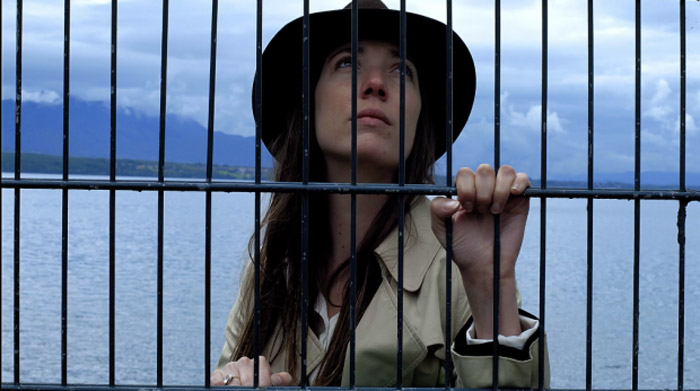
Whereas other filmmakers have used 3D as a way to immerse us in their worlds, legendary director Jean-Luc Godard utilizes it to emphasize disconnect in his latest film, Goodbye to Language. While you can’t help but feel close to the dogs, flowers, and nude bodies that pop out at you, Godard simultaneously detaches us from the action onscreen through his use of unconventional shot angles, narrative fragmentation, and a plethora of different cinematographic styles. At the same time, the film is deeply naturalistic and cinema verite-like, thus forming a fascinating contrast.

The result is less a traditional narrative than a cinematic montage of thematically related ideas. Josette (Héloise Godet) and Gédéon (Kamel Abdeli) are a pair of lovers who discuss the tenuous nature of their relationship (she’s married to someone else and he’s single) and muse on life in often compromising situations. As he sits on the toilet while she stands naked in front of him—which happens frequently throughout the film—Godard grants the audience a voyeuristic look at the relationship, which the 3D serves to exaggerate.

At the same time, we don’t learn much about this pair, due to the frequent cuts to other vignettes and images: A dog travels between town and country, seemingly unsure of his proper home; a couple prepares for their international travel on a cruise ship. Documentary footage is interspersed throughout, as various voice-overs explain details about Hitler’s rise to power and other historical events. The music of composers ranging from Beethoven to Sibelius fades in and out throughout these sequences, and the shots fall on a wide spectrum between hyperrealistic and deeply Impressionist.

Naturally, this chaotic approach doesn’t yield much in the way of narrative continuity, but that doesn’t seem to be what Godard is going for here. Rather, the film is about the feeling of existence—you can’t hope to understand what’s going on, but you grasp the emotions that are being conveyed. This works particularly well in the handheld, digital video-like segments, which effectively mimic the folksy appeal of home movies. The use of 3D accentuates  realism without undermining it through the inherent flashiness of the added dimension.

Goodbye to Language showcases a unique approach to 3D filmmaking, and one that more directors, hopefully, will have the courage—and funding—to attempt. While films like Gravity and Avatar use the technique to place audience in wholly unfamiliar situations, Godard adopts it strictly in the realm of the everyday. However, the discontinuity throughout the film’s 70-minute running time makes the mundane settings feel bizarre and obtuse. Everything onscreen is recognizable, but rendered foreign thanks to Godard’s constant juxtapositions. Goodbye to Language dramatizes the feeling of our increasingly paradoxical relationship with each other in the contemporary world—though we are closer than ever to each other thanks to the ties of technology, the digital world simultaneously alienates and isolates us. This makes for uncomfortable viewing, but an experience well worth having.

Goodbye to Language runs until Oct. 30 at 8 p.m. at Cinema du Parc (3575 Parc). Student tickets are $10.

a, McGill, News

Senate discusses safer campus, graduate student advising, and Senate composition

Principal Suzanne Fortier opened Wednesday’s Senate meeting with remarks on the Quebec government’s recent announcement of further budgetary cuts for the university sector.

“With regard to McGill, we believe that it means a decrease of approximately 15 million [dollars] that we already know about,” Fortier said. “Earlier this month, [the government has] also advised us that they will impose further reductions, probably at the beginning of the new year.  We don’t know the figure of the new reductions yet, nor how it will affect McGill [….] We had a budget that had been approved by the board with a projected deficit of 7 million.”

According to Fortier, the university will be challenged to meet it’s projected deficit within a year with this new reduction to its funding. McGill faces additional troubles, as the provincial government is asking for universities to have a balanced budget.

Other universities in Quebec are having similar difficulties meeting the expectations of the provincial government, according to Fortier.

“We also see more and more universities requesting more flexible approaches to the funding formula, certainly a simpler funding formula that would allow us to recruit additional funding to our institutions,” she said. “I think there [is] openness to review that by [the Quebec] government.”

Promoting a safer campus

The Senate also discussed a question from SSMU Senators VP University Affairs Claire Stewart-Kanigan and Law Senator Dan Snyder regarding the recent allegations concerning a member of the McGill Redmen football team.

“How will McGill help student athletes meet […] their obligations to uphold the high standard of conduct that comes with their position as student ambassadors and role models?” they asked in a document addressed towards the Senate.

They further asked Deputy Provost (Student Life and Learning) Ollivier Dyens if more resources will be allocated to the prevention of sexual violence, and whether “a culture of consent and gender equity” will be addressed by the upcoming review of McGill’s rules and regulations governing participation in varsity sports by a working group made up of administration and students. 

“Our recent experience with frosh made it clear that collaboration, partnership, and teamwork are the best ways to address issues of concerns for the whole campus,” Dyens responded. “Three new sections were added to the guide for varsity sports for student athletes: Responsibilities and Commitments of the Varsity sport Program, The Varsity Student-Athlete Context, and Varsity Sport Guiding Principles and Policies.”

According to Dyens, these measures, along with last semester’s appointment of a Harm Reduction Coordinator, will increase both campuses’ awareness of consent, more clearly increasing and defining the responsibilities of student-athletes in terms of behaviour and conduct. The Deputy Provost also referred to the #ConsentMcGill campaign that happened from Oct. 20 to Oct. 24 as a “respect campaign directed at all students and all members of the McGill Community.”

Graduate student advising

Presented by Dean of Graduate and Postdoctoral Studies Professor Martin Kreiswirth, recommendations on graduate student advising and supervision were debated during the Senate session.  The recommendations follow reports from the previous ombudsperson from 2010-2013, Professor Spencer Boudreau, and the Post-Graduate Students’ Society (PGSS) from 2012 to 2014. They were also made in consultation with, amongst others, the Academic Policy Committee, the Council of Graduate and Postdoctoral Studies (GPS), and the secretary-general of PGSS.

“Graduate supervision at McGill is rated below the high standard of achievement that characterizes other academic and research measures for the university,” Kreiswirth said in the statement. “Furthermore, the repeated call from the ombudsperson for an orientation for supervisors at McGill has remained unanswered [….The reports] indicate that supervision is a frequent cause for complaint.”

The recommended regulations and guidelines aim to standardize the relationship of supervision between professors and graduate students, so as to settle disputes if needed between the supervisor and the supervisee.  Professor Catherine Lu expressed her concerns regarding the proposed recommendations.

“Unlike the title says, the recommendations contain no regulation and [do] not define the role of the supervisor, the advisor, [or] the academic units,” she said. “There is no delineation and role assignation.”

Professor Alenoush Saroyan from the Department of Education also outlined the difficulties of having someone to fulfill the roles as indicated. 

“There is reference that [a] supervisor should have competence in the student proposed area of research,” Saroyan said. “Recently, there [was a] situation […] where the person in charge of the supervision had left the university and there was nobody in that unit to supervise the student.”

Senate reform

The Senate approved the revisions proposed by Masi following the approbation on May 2014 of the report and recommendations of the Ad Hoc Committee to Review the Composition of Senate. The reform increases the total number of Senators from 107 to 113 and proposes to change the number of seats allocated to each faculty proportionate to their size.  The number of seats allocated to the Faculty of Education was decreased from four to two. The number of undergraduates student seats remains at 13, while the graduate student seats  reached a total of five senators.

“Why [wasn’t the] opportunity taken to entertain increase student representation on Senate?” Stewart-Kanigan questioned. “For example, University of Alberta [has] 35 per cent of representation of students.  At Concordia, there is 29 per cent, whereas McGill is currently around 16 per cent and has dropped over this last review.”

Masi explained that the Ad Hoc Committee had not given any recommendation that the university should increase the proportion of student seats at Senate above its present levels.

“The ad hoc committee did look at different ways of composing Senate and the decision was taken to more or less keep the student representation as it is and to make these shifts,” Masi said. “For example, graduate students go up in this representation because of the increased number of graduate students presently at McGill.” 

a, Soccer, Sports

From the cheap seats: A damp, Impact-less performance

Major League Soccer is hard to compare to anything—one might say it stands alone, but in the least superlative sense possible. (more…)

a, McGill, News

Completion of construction along McTavish to be delayed by a month

Construction along McTavish Street has been delayed by a month, and is now set to conclude by the end of November, according to a press release from the Students’ Society of McGill University (SSMU) Communications and IT Director Ryan Hughes. The release cites multiple technical and logistical reasons for the delay.

“These delays announced by the city are, in part, explained by the following: Late start of the project, technical difficulties encountered during the construction [… more] bedrock excavation than anticipated, [and] imposed work stoppage due to permit conflict,” the release reads.

The construction, which had been delayed to begin after Springconvocation, was originally set to be complete by the end of October.

“The site should be paved and some fencing should be removed by mid-November,” the release now notes.

Students expressed disappointment at the delay, noting that it would prolong the challenges they face in getting to class and navigating campus.

“I don’t like the fact that construction has been delayed, because as a pedestrian, it’s just hard to walk through,” Tiffany Okotako, U1 Science, said. “It’s difficult to get to classes, it’s difficult to get to the library; it’s a valley of construction. It’s also really difficult to walk along Doctor Penfield, because the cars need to go through, I need to get through, but I need to not get hit—the crossing guards are not always there.”

a, From the BrainSTEM, Science & Technology

From the BrainSTEM: Federal science demands democratic reform

I’d like to think we live in a country where democracy is valued—a place where all groups are represented equally. (more…)

a, McGill, News

Panel discusses building consent culture on campus

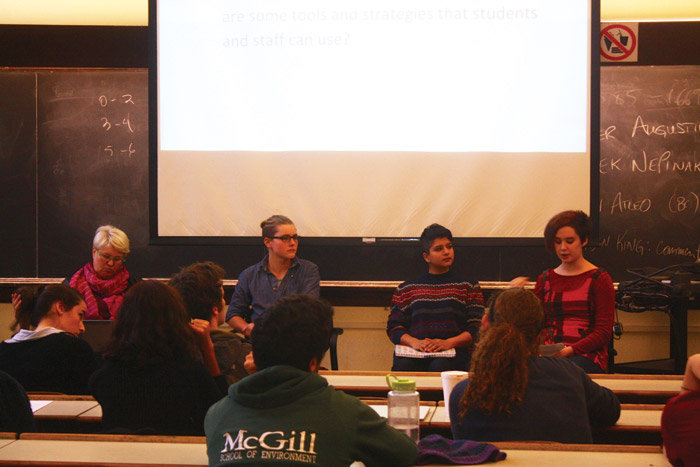
Students hosted a panel discussion on “Building a Culture of Consent on Campus” last Thursday as part of #ConsentMcGill, a week-long event organized and run by McGill students and administration. The panel responded to broad questions relating to the idea of a consent culture before opening up discussion with the audience of about 30 students. #ConsentMcGill was a campaign during Consent Week that sought to educate and increase campus awareness of consent in not only sexual activity, but also as it applies to students’ daily lives. The week included workshops on different aspects of consent and inclusivity on campus, as well as booths providing information to students.

The panel comprised of Alice Gauntley, U2 Arts; Roma Nadeem, U2 Arts; and Jean Murray, U3 Arts,  as well as Carrie Rentschler, Director for the Institute for Gender, Sexuality and Feminist Studies (IGSF). The first panel question asked what a culture of consent on campus would look like.

Gauntley stressed the importance of consent in all aspects of students life, citing social activities that may be undesired such as drinking.

“A consent culture should apply in all of our social relationships on a campus, and when that happens on a campus that creates a ripple effect in the larger community,” she said. “ In a culture of consent, we no longer think it’s okay to pressure our friends, to pressure our froshies into drinking more than they want to. I feel like a culture of consent removes the social acceptance behind any manipulative behaviors.”

One discussion question asked how a culture of consent on campus would address issues of sexual violence in the community and beyond McGill. In response, Murray commented that the community is created by the arbitrary merging of many diffuse communities.

“Everybody who comes here was almost certainly raised in a context of normalized gender and […] sexual-based violence,” Murray said. “We must work to create a new collaborative setting where this is not the case through a lot of education and a complete paradigm shift in the immediate community as well as [in]the surrounding area.”

Rentschler brought up the issue of how a large number of sexual assaults on campus are performed by a small number of people, and that a strong consent culture may not help as much in this regard.

“Does this prevent the small group of people who are doing most sexual assault on campus from doing what they do?” Rentschler questioned. “I’m not sure it does. So then there’s the question of how do we mobilize this way of thinking into a convention strategy that actually says ‘This has to stop.’ If we can’t do this through training on how to consent in a relationship,  then we need an alternative strategy for doing that as well. I think we build off of this consent culture to do that.”

Murray agreed and gave examples of action which have already been taken, such as including sexual assault education in frosh leader and server training.

“This needs to be an institutional change, it needs to be more than a group of people talking in a classroom,” she said.

Another question raised what advice the panelists could give for cultivating consent on campus, Nadeem said that although most of the focus is on large-scale campaigns, there are individual person-to-person changes people can make to enhance consent on campus and to normalize this amongst young people.

“[Things] such as bodily autonomy [and] asking people if you can give them a hug,” Nadeem listed as examples of ways to enhance consent. “Things like asking a friend if it’s okay to vent to them, if they’re in a good space to hear you rant.”

Murray emphasized the importance of active listening.

“Active listening is huge and it is one of the best things you can do to help people,” she said.

Rentschler said that ideally, people should take responsibility for mistakes or correcting others as a form of education, not shaming.

“We all need to learn how to do this and continue learning,” Rentschler said. “I see consent as a constant process and [….] It’s about ways of being responsive, so if you do do something you should not, you know how to respond.”

A final question asked what the role of accountability is in this possible culture. Gauntley affirmed that everyone is accountable for promoting a culture of consent.

“We are all accountable […] not to perpetuate a culture where consent is not present […] and to find ways to bring it into our lives by offering support for friends,” she said. “It is important that we are all accountable for each other in this culture that we are developing.”

Murray agreed with this sentiment but further emphasized that in the context of McGill hierarchy, more responsibility would lie on those in positions of power.

Following the organized questions, audience members began a dialogue on related topics such as the difficulties involved in holding perpetrators of sexual violence accountable, and how to prevent barriers to access within a culture of consent. The back and forth between panelists and audience members exhibited the interest and understanding developed from this event. Another lesson audience members agreed upon was that being safe is more important than being comfortable, and sometimes having difficult conversations is necessary if it can prevent future violence.

a, Research Briefs, Science & Technology

Research Briefs—Oct. 28, 2014

Physicists transport marbles with optical tractor beam

The tractor beam—a long-distance invisible attraction beam—is a legendary staple in science fiction. In real life, moving objects using only light seems absurd, if not impossible. However, in a paper published in Nature Photonics, a team of Australian and American physicists successfully transferred glass marble ten centimetres using only a laser beam.

Light is composed of tiny packets of energy called photons and it is through these that light can move objects. Each of these packets of energy has an associated momentum, so when they hit an object, their momentum is transferred to the object, nudging it forward slightly. Like rolling a bowling ball by throwing billions of dandelion seeds at it, scientists can use these photons to move microscopic objects—but only in the direction of the photons’ velocity.

To move the marbles backward, the team used a different approach. They fired a donut-shaped optical beam that heated up the beads. As the back of the beads heated up, the surrounding air pressure lowered and the beads moved backward. When the researchers adjusted the laser’s polarization, they could change whether the marbles moved forwards or backwards.

This technique may eventually be used for remote particle sampling or even for removing air pollutants.

Jet Lag, bacteria, and obesity

Jet lag may cause more than just fatigue. In mice, at least, it also makes them more prone to obesity, according to a study published in Nature last week.

Every life form has an internal clock that keeps track of daily cycles, which are known as circadian rhythms. A team of researchers, led by Eran Elinav at the Weizmann Institute of Science in Isreal, has found that these cycles may be connected to weight. The biologists observed that the composition of gut microbes in both humans and mice changes depending on the host’s circadian rhythm.

The team then tested the effect of jet lag on these populations. They simulated jet lag by disrupting the feeding and sleeping cycles of mice, so that the mice were eating when they would usually be sleeping.  These chronically jet-lagged mice gained more weight and displayed an increased risk of diabetes compared to the control group. When researchers analyzed fecal samples, they found that the usual fluctuation in the composition of gut microbiota was disrupted in the mice whose internal clocks had been shifted.

This research may help explain why shift workers have a higher risk of diabetes, as well as the association of disrupted sleep with diseases like cancer, obesity, and cardiovascular disease.

High-speed evolution in Florida lizards

Competition between two species of lizards in South Florida has produced a remarkable example of evolution. A study by researchers at the University of Texas at Austin documented how over the course of just 15 years, green anoles in the area have responded to pressure from invasive brown anoles by developing feet that are better at gripping branches.

The change in the lizards’ physiology may not have turned them into an entirely new species, but it is far from insignificant.

“To put this shift in perspective, if human height were evolving as fast as these lizards’ toes, the height of an average American man would increase from about [5’9’’] today to about [6’4’’]  within 20 generations—an increase that would make the average U.S. male the height of an NBA shooting guard,” explained lead author Yoel Stuart.

The scientific term for this phenomenon is called character displacement, and describes how species in competition with each other evolve to take advantage of different resources. In the green anole’s case, this means climbing higher up on branches than any nearby brown anoles. The speed with which this evolution has occurred makes it one of the few well-documented examples of character displacement that biologists have observed.

a, News, PGSS

PGSS General Assembly passes bylaw reform package, opposes austerity

At the Post-Graduate Students’ Society’s (PGSS) General Assembly (GA), held on Oct. 22, students participating in the meeting voted on a reform package of PGSS bylaws, the ratification of the appointment of directors, and discussed the possibility of participating in a protest against provincial austerity measures.

Bylaw reform package

The bylaw reform package was presented by Secretary-General Juan Pinto to the GA.

“This reform package seeks to redress critical issues arising from the composition and jurisdiction of the current Appeals Board,” reads the bylaw package. Other modifications to the package include changes to the number of members of the Internal Affairs Committee and creation of a Vice-Chair position for the Executive Committee.

Karim Bouayad-Gervais of Psychology voiced his concern over a change to bylaw 6.5.3.1, which stated that a judge would be nominated by the Graduate Law Students’ Association for the Appeals Board.

“I don’t think this is a good solution for the root problem we have,” Bouayad-Gervais said. “What we’re doing here is giving a preference for a student association to nominate one member on that committee. If you deem that students from the Law Students Association are more competent because of training to be on this committee, then they should apply like any other members of the Graduate Student Association (GSA) and be selected based [on] competence and not based on what part of the GSA they are coming from.”

In response, Pinto said the reality is the majority of students with legal training will be from the Law Students Association, and stressed that the procedure would not appoint the student to the Appeals Board directly, the procedure would simply result in a nomination.

“We’re not giving the power to one GSA just because we think they fit the criteria better or not. The reality is if you want to find someone who has legal training, who can explain the procedural rules, you will find that the decisions that are being rendered are being rendered in a better way,” Pinto said. “By having a lawyer or having someone with legal training, the procedural matters that are coming forward are easily solvable because in this procedure, the judges are not going to be appointed […] only nominated [….] The Appointments Board reviews the C.V. and decides, and then Council approves it.”

PGSS members voiced concern over certain changes to the bylaws, including sections 6.5.3.1 and 6.5.5.3, as well as sections 9.16 and 9.17, which required consultation by the Chief Justice for most legal actions taken by the PGSS. Motions to vote on those sections separately were not passed, however, and the General Assembly decided to vote on the package as a whole. It was approved by a two-thirds majority.

Austerity measures

The Assembly also passed a motion to oppose the austerity measures imposed by the provincial government on universities and public services and undertake actions in the spirit of the motion.

Andrea Palmer, a graduate student in the School of Social Work, presented the motion to the GA, asking members to vote for PGSS participating in a strike against the budget cuts on Oct. 31.

“Be it resolved that the PGSS oppose the budgetary compressions imposed on universities throughout Quebec, notably McGill as well as on public and social services in general,” she quoted from the motion. “Be it resolved that the PGSS endorse and participate in the Oct. 31 protest against the Liberal budget cuts [… and hold] a one day strike on that day and that PGSS support the strike by disseminating information and encouraging PGSS members at large to take part in it.”

The stikes will be organized by student groups and unions. Palmer emphasized the importance of austerity measures on society.

“I’m a social worker, so I know how these cuts can affect our most vulnerable population, including students; our future generation where education is a right [….]” she said.

External Affairs Officer Julien Ouellet expressed concern at the implications of committing PGSS to a strike, and whether the rally was in line with the society’s image and values.

“I don’t know much about this particular rally, and rallies in Quebec have [a tendency] to get out of hand,” Ouellet said.

The Assembly voted to strike two clauses from the motion that encouraged PGSS members at large to take part in the motion and mandated PGSS to participate in the Oct. 31 protests. A clause stating that the external affairs committee should be encouraged to organize actions in the spirit of the motion was also added. The revised motion was ultimately passed.

Board of Directors

The General Assembly also ratified the appointment of three new Board members to the Board of Directors: Marc Lemieux, Regine Debrosse, and Karim Bouayad-Gervais.

Read the latest issue

Read the latest issue