

Latest News

a, Arts & Entertainment, Music

Deep Cuts: Homesick Harmonies

Steel Rail Blues

Artist: Gordon Lightfoot

Album: Lightfoot!

Released: January 1966

Gordon Lightfoot is Canada’s preeminent folk musician, and he demonstrates it on this song from his first album, crafting a melodious chord progression that hums along like a relaxing first-class train ride while the lyrics carry the weight of freight cargo. The first four verses set the listener up for a happy ending where the lonesome, beaten-up rambler gets to reunite with his girl back home who has, “Sent me a railroad ticket too/ To take me to her lovin’ arms.” But then—since it is a blues song—we find out that he gambled his ticket away and won’t be coming home on that big steel rail after all.

On The Road

Artist: Max Webster

Album: High Class in Borrowed Shoes

Released: March 1, 1977

The acoustic “On the Road” is a rare departure from the hard rock that dominates Max Webster’s catalogue, but a welcome one. Kim Mitchell’s lush guitar strumming whisks us along as he reflects on the touring lifestyle. Straightforward observations like “On the road/ The heart is slow/ The mind is not clocked/ The feet are sore,” account for most of the lyrics. However, Mitchell saves his most insightful commentary for the chorus, acknowledging that the road offers freedom, but: “Freedom some say is when you get back home.”

Where U Goin

Artist: Arkells

Album: Michigan Left

Released: October 18, 2011

Everybody studying at an out-of-town school gets hit by a bit of homesickness at some point, even if they don’t care to admit it. There’s no hiding from it on this track, which culminates in a dorm-room conversation—taking place at McMaster University, where the Arkells formed—that shows us how those insecurities can easily bubble to the surface when we try to hide them: “And you know in your bones/ This may never feel like home/ Tonight (tonight, tonight).”

Carry Me Home

Artist: Hey Rosetta!

Album: Hey Rosetta!

Released: November 19, 2012

Nothing breeds homesickness quite like staying in a cheap hotel with stinky pillows on Christmas Eve, which is exactly what Tim Baker opens this track by singing about. Once the bells kick in after the first verse, the juxtaposition between the cheerful music and depressing lyrics is about as glaring as it gets. It’s cliché to talk about not taking things like home and family for granted, but this song reinforces why we should keep doing it anyways.

a, News, PGSS

PGSS Council endorses AGSEM union drive, creates Sustainability Committee

Last Wednesday, the Post-Graduate Students’ Society (PGSS) Council heard a presentation regarding a motion that would endorse the Association of Graduate Students Employed at McGill’s (AGSEM) drive to increase the scope of teaching support workers that they represented. In addition, Council passed motions concerning the Post-Graduate Student Life Reform Package, the creation of a PGSS Sustainability Committee, and the adoption of the Universal Public Transit Pass for students.

AGSEM union drive endorsement

Justin Irwin, president of AGSEM, presented a plan to expand the membership of AGSEM to include teaching support workers such as tutors, note-takers, graders, course assistants, and undergraduate teaching assistants. PGSS passed a motion to officially endorse the drive.

“[Teaching support workers] do very similar work to graduate student TAs, and often identical work, but make very different sums of money,” Irwin said. “A graduate student working as a teaching assistant makes $26.85 per hour including vacation pay, whereas an undergraduate or someone working as a grader or marker is paid basically depending on what the hiring end of the department they’re working for determines is appropriate.” 

Irwin pointed out the lack of standardized pay for teaching support workers and undergraduate teaching assistants, and noted that these workers have no protection from workplace issues.

“If any issues arise, whether it’s harassment in the workplace—which hopefully doesn’t happen all that often, but is still a problem sometimes—or any issues of getting paid, these people basically have to speak for themselves and represent themselves,” Irwin said. “They don’t have the protection of the union.”

Creation of the PGSS Sustainability Committee

Post-graduate psychology student Regine Debrosse and PGSS Environment Commissioner Amanda Winegardner presented a motion to create a PGSS Sustainability Committee, which was passed by Council. The motion proposed an amendment to the Student Activities Manual, allowing for the creation of a committee that operated in line with McGill’s existing approach to sustainability.

“This is an important motion because, with the termination […] of the sustainability coordinator position, we don’t have anyone who’s responsible for these types of issues,” Winegardner said. “So I think this is a good step.”

Universal public transit pass

External Affairs Officer of the PGSS Julien Ouellet presented the Executive Committee’s motion to support the creation of a Universal Public Transit Pass for McGill students. The motion was passed by Council.  It would combine students’ I.D. card, Opus Card, and student rebate card into a single pass.

“It’s basically a Montreal student Mastercard,” Ouellet said. “It will fuse all the cards you need into a single card.”

The card will be brought forward to Je Vois Montreal, a forum that decides on new products designed to revitalize the city. Ouellet hopes that the project will help with another larger goal to extend student fares to graduate students over 25.

“Students who are 25 years old or older cannot benefit from the reduced student fare in Montreal,” Ouellet said.” What we want to do is to use that opportunity to push this agenda through. It’s part of our work plan, and we’re really hoping it will be able to put a foot in the door for that particular project.”

PGSLF Reform Package

The Post-Graduate Student Life Fund (PGSLF) funds post-graduate student associations out of a fee levy paid by all PGSS members.  PGSS Financial Affairs Officer Danielle Meadows discussed amendments to the fund during Council.

“The idea behind changing the PGSLF system is to really put [the fund] back in students’ hands, to take it out of our office’s hands and really let the students be the drivers of their own destiny,” said Meadows. “It’s their money—they can use it and do what they’d like.”

The main change made to the PGSLF concerns post-doctorate fellows, whose student association—the  the Association of Post-Doctorate Fellows (APF)—currently receives no money from post-doctorate student fees. Instead, the funds go towards the student’s corresponding program student department. The proposed amendment would allocate 75 per cent of post-doctorate student fees to student departments and 25 per cent to the APF.

“Post-doc fellows are typically counted for [in] both [the] APF and their [own] department,” Meadows said. “At the moment, they have no funding, and in previous years they’ve come to the [executives] and the Council directly requesting that we take money out of other areas of our budget and allocate it to them [….] But that’s not really fair and it’s not giving them a sustainable mechanism for having funding going forward.”

The 75/25 split was in part influenced by feedback from some of the larger graduate student associations. These associations often must give up greater amounts of their budget to APF .funding through the current funding process due to the higher numbers of post-doctoral fellows, and would therefore support an alternative source of funding for the APF.

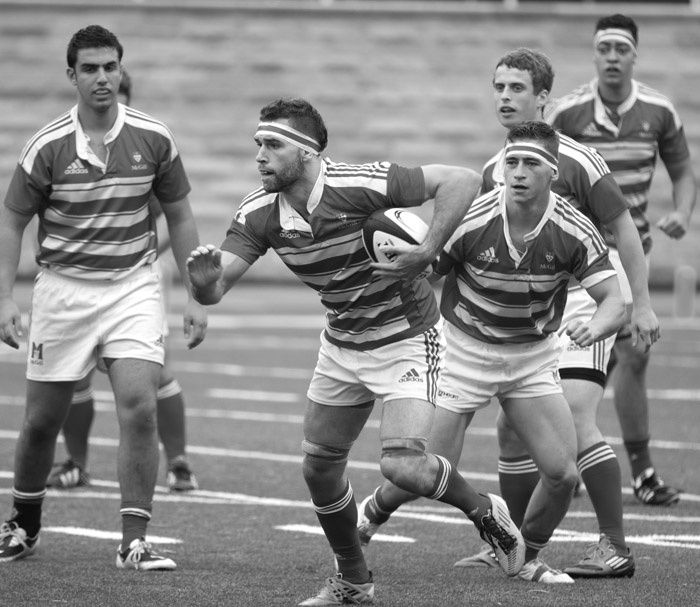
Marc Webster playing Rugby
a, Men's Varsity, Sports

No quarter given in attritional draw between McGill and Concordia

The Redmen (2-1-2) were clearly frustrated at the final whistle of Friday’s game against Concordia (3-1-1). (more…)

a, News, SSMU

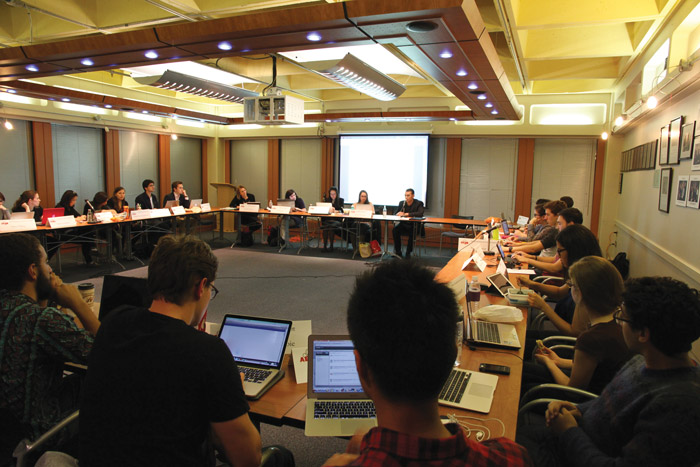
SSMU Council discusses cycling referendum, conflict of interest policies

Traditional Territory Acknowledgement Statement

Last Thursday, the Students’ Society of McGill University (SSMU) Legislative Council passed the “Motion Regarding the Adoption of a Traditional Territory Acknowledgement Statement,” which requires a statement of acknowledgement over McGill’s physical situation on traditional Kanien’kehá:ka territory be read at all future SSMU Council meetings and major SSMU events. 

The motion is similar to a motion of the same name passed by the Arts Undergraduate Society (AUS) Council in late September 2014, and was sponsored by VP University Affairs Claire Stewart-Kanigan, VP External Amina Moustaqim-Barrette, and Arts Senator Kareem Ibrahim.

“It’s a growing practice amongst universities, and McGill has historically been behind in supporting indigenous students,” Stewart-Kanigan said.

“It shows our effort to decolonize education and bring attention to the too often ignored issues facing First Nations communities,” Ibrahim said. “The land McGill occupies is unceded Kanien’kehá:ka traditional territory, also known as the land of the Mohawk First Nation. This is just one step in a very long journey that we have both as an institution and as a larger community here in Montreal to recognize the consequences of colonialism, how we are inherently a part of that process, and how these effects continue today in very prominent ways.”

Cycling referendum

Council also approved a plebiscite question for the second Fall Referendum ballot asking students if cycling should be allowed on lower campus and if SSMU should lobby the McGill administration to allow bikes on campus.

As a plebiscite question, the ballot has no weight beyond gathering data on student preferences, but some councillors expressed concern that the vote would mislead the student body by implying direct change as a result of the referendum.

McGill’s dismount policy, which required bikers to dismount and walk their bikes on campus since May 2010, was met with mixed reactions with the installation of swinging metal gates at the Milton entrance in September 2013. The bike gates were vandalized and faced formal opposition from AUS and SSMU council, leading to their removal in October 2013.

A Cycling Working Group was created to explore possible solutions after this incident. According to the motion, the working group recommended to McGill a “Shared Space” policy be implemented on campus, instead of the current dismount policy.

“Shared Space is an approach to street design that minimizes the separations between cyclists and pedestrians, forcing all mode users to share the space, and where the pedestrian is considered the primary user of the shared space and has the right of way at all times,” read the motion for the plebiscite question.

Conflict of interest regarding councillors’ employment

The Council also voted to allow special permissions to two councillors employed in SSMU operations, who would otherwise be prohibited from being employed by SSMU while on Council as per Bylaw I-2 Article 3.5.

Councillor Zacheriah Houston and councillor Alexander Kpeglo-Hennessy, working at the Student Run Cafe (SRC) and Gerts Student Bar respectively, were granted permission to continue their employment after heavy debate on the floor.

“I’ve always recommended not adding councillors to be employed by the SSMU, for the reason that there could be potential situations where I have to make an intervention with an employee […] who is also above me,” SSMU General Manager Pauline Gervais said.

Issues of conflict of interest were discussed as well as to whether the councillors had intended to pursue employment at the operations run by SSMU prior to being elected into their position at Council.

Event and services finances

VP Internal J. Daniel Chaim also discussed his work on SSMU’s annual Halloween party, 4Floors. According to Chaim, this year’s ticket prices would have to be increased from $15 to $25 per person in order to gain the necessary funds to improve the event from prior years. He explained that the increased price was necessary in order for the event to break even, which it struggled to do last year.

“We spent a while debating financial accessibility and the success of the event,” Chaim said. “It was financial accessibility that was was most in our minds, but we didn’t really didn’t have a choice [….] I’d rather tell people there was a deficit last year and we need to account for that.”

Council also approved the Audited Financial Statements for the 2013-2014 fiscal year. Gerts Bar reported more than $8,000 in profit, which was attributed to increased sales since its renovation two years ago. The SRC reported a $51,000 loss, primarily due to start-up costs such as equipment and training.

a, Student Life

Escape from reality with Echappe-Toi

Echappe-Toi, a real-life simulation experience based on Montreal’s Parthenais Prison, launched in Montreal on Tuesday, Oct. 7. Created by Montreal entrepreneurial lab Les Entrepreneurs Associés, the game offers participants 60 minutes to escape from a room using teamwork and a variety of clues.

Popularized by Japanese role-playing video games in which players are locked inside a room and must use their environment to escape, the experiences known as ‘Real Escape Games’ have been implemented worldwide to incredible success. Seventeen countries have established escape games so far, with Montreal being the third city in Canada to implement the simulation.

Located on the same street as the historical location of the Parthenais Prison, Echappe-Toi places participants in a room imitating a real cell from the prison. According to Emmanuel de Gouvello, one of the founders of Echappe-toi, a great impetus for introducing the game to Montreal was the unique cultural history of the location. 

“Historically, [this] is a jail street,” de Gouvello said. “What we like is that [the game] is related to the part of the city where we are, because Montreal has such an incredibly rich story.”

Setting up the game proved to be difficult in Montreal, where the creators had to consider a number of complex factors, including the bilingual nature of the participants. To add to the difficulty, Echappe- Toi chose not to engage in standard industry practice and visit other escape games for inspiration, opting instead to build the game from the ground up. De Gouvello stated that to do otherwise would render Echappe-toi a copycat experience.

“I know it’s not traditional, because normally you would go see your competition, see how they work, and try and take their idea,” he said. “But I love the idea of being truly original with an idea that has been developed by others in the world.”

Escape games have had an astonishingly low success rate internationally, with only three per cent of participants completing a successful escape, according to de Gouvello. As such, the Echappe-toi team views the game as a means to an end in order to create team chemistry—with escaping the room being just one of the desired goals. With two to six players allowed in each room, the game offers a variety of different clues and activities that appeal to a number of different skillsets, including more tactile-based clues and cryptographic puzzles.

After each session, the Echappe-toi team offers participants a debrief of their activities. According to co-founder Jérémie Abbou, the game appeals to a variety of clients who are intent on improving group dynamics.

“We build packages for schools, friends, families, and companies,” Abbou said. “[Packages include] group coaching, how to emphasize team building, [and] how to improve your efficiency.”

Although Echappe-toi has just launched, the founders are already thinking of new scenarios and rooms in anticipation of repeat customers—despite the fact that the game is almost fully booked for the next three months.

“We will make sure the game evolves,” de Gouvello said. “We’ll change the puzzles inside if you come back or if we have leaks, [so] there’s still value for everyone [….] We already have a few ideas in stock.”

However, the team’s primary focus has stayed steady throughout the process: Making sure that people enjoy their experience at Echappe-toi.

“It’s fun,” said Philippe Prevost, head of marketing for Echappe-toi. “And that’s what people are looking for, the pursuit of happiness […] That’s the objective of the team operating this event—that people leave happy.”

a, Science & Technology

Experts discuss life in outer space

Spanning two days, the Annual Trottier Public Science Symposium “Are We Alone?” took the audience to the moon, Mars, and beyond. Focusing on the origin of life in our solar system, the series explored the where and how of alien life.

Monday

Monday’s first speaker, Planetary Society President Jim Bell, discussed the journeys of Spirit, Opportunity, and Curiosity—three Mars rovers—as they furthered the search for microbial life in our solar system. Following him was Jill Tarter, director of the Search for Extra-Terrestrial Intelligence (SETI) Institute, explaining the possibility of sentient life and our current methods of finding it.

Bell started by presenting the idea that if we can prove that life evolved on another planet, then we know that it is not a cosmic coincidence—all of the universe should be full of life. Mars, due to the presence of water on its surface, is a prime target for this. Rovers have been sent to ancient lakes and bodies of water in order to study potential traces of life. By observing soil and air samples, or by taking photographs of the Martian surface to investigate the different layers of rock, scientists can extrapolate the conditions and determine how habitable they may be.

One of the major goals for NASA’s next mission is to set up a sample-return capsule, which could be brought back to Earth and analyzed.

Tarter pointed to the hundreds of thousands of confirmed extrasolar planets that have been discovered within a ‘habitable zone’—regions with sufficient atmospheric pressure to support liquid water—as necessary to study. She believes that there are more habitable planets than we are testing for because our definition of what makes planets livable is too narrow.

The goal of Tarter’s and SETI’s efforts is to detect a signal from an alien species, in order to answer two major questions: How close are other intelligent civilizations, and how far away are we?

Tuesday

Professor Sarah Seger began Tuesday’s talks by addressing some common questions about the search for another Earth. Called the ‘Indiana Jones of astronomy,’ Seger researches the edges of exoplanets—planets that do not orbit Earth’s sun— and their identification.

To set the stage for her talk, Seger gave the audience a glimpse of the vastness of the universe and the diversity of star systems. However, the detection of exoplanets is only the first step in the search for life. After astronomers find a planet, they still need to determine whether it contains any signs of biological activity.

So far, the search has produced an impressive list of exoplanets, but no sign of extraterrestrials. Even if scientists do find life markers, interstellar distances mean that a trip to visit any celestial neighbours would take millennia.

So why bother? Why search for something so far away when humans won’t be able to visit it for thousands of years?

The answer, according to Seger, is because one day, humans will make the trip.

“The desire to explore is so huge, so amazing, that one of our legacies of finding exoplanets is the thought that hundreds, thousands of years from now, people going on this trip [to other star systems] will look back at all of us here and they’ll say, ‘Wow, those were the first people who went out and tried to find those other worlds,’” she said.

Skeptic Joe Nickell shifted the audience’s focus away from the stars and back to Earth. As the world’s only full-time, professional paranormal investigator, Nickell touches upon tales of Earth’s more mythological inhabitants. The two mythologies represent different aspects of humanity’s relationship with the planet.

“Bigfoot is the symbol for [the world’s] endangered species,” he said.

As Nickell put it, humanity’s fascination with the infamous Sasquatch reflects the curiosity about our own origins in the natural world.

“We’re looking away from this planet,” Nickell said. “We’re looking to the moon, the stars, and so forth, and we’re imagining that there may be life out there.”

The speakers’ descriptions of the search for life beyond Earth revealed more about humans than about aliens. Even if life is not universal, the desire to find it is.

The rise of data journalism
a, Off the Board, Opinion

Off the board: The false promise of data journalism

Journalism, at its heart, is about telling a story. Over the years, journalists have developed different tools to tell these stories. (more…)

a, Men's Varsity, Sports

Winless streak continues as Redmen fall to Gaiters

In an exciting battle between the two remaining winless teams in the RSEQ conference, the Bishop’s Gaiters (1-4) came out on top, edging the Redmen (0-5) by a score of 17-13 on Thursday night at Molson Stadium. (more…)

a, Student Life, Student of the Week

Student of the Week: Candice Taguibao

Candice Taguibao, a U1 physiology student, is an athlete, an aspiring doctor, a teamplayer, and a fundraiser—all of which contribute to her aspiration of a career in medicine.

Taguibao attributes her diligence to her background in sports. She was the captain of her volleyball team in high school and is currently on a co-ed volleyball team called Get Spiked. In addition to playing regular intramural matches, she goes to drop-in volleyball at the Athletics Centre, where she can regroup and practice with the rest of her teammates. Taguibao has  also played tennis from a young age, which contributes to her strong sense of sportsmanship and determination.

“I trained […] a lot, and it’s really fun,” Taguibao said. “You learn a lot of discipline, which I’m really thankful for. But it’s also really fun and beneficial when you play a sport with a team [like volleyball] where you get to celebrate together and encourage each other.”

Taguibao also works with other students as a member of the MedLife fundraising committee, a McGill club that promotes medicine, education, and development for low-income families. Taguibao knew that she wanted to join a club in her first year, and decided on MedLife because she strongly agreed with its mandate. 

“I like how it emphasizes medicine, education, and development—all which I think are necessary to improving someone’s standard of living,” she said. 

In particular, Taguibao enjoys being a part of the fundraising committee because by organizing events, she gets a tangible demonstration of her hard work and success.

“Last year, we did a coffee house event where we got a lot of cultural clubs and musical groups to come,” she said. “Bringing the community together that way was really cool, and it was nice to be a part of something [where] you work together, create an event, and actually get to see it through.” 

Taguibao’s passion for medicine and helping others have inspired her to pursue a career as an Obstetrician/Gynecologist (OBGYN).

“As a woman, I’ve always had a passion to work with other women,” Taguibao said. “As a doctor, I want to be able to have a personal relationship with my patients.”

This past summer, in addition to being a tennis coach at two different locations, Taguibao volunteered with an OBGYN at Markham Stouffville Hospital. Taguibao said that what struck her most about her experience was the busy and demanding lifestyle that OBGYNs lead, which is one she realized she would like to follow.

“[Since] I only interacted with [the OBGYN] personally and not with any of the patients, I mostly got to learn from his personality,” she said. “He was [busy and] hard working, and he always cared about his patient, which I found really inspiring. It’s definitely [a lifestyle] that I can see myself leading.” 

Taguibao hopes to foster a safe medical environment where others receive the same sense of community support that she herself has benefitted from in all of her endeavours. 

McGill Tribune (MT): What would be on your ideal pizza?

Candice Taguibao (CT): Broccoli, bacon, a lot of cheese, and a winky face drawn in barbecue sauce.

MT: Favourite  and least favourite celebrity couple?

CT: Least favourite would be Kim Kardashian and Kanye West. Favourite would be Chris Pratt and Anna Faris.

MT: What’s your go-to TV show?

CT: 30 Rock and Parks and Recreation. 

MT: Your biggest pet peeve?

CT: When people chew gum very loudly.

MT: You have to hear one song on repeat for the rest of you life. Which one do you choose?

CT: Hey Jude by the Beatles.

a, Research Briefs, Science & Technology

Research Briefs—Oct. 15

Seeing is believing

In a preliminary UCLA study led by eye specialist Steven Schwartz, 18 legally blind patients were given embryonic stem cells; 10 showed substantial improvements in their vision. Although the research is in its initial steps, Schwartz and other scientists believe that the embryonic stem cell treatment shows promise for future cures for other medical conditions.

The stem cells used, known as human embryonic stem cells (hESCs), are able to become any type of cell in the body by using differentiating factors. In this study, they were differentiated into retinal pigment epithelium cells, which were then transplanted into patients with visual diseases known as Stargadt’s macular dystrophy and dry atrophic age-related macular degeneration. Neither disease currently has a viable cure, but this study shows promise for potential solutions.

A few of the patients exhibited minor side effects, which were attributed to the transplantation itself and the drugs that were taken to aid the process, not the hESCs. According to Schwartz, this study has the potential for paving the way for research.

“[It marks] an exciting step towards using hESC-derived stem cells as a safe source of cells for the treatment of various medical disorders requiring tissue repair or replacement,” he said.

Such great heights

A robotic airship featuring a ‘stabilizing fin’ designed at Greentown Labs in Somerville, Massachusetts has been developed in order to mimic a wind turbine—the most noticeable difference being the airship’s staggering height. While wind turbines are typically around 200 feet tall, this airship stands at 2,000 feet, features blade tips 720 feet long, and is surprisingly inflatable. This turbine, known as a buoyant airborne turbine (BAT), is one of Altaeros Energies’ most significant projects.

One of the most significant differences between ordinary wind turbines and the BAT is in installation. While wind turbines typically require a full crew and an extended period of time to put together, the BAT can be used right away.

According to Altaeros, the BAT will be most useful in areas where non-renewable energy sources are not economically feasible and solar panels are not practical, particularly in regions plagued with snow and frost. The Alaska Energy Authority has already given Altaeros a $740,000 grant to begin working with the BAT.

“We’re not trying to replace wind turbines,” said Altaeros co-founder and lead director Adam Rein. “We’re trying to expand wind energy to places where it doesn’t work today.”

In the dark

Dr. Prajwal Kafle, an astrophysicist from the University of Western Australia, worked with other astronomers to use an age-old method developed in 1915 to study the Milky Way—except their discoveries were far from ancient. In fact, they discovered that the galaxy is only half the size that scientists were previously led to believe.

According to Kafle, the reason for this discrepancy lies in the distribution of matter versus dark matter. Because four per cent of the galaxy is visible and 25 per cent is composed of dark matter, the remainder is considered to be ‘dark energy.’ Kafle’s study was unique in that it focused on the speed of stars all the way to the edges of the galaxy in order to measure the mass of the dark matter that exists in the Milky Way.

Professor Geraint Lewis, an astrophysicist from the University of Sydney, emphasized that the makeup of the galaxy has perplexed scientists for years.

“Dr Kafle’s work has shown that it might not be as bad as everyone thought, although there are still problems to overcome,” he said.

Read the latest issue

Read the latest issue