

Latest News

a, Student Life

Turntable for what

There’s something very relaxing about shopping for records—strolling through aisles of milk crates, occasionally flipping through stacks that look promising, and breathing in the slightly musty smell of 30-year-old cardboard. Similar to high-waisted jeans and Converse sneakers, vinyls are making a huge comeback. You can find turntables and vinyls in many locations, from Urban Outfitters to garage sales, so jump on the bandwagon if you haven’t already, and start experiencing music through records available at these locations.

Beatnick

Although it’s a half-hour walk from campus, shopping at Beatnick is an experience you can’t miss. The store is large and carries just about every genre of music you can think of—thankfully, it’s very well organized. The shelves also display CDs and some cool memorabilia, such as figurines and model cars. The staff is accommodating and friendly, providing ample knowledge of cool music trivia, which is not surprising considering the store has been around for over 20 years. The records are mostly used records, and the best deals are in the three for $1 bins; however, the records are all very reasonably priced ($5 to $10 on average).

Cheap Thrills

After climbing a lilting set of stairs, you’ll find yourself in a musty little nook of a store filled with records, CDs, and used books. It is recommended to head directly to the used section to find the best deals. The store is fairly well organized, which makes it easy to find the records of your liking. The new records tend to be between $20 and $30, while used records are priced anywhere between $5 and $20. The store also carries all genres, from ’40s jazz to current pop. A great bonus to this store is that it’s only a five-minute walk from campus.

Le Pick Up

This store carries an interesting assortment of records, mostly pop and alternative music from the 1960s to 1980s; however, there’s a large collection of classical music near the front as well. The store is a 20-minute walk from campus and well worth the trip. The owner is friendly, helpful, and plays great music, which provides a perfect ambiance for the store. The store also sells used books and cassettes. The records are mostly used and go for $5 to $20.  The owner also stocks mostly original records rather than reissues.

Soundcentral

This store is just over 30 minutes away on foot. More than just a record store, Soundcentral also carries cassettes, vintage gaming consoles, t-shirts, posters, and used books. It also has a small café that serves coffee and occasionally hosts live music performances and screenings of independent films at night. It sometimes sells used turntables, but it’s recommended to call ahead to see what’s available before making the trip. Their records are priced anywhere between 25 cents and $300, but the average price is around $10 to $20. As a bonus, the availability of records can be checked for online on the store’s website.

Death of Vinyl

This store feels like an empty bar full of records. Death of Vinyl is organized in a seemingly random fashion, so don’t hesitate to ask for help from the friendly staff. The records are priced around $10 to $30 and are mostly used. Although it’s quite a hike (an hour from campus), it’s one of the best places to buy a used turntable. New turntables can be priced anywhere from $150 to $150,000; however, Death of Vinyl understands the struggle of students on a budget, offering good-quality used turntables for between $50 and $100, with a three-month warranty.

a, McGill, News, SSMU

SSMU Council calls for university divestment

Councillors at the Students’ Society of McGill University (SSMU) Legislative Council passed a motion calling for McGill to take action in divesting from fossil fuel industries and mobilizing the McGill population—including students, faculty and staff in doing the same.

“The Society reaffirms, in accordance with the strong principles of justice and equity laid out in […] the Society’s Constitution, the commitment of [SSMU] to the implementation of socially responsible investment strategies by the SSMU and by McGill University, in particular its belief that both bodies should divest their holdings in companies involved in the Canadian Tar Sands, in fossil fuel extraction, production, or distribution,” the motion reads.

SSMU VP External Amina Moustaqim-Barrette, one of the sponsors of the motion, explained the importance for SSMU to increase pressure on McGill in affirming climate justice on campus.

“Just last week, we saw over 400,000 people in New York City and thousands of others across the world gather for the largest climate march in history,” Moustaqim-Barrette said. “The next day, the Rockefellers announced that they would be divesting from the fossil fuel industry. The momentum for this campaign is building all over the world, and it is important for SSMU to take an active role in pressuring McGill to uphold its commitments to sustainability and ethical practices and divest from the fossil fuel industry.”

Article 1 of the motion mandated that Moustaqim-Barrette work with other student unions across Quebec to create a coalition against pipeline projects in the province such as the Eastern Energy Pipeline, which is set to transport crude oil across Canada. However, it was met with concern from councillors regarding the external reach of the project.

Faculty of Law representative, Vincent-Pierre Fullerton, voiced his concerns that councillors would be exceeding their mandate in specifically condemning the construction of pipelines in Quebec, as it was an issue that was “specific, divisive, and external.”

“The Law Students’ Association (LSA) thought it best that the specific issue relating to the condemnation of pipeline projects in the province of Quebec be brought to the General Assembly, where each student will have the possibility to express their individual opinion,” Fullerton said. “Should such a motion then pass, it would be regarded as having much more legitimacy, coming directly from the student body and representing the majority’s opinion, as emanating from the wide diversity of opinions present in the McGill student body.”

Councillors ultimately voted to remove Article 1 from the motion and move it to the General Assembly on Oct. 22 for discussion. The rest of the motion was passed.

“The decision to separate Article 1 from the rest of the climate justice motion was extremely disappointing to me,” Moustaqim-Barrette said. “I would argue that approval of these pipelines will absolutely have a direct impact on our students, our community, and our collective future. Given the inextricable link between pipeline projects and the advancement of climate change, it is difficult for me to consolidate the fact that Council was willing to take a stance against the fossil fuel industry, but not against specific pipeline projects.”

a, Student Life

Five study spots on campus

Midterm season is just around the corner, meaning that the hour is drawing near to ditch tanning on lower field and hit the books. Luckily, McGill has a plethora of study spots, from its 13 library branches to student lounges and cafes.

Birks Reading Room

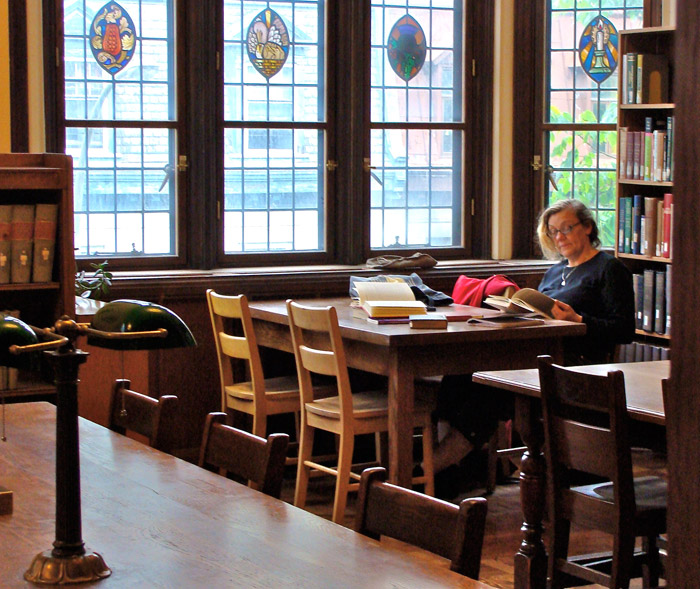
Tucked away on the second floor of the Birks Building, this silent haven is a great location to hibernate and ponder away the afternoon. Its architecture gives it a distinctively severe academic ambiance, yet the size makes it feel personal and comfortable. The hall features solid wood tables, beautiful mouldings, and large windows that let in dappled sunlight. Shoes are not permitted, so bring comfy socks or take advantage of the slippers provided. Reward yourself on your walk home with a caramel candy from the jar near the services desk.

Hours: Monday to Friday: 9:00-13:00, 14:00-17:00, Saturday to Sunday: Closed

Address: Birks Building, 3520 University Street

Noise level: Quiet

Islamic Studies

Library

This library may secretly be magic. Although it is one of the most central buildings on campus, entering through its huge wooden doors seems to transport students into another world. Study spots are plentiful in this gothic-style treasure, with widely available seating. Both the main and second floors feature study booths and tables, and are great for quiet essay writing. Those fortunate enough to stumble into the Octagon Room, near the back right of the main floor, will be greeted by a beautiful space with antique wooden display cabinets and delightfully scholarly study booths. During the winter months, this library is especially cozy and warm, providing the perfect refuge for in-between-class study sessions.

Hours: Monday to Friday: 9:00-17:00, Saturday to Sunday: Closed

Address: 3485 McTavish Street

Noise level: Quiet to moderate

Nahum Gelber Law Library

Located in the upper part of campus on Peel Street, this library has modern architecture, yet complements it with designs that give a nod to more classic bookish styles. Canadian artwork adorns the walls, tasteful lighting highlights textbooks, and plush red chairs provide comfortable seating. Don’t be afraid to branch out beyond the first two floors, and explore the entire range of study spots that grace the five floors of this library. The table by the enormous triangular window on the third floor is a favourite—a study spot with a view.

Hours: Monday to Friday: 9:00-23:00, Saturday to Sunday: 10:00-22:00

Address: 3660 Peel Street

Noise level: Quiet

Education

Curriculum

Resources Centre

The Education Curriculum Resources Centre has a serene and pleasant study atmosphere that boasts multiple areas for quiet or group study. It also contains numerous computers, which are helpful for those who don’t feel like lugging their laptops up the hill. There is also a cafe on the ground level, which offers a variety of snacks, as well as booths where students can chat and decompress on a study break.

Hours: Monday to Friday: 9:00-17:00, Saturday to Sunday: Closed

Address: 3700 McTavish Street

Noise level: Moderate

SSMU Cafeteria

Meander here after the lunch-hour rush for an unconventional but surprisingly effective study zone. Large windows provide excellent natural light, and the steady hum of conversations lends itself to the perfect amount of white noise for concentration. A great perk is that the multiple food options and microwaves available make studying much more enjoyable. This is great for both group and solo study sessions.

Hours: Monday to Friday: 7:00-13:00, Saturday to Sunday: Closed

Address: 3600 McTavish Street

Noise level: Moderate

a, Science & Technology

TISED talks address renewable electricity in Canada and the U.S.

Last Wednesday, Moyse Hall attendees watched society and technology collide. As part of a lecture series hosted by the Trottier Institute for Sustainability in Engineering and Design (TISED), McGill presented two views—one from an economist and one from an engineer—on the future of renewable power in North America.

The first speaker, economist John Reilly of MIT, discussed the ramifications of the U.S. power supply evolving to rely on 80 per cent renewable sources. Jim Burpee, president and CEO of the Canadian Electricity Association (CEA), followed up by bringing the subject matter closer to home and looking at the future of electricity in Canada.

Reilly’s study examined a few scenarios on what the makeup of energy sources in the U.S. could look like in a few decades. He emphasized the difficulty of using unpredictable renewable sources like wind and solar energy.

As an economist, Reilly then compared the costs of these energy sources to coal. He found that renewables like wind power are more expensive, not because of the cost of technology, but because of the unreliability of these sources.

In spite of these challenges, Reilly’s study found that with a flexible grid system and strategic placement of generators, 80 per cent renewable energy production in the U.S. is feasible using only today’s commercially available technologies. Furthermore, electricity prices in the model only went up as much as would be expected in order to reduce greenhouse gas (GHG) emissions.

However, Burpee showed that Canada’s energy sources were a different situation. He started his presentation with a breakdown of Canadian energy sources, of which 80 per cent were already non-GHG emitting.

Despite this impressive number, the CEA is continuing to improve sustainability.

In essence, decarbonization is the act of declining the average carbon intensity of primary energy over time. While global progress is slow—a 0.3 per cent decline per year, according to the Intergovernmental Panel on Climate Change (IPCC)—the trend is showing declining carbon use.

According to Burpee, “The question isn’t whether to decarbonize—it’s, ‘At what rate [should we decarbonize?]’”

To find an answer, Burpee explored the costs associated with decarbonization, the role of government regulation, and the viability of nuclear power to replace carbon. He discussed the three pillars of energy supply: Sustainability, affordability, and reliability. In order to improve sustainability without affecting reliability, the price of electricity has to go up.

Burpee also noted the potential for technological advancements to improve sustainability. Solar panel efficiency, for example, is 17 per cent. Even the internal combustion engine appears embarrassingly inefficient at 30 per cent, leaving room for improvement.

The evening ended with a Q&A period, where one of the final questions resonated with McGill students in particular: What role can young people play in the move towards sustainable sources?

Both presenters agreed that technological developments are integral to society’s ability to switch to renewable energy sources. Beyond engineers, computer scientists will also become increasingly important as the grid becomes smarter.

The second day’s lecturer, Jessika Trancik, also hailed from MIT. With a background in materials science, her lab analyzes the costs and environmental impacts of energy technologies. Her work aims to improve the efficiency of energy production and storage.

Trancik’s talk highlighted the immense improvements that have been made in renewable energy production. For example, photovoltaics—solar panels—are about 100 times cheaper today than they were in 1974.

However, these developments don’t happen in a vacuum. Investment in technology is essential to continue improving at this rate. Trancik’s work has shown the link between public funding and the rate of patent filing in both the U.S. and Japan. These links show growth in certain markets, particularly those focused on sustainability.

The talks highlighted the fact that the shift to renewable energy is not an isolated problem. It is important for people from all fields to take a stance to help solve the issues facing the implementation of renewable energy.

owen pallett plays the violin
a, Arts & Entertainment, Music

Owen Pallett reveals expertise in vocals, violin

As far as entrances go, Owen Pallett’s first appearance on stage during his concert at the Corona Theatre last week was a humble one. (more…)

a, Montreal, News

Montreal to become a Future Earth hub

As announced on Jul. 8, Montreal is set to be one of five hubs for Future Earth, a United Nations (UN)-based program that aims to fuel research and public policy reform in the field of environmental sustainability through international collaboration.

Stressing the importance of global partnerships in resolving key environmental issues, Future Earth will have other hubs in Paris, Tokyo, Stockholm, and Boulder.

Bidding for the ambitious initiative was competitive, according to Coryell Boffy, a project director for International Organizations at Montreal International, the consortium that played an instrumental role in bringing Future Earth to Montreal.

Instead of bidding for hub status separately, the representatives from the five cities decided to collaborate and present a proposal to design a global secretariat, which will work on mobilizing thousands of scientists while establishing strong public policy partnerships in the environmental sustainability field.

“[The] reason our bid was chosen was because it was a multi-country initiative, so it was a good base in terms of international reach,” Boffy explained.

The project aims to expand its secretariat to regional hubs in Africa, Asia, the Middle East, and Latin America in the future to incorporate the environmental needs of the developing world into the initiative.

“This program is unique because it attempts to integrate the natural sciences, the social sciences, and businesses to really boost environmental sustainability efforts,” Boffy said. “The creation of this international network will also create opportunities for local researchers to access a global network, and the best international ideas to integrate in their research.”

Montreal’s extensive academic base, research facilities, and multicultural values will be crucial for the 10-year project that is expected to be set up by early next year, according to Dr. Andrew Gonzalez, a biology professor at McGill. Gonzalez was part of the Montreal team that attended a meeting of potential candidates for the secretariat held in Paris last year. Since then, he has contributed to designing the distributed structure for the global secretariat.

“The Montreal hub […] has several jobs to do, [including] communications and outreach, research enabling, synthesis, and capacity building,” Gonzalez said. “At some point, it will specialize on a small set of those, but it is too early to say how the process is exactly going to work.”

Although the hub will be based in Concordia University, McGill will be directly involved in the initiative, acting as a sponsor for the hub along with seven other academic institutions like the Université de Montréal, Concordia University, Université du Québec à Montréal, L’École de technologie supérieure de Montréal, Montreal International, as well as the Quebec government.

According to Gonzalez, McGill’s strong research community and multi-disciplinary approach toward environmental sustainability will widen the scope of the program.

“There are several McGill researchers who are already committed to sustainability research and our research community is particularly strong in this area,” he said. “We have numerous departments working on environmental sustainability—the McGill School for Environment, the Departments of Geography and Biology, and Natural Resource Sciences out at the [Macdonald] campus. So, we have a very healthy community with world class research.”

At the moment, McGill is leading two promising biodiversity projects—namely “Eco-Services” which focuses on the services that humans obtain from ecosystems and “Bio-Genesis,” which deals with biodiversity change—in the field.

“However, we have many other research strengths like green chemistry, biofuels, and engineering solutions that I hope will become an important part of the Montreal hub’s emphasis,” Gonzalez said.

One of the major goals of the initiative is to also engage stakeholders such as urban dwellers and farmers in the research process in order to form a collaborative and multilateral network that encourages their contribution in tackling issues that affect them most.

The Future Earth initiative, with an annual budget of between $5 million and $10 million, is sponsored by the Science and Technology Alliance for Global Sustainability, comprised of not-for-profit organizations such as the International Council for Science (ICSU), the United Nations Educational, Scientific, and Cultural Organization (UNESCO), the United Nations Environment Programme (UNEP), as well as the World Meteorological Organization as an observer.

Marius Karolinski, U2 Science, commended the concept of the program.

“Any platforms and any ways of organizing like-minded people to discuss issues is very important, because some of the best ideas I have are the ones that have been derived through stimulating conversation,” Karolinski said.

a, Arts & Entertainment, Music

Album Review: Lights – Little Machines

Five years ago, the electronic music field looked vastly different than what it is today. Since then, La Roux proved a surprising newcomer with her hit single “Bulletproof,” Skrillex was the first electronic artist nominated for major Grammy awards, and Disclosure led the modern-day electronic charge into mainstream culture. The relatively young genre has transformed into an increasingly diversifying arena filled with quality artists as each year passes.

Let’s not forget Canadian artist Lights, who—after a string of albums and bubbly chart-hungry singles—finds herself releasing her third studio album, Little Machines, amidst a now packed-out electronic venue.

Interestingly, the album opens with a strikingly slower tempo song than Lights is known for.
“Portal” showcases smooth and somewhat dreamy vocals—free of the reverb and annoying auto-tune that plagued her previous album—supported by an increasingly pulsating beat and various atmospheric electronica. The result is a carefully designed song that never outdoes itself with sound. “The Same Sea” follows the same formula: A slow beginning that increases in both vocals and productions as it progresses, never sounding over-the-top. Although it represents an intriguing and new direction for Lights, it begins to wear thin. By seventh song “Oil & Water,” the muted drums become tiresome and her layered vocals sound tinny, which, when matched with somewhat understated production, results in a frustrating ‘almost-but-not-quite’ listen. It’s an experience that lacks the climactic final choruses the songs deserve.

Then everything changes. Eighth track “Slow Down” introduces an ’80s guitar riff and more earthy vocals—a welcome departure from the first half of the album. “How We Do It” is a highly uplifting track including lush synthesizers, while album closer “Don’t Go Home Without Me” is a stunning and personal moment—rare for Lights—in which she proclaims to her partner, “This is the song I’ll sing to you when you’re old and tired […] I’ll sing it to remind you that I’m old beside you.” It’s a conclusion to a much more self-aware and introspective album, one that thrives in the second half’s lyrical depth and retro-inspired arrangements rather than the heavily synthetic sound of her previous work.

Despite the slow start, Little Machines marks a mature turn for Lights. Creating an album in which the second half is stronger than the first is rare. Yet, Lights succeeds, creating a record that never over-indulges and provides the listener with an uplifting ’80s-esque experience and—although not necessarily providing an immediate chart-topper like her previous albums—ultimately maintaining her niche position of electropop in the current electronic and overall music scene.

a, McGill, News

New Dentistry building provides improved facilities for students

The Faculty of Dentistry completed its relocation to 2001 McGill College Avenue, from its previous location in the Montreal General Hospital on Sept. 3.

The costs for relocation amounted to an estimated $16.5 million, though only approximately $6.5 million have been raised to date, according to the Faculty of Dentistry’s website. The Dentistry Students’ Society (DSS) passed a referendum last October creating a mandatory $2,500 per semester fee for new students from Fall 2014 and onwards to help the faculty repay the loan needed for the relocation.

The fee would not affect students in the program before this semester and was scheduled to last five years before being put up for renewal. Paul Allison, dean of the Faculty of Dentistry, said that students were excited about the new facility and teaching equipment.

“In the faculty, we’ve been talking about this for many years. Everyone’s been looking forward to it,” Allison said. “There’s also some learning possibilities that students now have that they didn’t have before. There are more meeting rooms, there’s more versatility in the space, we’re closer together, so there [are] many, many advantages in the space we’ve moved into.”

The fee was met with controversy last year, with some students questioning the fairness of only charging new dentistry students.

“We had a debate within the faculty and with the students themselves,” Allison said. “The main argument of not charging [the fee] to students who were already in the program was that they did not know about this up front, that this was a new thing.”

According to Allison, McGill’s dentistry program tuition is still competitive across North America, even with the increased fee levy.

“I haven’t heard anything at all from the students, and I think the students are very aware that despite the fact that the dentistry society has voted for this contribution, they are still paying much less for their education in a dental program here compared [to] anywhere else in North America,” Allison said. “I think they can see that they are still getting an extremely good deal—very new equipment, fantastic facility, and much cheaper than any other dental school outside Quebec.”

Nazanin Hojjati, president of the DSS, also said first year students had not voiced any dissent to her so far.

“To be honest, I haven’t heard any complaints yet,” she said. “I’ve spoken to first years, I’ve met them, but no one has mentioned it to me.”

Hojjati went on to praise the new facility’s location and the improved equipment.

“We didn’t feel like we were part of the McGill community before, as we were so far away from the main campus, but now we feel that kind of unity with the university, which is great,” she said.

Yuxin Mei, fourth year Dentistry also spoke in favor of the move.

“[Is] it fair for existing students to decide what incoming students will be paying? Honestly, I don’t see how else they would’ve done it,” Mei said. “In my opinion, incoming students were told what they would be paying, they can make the decision themselves [….] I think it is one of the best facilities in Canada right now.” 

Two other dentistry students declined to comment on the new facility or the DSS fee.

Additional reporting by Cece Zhang.

a, Martlets, Sports

Martlets gear up for playoff race

The McGill Martlets (4-3-2) soccer team converted on a myriad of offensive opportunities in the second half to best the UQTR Patriotes (1-4-2) 2-0 at Molson Stadium Thursday evening.

The first half of the game was dominated by the Martlets as they continuously out-ran the UQTR defence to create scoring chances. Senior forward Rebecca Green led the offence in the first half, keeping constant pressure on the opposing team. She narrowly missed several chances created by fellow striker Meghan Bourque.

“We knew this was a game for us to win and we were all pleased with how we took control early on in the game,” Head Coach Jose-Luis Valdes said. “We created very good chances, but their keeper made the saves somehow to keep them in the game at the half.”

The Martlets came out even more determined in the second half, with Bourque, Green, and rookie forward Audrey-Ann Coughlan creating legitimate scoring chances. Bourque dominated the game offensively, creating multiple chances for both herself and her teammates.

“Meghan was determined and had an extra gear over everyone today,” Valdes said. “You could see she wanted to make a difference and players just feed off that attitude.”

UQTR cobbled together a rare offensive chance in the middle of the second half, but were turned away in front of the net by a tight Martlets defence led by junior Zoe Fasoulakis.

The Martlets quickly recovered, taking control of the game again soon after. Turning on her burners, Bourque sprinted down the left side of the field, blowing by several defenders and beating the UQTR goalkeeper before leaving the ball on a tee for Coughlan, who made no mistake finding the back of the net to put McGill ahead for good. The goal came with 15 minutes to spare and, despite their excellent play from the outset, the Martlets let out a collective sigh of relief.

“From that point on, you saw the weight come off our players’ shoulders and […] we did not force the play anymore,” Valdes explained.

Indeed, the Martlets appeared visibly looser, and were able to take advantage on their next scoring opportunity, with Hannah Kirby kicking home the insurance marker a few minutes after Coughlan’s go-ahead score. A goal by sophomore forward Taylor Anderson was disallowed due to an offsides call. Despite seeing limited action, sophomore goalkeeper Cassandra Fafalios stood tall in the Martlet net, making one save on the night. She was credited with her third shutout of the season, and continues to shine for McGill with consistently sharp play. The Martlets dominated the game in terms of possession, but as Valdes notes, possession is only consequential if scoring chances are created.

“[The team] still needs to work on pulling the trigger, as we sometimes just try to do things a little too pretty or tend to watch others and see what they will do,” Valdes explained following the Martlets’ Thursday night victory.

“We saw this in the first half and corrected it in the second. Hopefully versus Concordia we will play ninety minutes with the intention of making the difference in front of their goal.”

The Martlets were partially able to do live up to Valdes’ expectations as they drew 2-2 against the Concordia Stingers (2-3-3) on Sunday. Next weekend McGill hosts the RSEQ leading Laval Rouge et Or (7-1-0) on Friday night before travelling to Sherbrooke (5-2-0) on Sunday in hopes of gathering steam ahead of a post-season run.

a, Student Life, Student of the Week

Student of the Week: Wilkey Rong

Wilkey Rong, a U2 Arts student double majoring in economics and German, has actively begun to realize his goals and ideas in promoting a better future. He considers education reform and economic development to be the best foundations to build a more sustainable and prosperous future, and works enthusiastically to promote those changes.

Growing up in the metropolitan city of Shanghai, China, Rong was exposed first-hand to the consequences of the vast disparity between the rich and the poor. The systematic oppression of certain groups like migrant workers affected him deeply.

Rong is also invested in the problems concerning education in China. According to Rong, the schooling system often aims for students to complete degrees to earn high-paying jobs, instead of encouraging critical thinking and reflections on world issues.

“Schools should not dictate what is right or wrong, but should teach how to think about cause and effect,” Rong said.

Rong believes that education should act as a guide to explore topics and incite discussion, while cultivating rational and comparative thinking.

“Education is about encouraging people and teaching them to think,” Rong said.

Rong sees the connection between human rights and education, and is studying to find ways to connect the two.

Over the summer, Rong was a chief student leader for the International Baccalaureate World Student Conference (IBWSC), a conference created to bridge the conversation between high school students and teachers about involvement in human rights activism. Different perspectives were offered by guest speakers to generate interest and appeal to teenagers from a multitude of backgrounds. Rong worked with Service Point Enrolment to campaign for the event and recruit participants. He is also a leading member of the IB Alumni Advisory Council (IBAAC), a chapter that brings together former students in volunteer programs and other meet-and-greet events. His involvement with IB extends to his active participation in advancing the program by holding monthly advice meetings with IB coordinators throughout the year.

Rong has been involved with the Journalists for Human Rights (JHR) chapter at McGill since the beginning of this semester. As VP Internal Affairs, he is tasked with running financials for the club, while advocating its core beliefs and values. The organization seeks to create awareness about issues of fundamental rights in order to incite long-term and non-dependent change. According to Rong, JHR encourages the open discussion on controversial topics in support of the inherent equality of all human beings.

“JHR is really a platform to voice opinions,” Rong said.

After surviving his transitional year as an international student, Rong became an active member of the International Students Leadership Program (ISLP), which is a division of International Student Services (ISS). He organizes launch events with networking opportunities for both international and exchange students, acting as an advisor for them.

Rong’s biggest wish is for positive globalization. Increasing communication, circulation of ideas, and acceptance of different perspectives in multiple disciples are movements Rong thinks would benefit our world on a large scale. He maintains that world citizenship is critical, and that we must take further steps to turn this theory into reality.

“As long as communication is established, we can start to solve the problems,”  he said.

McGill Tribune: Who is your favourite TV show character?

Wilkey Rong: Monica from Friends—she’s hilarious.

MT: What’s in your fridge?

WR: Alles in Ordnung, (German for “I’m very organized”), so it is stocked with a little bit of everything.

MT: Current jams?

WR: Latch by Disclosure.

MT: How do you make your sandwiches?

WR: My homemade sandwiches have eggs, […] tomatoes, and cabbage. For sauces, I use both teriyaki and soy sauce.

MT: If you could trade places with anyone in the world who would it be?

WR: I wouldn’t want to change.

Read the latest issue

Read the latest issue