

Latest News

a, Montreal, News, PGSS

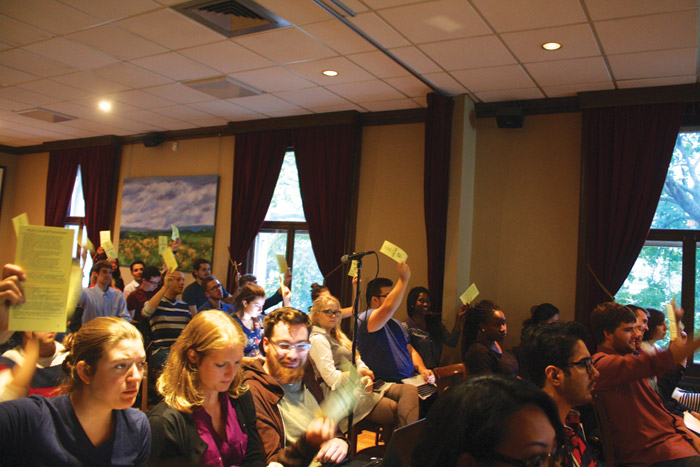
First PGSS Council of academic year debated proposed charter of students rights

Rassemblement des associations étudiantes (RAE)

On Sept. 5, the Quebec Superior Court found that the RAE, an organization that was formerly known as the Canadian Federation of Students Quebec (CFS-Q), was entitled to one-sixth of the membership fees collected by the Canadian Federation of Students National (CFS-N). The court also ruled that the RAE was entitled to membership fees that they collected between 2007 and 2010.

First-year Law student Jonathan Mooney, director of the RAE and former secretary general of PGSS, updated the Council on the case.

“The judge [ruled that] the money should go to the RAE, and that since PGSS is a member of RAE, that means that […] we will be getting some money back,” he said. “It’s also good for our colleagues at Concordia and Dawson, because they stand to gain some money from that judgement too.”

CFS vs. PGSS Case update

Ge Sa, PGSS’s internal affairs officer, spoke to the Council about a court case between himself and the CFS regarding dates for a referendum question proposing PGSS’s disaffiliation from CFS.

“The [Superior Court of Quebec’s] ruling is that the CFS will be mandated by court […] to give [PGSS] a referendum as soon as they can,” he said. “We will have a referendum hopefully this semester, and if this referendum passes, and we [agree to disaffiliate], we will no longer be a part of CFS.”

Sa highlighted his role as a graduate student at McGill, rather than as a member of the PGSS Executive committee, as the main plaintiff of the case.

“This sets a precedent for all student unions across Canada that have legal proceedings with the CFS: That individual students, such as myself, can ask the CFS to give us a referendum to disaffiliate from the CFS […] if students feel that their rights have been violated,” Sa said.

Charter of rights of students

PGSS External Affairs Officer Julien Ouellet spoke to Council about a proposed charter of rights of students at the provincial level that is being developed in conjunction with students at the University of Laval. The six major provisions of the charter would include general provisions regarding intellectual property, role and duties of research supervisors, role and duties of student researchers, role of the home institution, and role of the government.

“This goes pretty much hand in hand with the philosophy [of collaboration] that we’ve been nurturing at PGSS for the past couple of years,” Ouellet said. “We’ve tried to implement it [at McGill], but this is a good opportunity to collaborate with another student association and to have a broad legal framework that would support us in our campaign.”

The charter was critiqued at Council for being too broad in some of its provisions. Victor Frankel Vilches, a member of the Biology Graduate Student Association asked for a clearer definition of intellectual property.

“Oftentimes, what people say merits authorship on papers must be an intellectual contribution rather than simply just doing the [work],” Vilches said. “So [the charter] should mention some actual detail on [intellectual] contribution that merits authorship versus something that may be lab work or tech work that was assigned to [a student] as a per basis for pay or volunteership.”

In response to Council questions regarding possible discrepancies between the charter’s intellectual property policies and McGill’s own policies, Ouellet explained that the charter would supercede McGill’s policy.

“Since it’s a charter that would be ratified by the National Assembly [of Quebec], it would have more weight than the local university regulation,” Ouellet said, adding that the courts will not have the power to ultimately settle conflicts between the student and the supervisor.

The charter was amended to state that PGSS supported the spirit of the charter without necessarily signing on to all that the charter stipulated. The revised motion passed in council.

PGSS Bylaw reform

PGSS Secretary-General Juan Pinto spoke to Council about proposed bylaw changes. One aim of the changes is to consolidate a procedural structure so that decisions made by the Judicial Board will not contradict each other.

Pinto also proposed a restructuring of the judicial board.

“The secretary-general is the only sitting judge of the Judicial Board,” he said. “In any other system, this would not be allowed.”

Pinto continued to propose a system through which the Chief Justice would have the power to name two judges to a case on a case-by-case basis.

“The Chief Justice [would have] the power to name two judges, only to solve the one particular matter,” he said.

After a period of debate, the Council motioned to commit the issue to PGSS’s Policy and Structural Advisory Committee, which was passed.

The executive committee work plan, which outlines the responsibilities and projects of each executive member, was also approved by Council.

Premiere Moisson Bakery and Coffee Shop
a, McGill, News

New dining venues on campus recieve mixed reception

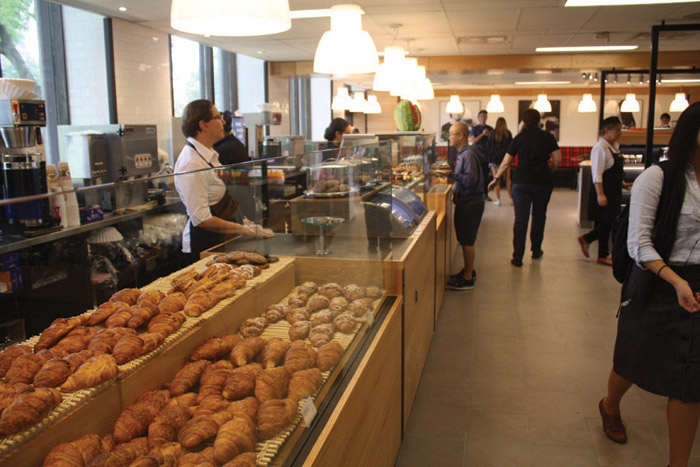
Première Moisson, the new dining option in the basement of Redpath Library, has drawn mixed reactions from students since opening earlier this month. The space, formerly occupied by Tim Hortons and Pizza Pizza, has been praised for its fair trade options, but criticized for its higher costs and for the lack of student input sought out prior to its implementation.

“There are definitely some students who do like Première Moisson,” Arts Senator Jacob Greenspon said. “There’s a whole spectrum of opinions here, but I think the important thing to emphasize is that this is such a huge decision that was [made] with basically no student consultation.”

According to Mathieu Laperle, senior director of Student Housing and Hospitality Services (SHHS), the unit under which dining services falls, student input was gathered through various indirect means.

“Over the years, we did some student surveys that gave us a lot of details and information about what people would like to see on campus,” Laperle said. “Many consultations have been done in residences.”

Greenspon said that the surveys conducted did not pose explicit questions regarding changes to the Redpath library space.

“It’s much more of a general cafeteria, food services on campus survey,” Greenspon said. “There wasn’t any sort of question that asked, ‘What kind of coffee space do you want in the Redpath library?’ It was all very general.”

Library Improvement Fund Coordinator Erin Sobat agreed, noting that the survey results were more general and not concrete suggestions.

“[SHHS’s] primary metric of student consultation was their annual [food and dining services] surveys,” said Sobat. “[SHHS suggested that there was] some sort of indications in the past that students wanted quality over cost and needs to renovate the space.”

According to Students’ Society of McGill University (SSMU) VP University Affairs Claire Stewart-Kanigan, incidents that indicate a lack of consultation with students on university matters could lead to feelings of hostility between students and the university administration.

“A decision [that] comes through that students don’t like, but at least know they’ve had the chance to be consulted [on] is going to be a lot less [damaging] in terms of the admin-student relationship, than if a decision comes through and students didn’t know where it comes from,” Stewart-Kanigan said.

Other concerns expressed by student representatives pertain to the the financial accessibility of the new café.

According to Oliver DeVolpi, executive chef of SHHS’s dining services, brewed coffee at Première Moisson costs approximately 40 to 50 cents more than it did at Tim Hortons, due to the quality and ethical sourcing of the product.

“This is a fair trade cup of coffee; it’s in a compostable cup,” he said.

Laperle said that a major factor in choosing Première Moisson was that it fell in line with the university’s goals to use locally-sourced food suppliers.

“We’re more and more sustainable, we buy more and more from local suppliers,” Laperle said. “So [Première Moisson] was the perfect fit for us.”

On the other hand, Stewart-Kanigan stressed the importance of finding a balance between fairly-sourced food and fair pricing.

“Environmental sustainability does not need to be at the expense of financial sustainability,” Stewart-Kanigan said. “I feel that students could feel that that element of sustainability was not centred in this discussion. Those two things do not have to be mutually exclusive.”

Nonetheless, Laperle said that Première Moisson, in its early stages, was open to adapting to student needs in terms of menu offerings, especially due to its unfamiliarity with the university market environment.

“Depending on the company, there is some flexibility,” he said. “Première Moisson, they are very open [….] The coffee we have for the Première Moisson here is not the same as what they’re offering in other [locations] in Montreal. This is an example of their flexibility.”

Nonetheless, Stewart-Kanigan suggested that a greater effort to consult students be made before changes are set for future decisions involving student space.

“It’s beneficial for everyone if student associations are kept in the loop earlier so that we can be involved in the consultation process,” Stewart-Kanigan said. “Consultation should be an expectation, not an afterthought.”

a, Arts & Entertainment, Theatre

Great venegance, furious anger, and Shakesperian dialogue

Spectators arriving to see Bard Fiction are immediately greeted by the warmth and intimacy of the Plateau’s Mainline Theatre. In anticipation of the show, audience members mingled in a small, dimly lit room filled with couches and the buzz of conversation. Eventually, a flute coaxed the audience into their seats with a Renaissance-style melody, setting the tone for this Shakespearian Pulp Fiction rendition.

The production is well done, even if it’s somewhat inaccessible to those who haven’t seen the iconic Quentin Tarantino film—though it’s hard to imagine why anyone wouldn’t have. Despite this potential flaw, the acting, set design, and script unite to form an extremely successful adaptation.

For the most part, the fast-paced Shakespearian dialect was perfectly executed, with the exception of a few slips of the tongue by contracted killer Jules Winnfield—in this production renamed Julius (Kareem Tristan Alleyne)—making some of his lines incomprehensible. Fake accents, dramatic fight scenes, and impassioned speeches were executed with precision and energy, bringing the script, staging, and storyline to life.

The simple set was expertly repurposed in each scene for a new and distinct use. It consisted of an antique looking table and benches, with various accessorizing objects: Cups in the restaurant, weapons in the weapons shop—effortless, yet effective. The characters’ interactions with such simple objects smoothly naturalized their transformations—the table metamorphosed into a wagon and the benches became their foot rests.

Effective lighting completes the play’s immersive visual world, harmonizing the various parts of the production. A unique lighting technique was put to good use when a treasure box was opened and the gold seemingly reflected onto Vincent’s (Timothy Diamond) face. Small details like this complete the production.

Music, however, is a weak point. The score is underwhelming, provided entirely by just a single, average flautist. Although those light touches of Renaissance-style melodies add a comic touch, working in juxtaposition with the modern concept the audience holds in their heads, it feels incomplete and shoddy at times. This is a minor detail, but one which could elevate the production significantly if executed well.

The wittily adapted script translates the vulgar silver-tongued lines of the main characters, Vincent and Julius, into hilarious Shakespearian dialogue. This amalgamation is spotlighted at critical moments, such as when the famous cheeseburger dialogue from Tarantino’s film is adapted to refer to a “cottage pie” instead—prompting a roar of laughter from the audience. The script adaption was a highlight of the production, in both quality and comic effect.

In many ways, the overall success of the production can be gauged by both the high attendance and postive reception. Few seats were left empty, and the sound of laughter more than filled the hollow spaces. Any flaws in the production are overshadowed by the successes in acting, set design, and lighting. The intimacy of the theatre played a pivotal role in the production, making each pained expression, each drop of sweat, and each small mistake visible. Bard Fiction is an authentic, gritty, and very real spectacle—and that may be its true success.

Bard Fiction will be playing at Mainline Theatre (3997 St. Laurent) until Sept. 28. Student tickets are $12.

a, Research Briefs, Science & Technology

Research Briefs

Fear not:

The Dreadnoughtus

The dreadnought was a type of battleship developed in the 20th century that was known for its size and speed. (more…)

a, Opinion

Commentary: Time-out for Quebec’s universal daycare fee?

Québec is known for its astounding art, delectable poutine, and, for some people, daycare with an affordable standard fee of $7 a day. However, the possibility looms that the province may be giving up one of these things in the near future. Earlier this month, the government’s proposal to scrap the universal rate of daycares in favour of a sliding-scale fee based on parental income caused public outrage. (more…)

a, McGill, News

McGill hosts Indigenous Homecoming for alumni

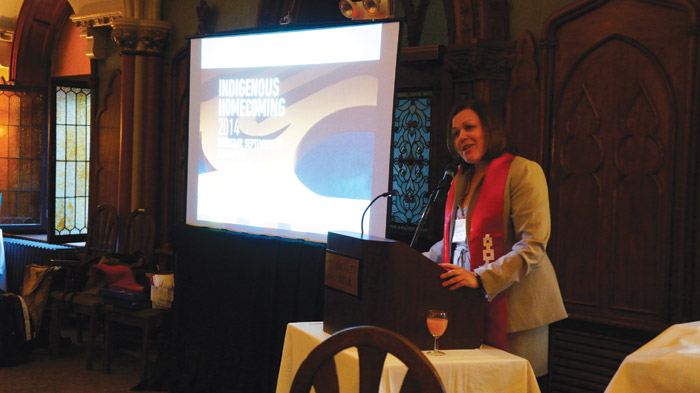
Last Thursday, Dr. Audra Simpson, a Mohawk scholar who received her PhD in Anthropology from McGill, and is currently an associate professor at Columbia University, addressed how McGill shaped her scholarly mind and the problems the university still faces in addressing indigenous issues at McGill’s first Indigenous Homecoming.

Simpson discussed the rigorous standards she faced at McGill during her time as a student, saying that the level of quality required was excessive in hindsight, but taught her how to deal with criticism.

“I’ve often talked to my colleague,” Simpson said. “We remembered how McGill simply taught us how to write, how to revise, how this made us absolutely fearless, so much so that we can literally take any form of critique and sift it for its value, not take anything personally and simply take it as need be.”

Yet for all its academic excellency, Simpson argued, McGill still needed to address the indigenous history that was intertwined with its own. Simpson asserted that her research showed that the university in its early days was kept afloat by money from unauthorized land sales by the Six Nations of the Grand River.

“McGill comes into being in a sea of dispossession,” Simpson said. “By this I mean two things: One, this land belonged to [indigenous peoples].  Second, and more specifically, McGill comes into being at a time when land is being wrested from indigenous peoples in bit-by-bit pieces.”

Simpson asked that McGill take actions to right its historical wrongs.

“What is needed along this to revitalize hidden pasts […] is diversifying this university in lines that do not paper over this history over further, that mark it, that act from it,” she said.

Simpson then questioned the audience on McGill’s current state of diversity.

“And here I want to ask, where are the indigenous scholars at McGill, scholars in tenure track and tenure positions,” she asked. “Part of excellence is diversity, right?”

Paige Issac, coordinator of the First Peoples’ House, said that the first Indigenous Homecoming idea arose out of the traditional alumni honouring ceremony at the Annual Pow Wow.

“This year we had our first ever homecoming event,” Issac said. “We had 20 or so people show up,” “I’ve heard such great feedback already.”

Issac also praised the efforts of Indigenous Education Advisor Allan Vicaire in organizing the Indigenous Awareness week.

According to Vicaire, student response to the week has been very positive.

“Students have personally come up to me to say, ‘Wow I’ve never heard about this before,’ whether it’s about inter-generational violence or just having a discussion about accountability and responsibility within an academy. So it’s been really positive, very constructive.”

However, Vicaire says indigenous students at McGill still face challenges, although steps are being made to improve the situation.

“Microaggressions do happen on campus,” he said. “ We’re often tokenized, or put in the place of being a cultural expert. [We need to] create that environment of inclusion, provide those education opportunities and create a safe space [for indigenous students].”

Issac acknowledged that although McGill still had problems in regards of lack of an indigenous scholar, it was making progress.

“Obviously there is still a lot of work to do but I’m happy in our achievements so far, and I’m happy to work on whatever comes next,” Issac said. “I see a lot of things building here at McGill, in terms of increasing indigenous awareness […] making it a place where indigenous students feel like they belong and they can thrive and have a sense of community here.”

Vicaire echoed the sentiment.

“We’re always striving and working to enhance the question of diversity within the faculties,” he said. “I think it takes a lot of work, not only from the administration but also from faculty, staff, and students. It’s a stepping stone and unfortunately within institutions, it takes a while for change to happen, but [we have] to recognize we’re all a part of this change.”

Additional reporting by Shrinkhala Dawadi.

a, Know Your Athlete, Martlets, Sports

Who’s that athlete: Zoe Fasoulakis

The Martlet soccer team is off to a strong start to the 2014-2015 season, which means business as usual for junior kinesiology student Zoe Fasoulakis. The center-back has seen teammates and coaches come and go, but winning has been a constant since she debuted in 2012.

(more…)

a, Student Life

Indulging in seasonal Italian dishes

The result of a brilliant collaboration between Michele Forgione, chef and owner of the beloved Old Port restaurant Osteria Venti, and Stefano Faita, son of Elena Faita—one of the most celebrated Montréal-culinarians, Impasto and Pizzeria Gema aim to present classic and authentic Italian specialties.

Impasto

Opened in July 2013, Impasto changed Little Italy forever. It stood out from its competitors by developing a reputation for delicious meals made with high-quality ingredients.

Located on the corner of Rue Dante and Rue Saint Dominique, Impasto presents a very simple interior. The kitchen is open for the public to observe, and tiled walls and wooden tables give the restaurant a young vibe.

The menu is small, changing daily to feature six starters, four pasta dishes, four meat plates, and a dessert selection. All the dishes are inspired by ingredients available at local markets. The chefs pack immense flavour into small dishes; as such, it’s recommended to order a number of plates to share.

The restaurant’s roasted octopus with navy beans is tender, with a nice sear on the outside, similar to the smoked caciocavallo on offer—a cheese similar to mozzarella—which is grilled to a slightly-melted consistency. They also offer market tomatoes with house-made burrata cheese, as well as a string bean, potato, and mint salad. These two dishes make for a refreshing combination, and are a great way to celebrate the fresh produce of early autumn.

However, the pasta at Impasto is the clear highlight of the menu. All pastas are made in-house and are cooked to al dente perfection. Favourites include the ricotta gnocchi in a tomato basil sauce, and casarecce, a long twisted pasta, dressed with an almond basil pesto and garnished with cherry tomatoes.

For dessert, the tiramisu—a classic Italian dessert—is presented in a small mason jar, with piled layers of cream, espresso, ladyfingers, and some shaved chocolate. The sweet and bitter flavours meld together to yield a delicious dessert.


Pizzeria Gema

Across the street from Impasto, Pizzeria Gema is perfect for large get-togethers or picking up a late-night Neapolitan-style pizza and frozen custard. Pizzeria Gema offers both dining and take-out options, with a menu comparable to Impasto’s—although slightly less expensive.

Forgione worked to perfect his pizza recipes for over a year before opening the restaurant, and even asked other chefs for advice. A crowd-favourite is the “1889”, a simple and classic Margherita pie with San Marzano tomatoes, fresh mozzarella, and basil. There are no overwhelming flavours; the tomatoes, cheese, spice, and dough work together perfectly.

One of the more unique pizza offerings at Pizzeria Gema is the Emilia, a riff on a white pizza—a pizza that has no tomato sauce— with a thyme cream, lardo, mushrooms, and onions. Another delicious combination is aptly named the Impasto, which features layers of porchetta (thinly sliced stuffed pork), smoked caciocavallo, and cherry peppers, garnished with a refreshing salsa verde.

The frozen custard is also a must-try. Available in French Vanilla and Belgian Chocolate, this frozen dessert is lighter than the typical ice cream, and is a perfect ending to a meal.


a, Science & Technology

The ongoing Bitcoin battle

The term ‘Bitcoin’ first appeared in 2009 when Satoshi Nakamoto—a potential pseudonym of either a single person or group—invented the world’s first decentralized digital currency.

This 21st century currency employs a third-party, intermediate, cryptography system resulting in a more secure and confidential medium of exchange. No governmental monetary authority controls this ‘cryptocurrency’; instead, computers running very sophisticated mathematic schemes mine Bitcoins. The mathematics of the Bitcoin system are designed in such a way that it becomes more and more difficult to create new units of the currency, fixing the ceiling at 21 million Bitcoins. This limitation prevents central banks from issuing massive amounts of Bitcoins, which would lead to its devaluation.

According to Tony Gallippi, the co-founder and executive chairman of BitPay, the largest global Bitcoin payment service, Bitcoins are being used beyond their role as currency, and are now seen as a valuable piece of technology.

“We are using [Bitcoins] as a currency, but you can also use it as a payment system or a distributed ledger to prove property rights,” Gallippi said. “What’s giving it value and is getting people excited is its utility.”

There are two main advantages of using cryptocurrency. It can be transferred directly at a low transaction cost, and is also a floating currency, which means that the monetary value of Bitcoins comes from its ability to fluctuate in relation to the foreign exchange market.

According to the webpage ‘History of Bitcoin,’ the number of Bitcoin transactions and the number of wallets—a system used to store the digital credentials for Bitcoin holdings—has continuously risen from its inception in 2009. However, some issues do arise from the use of the digital currency.

It is not officially recognized as a currency in itself in many countries—including Canada—and is thus not subject to the same regulations. This absence of regulation and the ability of guaranteed anonymity of the transactions paid in the cryptocurrency raise concerns.

An internal memo addressed to the former Canadian Minister of Finance Jim Flaherty stressed that the digital currency could represent an attractive payment method for criminals.

“Virtual currencies such as Bitcoins have been criticized for their potential to fund illicit activity, such as money laundering and terrorist financing,” the memo states.

Some tech companies have started to offer their employees the option to be paid in Bitcoins. Wagepoint, an American company offering online payroll software solutions to small businesses, recently added a Bitcoin option to its list of services. Employees from 10 different firms have already switched from traditional payment methods to a Bitcoin system.

Wagepoint CEO Shrad Rao himself is surprised by the popularity of this new option.

“What’s interesting is that we’ve actually had customers come to us because of the [Bitcoin] integration—which we were not expecting at all,” said Rao in an interview with CBC.

While the cryptocurrency is gaining momentum in Canada, many restrictions are slowing its assimilation. The government does not recognize Bitcoins as official currency—they’re classified under barter transactions—and thus, employees choosing to be paid in Bitcoins still have to pay their taxes in Canadian dollars. Furthermore, most brick-and-mortar companies do not accept Bitcoins as a method of payment.

a, Opinion

Commentary: People’s Climate march a sign of renewed grassroots fervor

I spent my summer scanning environmental news stories, specifically those related to climate change. (more…)

Read the latest issue

Read the latest issue