Latest News
What we learned opening a student-run café
After two years of planning, 3,493 burritos, and 7,824 customers, the Student-Run Cafe (SRC), “The Nest,” is wrapping up its first semester of operation. It has been an exhaustingly exhilarating experience, one that I feel very lucky and proud to have been a part of along with many other incredible students. No one tells you how hard opening a business is—not to mention a business in the food and beverage industry, under the meticulously bureaucratic structure that is the Students’ Society of McGill University (SSMU)—but we’ve been fortunate to have a team of staff members and a customer base that both inspire us to continually improve and remind us why all those late nights spent planning were worth it.
I cannot express enough gratitude or demonstrate enough humility. To every staff member that has given their time, and every customer that has given their taste buds—and money—thank you. Here, I’d like to share some of the successes, failures, and possibilities for the SRC moving forward.
One of the SRC’s biggest successes was our ability to strike a balance between quantity, quality, and price with respect to the food served. The reaction from customers in the first month was overwhelmingly about the reasonable pricing and the quality of the food. To get a homemade bowl of chili (in a vessel you could consume, no less) for $7 was something we worked really hard to achieve and maintain, and were glad to see noticed and appreciated.
Where I think the SRC fell short this semester was in its mission to be a hub for community engagement. While we did hold three engagement sessions during the Fall semester—which, I should add, only three people attended, press included—we were only able to collect feedback informally from our customer base during operation. This was incredibly useful, but still fell short of the collective decision-making model for which we were aiming. Engagement is an element of the SRC that should be addressed by both staff and SSMU executives, and I think we all underestimated the amount of time and energy required to just get schedules made and food served. While it was in fact only a take-away food service—although I would argue that a place that employed 12 students, supported seven student-run initiatives by way of affordable catering, and integrated composting services into the SSMU building embodies more than a mere lunch counter—this was one step in a direction that will continue to develop for several years.
To say that this intermediary step stifles momentum for the overall goal of bringing more student-centric space to the SSMU Building fails to appreciate or consider the way change operates within a bureaucratic structure as large and as complex as the SSMU. It would be advantageous and fruitful for the SRC and student-run spaces in general if, instead of destructively attacking the in-process efforts of individuals, the press actively engaged with and critically reflected upon the steps being taken as part of a greater picture.
Again, it seems the SRC is in a place of uncertainty. The building fee fiasco has left SSMU in a precarious position with respects to its financial sustainability, making projects like the SRC—which only recently adapted to a steep learning curve—vulnerable to reevaluation in the new funding environment. To be sure, it would be more profitable for SSMU to scrap the SRC, put in a new commercial tenant, and reap the rewards of revenue-generating real estate space, but this would be to reduce the SSMU to a society set on making money. It is my personal conviction that student societies should consider the value of their operations beyond their revenue-generating potential, but this must be echoed by the student body if it is to be realized.
What projects like the SRC need most is not more money, new equipment, or more catering events; what it needs desperately is engagement from students who care about the food they eat and the Society that serves them. The SRC has always been about more than just food; it’s meant to be a place where collaboration centralizes, and decision-making rests in the hands of the collective; where students can use the skills they’ve built in the classroom to construct and change the community they are a part of. This type of engagement does not require the physical space that the SRC currently lacks; it involves coming to the engagement sessions we hold, contributing feedback about the food and the service, and taking an active and invested role in the café’s future projects and development. The future of the SRC, like its past and present, rests in the hands of students; it can either be used and built, or lost.
Kathleen Bradley is a philosophy and economics student and is the VP Finance and Operations-elect for the 2014-2015 executive term. If you have any feedback, or would like to contribute to the SRC moving forward, you can contact her at [email protected].
The Med School Diaries: Nebras Warsi
Nebras Warsi is a first year medical student at McGill University. He was born in England but spent a part of his life growing up in Saskatchewan. As an undergraduate at McGill University, and after his mother moved to Montreal, he was able to apply to McGill as an in-province student.
McGill Tribune: How did you know you wanted to go into medicine?
Nebras Warsi: “I came to McGill and did my undergraduate in Neuroscience. During that time, I just started volunteering with the community and seeing the types of things I could do for people. As I grew up, I shadowed some physicians and I knew that I loved my science classes. It all came together where I knew it was a type of career where I could really do everything that I was passionate about. When I look back at those four years of university, it built up. Every experience, every extra curricular that I did—they all added more to my drive to want to be a physician.”
MT: A lot of people worry about having the “perfect package” to apply to medical school, what do you think about this?
NW: “There are a lot of ways you can get the skills to be a good leader, a good communicator, and someone who wants to care for people. I have friends who have done undergrad [degrees] in kinesiology, French literature, or science. It’s really up to you. Some people have done a ton of research and published a ton, and some people have done none because they’re not interested. As long as you are not sitting at home and doing absolutely nothing—I’d say you need to do something—there is no formula for it.”
NW: “I did student council, because I liked being able to serve the community as a volunteer. I liked being able to discover new things as a researcher and I liked being able to lead a team. But if you’re interested in global health, outreach programs, or working with the homeless [you should get involved]. It does not have to be medically related, as long as it is something that you are passionate about and is driving you into medicine.”
MT: How important do you think your GPA is to the application?
NW: “[I know] I got a few interviews because I know my GPA is high. So it definitely helps, but I would not say it is necessary. If you have a lower GPA, but because you have been doing all of these things that you are really interested in, then I think that’s fine [.…] [A] 4.0 is kind of unrealistic—there aren’t many people that I know that have one. You don’t need to have a 4.0 to get in.”
MT: You’re in the first year of McGill’s new medical program—how do you like it?
NW: “I love the new curriculum, but I obviously don’t know the old one. Before, the program was like an undergrad 2.0, where there was a lot of material and information to know. What they have tried to do is make it more clinically relevant now, so we’ll work with a family doctor every two weeks. It’s kind of the best thing, because while we’re in the respiratory block, we’ll learn the respiratory exam, but then we’ll get to go work with patients and take their vitals, take their history, do the respiratory exam; we’ll do cardio and then do the cardio exam—it really helps the information stick and stay with you a bit longer.”
MT: Did you ever consider PhD MD programs?
NW: “I was actually going to apply to that, but in the end I decided against it. Although I kind of still want to be a physician scientist, personally it was a little bit difficult to decide this early. A lot of physician scientists will do 80 per cent of time in research but then one half day clinical. But that’s not what I really wanted. I want to be first and foremost a clinical physician who sees patients most of the time and then does some research. I think that might be more of an MD-MSC thing to do, or to grab a PhD afterwards, but it is very possible in your residency program to get [another degree].”
MT: What type of medicine do you want to pursue?
NW: “I am super interested in neuroscience. At the same time, I am just a medical student interested in everything I am learning. They say you change your mind a minimum of eight times, so I don’t really know yet.”
McGill’s lack of sexual assault policy criticized by SACOMSS, SSMU executive
Student groups published an open letter to McGill on March 24 to express their frustration at the lack of a formal sexual assault policy at the university as well as propose various measures to consider in the implementation of one. The letter also requested increased consultation with the student body on the matter.
“We call upon you to carefully consider our recommendations regarding a sexual assault policy,” the letter states. “Furthermore, we ask that you include the undersigned in ongoing consultation in order to have a campus-based approach to the issue of campus-based sexual violence, and to treat this issue with the sense of urgency it deserves.”
The letter was co-signed by the Students’ Society of McGill University’s (SSMU) executive team, the Sexual Assault Centre of the McGill Students’ Society (SACOMSS), the Union for Gender Empowerment (UGE), Queer McGill, the SSMU Equity Committee, the Feminist Collective at McGill Law, Women and the Criminal Law, and the Quebec Public Interest Research Group (QPIRG).
QPIRG member Brooke Nancekivell stressed the importance of maintaining an inclusive consultation process in the formulation of a unified sexual assault policy at McGill.
“[There have been] many calls for the McGill administration to involve students, listen to students and engage with their feedback, input, and their desires for change,” Nancekivell said. “So far there’s been a lot of talk about it, but not a lot of action. QPIRG sees this policy as one way to institutionalize action and change through popular education and raising awareness about consent and sexual assault, and creating initiatives to support survivors.”
Dean of Students André Costopoulos maintained that the McGill administration will continue to value an inclusive approach to policy formation.
“We can always consult more,” he said. “We notice that there are other groups that we didn’t know about that we didn’t consult, and then they come forward, and [so] we bring them into the conversation [….] We’re here to take [student] concerns into consideration in any decision that we make and in any initiative we bring forward.”
The letter acknowledged McGill’s recent efforts to battle sexual assault on campus. After allegations surfaced last semester that three McGill football players sexually assaulted a Concordia student in 2012, McGill hosted a forum on consent and is in the process of expanding programs like Rez Project, which address sexual assault.
The open letter highlighted recommendations for a proposed Sexual Assault Policy, which include a proactive approach to sexual assault and rape culture and ensuring that the policy is applicable to the entire McGill community.
Costopoulos said he is hopeful that the recent appointment of Bianca Tétraul as harm reduction councillor will provide a comprehensive approach to combatting sexual assault.
“The harm reduction councillor is in the process of meeting with student groups around campus to figure out what the landscape is like,” he said. “The first [project] is to do a survey of what we have already, figure out what we need to have, and help with the [sexual assault] policy development. It’s about building a safe, respectful campus community, and combatting sexual assault is one piece of the puzzle.”
Nancekivell said she is hopeful that McGill will make changes to its current approach to sexual assault.
“Of course there’s the challenge of bureaucracy, but we’re hoping that, considering the amount of mobilization and attention directed towards sexual assault over the past year, this will be something that people will take up and really push for,” she said. “We see this as something that’s really needed on campus.”
SSMU Report Cards 2013-2014
At the end of each academic year, the McGill Tribune assesses the performance of the SSMU executive team based on our own observations, the opinions of the executives themselves, and—new this year—feedback from SSMU councillors. To promote transparency in this process, this year we are presenting each assessment in an evaluation rubric. Our main criterion is “Portfolio management,” which encompasses the completion of the portfolio’s activities and the advancement of the portfolio. Our “Initiative” category judges the executives’ ability to show leadership in their positions and to deal professionally with unpredictable situations. Finally, “Transparency” relates to executives’ openness about their work and the attempts they made to keep themselves accountable for their actions.

Katie Larson: President
Portfolio management: 7/10
As a representative of SSMU to the administration, Larson was tasked with the responsibility of negotiating the terms of the society’s lease on the SSMU Building. We applaud Larson for successfully finalizing the lease and bringing four years of negotiations to an end.
Larson also brought a number of improvements to her portfolio, including the first Red and White week, a series of events tailored to graduating students; an overhaul of the bylaws; and the revision of the SSMU Constitution, which was passed in the Fall referendum period.
Initiative: 4/10
Although signing the lease is a significant accomplishment, Larson did not adequately see the project through. Along with the rest of the executive team, she failed to publicize the University Centre Building fee referendum question through either a ‘yes’ campaign or a clearer description of the consequences of a ‘no’ vote on the question, leading to its failure in the Winter 2014 referendum period.
Another missed opportunity to exhibit leadership was her failure to advertise the Fall 2013 General Assembly (GA), where lack of quorum limited the GA’s power and left the SSMU without a board of directors for several additional weeks. While a second, better-advertised GA remedied this problem, the incident wasted time and resources, and is indicative of Larson’s inability to accurately assess and connect with her constituents throughout the year.
Transparency: 3/10
Larson’s work this year has been marked by a lack of transparency to both student media and the student body at large. Perhaps the strongest indication of this problem lies in her management of the loss of the sustainability coordinator this year. SSMU is mandated to fulfill this position, and yet its termination was only discussed within confidential session of SSMU Council.
With matters regarding sustainability falling under her portfolio, Larson’s unwillingness to address this situation represents a troubling inability to effectively communicate and compounds a general lack of openness throughout the year.
Tyler Hofmeister: VP Finance and Operations
Portfolio management: 8/10
Hofmeister’s work as Vice-President Finance and Operations has been relatively successful despite numerous financial obstacles. Early on in the year, he was able to balance the SSMU budget, preventing an otherwise projected deficit of $90,000.
Another major success in his portfolio is the launch of the student-run café this semester. Since its opening in January, the Nest has run smoothly, and according to Hofmeister, aims to break even this semester.
Under Hofmeister’s management, Gerts has both successfully generated a profit this year and seen improvements such as the addition of a jukebox and a pinball machine.
Initiative: 7/10

Regarding the University Centre Building Fee, Hofmeister failed his constituents by not preparing or publicizing a contingency budget to explain the consequences of a ‘no’ vote.
Nonetheless, in the wake of the question’s failure, Hofmeister successfully drew up a reasonable budget in preparation for the upcoming year in a very short amount of time, and we commend him for that effort.
Transparency: 5/10
Early last semester, Hofmeister’s transparency suffered from his refusal to grant in-person interviews with the media, which prevented accurate reporting on important financial issues such as the budget. Councillors also found cause for complaint, including his presentation of the budget to Council without adequate time for Councillors to prepare for its discussion.
Hofmeister has greatly improved his communication efforts this semester, which has enabled much-needed transparency in light of the recent criticism of lease negotiations and the 2014-2015 budgetary issues that have arisen.

Joey Shea: VP University Affairs
Portfolio Management: 9/10
The Tribune saw Shea as the most accomplished executive this year in her work on projects that we expect to have a lasting impact on SSMU. Shea led the development of a much-needed SSMU Mental Health Policy, which entails hiring a mental health coordinator and creating a website to compile mental health resources.
According to councillors, Shea has had a strong voice at both Senate and Council this year. As a student representative to Senate, Shea brought undergraduate priorities to the attention of senators, notably with regard to the allocation of funds from the Student Services surplus. She was also one of the most involved student senators, often bringing attention to the administration in regards to undergraduate issues.
Another major project this year has been the improvement of the equity policy. While this is an ongoing project, it has yet to see results. Furthermore, attendence at consultative forums on equity policy revisions has been low due to a lack of promotion.
Initiative: 7/10
In the wake of criticism last Fall regarding McGill’s lack of a sexual assault policy, Shea stepped up to support campus initiatives to address this concern. Most significantly, Shea provided support for the student groups involved in writing a Sexual Assault Policy, which groups hope to eventually present to the administration. Additionally, Shea co-chaired the Forum on Consent in February.
Nevertheless, Shea showed poor leadership regarding the failure of the University Centre Building Fee in March, when she, as well as the rest of the executive team, did not adequately promote the fee and communicate its necessity to students. Her blame of students for not understanding the referendum’s implications are troubling.
Transparency: 8/10
Shea has been consistently communicative with campus media by responding to emails and making herself available for interviews. Throughout the year, she has consistently sought to communicate important issues and initiatives to her constituents. However, she could have done more to actively reach out to students, especially with regards to the University Centre Building Fee and the consultation forums on the equity policy revision.
Sam Harris: VP External
Portfolio Managment: 6/10
As Vice-President External, Harris has met the minimum standard of his portfolio. While he successfully engaged with the Milton-Parc Community by organizing street teams throughout the year and training Community Ambassadors, Harris failed to publicize these initiatives.
As SSMU’s TaCEQ representative, Harris attended the federation’s meetings, hosted several at McGill, and later reported on them to Council. He also attempted to improve TaCEQ‘s transparency with the translation of their website, although these efforts failed to yield results.
Initiative: 1/10

There were many external-related issues that directly affected students this year, and Harris failed to address any of them adequately or productively. Although he initiated a motion to condemn the Charter of Values, Harris did not take the initiative to address the matter in any other way. The ad-hoc committee he formed on the topic has apparently achieved little since its creation in the Fall.
Despite numerous concerns about TaCEQ, Harris failed to initiate a discussion of SSMU’s relationship to the student federation, despite promising consultative forums on the subject. In addition, he made no effort to explain TaCEQ to students. He only brought forward the referendum question to leave TaCEQ after one of the other student associations voted to leave. Additionally, he has proposed no future plans or alternatives now that SSMU has voted to leave the federation.
Transparency: 8/10
Harris was open to student media throughout the year and was always available for interviews, in addition to fulfilling his role as SSMU’s representative to off-campus media on external issues.
However, councillors have noted that Harris failed to properly communicate the details and implications of TaCEQ’s deteriorating circumstances.

Brian Farnan: VP Internal
Portfolio management: 6/10
Farnan consistently met the requirements of his portfolio. However, the loss of $21,000 due to careless mistakes in frosh budgeting represents a major shortfall of his tenure.
Farnan sent out regularly-timed listservs with information about SSMU and community initiatives; successfully organized SSMU’s signature events, including collaborating with faculties on Frosh and coordinating 4Floors and Faculty Olympics; and worked as a student representative on the Centraide service-oriented campaign.
In addition, Farnan worked with the francophone commissioners to host a conference on the state of French in North America. He also played a role in implementing several frosh initiatives, including increased training for leaders, a ‘chill zone,’ and a phone line that students could contact with questions and concerns.
Initiative: 7/10
Farnan displayed initiative in the communications aspect of the portfolio, working throughout the year to create and implement a Communications Guide, a Style Guide, and a Communications Strategy. These three documents provide long-term vision for the portfolio.
In collaboration with President Larson, Farnan has worked to organize McGill’s first ever Red and White week with activities for graduating students. While this is an exciting initiative, whether it proves successful and useful remains to be seen.
Throughout the year, Farnan failed to adequately promote his initiatives, such as Soapbox—a student idea promotion tool—which has remained little used and unknown across campus.
Transparency: 6/10
Farnan has not been consistently accessible and responsive, as the Tribune found him difficult to reach for comment with coverage of myInvolvement and Red and White week. Farnan has seen notable improvement in the second semester, as he responded more promptly to interview requests.
Stefan Fong: VP Clubs and Services
Portfolio management: 6/10
Fong has worked consistently to overcome the overwhelming workload involved in the clubs and services portfolio. Nonetheless, his constituents have criticized his inefficiency in managing day-to-day work such as the assignment of offices and lockers.
In advancing the portfolio, Fong played a role in the formation of the Co-Curricular Record of Involvement (CCRI), an official document that summarizes students’ extracurricular activities. He has also made improvements to the advanced room booking system for the SSMU Building, giving internal groups priority over external groups in room bookings.
Initiative: 6/10

Fong successfully made reforms to the format of Activities Night, such as expanding the space to include the Brown Building and implementing a one-way route. On the other hand, students gave mixed feedback about these changes, citing the emergence of safety issues and problems accessing health services.
Additionally, long-term intiatives in Fong’s portfolio have seen little progress this year. One disappointment has been the failure of Clubpedia, a collection of information about clubs, which was part of Fong’s original platform. Fong’s new idea for the creation of Clubhub, a proposed information centre for clubs, has also been slow to develop.
Transparency: 7/10
Fong has been clear in his answers, providing students with detailed responses and justifications on his courses of action. Despite his admitted lag in responding to emails, he has displayed a willingness to meet with student groups face-to-face to discuss their concerns and negotiate solutions.
Court grants student right to vote in provincial elections
A McGill student who filed a court challenge for being refused voter registration was able to cast his vote on Monday, following the ruling of Quebec’s Superior Court.
Brendan Edge, U2 Arts, was one of five McGill students who filed the challenge against the Director General of the Elections of Quebec (DGE) on April 1.
Edge, who is also a candidate for the Green Party in the Chomedey riding, was added to the voters list by a court order on April 4—one day after the special revision period for voter registration.
The five students filed the challenge after being turned away from their local revision offices the previous week. The students were told they had not been “domiciled” in Quebec for at least six months before the election, which is a requirement to vote under Quebec law.
Edge attempted to register as a voter after registering as a candidate, but was told that the documents he brought with him did not constitute enough proof of domicile to register as a voter. Moreover, he was also told he was not a candidate in the election, despite appearing on the candidates’ list on the DGE’s website.
According to Jason Chung, a graduate of the McGill Faculty of Law, the process of establishing domicile is a challenging question that has seen uneven—and possibly selective—enforcement this election. Chung is the founder and moderator of the Quebec Voter Support Network, a Facebook group that allows voters to solicit information from law students, law graduates, and lawyers on the registration process and voters’ rights.
“Based on the comments that [the group has] received, it seemed that the biggest frustration was that everything was done in an ad-hoc manner,” Chung said. “[The process] wasn’t very transparent [regarding] what documents were requested and it seemed arbitrary.”
A clarifying statement from the DGE published on March 22 states that domicile is “demonstrated by intention” and is defined as “the place a person considers to be his or her principal establishment, gives as a reference for the exercise of his or her civil rights, and indicates publicly as being his or her domicile.”
According to the release, the board of revisors may request documents such as a Quebec health insurance card, a Quebec driver’s licence, or income tax returns made to Quebec as evidence of intention.
However, according to a document published by the Quebec Voter Support Network, domicile “can be established in the absence of these criteria” as long as the applicant can establish intent to make Quebec his or her principal residence.
According to the students present at the ruling on Friday, the judge did not consider the other four students’ situations to warrant a court injunction.
“[According to the judge], an injunction should only be granted in the most pressing circumstances,” Simren Sandhu, another student involved in the court challenge, said. “Brendan [Edge]’s situation was unusual. For [the rest of] us, [the issue of eligibility] could be sorted out after the election, the judge said.”
According to Sandhu, the judge ruled that he and another student, Arielle Vaniderstein, were not eligible to vote because they had reached the age of majority fewer than six months before the election. The judge did not consider the months spent residing in Quebec before the age of majority to count toward the domicile requirement.
The other two students, Matthew Satterthwaite and James Hallifax, were also denied permission to vote because it was difficult to determine how long they had lived in Quebec.
According to Edge, though the four students were not added to the voters list, their case was not terminated by the ruling in April—the court will be back in session later this month.
“[While] the judge ruled that the electoral officers were within their right to refuse [the other four students’] registration […] this comes down to the question of domicile [and] how that is clarified,” Edge said. “It’s a complex issue, and [we’re] told it’s not one to be decided upon during an election campaign.”
Chung is also in the process of collecting data from a survey in the Facebook group, particularly with regard to the documents that were requested from voters intending to register and the justifications behind those requests. The goal is to publish a report on trends that the data indicates.
The remaining students in the court challenge hope the process will lead to a clarification of the law.
“Ideally, we were hoping we could get the right to vote too […] but we are pleased to have shed a spotlight [on] the issue of [establishing] domicile,” Sandhu said. “Whoever forms government will know they need to take a closer look at this [issue] for next time.”
The DGE declined to comment on the court’s ruling.
Reviewing the SSMU lease: behind four years of confidential negotiations
Despite the four years of negotiations on the lease, most students know relatively little about the new contract signed by the Students’ Society of McGill University (SSMU) and the McGill administration for the SSMU Building.
More recently, the lease has prompted criticism from the student body, following the failure of the Building Fee in the Winter 2014 referendum period. The fee would have paid for the increasing rent and utilities costs that the lease entails.
As a result, cuts will be made to the 2014-2015 SSMU budget in order to fund the agreement. Some students have criticized the increased costs of the new lease that necessitate these cuts.
Under the previous lease agreement, SSMU paid $110,000 annualy for rent and did not pay any utility costs. With the new lease, SSMU will pay $130,000 this year for rent—a cost that will increase by $5,000 each year until 2021. SSMU is also newly responsible for $100,000 per year in utility costs.
Although the negotiations have been ongoing, the lease’s contents were largely confidential throughout this process. This week, the Tribune sat down with current and former SSMU executives to find out how the lease has evolved throughout negotiations and why it took four years to reach an agreement with the university.
The symbolic lease
SSMU’s previous lease expired in May 2011. In the interim three years, SSMU operated in the building without a legal agreement until the Board of Governors approved the current lease on Feb. 27.
Until 1999, SSMU paid a $1 symbolic lease for the building. The 2011-2012 SSMU executives initially argued for a return to this symbolic lease, but were unable to make progress with this stance. According to 2012-13 SSMU President Josh Redel, his executive team made the decision to abandon that line of negotiations.
“[The administrators] told us that [a symbolic lease} cannot exist in today’s financial realities,” he said. “There would be no way they would be able to support a building like that; they don’t have the money to support something on principles alone.”
Deputy Provost (Student Life and Learning) Ollivier Dyens said Quebec law only requires the university to provide SSMU with an office and furniture for free, which McGill offers through the 377-square metre executive offices. He said the university charges rent for the SSMU Building partly because it houses commercial operations that generate revenue.
“The rent is still very competitive when you compare it to the same amount of space in downtown Montreal,” he said. “We’re not trying to squeeze students at all; we’re just trying to have something that is good for both sides.”
Main topics of negotiation
Over four years, the negotiations were primarily concerned with topics such as energy costs, the heating, ventilation, and air conditioning (HVAC) system, and the duration of the lease.
According to Redel, energy was always the most contentious part of the negotiations. The administration initially proposed a sliding scale for utilities, where SSMU would have gradually taken on more of the costs until the society paid for 90 per cent.
Redel said one of SSMU’s biggest achievements in the negotiations was arguing against this sliding scale. Under the current agreement, SSMU pays a set 25 per cent of utility costs, while McGill pays the remaining 75 per cent.
“[In] the initial McGill [proposal] where they had that sliding percentage, the energy alone would have been millions over a few years,” he said.
An additional complication to the utilities negotiations was the state of the HVAC system, which, according to SSMU President Katie Larson, has not been upgraded since the building’s construction in the 1960s.
“The ducts hadn’t been cleaned in forever [and] the engineer came last summer and said [they were] not sure that this HVAC [was] going to last through the winter,” she said.
McGill at first asked SSMU to pay 50 per cent of the multi-million dollar HVAC project on top of the sliding energy scale, but executives argued successfully that SSMU should not be responsible for its maintenance.
“We should not be paying for [the HVAC system] because that’s the responsibility of the landowners,” said SSMU Vice-President University Affairs Joey Shea. “If the plumbing [stops working] in your apartment […] you’re not supposed to be paying to fix it [….] The owners of the building are responsible for large infrastructural issues.”
McGill has agreed to fund renovations to the HVAC system, which are scheduled to take place next summer.
One last point of contention during negotiations was the duration of the agreement. The administration advocated for a shorter-term lease, similar to the previous five-year agreement.
“You don’t know what’s going to happen five years down the road,” Dyens said. “Will the financial situation change? Will the market prices change?”
Having already spent several years in negotiations, however, the SSMU executive refused to accept a five-year lease.
“If it’s a shorter term lease, it comes up sooner and it gives [the administration] the opportunity to jack up prices for energy and rent even more,” Shea said.
“A really lengthy lease gives you the opportunity to finance projects over a long period of time— like renovating the cafeteria,” Redel said. “A longer-term lease is really important for making [these projects] a reality.”
One proposal from the administration involved a longer lease if SSMU allowed McGill Food and Dining Services (MFDS) to operate from the building, according to Shea. However, these plans were eventually scrapped.
“It was really important for SSMU to maintain its autonomy from McGill,” Shea said. “We knew at the end of the day we didn’t really want to go in that direction.”
Negotiations
The negotiations were also affected by other factors. Redel explained his discomfort with the negotiations, especially the way the administration initially asked SSMU to communicate through a proxy negotiator instead of directly through the deputy provost.
“The way McGill negotiated was awful—really truly awful,” he said. “They told us if we brought a lawyer, they’d leave. We started bringing a notetaker and they were up in arms. The administration constantly calls on SSMU to act responsibly and with due diligence, but when those same people are upset that we want to have thorough notes taken at a meeting [….] I think it speaks miles to the tone they set for the negotiations as a whole.”
Larson noted the difficulty of engaging with McGill representatives at the bargaining table.
“McGill shows up with what [they’re] going to make you pay and then you have to talk them down from it,” Larson said. “There’s a power differential that’s insurmountable.”
Due to such issues, this year’s executives refused negotiations with anyone other than Dyens, to whom Shea attributes their successful securement of the 10-year lease.
“It just shows how McGill has been negotiating this entire time and frustrations with miscommunications,” she said. “[Dyens was] new and [he wanted] to establish good relations with students off the bat [….] I don’t think we would have gotten [that] had we continued to negotiate with Morton Mendelson.”
Dyens said he could not comment on negotiations under his predecessor, Morton Mendelson.
“My negotiations with SSMU this year was done with respect and openness,” he said. “At no time did my administration pressure students to sign. We worked together to address the still unresolved issues and came very quickly to an agreement.”
Looking forward
After multiple years of work on the lease, SSMU executives expressed relief that the long negotiations are finally over.
“It’s not the symbolic lease, […] it’s not what we wanted, but it’s good for what I think McGill’s reality was,” Redel said.
However, because the proposed building fee created to pay for the lease did not pass this semester, SSMU faces financial difficulties in the upcoming year. The SSMU is currently planning to run the referendum question again in the Fall.
Shea emphasized the necessity for the incoming executives to stress the necessity of the fee.
“[Signing the lease] was a really long, arduous process,” she said. “What will be really important is to educate students on why we signed this lease.”
PGSS mental health policy aims to increase access to services
The first mental health policy for the Post-Graduate Students’ Society of McGill University (PGSS) is being developed, according to an announcement made at PGSS Council last Wednesday.
The mental health policy committee announced it would begin implementing the policy next year. The committee, which runs under the health and wellness committee, seeks to cater to graduate students’ mental health needs.
Samara Perez, chair of the committee, explained that the decision to create a policy came from a need to address the needs of PGSS members—particularly for crises or trauma during high-stress periods such as around thesis submission deadlines.
“This policy [is] a positive stance for supporting mental health and education, access to mental health services for graduate students, and advocating for graduating students mental health needs,” Perez said.
The policy also opposes discrimination against students seeking access to mental health services and inequality in access to services.
“Graduate students should have access to mental health services regardless of student status (e.g. full-time, part-time, international),” the motion reads. “Implementation and/or increase of monetary fees […] would prevent students’ access to mental health services on campus due to financial restrictions.”
Perez also explained that the committee would develop specific short-term and long-term goals for the policy.
“The idea is that with this committee […] we will implement one-year, three-year, and five-year mental health plans,” Perez said. “[The policy] is about advocacy for the needs and making the graduate students aware of what services exist for them.”
Library Improvement Fund Proposal
PGSS Academic Affairs Officer Adam Bouchard presented the Library Improvement Fund Committee’s spending proposal.
The PGSS Library Improvement Fund is supported by a non-opt-outable fee levy of $3.00 per PGSS member per semester. The fund is matched by McGill, and is currently valued at $120,000.
Council approved the committee’s motion to spend $50,200 on the creation of a Grad Zone. Furthermore, $5,440 will be allocated towards updating the Ph.D. room, $25,470 for book scanner updates, and $23,360 for 108 new student storage lockers, which will be distributed to individuals without offices or carrels.
Lila Shapiro, representative from the Graduate Association of Students in Psychology, asked for an explanation of the cost of the lockers.
“There are different sizes of laptop lockers and tall lockers,” Bouchard said. “The money is for the purchase of these 108 lockers and for the extra money on a security camera. Based on consultation [… students] would not feel as comfortable leaving their laptops without the camera, which is why this is more expensive.”
Leaked documents shed light on Khan presidential invalidation
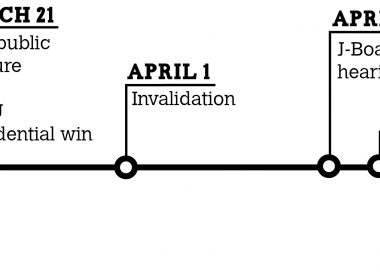
Documents leaked to the McGill Daily allege that Tariq Khan’s campaign for the presidency of the Students’ Society of McGill University (SSMU) included 15 bylaw violations.
A petition was submitted to the SSMU Judicial Board (J-Board) following Khan’s March 21 win. The documents name Elections SSMU Chief Electoral Officer (CEO) Ben Fung as the respondent.
The petition identifies multiple bylaw infractions on Khan’s behalf, including “intimidating tactics” and “coercive measures to get students to vote,” such as “personally approaching students without leaving them privacy to vote.”
The petition charges Fung with inadequately responding to these alleged violations.
“Mr. Khan continually demonstrated a lack of integrity and consideration for the Elections By-Laws,” the petition reads. “This lack of action on the part of [Fung] gave Mr. Khan an unfair advantage throughout the entirety of the campaign period.”
Because Elections SSMU later invalidated Khan’s presidency on April 1, the Judicial Board case was retracted. While some of the information in the petition may be the same as that compiled by Elections SSMU, Fung said the two investigations were unrelated.
“[The decision] wasn’t prompted by [the petition],” he said. “We have been working on this for a very long time before the petition was submitted to the Judicial board.”
Fung said Elections SSMU received evidence that Khan violated multiple bylaws during the campaign period.
“In the time following the elections we were made aware of several things, either through email, our own investigations, or requests for investigations of new information,” he said. “Part of our due diligence is to seek the testimony of all parties [….] We [took] all this information into consideration.”
According to Elections SSMU, Khan’s bylaw infractions include financial inconsistencies within his budget report, unsolicited messages regarding campaigning to SSMU members, and the “impingement of the spirit of a fair campaign and of the voting process.”
“We won’t go into more detail at this time because we want to respect the privacy of all the parties involved in this situation,” Fung said.
Khan said he is taking the allegations by Elections SSMU seriously.
“I am the first to step forward and acknowledge that my campaign has not been without fault,” he said. “However, I am deeply disheartened at the intensity with which many allegations have been brought forward in regards to my campaign.”
As a result of the invalidation, runner-up Courtney Ayukawa has been declared president-elect. SSMU bylaws allow the CEO to invalidate an election if he or she deems “any grave violation of the Constitution, bylaws, or policies” to have “adversely affected the outcome of the election.”
The Judicial Board has the ability to overturn the decision, although Khan would not confirm if he was planning to submit a petition to challenge the ruling.
“My advocate and I are working to take immediate and appropriate action to ensure that fair spirit is preserved and that the democratic process, which is so vital to elections, is not deterred,” he said.
According to Fung, Ayukawa was declared president-elect due to bylaw 16.3 which mandates that in the case of an invalidation, the runner-up becomes the winner. Additionally, there is not enough time left in the semester to run another election according to the bylaws.
Ayukawa expressed excitement at the news.
“This obviously isn’t the ideal way to start off a presidency, but I have a lot of faith in the Society and I have a lot of faith in the students on campus,” she said. “With that confidence, I think I can work with the rest of the executives to have next year be really strong.”
Ayukawa said the controversy around the decision may indicate the need to reform its governing documents.
“I’m definitely very interested in working with people […] to see if they have any opinions on how to change the elections structures and policies to ensure that something like this doesn’t happen again in the future,” she said.
Professors, students defend value of studying the humanities
Growing concerns about the state of the humanities both at McGill and in academia were the topics of a roundtable discussion called “McGill for Humanities” on April 1.
Hosted by the Department of English Student Association (DESA), the event was one in a series of four organized by English professor Maggie Kilgour in response to recent budget cuts to the Faculty of Arts, as well as a widespread perception that humanities offer little practical value for students.
“There’s been so much talk recently about the crisis in the humanities [….] and a sense that they’re under the gun,” Kilgour said. “I thought it would be important for us to have this discussion because it’s something that’s affecting us and something everyone’s aware of, and rather than just brooding about it in silence, to talk about it.”
The event featured a discussion panel comprised of Arts students and faculty members from a wide range of departments. Their discussion centred on the notion of a perceived crisis in humanities education; panellists responded to those claims and asserted the value of the discipline.
“Especially now, students are feeling the pressure of ‘Why aren’t you studying something that will get you a job?’” Kilgour said. “Most of you have therefore had to articulate to yourself a reason about why you’re studying what you’re studying.”
Kilgour emphasized the importance of studying Arts disciplines, in addition to job prospects.
“Training in the humanities is useful and leads to jobs in a wide range of fields,” Kilgour said. “Our adaptability and creativity, are valued highly [….] Studying in the humanities encourages us to question a world in which everything is increasingly measured in terms of economy and efficiency; it asks us to think about what it means to be human today.”
Panellists and audience members advocated that humanities are taught most effectively in smaller environments that allow for discussion and participation—environments that have been notably reduced at McGill after last year’s budget cuts.
Mark Weissfelner, U3 Arts, explained that oversized classes pose threats to the humanities experience.
“After the first semester [at McGill], I was in almost exclusively classes with over 100 or 150 students, and the experience was just horrid,” Weissfelner said. “In the second semester, I managed to get into a smaller upper-level course; it was the one saving grace of the year and that’s why I decided to continue with my studies.”
The event also included an open discussion in which audience members could voice their opinions. Panellist Alexander McAuley, a PhD candidate and Classics lecturer, spoke in favour of interdisciplinary discussions.
“I think it was great to have the chance to break down the departmental divides and have people from English, philosophy, communications, art history, etc., sit in the same room and talk about the same questions head on,” McAuley said. “It’s one of the few times that we address them in a very direct and honest manner.”
Participants had an overall positive impression of the event.
“[It was a] very thought-provoking event,” Weissfelner said. “Some of the perspectives offered, especially by the students present, were magnificent.”
Others felt the series would have benefitted from involving a wider audience.
“This is a great forum to have, and it’s a fantastic opportunity to sit down and discuss these things, but I think that we always run the risk of just preaching to the choir,” McAuley said. “The idea is that we have to start engaging with people outside the humanities and broadening this a little bit more.”
Kilgour explained that she came up with the idea for “McGill for Humanities” relatively recently, and she’s thought about organizing more events promoting humanities next year that could be planned further in advance.
“This was all very improvisational,” said Kilgour. “Basically, I got who I could get [to speak]. I don’t know if I would do it in exactly the same form, but it might be good to have a couple of conversations and try to widen it.”